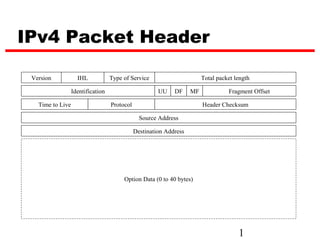
IPv4 Packet Header

 Version            IHL            Type of Service                       Total packet length

                  Identification                       UU    DF     MF             Fragment Offset

   Time to Live                    Protocol                              Header Checksum

                                                Source Address

                                              Destination Address


                                        Option Data (0 to 40 bytes)


                                                                                       1
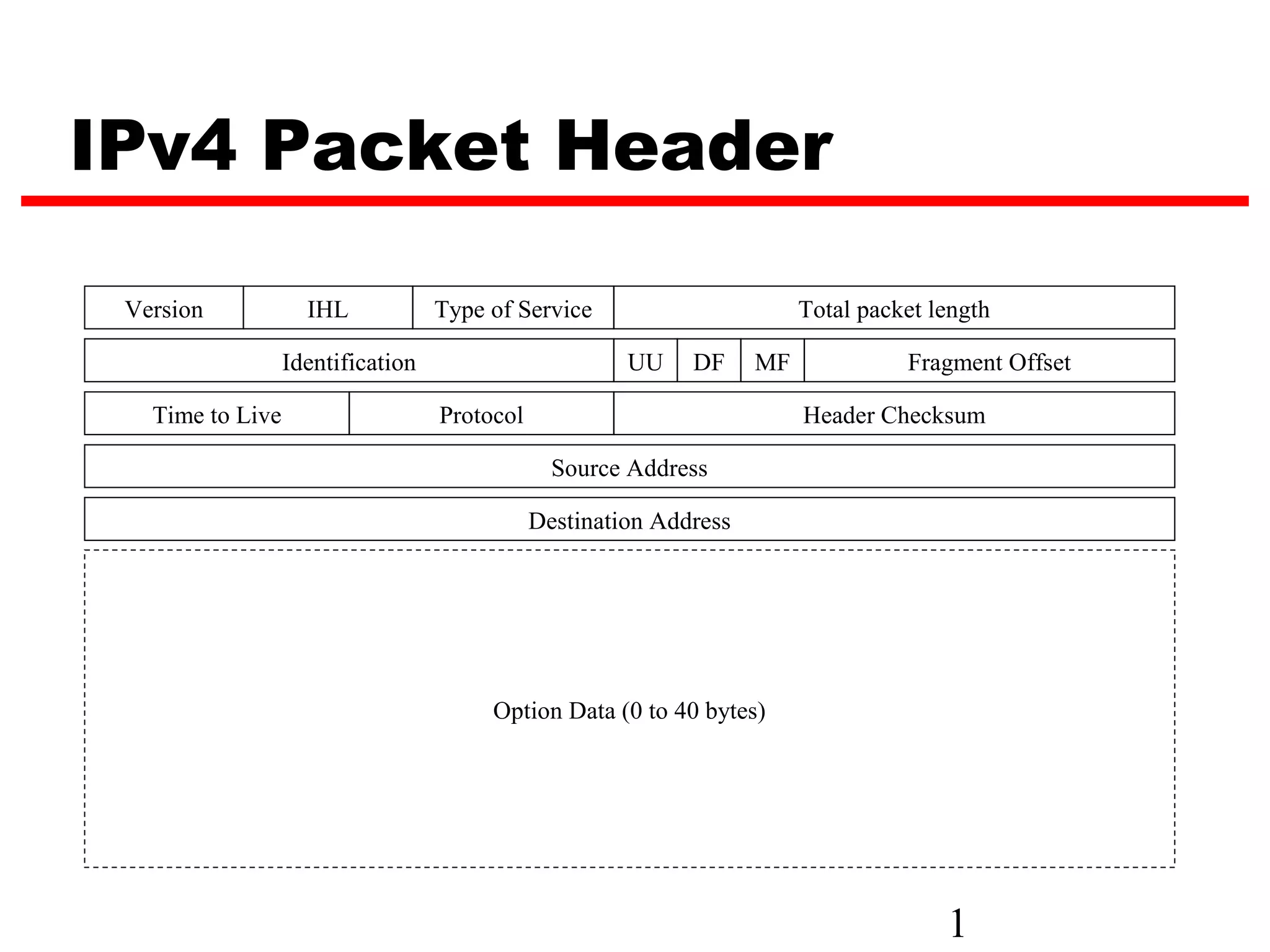
IPv6 Packet Base Header

 Version   Priority                               Flow label

           Payload length                Next header           Hop limit


                              Source address


                            Destination address


                                                               2
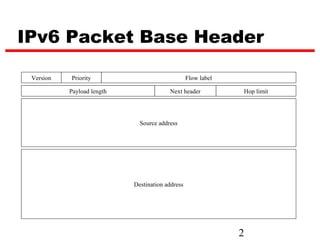
IPv6 Base Header Cont.
 Version – 4 bit IP version (6)
 Priority – 4 bit priority value
   Differentiates congestion-controlled traffic vs.
   non congestion-controlled traffic
 Flow Label – 24 bit value identifying flow
 requirements
   Used by routers to allocate resources or define
   routing


                                        3
IPv6 Base Header Cont.
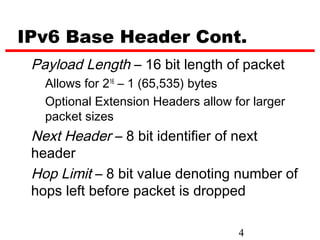
 Payload Length – 16 bit length of packet
   Allows for 216 – 1 (65,535) bytes
   Optional Extension Headers allow for larger
   packet sizes
 Next Header – 8 bit identifier of next
 header
 Hop Limit – 8 bit value denoting number of
 hops left before packet is dropped

                                     4
IPv6 Base Header Cont.
 Source Address – 128 bit address of
 sending host
 Target Address – 128 bit address of target
 host


                                 5
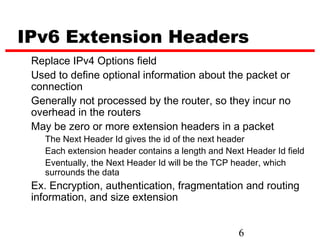
IPv6 Extension Headers
 Replace IPv4 Options field
 Used to define optional information about the packet or
 connection
 Generally not processed by the router, so they incur no
 overhead in the routers
 May be zero or more extension headers in a packet
   The Next Header Id gives the id of the next header
   Each extension header contains a length and Next Header Id field
   Eventually, the Next Header Id will be the TCP header, which
   surrounds the data
 Ex. Encryption, authentication, fragmentation and routing
 information, and size extension


                                                  6
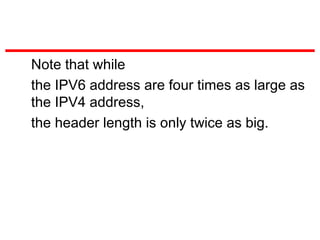
Note that while
the IPV6 address are four times as large as
the IPV4 address,
the header length is only twice as big.
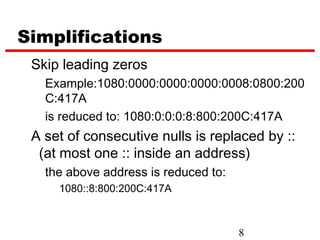
Simplifications
 Skip leading zeros
   Example:1080:0000:0000:0000:0008:0800:200
   C:417A
   is reduced to: 1080:0:0:0:8:800:200C:417A
 A set of consecutive nulls is replaced by ::
  (at most one :: inside an address)
   the above address is reduced to:
     1080::8:800:200C:417A


                                      8
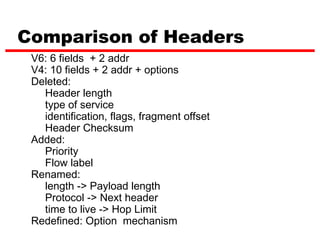
Comparison of Headers
 V6: 6 fields + 2 addr
 V4: 10 fields + 2 addr + options
 Deleted:
   Header length
   type of service
   identification, flags, fragment offset
   Header Checksum
 Added:
   Priority
   Flow label
 Renamed:
   length -> Payload length
   Protocol -> Next header
   time to live -> Hop Limit
 Redefined: Option mechanism
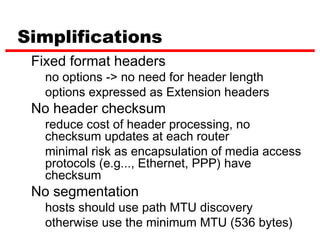
Simplifications
 Fixed format headers
   no options -> no need for header length
   options expressed as Extension headers
 No header checksum
   reduce cost of header processing, no
   checksum updates at each router
   minimal risk as encapsulation of media access
   protocols (e.g..., Ethernet, PPP) have
   checksum
 No segmentation
   hosts should use path MTU discovery
   otherwise use the minimum MTU (536 bytes)
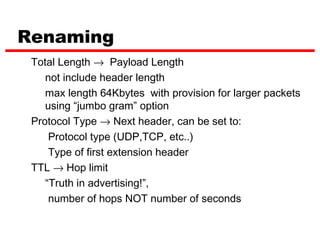
Renaming
 Total Length → Payload Length
    not include header length
    max length 64Kbytes with provision for larger packets
    using “jumbo gram” option
 Protocol Type → Next header, can be set to:
     Protocol type (UDP,TCP, etc..)
     Type of first extension header
 TTL → Hop limit
    “Truth in advertising!”,
     number of hops NOT number of seconds
New Fields
 Flow label & Priority
   to facilitate the handling of real time traffic
Options        Extension Headers
 Routers treats packets with options as
 “second class citizens” because it is slow
 to process, thus programmers tend not use
 them and options almost became obsolete.
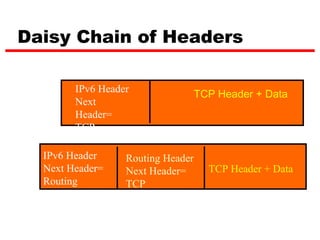
Daisy Chain of Headers

        IPv6 Header                TCP Header + Data
        Next
        Header=
        TCP

  IPv6 Header     Routing Header
  Next Header=    Next Header=       TCP Header + Data
  Routing         TCP
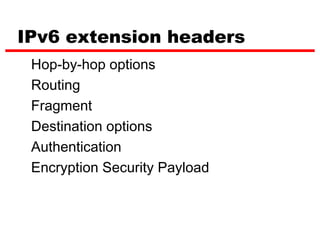
IPv6 extension headers
 Hop-by-hop options
 Routing
 Fragment
 Destination options
 Authentication
 Encryption Security Payload
Routing Header
   Next Header       0         Num addrs Next Addr
     Reserved       strict/loose bit mask (24)
                      Address[0]


     ………………………...
                 Address[Num Addrs -1]

Routers will only look at the routing header if they recognize
one of their addresses in the destination field of the main header
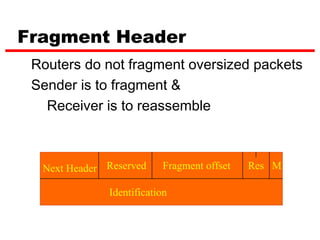
Fragment Header
 Routers do not fragment oversized packets
 Sender is to fragment &
   Receiver is to reassemble


  Next Header Reserved     Fragment offset   Res M

              Identification
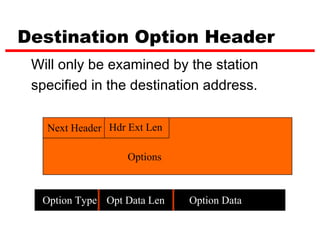
Destination Option Header
 Will only be examined by the station
 specified in the destination address.

   Next Header Hdr Ext Len

                   Options


  Option Type Opt Data Len   Option Data
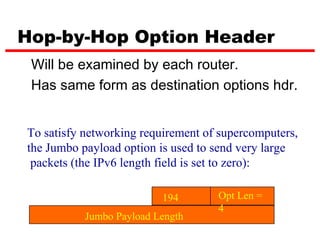
Hop-by-Hop Option Header
 Will be examined by each router.
 Has same form as destination options hdr.


To satisfy networking requirement of supercomputers,
the Jumbo payload option is used to send very large
 packets (the IPv6 length field is set to zero):

                          194       Opt Len =
                                    4
           Jumbo Payload Length
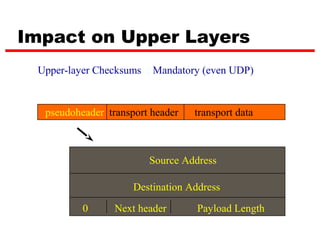
Impact on Upper Layers
 Upper-layer Checksums : Mandatory (even UDP)


  pseudoheader transport header   transport data


                        Source Address

                     Destination Address

          0      Next header      Payload Length
Points of Controversy
 Do we need more than 255 Hops?
   allowing hop count to be very large, looping packets
   will be relayed many times before being discarded
 Should packets be larger than 64K?
   allowing very large packets increase the size of queues
   and the variability of queuing delays
 Can we live without checksum?
   Some IPv4 routers started to cut corners by not
   verifying checksums to gain advantage over
   competition. By removing checksum altogether offers
   all routers the same advantage.
Real-time Support & Flows
 A proper handling of flows is required for
 high-quality multimedia communications in
 the new Internet
 A flow is a sequence of packets sent from
 a particular source to a particular (unicast
 or multicast) destination for which the
 source desires special handling by the
 intervening routers.


                                   22
Security
 If security is provided at the IP level it
 becomes standard service that all
 applications can use
 It is absolutely necessary to implement if
 we want to develop of commercial use the
 Internet, e.g...., to deter sniffing attacks on
 passwords and credit card numbers.


                                     23
Headers
 Authentication header
   Guarantee that the source address is authentic
   &
   the packet has not been altered during
   transmission.


 Encryption header
   Guarantee that only legitimate receivers
   will be able to read the content of the packet

                                       24
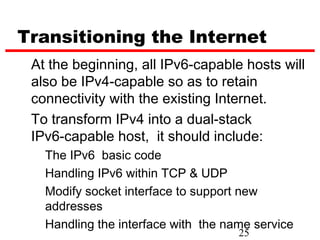
Transitioning the Internet
 At the beginning, all IPv6-capable hosts will
 also be IPv4-capable so as to retain
 connectivity with the existing Internet.
 To transform IPv4 into a dual-stack
 IPv6-capable host, it should include:
   The IPv6 basic code
   Handling IPv6 within TCP & UDP
   Modify socket interface to support new
   addresses
   Handling the interface with the name service
                                     25
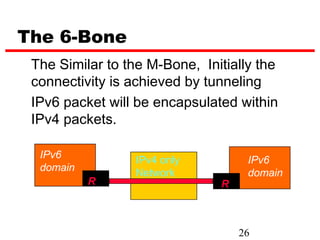
The 6-Bone
 The Similar to the M-Bone, Initially the
 connectivity is achieved by tunneling
 IPv6 packet will be encapsulated within
 IPv4 packets.

  IPv6           IPv4 only          IPv6
  domain         Network            domain
           R                   R


                                   26
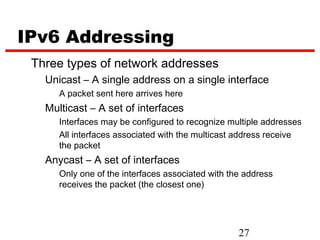
IPv6 Addressing
 Three types of network addresses
   Unicast – A single address on a single interface
      A packet sent here arrives here
   Multicast – A set of interfaces
      Interfaces may be configured to recognize multiple addresses
      All interfaces associated with the multicast address receive
      the packet
   Anycast – A set of interfaces
      Only one of the interfaces associated with the address
      receives the packet (the closest one)


                                                   27
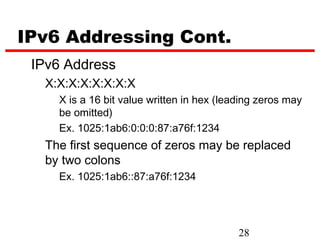
IPv6 Addressing Cont.
 IPv6 Address
  X:X:X:X:X:X:X:X
    X is a 16 bit value written in hex (leading zeros may
    be omitted)
    Ex. 1025:1ab6:0:0:0:87:a76f:1234
  The first sequence of zeros may be replaced
  by two colons
    Ex. 1025:1ab6::87:a76f:1234


                                           28
IPv6 Addressing Cont.
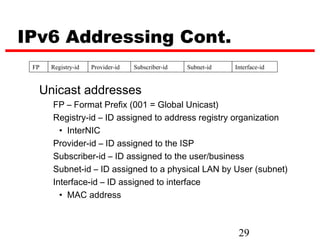
 FP   Registry-id   Provider-id   Subscriber-id   Subnet-id   Interface-id


  Unicast addresses
      FP – Format Prefix (001 = Global Unicast)
      Registry-id – ID assigned to address registry organization
        • InterNIC
      Provider-id – ID assigned to the ISP
      Subscriber-id – ID assigned to the user/business
      Subnet-id – ID assigned to a physical LAN by User (subnet)
      Interface-id – ID assigned to interface
        • MAC address


                                                               29
IPv6 Addressing Cont.
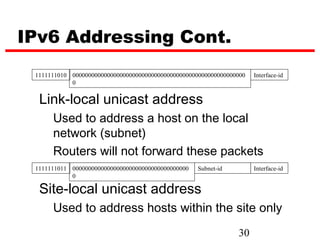
 1111111010 0000000000000000000000000000000000000000000000000000000   Interface-id
            0


  Link-local unicast address
      Used to address a host on the local
      network (subnet)
      Routers will not forward these packets
 1111111011 0000000000000000000000000000000000000   Subnet-id         Interface-id
            0

  Site-local unicast address
      Used to address hosts within the site only
                                                                30
IPv6 Addressing Cont.
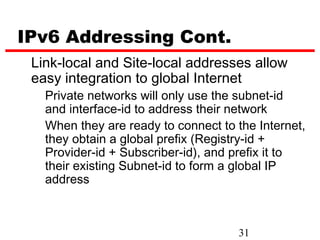
 Link-local and Site-local addresses allow
 easy integration to global Internet
   Private networks will only use the subnet-id
   and interface-id to address their network
   When they are ready to connect to the Internet,
   they obtain a global prefix (Registry-id +
   Provider-id + Subscriber-id), and prefix it to
   their existing Subnet-id to form a global IP
   address


                                     31
IPv6 Addressing Cont.
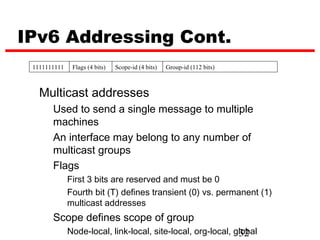
 1111111111    Flags (4 bits)   Scope-id (4 bits)   Group-id (112 bits)


   Multicast addresses
       Used to send a single message to multiple
       machines
       An interface may belong to any number of
       multicast groups
       Flags
              First 3 bits are reserved and must be 0
              Fourth bit (T) defines transient (0) vs. permanent (1)
              multicast addresses
       Scope defines scope of group
              Node-local, link-local, site-local, org-local, global
                                                              32
IPv6 Addressing Cont.
 Anycast address
   Looks like any other unique address
   Cannot be used as a source address
   Generally to be used only on routers
   Identifies a group of interfaces
     Usually each interface is on a separate machine
     Only one will receive the packet, typically the closest
   One form already predefined – subnet-router
     Defined as an interface address of all zeros
     All routers are required to support it
     Used to address the closest router that is connected to a
     subnet


                                                    33
IPv6 Addressing Cont.
 Unspecified address
   0:0:0:0:0:0:0:0
   Used when sending host does not know its IP
   address
     Ex. – During startup before IP address has been
     assigned
   May never be used as destination address


                                          34
IPv6 Addressing Cont.
 Loopback address
  0:0:0:0:0:0:0:1
  Never leaves the interface card


                                    35
Transition: How do we get
there?
 IPv6 will be implemented slowly
 Multiple IPv6 networks will need to
 communicate, but will have only IPv4
 networks connecting them
 IPv6 systems will have to be able to talk to
 IPv4 systems


                                   36
Transition: How do we get
there?
 Two new address types defined:
   IPv4-compatible
   IPv4-mapped
 IPv6 routers at the boundary between an
 IPv4 network and an IPv6 network will
 convert the IPv6 packets to IPv4 packets


                                  37
Transition: How do we get
there?
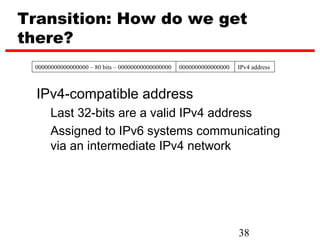
 00000000000000000 – 80 bits – 00000000000000000   0000000000000000   IPv4 address


  IPv4-compatible address
      Last 32-bits are a valid IPv4 address
      Assigned to IPv6 systems communicating
      via an intermediate IPv4 network


                                                                      38
Transition: How do we get
there?
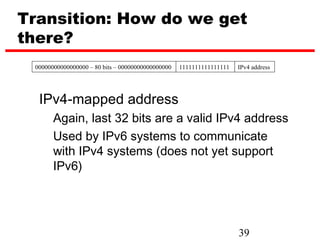
 00000000000000000 – 80 bits – 00000000000000000   1111111111111111   IPv4 address


  IPv4-mapped address
       Again, last 32 bits are a valid IPv4 address
       Used by IPv6 systems to communicate
       with IPv4 systems (does not yet support
       IPv6)


                                                                      39
IPv6
 In anticipation of impending demise of
 IPv4, the Internet Engineering Task Force
 (IETF) has produced a comprehensive set
 of specifications (RFC 1752, 1883, 1886,
 1971, 1993 etc.)
 IPv6, the Next-Generation Internet
 Protocol, was approved by the Internet
 Engineering Steering Group on November
 17, 1994 as a Proposed Standard.
                                 40

Ipv6up

  • 1.
    IPv4 Packet Header Version IHL Type of Service Total packet length Identification UU DF MF Fragment Offset Time to Live Protocol Header Checksum Source Address Destination Address Option Data (0 to 40 bytes) 1
  • 2.
    IPv6 Packet BaseHeader Version Priority Flow label Payload length Next header Hop limit Source address Destination address 2
  • 3.
    IPv6 Base HeaderCont. Version – 4 bit IP version (6) Priority – 4 bit priority value Differentiates congestion-controlled traffic vs. non congestion-controlled traffic Flow Label – 24 bit value identifying flow requirements Used by routers to allocate resources or define routing 3
  • 4.
    IPv6 Base HeaderCont. Payload Length – 16 bit length of packet Allows for 216 – 1 (65,535) bytes Optional Extension Headers allow for larger packet sizes Next Header – 8 bit identifier of next header Hop Limit – 8 bit value denoting number of hops left before packet is dropped 4
  • 5.
    IPv6 Base HeaderCont. Source Address – 128 bit address of sending host Target Address – 128 bit address of target host 5
  • 6.
    IPv6 Extension Headers Replace IPv4 Options field Used to define optional information about the packet or connection Generally not processed by the router, so they incur no overhead in the routers May be zero or more extension headers in a packet The Next Header Id gives the id of the next header Each extension header contains a length and Next Header Id field Eventually, the Next Header Id will be the TCP header, which surrounds the data Ex. Encryption, authentication, fragmentation and routing information, and size extension 6
  • 7.
    Note that while theIPV6 address are four times as large as the IPV4 address, the header length is only twice as big.
  • 8.
    Simplifications Skip leadingzeros Example:1080:0000:0000:0000:0008:0800:200 C:417A is reduced to: 1080:0:0:0:8:800:200C:417A A set of consecutive nulls is replaced by :: (at most one :: inside an address) the above address is reduced to: 1080::8:800:200C:417A 8
  • 9.
    Comparison of Headers V6: 6 fields + 2 addr V4: 10 fields + 2 addr + options Deleted: Header length type of service identification, flags, fragment offset Header Checksum Added: Priority Flow label Renamed: length -> Payload length Protocol -> Next header time to live -> Hop Limit Redefined: Option mechanism
  • 10.
    Simplifications Fixed formatheaders no options -> no need for header length options expressed as Extension headers No header checksum reduce cost of header processing, no checksum updates at each router minimal risk as encapsulation of media access protocols (e.g..., Ethernet, PPP) have checksum No segmentation hosts should use path MTU discovery otherwise use the minimum MTU (536 bytes)
  • 11.
    Renaming Total Length→ Payload Length not include header length max length 64Kbytes with provision for larger packets using “jumbo gram” option Protocol Type → Next header, can be set to: Protocol type (UDP,TCP, etc..) Type of first extension header TTL → Hop limit “Truth in advertising!”, number of hops NOT number of seconds
  • 12.
    New Fields Flowlabel & Priority to facilitate the handling of real time traffic
  • 13.
    Options Extension Headers Routers treats packets with options as “second class citizens” because it is slow to process, thus programmers tend not use them and options almost became obsolete.
  • 14.
    Daisy Chain ofHeaders IPv6 Header TCP Header + Data Next Header= TCP IPv6 Header Routing Header Next Header= Next Header= TCP Header + Data Routing TCP
  • 15.
    IPv6 extension headers Hop-by-hop options Routing Fragment Destination options Authentication Encryption Security Payload
  • 16.
    Routing Header Next Header 0 Num addrs Next Addr Reserved strict/loose bit mask (24) Address[0] ………………………... Address[Num Addrs -1] Routers will only look at the routing header if they recognize one of their addresses in the destination field of the main header
  • 17.
    Fragment Header Routersdo not fragment oversized packets Sender is to fragment & Receiver is to reassemble Next Header Reserved Fragment offset Res M Identification
  • 18.
    Destination Option Header Will only be examined by the station specified in the destination address. Next Header Hdr Ext Len Options Option Type Opt Data Len Option Data
  • 19.
    Hop-by-Hop Option Header Will be examined by each router. Has same form as destination options hdr. To satisfy networking requirement of supercomputers, the Jumbo payload option is used to send very large packets (the IPv6 length field is set to zero): 194 Opt Len = 4 Jumbo Payload Length
  • 20.
    Impact on UpperLayers Upper-layer Checksums : Mandatory (even UDP) pseudoheader transport header transport data Source Address Destination Address 0 Next header Payload Length
  • 21.
    Points of Controversy Do we need more than 255 Hops? allowing hop count to be very large, looping packets will be relayed many times before being discarded Should packets be larger than 64K? allowing very large packets increase the size of queues and the variability of queuing delays Can we live without checksum? Some IPv4 routers started to cut corners by not verifying checksums to gain advantage over competition. By removing checksum altogether offers all routers the same advantage.
  • 22.
    Real-time Support &Flows A proper handling of flows is required for high-quality multimedia communications in the new Internet A flow is a sequence of packets sent from a particular source to a particular (unicast or multicast) destination for which the source desires special handling by the intervening routers. 22
  • 23.
    Security If securityis provided at the IP level it becomes standard service that all applications can use It is absolutely necessary to implement if we want to develop of commercial use the Internet, e.g...., to deter sniffing attacks on passwords and credit card numbers. 23
  • 24.
    Headers Authentication header Guarantee that the source address is authentic & the packet has not been altered during transmission. Encryption header Guarantee that only legitimate receivers will be able to read the content of the packet 24
  • 25.
    Transitioning the Internet At the beginning, all IPv6-capable hosts will also be IPv4-capable so as to retain connectivity with the existing Internet. To transform IPv4 into a dual-stack IPv6-capable host, it should include: The IPv6 basic code Handling IPv6 within TCP & UDP Modify socket interface to support new addresses Handling the interface with the name service 25
  • 26.
    The 6-Bone TheSimilar to the M-Bone, Initially the connectivity is achieved by tunneling IPv6 packet will be encapsulated within IPv4 packets. IPv6 IPv4 only IPv6 domain Network domain R R 26
  • 27.
    IPv6 Addressing Threetypes of network addresses Unicast – A single address on a single interface A packet sent here arrives here Multicast – A set of interfaces Interfaces may be configured to recognize multiple addresses All interfaces associated with the multicast address receive the packet Anycast – A set of interfaces Only one of the interfaces associated with the address receives the packet (the closest one) 27
  • 28.
    IPv6 Addressing Cont. IPv6 Address X:X:X:X:X:X:X:X X is a 16 bit value written in hex (leading zeros may be omitted) Ex. 1025:1ab6:0:0:0:87:a76f:1234 The first sequence of zeros may be replaced by two colons Ex. 1025:1ab6::87:a76f:1234 28
  • 29.
    IPv6 Addressing Cont. FP Registry-id Provider-id Subscriber-id Subnet-id Interface-id Unicast addresses FP – Format Prefix (001 = Global Unicast) Registry-id – ID assigned to address registry organization • InterNIC Provider-id – ID assigned to the ISP Subscriber-id – ID assigned to the user/business Subnet-id – ID assigned to a physical LAN by User (subnet) Interface-id – ID assigned to interface • MAC address 29
  • 30.
    IPv6 Addressing Cont. 1111111010 0000000000000000000000000000000000000000000000000000000 Interface-id 0 Link-local unicast address Used to address a host on the local network (subnet) Routers will not forward these packets 1111111011 0000000000000000000000000000000000000 Subnet-id Interface-id 0 Site-local unicast address Used to address hosts within the site only 30
  • 31.
    IPv6 Addressing Cont. Link-local and Site-local addresses allow easy integration to global Internet Private networks will only use the subnet-id and interface-id to address their network When they are ready to connect to the Internet, they obtain a global prefix (Registry-id + Provider-id + Subscriber-id), and prefix it to their existing Subnet-id to form a global IP address 31
  • 32.
    IPv6 Addressing Cont. 1111111111 Flags (4 bits) Scope-id (4 bits) Group-id (112 bits) Multicast addresses Used to send a single message to multiple machines An interface may belong to any number of multicast groups Flags First 3 bits are reserved and must be 0 Fourth bit (T) defines transient (0) vs. permanent (1) multicast addresses Scope defines scope of group Node-local, link-local, site-local, org-local, global 32
  • 33.
    IPv6 Addressing Cont. Anycast address Looks like any other unique address Cannot be used as a source address Generally to be used only on routers Identifies a group of interfaces Usually each interface is on a separate machine Only one will receive the packet, typically the closest One form already predefined – subnet-router Defined as an interface address of all zeros All routers are required to support it Used to address the closest router that is connected to a subnet 33
  • 34.
    IPv6 Addressing Cont. Unspecified address 0:0:0:0:0:0:0:0 Used when sending host does not know its IP address Ex. – During startup before IP address has been assigned May never be used as destination address 34
  • 35.
    IPv6 Addressing Cont. Loopback address 0:0:0:0:0:0:0:1 Never leaves the interface card 35
  • 36.
    Transition: How dowe get there? IPv6 will be implemented slowly Multiple IPv6 networks will need to communicate, but will have only IPv4 networks connecting them IPv6 systems will have to be able to talk to IPv4 systems 36
  • 37.
    Transition: How dowe get there? Two new address types defined: IPv4-compatible IPv4-mapped IPv6 routers at the boundary between an IPv4 network and an IPv6 network will convert the IPv6 packets to IPv4 packets 37
  • 38.
    Transition: How dowe get there? 00000000000000000 – 80 bits – 00000000000000000 0000000000000000 IPv4 address IPv4-compatible address Last 32-bits are a valid IPv4 address Assigned to IPv6 systems communicating via an intermediate IPv4 network 38
  • 39.
    Transition: How dowe get there? 00000000000000000 – 80 bits – 00000000000000000 1111111111111111 IPv4 address IPv4-mapped address Again, last 32 bits are a valid IPv4 address Used by IPv6 systems to communicate with IPv4 systems (does not yet support IPv6) 39
  • 40.
    IPv6 In anticipationof impending demise of IPv4, the Internet Engineering Task Force (IETF) has produced a comprehensive set of specifications (RFC 1752, 1883, 1886, 1971, 1993 etc.) IPv6, the Next-Generation Internet Protocol, was approved by the Internet Engineering Steering Group on November 17, 1994 as a Proposed Standard. 40