IPV6
Niranjan Baral
11/25/2015
Introduction
 Internet Protocol version 6 (IPv6) is the latest version of the Internet
Protocol (IP), the communications protocol that provides an identification
and location system for computers on networks and routes traffic across the
Internet.
 IPv6 was developed by the Internet Engineering Task Force (IETF) to deal
with the long-anticipated problem of IPv4 address exhaustion.
 IPv6 is intended to replace IPv4, which still carries more than 96% of
Internet traffic worldwide as of May 2014.As of February 2014, the
percentage of users reaching Google services over IPv6 surpassed 3% for
the first time.
11/25/2015
Intro……….
With the ever-increasing number of new devices being
connected to the Internet, the need arose for more addresses than
the IPv4 address space has available. IPv6 uses a 128-bit
address, allowing 2128, or approximately 3.4×1038 addresses, or
more than 7.9×1028 times as many as IPv4, which uses 32-bit
addresses.
11/25/2015
Features
 New Header Format: IPv6 has a new format that is designed to minimize header processing
achieved by moving the nonessential and optional fields to extensions header that are placed after
the IPv6 header.
 Large Header Space: Pv6 has 128-bit (16-byte) source and destination addresses. Although 128
bits can provide over 3.4×1038 possible combinations, the large address space of IPv6 has been
designed to allow for multiple levels of subnetting and address allocation from the Internet backbone
to the individual subnets within an organization.
 Built in Security: Support for IPSec is an IPv6 protocol suite requirement. This requirement
provides a standards-based solution for network security needs and promotes interoperability
between different IPv6 implementations. IPSec consist Authentication Header to provide data
integrity and data authentication and Encapsulatiing Security payload header and trailer to provide
data integrity , data authentication and data confedentiality.
 Better support for prioritized delivery: New fields in the IPv6 header define how traffic is
handled and identified. Traffic identification, by using a Flow Label field in the IPv6 header, allows
routers to identify and provide special handling for packets that belong to a flow. A flow is a series
of packets between a source and destination. (Because the traffic is identified in the IPv6 header,
support for QoS can be easily achieved even when the packet payload is encrypted with IPSec.)
11/25/2015
Features
 New protocol for neighboring node interaction :The Neighbor Discovery protocol
for IPv6 is a series of Internet Control Message Protocol for IPv6 (ICMPv6) messages
that manage the interaction of neighboring nodes (that is, nodes on the same link).
Neighbor Discovery replaces Address Resolution Protocol (ARP), ICMPv4 Router
Discovery, and ICMPv4 Redirect messages with efficient multicast and unicast
messages and provides additional functionality.
 Extensibility: IPv6 can be extended for new features by adding extension headers after
the IPv6 header. Unlike the IPv4 header, which can only support 40 bytes of options,
the size of IPv6 extension headers is only constrained by the size of the IPv6 packet i.e
options in IPv6 can be as much as the size of IPv6 packet itself.
 End-to-end Connectivity Every system now has unique IP address and can traverse
through the Internet without using NAT or other translating components. After IPv6 is
fully implemented, every host can directly reach other hosts on the Internet, with some
limitations involved like Firewall, organization policies, etc.
 . 11/25/2015
Features
 Stateless and stateful address configuration To simplify host configuration, IPv6 supports both
stateful address configuration, such as address configuration in the presence of a DHCP server, and
stateless address configuration (address configuration in the absence of a DHCP server). With
stateless address configuration, hosts on a link automatically configure themselves with IPv6
addresses for the link (link-local addresses) and with addresses that are derived from prefixes
advertised by local routers. Even in the absence of a router, hosts on the same link can automatically
configure themselves with link-local addresses and communicate without manual configuration
 No Broadcast Address: Though Ethernet/Token Ring are considered as broadcast network because
they support Broadcasting, IPv6 does not have any broadcast support any more. It uses multicast to
communicate with multiple hosts.
 Anycast Support: This is another characteristic of IPv6. IPv6 has introduced Anycast mode of
packet routing. In this mode, multiple interfaces over the Internet are assigned same Anycast IP
address. Routers, while routing, send the packet to the nearest destination.
 Mobility: IPv6 was designed keeping mobility in mind. This feature enables hosts (such as mobile
phone) to roam around in different geographical area and remain connected with the same IP
address. The mobility feature of IPv6 takes advantage of auto IP configuration and Extension
headers.
11/25/2015
Advantages
Larger IP address space: IPv6 has 128-bit address space or 4 times
more address bits compared to IPv4's 32-bit address space. This large
address space will provide enough address space for many decades to
come. This address can accumulate the aggressive requirement of
address allotment for almost everything in this world. According to an
estimate, 1564 addresses can be allocated to every square meter of this
earth.
Better security: IPv6 includes security in the underlying protocol.
Internet Protocol security (IPsec) was originally developed for IPv6,
but found widespread deployment first in IPv4, for which it was re-
engineered. IPsec was a mandatory specification of the base IPv6
protocol suite, but later had been made optional.
11/25/2015
Adv ………….
 Consideration to real time: To implement better support for real-
time traffic (such as videoconference), IPv6 includes a flow label
mechanism so routers can more easily recognize where to send
information.
 Plug and play: IPv6 includes plug and play, which is easier for
novice users to connect their machines to the network. Essentially,
configuration will happen automatically.
 Better optimization: IPv6 takes the best of what made IPv4
successful and gets rid of minor flaws and unused features
11/25/2015
Packet Format
11/25/2015
Packet format explained….
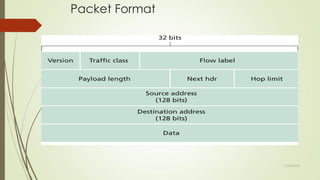
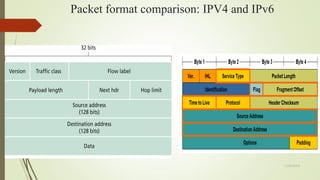
 Version: 4 bit, It identifies the IP version number.
 Traffic Class(8): Similar to TOS or Service type in IPV4. It can be used to classify packets
to give priority value and also for congestion control.
 Flow Label(20): This large field was created to provide additional support for real-time
datagram delivery and quality of service features. The concept of a flow is defined in RFC
2460 as a sequence of datagrams sent from a source device to one or more destination
devices. A unique flow label is used to identify all the datagrams in a particular flow, so
that routers between the source and destination all handle them the same way, to help
ensure uniformity in how the datagrams in the flow are delivered. For example, if a video
stream is being sent across an IP internetwork, the datagrams containing the stream could
be identified with a flow label to ensure that they are delivered with minimal latency.
 .
11/25/2015
 Next Header(8): field tells the receiver how to interpret the data which follows the
header. If the packet contains options, this field contains the option type of the next
option. It identifies the protocol to which the contents of this datagram will be
delivered (eg TCP or UDP)
 Hop Limit(8): The counter of this field decrements by one by each router that
forwards the datagram. If the hop limit count reaches zero the datagram are
discarded.
 Payload length: This 16 bit field gives the number of bytes in the IPV6 datagram
following the fixed length(40 byte) datagram header
11/25/2015
Extension Header
 The IPv4 header includes all options. Each intermediate router must check for their existence and
process when present. This can cause performance degradation in the forwarding of IPv4 packets. With
IPv6, delivery and forwarding options are moved to extension header. The extension header that must
be processed at each intermediate router is Hop by Hop options extension header. This increase header
processing speed and improve performance of forwarding IPv6 packets. Extension headers carry
optional Internet Layer information, and are placed between the fixed header and the upper-layer
protocol header. The headers form a chain, using the Next Header fields.
 The Next Header field in the fixed header indicates the type of the first extension header; the Next
Header field of the last extension header indicates the type of the upper-layer protocol header in the
payload of the packet.
 All extension headers are a multiple of 8 octets in size; some extension headers require internal padding
to meet this requirements. There are several extension headers defined, and new extension headers may
be defined in the future.
 All extension headers are optional and should only appear at most once, except for the Destination
Options header, which may appear twice.
11/25/2015
Extension Header Type Description
Hop-by-Hop Options 0
Options that need to be examined
by all devices on the path.
Destination Options (before
routing header)
60
Options that need to be examined
only by the destination of the
packet.
Routing 43
Methods to specify the route for a
datagram.
Fragment 44
Contains parameters for
fragmentation of datagrams.
Authentication Header (AH) 51
Contains information used to
verify the authenticity of most
parts of the packet.
Encapsulating Security Payload
(ESP)
50
Carries encrypted data for secure
communication.
Destination Options (before
upper-layer header)
60
Options that need to be examined
only by the destination of the
packet.
Mobility (currently without
135
Parameters used with Mobile
11/25/2015
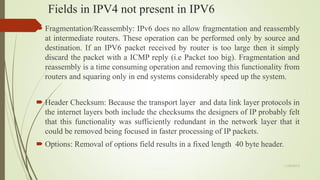
Packet format comparison: IPV4 and IPv6
11/25/2015
Fields in IPV4 not present in IPV6
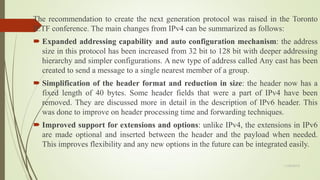
 Fragmentation/Reassembly: IPv6 does no allow fragmentation and reassembly
at intermediate routers. These operation can be performed only by source and
destination. If an IPV6 packet received by router is too large then it simply
discard the packet with a ICMP reply (i.e Packet too big). Fragmentation and
reassembly is a time consuming operation and removing this functionality from
routers and squaring only in end systems considerably speed up the system.
 Header Checksum: Because the transport layer and data link layer protocols in
the internet layers both include the checksums the designers of IP probably felt
that this functionality was sufficiently redundant in the network layer that it
could be removed being focused in faster processing of IP packets.
 Options: Removal of options field results in a fixed length 40 byte header.
11/25/2015
The recommendation to create the next generation protocol was raised in the Toronto
IETF conference. The main changes from IPv4 can be summarized as follows:
 Expanded addressing capability and auto configuration mechanism: the address
size in this protocol has been increased from 32 bit to 128 bit with deeper addressing
hierarchy and simpler configurations. A new type of address called Any cast has been
created to send a message to a single nearest member of a group.
 Simplification of the header format and reduction in size: the header now has a
fixed length of 40 bytes. Some header fields that were a part of IPv4 have been
removed. They are discussed more in detail in the description of IPv6 header. This
was done to improve on header processing time and forwarding techniques.
 Improved support for extensions and options: unlike IPv4, the extensions in IPv6
are made optional and inserted between the header and the payload when needed.
This improves flexibility and any new options in the future can be integrated easily.
11/25/2015
 Extensions for authentications and privacy: support for data authentications and data
security has been specified.
 Flow labelling capability: packets belonging to the same traffic flow needing special
handling or security can be labelled by the sender
 Header Format Simplification
• Fixed length of header
– Length field eliminated by no options
• No fragmentation on router
– Fragmentation field and option field moved to extension header
– Hosts should use the path MTU discovery
• No header checksum
– Reduce cost of header processing, no checksum updates at each router (has header integrity
check
11/25/2015
IPv6 Address representation
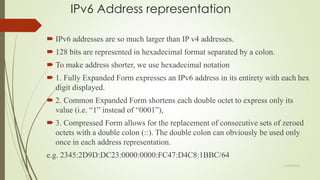
 IPv6 addresses are so much larger than IP v4 addresses.
 128 bits are represented in hexadecimal format separated by a colon.
 To make address shorter, we use hexadecimal notation
 1. Fully Expanded Form expresses an IPv6 address in its entirety with each hex
digit displayed.
 2. Common Expanded Form shortens each double octet to express only its
value (i.e. ―1‖ instead of ―0001‖),
 3. Compressed Form allows for the replacement of consecutive sets of zeroed
octets with a double colon (::). The double colon can obviously be used only
once in each address representation.
e.g. 2345:2D9D:DC23:0000:0000:FC47:D4C8:1BBC/64
11/25/2015
Zero Suppression and Zero Compression
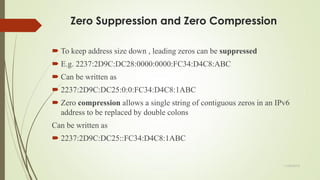
 To keep address size down , leading zeros can be suppressed
 E.g. 2237:2D9C:DC28:0000:0000:FC34:D4C8:ABC
 Can be written as
 2237:2D9C:DC25:0:0:FC34:D4C8:1ABC
 Zero compression allows a single string of contiguous zeros in an IPv6
address to be replaced by double colons
Can be written as
 2237:2D9C:DC25::FC34:D4C8:1ABC
11/25/2015
IPv6 Prefix
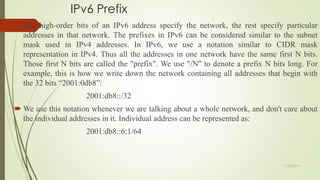
 The high-order bits of an IPv6 address specify the network, the rest specify particular
addresses in that network. The prefixes in IPv6 can be considered similar to the subnet
mask used in IPv4 addresses. In IPv6, we use a notation similar to CIDR mask
representation in IPv4. Thus all the addresses in one network have the same first N bits.
Those first N bits are called the "prefix". We use "/N" to denote a prefix N bits long. For
example, this is how we write down the network containing all addresses that begin with
the 32 bits ―2001:0db8‖:
2001:db8::/32
 We use this notation whenever we are talking about a whole network, and don't care about
the individual addresses in it. Individual address can be represented as:
2001:db8::6:1/64
11/25/2015
IPV6 Address type
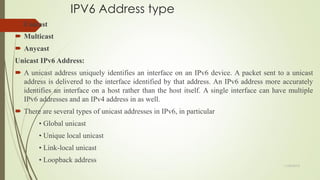
 Unicast
 Multicast
 Anycast
Unicast IPv6 Address:
 A unicast address uniquely identifies an interface on an IPv6 device. A packet sent to a unicast
address is delivered to the interface identified by that address. An IPv6 address more accurately
identifies an interface on a host rather than the host itself. A single interface can have multiple
IPv6 addresses and an IPv4 address in as well.
 There are several types of unicast addresses in IPv6, in particular
• Global unicast
• Unique local unicast
• Link-local unicast
• Loopback address
11/25/2015
 List of assigned prefixes
 Allocation Prefix binary Prefix hex Fraction of
address space
Global unicast 001 2000::/3 1/8
Link-local unicast 1111 1110 10 fe80::/10 1/1024
Unique-local IPv6 address 1111 110 fc00::/7
Multicast 1111 1111 ff00::/8 1/256
Global Unicast
 Global unicast addresses are identified by the binary prefix 001, as shown above
 These are equivalent to public IPv4 addresses. They are globally routable and reachable on
the IPv6 Internet and allocated by the Internet Assigned Numbers Authority. Global Unicast
addresses always have the first three bits set to 001.
11/25/2015
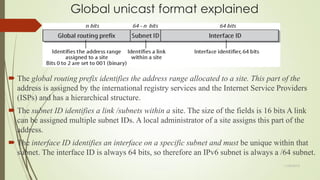
Global unicast format explained
 The global routing prefix identifies the address range allocated to a site. This part of the
address is assigned by the international registry services and the Internet Service Providers
(ISPs) and has a hierarchical structure.
 The subnet ID identifies a link /subnets within a site. The size of the fields is 16 bits A link
can be assigned multiple subnet IDs. A local administrator of a site assigns this part of the
address.
 The interface ID identifies an interface on a specific subnet and must be unique within that
subnet. The interface ID is always 64 bits, so therefore an IPv6 subnet is always a /64 subnet.
11/25/2015
Link Local Unicast Address
 Link-local addresses, identified by 1111 1110 10, are used by nodes when communicating with
neighboring nodes on the same link. For example, on a single link IPv6 network with no router, link-
local addresses are used to communicate between hosts on the link. Link-local addresses are
equivalent to Automatic Private IP Addressing (APIPA) IPv4 addresses (using the 169.254.0.0/16
prefix). The scope of a link-local address is the local link. In IPv6, link-local addresses always begin
with 1111111010 (FE80).
 A link-local address is required for Neighbor Discovery processes and is always automatically
configured, even in the absence of all other unicast addresses. A link-local address is for use on a
single link and should never be routed. It doesn’t need a global prefix and can be used for Auto
configuration mechanisms, for Neighbor Discovery, and on networks with no routers, so it is useful
for creating temporary net-works.
 Let’s say you meet your friend in a conference room and you want to share files on your computers.
You can connect your computers using a wireless network or a cross cable between your Ethernet
interfaces, and you can share files without any special configuration by using the link-local address.
 With the 64-bit interface identifier, the prefix for link-local addresses is always FE80::/10. An IPv6
router never forwards link-local traffic beyond the link. The last 64 bits are set randomly by the
operating system. 11/25/2015
Unique local IPv6 Address
 These addresses are the replacement for site-local addresses (which were part of earlier IPv6
standards). They’re designed to be used only within an organization. These address are
Internet Service Provider independent and can be used for communications inside of a site
without having any permanent Internet connectivity.
 The first eight bits are always 11111101, meaning all unique-local addresses start with ―FD."
The next 40 bits make up the global ID, which can be used to identify buildings or locations
within an organization. The last 16 network ID bits comprise the subnet ID, allowing
multiple subnets within a single location.
 The global ID is made with random numbers to future-proof your network in case of a
possible merger with another network. If both organizations use "10" as a global ID, you'd
have a problem. It's unlikely that two organizations' IDs would overlap if the global ID were
made of random numbers.
11/25/2015
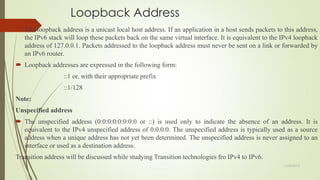
Loopback Address
 The loopback address is a unicast local host address. If an application in a host sends packets to this address,
the IPv6 stack will loop these packets back on the same virtual interface. It is equivalent to the IPv4 loopback
address of 127.0.0.1. Packets addressed to the loopback address must never be sent on a link or forwarded by
an IPv6 router.
 Loopback addresses are expressed in the following form:
::1 or, with their appropriate prefix
::1/128
Note:
Unspecified address
 The unspecified address (0:0:0:0:0:0:0:0 or ::) is used only to indicate the absence of an address. It is
equivalent to the IPv4 unspecified address of 0.0.0.0. The unspecified address is typically used as a source
address when a unique address has not yet been determined. The unspecified address is never assigned to an
interface or used as a destination address.
Transition address will be discussed while studying Transition technologies fro IPv4 to IPv6.
11/25/2015
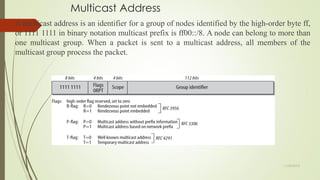
Multicast Address
 A multicast address is an identifier for a group of nodes identified by the high-order byte ff,
or 1111 1111 in binary notation multicast prefix is ff00::/8. A node can belong to more than
one multicast group. When a packet is sent to a multicast address, all members of the
multicast group process the packet.
11/25/2015
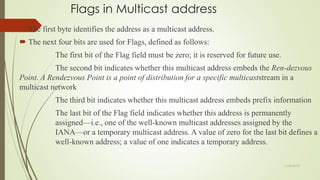
Flags in Multicast address
 The first byte identifies the address as a multicast address.
 The next four bits are used for Flags, defined as follows:
The first bit of the Flag field must be zero; it is reserved for future use.
The second bit indicates whether this multicast address embeds the Ren-dezvous
Point. A Rendezvous Point is a point of distribution for a specific multicaststream in a
multicast network
The third bit indicates whether this multicast address embeds prefix information
The last bit of the Flag field indicates whether this address is permanently
assigned—i.e., one of the well-known multicast addresses assigned by the
IANA—or a temporary multicast address. A value of zero for the last bit defines a
well-known address; a value of one indicates a temporary address.
11/25/2015
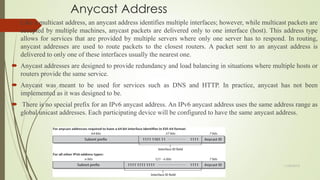
Anycast Address
 Like a multicast address, an anycast address identifies multiple interfaces; however, while multicast packets are
accepted by multiple machines, anycast packets are delivered only to one interface (host). This address type
allows for services that are provided by multiple servers where only one server has to respond. In routing,
anycast addresses are used to route packets to the closest routers. A packet sent to an anycast address is
delivered to only one of these interfaces usually the nearest one.
 Anycast addresses are designed to provide redundancy and load balancing in situations where multiple hosts or
routers provide the same service.
 Anycast was meant to be used for services such as DNS and HTTP. In practice, anycast has not been
implemented as it was designed to be.
 There is no special prefix for an IPv6 anycast address. An IPv6 anycast address uses the same address range as
global unicast addresses. Each participating device will be configured to have the same anycast address.
11/25/2015
Applications of anycast IPv6 Address
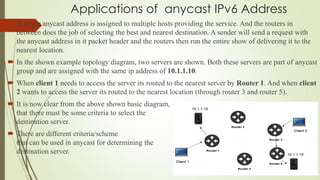
 A single anycast address is assigned to multiple hosts providing the service. And the routers in
between does the job of selecting the best and nearest destination. A sender will send a request with
the anycast address in it packet header and the routers then run the entire show of delivering it to the
nearest location.
 In the shown example topology diagram, two servers are shown. Both these servers are part of anycast
group and are assigned with the same ip address of 10.1.1.10.
 When client 1 needs to access the server its routed to the nearest server by Router 1. And when client
2 wants to access the server its routed to the nearest location (through router 3 and router 5).
 It is now clear from the above shown basic diagram,
that there must be some criteria to select the
destination server.
 There are different criteria/scheme
that can be used in anycast for determining the best
destination server.
11/25/2015
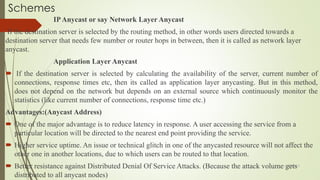
Schemes
IPAnycast or say Network Layer Anycast
If the destination server is selected by the routing method, in other words users directed towards a
destination server that needs few number or router hops in between, then it is called as network layer
anycast.
Application Layer Anycast
 If the destination server is selected by calculating the availability of the server, current number of
connections, response times etc, then its called as application layer anycasting. But in this method,
does not depend on the network but depends on an external source which continuously monitor the
statistics (like current number of connections, response time etc.)
Advantages:(Anycast Address)
 One of the major advantage is to reduce latency in response. A user accessing the service from a
particular location will be directed to the nearest end point providing the service.
 Higher service uptime. An issue or technical glitch in one of the anycasted resource will not affect the
other one in another locations, due to which users can be routed to that location.
 Better resistance against Distributed Denial Of Service Attacks. (Because the attack volume gets
distributed to all anycast nodes)
11/25/2015
Assignments
IEEE EUI-64 Address
Converting IEEE 802 Address to EUI-64
Converting IEEE 802 Address to IPv6 interface identifiers
11/25/2015
11/25/2015
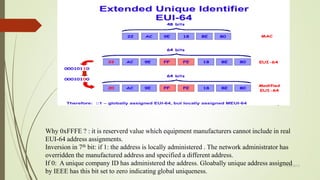
Why 0xFFFE ? : it is reserverd value which equipment manufacturers cannot include in real
EUI-64 address assignments.
Inversion in 7th bit: if 1: the address is locally administered . The network administrator has
overridden the manufactured address and specified a different address.
If 0: A unique company ID has administered the address. Gloabally unique address assigned
by IEEE has this bit set to zero indicating global uniqueness.

IPv6 .pdf

  • 1.
  • 2.
    Introduction  Internet Protocolversion 6 (IPv6) is the latest version of the Internet Protocol (IP), the communications protocol that provides an identification and location system for computers on networks and routes traffic across the Internet.  IPv6 was developed by the Internet Engineering Task Force (IETF) to deal with the long-anticipated problem of IPv4 address exhaustion.  IPv6 is intended to replace IPv4, which still carries more than 96% of Internet traffic worldwide as of May 2014.As of February 2014, the percentage of users reaching Google services over IPv6 surpassed 3% for the first time. 11/25/2015
  • 3.
    Intro………. With the ever-increasingnumber of new devices being connected to the Internet, the need arose for more addresses than the IPv4 address space has available. IPv6 uses a 128-bit address, allowing 2128, or approximately 3.4×1038 addresses, or more than 7.9×1028 times as many as IPv4, which uses 32-bit addresses. 11/25/2015
  • 4.
    Features  New HeaderFormat: IPv6 has a new format that is designed to minimize header processing achieved by moving the nonessential and optional fields to extensions header that are placed after the IPv6 header.  Large Header Space: Pv6 has 128-bit (16-byte) source and destination addresses. Although 128 bits can provide over 3.4×1038 possible combinations, the large address space of IPv6 has been designed to allow for multiple levels of subnetting and address allocation from the Internet backbone to the individual subnets within an organization.  Built in Security: Support for IPSec is an IPv6 protocol suite requirement. This requirement provides a standards-based solution for network security needs and promotes interoperability between different IPv6 implementations. IPSec consist Authentication Header to provide data integrity and data authentication and Encapsulatiing Security payload header and trailer to provide data integrity , data authentication and data confedentiality.  Better support for prioritized delivery: New fields in the IPv6 header define how traffic is handled and identified. Traffic identification, by using a Flow Label field in the IPv6 header, allows routers to identify and provide special handling for packets that belong to a flow. A flow is a series of packets between a source and destination. (Because the traffic is identified in the IPv6 header, support for QoS can be easily achieved even when the packet payload is encrypted with IPSec.) 11/25/2015
  • 5.
    Features  New protocolfor neighboring node interaction :The Neighbor Discovery protocol for IPv6 is a series of Internet Control Message Protocol for IPv6 (ICMPv6) messages that manage the interaction of neighboring nodes (that is, nodes on the same link). Neighbor Discovery replaces Address Resolution Protocol (ARP), ICMPv4 Router Discovery, and ICMPv4 Redirect messages with efficient multicast and unicast messages and provides additional functionality.  Extensibility: IPv6 can be extended for new features by adding extension headers after the IPv6 header. Unlike the IPv4 header, which can only support 40 bytes of options, the size of IPv6 extension headers is only constrained by the size of the IPv6 packet i.e options in IPv6 can be as much as the size of IPv6 packet itself.  End-to-end Connectivity Every system now has unique IP address and can traverse through the Internet without using NAT or other translating components. After IPv6 is fully implemented, every host can directly reach other hosts on the Internet, with some limitations involved like Firewall, organization policies, etc.  . 11/25/2015
  • 6.
    Features  Stateless andstateful address configuration To simplify host configuration, IPv6 supports both stateful address configuration, such as address configuration in the presence of a DHCP server, and stateless address configuration (address configuration in the absence of a DHCP server). With stateless address configuration, hosts on a link automatically configure themselves with IPv6 addresses for the link (link-local addresses) and with addresses that are derived from prefixes advertised by local routers. Even in the absence of a router, hosts on the same link can automatically configure themselves with link-local addresses and communicate without manual configuration  No Broadcast Address: Though Ethernet/Token Ring are considered as broadcast network because they support Broadcasting, IPv6 does not have any broadcast support any more. It uses multicast to communicate with multiple hosts.  Anycast Support: This is another characteristic of IPv6. IPv6 has introduced Anycast mode of packet routing. In this mode, multiple interfaces over the Internet are assigned same Anycast IP address. Routers, while routing, send the packet to the nearest destination.  Mobility: IPv6 was designed keeping mobility in mind. This feature enables hosts (such as mobile phone) to roam around in different geographical area and remain connected with the same IP address. The mobility feature of IPv6 takes advantage of auto IP configuration and Extension headers. 11/25/2015
  • 7.
    Advantages Larger IP addressspace: IPv6 has 128-bit address space or 4 times more address bits compared to IPv4's 32-bit address space. This large address space will provide enough address space for many decades to come. This address can accumulate the aggressive requirement of address allotment for almost everything in this world. According to an estimate, 1564 addresses can be allocated to every square meter of this earth. Better security: IPv6 includes security in the underlying protocol. Internet Protocol security (IPsec) was originally developed for IPv6, but found widespread deployment first in IPv4, for which it was re- engineered. IPsec was a mandatory specification of the base IPv6 protocol suite, but later had been made optional. 11/25/2015
  • 8.
    Adv ………….  Considerationto real time: To implement better support for real- time traffic (such as videoconference), IPv6 includes a flow label mechanism so routers can more easily recognize where to send information.  Plug and play: IPv6 includes plug and play, which is easier for novice users to connect their machines to the network. Essentially, configuration will happen automatically.  Better optimization: IPv6 takes the best of what made IPv4 successful and gets rid of minor flaws and unused features 11/25/2015
  • 9.
  • 10.
    Packet format explained…. Version: 4 bit, It identifies the IP version number.  Traffic Class(8): Similar to TOS or Service type in IPV4. It can be used to classify packets to give priority value and also for congestion control.  Flow Label(20): This large field was created to provide additional support for real-time datagram delivery and quality of service features. The concept of a flow is defined in RFC 2460 as a sequence of datagrams sent from a source device to one or more destination devices. A unique flow label is used to identify all the datagrams in a particular flow, so that routers between the source and destination all handle them the same way, to help ensure uniformity in how the datagrams in the flow are delivered. For example, if a video stream is being sent across an IP internetwork, the datagrams containing the stream could be identified with a flow label to ensure that they are delivered with minimal latency.  . 11/25/2015
  • 11.
     Next Header(8):field tells the receiver how to interpret the data which follows the header. If the packet contains options, this field contains the option type of the next option. It identifies the protocol to which the contents of this datagram will be delivered (eg TCP or UDP)  Hop Limit(8): The counter of this field decrements by one by each router that forwards the datagram. If the hop limit count reaches zero the datagram are discarded.  Payload length: This 16 bit field gives the number of bytes in the IPV6 datagram following the fixed length(40 byte) datagram header 11/25/2015
  • 12.
    Extension Header  TheIPv4 header includes all options. Each intermediate router must check for their existence and process when present. This can cause performance degradation in the forwarding of IPv4 packets. With IPv6, delivery and forwarding options are moved to extension header. The extension header that must be processed at each intermediate router is Hop by Hop options extension header. This increase header processing speed and improve performance of forwarding IPv6 packets. Extension headers carry optional Internet Layer information, and are placed between the fixed header and the upper-layer protocol header. The headers form a chain, using the Next Header fields.  The Next Header field in the fixed header indicates the type of the first extension header; the Next Header field of the last extension header indicates the type of the upper-layer protocol header in the payload of the packet.  All extension headers are a multiple of 8 octets in size; some extension headers require internal padding to meet this requirements. There are several extension headers defined, and new extension headers may be defined in the future.  All extension headers are optional and should only appear at most once, except for the Destination Options header, which may appear twice. 11/25/2015
  • 13.
    Extension Header TypeDescription Hop-by-Hop Options 0 Options that need to be examined by all devices on the path. Destination Options (before routing header) 60 Options that need to be examined only by the destination of the packet. Routing 43 Methods to specify the route for a datagram. Fragment 44 Contains parameters for fragmentation of datagrams. Authentication Header (AH) 51 Contains information used to verify the authenticity of most parts of the packet. Encapsulating Security Payload (ESP) 50 Carries encrypted data for secure communication. Destination Options (before upper-layer header) 60 Options that need to be examined only by the destination of the packet. Mobility (currently without 135 Parameters used with Mobile 11/25/2015
  • 14.
    Packet format comparison:IPV4 and IPv6 11/25/2015
  • 15.
    Fields in IPV4not present in IPV6  Fragmentation/Reassembly: IPv6 does no allow fragmentation and reassembly at intermediate routers. These operation can be performed only by source and destination. If an IPV6 packet received by router is too large then it simply discard the packet with a ICMP reply (i.e Packet too big). Fragmentation and reassembly is a time consuming operation and removing this functionality from routers and squaring only in end systems considerably speed up the system.  Header Checksum: Because the transport layer and data link layer protocols in the internet layers both include the checksums the designers of IP probably felt that this functionality was sufficiently redundant in the network layer that it could be removed being focused in faster processing of IP packets.  Options: Removal of options field results in a fixed length 40 byte header. 11/25/2015
  • 16.
    The recommendation tocreate the next generation protocol was raised in the Toronto IETF conference. The main changes from IPv4 can be summarized as follows:  Expanded addressing capability and auto configuration mechanism: the address size in this protocol has been increased from 32 bit to 128 bit with deeper addressing hierarchy and simpler configurations. A new type of address called Any cast has been created to send a message to a single nearest member of a group.  Simplification of the header format and reduction in size: the header now has a fixed length of 40 bytes. Some header fields that were a part of IPv4 have been removed. They are discussed more in detail in the description of IPv6 header. This was done to improve on header processing time and forwarding techniques.  Improved support for extensions and options: unlike IPv4, the extensions in IPv6 are made optional and inserted between the header and the payload when needed. This improves flexibility and any new options in the future can be integrated easily. 11/25/2015
  • 17.
     Extensions forauthentications and privacy: support for data authentications and data security has been specified.  Flow labelling capability: packets belonging to the same traffic flow needing special handling or security can be labelled by the sender  Header Format Simplification • Fixed length of header – Length field eliminated by no options • No fragmentation on router – Fragmentation field and option field moved to extension header – Hosts should use the path MTU discovery • No header checksum – Reduce cost of header processing, no checksum updates at each router (has header integrity check 11/25/2015
  • 18.
    IPv6 Address representation IPv6 addresses are so much larger than IP v4 addresses.  128 bits are represented in hexadecimal format separated by a colon.  To make address shorter, we use hexadecimal notation  1. Fully Expanded Form expresses an IPv6 address in its entirety with each hex digit displayed.  2. Common Expanded Form shortens each double octet to express only its value (i.e. ―1‖ instead of ―0001‖),  3. Compressed Form allows for the replacement of consecutive sets of zeroed octets with a double colon (::). The double colon can obviously be used only once in each address representation. e.g. 2345:2D9D:DC23:0000:0000:FC47:D4C8:1BBC/64 11/25/2015
  • 19.
    Zero Suppression andZero Compression  To keep address size down , leading zeros can be suppressed  E.g. 2237:2D9C:DC28:0000:0000:FC34:D4C8:ABC  Can be written as  2237:2D9C:DC25:0:0:FC34:D4C8:1ABC  Zero compression allows a single string of contiguous zeros in an IPv6 address to be replaced by double colons Can be written as  2237:2D9C:DC25::FC34:D4C8:1ABC 11/25/2015
  • 20.
    IPv6 Prefix  Thehigh-order bits of an IPv6 address specify the network, the rest specify particular addresses in that network. The prefixes in IPv6 can be considered similar to the subnet mask used in IPv4 addresses. In IPv6, we use a notation similar to CIDR mask representation in IPv4. Thus all the addresses in one network have the same first N bits. Those first N bits are called the "prefix". We use "/N" to denote a prefix N bits long. For example, this is how we write down the network containing all addresses that begin with the 32 bits ―2001:0db8‖: 2001:db8::/32  We use this notation whenever we are talking about a whole network, and don't care about the individual addresses in it. Individual address can be represented as: 2001:db8::6:1/64 11/25/2015
  • 21.
    IPV6 Address type Unicast  Multicast  Anycast Unicast IPv6 Address:  A unicast address uniquely identifies an interface on an IPv6 device. A packet sent to a unicast address is delivered to the interface identified by that address. An IPv6 address more accurately identifies an interface on a host rather than the host itself. A single interface can have multiple IPv6 addresses and an IPv4 address in as well.  There are several types of unicast addresses in IPv6, in particular • Global unicast • Unique local unicast • Link-local unicast • Loopback address 11/25/2015
  • 22.
     List ofassigned prefixes  Allocation Prefix binary Prefix hex Fraction of address space Global unicast 001 2000::/3 1/8 Link-local unicast 1111 1110 10 fe80::/10 1/1024 Unique-local IPv6 address 1111 110 fc00::/7 Multicast 1111 1111 ff00::/8 1/256 Global Unicast  Global unicast addresses are identified by the binary prefix 001, as shown above  These are equivalent to public IPv4 addresses. They are globally routable and reachable on the IPv6 Internet and allocated by the Internet Assigned Numbers Authority. Global Unicast addresses always have the first three bits set to 001. 11/25/2015
  • 23.
    Global unicast formatexplained  The global routing prefix identifies the address range allocated to a site. This part of the address is assigned by the international registry services and the Internet Service Providers (ISPs) and has a hierarchical structure.  The subnet ID identifies a link /subnets within a site. The size of the fields is 16 bits A link can be assigned multiple subnet IDs. A local administrator of a site assigns this part of the address.  The interface ID identifies an interface on a specific subnet and must be unique within that subnet. The interface ID is always 64 bits, so therefore an IPv6 subnet is always a /64 subnet. 11/25/2015
  • 24.
    Link Local UnicastAddress  Link-local addresses, identified by 1111 1110 10, are used by nodes when communicating with neighboring nodes on the same link. For example, on a single link IPv6 network with no router, link- local addresses are used to communicate between hosts on the link. Link-local addresses are equivalent to Automatic Private IP Addressing (APIPA) IPv4 addresses (using the 169.254.0.0/16 prefix). The scope of a link-local address is the local link. In IPv6, link-local addresses always begin with 1111111010 (FE80).  A link-local address is required for Neighbor Discovery processes and is always automatically configured, even in the absence of all other unicast addresses. A link-local address is for use on a single link and should never be routed. It doesn’t need a global prefix and can be used for Auto configuration mechanisms, for Neighbor Discovery, and on networks with no routers, so it is useful for creating temporary net-works.  Let’s say you meet your friend in a conference room and you want to share files on your computers. You can connect your computers using a wireless network or a cross cable between your Ethernet interfaces, and you can share files without any special configuration by using the link-local address.  With the 64-bit interface identifier, the prefix for link-local addresses is always FE80::/10. An IPv6 router never forwards link-local traffic beyond the link. The last 64 bits are set randomly by the operating system. 11/25/2015
  • 25.
    Unique local IPv6Address  These addresses are the replacement for site-local addresses (which were part of earlier IPv6 standards). They’re designed to be used only within an organization. These address are Internet Service Provider independent and can be used for communications inside of a site without having any permanent Internet connectivity.  The first eight bits are always 11111101, meaning all unique-local addresses start with ―FD." The next 40 bits make up the global ID, which can be used to identify buildings or locations within an organization. The last 16 network ID bits comprise the subnet ID, allowing multiple subnets within a single location.  The global ID is made with random numbers to future-proof your network in case of a possible merger with another network. If both organizations use "10" as a global ID, you'd have a problem. It's unlikely that two organizations' IDs would overlap if the global ID were made of random numbers. 11/25/2015
  • 26.
    Loopback Address  Theloopback address is a unicast local host address. If an application in a host sends packets to this address, the IPv6 stack will loop these packets back on the same virtual interface. It is equivalent to the IPv4 loopback address of 127.0.0.1. Packets addressed to the loopback address must never be sent on a link or forwarded by an IPv6 router.  Loopback addresses are expressed in the following form: ::1 or, with their appropriate prefix ::1/128 Note: Unspecified address  The unspecified address (0:0:0:0:0:0:0:0 or ::) is used only to indicate the absence of an address. It is equivalent to the IPv4 unspecified address of 0.0.0.0. The unspecified address is typically used as a source address when a unique address has not yet been determined. The unspecified address is never assigned to an interface or used as a destination address. Transition address will be discussed while studying Transition technologies fro IPv4 to IPv6. 11/25/2015
  • 27.
    Multicast Address  Amulticast address is an identifier for a group of nodes identified by the high-order byte ff, or 1111 1111 in binary notation multicast prefix is ff00::/8. A node can belong to more than one multicast group. When a packet is sent to a multicast address, all members of the multicast group process the packet. 11/25/2015
  • 28.
    Flags in Multicastaddress  The first byte identifies the address as a multicast address.  The next four bits are used for Flags, defined as follows: The first bit of the Flag field must be zero; it is reserved for future use. The second bit indicates whether this multicast address embeds the Ren-dezvous Point. A Rendezvous Point is a point of distribution for a specific multicaststream in a multicast network The third bit indicates whether this multicast address embeds prefix information The last bit of the Flag field indicates whether this address is permanently assigned—i.e., one of the well-known multicast addresses assigned by the IANA—or a temporary multicast address. A value of zero for the last bit defines a well-known address; a value of one indicates a temporary address. 11/25/2015
  • 29.
    Anycast Address  Likea multicast address, an anycast address identifies multiple interfaces; however, while multicast packets are accepted by multiple machines, anycast packets are delivered only to one interface (host). This address type allows for services that are provided by multiple servers where only one server has to respond. In routing, anycast addresses are used to route packets to the closest routers. A packet sent to an anycast address is delivered to only one of these interfaces usually the nearest one.  Anycast addresses are designed to provide redundancy and load balancing in situations where multiple hosts or routers provide the same service.  Anycast was meant to be used for services such as DNS and HTTP. In practice, anycast has not been implemented as it was designed to be.  There is no special prefix for an IPv6 anycast address. An IPv6 anycast address uses the same address range as global unicast addresses. Each participating device will be configured to have the same anycast address. 11/25/2015
  • 30.
    Applications of anycastIPv6 Address  A single anycast address is assigned to multiple hosts providing the service. And the routers in between does the job of selecting the best and nearest destination. A sender will send a request with the anycast address in it packet header and the routers then run the entire show of delivering it to the nearest location.  In the shown example topology diagram, two servers are shown. Both these servers are part of anycast group and are assigned with the same ip address of 10.1.1.10.  When client 1 needs to access the server its routed to the nearest server by Router 1. And when client 2 wants to access the server its routed to the nearest location (through router 3 and router 5).  It is now clear from the above shown basic diagram, that there must be some criteria to select the destination server.  There are different criteria/scheme that can be used in anycast for determining the best destination server. 11/25/2015
  • 31.
    Schemes IPAnycast or sayNetwork Layer Anycast If the destination server is selected by the routing method, in other words users directed towards a destination server that needs few number or router hops in between, then it is called as network layer anycast. Application Layer Anycast  If the destination server is selected by calculating the availability of the server, current number of connections, response times etc, then its called as application layer anycasting. But in this method, does not depend on the network but depends on an external source which continuously monitor the statistics (like current number of connections, response time etc.) Advantages:(Anycast Address)  One of the major advantage is to reduce latency in response. A user accessing the service from a particular location will be directed to the nearest end point providing the service.  Higher service uptime. An issue or technical glitch in one of the anycasted resource will not affect the other one in another locations, due to which users can be routed to that location.  Better resistance against Distributed Denial Of Service Attacks. (Because the attack volume gets distributed to all anycast nodes) 11/25/2015
  • 32.
    Assignments IEEE EUI-64 Address ConvertingIEEE 802 Address to EUI-64 Converting IEEE 802 Address to IPv6 interface identifiers 11/25/2015
  • 33.
    11/25/2015 Why 0xFFFE ?: it is reserverd value which equipment manufacturers cannot include in real EUI-64 address assignments. Inversion in 7th bit: if 1: the address is locally administered . The network administrator has overridden the manufactured address and specified a different address. If 0: A unique company ID has administered the address. Gloabally unique address assigned by IEEE has this bit set to zero indicating global uniqueness.