TCP/ IP
& IPV6
RAMKRISHNA BHAGAT
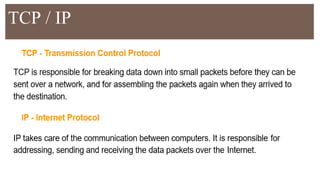
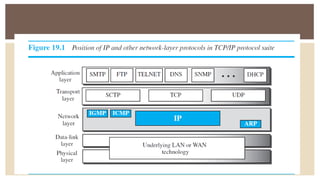
TCP / IP
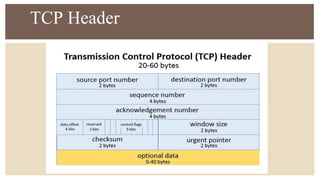
TCP Header
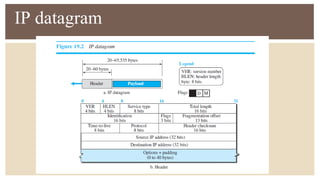
IP datagram
Why We Need IPv6 ?
Internet Protocol Version 6(IPv6) is the latest revision of the Internet Protocol, the
communication protocol that provides an identification and location system for
computers on networks and routes traffic across the internet.
IPv6 was developed by IETF to deal with the long-anticipated problem of IPv4
address exhaustion.
IPv6 was intended to replace IPv4, which still carries the vast majority of Internet
traffic.
In contrast to IPv4, which defined an IP address as a 32-bit value, IPv6 addresses
have a size of 128 bits. Therefore, IPv6 has a vastly enlarged address space
compared to IPv4.
Introduction
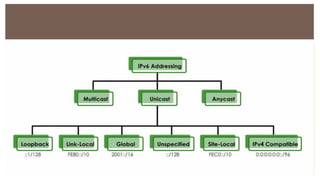
There are three types of IPv6 address :
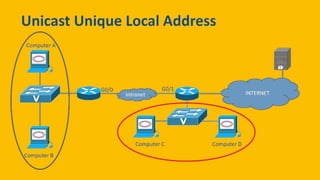
 Unicast
messages to a single networkUnicast transmission is the sending of
destination identified by a unique address.
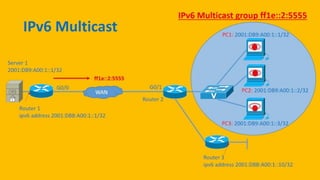
 Multicast
Multicast is the delivery of a message or information to a group of destination
computers simultaneously in a single transmission from the source.
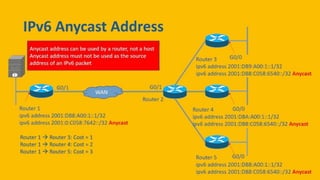
 Anycast
Anycast is a network addressing and routing methodology in which datagrams
from a single sender are routed to the topologically nearest node in a group of
potential receiver, though it may be sent to a several nodes, all
identified by the same destination address.
IPV6ADDRESSING
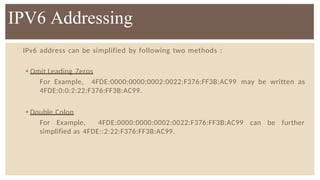
IPv6 address can be simplified by following two methods :
 Omit Leading Zeros
For Example, 4FDE:0000:0000:0002:0022:F376:FF3B:AC99 may be written as
4FDE:0:0:2:22:F376:FF3B:AC99.
can be further
 Double Colon
For Example, 4FDE:0000:0000:0002:0022:F376:FF3B:AC99
simplified as 4FDE::2:22:F376:FF3B:AC99.
IPV6 Addressing
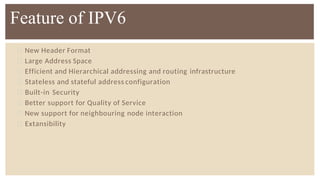
New Header Format
Large Address Space
Efficient and Hierarchical addressing and routing infrastructure
Stateless and stateful address configuration
Built-in Security
Better support for Quality of Service
New support for neighbouring node interaction
Extansibility
Feature of IPV6
The size of the IPv6 address is four times longer than 32-bit IPv4 address.
The number of possible address in IPv6 is 2^128(3.4*10^38) addresses.
340,282,366,920,938,463,463,374,607,431,768,211,456 to be exact.
Such a large amount of available IP addresses ensure that we will never again run
out of IP addresses.
IPV6 Addressing
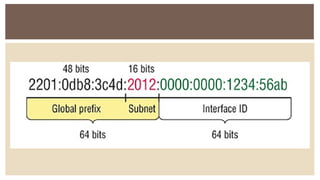
The IPv6 address size is 128-bit which is represented in hexadecimals.
The 128-bit address is divided into 16-bits, and each 16-bit block is converted into 4- digit
hexadecimal number and separated by colons. This type of representation is called colon
hexadecimal.
The format of IPv6 address is xxxx: xxxx: xxxx: xxxx: xxxx: xxxx: xxxx: xxxx where each x is a
hexadecimal representing 4 bits or anibble.
IPv6 address range from 0000:0000:0000:0000:0000:0000:0000:0000 to ffff: ffff: ffff: ffff:
ffff: ffff: ffff: ffff.
IPV6 Addressing
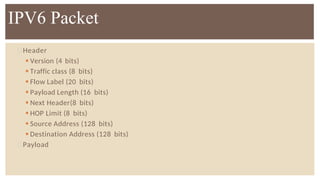
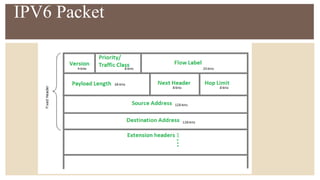
Header
 Version (4 bits)
 Traffic class (8 bits)
 Flow Label (20 bits)
 Payload Length (16 bits)
 Next Header(8 bits)
 HOP Limit (8 bits)
 Source Address (128 bits)
 Destination Address (128 bits)
Payload
IPV6 Packet
IPV6 Packet
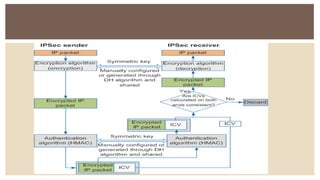
IPSec Algorithm
 Encryption Algorithm
 Data Encryption Standard (DES)
 Advanced Encryption Standard (AES)
 Authentication Method
 Preshared Key
 Kerberos V5
 NT LAN Manager (NTLM) etc.
IPSec in IPV6
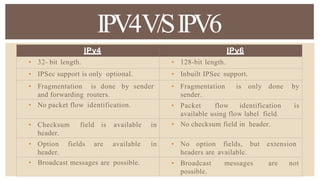
IPv4 IPv6
• 32- bit length. • 128-bit length.
• IPSec support is only optional. • Inbuilt IPSec support.
• Fragmentation is done by sender
and forwarding routers.
• Fragmentation is only done by
sender.
• No packet flow identification. • Packet flow identification is
available using flow label field.
• Checksum field is available in
header.
• No checksum field in header.
• Option fields are available in
header.
• No option fields, but extension
headers are available.
• Broadcast messages are possible. • Broadcast messages are not
possible.
IPV4V/SIPV6
THANK

YOU

IPV6 , ipv6 ,TCP/IP, TCP ,IP

  • 1.
  • 2.
  • 3.
  • 5.
  • 6.
  • 7.
    Internet Protocol Version6(IPv6) is the latest revision of the Internet Protocol, the communication protocol that provides an identification and location system for computers on networks and routes traffic across the internet. IPv6 was developed by IETF to deal with the long-anticipated problem of IPv4 address exhaustion. IPv6 was intended to replace IPv4, which still carries the vast majority of Internet traffic. In contrast to IPv4, which defined an IP address as a 32-bit value, IPv6 addresses have a size of 128 bits. Therefore, IPv6 has a vastly enlarged address space compared to IPv4. Introduction
  • 8.
    There are threetypes of IPv6 address :  Unicast messages to a single networkUnicast transmission is the sending of destination identified by a unique address.  Multicast Multicast is the delivery of a message or information to a group of destination computers simultaneously in a single transmission from the source.  Anycast Anycast is a network addressing and routing methodology in which datagrams from a single sender are routed to the topologically nearest node in a group of potential receiver, though it may be sent to a several nodes, all identified by the same destination address. IPV6ADDRESSING
  • 10.
    IPv6 address canbe simplified by following two methods :  Omit Leading Zeros For Example, 4FDE:0000:0000:0002:0022:F376:FF3B:AC99 may be written as 4FDE:0:0:2:22:F376:FF3B:AC99. can be further  Double Colon For Example, 4FDE:0000:0000:0002:0022:F376:FF3B:AC99 simplified as 4FDE::2:22:F376:FF3B:AC99. IPV6 Addressing
  • 15.
    New Header Format LargeAddress Space Efficient and Hierarchical addressing and routing infrastructure Stateless and stateful address configuration Built-in Security Better support for Quality of Service New support for neighbouring node interaction Extansibility Feature of IPV6
  • 16.
    The size ofthe IPv6 address is four times longer than 32-bit IPv4 address. The number of possible address in IPv6 is 2^128(3.4*10^38) addresses. 340,282,366,920,938,463,463,374,607,431,768,211,456 to be exact. Such a large amount of available IP addresses ensure that we will never again run out of IP addresses. IPV6 Addressing
  • 17.
    The IPv6 addresssize is 128-bit which is represented in hexadecimals. The 128-bit address is divided into 16-bits, and each 16-bit block is converted into 4- digit hexadecimal number and separated by colons. This type of representation is called colon hexadecimal. The format of IPv6 address is xxxx: xxxx: xxxx: xxxx: xxxx: xxxx: xxxx: xxxx where each x is a hexadecimal representing 4 bits or anibble. IPv6 address range from 0000:0000:0000:0000:0000:0000:0000:0000 to ffff: ffff: ffff: ffff: ffff: ffff: ffff: ffff. IPV6 Addressing
  • 18.
    Header  Version (4bits)  Traffic class (8 bits)  Flow Label (20 bits)  Payload Length (16 bits)  Next Header(8 bits)  HOP Limit (8 bits)  Source Address (128 bits)  Destination Address (128 bits) Payload IPV6 Packet
  • 19.
  • 21.
    IPSec Algorithm  EncryptionAlgorithm  Data Encryption Standard (DES)  Advanced Encryption Standard (AES)  Authentication Method  Preshared Key  Kerberos V5  NT LAN Manager (NTLM) etc. IPSec in IPV6
  • 23.
    IPv4 IPv6 • 32-bit length. • 128-bit length. • IPSec support is only optional. • Inbuilt IPSec support. • Fragmentation is done by sender and forwarding routers. • Fragmentation is only done by sender. • No packet flow identification. • Packet flow identification is available using flow label field. • Checksum field is available in header. • No checksum field in header. • Option fields are available in header. • No option fields, but extension headers are available. • Broadcast messages are possible. • Broadcast messages are not possible. IPV4V/SIPV6
  • 24.