IPV6 PACKET FORMAT
Prepared by,
G.Deena
Assistant Professor
Department of Computer Science and Engineering
IPv6 Packet format
• IPv6 packet is composed of a mandatory base
header followed by the payload.
• Payload consists of two parts:
• optional extension headers and
• data from an upper layer.
• The base header occupies 40 bytes, whereas the extension
headers and data from the upper layer contain up to
65,535 bytes of information.
IPV6 Datagram
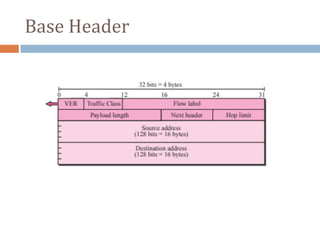
Base Header
Header
 Version
 In IPv6, the version is 6.
 Traffic Class
 This 8-bit field is used to distinguish different payloads
with different delivery requirements. It replaces the
service class field in IPv4.
 Flow label
 The flow label is a 20-bit field, designed to provide
special handling for a particular flow of data.
 Payload length
 The 2-byte payload length field defines the length of the
IP datagram excluding the base header
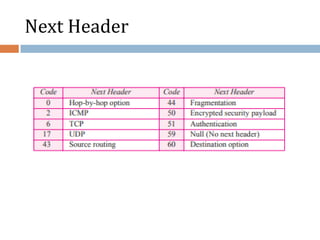
 The next header is an 8-bit field defining the header that
follows the base header in the datagram.
 The next header is either one of the optional extension
headers used by IP or the header of an encapsulated packet
such as UDP or TCP.
Next Header
 Hop limit
 This 8-bit hop limit field serves the same purpose as the
TTL field in IPv4.
 Source address
 The source address field is a 16-byte (128-bit) Internet
address that identifies the original source of the datagram.
 Destination address
 The destination address field is a 16-byte (128-bit)
Internet address that usually identifies the final
destination of the datagram
Flow Label
 IP protocol was designed as a connectionless protocol.
 To a router, a flow is a sequence of packets that share the
same characteristics, such as traveling the same path, using
the same resources, having the same kind of security.
 A router in the flow label has a flow label table.
 The table has an entry for each active flow label.
 Each entry defines the services required by the
corresponding flow label.
 When the router receives a packet, it consults its flow label
table to find the corresponding entry for the flow label
value defined in the packet.
 The information is provided by other means such as the
hop-by-hop options or other protocols.
 Flow label can be used to speed up the processing of a
packet by a router.
 When a router receives a packet, instead of consulting the routing
table and going through a routing algorithm to define the address
of the next hop.
 Flow label can be used to support the transmission of real-time
audio and video.
 Real-time audio or video, in digital form that requires resources
such as high bandwidth, large buffers, long processing time.
 A process can make a reservation for these resources to guarantee
that real-time data will not be delayed due to a lack of resources.
Rules
 For effective use of flow labels, three rules have been defined:
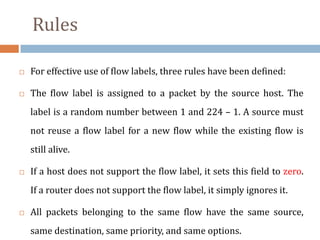
 The flow label is assigned to a packet by the source host. The
label is a random number between 1 and 224 – 1. A source must
not reuse a flow label for a new flow while the existing flow is
still alive.
 If a host does not support the flow label, it sets this field to zero.
If a router does not support the flow label, it simply ignores it.
 All packets belonging to the same flow have the same source,
same destination, same priority, and same options.
Comparison between IPv4 and IPv6
Headers
 The header length field is eliminated in IPv6 because the
length of the header is fixed in this version.
 The service type field is eliminated in IPv6. The traffic
class and flow label fields together take over the function
of the service type field.
 The total length field is eliminated in IPv6 and replaced by
the payload length field.
 The identification, flag, and offset fields are eliminated
from the base header in IPv6. They are included in the
fragmentation extension header.
 The TTL field is called hop limit in IPv6.
 The protocol field is replaced by the next header field.
 The header checksum is eliminated because the checksum
is provided by upper layer protocols.
 The option fields in IPv4 are implemented as extension
headers in IPv6.
Ipv6  packet fomat

Ipv6 packet fomat

  • 1.
    IPV6 PACKET FORMAT Preparedby, G.Deena Assistant Professor Department of Computer Science and Engineering
  • 2.
    IPv6 Packet format •IPv6 packet is composed of a mandatory base header followed by the payload. • Payload consists of two parts: • optional extension headers and • data from an upper layer. • The base header occupies 40 bytes, whereas the extension headers and data from the upper layer contain up to 65,535 bytes of information.
  • 3.
  • 4.
  • 5.
    Header  Version  InIPv6, the version is 6.  Traffic Class  This 8-bit field is used to distinguish different payloads with different delivery requirements. It replaces the service class field in IPv4.  Flow label  The flow label is a 20-bit field, designed to provide special handling for a particular flow of data.  Payload length  The 2-byte payload length field defines the length of the IP datagram excluding the base header
  • 6.
     The nextheader is an 8-bit field defining the header that follows the base header in the datagram.  The next header is either one of the optional extension headers used by IP or the header of an encapsulated packet such as UDP or TCP.
  • 7.
  • 8.
     Hop limit This 8-bit hop limit field serves the same purpose as the TTL field in IPv4.  Source address  The source address field is a 16-byte (128-bit) Internet address that identifies the original source of the datagram.  Destination address  The destination address field is a 16-byte (128-bit) Internet address that usually identifies the final destination of the datagram
  • 9.
    Flow Label  IPprotocol was designed as a connectionless protocol.  To a router, a flow is a sequence of packets that share the same characteristics, such as traveling the same path, using the same resources, having the same kind of security.  A router in the flow label has a flow label table.  The table has an entry for each active flow label.  Each entry defines the services required by the corresponding flow label.
  • 10.
     When therouter receives a packet, it consults its flow label table to find the corresponding entry for the flow label value defined in the packet.  The information is provided by other means such as the hop-by-hop options or other protocols.  Flow label can be used to speed up the processing of a packet by a router.
  • 11.
     When arouter receives a packet, instead of consulting the routing table and going through a routing algorithm to define the address of the next hop.  Flow label can be used to support the transmission of real-time audio and video.  Real-time audio or video, in digital form that requires resources such as high bandwidth, large buffers, long processing time.  A process can make a reservation for these resources to guarantee that real-time data will not be delayed due to a lack of resources.
  • 12.
    Rules  For effectiveuse of flow labels, three rules have been defined:  The flow label is assigned to a packet by the source host. The label is a random number between 1 and 224 – 1. A source must not reuse a flow label for a new flow while the existing flow is still alive.  If a host does not support the flow label, it sets this field to zero. If a router does not support the flow label, it simply ignores it.  All packets belonging to the same flow have the same source, same destination, same priority, and same options.
  • 13.
    Comparison between IPv4and IPv6 Headers  The header length field is eliminated in IPv6 because the length of the header is fixed in this version.  The service type field is eliminated in IPv6. The traffic class and flow label fields together take over the function of the service type field.  The total length field is eliminated in IPv6 and replaced by the payload length field.
  • 14.
     The identification,flag, and offset fields are eliminated from the base header in IPv6. They are included in the fragmentation extension header.  The TTL field is called hop limit in IPv6.  The protocol field is replaced by the next header field.  The header checksum is eliminated because the checksum is provided by upper layer protocols.  The option fields in IPv4 are implemented as extension headers in IPv6.