PRESENTED BY:
INIYAN V
Fundamentals of
IPv6
What is IPv6
IPv6 or Internet Protocol v6 is a network layer protocol that
allows communication to take place over the network. IPv6
was designed by Internet Engineering Task Force (IETF) in
December 1998 with the purpose of superseding the IPv4 due
to the global exponentially growing internet users.
Why IPv6?
The traditional IPv4 consists of 32 bits, which totals a
few billion addresses. Even as the number seems to be
large, it is not sufficient. So, to meet the increasing
demands of IP addresses, IPv6 was created with 128 bits
which is some billion times more than IPv4.
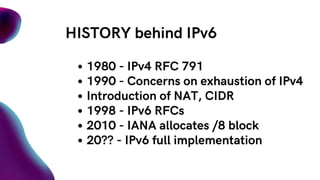
HISTORY behind IPv6
1980 - IPv4 RFC 791
1990 - Concerns on exhaustion of IPv4
Introduction of NAT, CIDR
1998 - IPv6 RFCs
2010 - IANA allocates /8 block
20?? - IPv6 full implementation
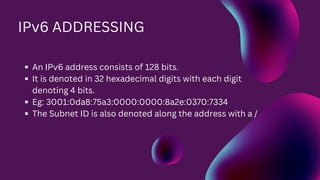
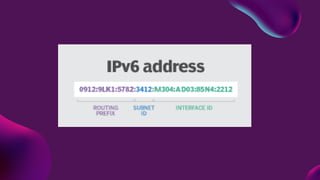
IPv6 ADDRESSING
An IPv6 address consists of 128 bits.
It is denoted in 32 hexadecimal digits with each digit
denoting 4 bits.
Eg: 3001:0da8:75a3:0000:0000:8a2e:0370:7334
The Subnet ID is also denoted along the address with a /
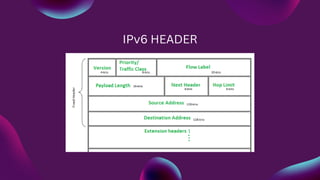
IPv6 HEADER
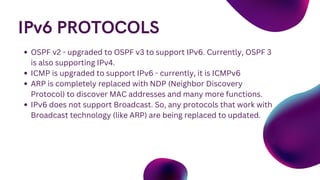
IPv6 PROTOCOLS
OSPF v2 - upgraded to OSPF v3 to support IPv6. Currently, OSPF 3
is also supporting IPv4.
ICMP is upgraded to support IPv6 - currently, it is ICMPv6
ARP is completely replaced with NDP (Neighbor Discovery
Protocol) to discover MAC addresses and many more functions.
IPv6 does not support Broadcast. So, any protocols that work with
Broadcast technology (like ARP) are being replaced to updated.
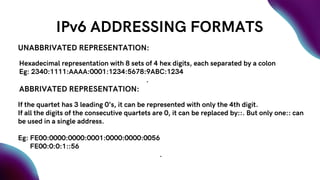
IPv6 ADDRESSING FORMATS
UNABBRIVATED REPRESENTATION:
Hexadecimal representation with 8 sets of 4 hex digits, each separated by a colon
Eg: 2340:1111:AAAA:0001:1234:5678:9ABC:1234
.
ABBRIVATED REPRESENTATION:
If the quartet has 3 leading 0's, it can be represented with only the 4th digit.
If all the digits of the consecutive quartets are 0, it can be replaced by::. But only one:: can
be used in a single address.
Eg: FE00:0000:0000:0001:0000:0000:0056
FE00:0:0:1::56
.
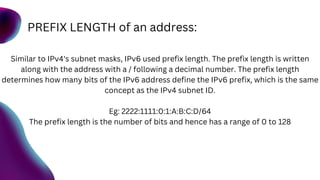
PREFIX LENGTH of an address:
Similar to IPv4's subnet masks, IPv6 used prefix length. The prefix length is written
along with the address with a / following a decimal number. The prefix length
determines how many bits of the IPv6 address define the IPv6 prefix, which is the same
concept as the IPv4 subnet ID.
Eg: 2222:1111:0:1:A:B:C:D/64
The prefix length is the number of bits and hence has a range of 0 to 128
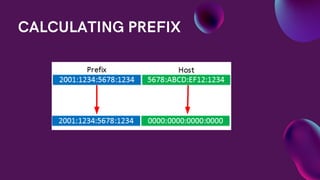
CALCULATING PREFIX
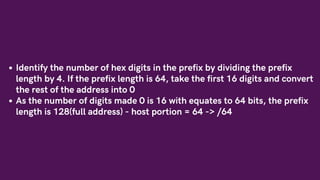
Identify the number of hex digits in the prefix by dividing the prefix
length by 4. If the prefix length is 64, take the first 16 digits and convert
the rest of the address into 0
As the number of digits made 0 is 16 with equates to 64 bits, the prefix
length is 128(full address) - host portion = 64 -> /64
FUN FACT
WHY NO IPv5?
There was an earlier effort to create a new version of IP after IPv4
and it was numbered IPv5, but it did not progress to the standard
stage. So the development of IPv5 has been terminated and a new
version named IPv6 was developed, which proved to be successful.

IPv6.pdf

  • 1.
  • 2.
    What is IPv6 IPv6or Internet Protocol v6 is a network layer protocol that allows communication to take place over the network. IPv6 was designed by Internet Engineering Task Force (IETF) in December 1998 with the purpose of superseding the IPv4 due to the global exponentially growing internet users.
  • 3.
    Why IPv6? The traditionalIPv4 consists of 32 bits, which totals a few billion addresses. Even as the number seems to be large, it is not sufficient. So, to meet the increasing demands of IP addresses, IPv6 was created with 128 bits which is some billion times more than IPv4.
  • 4.
    HISTORY behind IPv6 1980- IPv4 RFC 791 1990 - Concerns on exhaustion of IPv4 Introduction of NAT, CIDR 1998 - IPv6 RFCs 2010 - IANA allocates /8 block 20?? - IPv6 full implementation
  • 5.
    IPv6 ADDRESSING An IPv6address consists of 128 bits. It is denoted in 32 hexadecimal digits with each digit denoting 4 bits. Eg: 3001:0da8:75a3:0000:0000:8a2e:0370:7334 The Subnet ID is also denoted along the address with a /
  • 7.
  • 8.
    IPv6 PROTOCOLS OSPF v2- upgraded to OSPF v3 to support IPv6. Currently, OSPF 3 is also supporting IPv4. ICMP is upgraded to support IPv6 - currently, it is ICMPv6 ARP is completely replaced with NDP (Neighbor Discovery Protocol) to discover MAC addresses and many more functions. IPv6 does not support Broadcast. So, any protocols that work with Broadcast technology (like ARP) are being replaced to updated.
  • 9.
    IPv6 ADDRESSING FORMATS UNABBRIVATEDREPRESENTATION: Hexadecimal representation with 8 sets of 4 hex digits, each separated by a colon Eg: 2340:1111:AAAA:0001:1234:5678:9ABC:1234 . ABBRIVATED REPRESENTATION: If the quartet has 3 leading 0's, it can be represented with only the 4th digit. If all the digits of the consecutive quartets are 0, it can be replaced by::. But only one:: can be used in a single address. Eg: FE00:0000:0000:0001:0000:0000:0056 FE00:0:0:1::56 .
  • 10.
    PREFIX LENGTH ofan address: Similar to IPv4's subnet masks, IPv6 used prefix length. The prefix length is written along with the address with a / following a decimal number. The prefix length determines how many bits of the IPv6 address define the IPv6 prefix, which is the same concept as the IPv4 subnet ID. Eg: 2222:1111:0:1:A:B:C:D/64 The prefix length is the number of bits and hence has a range of 0 to 128
  • 11.
  • 12.
    Identify the numberof hex digits in the prefix by dividing the prefix length by 4. If the prefix length is 64, take the first 16 digits and convert the rest of the address into 0 As the number of digits made 0 is 16 with equates to 64 bits, the prefix length is 128(full address) - host portion = 64 -> /64
  • 13.
    FUN FACT WHY NOIPv5? There was an earlier effort to create a new version of IP after IPv4 and it was numbered IPv5, but it did not progress to the standard stage. So the development of IPv5 has been terminated and a new version named IPv6 was developed, which proved to be successful.