INTRODUCTION TO  COMPUTER NETWORKS Avnika Nautiyal (N-17) Manish Singhal (N-39) FACULTY OF MANAGEMENT STUDIES UNIVERSITY OF DELHI DELHI - 110007
Content IP Protocols - TCP/IP  IP addressing - class A, B, C , D, E  Routing and Routing protocols  DNS  IPv4 vs V6
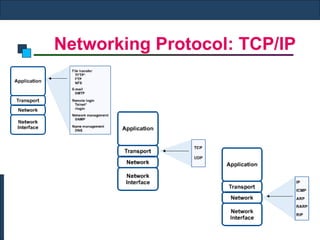
Networking Protocol: TCP/IP
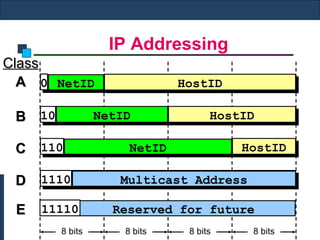
IP Addressing Reserved for future 0 NetID 10 110 NetID 1110 Multicast Address HostID NetID HostID HostID Class A B C D 8 bits 8 bits 8 bits 8 bits E 11110
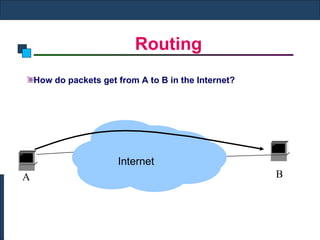
Routing A B Internet How do packets get from A to B in the Internet?
Routing Protocol A routing protocol is the implementation of a routing algorithm in software or hardware.  A routing protocol uses metrics to determine which path to utilize to transmit a packet across an internetwork. The metrics used by routing protocols include: Number of network layer devices along the path (hop count) Bandwidth Delay Load MTU Cost  The   Routing protocols store the results of these metrics in a routing table.
Interior Routing Protocol Interior Gateway Protocols (IGPs) handle routing within an Autonomous System. These protocols keep track of how to get from one destination to the other inside a network or set of networks that you administrate (all of the networks you manage combined are usually just one Autonomous System). IGP fall into two categories:    Distance Vector Protocols  Routing Information Protocol (RIP) Interior Gateway Routing Protocol (IGRP)     Link State Protocols  Open Shortest Path First (OSPF)      Intermediate System to Intermediate System (IS-IS)
Exterior Routing Protocol To get from place to place outside your network's, i.e. on the Internet, you must use an Exterior Gateway Protocol. Exterior Gateway Protocols handle routing outside an Autonomous System and get you from your network, through your Internet provider's network and onto any other network. BGP is used by companies with more than one Internet provider. Examples of an EGP:     Border Gateway Protocol (BGP) Exterior Gateway Protocol (Replaced by BGP)
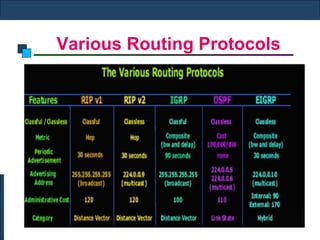
Various Routing Protocols
DNS Domain Name Server provides a mapping from names to resources of several types. It is a lookup mechanism for translating objects into other objects. It is a globally distributed, loosely coherent, scalable, reliable, dynamic database. It is comprised of three components A “name space” Servers making that name space available Resolvers (clients) which query the servers about the name space No single computer has all DNS data DNS lookups can be performed by any device Remote DNS data is locally cacheable to improve performance.
DNS - Names The namespace needs to be made hierarchical to be able to scale. The idea is to name objects based on  location (within country, set  of organizations, set of companies, etc) unit within that location (company within set of company, etc) object within unit (name of person in company)  Fully Qualified Domain Name (FQDN) WWW.RIPE.NET. labels separated by dots DNS provides a mapping from FQDNs to resources of several types Names are used as a key when fetching data in the DNS Note the trailing dot
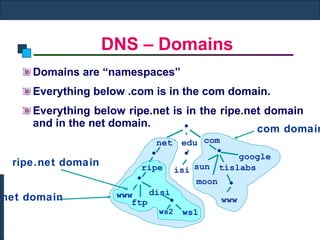
DNS – Domains Domains are “namespaces” Everything below .com is in the com domain. Everything below ripe.net is in the ripe.net domain and in the net domain. net domain com domain ripe.net domain net com ripe www www edu isi tislabs • disi ws1 ws2 • • • • • • ftp sun moon google
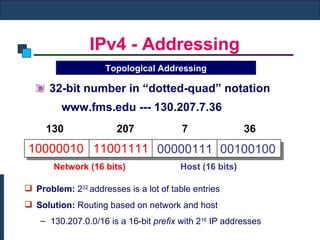
IPv4 - Addressing  32-bit number in “dotted-quad” notation www.fms.edu --- 130.207.7.36 Topological   Addressing Problem:  2 32  addresses is a lot of table entries Solution:  Routing based on network and host 130.207.0.0/16 is a 16-bit  prefix  with 2 16  IP addresses Network (16 bits)   Host (16 bits)   130 207 7 36 10000010 11001111 00000111 00100100
IPv6 – Address Space Scarcity 128-bit addresses Top 48-bits: Public Routing Topology (PRT) 3 bits for aggregation 13 bits for TLA (like “tier-1 ISPs”) 8 reserved bits 24 bits for NLA 16-bit Site Identifier: aggregation within an AS 64-bit Interface ID: 48-bit Ethernet + 16 more bits Pure provider-based addressing Changing ISPs requires renumbering
Comparison – IPv4 Vs IPv6 Simplified header format. IPv6 has a fixed length header, which does not include most of the options an IPv4 header can include. Even though the IPv6 header contains two 128 bit addresses (source and destination IP address) the whole header has a fixed length of 40 bytes only. This allows for faster processing. Options are dealt with in extension headers, which are only inserted after the IPv6 header if needed. So for instance if a packet needs to be fragmented, the fragmentation header is inserted after the IPv6 header. The basic set of extension headers is defined in RFC 2460.  Address extended to 128 bits. This allows for hierarchical structure of the address space and provides enough addresses for almost every 'grain of sand' on the earth. Important for security and new services/devices that will need multiple IP addresses and/or permanent connectivity.  A lot of the new IPv6 functionality is built into ICMPv6 such as Neighbor Discovery, Autoconfiguration, Multicast Listener Discovery, Path MTU Discovery.  Enhanced Security and QoS Features.

Networking presentation 9 march 2009

  • 1.
    INTRODUCTIONTO COMPUTER NETWORKS Avnika Nautiyal (N-17) Manish Singhal (N-39) FACULTY OF MANAGEMENT STUDIES UNIVERSITY OF DELHI DELHI - 110007
  • 2.
    Content IP Protocols- TCP/IP IP addressing - class A, B, C , D, E Routing and Routing protocols DNS IPv4 vs V6
  • 3.
  • 4.
    IP Addressing Reservedfor future 0 NetID 10 110 NetID 1110 Multicast Address HostID NetID HostID HostID Class A B C D 8 bits 8 bits 8 bits 8 bits E 11110
  • 5.
    Routing A BInternet How do packets get from A to B in the Internet?
  • 6.
    Routing Protocol Arouting protocol is the implementation of a routing algorithm in software or hardware. A routing protocol uses metrics to determine which path to utilize to transmit a packet across an internetwork. The metrics used by routing protocols include: Number of network layer devices along the path (hop count) Bandwidth Delay Load MTU Cost The Routing protocols store the results of these metrics in a routing table.
  • 7.
    Interior Routing ProtocolInterior Gateway Protocols (IGPs) handle routing within an Autonomous System. These protocols keep track of how to get from one destination to the other inside a network or set of networks that you administrate (all of the networks you manage combined are usually just one Autonomous System). IGP fall into two categories:    Distance Vector Protocols Routing Information Protocol (RIP) Interior Gateway Routing Protocol (IGRP)    Link State Protocols Open Shortest Path First (OSPF)     Intermediate System to Intermediate System (IS-IS)
  • 8.
    Exterior Routing ProtocolTo get from place to place outside your network's, i.e. on the Internet, you must use an Exterior Gateway Protocol. Exterior Gateway Protocols handle routing outside an Autonomous System and get you from your network, through your Internet provider's network and onto any other network. BGP is used by companies with more than one Internet provider. Examples of an EGP:    Border Gateway Protocol (BGP) Exterior Gateway Protocol (Replaced by BGP)
  • 9.
  • 10.
    DNS Domain NameServer provides a mapping from names to resources of several types. It is a lookup mechanism for translating objects into other objects. It is a globally distributed, loosely coherent, scalable, reliable, dynamic database. It is comprised of three components A “name space” Servers making that name space available Resolvers (clients) which query the servers about the name space No single computer has all DNS data DNS lookups can be performed by any device Remote DNS data is locally cacheable to improve performance.
  • 11.
    DNS - NamesThe namespace needs to be made hierarchical to be able to scale. The idea is to name objects based on location (within country, set of organizations, set of companies, etc) unit within that location (company within set of company, etc) object within unit (name of person in company) Fully Qualified Domain Name (FQDN) WWW.RIPE.NET. labels separated by dots DNS provides a mapping from FQDNs to resources of several types Names are used as a key when fetching data in the DNS Note the trailing dot
  • 12.
    DNS – DomainsDomains are “namespaces” Everything below .com is in the com domain. Everything below ripe.net is in the ripe.net domain and in the net domain. net domain com domain ripe.net domain net com ripe www www edu isi tislabs • disi ws1 ws2 • • • • • • ftp sun moon google
  • 13.
    IPv4 - Addressing 32-bit number in “dotted-quad” notation www.fms.edu --- 130.207.7.36 Topological Addressing Problem: 2 32 addresses is a lot of table entries Solution: Routing based on network and host 130.207.0.0/16 is a 16-bit prefix with 2 16 IP addresses Network (16 bits) Host (16 bits) 130 207 7 36 10000010 11001111 00000111 00100100
  • 14.
    IPv6 – AddressSpace Scarcity 128-bit addresses Top 48-bits: Public Routing Topology (PRT) 3 bits for aggregation 13 bits for TLA (like “tier-1 ISPs”) 8 reserved bits 24 bits for NLA 16-bit Site Identifier: aggregation within an AS 64-bit Interface ID: 48-bit Ethernet + 16 more bits Pure provider-based addressing Changing ISPs requires renumbering
  • 15.
    Comparison – IPv4Vs IPv6 Simplified header format. IPv6 has a fixed length header, which does not include most of the options an IPv4 header can include. Even though the IPv6 header contains two 128 bit addresses (source and destination IP address) the whole header has a fixed length of 40 bytes only. This allows for faster processing. Options are dealt with in extension headers, which are only inserted after the IPv6 header if needed. So for instance if a packet needs to be fragmented, the fragmentation header is inserted after the IPv6 header. The basic set of extension headers is defined in RFC 2460. Address extended to 128 bits. This allows for hierarchical structure of the address space and provides enough addresses for almost every 'grain of sand' on the earth. Important for security and new services/devices that will need multiple IP addresses and/or permanent connectivity. A lot of the new IPv6 functionality is built into ICMPv6 such as Neighbor Discovery, Autoconfiguration, Multicast Listener Discovery, Path MTU Discovery. Enhanced Security and QoS Features.