IPV4 & IPV6
1
IP VERSIONS!
What is ip address?
❏ An IP Address is an identifier for a particular
machine on a particular network. It is part of a
scheme to identify computers on the internet.
❏ Ip address are also referred to as IP number and
internet address.
❏ The network portion of the IP address is
allocated to internet service providers (ISP) by
the InterNIC, under the authority of the internet
assigned number authority (IANA).
❏ ISP’s then assign the host portion of the IP
address to the machines on the networks that
they operate. 2
Which section of the IP address
represent the network & which
sections represents the machine
will depend on what “class” of IP
address is assigned to a network.
3
QUESTIONS?
ipV4
4
IPV4
❏ It is 32 bit number represented in 4
decimal number where each decimal
number is of 8bit (octet) is separated by a
dot(.)
❏ Thus representation known as doted
decimal representation. IP address
consists of 2 components the network id
and the host id.
IPV4
❏ Network id:-it is the number assigned
to a network in the internet. Host id:- it
represents the id assigned to a host in
the network.
❏ IPv4 allows 232 (4294967296) unique
address which section of IP address
show the network id & which section
show the machine or host id depend on
the class network. 6
IPV4
There are five classes of IP addresses:
❏ Class A
❏ Class B
❏ Class C
❏ Class D
❏ Class E
7
IPV4 : CLASS A
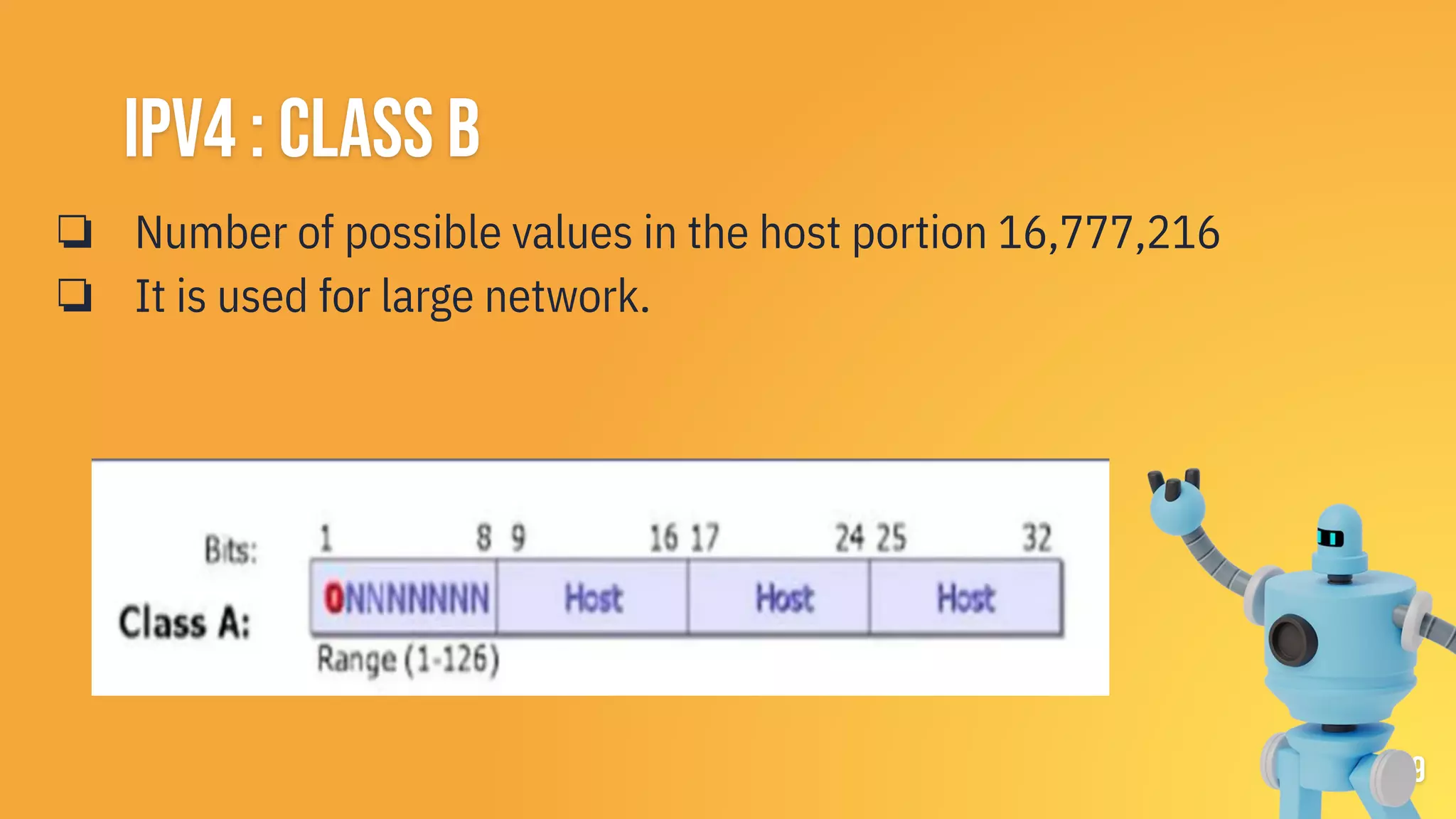
❏ The first byte is a network id (8 bits) & the
last 3 bytes are for host id (24 bits).
❏ The first bit is ‘0’.
❏ Range of network number-1.0.0.0 to
126.0.0.0
❏ Number of possible networks-127(1-126
usable, 127 is reserved)
8
IPV4 : CLASS B
❏ Number of possible values in the host portion 16,777,216
❏ It is used for large network.
9
IPV4: CLASS B
❏ The first 2 bytes are a network id (16 bits) & the
last 2 bytes are for host id (16 bits).
❏ The first 2 bits are ‘10’.
❏ Range of network number- 128.0.0.0 to
191.255.0.0
❏ Number of possible networks- 16,384
10
IPV4:CLASS B
❏ Number of possible values in the host
portion- 65536
❏ Used for medium size network.
11
IPV4: CLASS C
❏ The first 3 bytes are a network id (24 bits) &
the last 1 byte are for host id (8 bit).
❏ The first 3 bits are ‘110’.
❏ Range of network number- 192.0.0.0 to
223.255.255.0
❏ Number of possible networks- 2,097,152
❏ Number of possible values in the host
portion- 256
❏ Used in local area network(LAN). 12
13
Ipv4: class d
❏ An IP address which belong to class D
has the first octet has its 4bit set to
‘1110’.
❏ Range of network number- 224.0.0.0 to
239.255.255.255
❏ Used for multicasting
14
Ipv4: class e
❏ It reserved for experimental & for
future testing purpose.
❏ Range of network number-
240.0.0.0 to 255.255.255.254
16
ipv6
17
18
ipv6
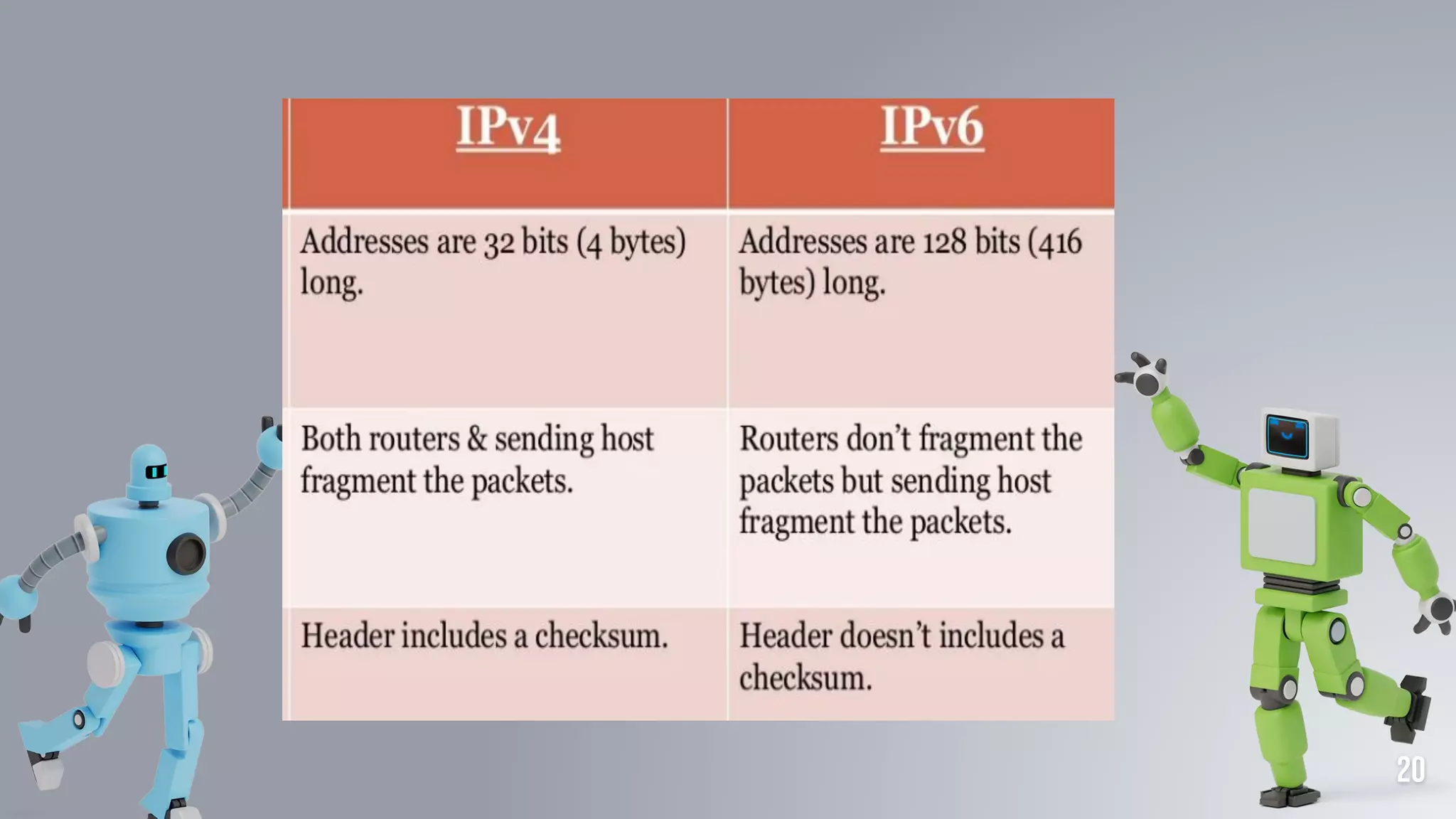
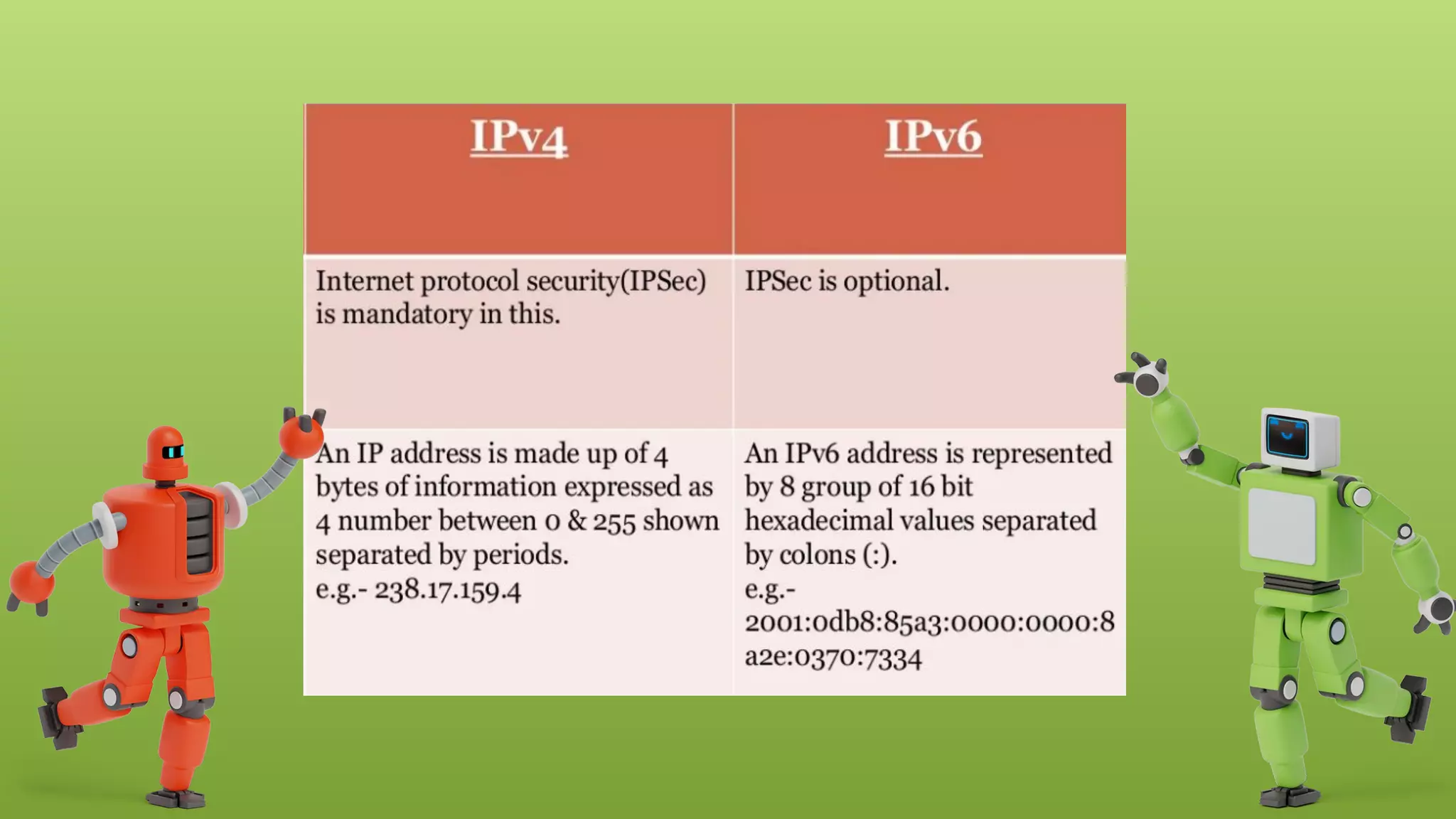
❏ IPv6 will make use of 128 bit IP address.
❏ An IPv6 address is represented as 8
groups of 4 hexadecimal digits, each
group representing 16 bits (2 octets).
❏ The groups are separated by colons(:).
E.g.2001:0db8.85a3:0000:0000:8a2e:0
370 :7334
The difference
Ipv4 & Ipv6
19
20
Any questions?
24
Team Presentation
25
Adrian TeoJacob Binala
Zyrrine Garma
Ashley Magbaleta
Jericho Peralta Faye Tulali
Christian Jacob Ramos

ip versions.pdf

  • 1.
  • 2.
    What is ipaddress? ❏ An IP Address is an identifier for a particular machine on a particular network. It is part of a scheme to identify computers on the internet. ❏ Ip address are also referred to as IP number and internet address. ❏ The network portion of the IP address is allocated to internet service providers (ISP) by the InterNIC, under the authority of the internet assigned number authority (IANA). ❏ ISP’s then assign the host portion of the IP address to the machines on the networks that they operate. 2
  • 3.
    Which section ofthe IP address represent the network & which sections represents the machine will depend on what “class” of IP address is assigned to a network. 3 QUESTIONS?
  • 4.
  • 5.
    IPV4 ❏ It is32 bit number represented in 4 decimal number where each decimal number is of 8bit (octet) is separated by a dot(.) ❏ Thus representation known as doted decimal representation. IP address consists of 2 components the network id and the host id.
  • 6.
    IPV4 ❏ Network id:-itis the number assigned to a network in the internet. Host id:- it represents the id assigned to a host in the network. ❏ IPv4 allows 232 (4294967296) unique address which section of IP address show the network id & which section show the machine or host id depend on the class network. 6
  • 7.
    IPV4 There are fiveclasses of IP addresses: ❏ Class A ❏ Class B ❏ Class C ❏ Class D ❏ Class E 7
  • 8.
    IPV4 : CLASSA ❏ The first byte is a network id (8 bits) & the last 3 bytes are for host id (24 bits). ❏ The first bit is ‘0’. ❏ Range of network number-1.0.0.0 to 126.0.0.0 ❏ Number of possible networks-127(1-126 usable, 127 is reserved) 8
  • 9.
    IPV4 : CLASSB ❏ Number of possible values in the host portion 16,777,216 ❏ It is used for large network. 9
  • 10.
    IPV4: CLASS B ❏The first 2 bytes are a network id (16 bits) & the last 2 bytes are for host id (16 bits). ❏ The first 2 bits are ‘10’. ❏ Range of network number- 128.0.0.0 to 191.255.0.0 ❏ Number of possible networks- 16,384 10
  • 11.
    IPV4:CLASS B ❏ Numberof possible values in the host portion- 65536 ❏ Used for medium size network. 11
  • 12.
    IPV4: CLASS C ❏The first 3 bytes are a network id (24 bits) & the last 1 byte are for host id (8 bit). ❏ The first 3 bits are ‘110’. ❏ Range of network number- 192.0.0.0 to 223.255.255.0 ❏ Number of possible networks- 2,097,152 ❏ Number of possible values in the host portion- 256 ❏ Used in local area network(LAN). 12
  • 13.
  • 14.
    Ipv4: class d ❏An IP address which belong to class D has the first octet has its 4bit set to ‘1110’. ❏ Range of network number- 224.0.0.0 to 239.255.255.255 ❏ Used for multicasting 14
  • 16.
    Ipv4: class e ❏It reserved for experimental & for future testing purpose. ❏ Range of network number- 240.0.0.0 to 255.255.255.254 16
  • 17.
  • 18.
    18 ipv6 ❏ IPv6 willmake use of 128 bit IP address. ❏ An IPv6 address is represented as 8 groups of 4 hexadecimal digits, each group representing 16 bits (2 octets). ❏ The groups are separated by colons(:). E.g.2001:0db8.85a3:0000:0000:8a2e:0 370 :7334
  • 19.
  • 20.
  • 24.
  • 25.
    Team Presentation 25 Adrian TeoJacobBinala Zyrrine Garma Ashley Magbaleta Jericho Peralta Faye Tulali Christian Jacob Ramos