Rahul kundu
6th sem, IT
content
 What is IP address ?
 Intro to IPv4
 Type of IPv4 class
 Class A
 Class B
 Class C
 Class D
 Class E
content
 Define Ipv6
 Difference between IPv4 and IPv6
 What is IP address ?
 An IP address is an identifier for a
particular machine on a particular
network. It is part of a scheme to
identify computers on the internet.
 IP address are also referred to as IP
number and internet address.
 The network portion of the IP address is
allocated to internet service
provider(ISP) by the InterNIC, under
authority of the internet assigned
number authority(IANA).
 ISPs then assign the host portion of the
IP address to the machines on the
networks that they operate.
 Which section of the IP address
represent the network & which sections
represent the machine will depend on
what “class” of IP address is assigned to
a network.
 IPv4
 It is 32 bit number represented in 4
decimal number where each decimal
number is of 8 bit (octet) is separated by
a dot(.).
 Thus representation known as doted
decimal representation.
 IP address consists of 2 components the
network id and the host id.
 IPv4 cont…
 Network id:-it is the number assigned to
a network in the internet.
Host id:- it represents the id assigned to
a host in the network.
 IPv4 allows 232 (4294967296) unique
address which section of IP address
show the network id & which section
show the machine or host id depend on
the class network.
 IPv4 cont…
 There are five classes of IP addresses:-
 Class A
 Class B
 Class C
 Class D
 Class E
 IPv4 cont…
Class A:-
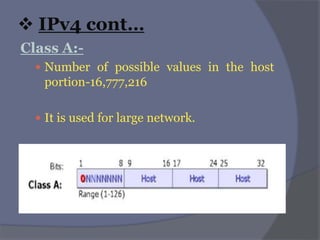
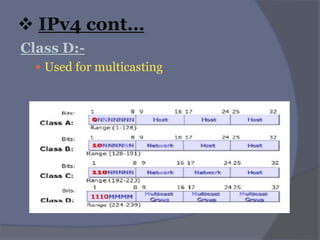
 The first byte is a network id (8 bits) &
the last 3 bytes are for host id (24 bits).
 The first bit is ‘0’.
 Range of network number-1.0.0.0 to
126.0.0.0
 Number of possible networks-127(1-126
usable, 127 is reserved)
 IPv4 cont…
Class A:-
 Number of possible values in the host
portion-16,777,216
 It is used for large network.
 IPv4 cont…
Class B:-
 The first 2 bytes are a network id (16 bits)
& the last 2 bytes are for host id (16 bits).
 The first 2 bits are ‘10’.
 Range of network number- 128.0.0.0 to
191.255.0.0
 Number of possible networks- 16,384
 IPv4 cont…
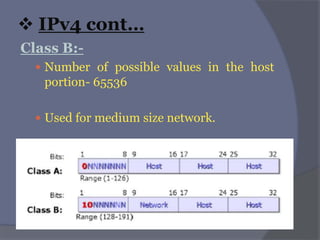
Class B:-
 Number of possible values in the host
portion- 65536
 Used for medium size network.
 IPv4 cont…
Class C:-
 The first 3 bytes are a network id (24 bits)
& the last 1 byte are for host id (8 bit).
 The first 3 bits are ‘110’.
 Range of network number- 192.0.0.0 to
223.255.255.0
 Number of possible networks- 2,097,152
 IPv4 cont…
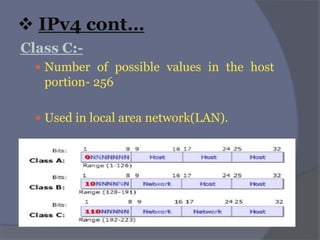
Class C:-
 Number of possible values in the host
portion- 256
 Used in local area network(LAN).
 IPv4 cont…
Class D:-
 An IP address which belong to class D has
the first octet has its 4bit set to ‘1110’.
 Range of network number- 224.0.0.0 to
239.255.255.255
 IPv4 cont…
Class D:-
 Used for multicasting
 IPv4 cont…
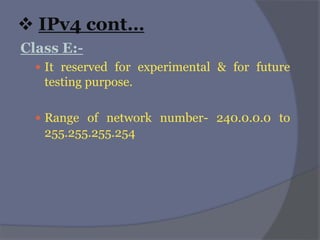
Class E:-
 It reserved for experimental & for future
testing purpose.
 Range of network number- 240.0.0.0 to
255.255.255.254
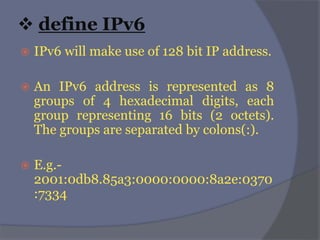
 define IPv6
 IPv6 will make use of 128 bit IP address.
 An IPv6 address is represented as 8
groups of 4 hexadecimal digits, each
group representing 16 bits (2 octets).
The groups are separated by colons(:).
 E.g.-
2001:0db8.85a3:0000:0000:8a2e:0370
:7334
 difference between IPv4
and IPv6
S.N IPv4 IPv6
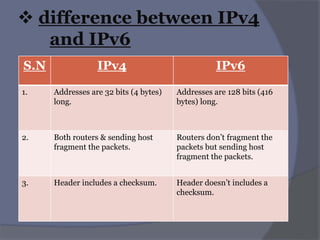
1. Addresses are 32 bits (4 bytes)
long.
Addresses are 128 bits (416
bytes) long.
2. Both routers & sending host
fragment the packets.
Routers don’t fragment the
packets but sending host
fragment the packets.
3. Header includes a checksum. Header doesn’t includes a
checksum.
 difference between IPv4
and IPv6 cont…
S.N IPv4 IPv6
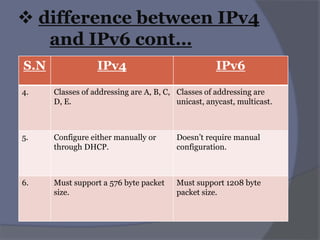
4. Classes of addressing are A, B, C,
D, E.
Classes of addressing are
unicast, anycast, multicast.
5. Configure either manually or
through DHCP.
Doesn’t require manual
configuration.
6. Must support a 576 byte packet
size.
Must support 1208 byte
packet size.
 difference between IPv4
and IPv6 cont…
S.N IPv4 IPv6
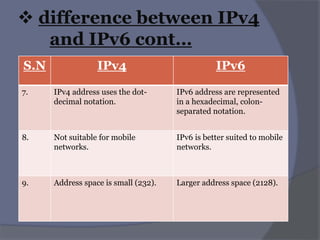
7. IPv4 address uses the dot-
decimal notation.
IPv6 address are represented
in a hexadecimal, colon-
separated notation.
8. Not suitable for mobile
networks.
IPv6 is better suited to mobile
networks.
9. Address space is small (232). Larger address space (2128).
 difference between IPv4
and IPv6 cont…
S.N IPv4 IPv6
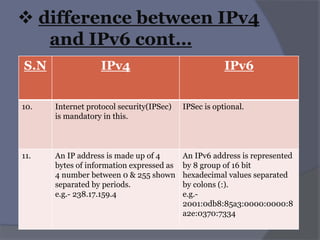
10. Internet protocol security(IPSec)
is mandatory in this.
IPSec is optional.
11. An IP address is made up of 4
bytes of information expressed as
4 number between 0 & 255 shown
separated by periods.
e.g.- 238.17.159.4
An IPv6 address is represented
by 8 group of 16 bit
hexadecimal values separated
by colons (:).
e.g.-
2001:0db8:85a3:0000:0000:8
a2e:0370:7334
Rahul kundu
6th sem, IT

presentation hhgfhfgd lhjfgddffdfsdfsfdsdfsfd.pdf

  • 1.
  • 2.
    content  What isIP address ?  Intro to IPv4  Type of IPv4 class  Class A  Class B  Class C  Class D  Class E
  • 3.
    content  Define Ipv6 Difference between IPv4 and IPv6
  • 4.
     What isIP address ?  An IP address is an identifier for a particular machine on a particular network. It is part of a scheme to identify computers on the internet.  IP address are also referred to as IP number and internet address.
  • 5.
     The networkportion of the IP address is allocated to internet service provider(ISP) by the InterNIC, under authority of the internet assigned number authority(IANA).  ISPs then assign the host portion of the IP address to the machines on the networks that they operate.
  • 6.
     Which sectionof the IP address represent the network & which sections represent the machine will depend on what “class” of IP address is assigned to a network.
  • 7.
     IPv4  Itis 32 bit number represented in 4 decimal number where each decimal number is of 8 bit (octet) is separated by a dot(.).  Thus representation known as doted decimal representation.  IP address consists of 2 components the network id and the host id.
  • 8.
     IPv4 cont… Network id:-it is the number assigned to a network in the internet. Host id:- it represents the id assigned to a host in the network.  IPv4 allows 232 (4294967296) unique address which section of IP address show the network id & which section show the machine or host id depend on the class network.
  • 9.
     IPv4 cont… There are five classes of IP addresses:-  Class A  Class B  Class C  Class D  Class E
  • 10.
     IPv4 cont… ClassA:-  The first byte is a network id (8 bits) & the last 3 bytes are for host id (24 bits).  The first bit is ‘0’.  Range of network number-1.0.0.0 to 126.0.0.0  Number of possible networks-127(1-126 usable, 127 is reserved)
  • 11.
     IPv4 cont… ClassA:-  Number of possible values in the host portion-16,777,216  It is used for large network.
  • 12.
     IPv4 cont… ClassB:-  The first 2 bytes are a network id (16 bits) & the last 2 bytes are for host id (16 bits).  The first 2 bits are ‘10’.  Range of network number- 128.0.0.0 to 191.255.0.0  Number of possible networks- 16,384
  • 13.
     IPv4 cont… ClassB:-  Number of possible values in the host portion- 65536  Used for medium size network.
  • 14.
     IPv4 cont… ClassC:-  The first 3 bytes are a network id (24 bits) & the last 1 byte are for host id (8 bit).  The first 3 bits are ‘110’.  Range of network number- 192.0.0.0 to 223.255.255.0  Number of possible networks- 2,097,152
  • 15.
     IPv4 cont… ClassC:-  Number of possible values in the host portion- 256  Used in local area network(LAN).
  • 16.
     IPv4 cont… ClassD:-  An IP address which belong to class D has the first octet has its 4bit set to ‘1110’.  Range of network number- 224.0.0.0 to 239.255.255.255
  • 17.
     IPv4 cont… ClassD:-  Used for multicasting
  • 18.
     IPv4 cont… ClassE:-  It reserved for experimental & for future testing purpose.  Range of network number- 240.0.0.0 to 255.255.255.254
  • 19.
     define IPv6 IPv6 will make use of 128 bit IP address.  An IPv6 address is represented as 8 groups of 4 hexadecimal digits, each group representing 16 bits (2 octets). The groups are separated by colons(:).  E.g.- 2001:0db8.85a3:0000:0000:8a2e:0370 :7334
  • 20.
     difference betweenIPv4 and IPv6 S.N IPv4 IPv6 1. Addresses are 32 bits (4 bytes) long. Addresses are 128 bits (416 bytes) long. 2. Both routers & sending host fragment the packets. Routers don’t fragment the packets but sending host fragment the packets. 3. Header includes a checksum. Header doesn’t includes a checksum.
  • 21.
     difference betweenIPv4 and IPv6 cont… S.N IPv4 IPv6 4. Classes of addressing are A, B, C, D, E. Classes of addressing are unicast, anycast, multicast. 5. Configure either manually or through DHCP. Doesn’t require manual configuration. 6. Must support a 576 byte packet size. Must support 1208 byte packet size.
  • 22.
     difference betweenIPv4 and IPv6 cont… S.N IPv4 IPv6 7. IPv4 address uses the dot- decimal notation. IPv6 address are represented in a hexadecimal, colon- separated notation. 8. Not suitable for mobile networks. IPv6 is better suited to mobile networks. 9. Address space is small (232). Larger address space (2128).
  • 23.
     difference betweenIPv4 and IPv6 cont… S.N IPv4 IPv6 10. Internet protocol security(IPSec) is mandatory in this. IPSec is optional. 11. An IP address is made up of 4 bytes of information expressed as 4 number between 0 & 255 shown separated by periods. e.g.- 238.17.159.4 An IPv6 address is represented by 8 group of 16 bit hexadecimal values separated by colons (:). e.g.- 2001:0db8:85a3:0000:0000:8 a2e:0370:7334
  • 24.