IP Addressing
What is an IP address
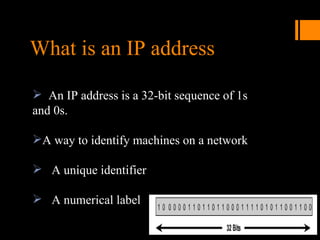
 An IP address is a 32-bit sequence of 1s
and 0s.
A way to identify machines on a network
 A unique identifier
 A numerical label
IP usage
Used to connect to another computer
Allows transfers of files and e-mail
What is an Internet Protocol
 Protocol used for communicating data
 Across a packet-switched
Services provided by IP
 Addressing
 Fragmentation
Part of IP Address
 Network Part
 Local or Host Part
IP Structure
IP addresses consist of four sections
Each section is 8 bits long
Each section can range from 0 to 255
Written, for example, 128.35.0.72
IP structure
5 Classes of IP address A B C D and E
Class A reserved for governments
Class B reserved for medium companies
Class C reserved for small companies
Class D are reserved for multicasting
Class E are reserved for future use
IP ranges
Class Address Range Supports
Class A 1.0.0.1 to 126.255.255.254 Supports 16 million hosts on each of 127 networks.
Class B 128.1.0.1 to 191.255.255.254 Supports 65,000 hosts on each of 16,000 networks.
Class C 192.0.1.1 to 223.255.254.254 Supports 254 hosts on each of 2 million networks.
Class D 224.0.0.0 to 239.255.255.255 Reserved for multicast groups.
Class E 240.0.0.0 to 254.255.255.254 Reserved for future use, or Research and Development Purposes.
IP addresses are divided into
classes A,B and C to define large,
medium, and small networks.
Example
How to Calculate
Historical classful network architecture
Class
First octet in
binary
Range of first
octet
Network ID Host ID
Number of
networks
Number of
addresses
A 0XXXXXXX 0 - 127 a b.c.d 27
= 128
224
-2 =
16,777,214
B 10XXXXXX 128 - 191 a.b c.d 214
= 16,384 216
-2 = 65,534
C 110XXXXX 192 - 223 a.b.c d 221
= 2,097,152 28
-2 = 254
IP versions
IP version 4 addresses
IP version 6 addresses
IP versions
 IPv4: 32-bit* number: Written in Dotted Decimal
Notation
205.150.58.7
4 billion different host addresses
 IPv6: 128-bit* number: Written in Hex Decimal
Notation
2001:0503:0C27:0000:0000:0000:0000:0000
16 billion billion network addresses
Types of IP address
Static address
Dynamic address
Types of IP address
Static IP address
manually input by network administrator
manageable for small networks
requires careful checks to avoid duplication
Types of IP address
Dynamic IP address
examples - BOOTP, DHCP
 assigned by server when host boots
derived automatically from a range of
addresses
duration of ‘lease’ negotiated, then address
released back to server
How to determine an IP address.
 Microsoft Windows Users
§ Click Start / Run and type: cmd or command to open a
Windows command line.
§ From the prompt, type ipconfig and press enter. This should
give you information similar to what is shown below.
 Windows XP IP Configuration
 Ethernet adapter Local Area Connection:
 Connection-specific DNS Suffix . :
IP Address. . . . . . . . . . . . : 192.168.1.101
Subnet Mask . . . . . . . . . . : 255.255.255.0
Default Gateway . . . . . . . : 192.168.1.1
How do I determine the IP address of
another computer or website?
 We must either the computer name or domain name
 use the ping command
 Example:
c:>ping google.com
Pinging google.com [209.85.231.104] with 32 bytes of data:
Reply from 209.85.231.104: bytes=32 time=29ms TTL=54 ....
Ping statistics for 204.228.150.3: Packets: Sent = 4, Received = 4,
Lost = 0 (0% loss), Approximate round trip times in milli-seconds:
Minimum = 28ms, Maximum = 29ms, Average = 28ms
in the above example the IP address 209.85.231.104 is the IP address of the
google.com domain.
Troubleshoot Basic IP Problems
Series of commands :
c:>IPCONFIG /RELEASE
c:>IPCONFIG /RENEW
c:>IPCONFIG /ALL
Communications Failure
References :
www.howstuffworks.com
www.ip-adress.com
Ip.com
Webopedia.com
Thanks For Your Time

Ip base

  • 1.
  • 2.
    What is anIP address  An IP address is a 32-bit sequence of 1s and 0s. A way to identify machines on a network  A unique identifier  A numerical label
  • 3.
    IP usage Used toconnect to another computer Allows transfers of files and e-mail
  • 4.
    What is anInternet Protocol  Protocol used for communicating data  Across a packet-switched
  • 5.
    Services provided byIP  Addressing  Fragmentation
  • 6.
    Part of IPAddress  Network Part  Local or Host Part
  • 7.
    IP Structure IP addressesconsist of four sections Each section is 8 bits long Each section can range from 0 to 255 Written, for example, 128.35.0.72
  • 8.
    IP structure 5 Classesof IP address A B C D and E Class A reserved for governments Class B reserved for medium companies Class C reserved for small companies Class D are reserved for multicasting Class E are reserved for future use
  • 9.
    IP ranges Class AddressRange Supports Class A 1.0.0.1 to 126.255.255.254 Supports 16 million hosts on each of 127 networks. Class B 128.1.0.1 to 191.255.255.254 Supports 65,000 hosts on each of 16,000 networks. Class C 192.0.1.1 to 223.255.254.254 Supports 254 hosts on each of 2 million networks. Class D 224.0.0.0 to 239.255.255.255 Reserved for multicast groups. Class E 240.0.0.0 to 254.255.255.254 Reserved for future use, or Research and Development Purposes.
  • 10.
    IP addresses aredivided into classes A,B and C to define large, medium, and small networks.
  • 11.
  • 12.
    How to Calculate Historicalclassful network architecture Class First octet in binary Range of first octet Network ID Host ID Number of networks Number of addresses A 0XXXXXXX 0 - 127 a b.c.d 27 = 128 224 -2 = 16,777,214 B 10XXXXXX 128 - 191 a.b c.d 214 = 16,384 216 -2 = 65,534 C 110XXXXX 192 - 223 a.b.c d 221 = 2,097,152 28 -2 = 254
  • 13.
    IP versions IP version4 addresses IP version 6 addresses
  • 14.
    IP versions  IPv4:32-bit* number: Written in Dotted Decimal Notation 205.150.58.7 4 billion different host addresses  IPv6: 128-bit* number: Written in Hex Decimal Notation 2001:0503:0C27:0000:0000:0000:0000:0000 16 billion billion network addresses
  • 15.
    Types of IPaddress Static address Dynamic address
  • 16.
    Types of IPaddress Static IP address manually input by network administrator manageable for small networks requires careful checks to avoid duplication
  • 17.
    Types of IPaddress Dynamic IP address examples - BOOTP, DHCP  assigned by server when host boots derived automatically from a range of addresses duration of ‘lease’ negotiated, then address released back to server
  • 18.
    How to determinean IP address.  Microsoft Windows Users § Click Start / Run and type: cmd or command to open a Windows command line. § From the prompt, type ipconfig and press enter. This should give you information similar to what is shown below.  Windows XP IP Configuration  Ethernet adapter Local Area Connection:  Connection-specific DNS Suffix . : IP Address. . . . . . . . . . . . : 192.168.1.101 Subnet Mask . . . . . . . . . . : 255.255.255.0 Default Gateway . . . . . . . : 192.168.1.1
  • 19.
    How do Idetermine the IP address of another computer or website?  We must either the computer name or domain name  use the ping command  Example: c:>ping google.com Pinging google.com [209.85.231.104] with 32 bytes of data: Reply from 209.85.231.104: bytes=32 time=29ms TTL=54 .... Ping statistics for 204.228.150.3: Packets: Sent = 4, Received = 4, Lost = 0 (0% loss), Approximate round trip times in milli-seconds: Minimum = 28ms, Maximum = 29ms, Average = 28ms in the above example the IP address 209.85.231.104 is the IP address of the google.com domain.
  • 20.
    Troubleshoot Basic IPProblems Series of commands : c:>IPCONFIG /RELEASE c:>IPCONFIG /RENEW c:>IPCONFIG /ALL Communications Failure
  • 21.
  • 22.