An Internet Protocol (IP)
address is a number that
identifies a device on a
computer network.
IP HISTORY AND
MANAGEMENT
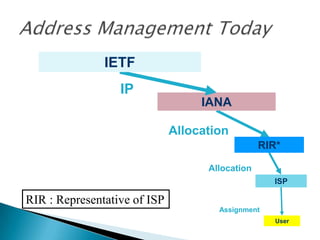
User
Assignment
ISP
Allocation
RIR*
Allocation
IANA
IP
IETF
RIR : Representative of ISP
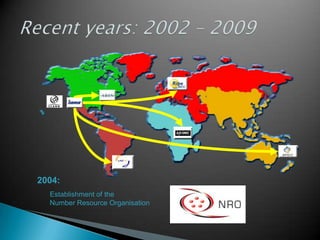
2004:
Establishment of the
Number Resource Organisation
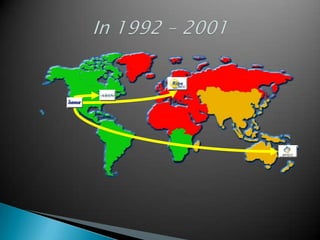
 A regional Internet registry (RIR) is an organization overseeing
the allocation and registration of Internet Number resources
within a particular region of the world. Resources include IP
addresses.
There are currently five RIRs in operation:
 American Registry for Internet Numbers (ARIN) for North
America and parts of the Caribbean
 RIPE Network Coordination Centre (RIPE NCC) for Europe, the
Middle East and Central Asia
 Asia-Pacific Network Information Centre (APNIC) for Asia and
the Pacific region
 Latin American and Caribbean Internet Addresses Registry
(LACNIC) for Latin America and parts of the Caribbean region
 African Network Information Centre (AfriNIC) for Africa
 Address consists of 32 Bits
 Represented in A.B.C.D where A represent
Decimal Value of 8 Bits or 1 Byte
 A range from 0-255.
 Few Examples of Binary conversions
 Binary to Decimal
 Decimal to Binary
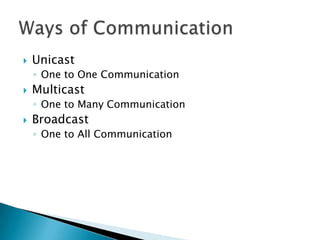
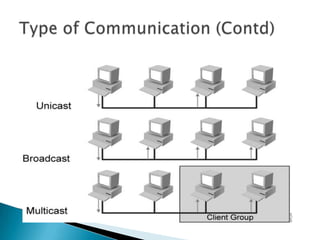
 Unicast
◦ One to One Communication
 Multicast
◦ One to Many Communication
 Broadcast
◦ One to All Communication
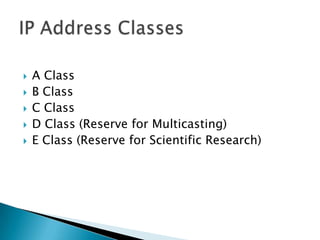
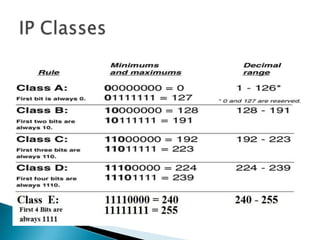
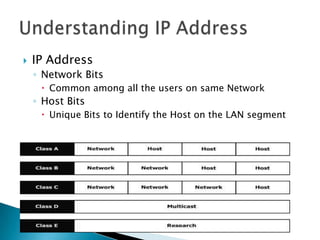
 A Class
 B Class
 C Class
 D Class (Reserve for Multicasting)
 E Class (Reserve for Scientific Research)
 IP Address
◦ Network Bits
 Common among all the users on same Network
◦ Host Bits
 Unique Bits to Identify the Host on the LAN segment
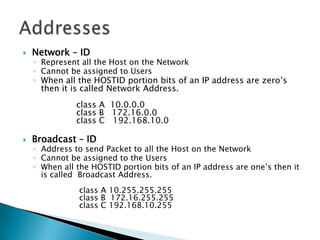
 Network – ID
◦ Represent all the Host on the Network
◦ Cannot be assigned to Users
◦ When all the HOSTID portion bits of an IP address are zero’s
then it is called Network Address.
class A 10.0.0.0
class B 172.16.0.0
class C 192.168.10.0
 Broadcast – ID
◦ Address to send Packet to all the Host on the Network
◦ Cannot be assigned to the Users
◦ When all the HOSTID portion bits of an IP address are one’s then it
is called Broadcast Address.
class A 10.255.255.255
class B 172.16.255.255
class C 192.168.10.255
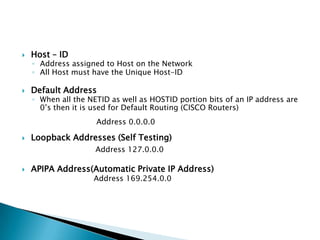
 Host – ID
◦ Address assigned to Host on the Network
◦ All Host must have the Unique Host-ID
 Default Address
◦ When all the NETID as well as HOSTID portion bits of an IP address are
0’s then it is used for Default Routing (CISCO Routers)
Address 0.0.0.0
 Loopback Addresses (Self Testing)
Address 127.0.0.0
 APIPA Address(Automatic Private IP Address)
Address 169.254.0.0
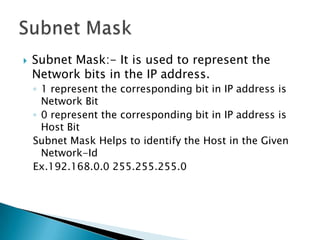
 Subnet Mask:- It is used to represent the
Network bits in the IP address.
◦ 1 represent the corresponding bit in IP address is
Network Bit
◦ 0 represent the corresponding bit in IP address is
Host Bit
Subnet Mask Helps to identify the Host in the Given
Network-Id
Ex.192.168.0.0 255.255.255.0
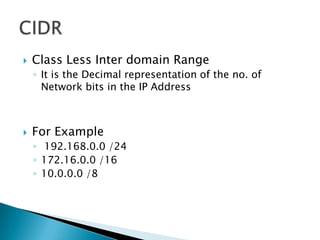
 Class Less Inter domain Range
◦ It is the Decimal representation of the no. of
Network bits in the IP Address
 For Example
◦ 192.168.0.0 /24
◦ 172.16.0.0 /16
◦ 10.0.0.0 /8
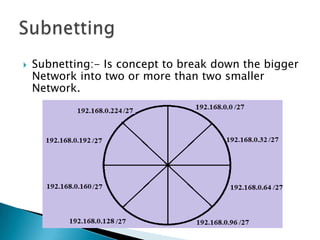
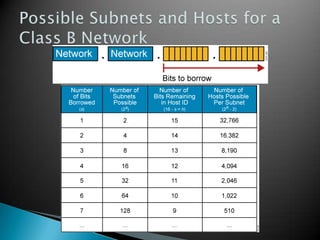
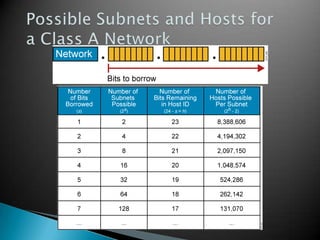
 Subnetting:- Is concept to break down the bigger
Network into two or more than two smaller
Network.
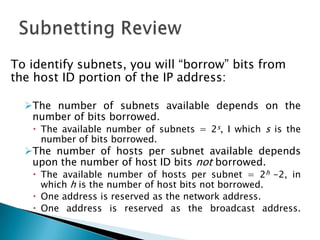
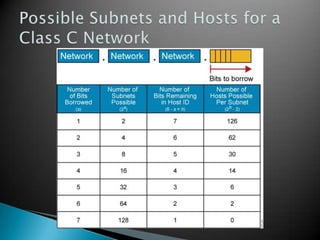
To identify subnets, you will “borrow” bits from
the host ID portion of the IP address:
The number of subnets available depends on the
number of bits borrowed.
 The available number of subnets = 2s, I which s is the
number of bits borrowed.
The number of hosts per subnet available depends
upon the number of host ID bits not borrowed.
 The available number of hosts per subnet = 2h -2, in
which h is the number of host bits not borrowed.
 One address is reserved as the network address.
 One address is reserved as the broadcast address.
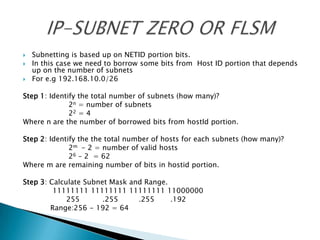
 Subnetting is based up on NETID portion bits.
 In this case we need to borrow some bits from Host ID portion that depends
up on the number of subnets
 For e.g 192.168.10.0/26
Step 1: Identify the total number of subnets (how many)?
2n = number of subnets
22 = 4
Where n are the number of borrowed bits from hostId portion.
Step 2: Identify the the total number of hosts for each subnets (how many)?
2m - 2 = number of valid hosts
26 – 2 = 62
Where m are remaining number of bits in hostid portion.
Step 3: Calculate Subnet Mask and Range.
11111111 11111111 11111111 11000000
255 .255 .255 .192
Range:256 - 192 = 64
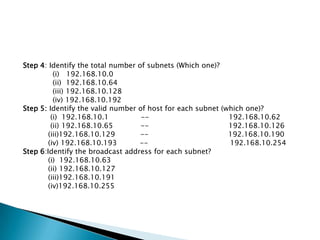
Step 4: Identify the total number of subnets (Which one)?
(i) 192.168.10.0
(ii) 192.168.10.64
(iii) 192.168.10.128
(iv) 192.168.10.192
Step 5: Identify the valid number of host for each subnet (which one)?
(i) 192.168.10.1 -- 192.168.10.62
(ii) 192.168.10.65 -- 192.168.10.126
(iii)192.168.10.129 -- 192.168.10.190
(iv) 192.168.10.193 -- 192.168.10.254
Step 6:Identify the broadcast address for each subnet?
(i) 192.168.10.63
(ii) 192.168.10.127
(iii)192.168.10.191
(iv)192.168.10.255
Subnet a network with a private network
address of 172.16.0.0./16 so that it provides
100 subnets and maximizes the number of host
addresses for each subnet.
◦ How many bits will need to be borrowed?
◦ What is the new subnet mask?
◦ What are the first four subnets?
◦ What are the range of host addresses for the four
subnets?
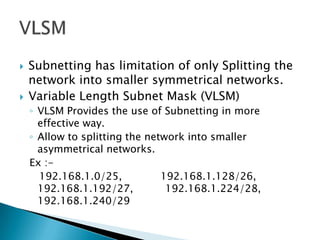
 Subnetting has limitation of only Splitting the
network into smaller symmetrical networks.
 Variable Length Subnet Mask (VLSM)
◦ VLSM Provides the use of Subnetting in more
effective way.
◦ Allow to splitting the network into smaller
asymmetrical networks.
Ex :-
192.168.1.0/25, 192.168.1.128/26,
192.168.1.192/27, 192.168.1.224/28,
192.168.1.240/29
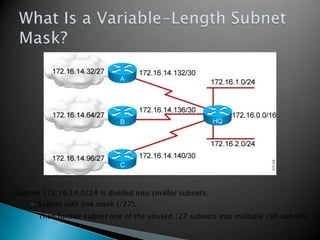
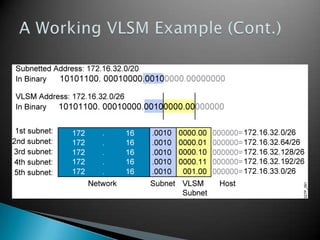
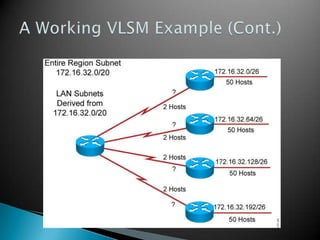
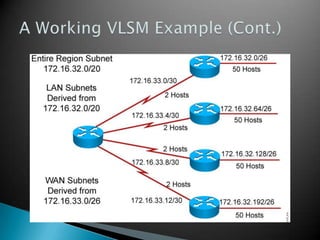
Subnet 172.16.14.0/24 is divided into smaller subnets.
– Subnet with one mask (/27).
– Then further subnet one of the unused /27 subnets into multiple /30 subnets.
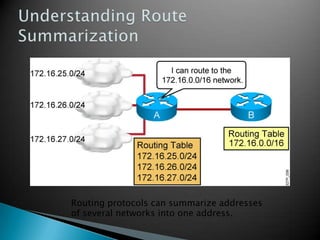
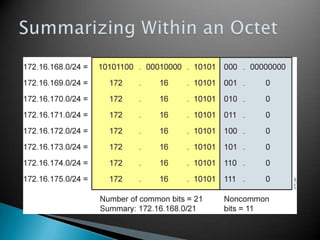
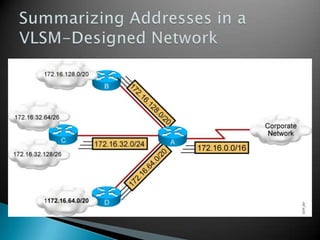
Routing protocols can summarize addresses
of several networks into one address.
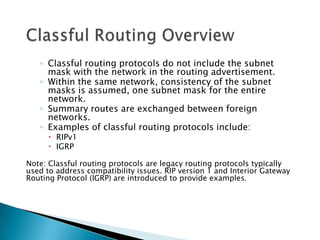
◦ Classful routing protocols do not include the subnet
mask with the network in the routing advertisement.
◦ Within the same network, consistency of the subnet
masks is assumed, one subnet mask for the entire
network.
◦ Summary routes are exchanged between foreign
networks.
◦ Examples of classful routing protocols include:
 RIPv1
 IGRP
Note: Classful routing protocols are legacy routing protocols typically
used to address compatibility issues. RIP version 1 and Interior Gateway
Routing Protocol (IGRP) are introduced to provide examples.
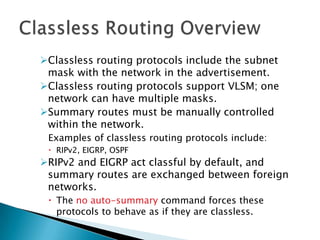
Classless routing protocols include the subnet
mask with the network in the advertisement.
Classless routing protocols support VLSM; one
network can have multiple masks.
Summary routes must be manually controlled
within the network.
Examples of classless routing protocols include:
 RIPv2, EIGRP, OSPF
RIPv2 and EIGRP act classful by default, and
summary routes are exchanged between foreign
networks.
 The no auto-summary command forces these
protocols to behave as if they are classless.
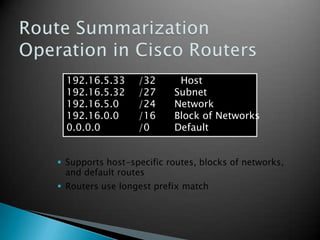
192.16.5.33 /32 Host
192.16.5.32 /27 Subnet
192.16.5.0 /24 Network
192.16.0.0 /16 Block of Networks
0.0.0.0 /0 Default
 Supports host-specific routes, blocks of networks,
and default routes
 Routers use longest prefix match
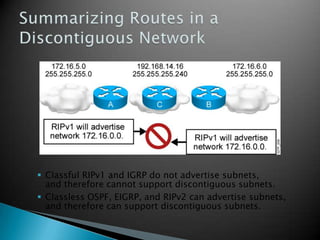
 Classful RIPv1 and IGRP do not advertise subnets,
and therefore cannot support discontiguous subnets.
 Classless OSPF, EIGRP, and RIPv2 can advertise subnets,
and therefore can support discontiguous subnets.
◦ Subnetting lets you efficiently allocate addresses by
taking one large broadcast domain and breaking it
up into smaller more manageable broadcast
domains.
◦ VLSMs let you more efficiently allocate IP addresses
by adding multiple layers of the addressing
hierarchy.
◦ The benefits of route summarization include
smaller routing tables and the ability to isolate
topology changes.
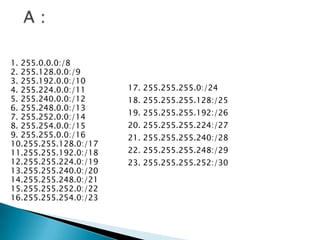
1. 255.0.0.0:/8
2. 255.128.0.0:/9
3. 255.192.0.0:/10
4. 255.224.0.0:/11
5. 255.240.0.0:/12
6. 255.248.0.0:/13
7. 255.252.0.0:/14
8. 255.254.0.0:/15
9. 255.255.0.0:/16
10.255.255.128.0:/17
11.255.255.192.0:/18
12.255.255.224.0:/19
13.255.255.240.0:/20
14.255.255.248.0:/21
15.255.255.252.0:/22
16.255.255.254.0:/23
17. 255.255.255.0:/24
18. 255.255.255.128:/25
19. 255.255.255.192:/26
20. 255.255.255.224:/27
21. 255.255.255.240:/28
22. 255.255.255.248:/29
23. 255.255.255.252:/30
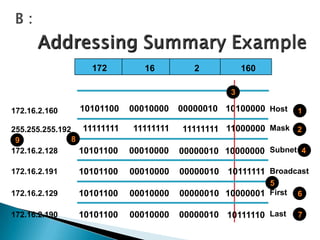
10101100
11111111
10101100
00010000
11111111
00010000
11111111
00000010
10100000
11000000
10000000
00000010
10101100 00010000 00000010 10111111
10101100 00010000 00000010 10000001
10101100 00010000 00000010 10111110
Host
Mask
Subnet
Broadcast
Last
First
172.16.2.160
255.255.255.192
172.16.2.128
172.16.2.191
172.16.2.129
172.16.2.190
1
2
3
4
5
6
7
89
16172 2 160
B:

Ip addressing

  • 2.
    An Internet Protocol(IP) address is a number that identifies a device on a computer network.
  • 3.
  • 4.
  • 6.
    2004: Establishment of the NumberResource Organisation
  • 7.
     A regionalInternet registry (RIR) is an organization overseeing the allocation and registration of Internet Number resources within a particular region of the world. Resources include IP addresses. There are currently five RIRs in operation:  American Registry for Internet Numbers (ARIN) for North America and parts of the Caribbean  RIPE Network Coordination Centre (RIPE NCC) for Europe, the Middle East and Central Asia  Asia-Pacific Network Information Centre (APNIC) for Asia and the Pacific region  Latin American and Caribbean Internet Addresses Registry (LACNIC) for Latin America and parts of the Caribbean region  African Network Information Centre (AfriNIC) for Africa
  • 8.
     Address consistsof 32 Bits  Represented in A.B.C.D where A represent Decimal Value of 8 Bits or 1 Byte  A range from 0-255.
  • 9.
     Few Examplesof Binary conversions  Binary to Decimal  Decimal to Binary
  • 10.
     Unicast ◦ Oneto One Communication  Multicast ◦ One to Many Communication  Broadcast ◦ One to All Communication
  • 12.
     A Class B Class  C Class  D Class (Reserve for Multicasting)  E Class (Reserve for Scientific Research)
  • 14.
     IP Address ◦Network Bits  Common among all the users on same Network ◦ Host Bits  Unique Bits to Identify the Host on the LAN segment
  • 15.
     Network –ID ◦ Represent all the Host on the Network ◦ Cannot be assigned to Users ◦ When all the HOSTID portion bits of an IP address are zero’s then it is called Network Address. class A 10.0.0.0 class B 172.16.0.0 class C 192.168.10.0  Broadcast – ID ◦ Address to send Packet to all the Host on the Network ◦ Cannot be assigned to the Users ◦ When all the HOSTID portion bits of an IP address are one’s then it is called Broadcast Address. class A 10.255.255.255 class B 172.16.255.255 class C 192.168.10.255
  • 16.
     Host –ID ◦ Address assigned to Host on the Network ◦ All Host must have the Unique Host-ID  Default Address ◦ When all the NETID as well as HOSTID portion bits of an IP address are 0’s then it is used for Default Routing (CISCO Routers) Address 0.0.0.0  Loopback Addresses (Self Testing) Address 127.0.0.0  APIPA Address(Automatic Private IP Address) Address 169.254.0.0
  • 17.
     Subnet Mask:-It is used to represent the Network bits in the IP address. ◦ 1 represent the corresponding bit in IP address is Network Bit ◦ 0 represent the corresponding bit in IP address is Host Bit Subnet Mask Helps to identify the Host in the Given Network-Id Ex.192.168.0.0 255.255.255.0
  • 18.
     Class LessInter domain Range ◦ It is the Decimal representation of the no. of Network bits in the IP Address  For Example ◦ 192.168.0.0 /24 ◦ 172.16.0.0 /16 ◦ 10.0.0.0 /8
  • 19.
     Subnetting:- Isconcept to break down the bigger Network into two or more than two smaller Network.
  • 20.
    To identify subnets,you will “borrow” bits from the host ID portion of the IP address: The number of subnets available depends on the number of bits borrowed.  The available number of subnets = 2s, I which s is the number of bits borrowed. The number of hosts per subnet available depends upon the number of host ID bits not borrowed.  The available number of hosts per subnet = 2h -2, in which h is the number of host bits not borrowed.  One address is reserved as the network address.  One address is reserved as the broadcast address.
  • 24.
     Subnetting isbased up on NETID portion bits.  In this case we need to borrow some bits from Host ID portion that depends up on the number of subnets  For e.g 192.168.10.0/26 Step 1: Identify the total number of subnets (how many)? 2n = number of subnets 22 = 4 Where n are the number of borrowed bits from hostId portion. Step 2: Identify the the total number of hosts for each subnets (how many)? 2m - 2 = number of valid hosts 26 – 2 = 62 Where m are remaining number of bits in hostid portion. Step 3: Calculate Subnet Mask and Range. 11111111 11111111 11111111 11000000 255 .255 .255 .192 Range:256 - 192 = 64
  • 25.
    Step 4: Identifythe total number of subnets (Which one)? (i) 192.168.10.0 (ii) 192.168.10.64 (iii) 192.168.10.128 (iv) 192.168.10.192 Step 5: Identify the valid number of host for each subnet (which one)? (i) 192.168.10.1 -- 192.168.10.62 (ii) 192.168.10.65 -- 192.168.10.126 (iii)192.168.10.129 -- 192.168.10.190 (iv) 192.168.10.193 -- 192.168.10.254 Step 6:Identify the broadcast address for each subnet? (i) 192.168.10.63 (ii) 192.168.10.127 (iii)192.168.10.191 (iv)192.168.10.255
  • 26.
    Subnet a networkwith a private network address of 172.16.0.0./16 so that it provides 100 subnets and maximizes the number of host addresses for each subnet. ◦ How many bits will need to be borrowed? ◦ What is the new subnet mask? ◦ What are the first four subnets? ◦ What are the range of host addresses for the four subnets?
  • 27.
     Subnetting haslimitation of only Splitting the network into smaller symmetrical networks.  Variable Length Subnet Mask (VLSM) ◦ VLSM Provides the use of Subnetting in more effective way. ◦ Allow to splitting the network into smaller asymmetrical networks. Ex :- 192.168.1.0/25, 192.168.1.128/26, 192.168.1.192/27, 192.168.1.224/28, 192.168.1.240/29
  • 28.
    Subnet 172.16.14.0/24 isdivided into smaller subnets. – Subnet with one mask (/27). – Then further subnet one of the unused /27 subnets into multiple /30 subnets.
  • 33.
    Routing protocols cansummarize addresses of several networks into one address.
  • 34.
    ◦ Classful routingprotocols do not include the subnet mask with the network in the routing advertisement. ◦ Within the same network, consistency of the subnet masks is assumed, one subnet mask for the entire network. ◦ Summary routes are exchanged between foreign networks. ◦ Examples of classful routing protocols include:  RIPv1  IGRP Note: Classful routing protocols are legacy routing protocols typically used to address compatibility issues. RIP version 1 and Interior Gateway Routing Protocol (IGRP) are introduced to provide examples.
  • 35.
    Classless routing protocolsinclude the subnet mask with the network in the advertisement. Classless routing protocols support VLSM; one network can have multiple masks. Summary routes must be manually controlled within the network. Examples of classless routing protocols include:  RIPv2, EIGRP, OSPF RIPv2 and EIGRP act classful by default, and summary routes are exchanged between foreign networks.  The no auto-summary command forces these protocols to behave as if they are classless.
  • 38.
    192.16.5.33 /32 Host 192.16.5.32/27 Subnet 192.16.5.0 /24 Network 192.16.0.0 /16 Block of Networks 0.0.0.0 /0 Default  Supports host-specific routes, blocks of networks, and default routes  Routers use longest prefix match
  • 39.
     Classful RIPv1and IGRP do not advertise subnets, and therefore cannot support discontiguous subnets.  Classless OSPF, EIGRP, and RIPv2 can advertise subnets, and therefore can support discontiguous subnets.
  • 40.
    ◦ Subnetting letsyou efficiently allocate addresses by taking one large broadcast domain and breaking it up into smaller more manageable broadcast domains. ◦ VLSMs let you more efficiently allocate IP addresses by adding multiple layers of the addressing hierarchy. ◦ The benefits of route summarization include smaller routing tables and the ability to isolate topology changes.
  • 41.
    1. 255.0.0.0:/8 2. 255.128.0.0:/9 3.255.192.0.0:/10 4. 255.224.0.0:/11 5. 255.240.0.0:/12 6. 255.248.0.0:/13 7. 255.252.0.0:/14 8. 255.254.0.0:/15 9. 255.255.0.0:/16 10.255.255.128.0:/17 11.255.255.192.0:/18 12.255.255.224.0:/19 13.255.255.240.0:/20 14.255.255.248.0:/21 15.255.255.252.0:/22 16.255.255.254.0:/23 17. 255.255.255.0:/24 18. 255.255.255.128:/25 19. 255.255.255.192:/26 20. 255.255.255.224:/27 21. 255.255.255.240:/28 22. 255.255.255.248:/29 23. 255.255.255.252:/30
  • 42.
    10101100 11111111 10101100 00010000 11111111 00010000 11111111 00000010 10100000 11000000 10000000 00000010 10101100 00010000 0000001010111111 10101100 00010000 00000010 10000001 10101100 00010000 00000010 10111110 Host Mask Subnet Broadcast Last First 172.16.2.160 255.255.255.192 172.16.2.128 172.16.2.191 172.16.2.129 172.16.2.190 1 2 3 4 5 6 7 89 16172 2 160 B: