• Businesses, mostgovernment agencies, and
many individuals now have Web sites.
• The reality is that the Internet and the Web
are extremely vulnerable to compromises of
various sorts.
3.
Web Security Considerations
•The World Wide Web is fundamentally a
client/server application running over the
Internet and TCP/IP intranets
4.
Following characteristics ofWeb usage suggest the
need for modifying security tools:
• Web browsers are very easy to use
• Web servers are relatively easy to configure
and manage, and
• Web content is increasingly easy to develop
• the underlying software is extraordinarily
complex. This complex software may hide
many potential security flaws.
• vulnerable to a variety of security attacks.
5.
• A Webserver can be exploited as a launching
pad into the corporation’s or agency’s entire
computer complex.
• Once the Web server is destabalised, an
attacker may be able to gain access to data
and systems not part of the Web itself but
connected to the server at the local site.
6.
• Casual anduntrained (in security matters)
users are common clients for Webbased
services. Such users are not necessarily aware
of the security risks that exist and do not have
the tools or knowledge to take effective
countermeasures.
7.
Web Security Threats
passiveand active attacks
• Passive attacks include eavesdropping on
network traffic between browser and server
and gaining access to information on a Web site
that is supposed to be restricted.
• Active attacks include impersonating another
user, altering messages in transit between client
and server, and altering information on a Web
site.
9.
Another way toclassify Web security threats is
in terms of the location of the threat:
• Web server, Web browser, and network traffic
between browser and server.
11.
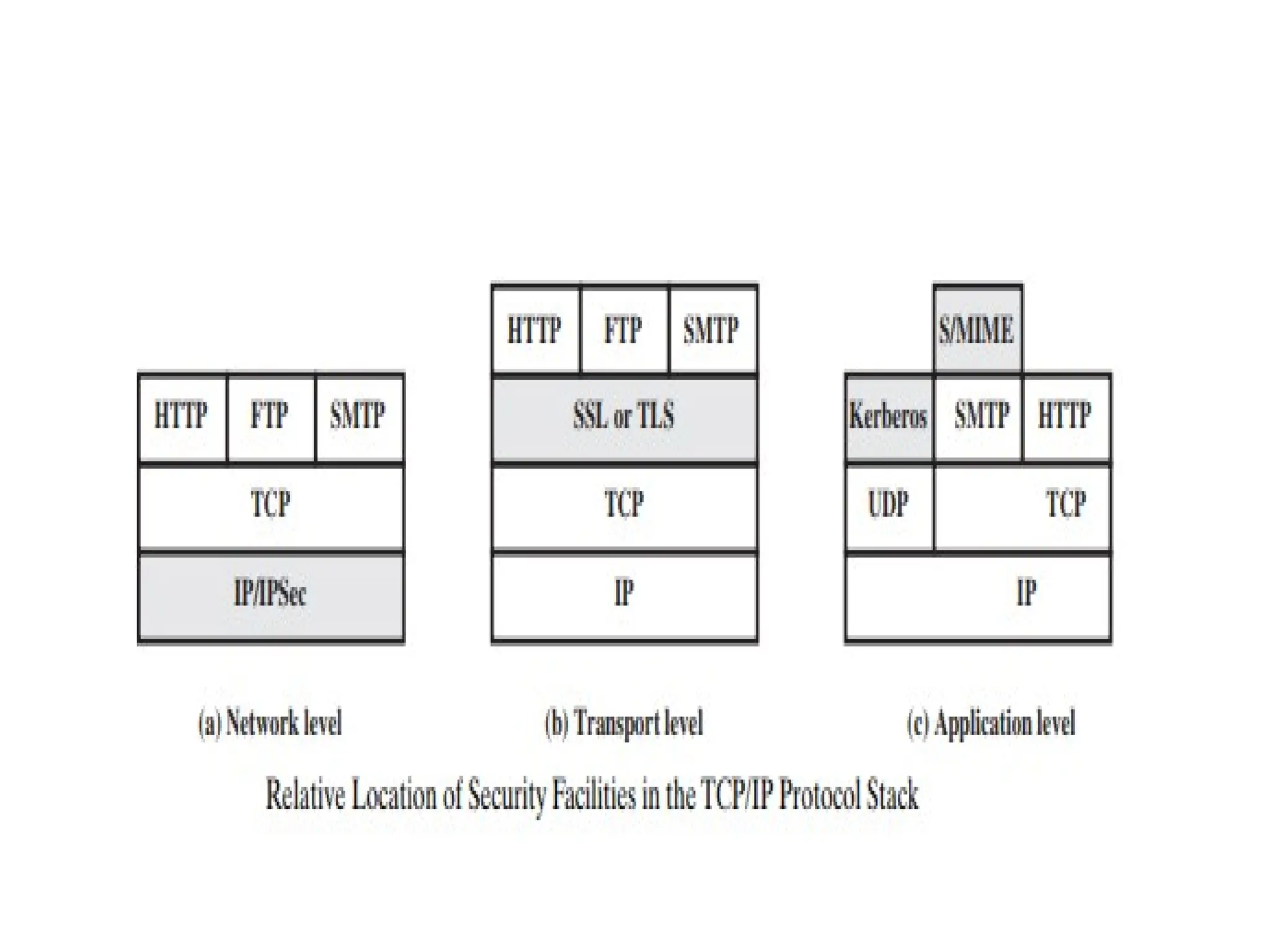
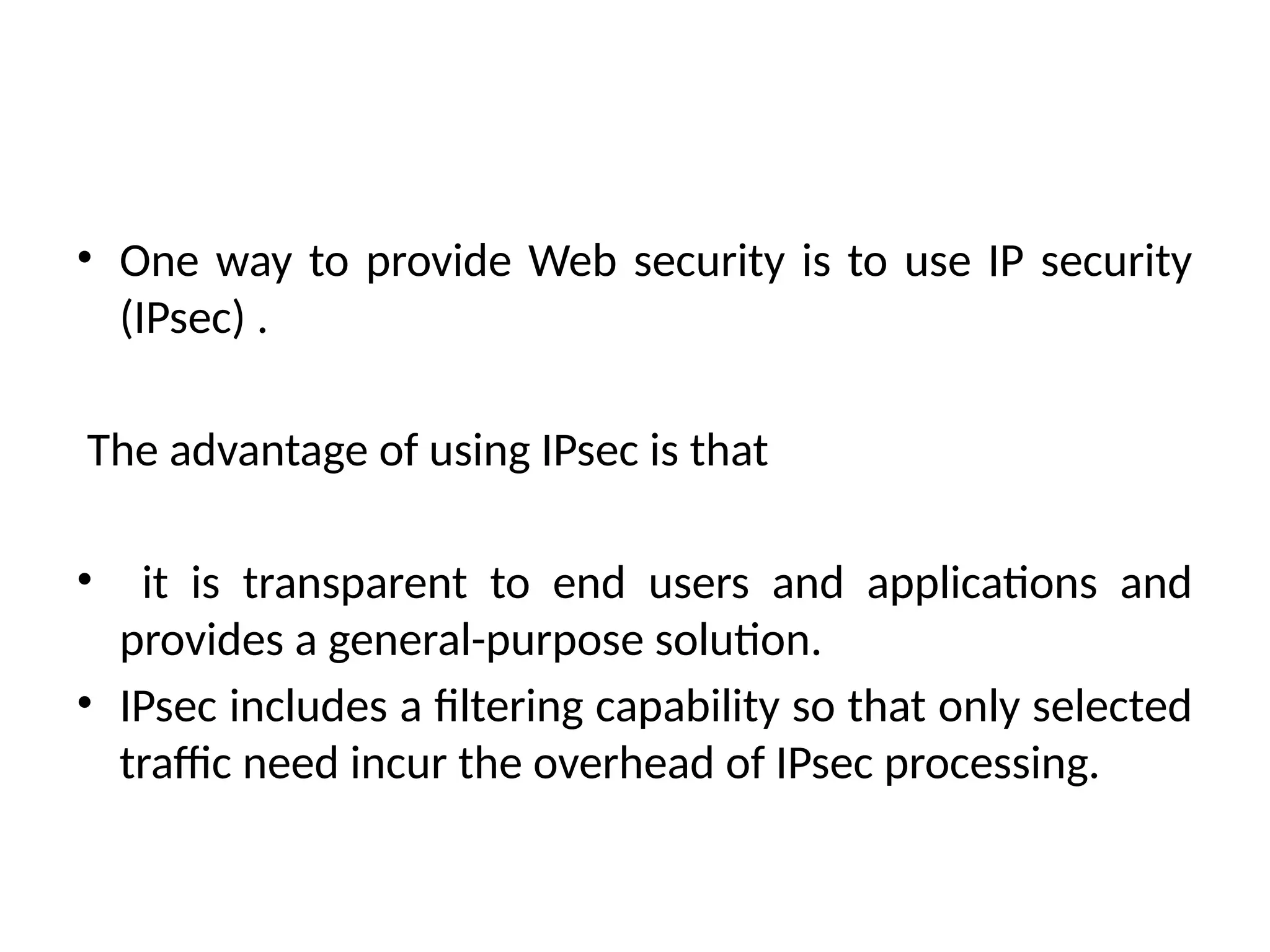
• One wayto provide Web security is to use IP security
(IPsec) .
The advantage of using IPsec is that
• it is transparent to end users and applications and
provides a general-purpose solution.
• IPsec includes a filtering capability so that only selected
traffic need incur the overhead of IPsec processing.
12.
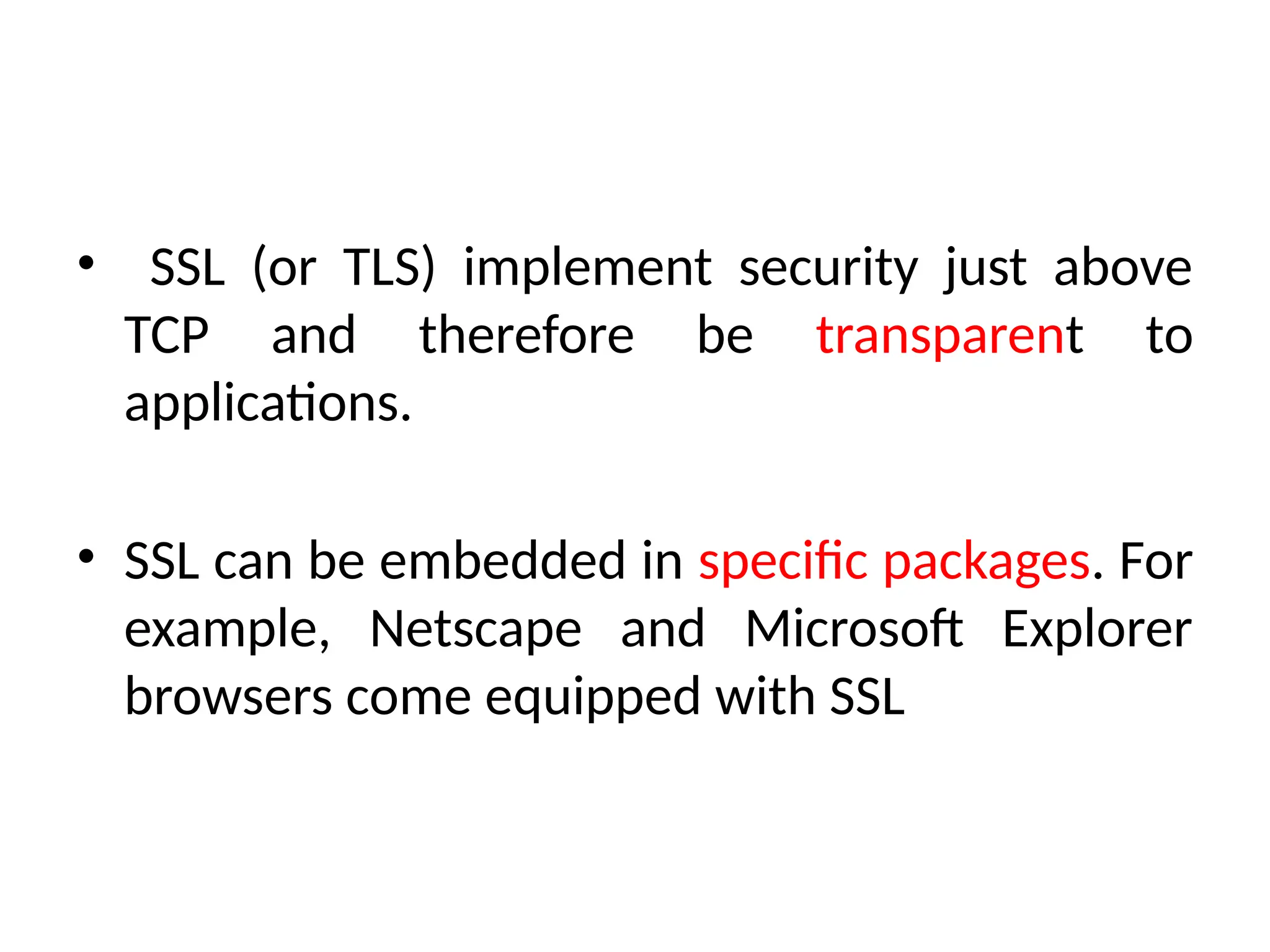
• SSL (orTLS) implement security just above
TCP and therefore be transparent to
applications.
• SSL can be embedded in specific packages. For
example, Netscape and Microsoft Explorer
browsers come equipped with SSL
13.
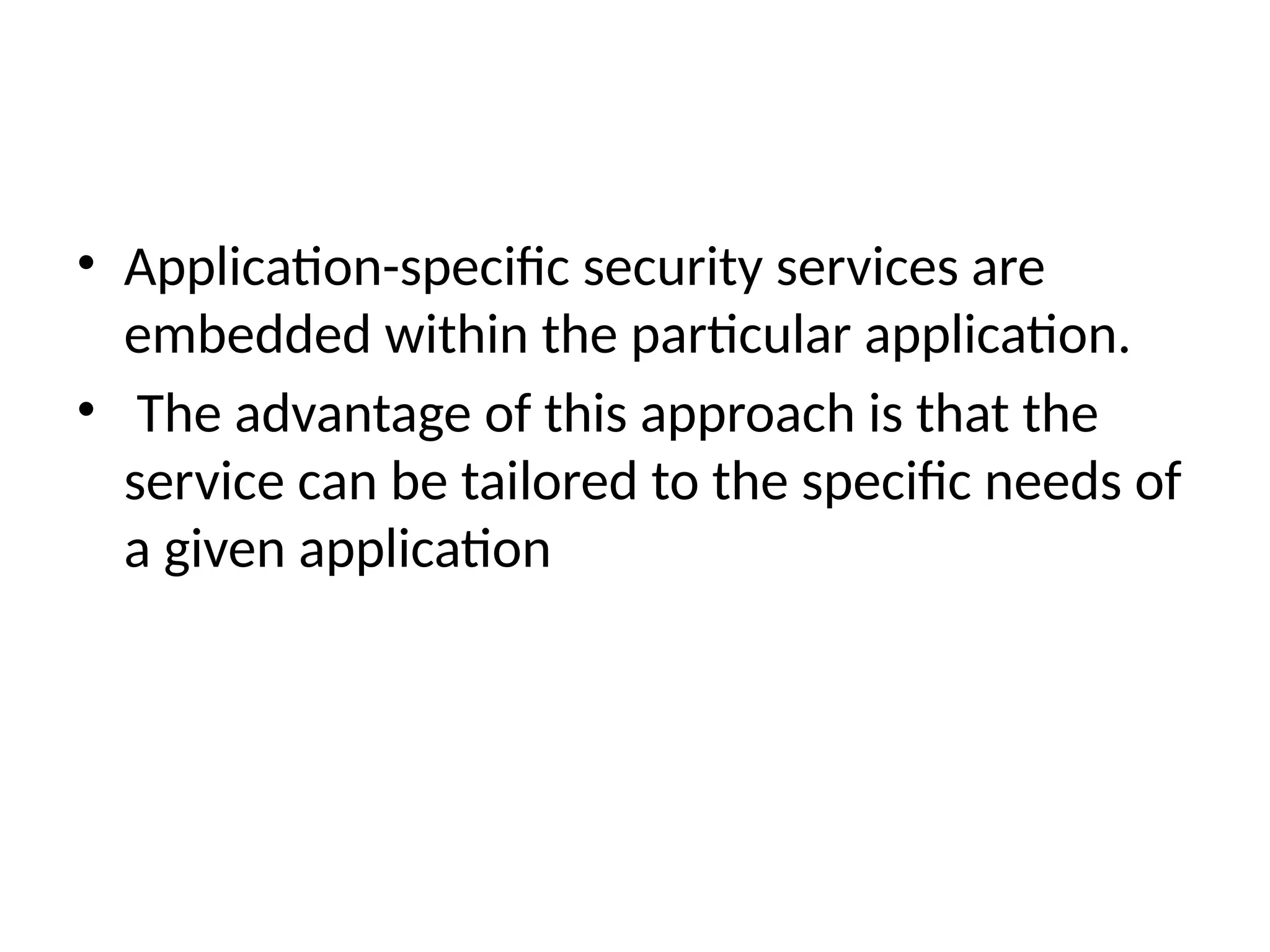
• Application-specific securityservices are
embedded within the particular application.
• The advantage of this approach is that the
service can be tailored to the specific needs of
a given application
14.
Secure Socket Layer(SSL)Architecture
• SSL is designed to make use of TCP to provide
a reliable end-to-end secure service.
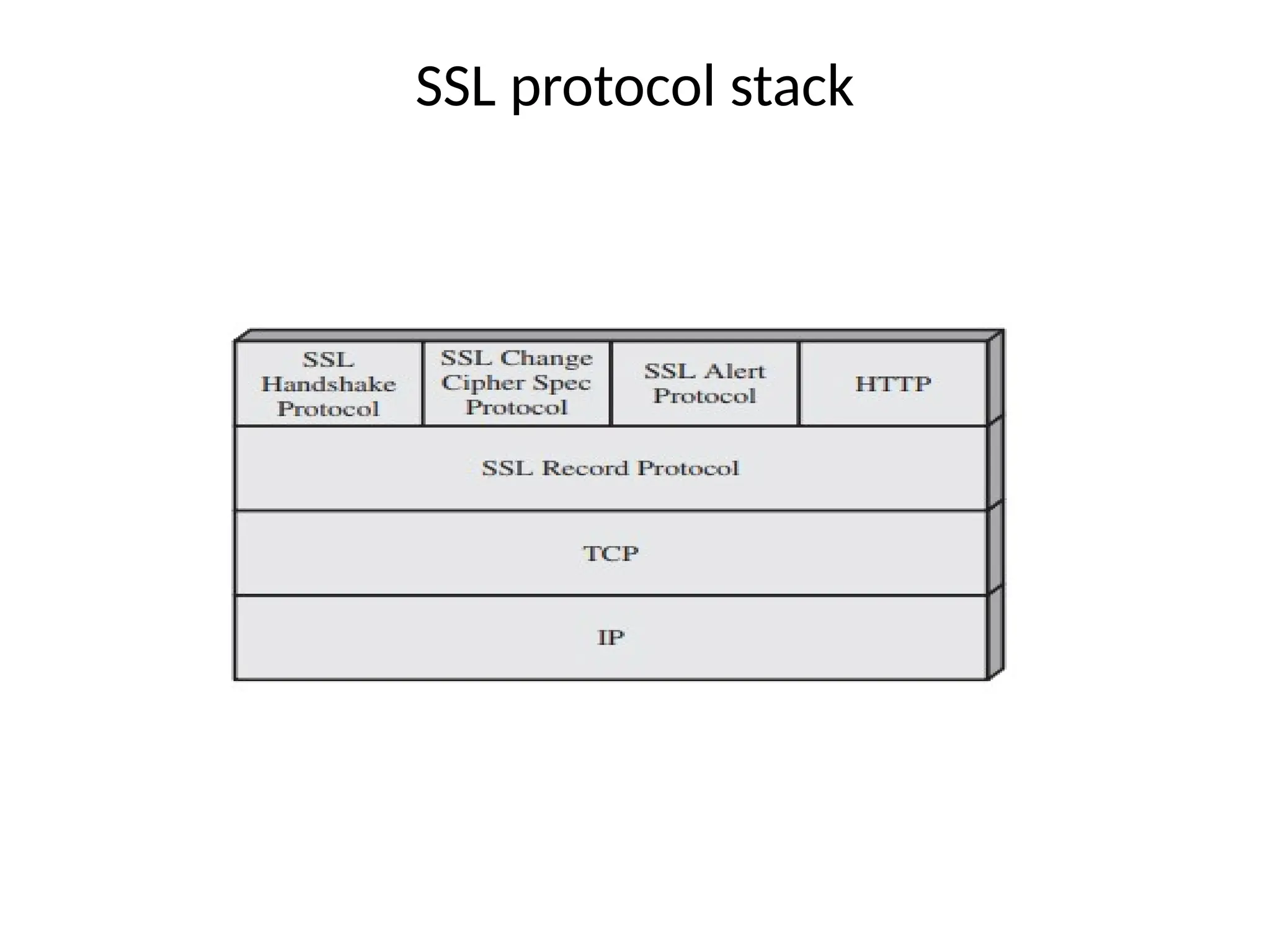
• SSL is not a single protocol but rather two
layers of protocols.
• The SSL Record Protocol provides security
services to various higher layer protocols. In
particular, the Hypertext Transfer Protocol
(HTTP), operate on top of SSL
Two important SSLconcepts are the
SSL session and
SSL connection
• connections -are peer-to-peer relationships.
The connections are transient(last for short
time).
• Every connection is associated with one
session.
17.
• Session: AnSSL session is an association
between a client and a server.
• Sessions are created by the Handshake
Protocol
• define a set of cryptographic parameters
which can be shared among multiple
connections .
18.
There are anumber of states associated with each session
• Session identifier: An arbitrary byte sequence chosen by the server to
identify an active or resumable session state.
• Peer certificate: An X509.v3 certificate of the peer. This element of the state
may be null. (digital certificate to verify that public key belongs to user).
• Compression method: The algorithm used to compress data prior to
encryption.
• Cipher spec: Specifies the bulk data encryption algorithm (such as null, AES,
etc.) and a hash algorithm (such as MD5 or SHA-1) used for MAC
calculation. It also defines cryptographic attributes such as the hash_size.
• Master secret: 48-byte secret shared between the client and the server.
• Is resumable: A flag indicating whether the session can be used to initiate
new connections.
19.
A connection stateis defined by the following
parameters
• Server and client random: Byte sequences that are
chosen by the server and client for each connection.
• Server write MAC secret: The secret key used in MAC
operations on data sent by the server.
• Client write MAC secret: The secret key used in MAC
operations on data sent by the client.
• Server write key: The secret encryption key for data
encrypted by the server and decrypted by the client.
20.
• Client writekey: The symmetric encryption key for data encrypted
by the client and decrypted by the server.
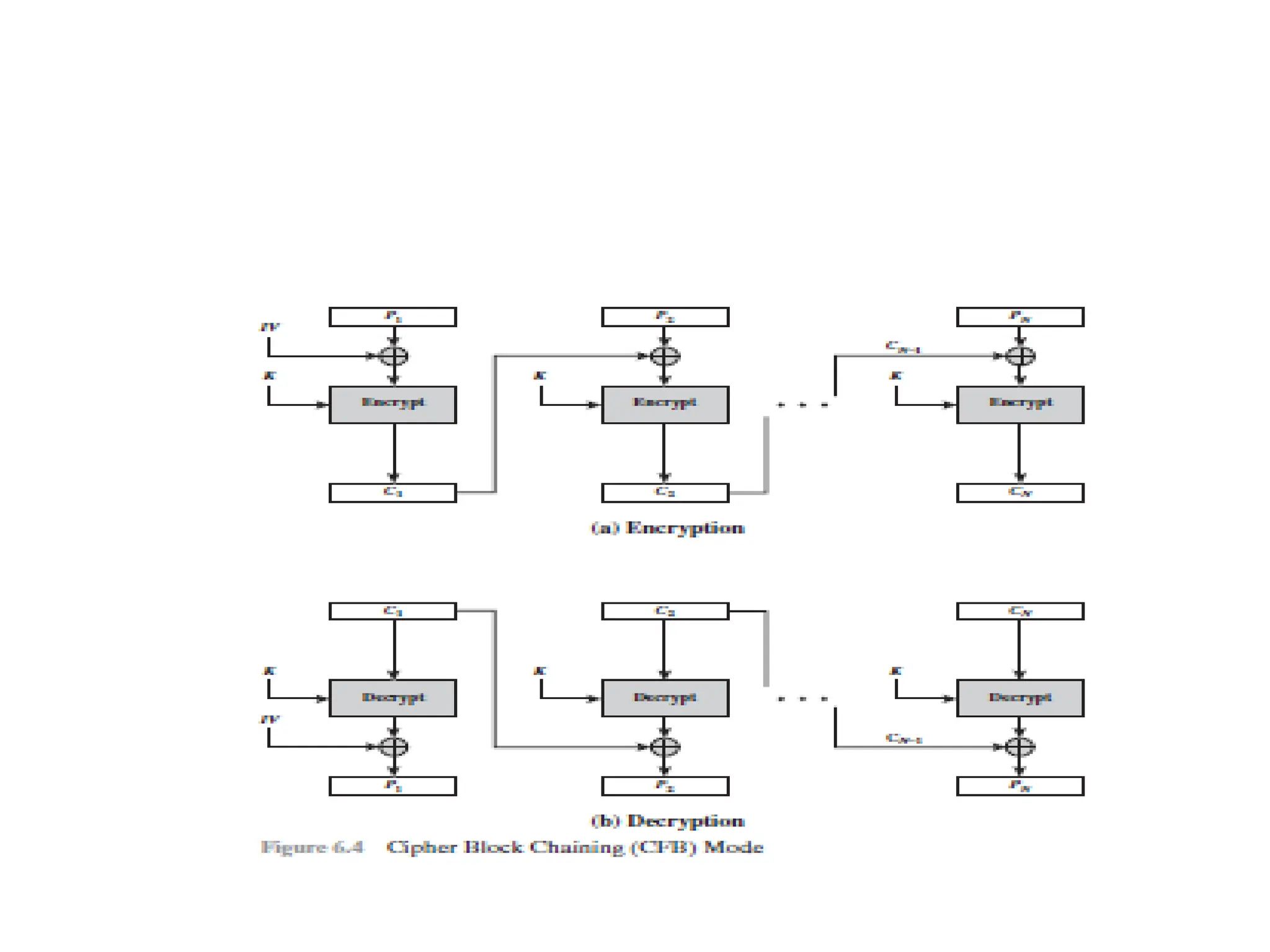
• Initialization vectors: When a block cipher in CBC mode is used, an
initialization vector (IV) is maintained for each key. This field is
first initialized by the SSL Handshake Protocol. Thereafter, the final
ciphertext block from each record is preserved for use as the IV
with the following record.
• Sequence numbers: Each party maintains separate sequence
numbers for transmitted and received messages for each
connection. Sequence numbers may not exceed 264 - 1.
22.
SSL Record Protocol
TheSSL Record Protocol provides two services
for SSL connections:
• Confidentiality: The Handshake Protocol
defines a shared secret key that is used for
conventional encryption of SSL payloads.
• Message Integrity: The Handshake Protocol
also defines a shared secret key that is used to
form a message authentication code (MAC)
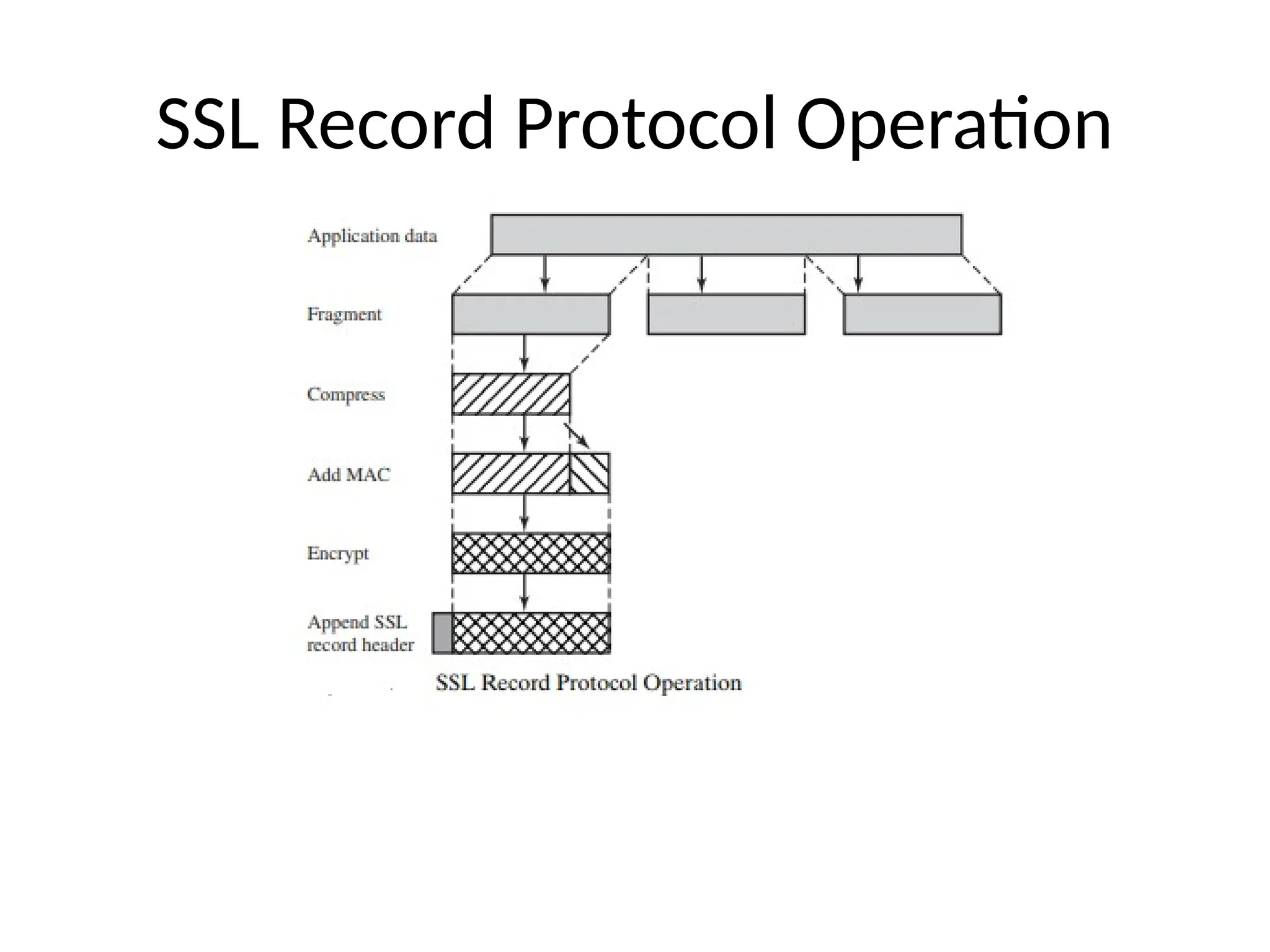
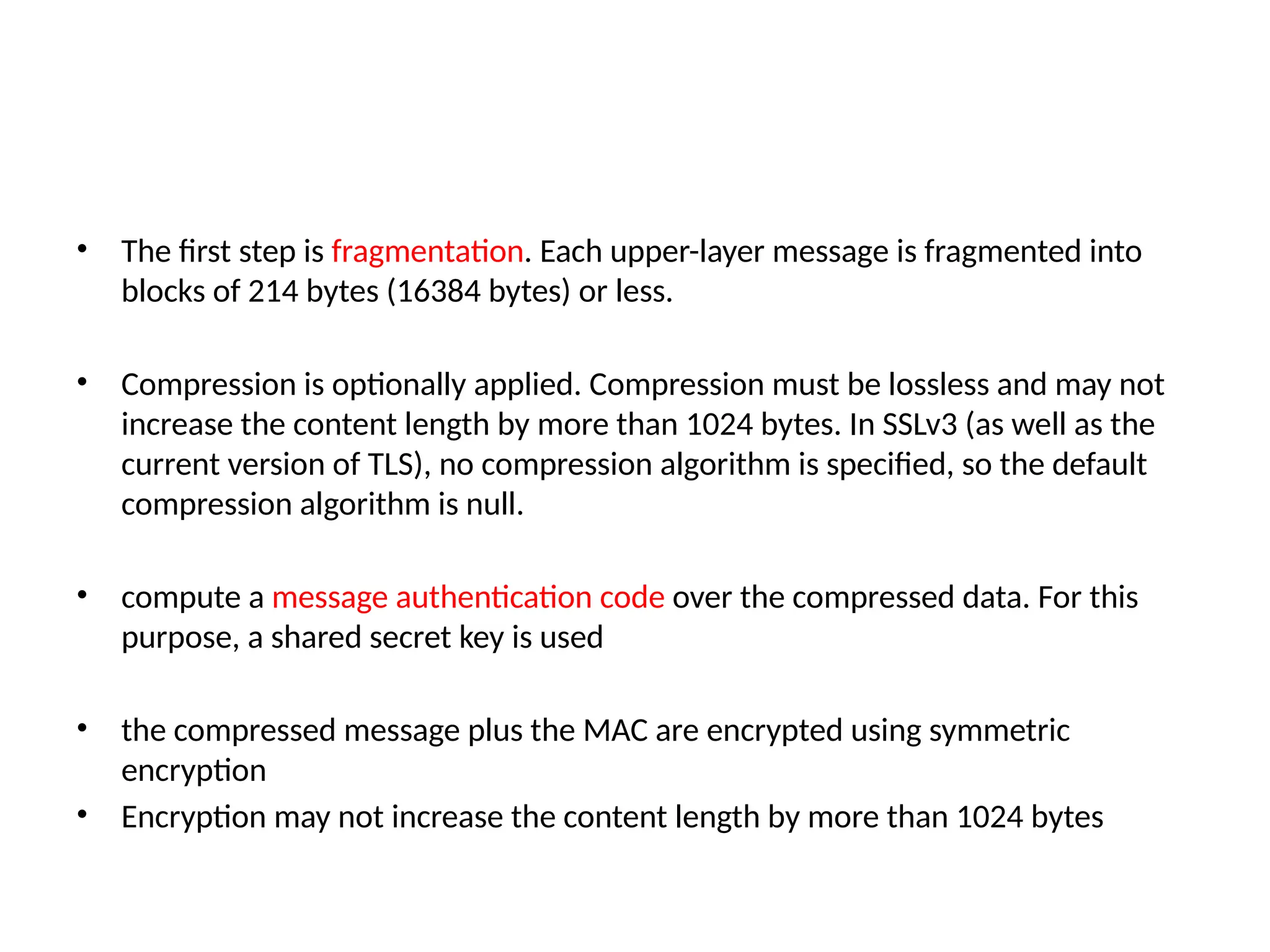
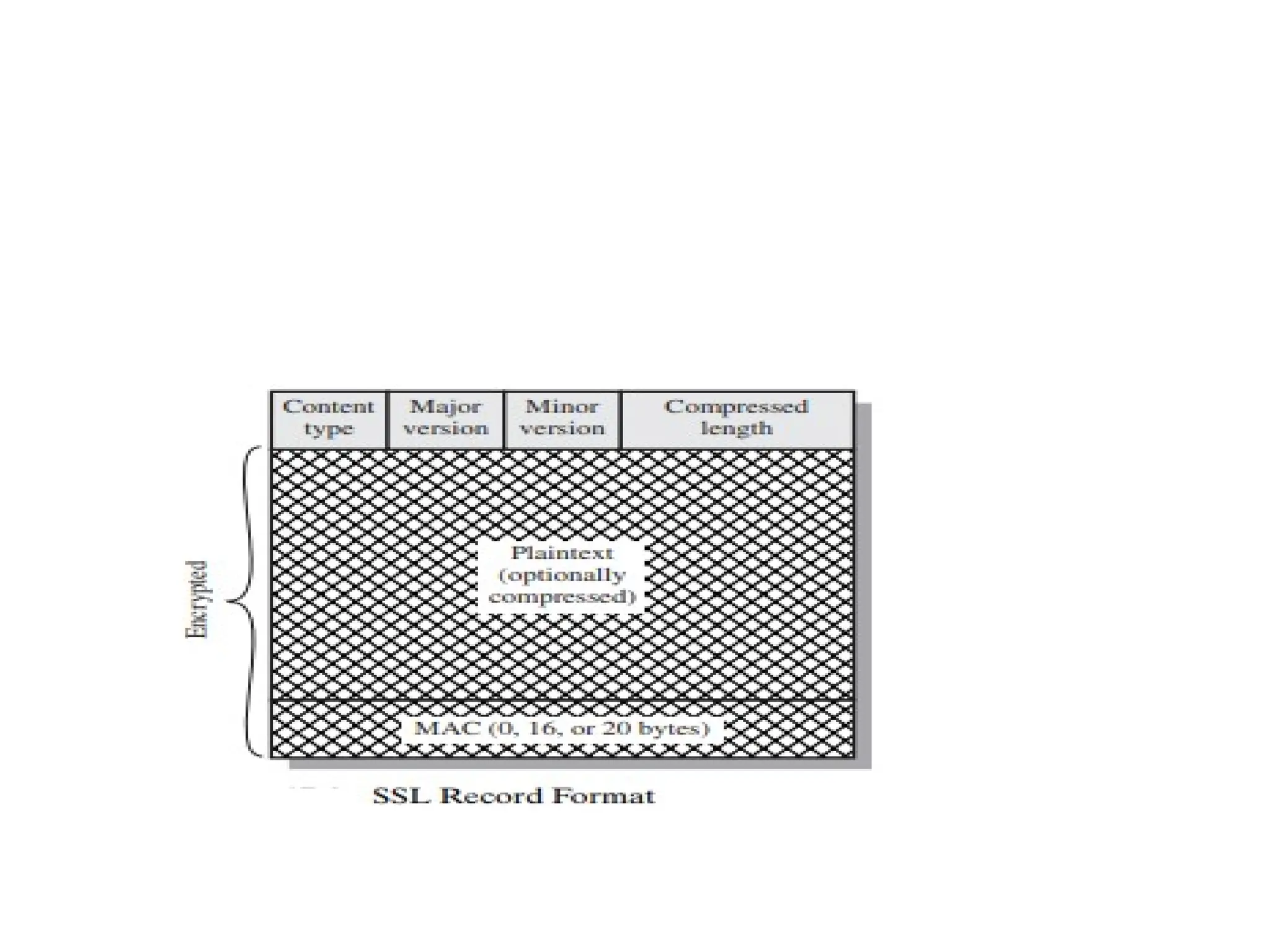
• The firststep is fragmentation. Each upper-layer message is fragmented into
blocks of 214 bytes (16384 bytes) or less.
• Compression is optionally applied. Compression must be lossless and may not
increase the content length by more than 1024 bytes. In SSLv3 (as well as the
current version of TLS), no compression algorithm is specified, so the default
compression algorithm is null.
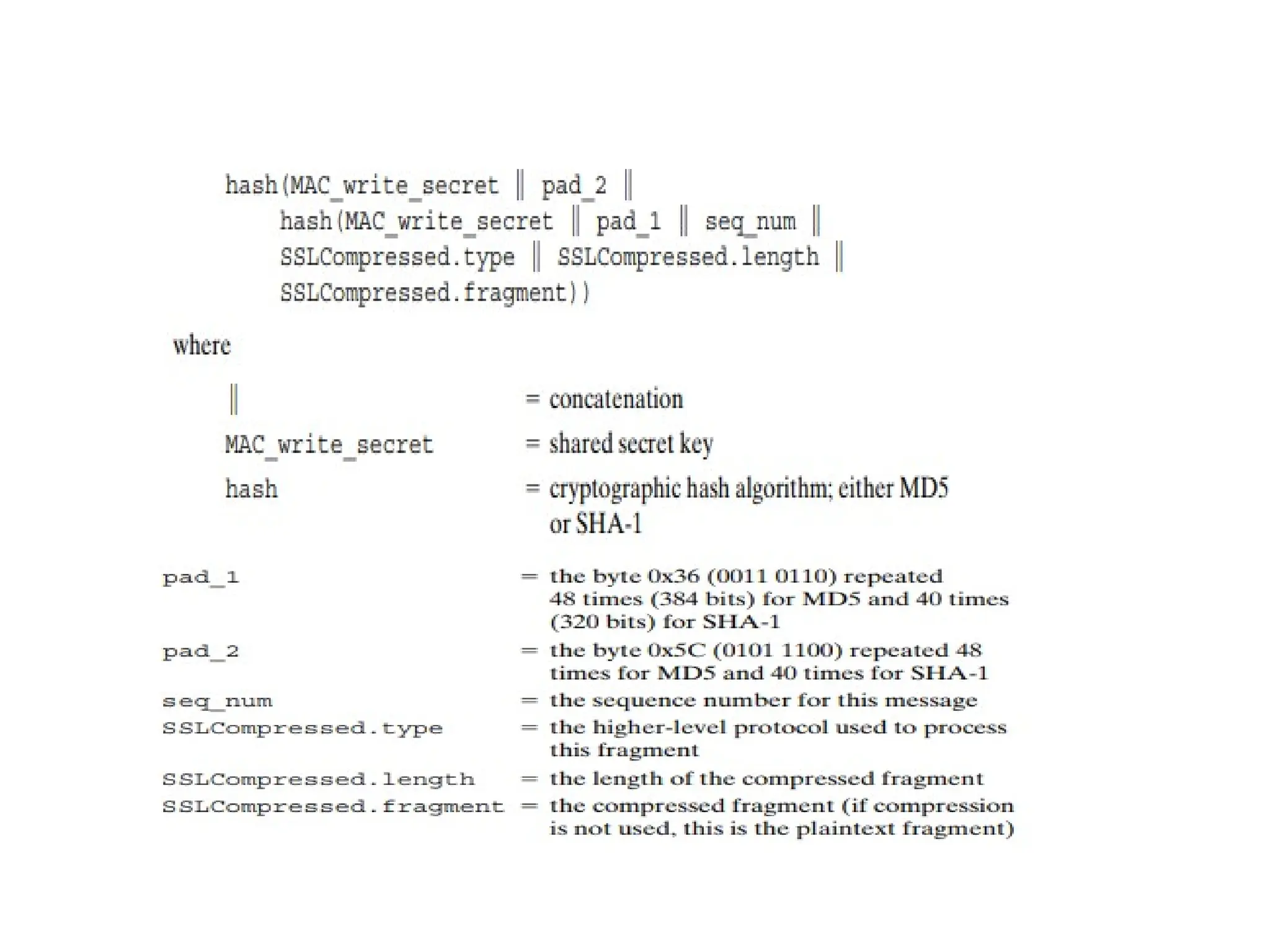
• compute a message authentication code over the compressed data. For this
purpose, a shared secret key is used
• the compressed message plus the MAC are encrypted using symmetric
encryption
• Encryption may not increase the content length by more than 1024 bytes
• For streamencryption, the compressed
message plus the MAC are encrypted. Note
that the MAC is computed before encryption
takes place and that the MAC is then
encrypted along with the plaintext or
compressed plaintext
28.
• For blockencryption, padding may be added
after the MAC prior to encryption.
• An example is a plaintext (or compressed text if
compression is used) of 58 bytes, with a MAC
of 20 bytes (using SHA-1), that is encrypted
using a block length of 8 bytes (e.g., DES). With
the padding-length byte, this yields a total of
79 bytes. To make the total an integer multiple
of 8, one byte of padding is added
29.
The final stepof SSL Record Protocol processing is to prepare a header consisting
of the following fields:
• Content Type (8 bits): The higher-layer protocol used to process the enclosed
fragment. (The content types that have been defined are change_cipher_spec,
alert, handshake, and application_data)
• Major Version (8 bits): Indicates major version of SSL in use. For SSLv3, the value
is 3.
• Minor Version (8 bits): Indicates minor version in use. For SSLv3, the value is 0.
• Compressed Length (16 bits): The length in bytes of the plaintext fragment (or
compressed fragment if compression is used). The maximum value is 214 + 2048.
31.
Change Cipher SpecProtocol
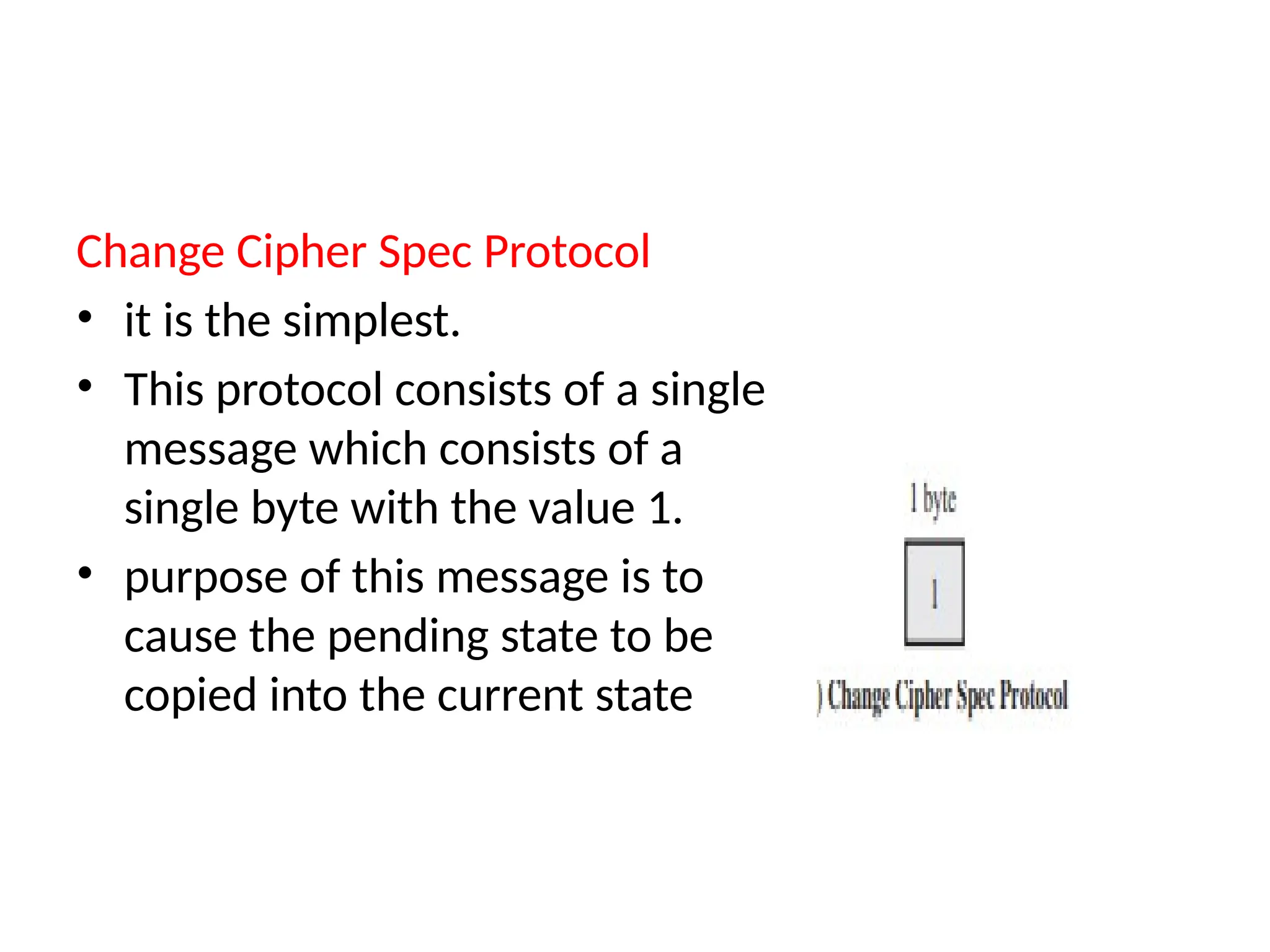
• it is the simplest.
• This protocol consists of a single
message which consists of a
single byte with the value 1.
• purpose of this message is to
cause the pending state to be
copied into the current state
32.
Alert Protocol
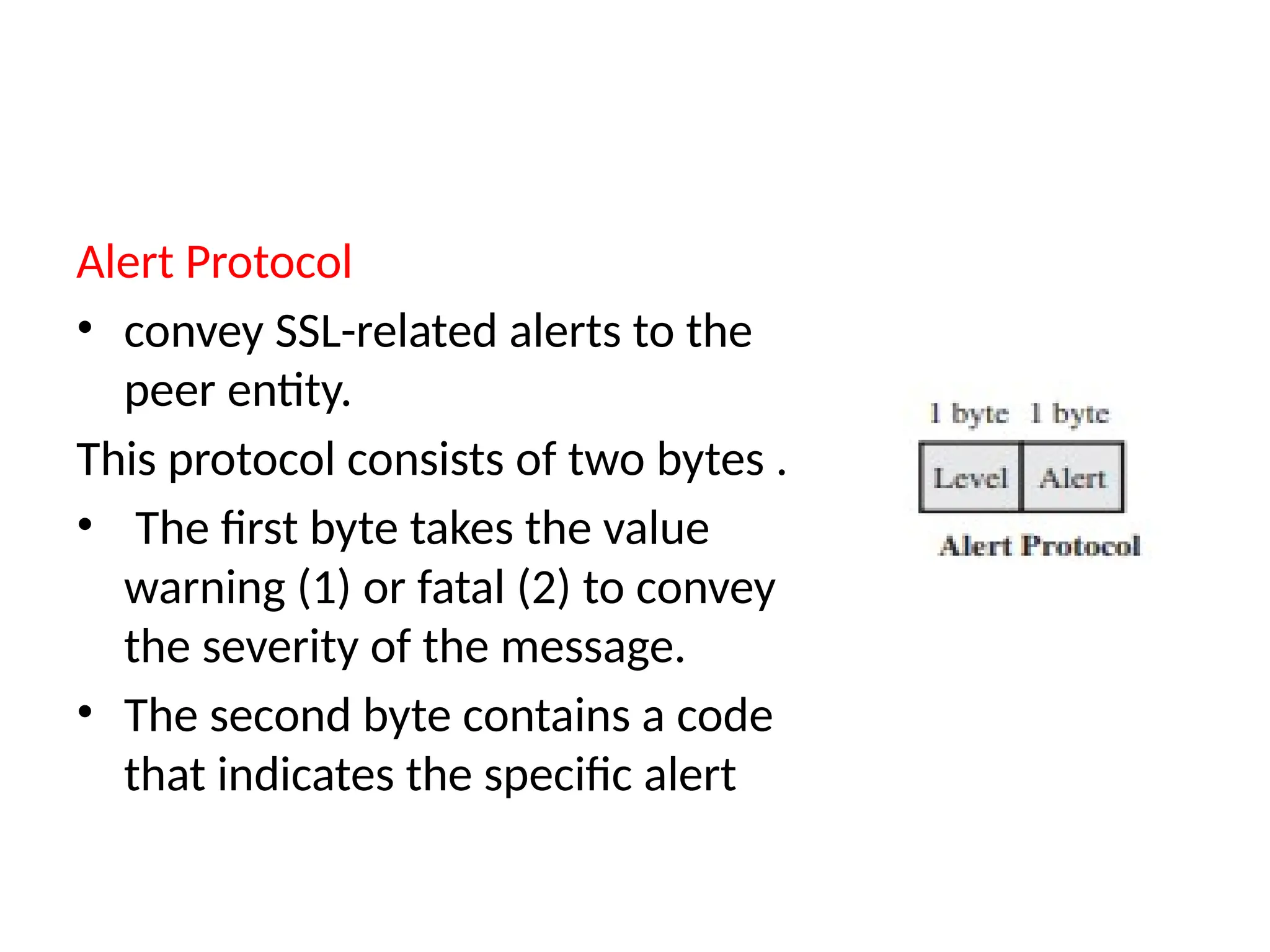
• conveySSL-related alerts to the
peer entity.
This protocol consists of two bytes .
• The first byte takes the value
warning (1) or fatal (2) to convey
the severity of the message.
• The second byte contains a code
that indicates the specific alert
33.
Alerts that arealways fatal
• unexpected_message: An inappropriate message was received.
• bad_record_mac: An incorrect MAC was received.
• decompression_failure: The decompression function received
improper input (e.g., unable to decompress or decompress to
greater than maximum allowable length).
• handshake_failure: Sender was unable to negotiate an
acceptable set of security parameters given the options
available.
• illegal_parameter: A field in a handshake message was out of
range or inconsistent with other fields
34.
The remaining alertsare the following.
• close_notify: Notifies the recipient that the sender will not send any
more messages on this connection. Each party is required to send a
close_ notify alert before closing the write side of a connection.
• no_certificate: May be sent in response to a certificate request if no
appropriate certificate is available.
• bad_certificate: A received certificate was corrupt (e.g., contained a
signature that did not verify).
• unsupported_certificate: The type of the received certificate is not
supported.
35.
• certificate_revoked: Acertificate has been
revoked by its signer.
• certificate_expired: A certificate has expired.
• certificate_unknown: Some other unspecified
issue arose in processing the certificate,
rendering it unacceptable
36.
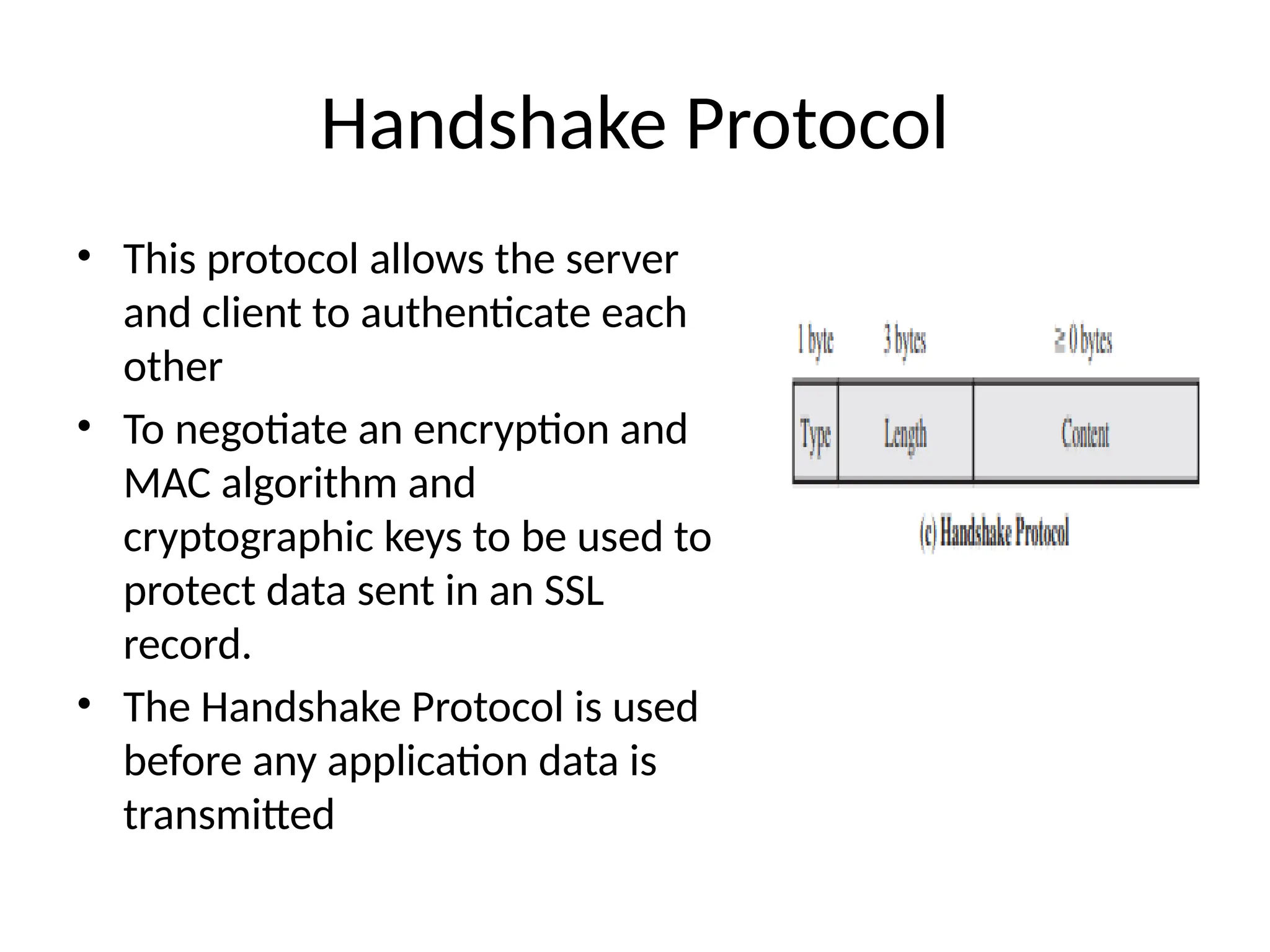
Handshake Protocol
• Thisprotocol allows the server
and client to authenticate each
other
• To negotiate an encryption and
MAC algorithm and
cryptographic keys to be used to
protect data sent in an SSL
record.
• The Handshake Protocol is used
before any application data is
transmitted
37.
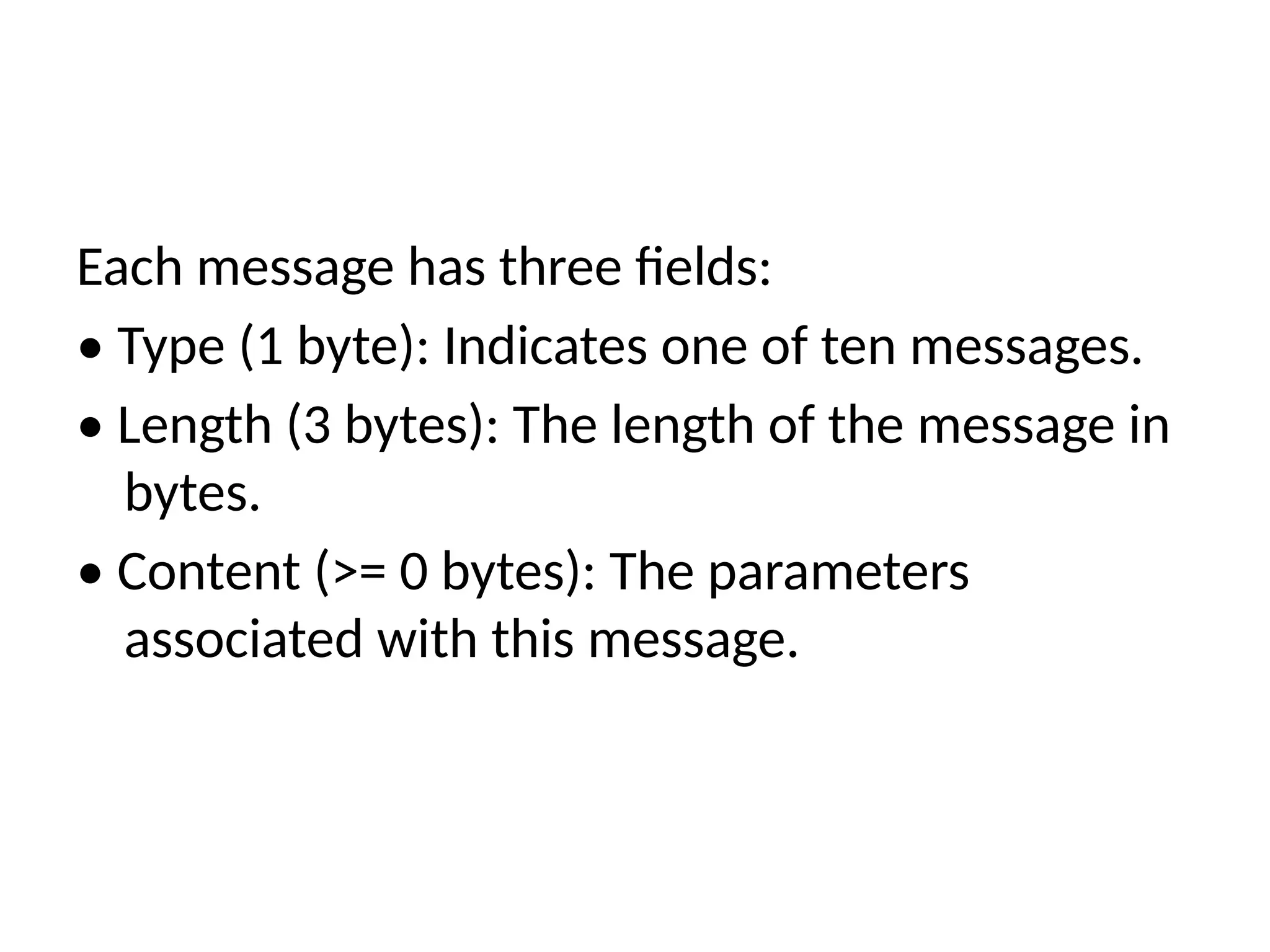
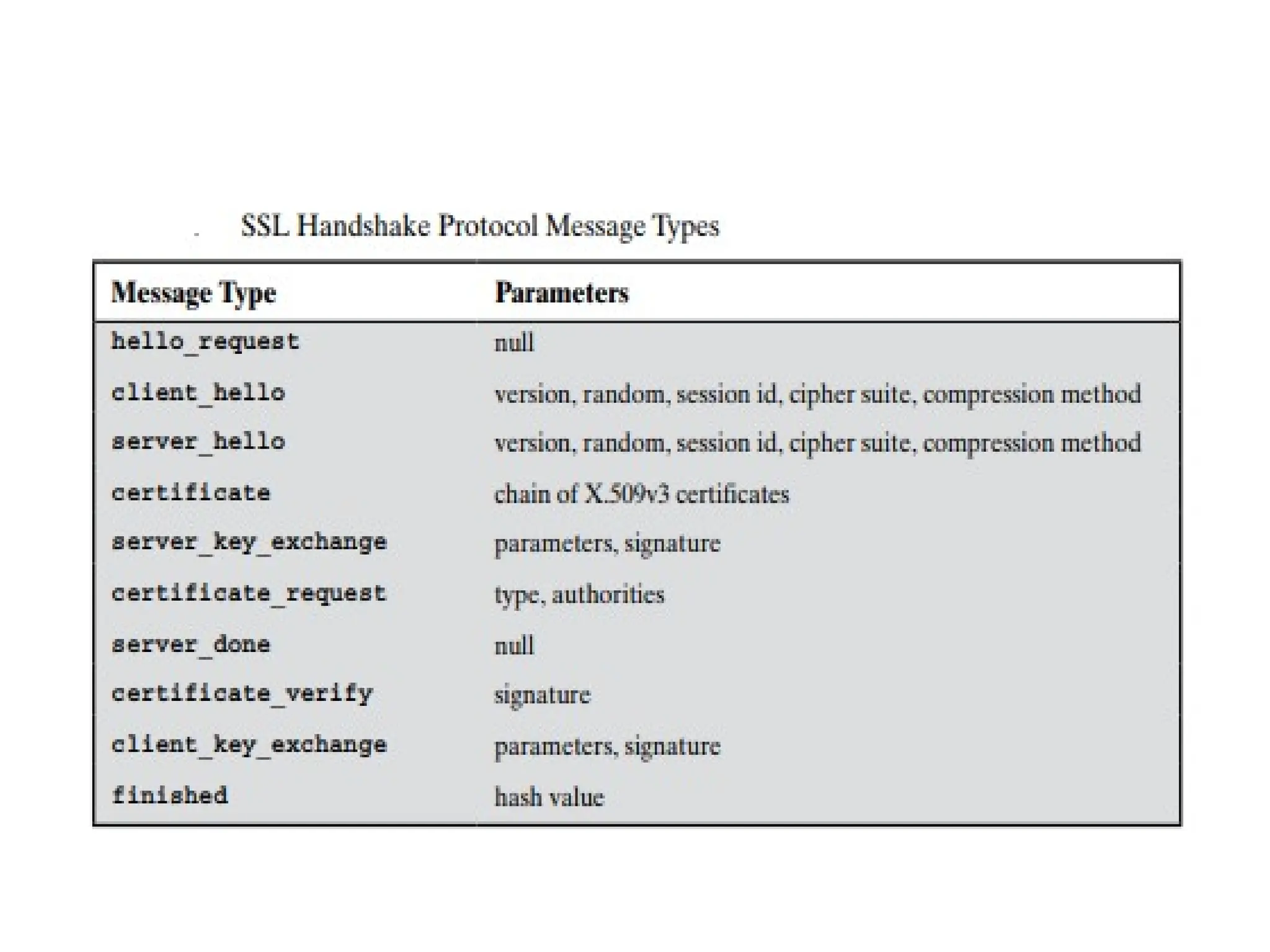
Each message hasthree fields:
• Type (1 byte): Indicates one of ten messages.
• Length (3 bytes): The length of the message in
bytes.
• Content (>= 0 bytes): The parameters
associated with this message.
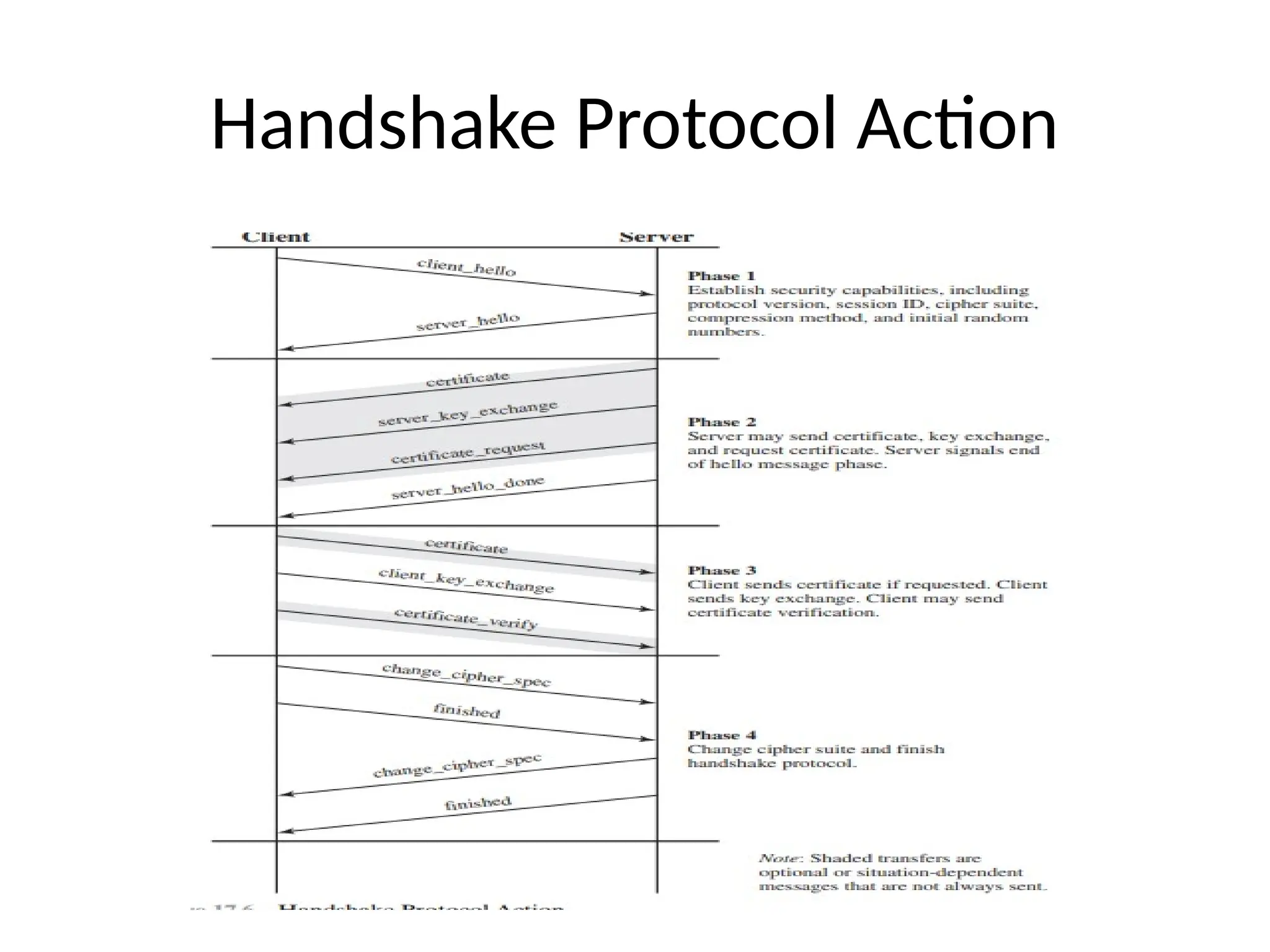
Phase 1. EstablishSecurity Capabilities
• This phase is used to initiate a logical connection and to
establish the security capabilities
• The exchange is initiated by the client, which sends a
client_hello message with following parameter
• Version: The highest SSL version[2.0] understood by the client.
• Random: Clients send random number,from this number pre
master key is generateed
These values serve as nonces and are used during key
exchange to prevent replay attacks.
41.
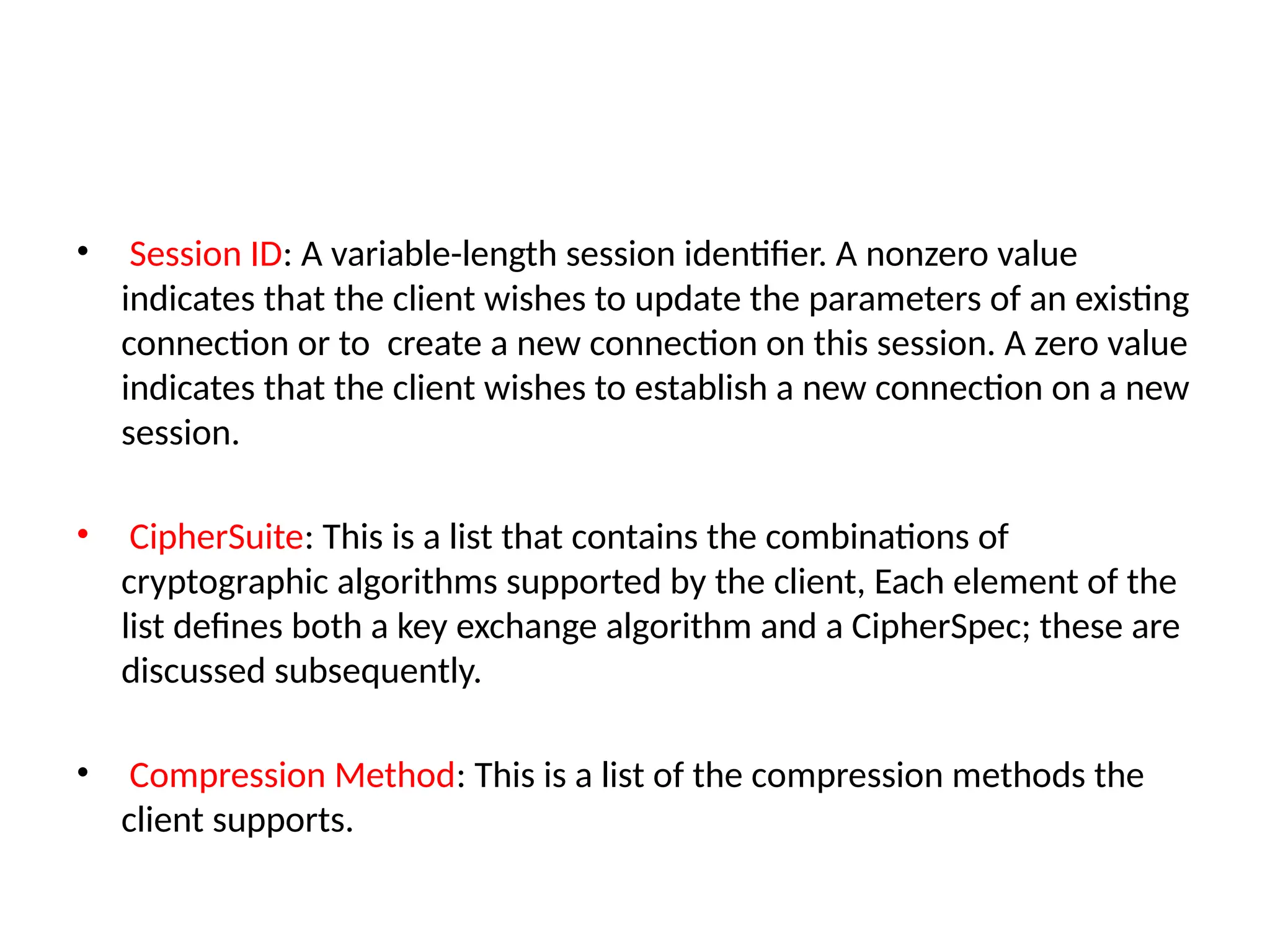
• Session ID:A variable-length session identifier. A nonzero value
indicates that the client wishes to update the parameters of an existing
connection or to create a new connection on this session. A zero value
indicates that the client wishes to establish a new connection on a new
session.
• CipherSuite: This is a list that contains the combinations of
cryptographic algorithms supported by the client, Each element of the
list defines both a key exchange algorithm and a CipherSpec; these are
discussed subsequently.
• Compression Method: This is a list of the compression methods the
client supports.
42.
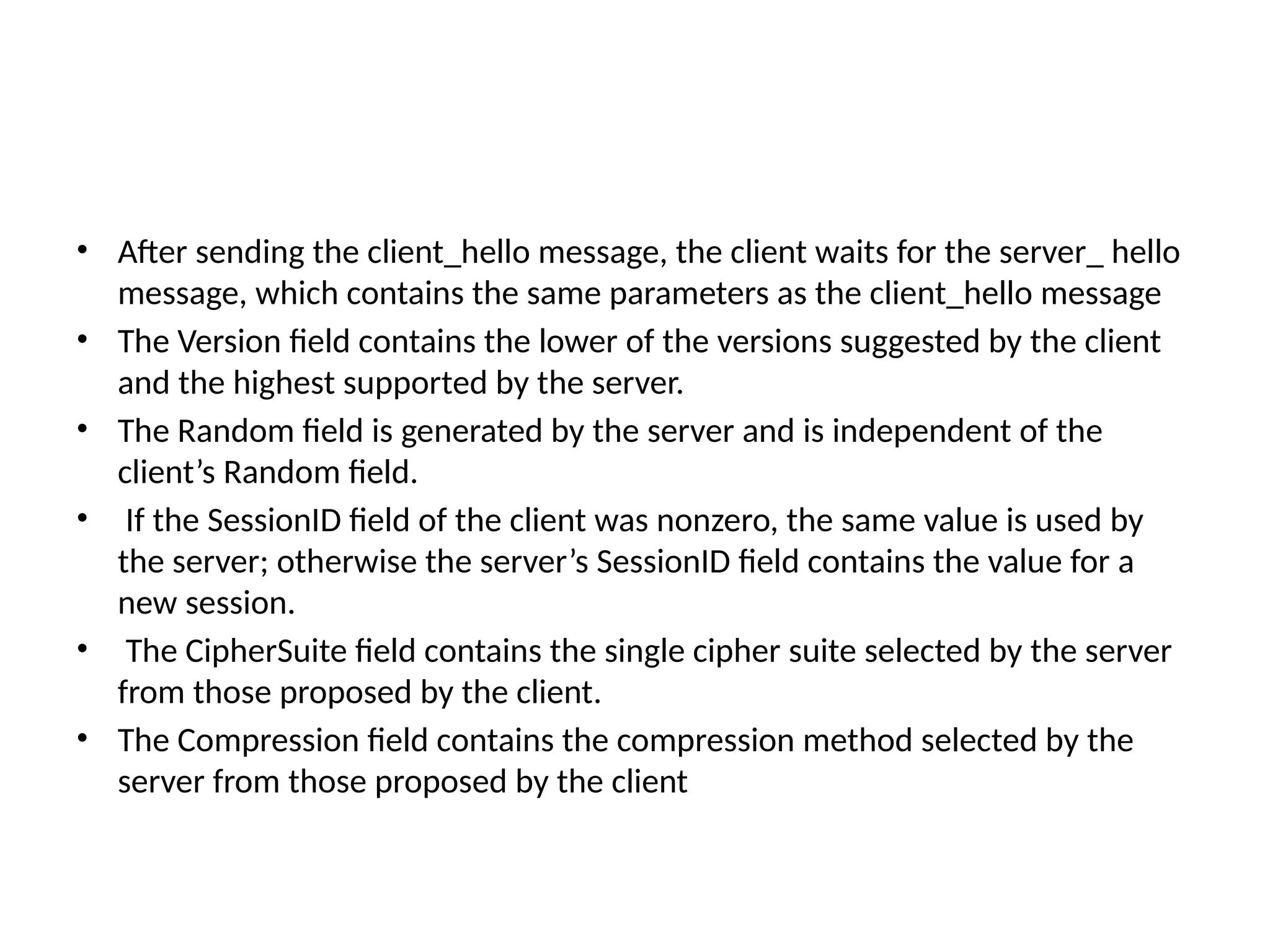
• After sendingthe client_hello message, the client waits for the server_ hello
message, which contains the same parameters as the client_hello message
• The Version field contains the lower of the versions suggested by the client
and the highest supported by the server.
• The Random field is generated by the server and is independent of the
client’s Random field.
• If the SessionID field of the client was nonzero, the same value is used by
the server; otherwise the server’s SessionID field contains the value for a
new session.
• The CipherSuite field contains the single cipher suite selected by the server
from those proposed by the client.
• The Compression field contains the compression method selected by the
server from those proposed by the client
43.
The first elementof the CipherSuite parameter is the key exchange method
• RSA –sender uses receiver ‘s public key to encrypt and receiver decrypt it using
private key ,which only he knows . A public-key certificate for the receiver’s key
must be made available.
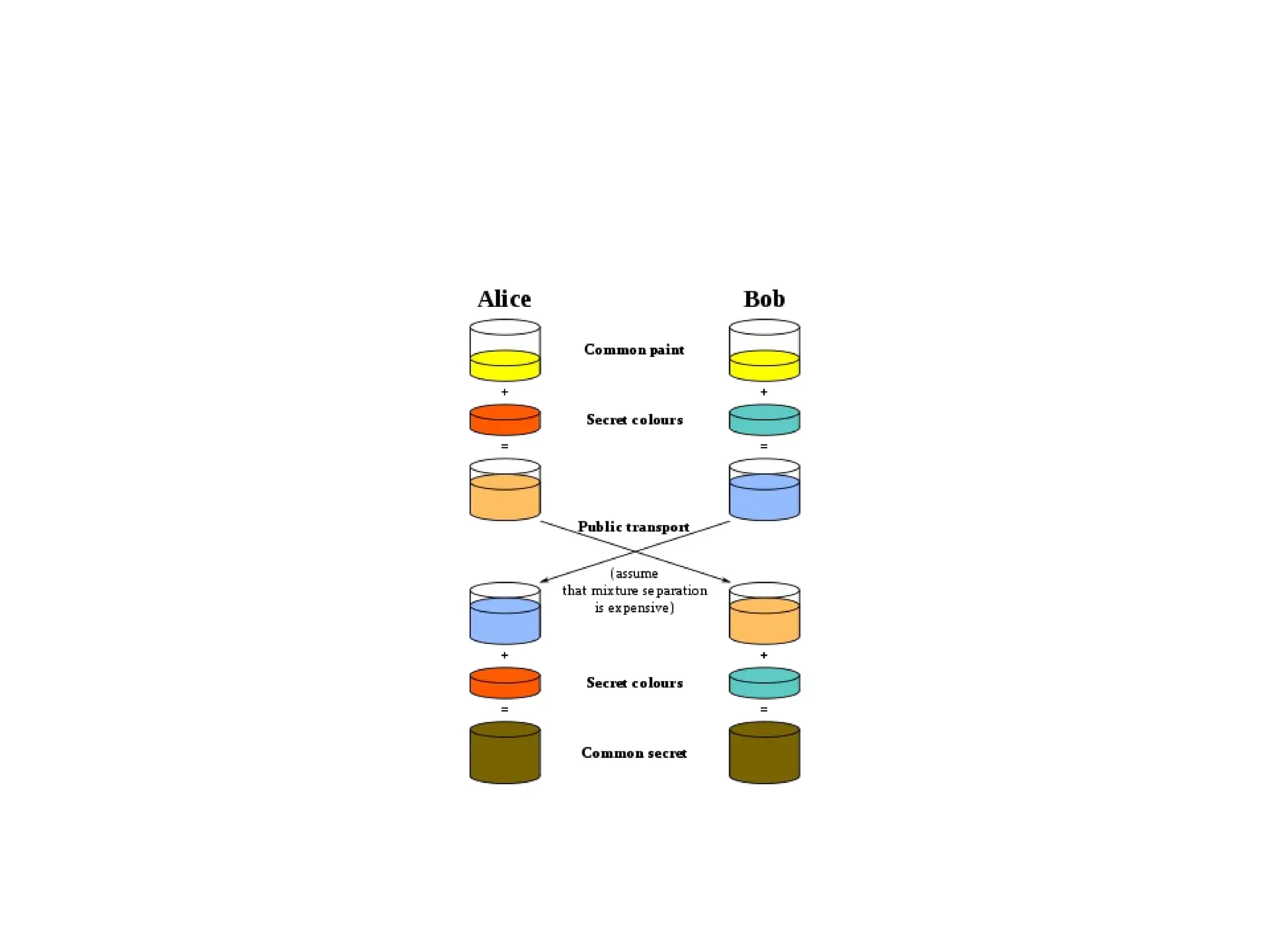
Three version of Diffie-Hellman
• Fixed Diffie-Hellman: This method results in a fixed secret key between two
peers based on the Diffie-Hellman calculation using the fixed public keys
• Ephemeral Diffie-Hellman: This technique is used to create ephemeral
(temporary, one-time) secret keys
• Anonymous Diffie-Hellman: each side sends its public Diffie-Hellman parameters
to the other with no authentication
• Fortezza
45.
CipherSpec-name used toselect algorithm for signing,keyexchange
and encryption
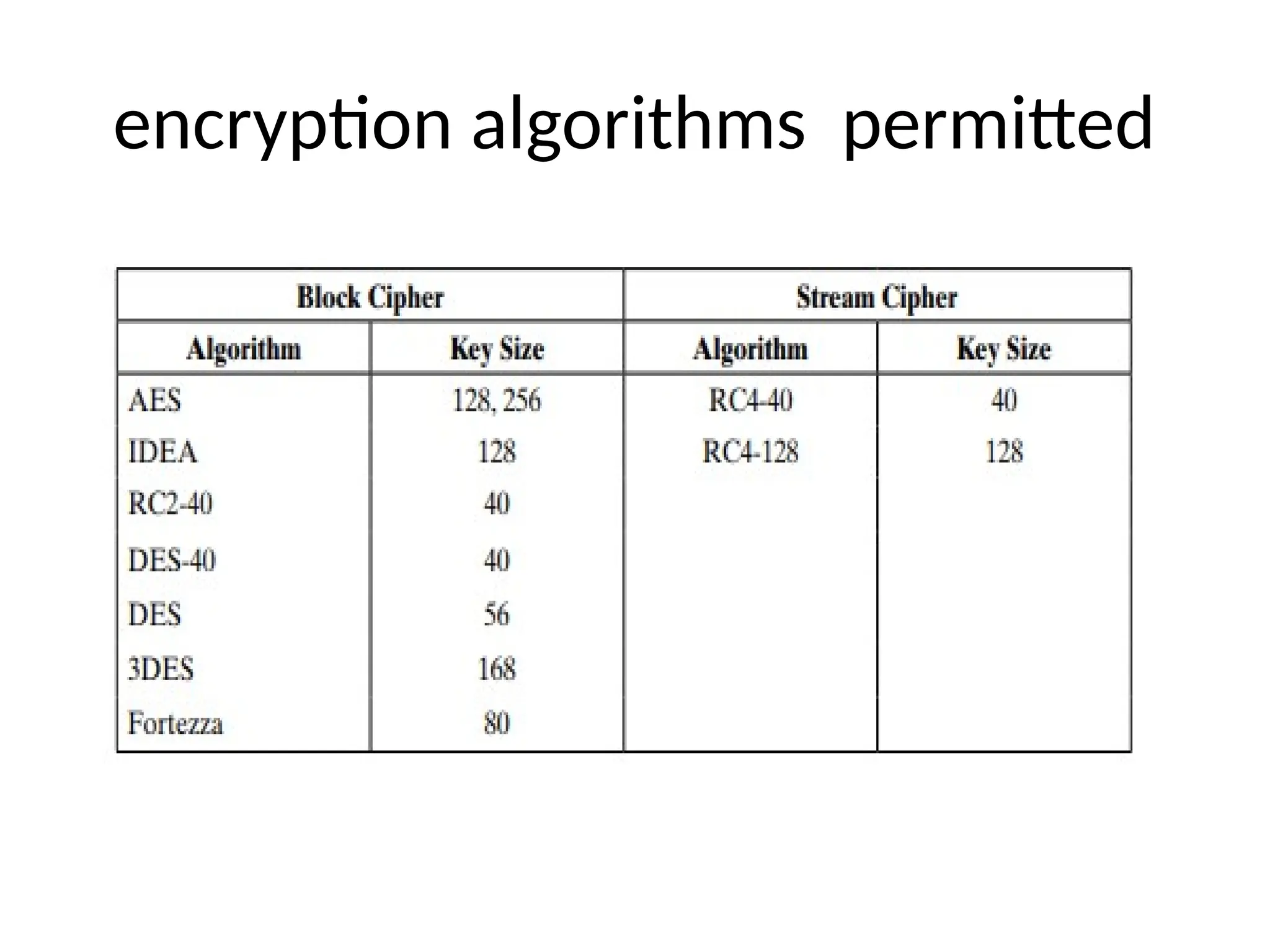
• CipherAlgorithm: Any of the algorithms mentioned earlier: RC4,
RC2, DES, 3DES, DES40, IDEA, or Fortezza
• MACAlgorithm: MD5 or SHA-1
• CipherType: Stream or Block
• HashSize: 0, 16 (for MD5), or 20 (for SHA-1) bytes
• Key Material: A sequence of bytes that contain data used in
generating the write keys
• IV Size: The size of the Initialization Value for Cipher Block Chaining
(CBC) encryption
46.
Phase 2. ServerAuthentication and Key
Exchange
• The server begins this phase by sending its
certificate if it needs to be authenticated; the
message contains one or a chain of X.509
certificates.
• Certificates are used to authenticate the
public keys
47.
• a server_key_exchangemessage may be sent
if it is required. It is not required in two
instances:
• (1) The server has sent a certificate with fixed
DiffieHellman parameters or
• (2) a RSA key exchange is to be used.
48.
• The server_key_exchange message is needed
for the following:
• Anonymous Diffie-Hellman
• Ephemeral Diffie-Hellman:
• RSA key exchange (in which the server is using
RSA but has a signature-only RSA key)
• Fortezza
49.
• Next, anonanonymous server (server not
using anonymous Diffie-Hellman) can request
a certificate from the client.
• The certificate_request message includes two
parameters:
• certificate_type and
• certificate_authorities.
50.
• The certificatetype indicates the public-key algorithm and its use:
• an RSA signature is a type of digital signature, which uses the RSA
asymmetric key algorithm.
• RSA, signature only
• DSS, signature only
• RSA for fixed Diffie-Hellman; in this case the signature is used
only for authentication, by sending a certificate signed with RSA
• DSS for fixed Diffie-Hellman; again, used only for authentication
• RSA for ephemeral Diffie-Hellman
• DSS for ephemeral Diffie-Hellman
• Fortezza
51.
• The secondparameter in the
certificate_request message is a list of the
distinguished names of acceptable certificate
authorities.
52.
The final messagein phase 2
• is the server_ done message, which is sent by
the server to indicate the end of the server
hello and associated messages.
• After sending this message, the server will
wait for a client response. This message has
no parameters.
53.
Phase 3. ClientAuthentication and Key
Exchange
• Upon receipt of the server_done message, the
client should verify that the server provided a
valid certificate (if required) and check that the
server_hello parameters are acceptable.
• If the server has requested a certificate, the
client begins this phase by sending a certificate
message. If no suitable certificate is available,
the client sends a no_certificate alert instead.
54.
client_key_exchange message, whichmust be sent in this
phase. The content of the message depends on the type of
key exchange, as follows.
• Rsa: The client generates a 48-byte pre-master secret and
encrypts with the public key from the server’s certificate or
temporary RSA key from a server_key_exchange message.
Its use to compute a master secret .
• Ephemeral or Anonymous Diffie-Hellman: The client’s public
Diffie-Hellman parameters are sent.
55.
• Fixed Diffie-Hellman:The client’s public Diffie-
Hellman parameters were sent in a certificate
message, so the content of this message is null.
• Fortezza: The client’s Fortezza parameters are
sent
• in this phase, the client may send a
certificate_verify message to provide explicit
verification of a client certificate
56.
Phase 4. Finish
•This phase completes the setting up of a secure
connection
• The client sends a change_cipher_spec message and
copies the pending CipherSpec into the current
CipherSpec.
• The client then immediately sends the finished
message under the new algorithms, keys, and
secrets. The finished message verifies that the key
exchange and authentication processes were
successful
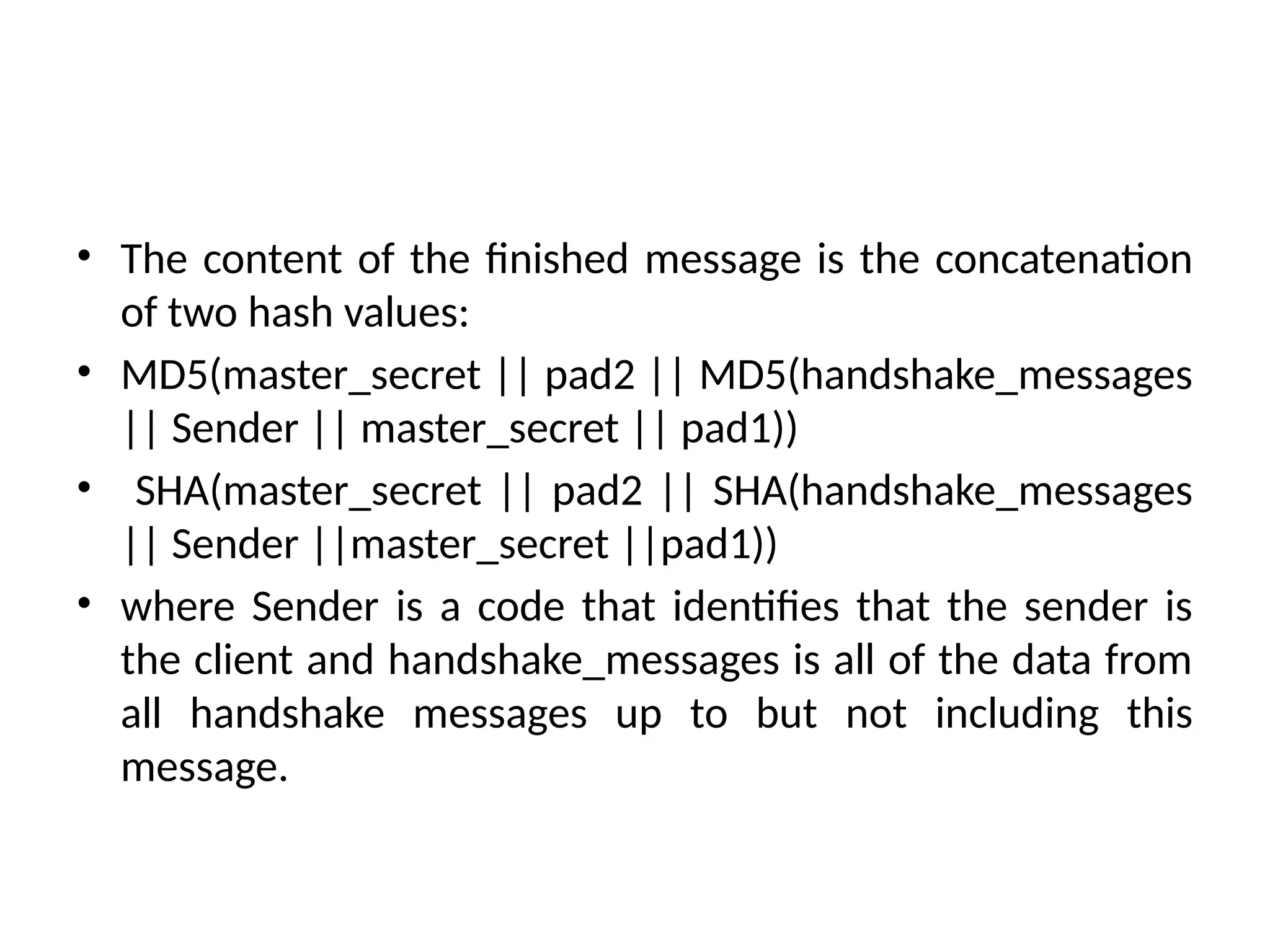
57.
• The contentof the finished message is the concatenation
of two hash values:
• MD5(master_secret || pad2 || MD5(handshake_messages
|| Sender || master_secret || pad1))
• SHA(master_secret || pad2 || SHA(handshake_messages
|| Sender ||master_secret ||pad1))
• where Sender is a code that identifies that the sender is
the client and handshake_messages is all of the data from
all handshake messages up to but not including this
message.
58.
• The handshakeis complete and the client and
server may begin to exchange application-
layer data.
59.
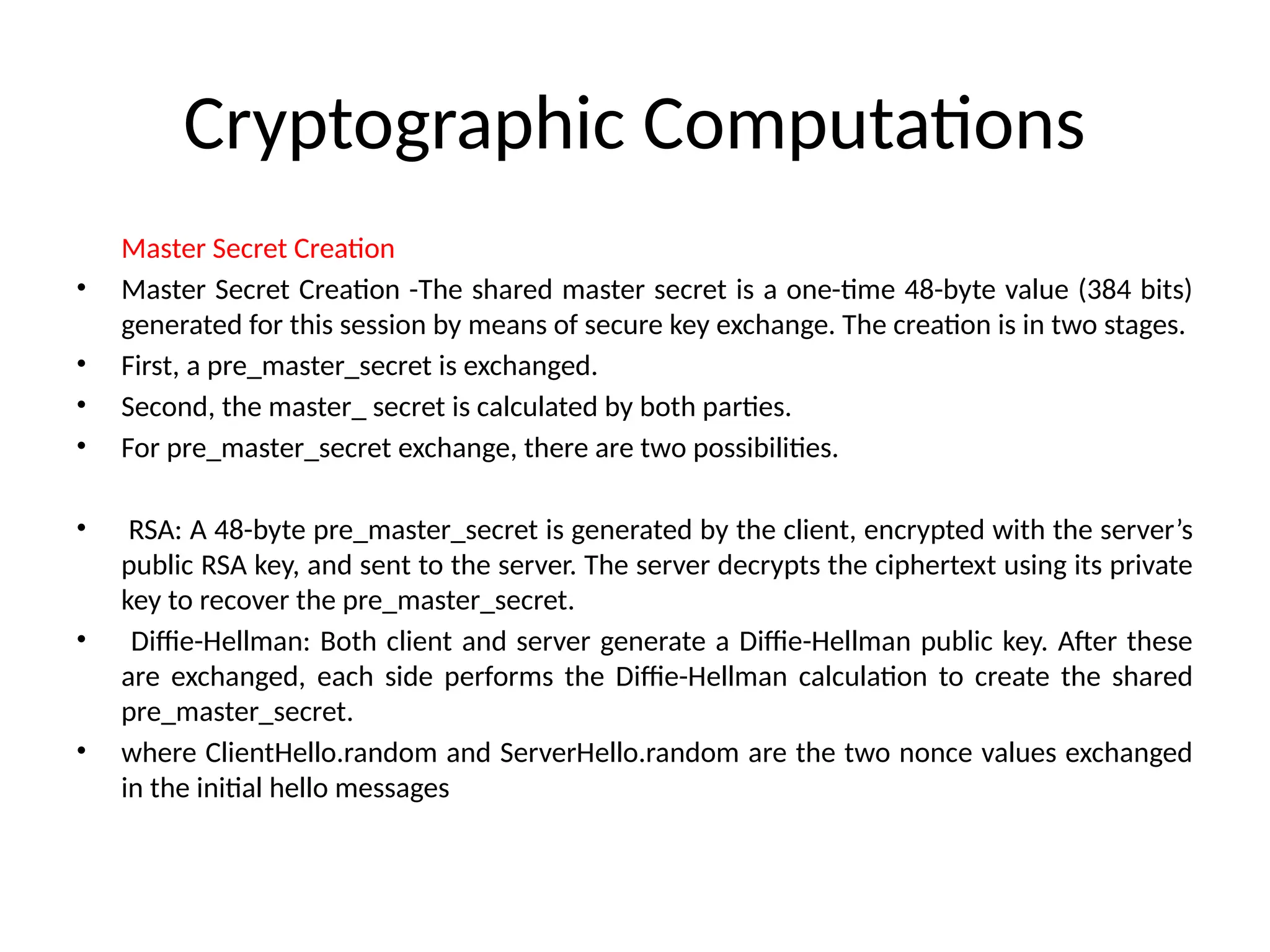
Cryptographic Computations
Master SecretCreation
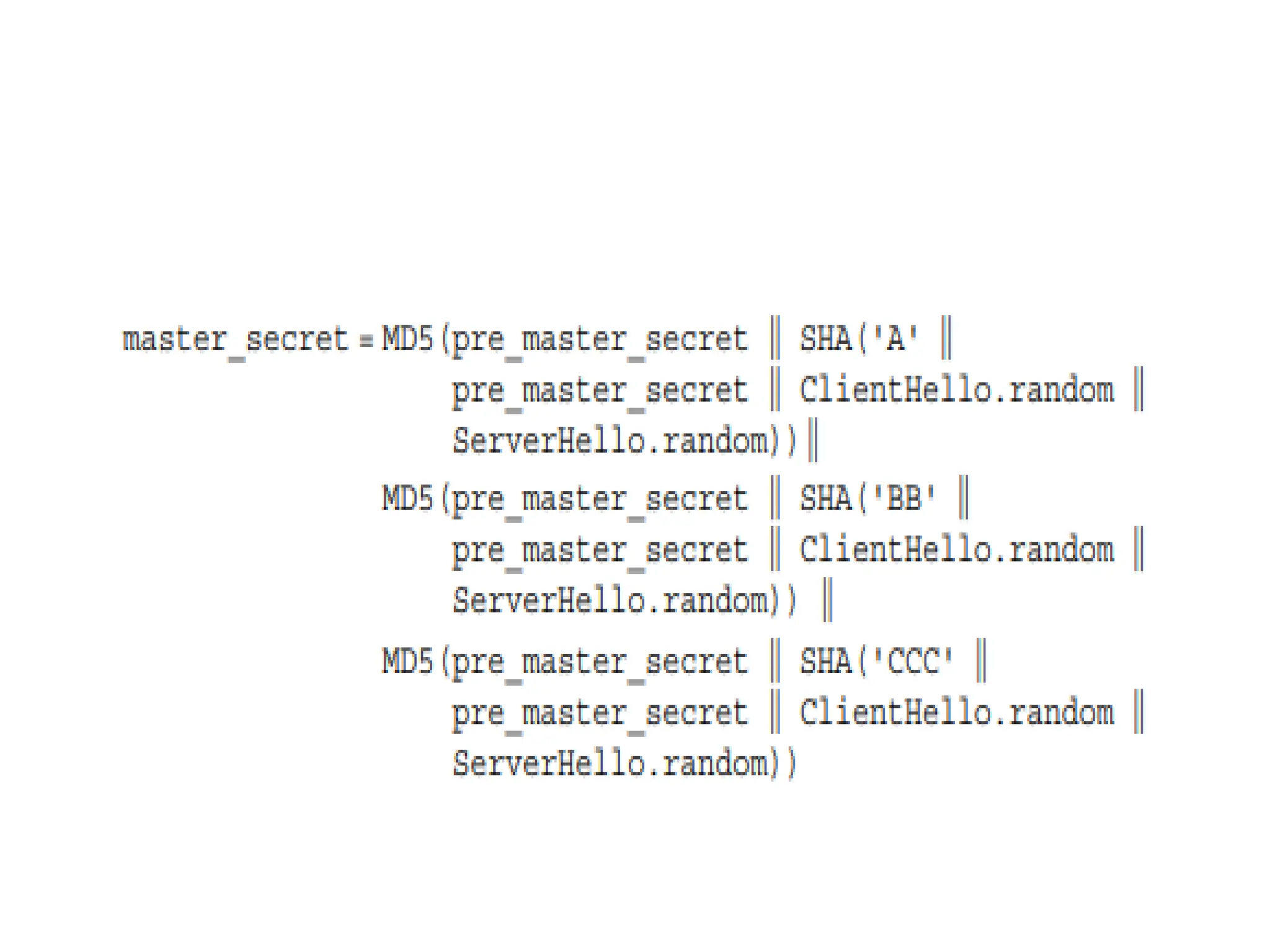
• Master Secret Creation -The shared master secret is a one-time 48-byte value (384 bits)
generated for this session by means of secure key exchange. The creation is in two stages.
• First, a pre_master_secret is exchanged.
• Second, the master_ secret is calculated by both parties.
• For pre_master_secret exchange, there are two possibilities.
• RSA: A 48-byte pre_master_secret is generated by the client, encrypted with the server’s
public RSA key, and sent to the server. The server decrypts the ciphertext using its private
key to recover the pre_master_secret.
• Diffie-Hellman: Both client and server generate a Diffie-Hellman public key. After these
are exchanged, each side performs the Diffie-Hellman calculation to create the shared
pre_master_secret.
• where ClientHello.random and ServerHello.random are the two nonce values exchanged
in the initial hello messages
61.
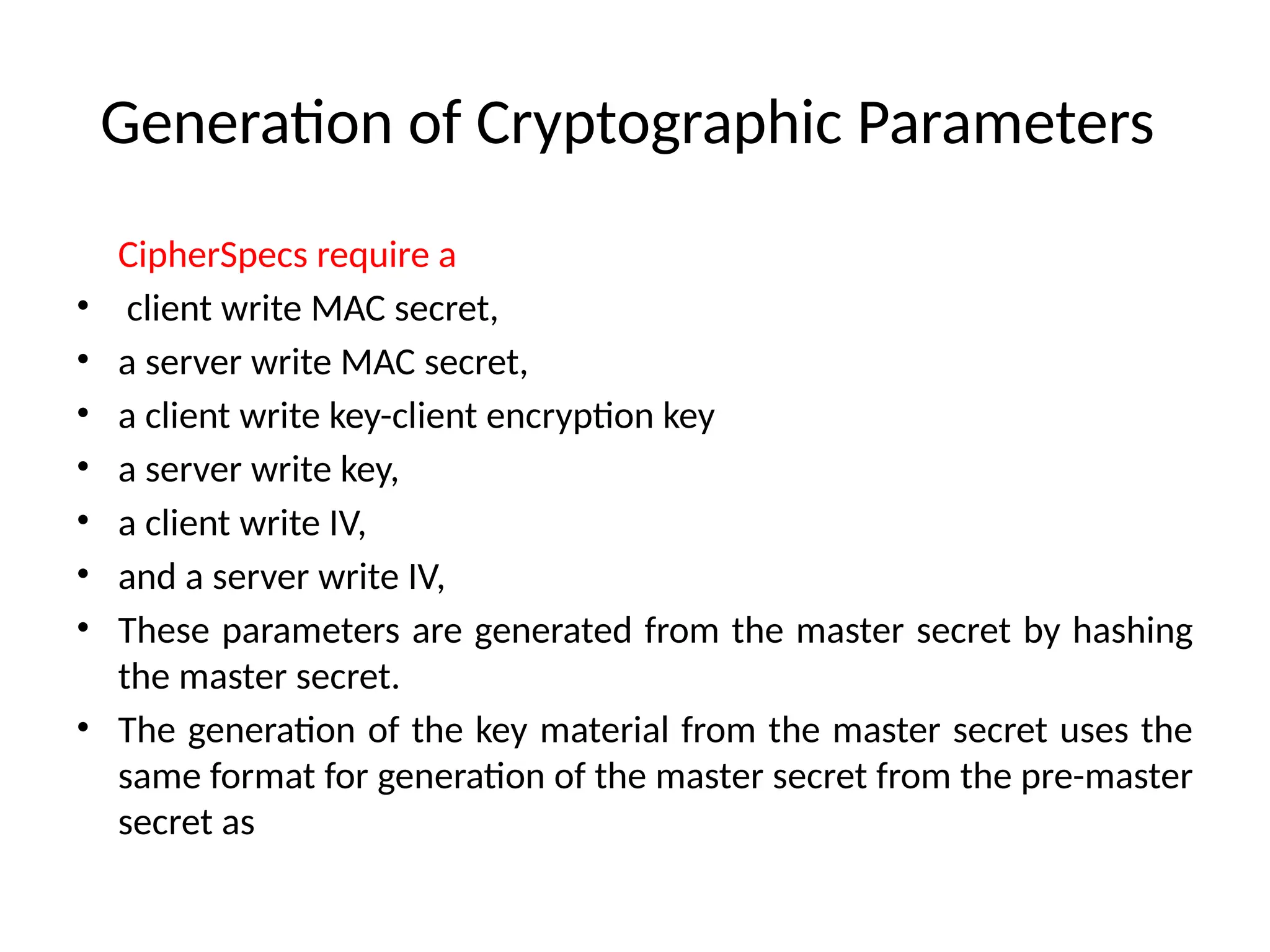
Generation of CryptographicParameters
CipherSpecs require a
• client write MAC secret,
• a server write MAC secret,
• a client write key-client encryption key
• a server write key,
• a client write IV,
• and a server write IV,
• These parameters are generated from the master secret by hashing
the master secret.
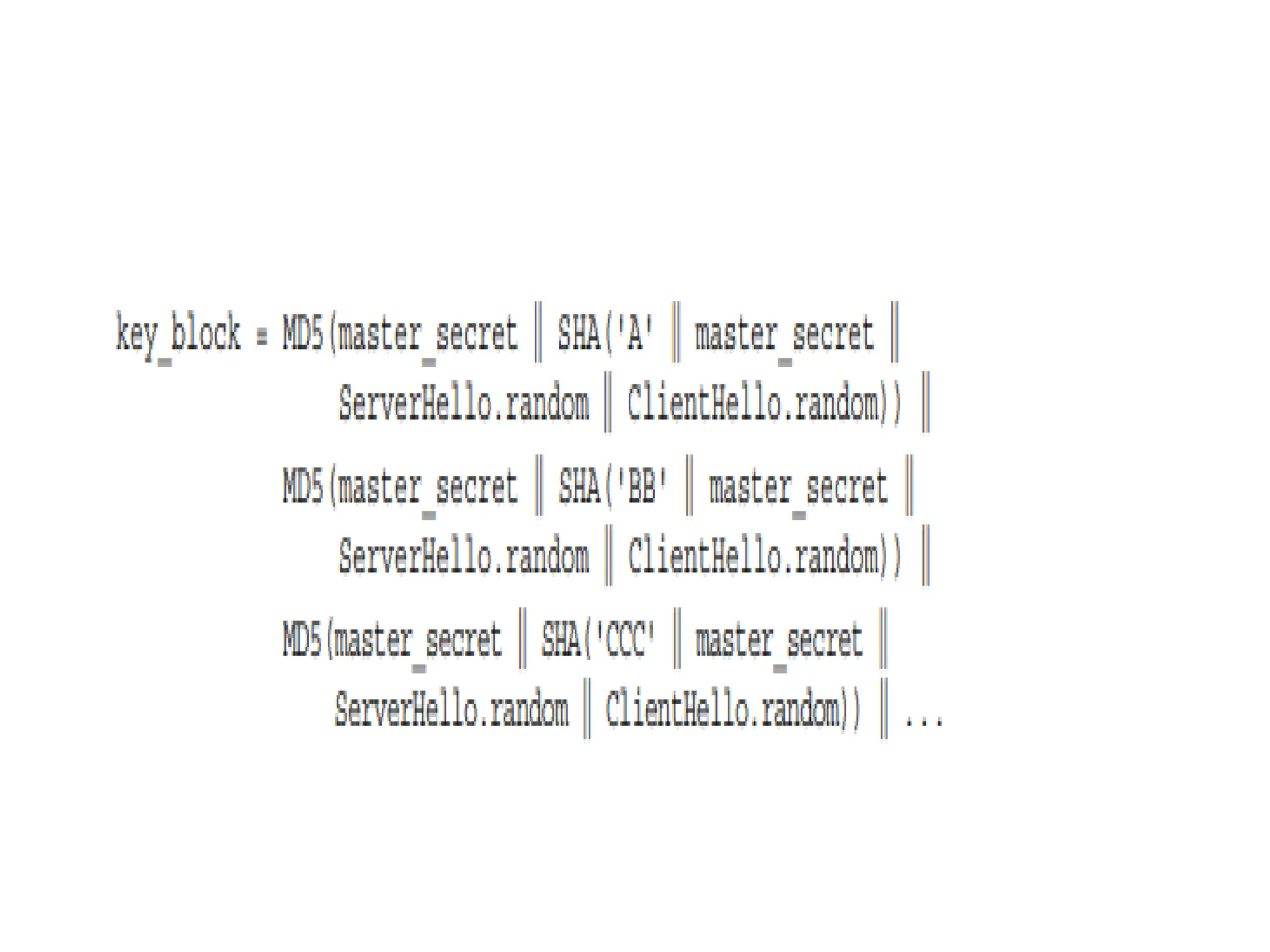
• The generation of the key material from the master secret uses the
same format for generation of the master secret from the pre-master
secret as
63.
Transport Layer Security
•TLS is the successor protocol to SSL.
• TLS is an improved version of SSL
• Widely used for internet communications and
online transactions.
• It is an IEFT standard intended to prevent
eavesdropping, tampering and message
forgery.
64.
Version Number
• TheTLS Record Format is the same as that of the
SSL Record Format
• the fields in the header have the same meanings
• The one difference is in version values. For the
current version of TLS,
• The major version is 3 and the minor version is 3.
65.
Message Authentication Code
•TLS makes use of the HMAC algorithm defined in RFC 2104.
• HMACK(M) = H[(K+ opad) } H[(K+ ipad) } M]]
⊕ ⊕
where H = embedded hash function (for TLS, either MD5 or SHA-1)
M = message input to HMAC
K+ = secret key padded with zeros on the left so that the result is equal to the block length
of the hash code (for MD5 and SHA-1, block length = 512 bits)
ipad = 00110110 (36 in hexadecimal) repeated 64 times (512 bits)
opad = 01011100 (5C in hexadecimal) repeated 64 times (512 bits)
SSLv3 uses the same algorithm, except that the padding bytes are concatenated with the
secret key rather than being XORed with the secret key padded to the block length
66.
• For TLS,the MAC calculation encompasses the fields
indicated in the following expression:
• MAC(MAC_write_secret,seq_num || TLSCompressed.type ||
TLSCompressed.version || TLSCompressed.length ||TLSCompressed.fragment)
• MAC_write_secret,seq_num –mac secret key seq no.
• The MAC calculation covers all of the fields covered by
the SSLv3 calculation, plus the field
TLSCompressed.version, which is the version of the
protocol being employed.
67.
Pseudorandom Function
• TLSmakes use of a pseudorandom function referred
to as PRF to expand secrets into blocks of data for
purposes of key generation or validation.
• The objective is to make use of a relatively small
shared secret value but to generate longer blocks of
data in a way that is secure from the kinds of attacks
made on hash functions and MACs.
• The PRF is based on the data expansion function
68.
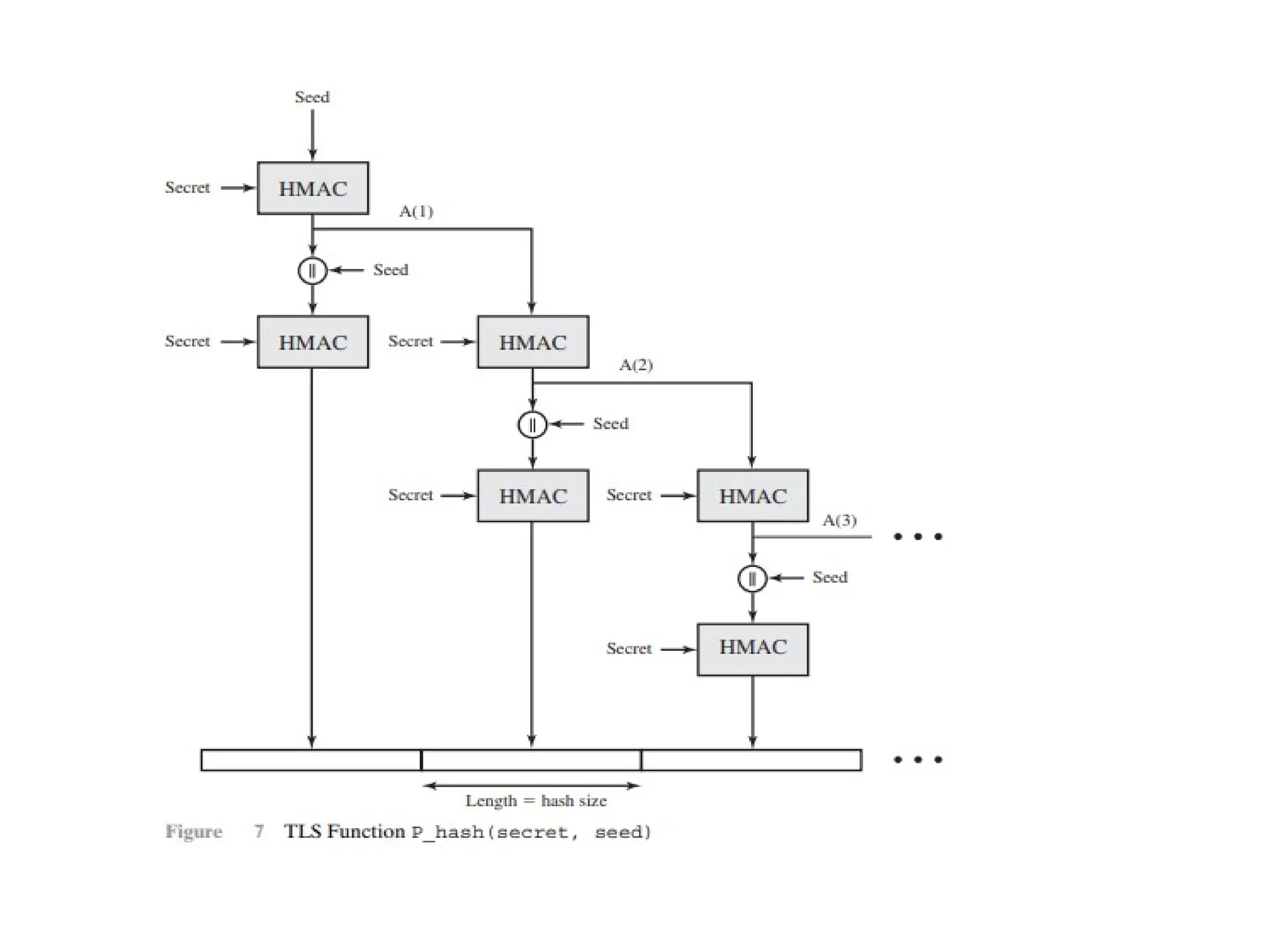
• we definea data expansion function, P_hash(secret, data)
which uses a single hash function to expand a secret and seed
into an arbitrary quantity of output:
• P_hash(secret, seed) = HMAC_hash(secret, A(1) + seed) +
HMAC_hash(secret, A(2) + seed) + HMAC_hash(secret, A(3) +
seed) + ...
• Where + indicates concatenation.
• A() is defined as: A(0) = seed
• A(i) = HMAC_hash(secret, A(i-1))
70.
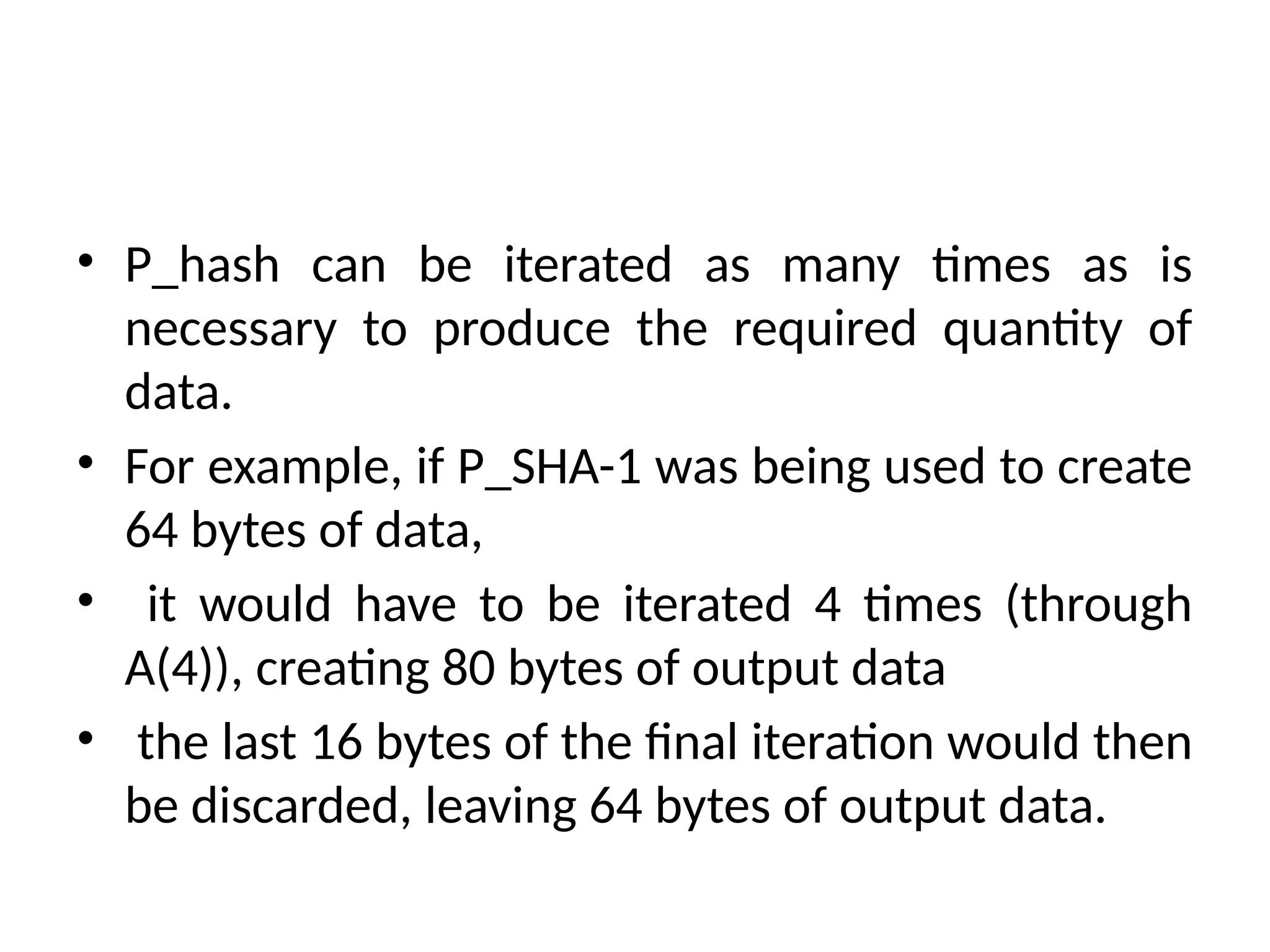
• P_hash canbe iterated as many times as is
necessary to produce the required quantity of
data.
• For example, if P_SHA-1 was being used to create
64 bytes of data,
• it would have to be iterated 4 times (through
A(4)), creating 80 bytes of output data
• the last 16 bytes of the final iteration would then
be discarded, leaving 64 bytes of output data.
71.
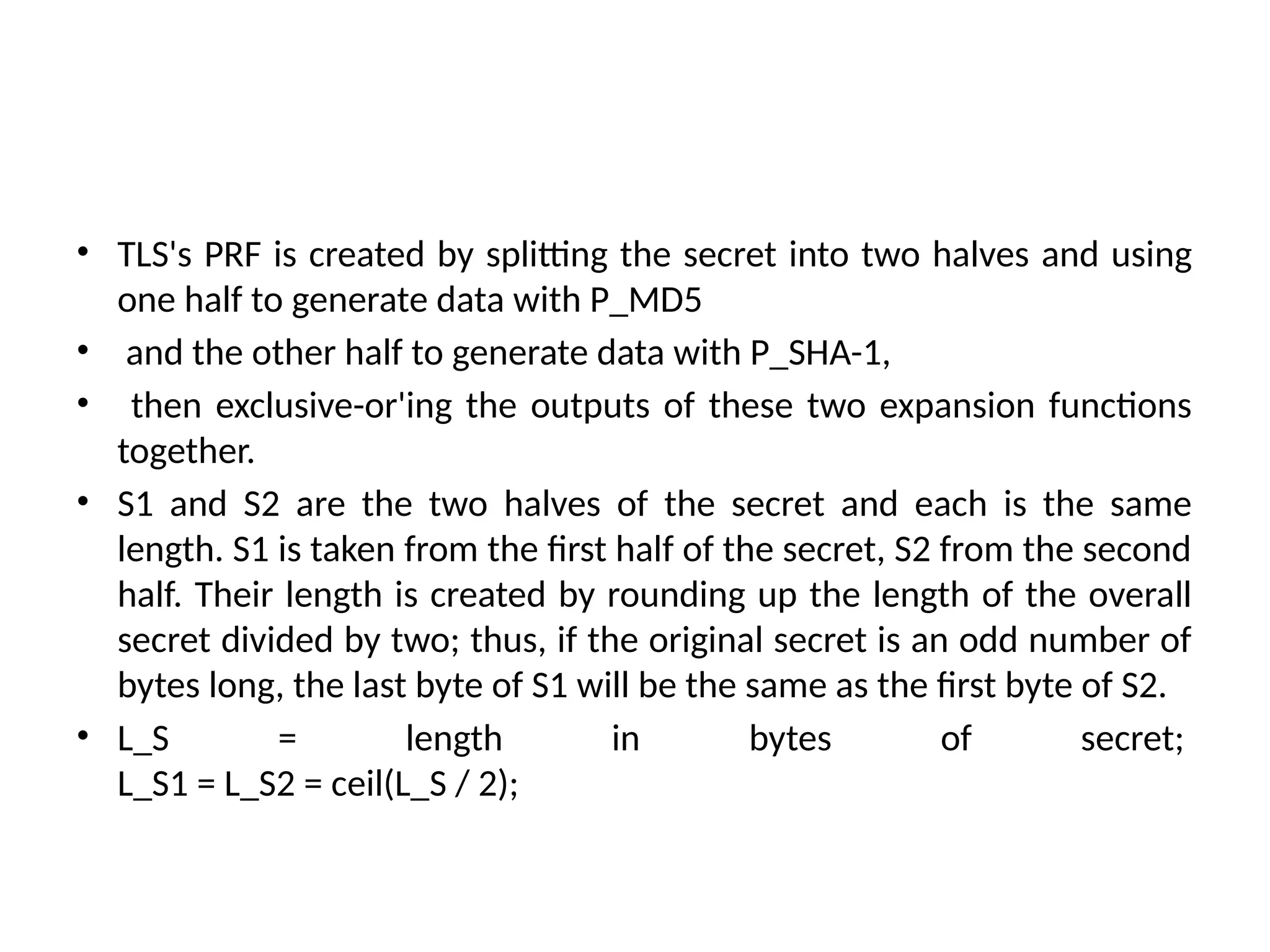
• TLS's PRFis created by splitting the secret into two halves and using
one half to generate data with P_MD5
• and the other half to generate data with P_SHA-1,
• then exclusive-or'ing the outputs of these two expansion functions
together.
• S1 and S2 are the two halves of the secret and each is the same
length. S1 is taken from the first half of the secret, S2 from the second
half. Their length is created by rounding up the length of the overall
secret divided by two; thus, if the original secret is an odd number of
bytes long, the last byte of S1 will be the same as the first byte of S2.
• L_S = length in bytes of secret;
L_S1 = L_S2 = ceil(L_S / 2);
72.
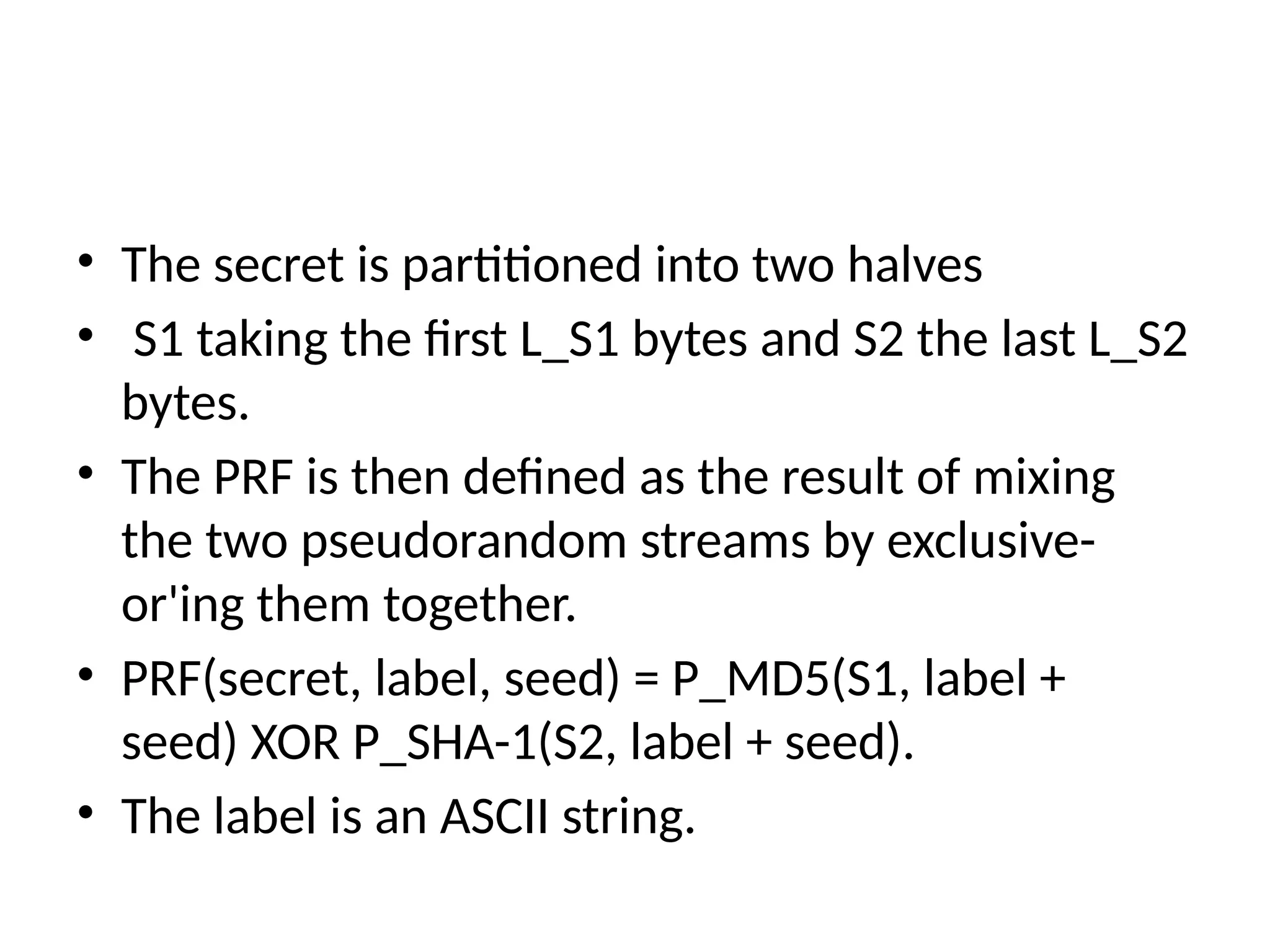
• The secretis partitioned into two halves
• S1 taking the first L_S1 bytes and S2 the last L_S2
bytes.
• The PRF is then defined as the result of mixing
the two pseudorandom streams by exclusive-
or'ing them together.
• PRF(secret, label, seed) = P_MD5(S1, label +
seed) XOR P_SHA-1(S2, label + seed).
• The label is an ASCII string.
73.
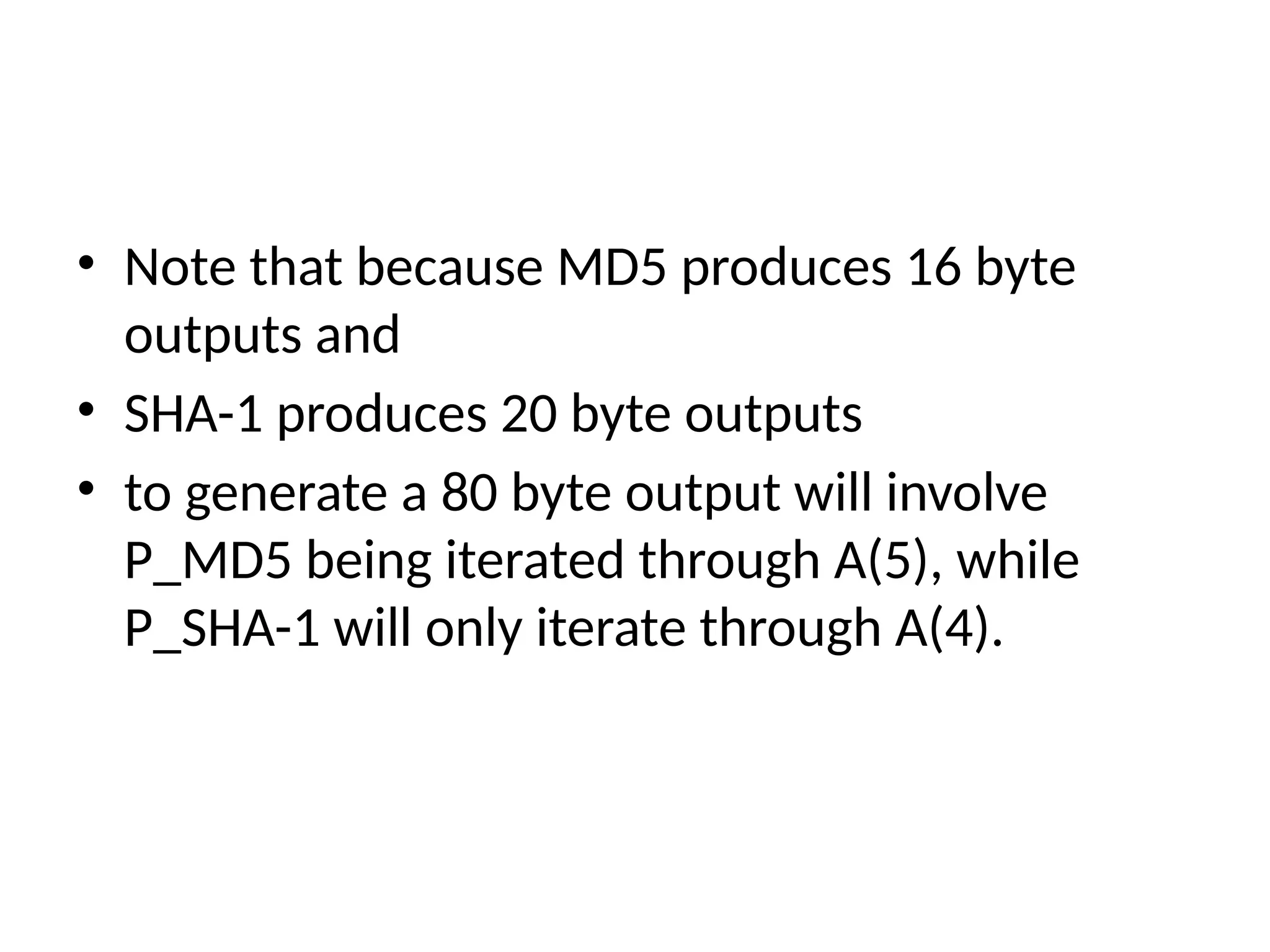
• Note thatbecause MD5 produces 16 byte
outputs and
• SHA-1 produces 20 byte outputs
• to generate a 80 byte output will involve
P_MD5 being iterated through A(5), while
P_SHA-1 will only iterate through A(4).
74.
Alert Codes
following arealways fatal.
• record_overflow: A TLS record was received with
a payload (ciphertext) whose length exceeds 214
+
2048 bytes, or the ciphertext decrypted to a
length of greater than 214
+ 1024 bytes.
• access_denied: A valid certificate was received,
but when access control was applied, the sender
decided not to proceed with the negotiation.
75.
• unknown_ca: Avalid certificate chain or partial chain was
received, but the certificate was not accepted because the
CA certificate could not be located or could not be matched
with a known, trusted CA
If the server sends you a TLS alert unknown ca, the server
does not accept the client certificate you have send.
One reason for this might be that you have used the wrong
certificate.
Another reason might be that you've used the correct
certificate but failed to add the necessary chain certificates.
76.
• decode_error: Amessage could not be decoded, because either a
field was out of its specified range or the length of the message was
incorrect.
• protocol_version: The protocol version the client attempted to
negotiate is recognized but not supported.
• insufficient_security: Returned instead of handshake_failure when a
negotiation has failed specifically because the server requires ciphers
more secure than those supported by the client.
.
77.
• unsupported_extension: Anextension type MUST NOT appear in the
ServerHello unless the same extension type appeared in the
corresponding ClientHello. If a client receives an extension type in
ServerHello that it did not request in the associated ClientHello, it MUST
abort the handshake with an unsupported_extension fatal alert.
• The extensions specified are server_name, max_fragment_length,
client_certificate_url, trusted_ca_keys, truncated_hmac, and
status_request.
• decrypt_error: A handshake cryptographic operation failed, including
being unable to verify a signature, decrypt a key exchange, or validate a
finished message
78.
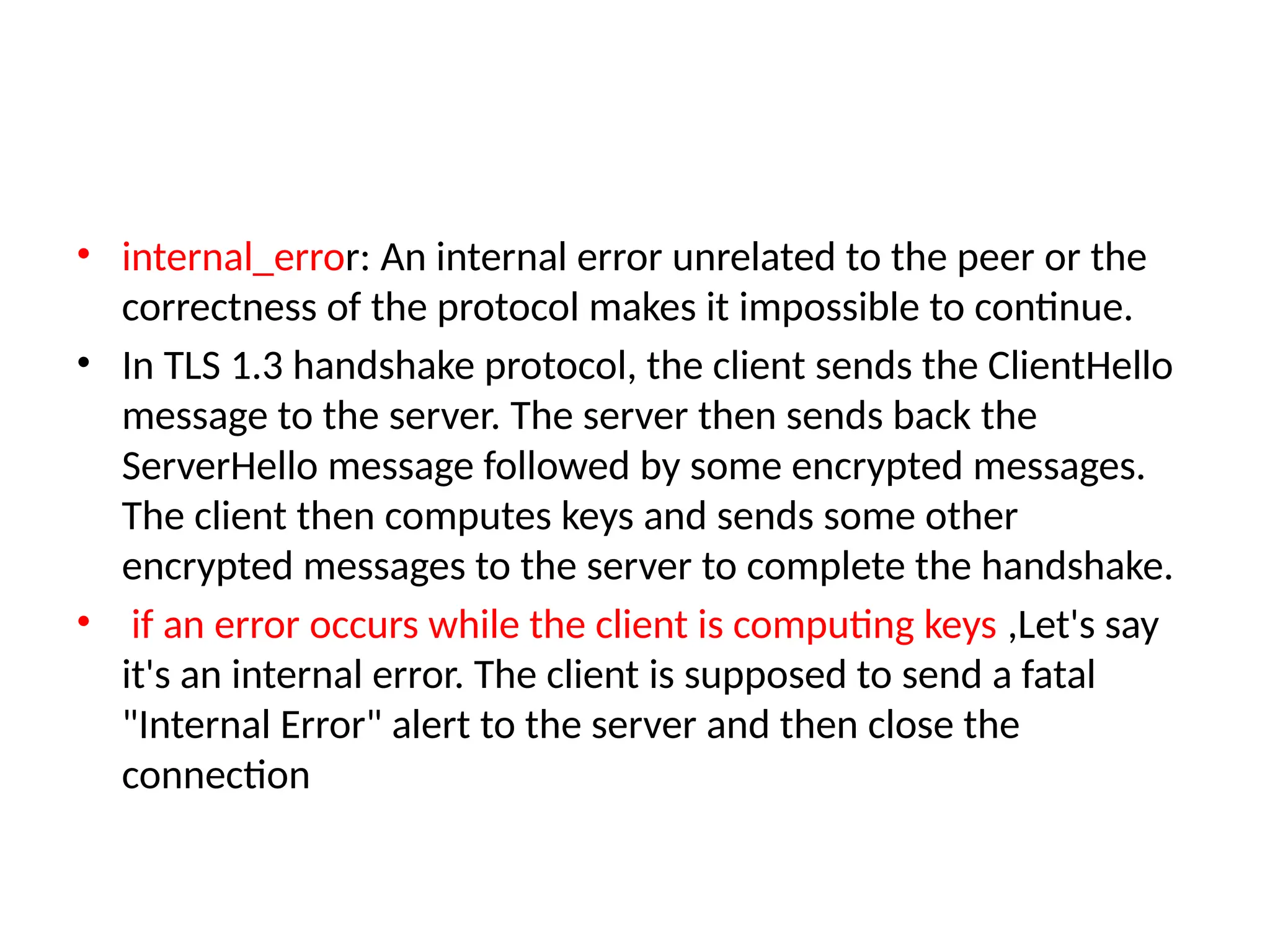
• internal_error: Aninternal error unrelated to the peer or the
correctness of the protocol makes it impossible to continue.
• In TLS 1.3 handshake protocol, the client sends the ClientHello
message to the server. The server then sends back the
ServerHello message followed by some encrypted messages.
The client then computes keys and sends some other
encrypted messages to the server to complete the handshake.
• if an error occurs while the client is computing keys ,Let's say
it's an internal error. The client is supposed to send a fatal
"Internal Error" alert to the server and then close the
connection
79.
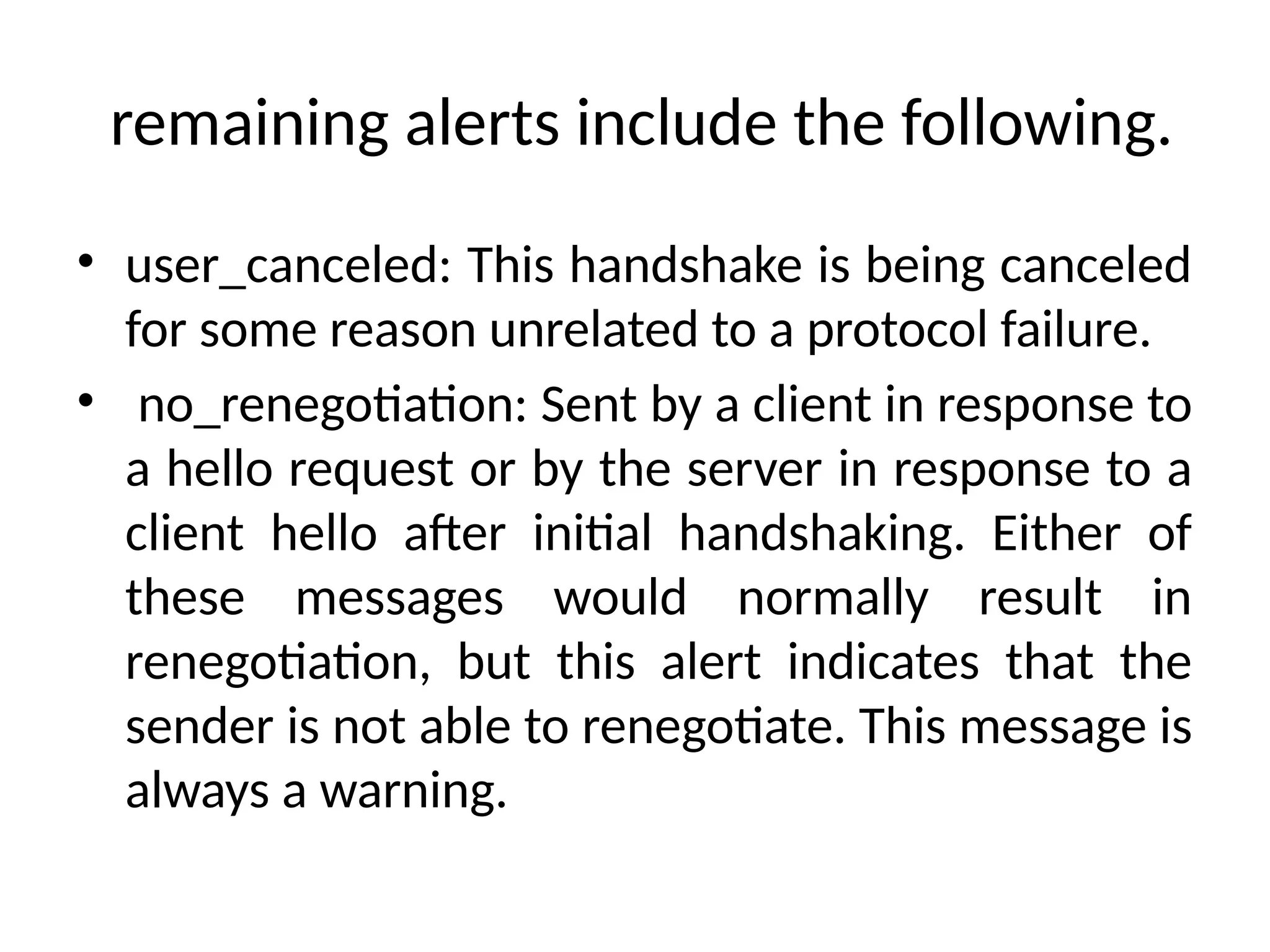
remaining alerts includethe following.
• user_canceled: This handshake is being canceled
for some reason unrelated to a protocol failure.
• no_renegotiation: Sent by a client in response to
a hello request or by the server in response to a
client hello after initial handshaking. Either of
these messages would normally result in
renegotiation, but this alert indicates that the
sender is not able to renegotiate. This message is
always a warning.
80.
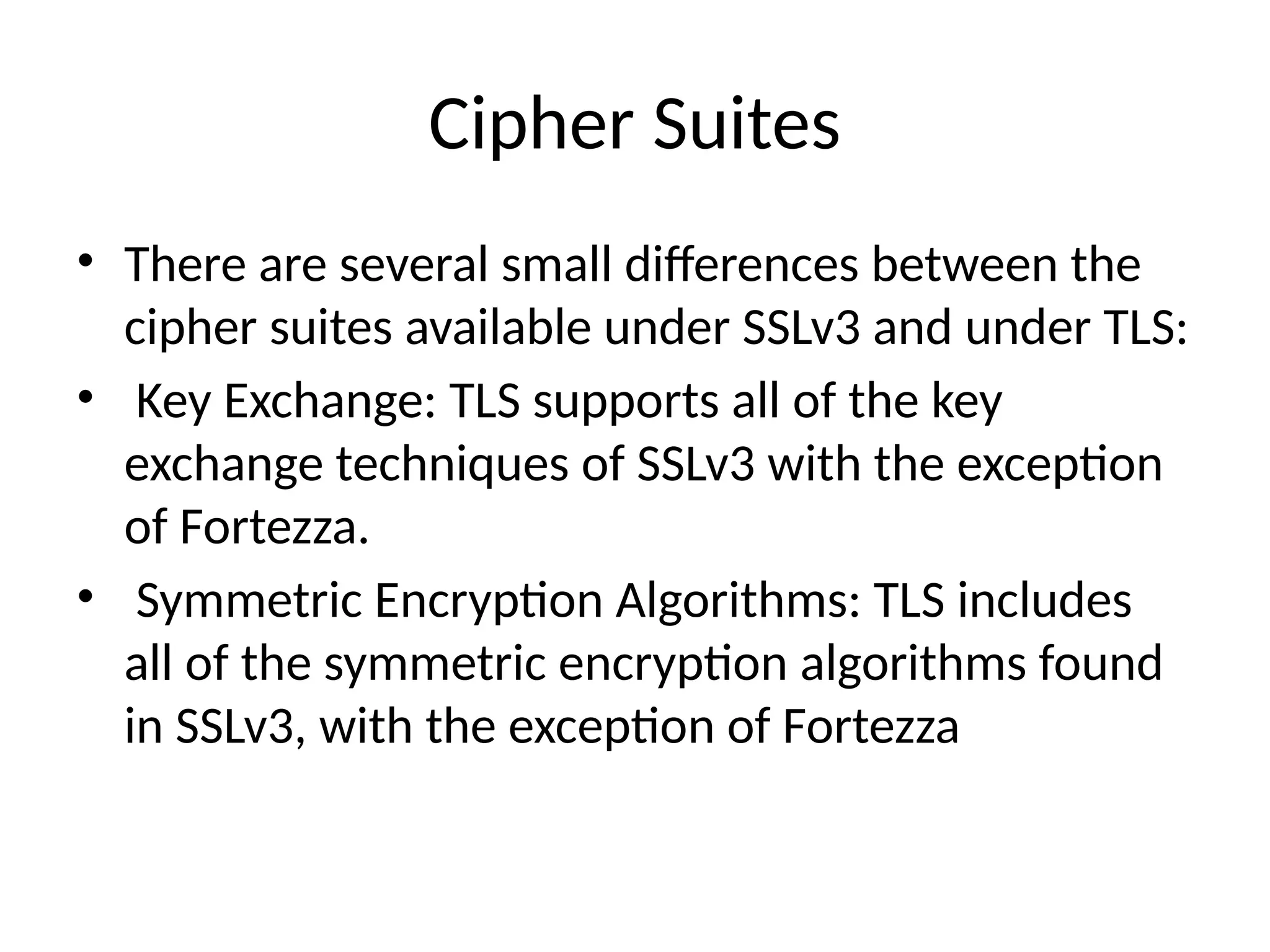
Cipher Suites
• Thereare several small differences between the
cipher suites available under SSLv3 and under TLS:
• Key Exchange: TLS supports all of the key
exchange techniques of SSLv3 with the exception
of Fortezza.
• Symmetric Encryption Algorithms: TLS includes
all of the symmetric encryption algorithms found
in SSLv3, with the exception of Fortezza
81.
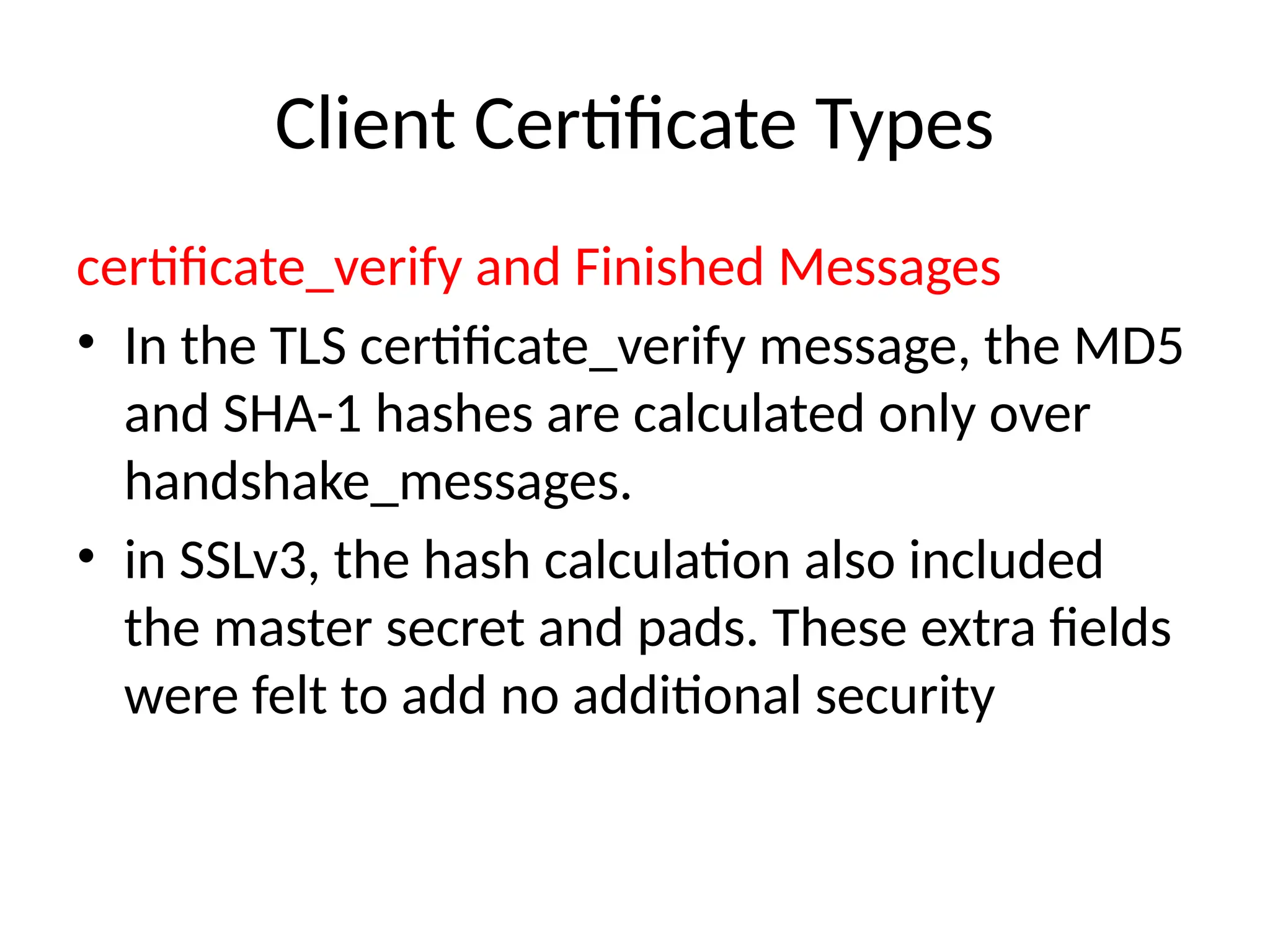
Client Certificate Types
certificate_verifyand Finished Messages
• In the TLS certificate_verify message, the MD5
and SHA-1 hashes are calculated only over
handshake_messages.
• in SSLv3, the hash calculation also included
the master secret and pads. These extra fields
were felt to add no additional security
82.
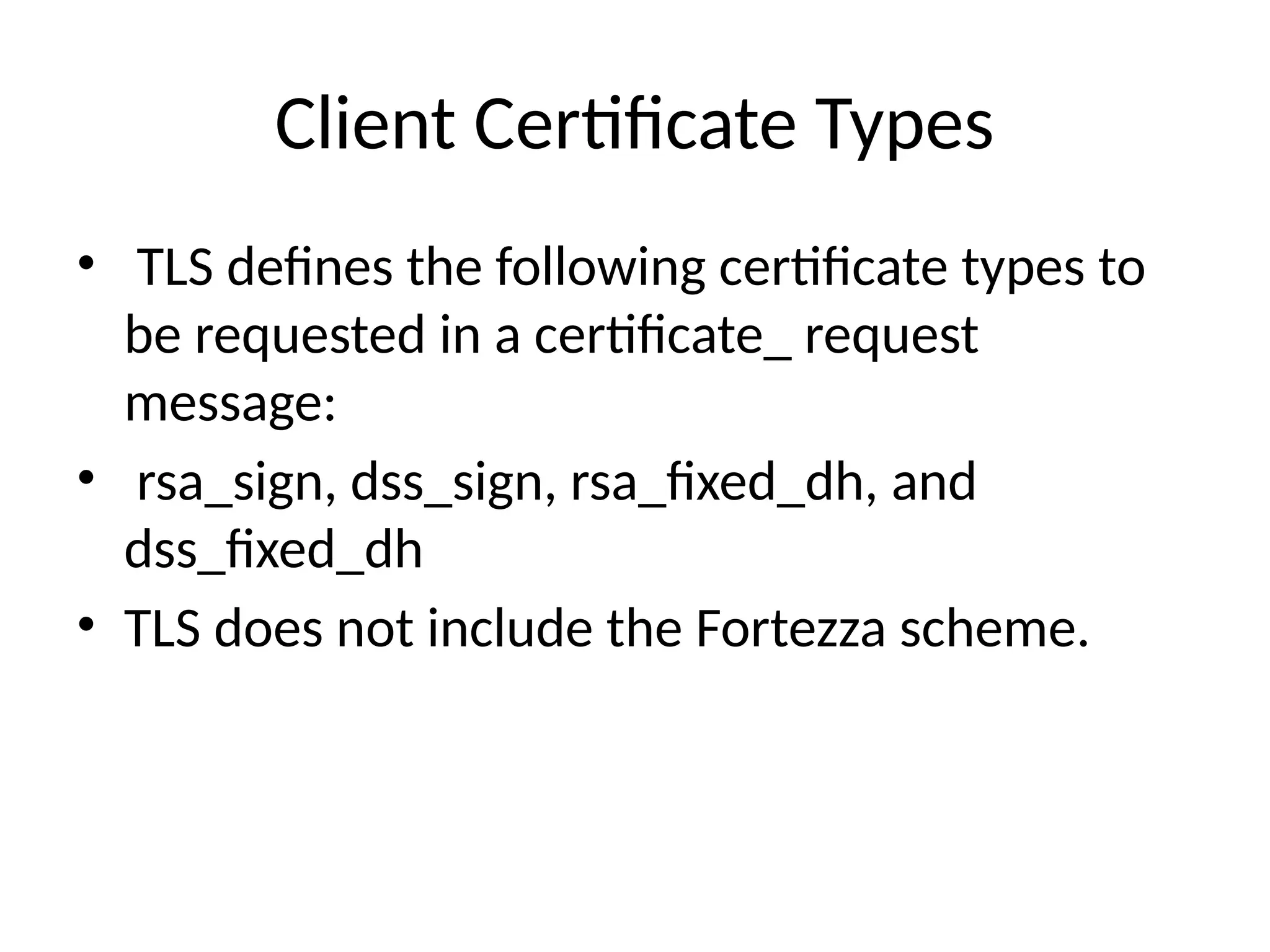
Client Certificate Types
•TLS defines the following certificate types to
be requested in a certificate_ request
message:
• rsa_sign, dss_sign, rsa_fixed_dh, and
dss_fixed_dh
• TLS does not include the Fortezza scheme.
83.
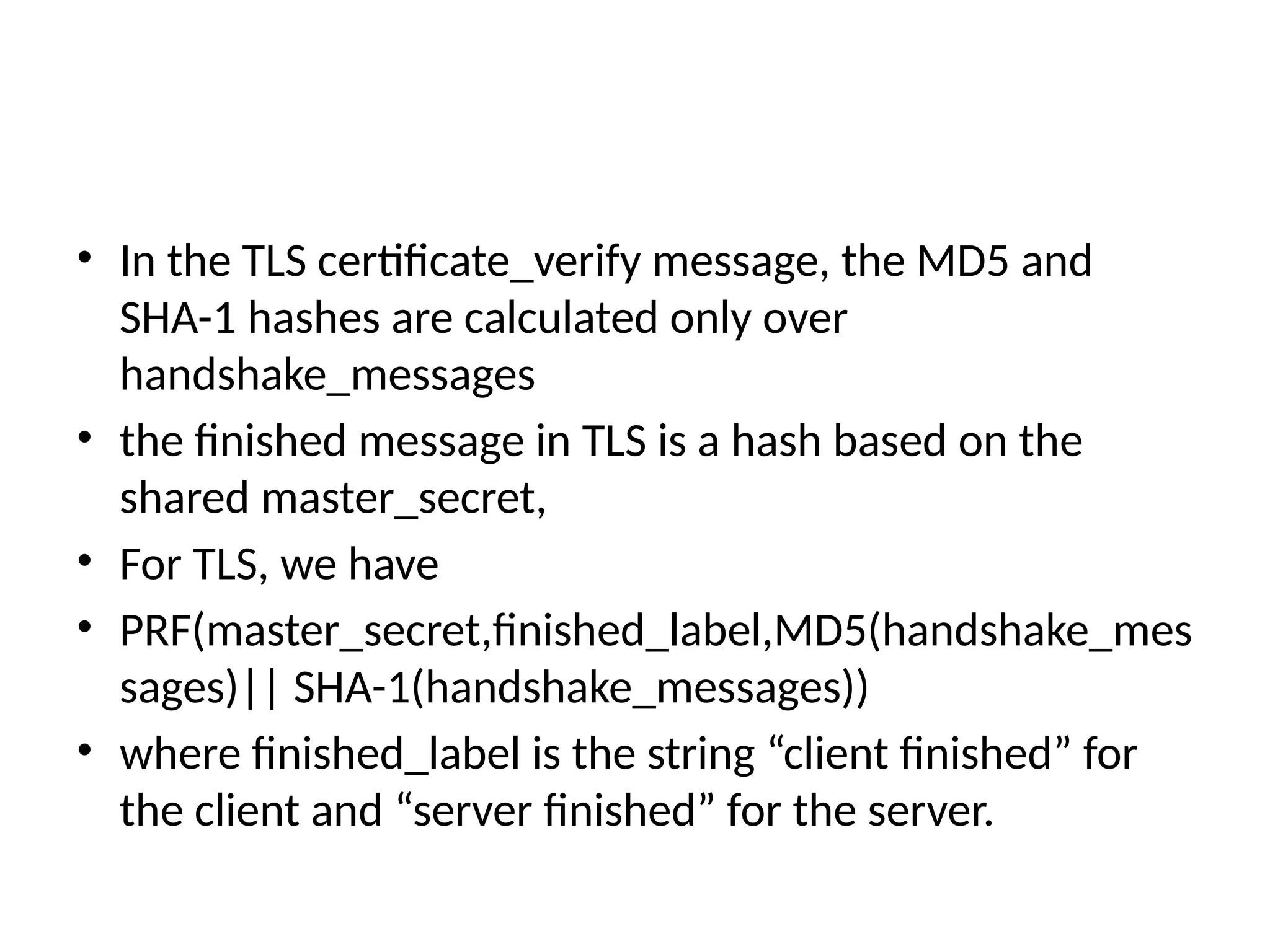
• In theTLS certificate_verify message, the MD5 and
SHA-1 hashes are calculated only over
handshake_messages
• the finished message in TLS is a hash based on the
shared master_secret,
• For TLS, we have
• PRF(master_secret,finished_label,MD5(handshake_mes
sages)|| SHA-1(handshake_messages))
• where finished_label is the string “client finished” for
the client and “server finished” for the server.
84.
Cryptographic Computations
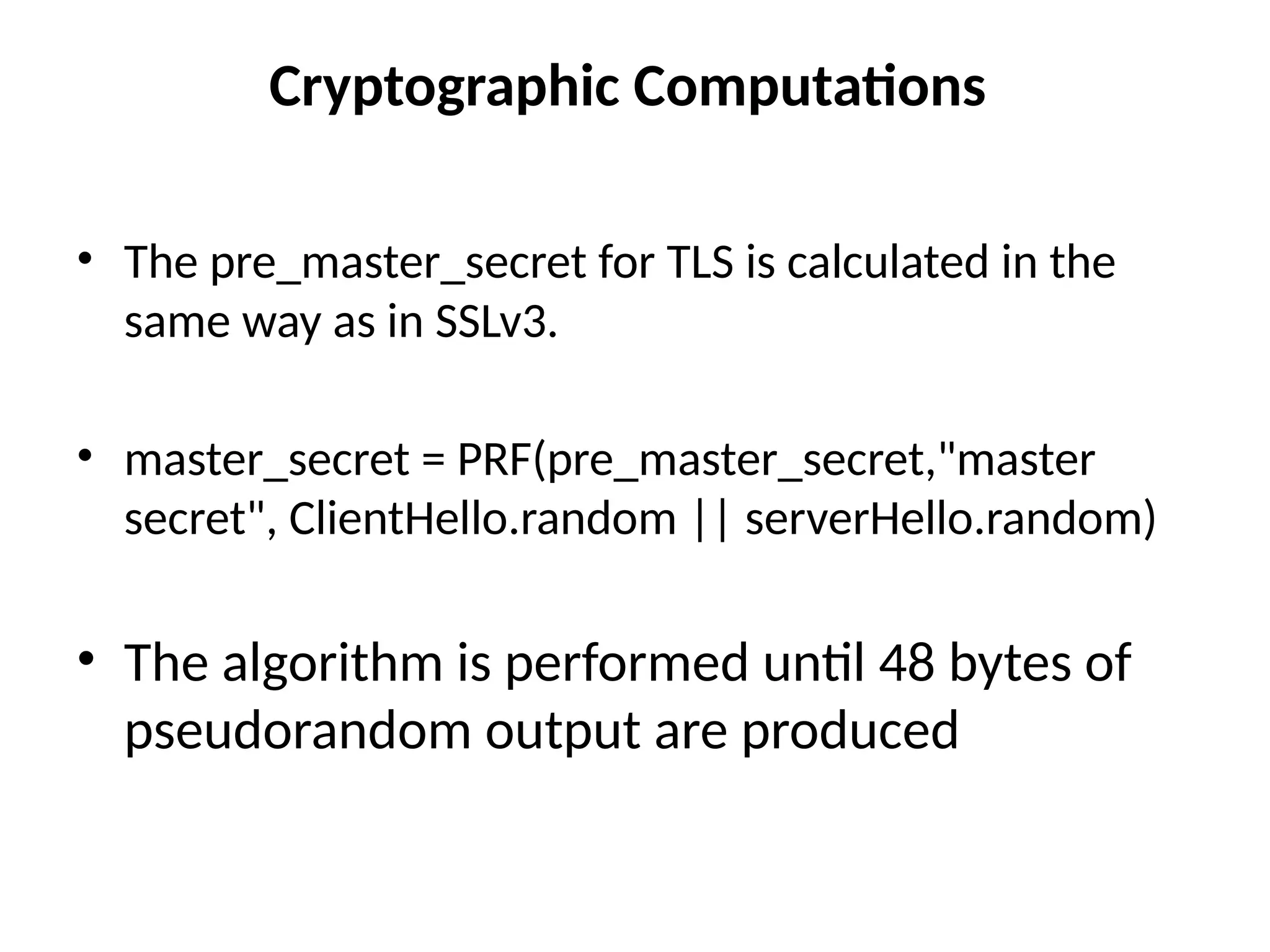
• Thepre_master_secret for TLS is calculated in the
same way as in SSLv3.
• master_secret = PRF(pre_master_secret,"master
secret", ClientHello.random || serverHello.random)
• The algorithm is performed until 48 bytes of
pseudorandom output are produced
85.
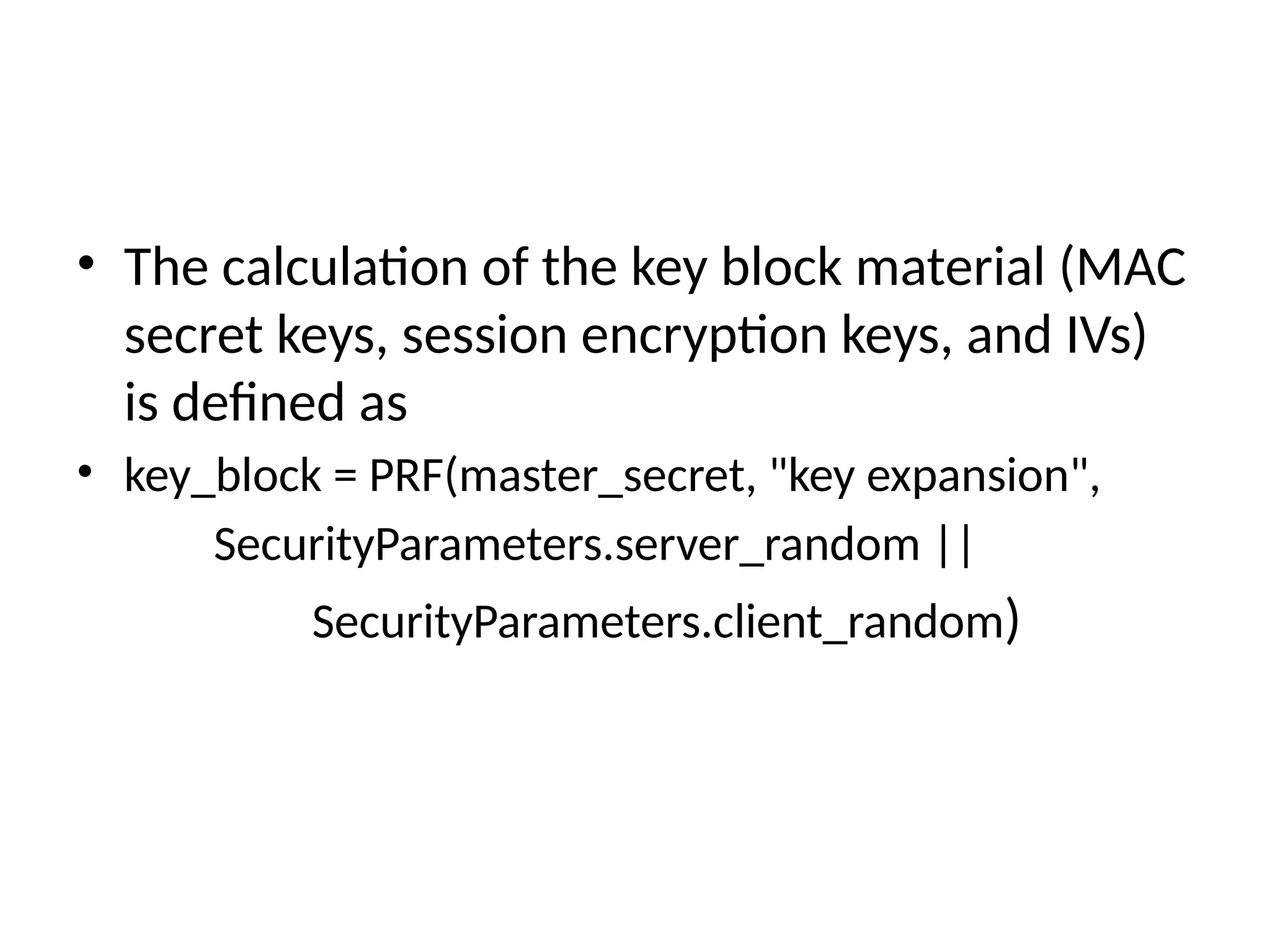
• The calculationof the key block material (MAC
secret keys, session encryption keys, and IVs)
is defined as
• key_block = PRF(master_secret, "key expansion",
SecurityParameters.server_random ||
SecurityParameters.client_random)
86.
Padding
• In SSL,the padding added prior to encryption of user data is the minimum
amount required so that the total size of the data to be encrypted is a multiple
of the cipher’s block length.
• In TLS, the padding can be any amount that results in a total that is a multiple
of the cipher’s block length, up to a maximum of 255 bytes.
• For example, if the plaintext (or compressed text if compression is used) plus
MAC plus padding. length byte is 79 bytes long, then the padding length (in
bytes) can be 1, 9, 17, and so on, up to 249.
• A variable padding length may be used to frustrate attacks based on an analysis
of the lengths of exchanged messages.
87.
HTTPS
• HTTPS (HTTPover SSL) refers to the combination of HTTP and SSL
to implement secure communication between a Web browser and
a Web server
• For example, some search engines do not support HTTPS. Google
provides HTTPS as an option: https://google.com.
• The principal difference seen by a user of a Web browser is that
URL (uniform resource locator) addresses begin with https://
rather than http://.
• A normal HTTP connection uses port 80. If HTTPS is specified, port
443 is used, which invokes SSL.
88.
• When HTTPSis used, the following elements of the
communication are encrypted:
• URL of the requested document
• Contents of the document
• Contents of browser forms (filled in by browser user)
• Cookies sent from browser to server and from server to
browser
• Contents of HTTP header
• HTTPS is documented in RFC 2818, HTTP Over TLS. There is no
fundamental change in using HTTP over either SSL or TLS, and
both implementations are referred to as HTTPS
89.
Secure Shell (SSH)
•Secure Shell (SSH) is a protocol for secure
network communications designed to be
relatively simple and inexpensive to
implement
• SSH client and server applications are widely
available for most operating systems.
• It has become the method of choice for
remote login and X tunneling.
90.
• SSH isa popular protocol used mainly by Linux
and Unix users to connect from one computer
to another.
• The main use of SSH is to establish an
encrypted connection so that nobody in
between can read the traffic
91.
• Remote loginallows an authorized user to login to
other machines (hosts) on a network and to interact
as if the user were physically at the host computer.
• Once logged in to the host, the user can do anything
that the host has given permission for, such as read,
edit, or delete files.
• X is a window system meant to provide a GUI
environment on unix operating system.
• X11 forwarding refers to executing such program
remotely through an SSH connection.
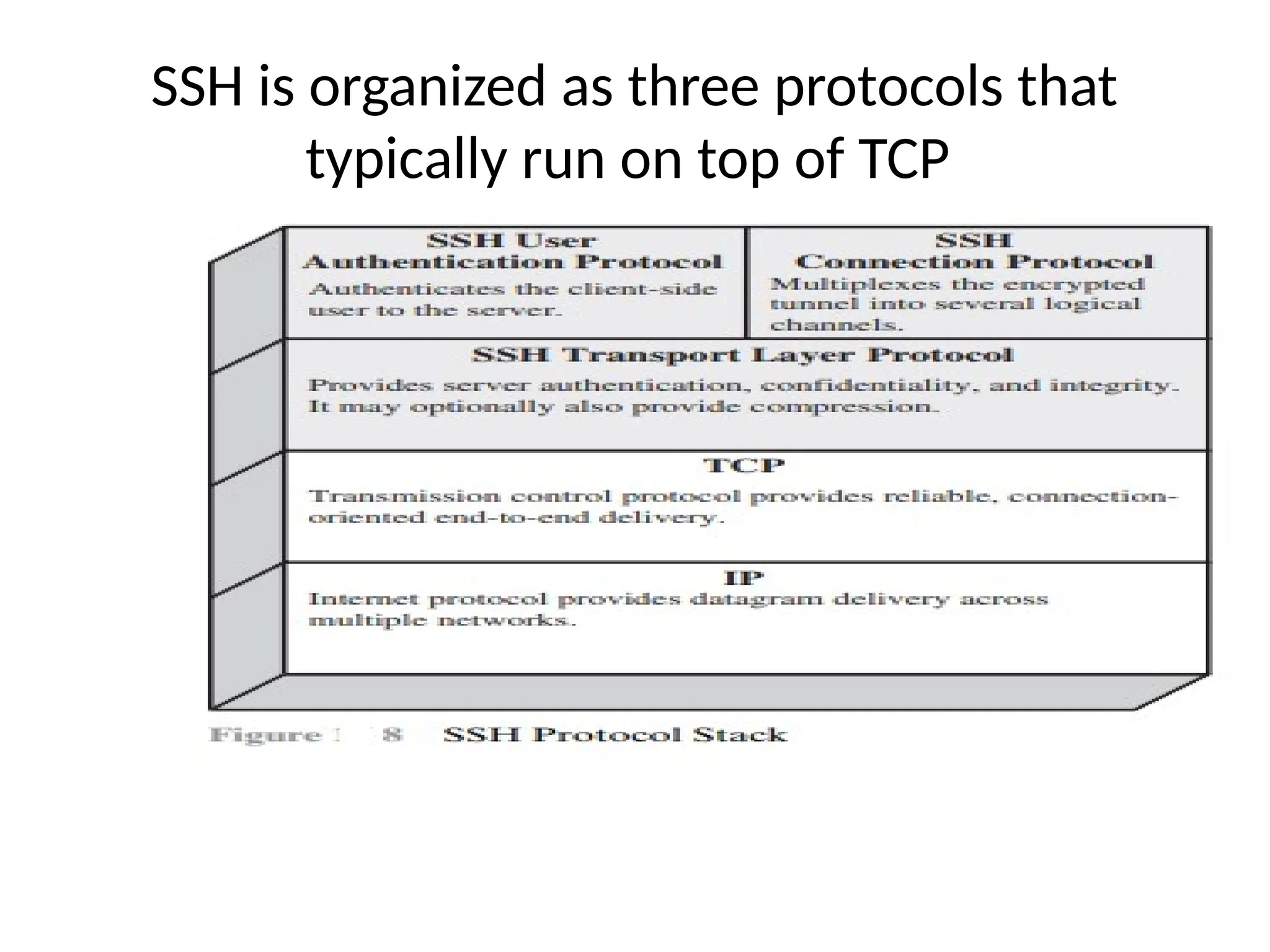
92.
SSH is organizedas three protocols that
typically run on top of TCP
93.
SSH is organizedas three protocols that
typically run on top of TCP
• Transport Layer Protocol: Provides server
authentication, data confidentiality, and data
integrity .The transport layer may optionally
provide compression.
• User Authentication Protocol: Authenticates
the user to the server.
• Connection Protocol: Multiplexes multiple
logical communications channels over a single,
underlying SSH connection.
94.
Transport Layer Protocol
•A host key is a cryptographic key used for
authenticating computers in the SSH protocol.
• Host keys are key pairs, typically using the RSA
, DSA, or ECDSA algorithms. Public host keys
are stored on and/or distributed to SSH clients
, and
• private keys are stored on SSH servers.
95.
• Each host(i.e., computer) should have a
unique host key. Sharing host keys is strongly
not recommended, and can result in
vulnerability to man-in-the-middle attacks.
However, in computing clusters sharing hosts
keys may sometimes be acceptable and
practical.
96.
• SSH clientsstore host keys for hosts they have
ever connected to. These stored host keys are
called known host keys, and the collection is
often called known hosts
97.
Transport Layer Protocol
•A server may have multiple host keys using
multiple different asymmetric encryption
algorithms.
• Multiple hosts may share the same host key. In
any case, the server host key is used during key
exchange to authenticate the identity of the host.
• For this to be possible, the client must have a
priori knowledge of the server’s public host key.
98.
RFC 4251 dictatestwo alternative trust models that can be used:
• 1. The client has a local database that associates each host name
(as typed by the user) with the corresponding public host key. This
method requires no centrally administered infrastructure and no
third-party coordination. The downside is that the database of
name-to-key associations may become burdensome to maintain.
• 2. The host name-to-key association is certified by a trusted
certification authority (CA). The client only knows the CA root key
and can verify the validity of all host keys certified by accepted
CAs. This alternative eases the maintenance problem, since
ideally, only a single CA key needs to be securely stored on the
client. On the other hand, each host key must be appropriately
certified by a central authority before authorization is possible.
99.
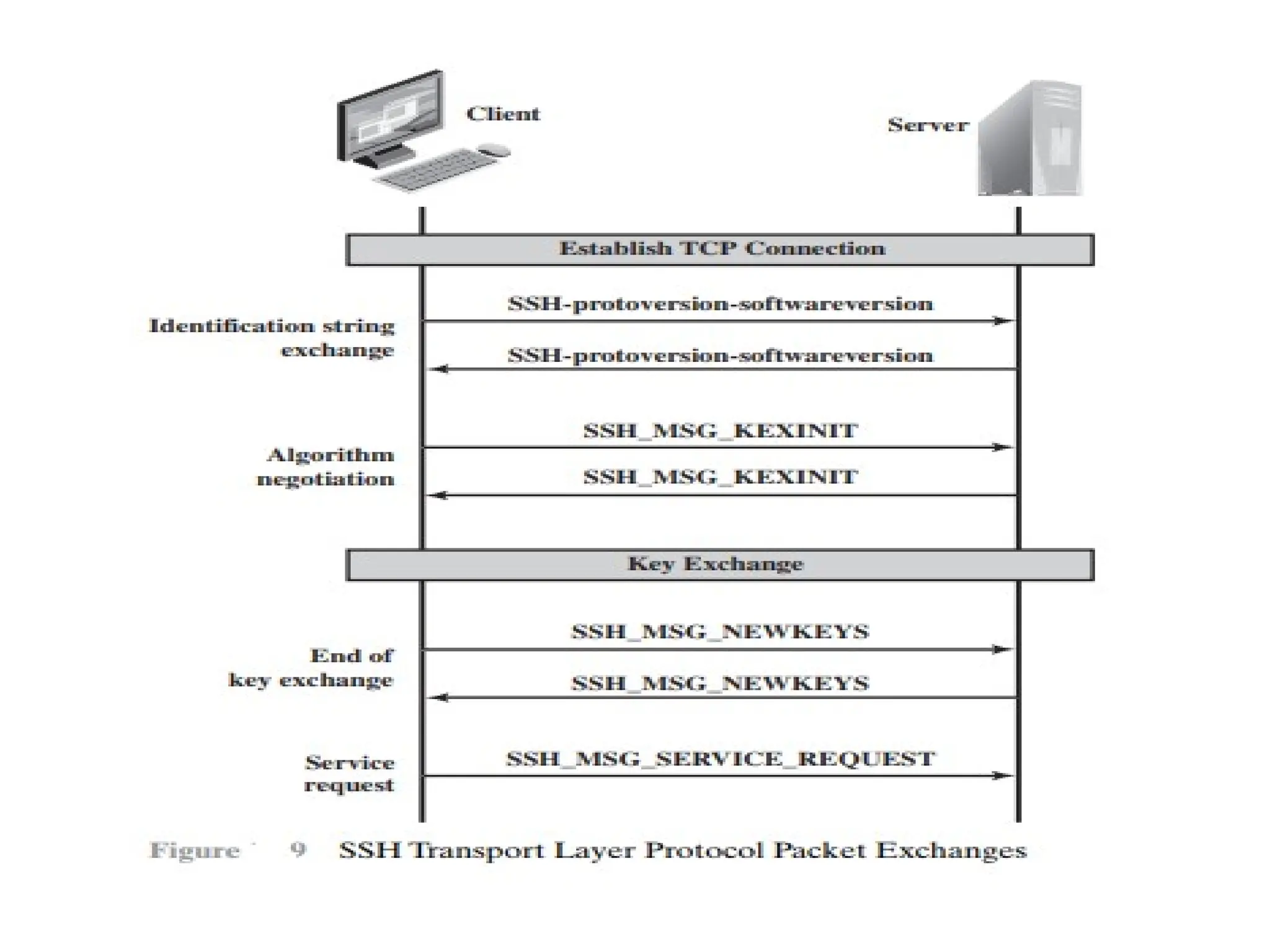
• Packet Exchange:Fig illustrates the sequence of
events in the SSH Transport Layer Protocol.
• First, the client establishes a TCP connection to
the server. This is done via the TCP protocol.
• Once the connection is established, the client
and server exchange data, referred to as
packets, in the data field of a TCP segment.
• Each packet is in the following format .
100.
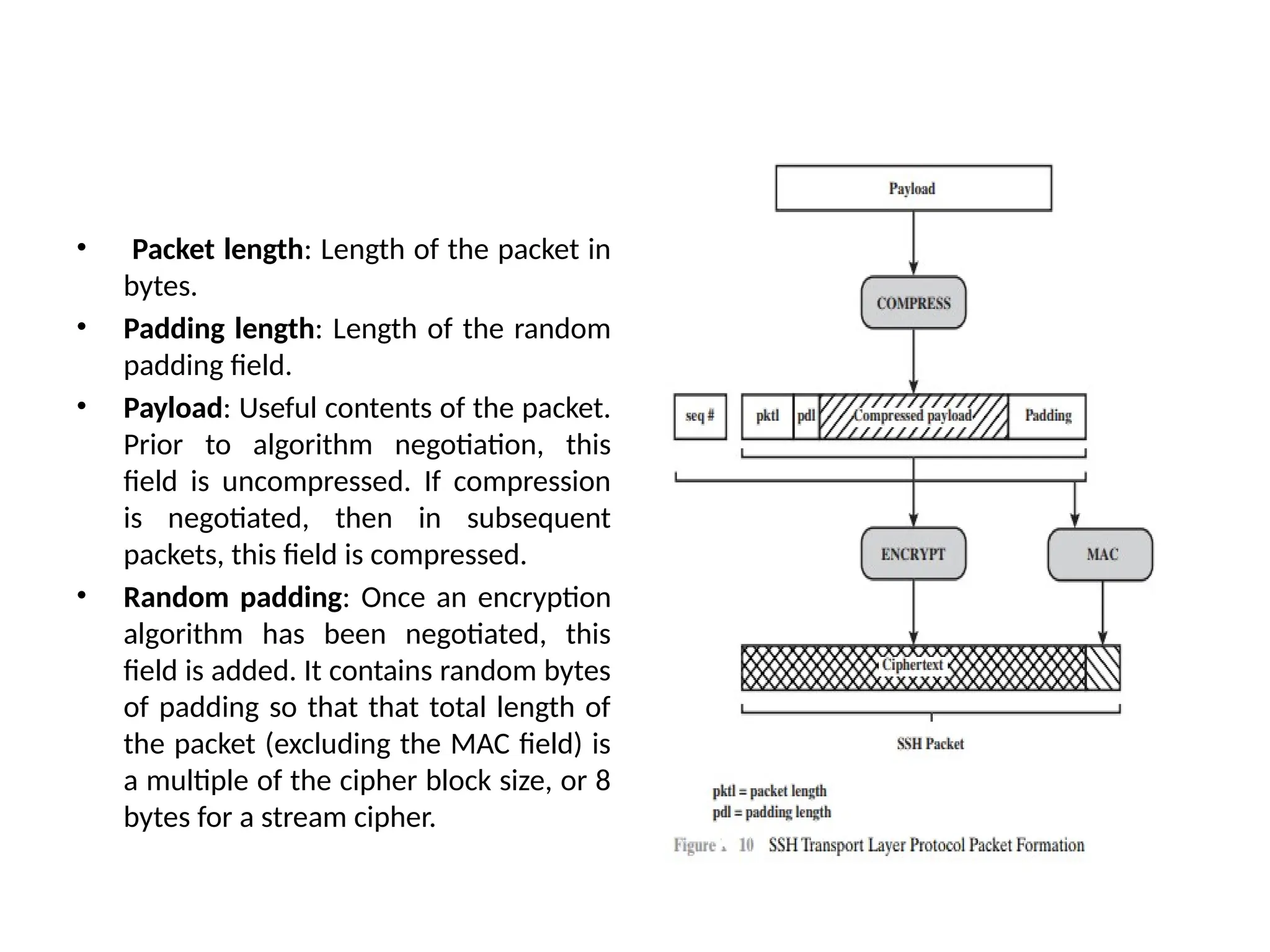
• Packet length:Length of the packet in
bytes.
• Padding length: Length of the random
padding field.
• Payload: Useful contents of the packet.
Prior to algorithm negotiation, this
field is uncompressed. If compression
is negotiated, then in subsequent
packets, this field is compressed.
• Random padding: Once an encryption
algorithm has been negotiated, this
field is added. It contains random bytes
of padding so that that total length of
the packet (excluding the MAC field) is
a multiple of the cipher block size, or 8
bytes for a stream cipher.
101.
• Message authenticationcode (MAC): If message
authentication has been negotiated, this field contains
the MAC value.
• The MAC value is computed over the entire packet plus
a sequence number, excluding the MAC field.
• The sequence number is an implicit 32-bit packet
sequence that is initialized to zero for the first packet
and incremented for every packet.
• sequence number is not included in the packet sent
over the TCP connection.
102.
• Once anencryption algorithm has been
negotiated, the entire packet (excluding the
MAC field) is encrypted after the MAC value is
calculated
104.
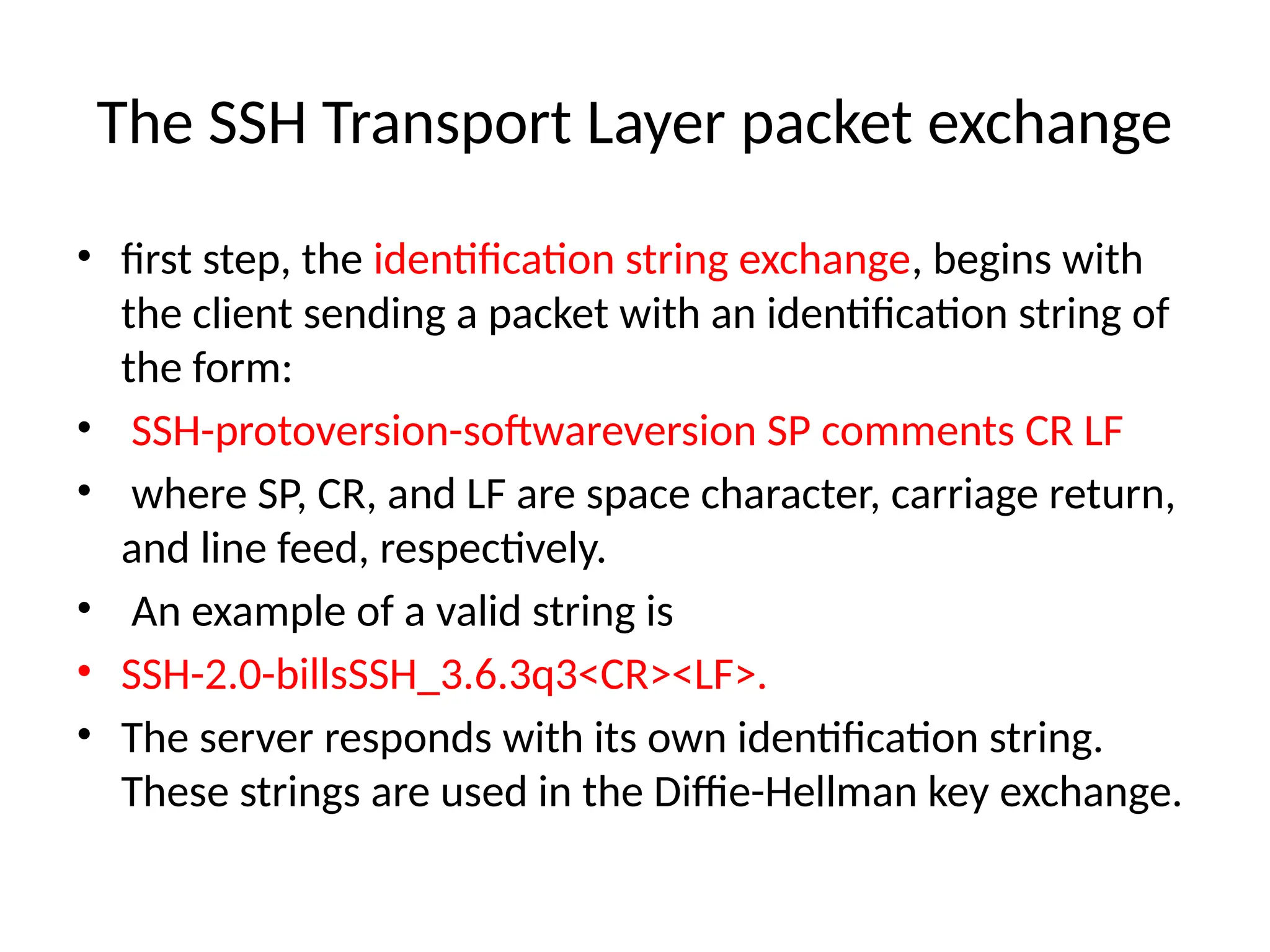
The SSH TransportLayer packet exchange
• first step, the identification string exchange, begins with
the client sending a packet with an identification string of
the form:
• SSH-protoversion-softwareversion SP comments CR LF
• where SP, CR, and LF are space character, carriage return,
and line feed, respectively.
• An example of a valid string is
• SSH-2.0-billsSSH_3.6.3q3<CR><LF>.
• The server responds with its own identification string.
These strings are used in the Diffie-Hellman key exchange.
105.
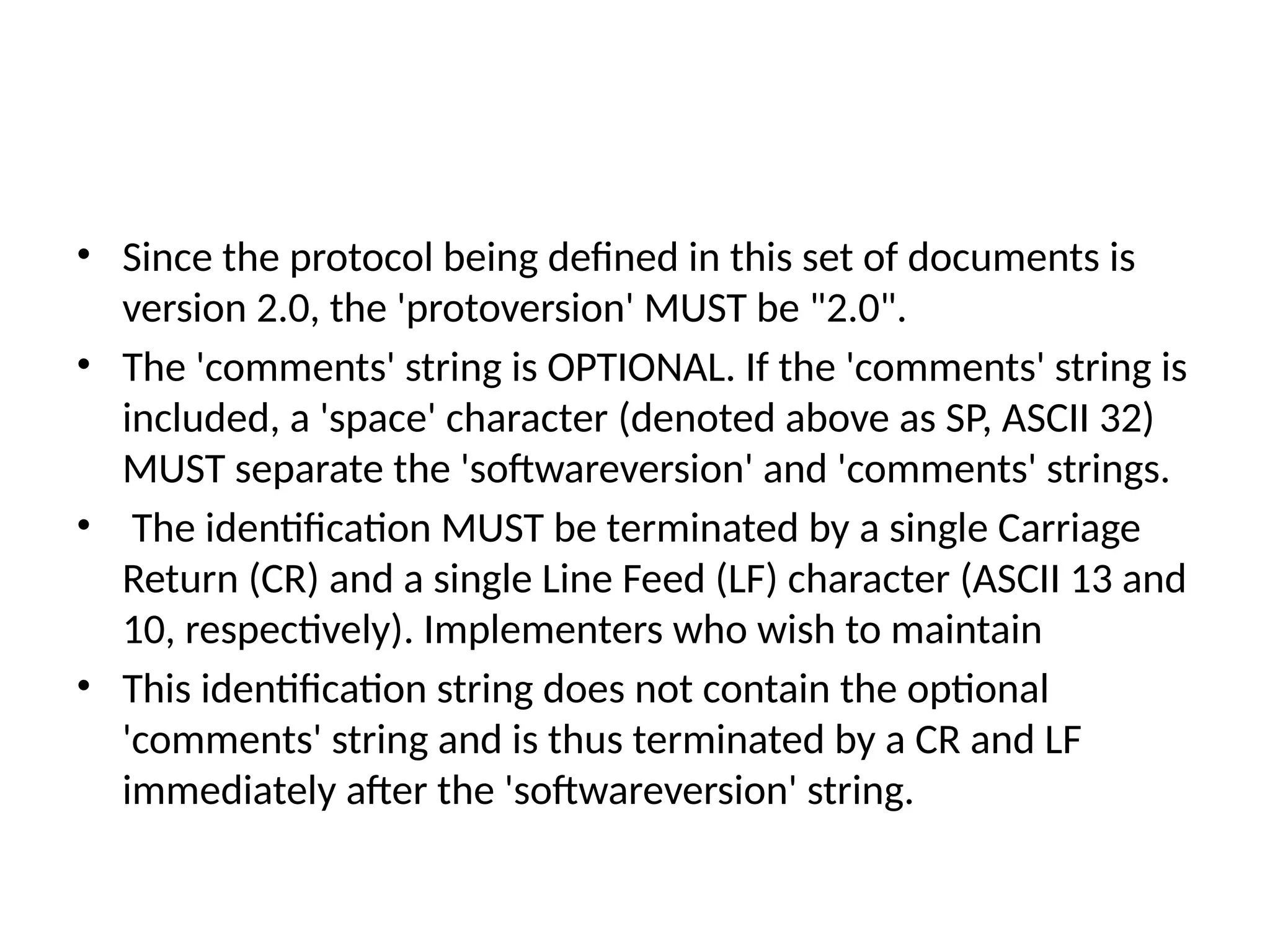
• Since theprotocol being defined in this set of documents is
version 2.0, the 'protoversion' MUST be "2.0".
• The 'comments' string is OPTIONAL. If the 'comments' string is
included, a 'space' character (denoted above as SP, ASCII 32)
MUST separate the 'softwareversion' and 'comments' strings.
• The identification MUST be terminated by a single Carriage
Return (CR) and a single Line Feed (LF) character (ASCII 13 and
10, respectively). Implementers who wish to maintain
• This identification string does not contain the optional
'comments' string and is thus terminated by a CR and LF
immediately after the 'softwareversion' string.
106.
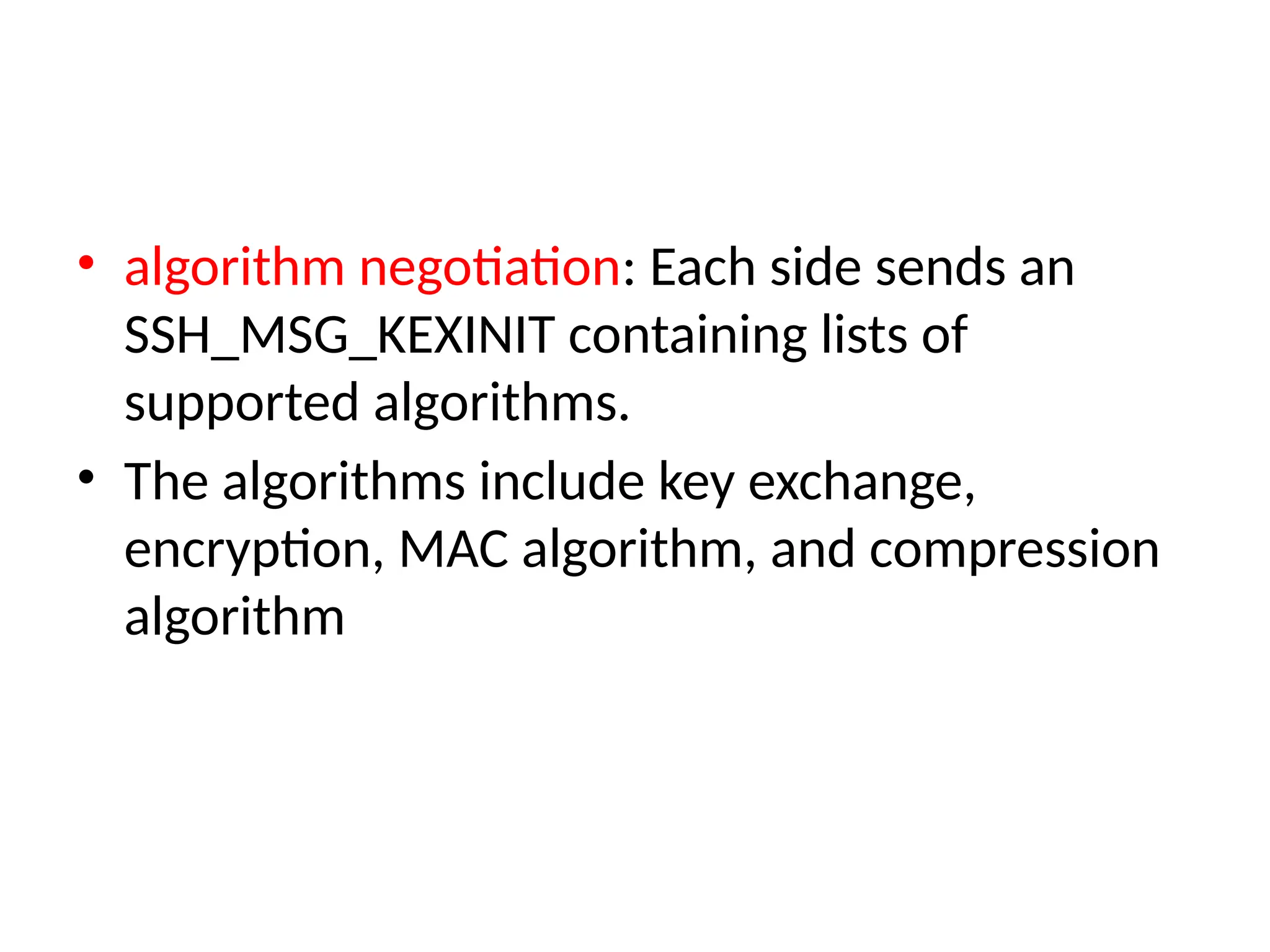
• algorithm negotiation:Each side sends an
SSH_MSG_KEXINIT containing lists of
supported algorithms.
• The algorithms include key exchange,
encryption, MAC algorithm, and compression
algorithm
107.
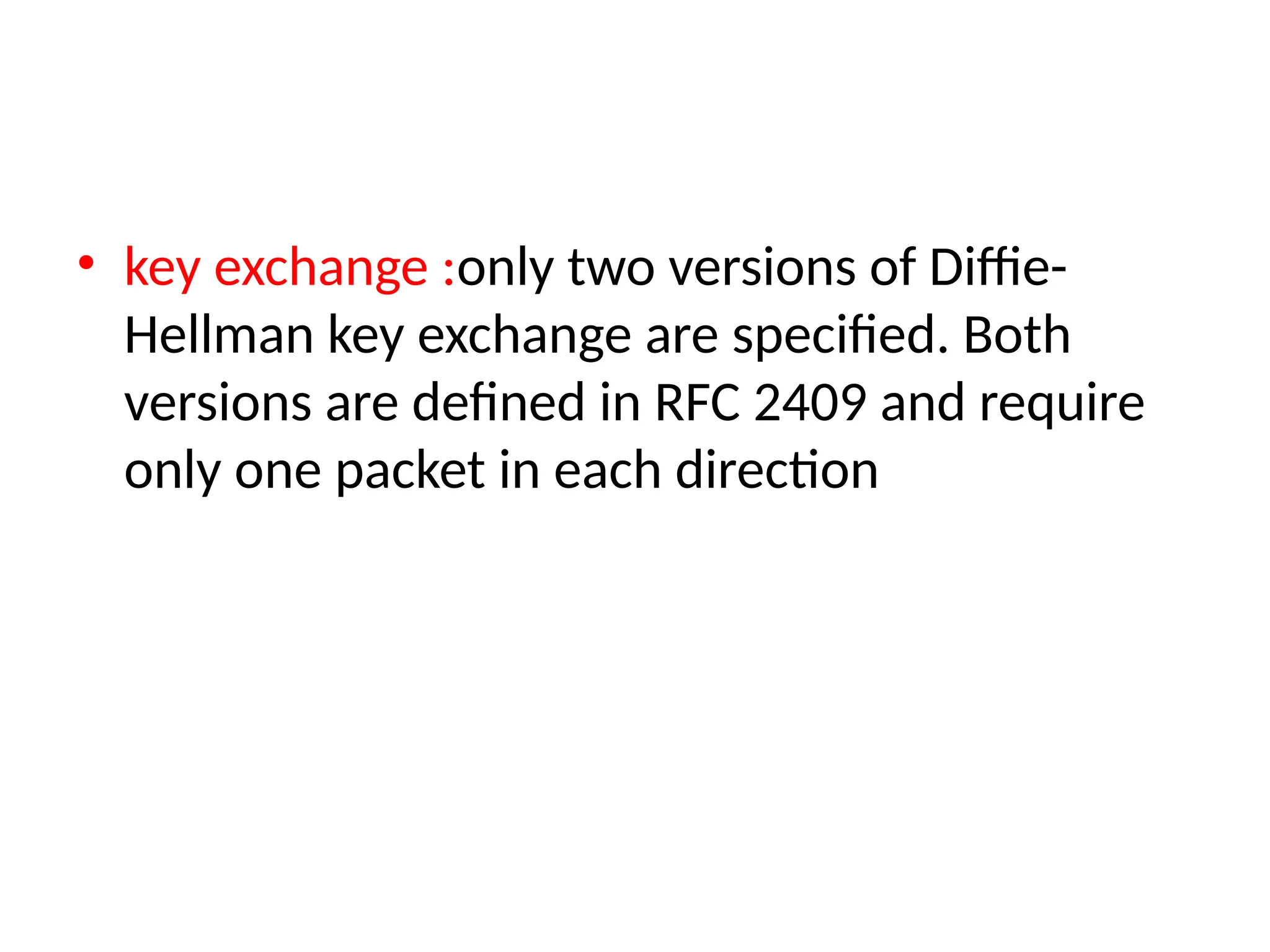
• key exchange:only two versions of Diffie-
Hellman key exchange are specified. Both
versions are defined in RFC 2409 and require
only one packet in each direction
108.
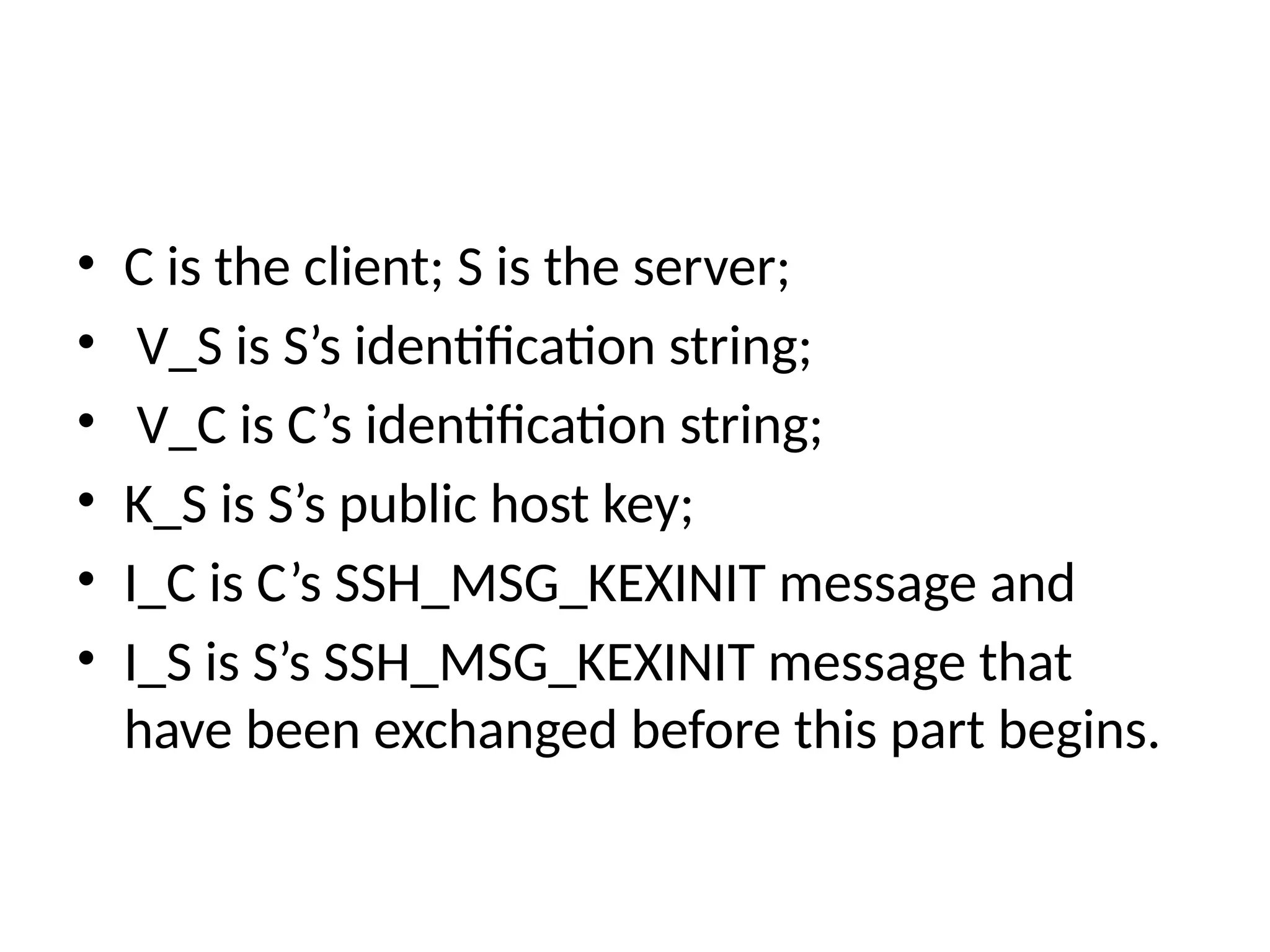
• C isthe client; S is the server;
• V_S is S’s identification string;
• V_C is C’s identification string;
• K_S is S’s public host key;
• I_C is C’s SSH_MSG_KEXINIT message and
• I_S is S’s SSH_MSG_KEXINIT message that
have been exchanged before this part begins.
109.
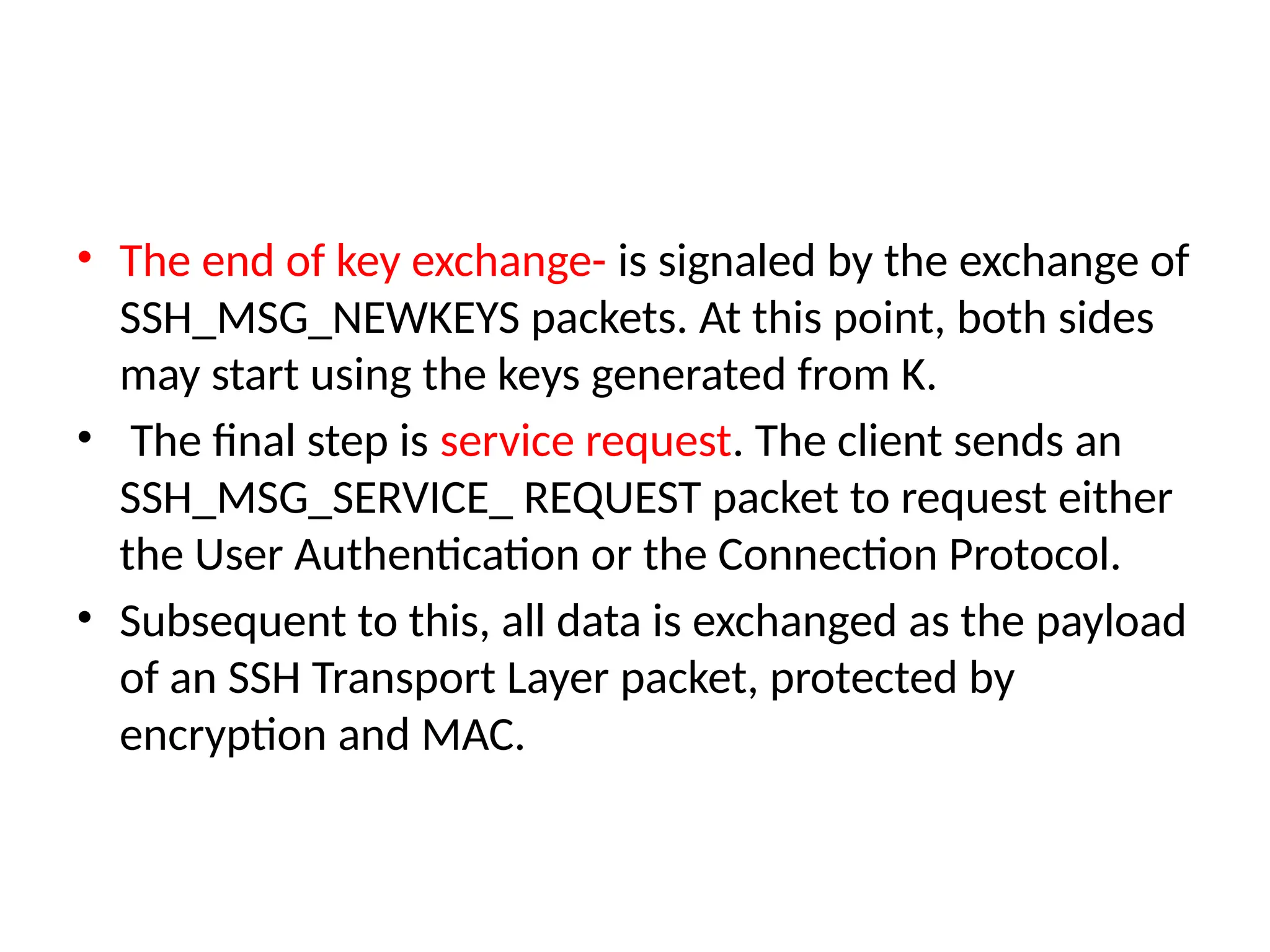
• The endof key exchange- is signaled by the exchange of
SSH_MSG_NEWKEYS packets. At this point, both sides
may start using the keys generated from K.
• The final step is service request. The client sends an
SSH_MSG_SERVICE_ REQUEST packet to request either
the User Authentication or the Connection Protocol.
• Subsequent to this, all data is exchanged as the payload
of an SSH Transport Layer packet, protected by
encryption and MAC.
110.
Key Generation
• Thekey exchange produces two values: a shared
secret K, and an exchange hash H. Encryption and
authentication keys are derived from these.
• and the session identifier, which is equal to H.
• The values are computed as follows.
• HASH(K || H || "A" || session_id) (Here K is
encoded as mpint and "A" as byte and session_id
as raw data. "A" means the single character A,
ASCII 65).
111.
• Mpint isa data type ,represents multiple
precision integers in to two’s complement
format.
• stored as string .
112.
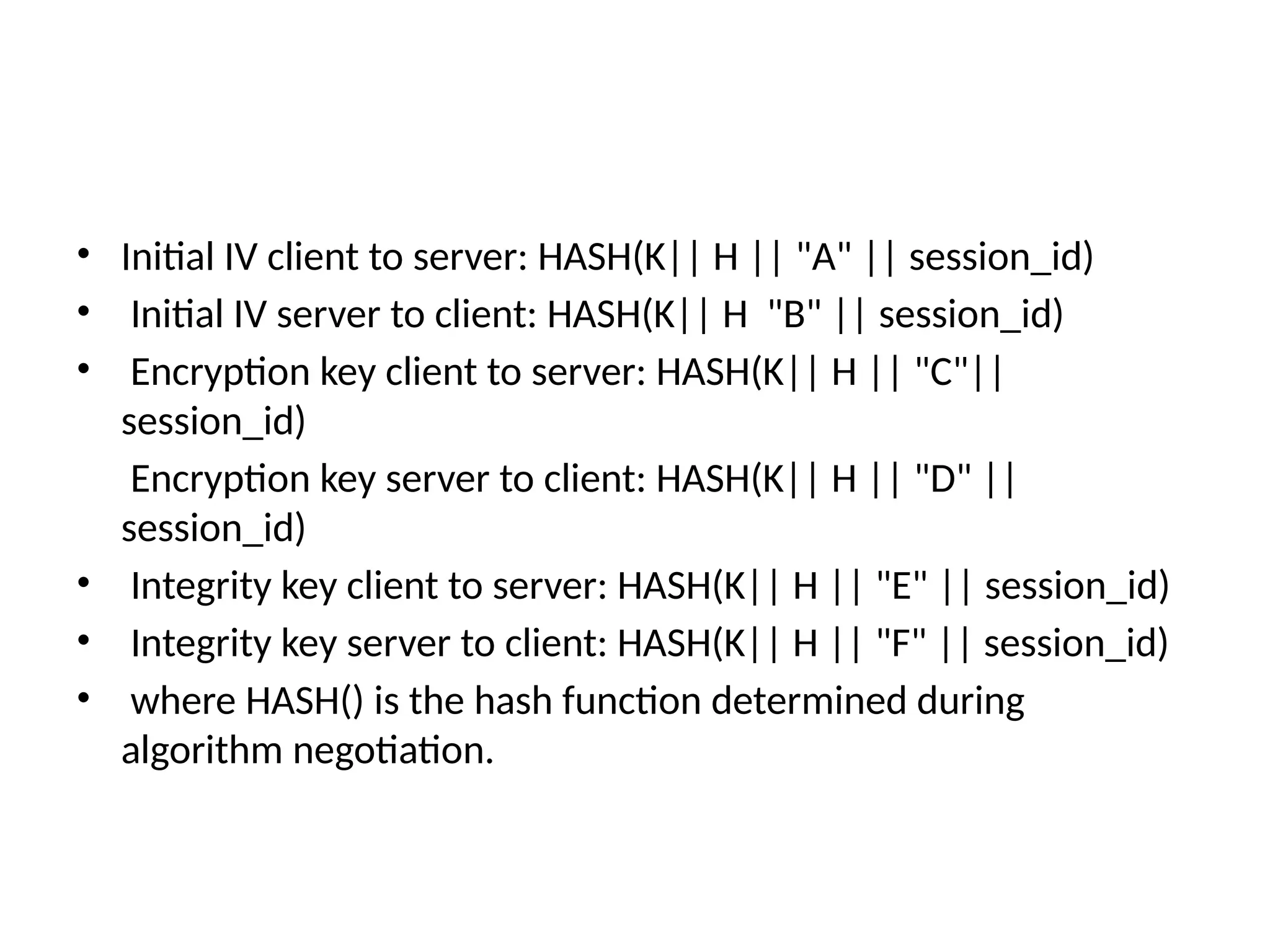
• Initial IVclient to server: HASH(K|| H || "A" || session_id)
• Initial IV server to client: HASH(K|| H "B" || session_id)
• Encryption key client to server: HASH(K|| H || "C"||
session_id)
Encryption key server to client: HASH(K|| H || "D" ||
session_id)
• Integrity key client to server: HASH(K|| H || "E" || session_id)
• Integrity key server to client: HASH(K|| H || "F" || session_id)
• where HASH() is the hash function determined during
algorithm negotiation.
113.
User Authentication Protocol
•User Authentication Protocol provides the
means by which the client is authenticated to
the server.
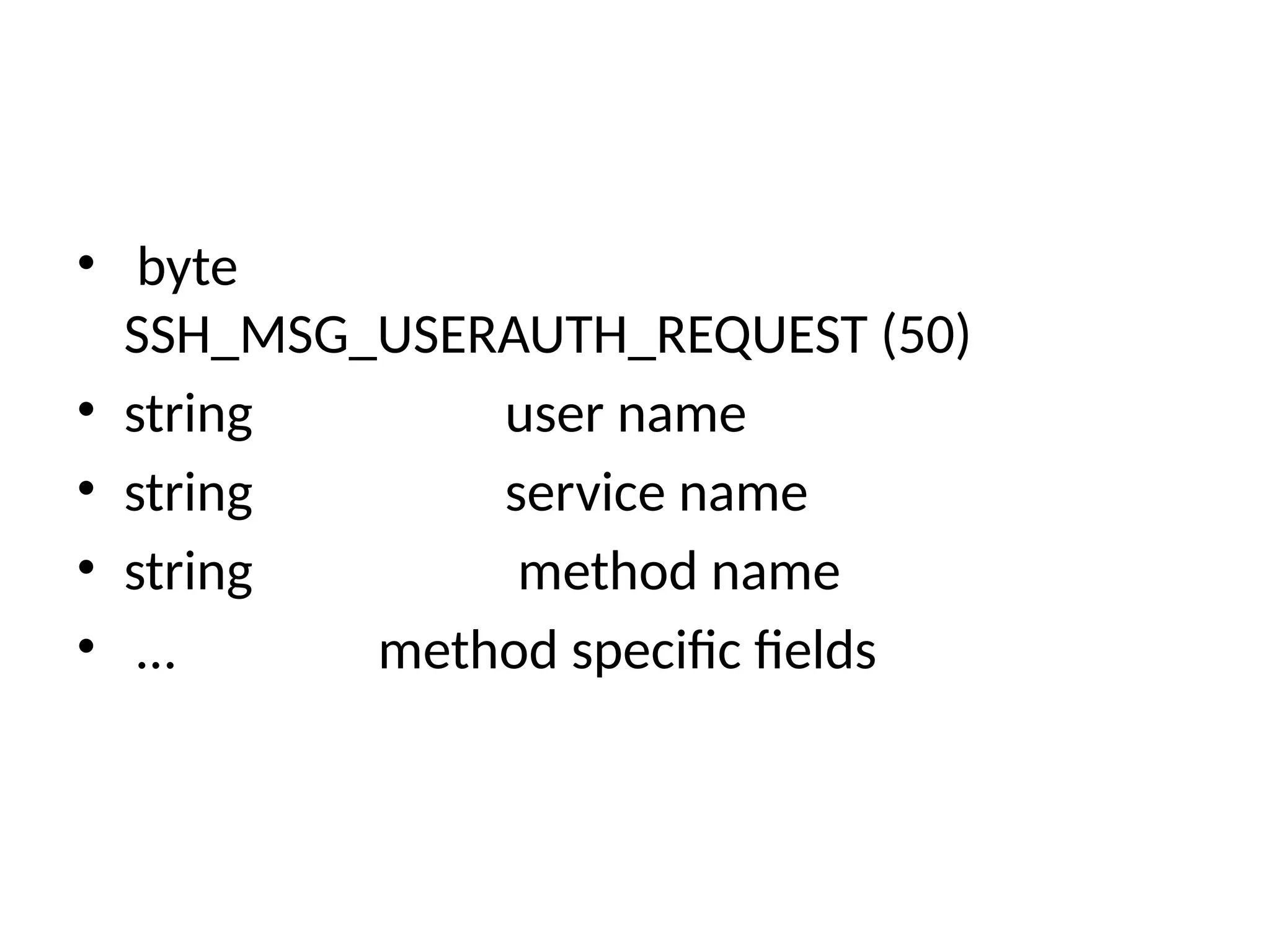
• message Types and Formats Three types of
messages are always used in the User
Authentication Protocol.
• Authentication requests from the client have
the format
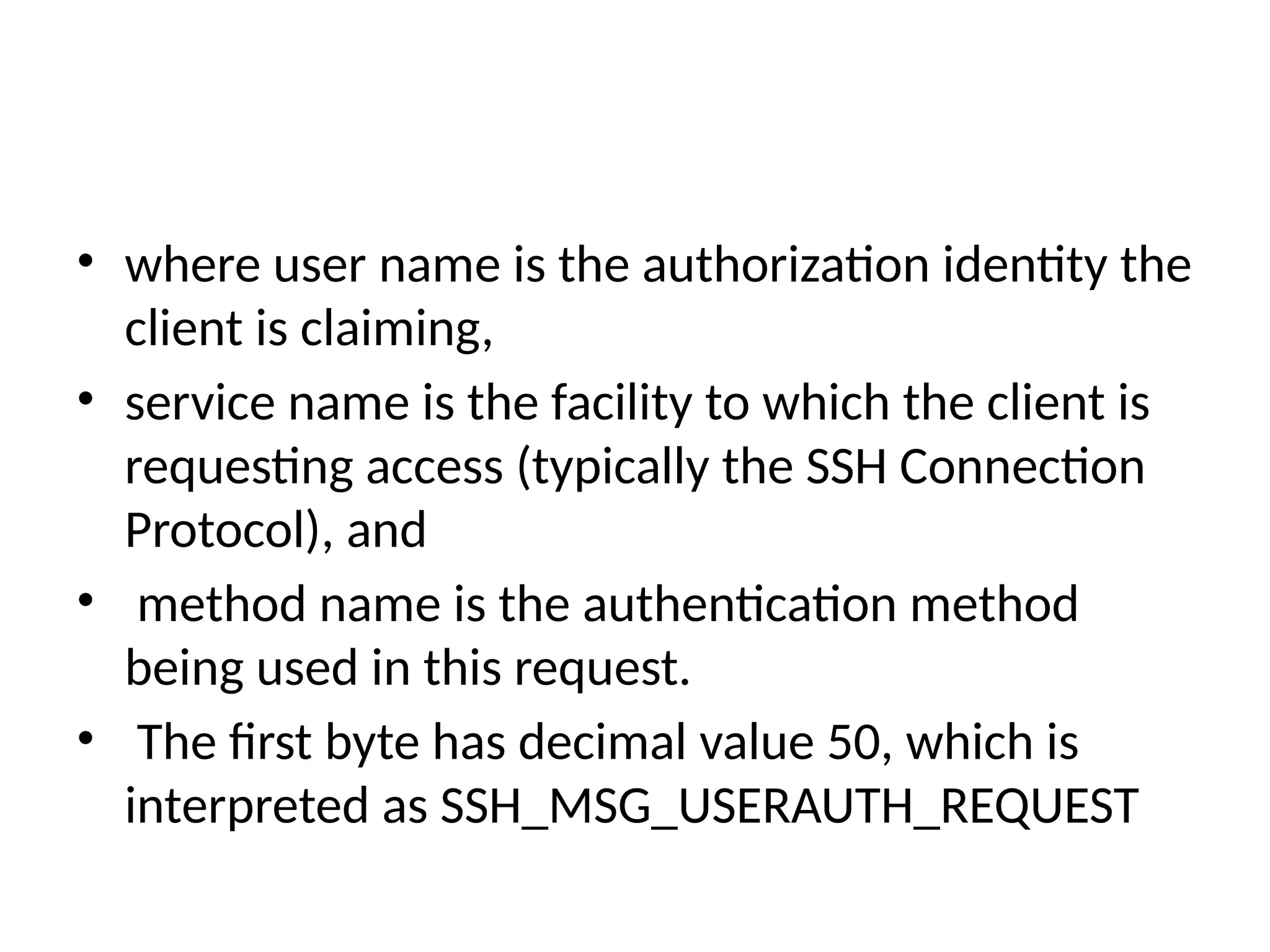
• where username is the authorization identity the
client is claiming,
• service name is the facility to which the client is
requesting access (typically the SSH Connection
Protocol), and
• method name is the authentication method
being used in this request.
• The first byte has decimal value 50, which is
interpreted as SSH_MSG_USERAUTH_REQUEST
116.
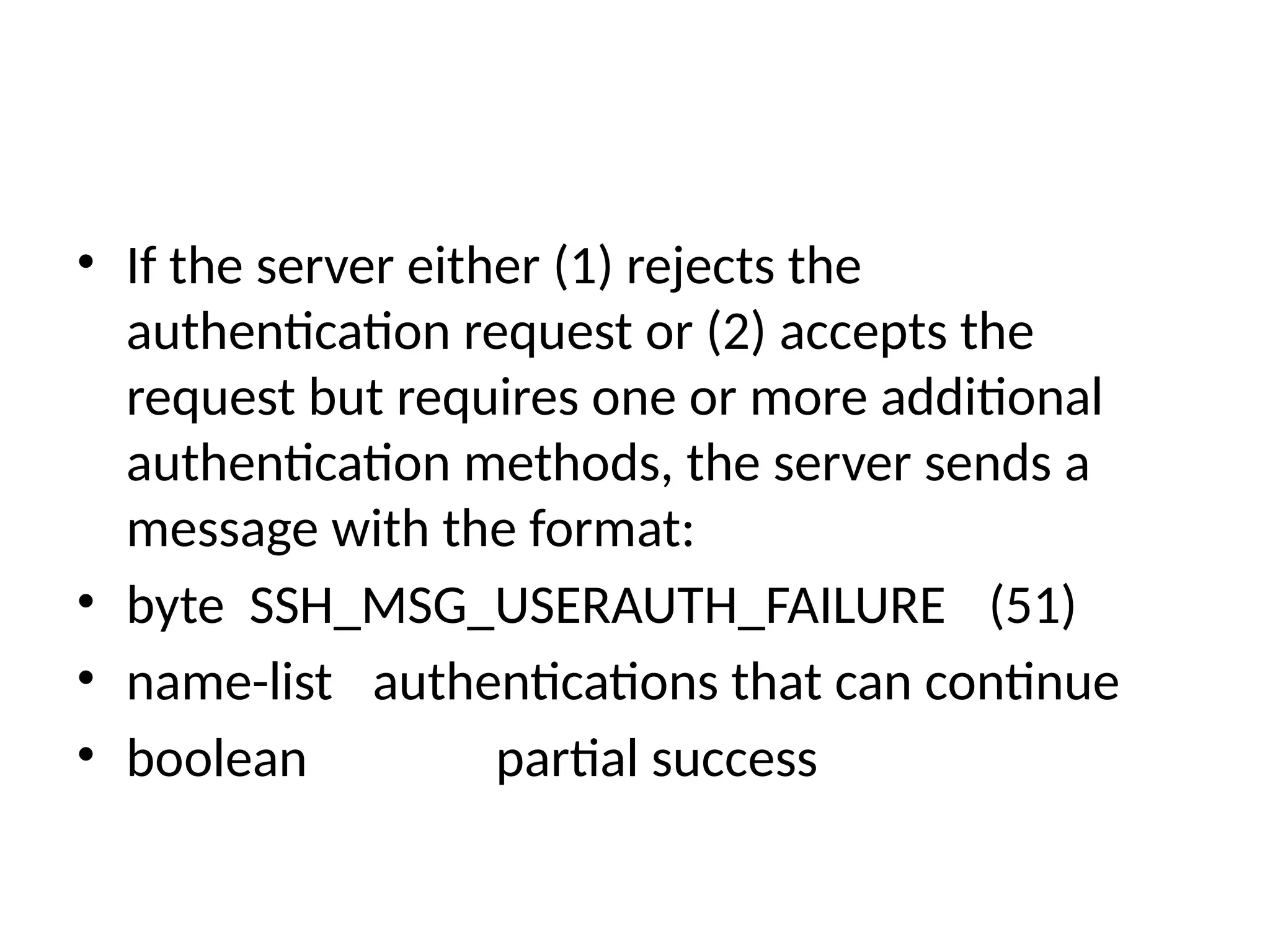
• If theserver either (1) rejects the
authentication request or (2) accepts the
request but requires one or more additional
authentication methods, the server sends a
message with the format:
• byte SSH_MSG_USERAUTH_FAILURE (51)
• name-list authentications that can continue
• boolean partial success
117.
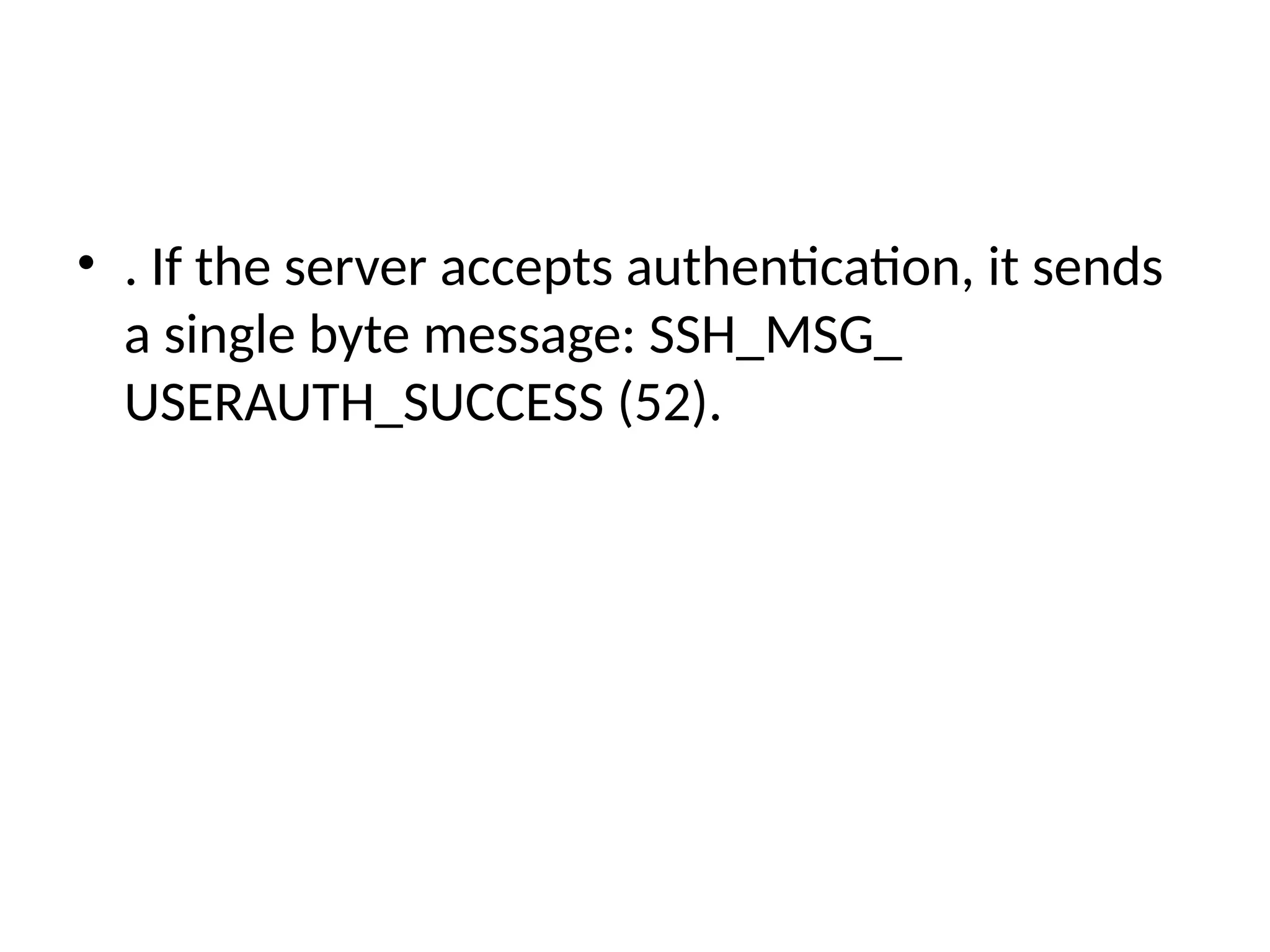
• . Ifthe server accepts authentication, it sends
a single byte message: SSH_MSG_
USERAUTH_SUCCESS (52).
118.
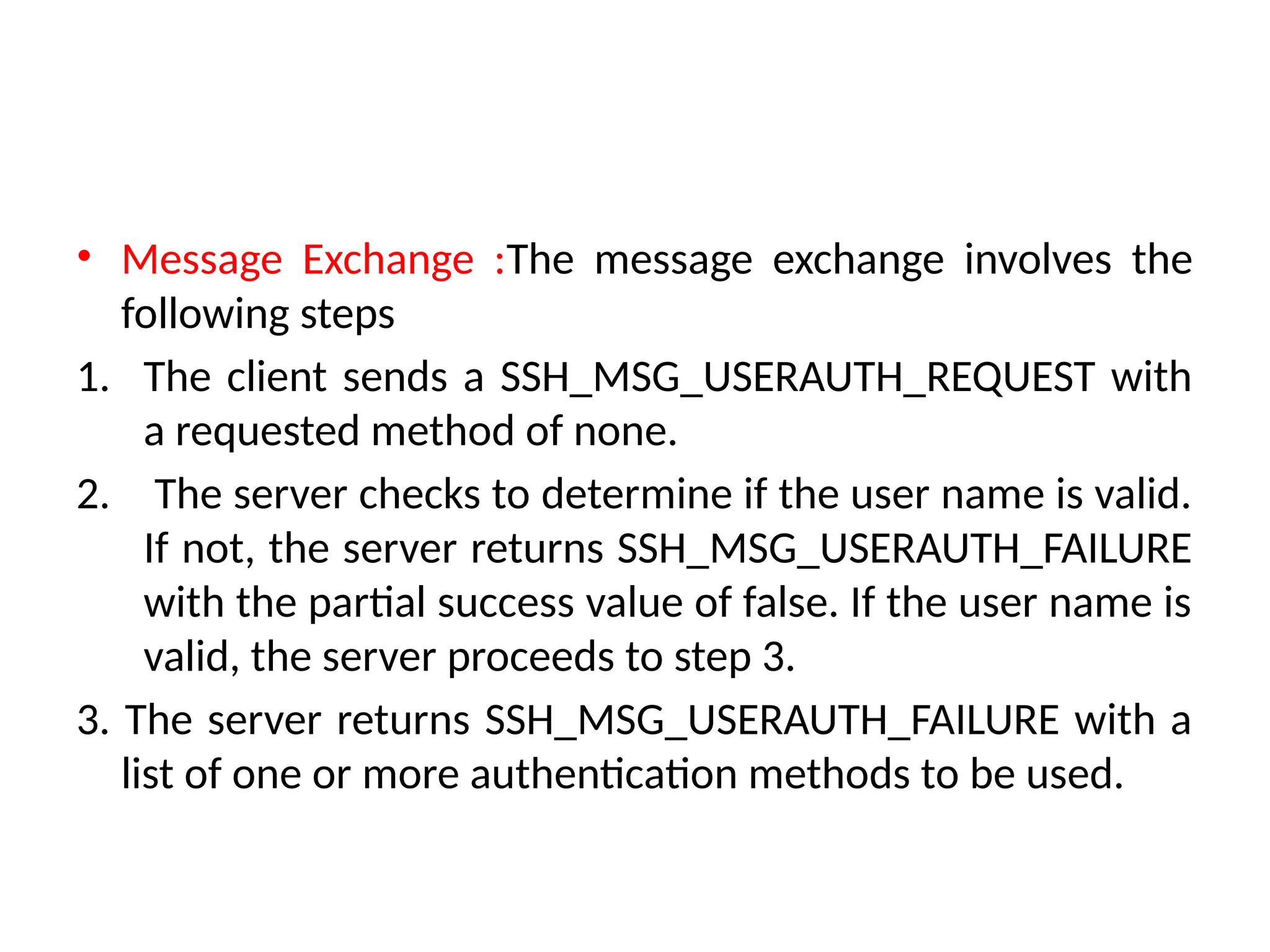
• Message Exchange:The message exchange involves the
following steps
1. The client sends a SSH_MSG_USERAUTH_REQUEST with
a requested method of none.
2. The server checks to determine if the user name is valid.
If not, the server returns SSH_MSG_USERAUTH_FAILURE
with the partial success value of false. If the user name is
valid, the server proceeds to step 3.
3. The server returns SSH_MSG_USERAUTH_FAILURE with a
list of one or more authentication methods to be used.
119.
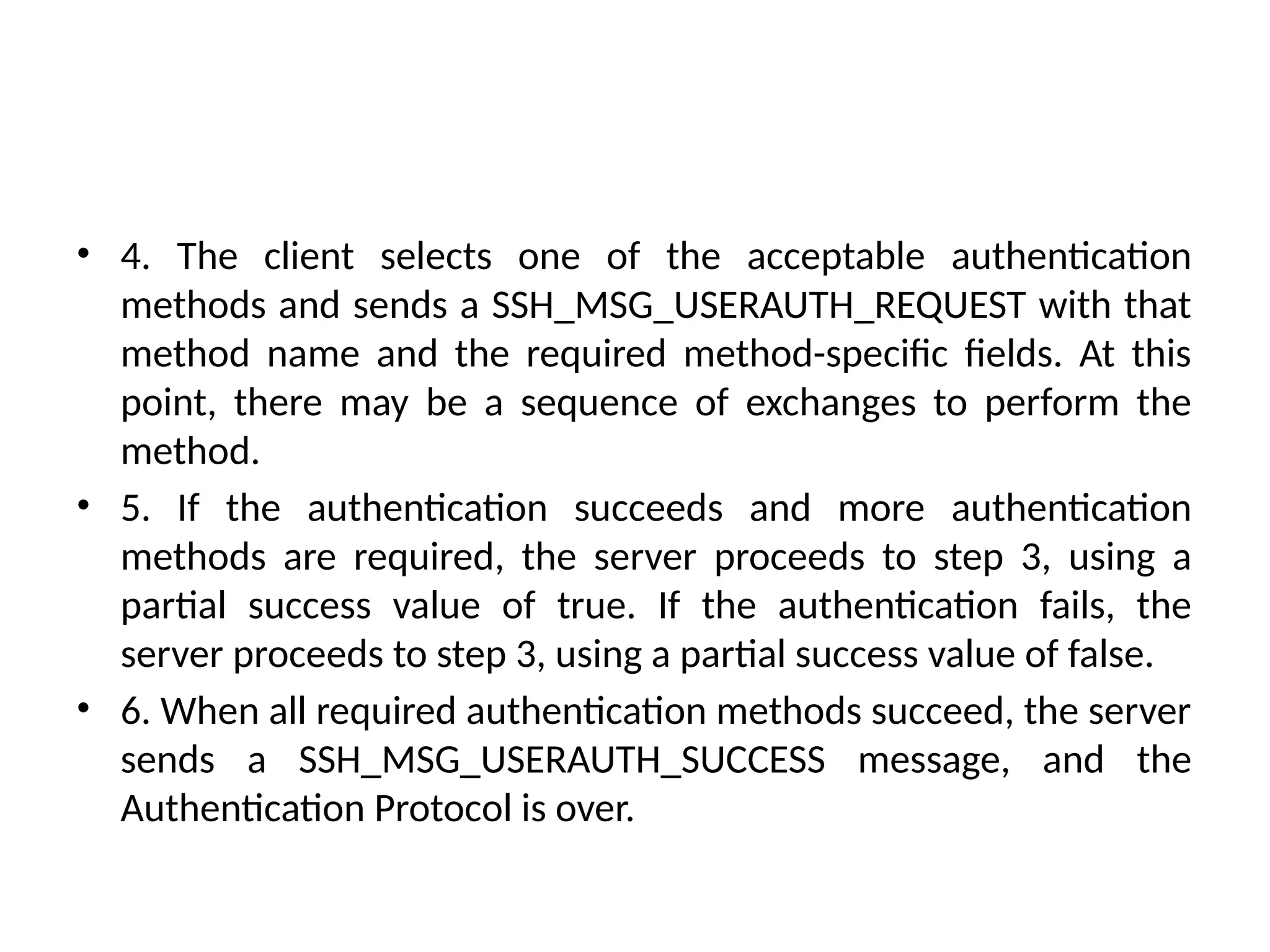
• 4. Theclient selects one of the acceptable authentication
methods and sends a SSH_MSG_USERAUTH_REQUEST with that
method name and the required method-specific fields. At this
point, there may be a sequence of exchanges to perform the
method.
• 5. If the authentication succeeds and more authentication
methods are required, the server proceeds to step 3, using a
partial success value of true. If the authentication fails, the
server proceeds to step 3, using a partial success value of false.
• 6. When all required authentication methods succeed, the server
sends a SSH_MSG_USERAUTH_SUCCESS message, and the
Authentication Protocol is over.
120.
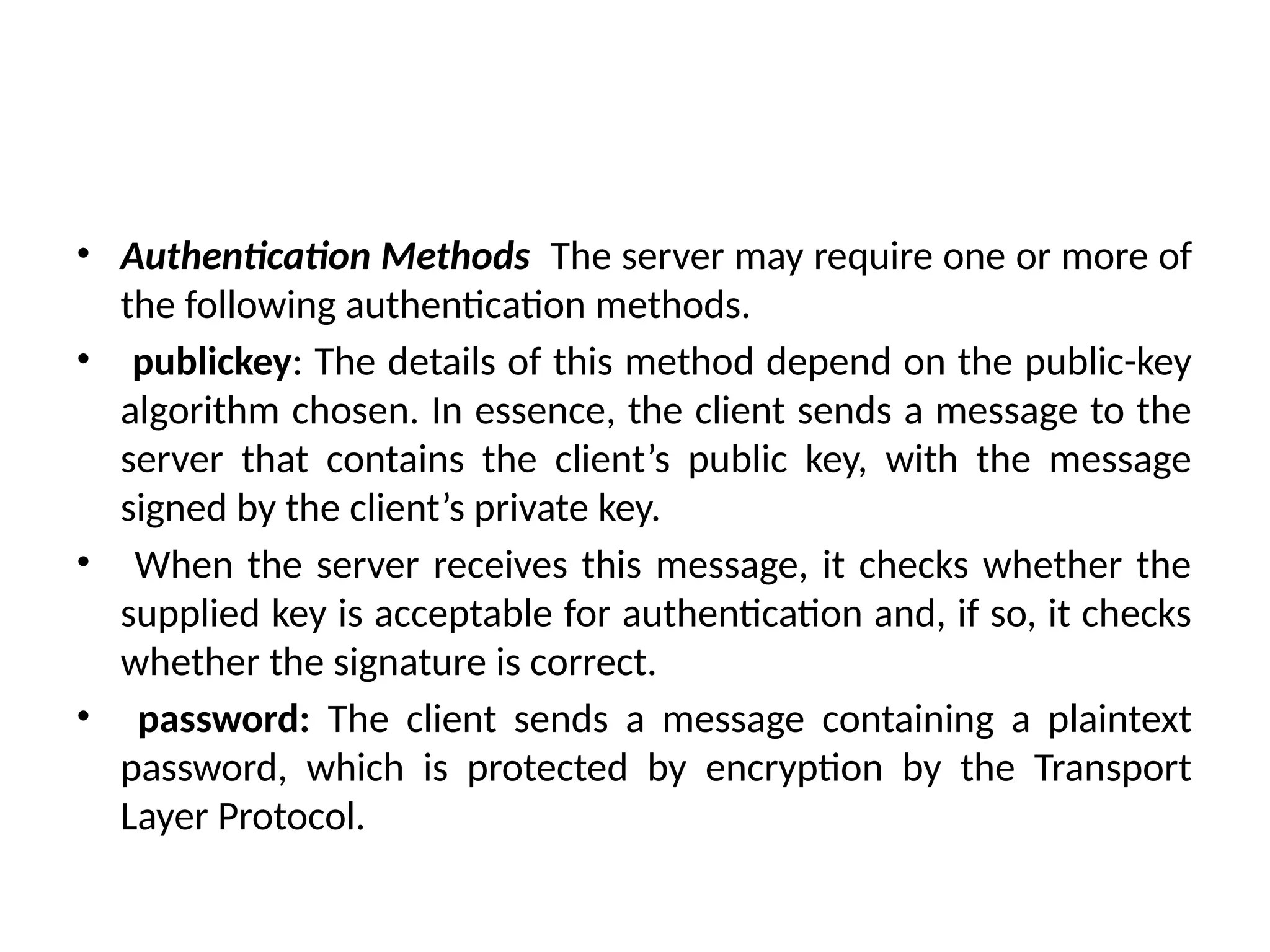
• Authentication MethodsThe server may require one or more of
the following authentication methods.
• publickey: The details of this method depend on the public-key
algorithm chosen. In essence, the client sends a message to the
server that contains the client’s public key, with the message
signed by the client’s private key.
• When the server receives this message, it checks whether the
supplied key is acceptable for authentication and, if so, it checks
whether the signature is correct.
• password: The client sends a message containing a plaintext
password, which is protected by encryption by the Transport
Layer Protocol.
121.
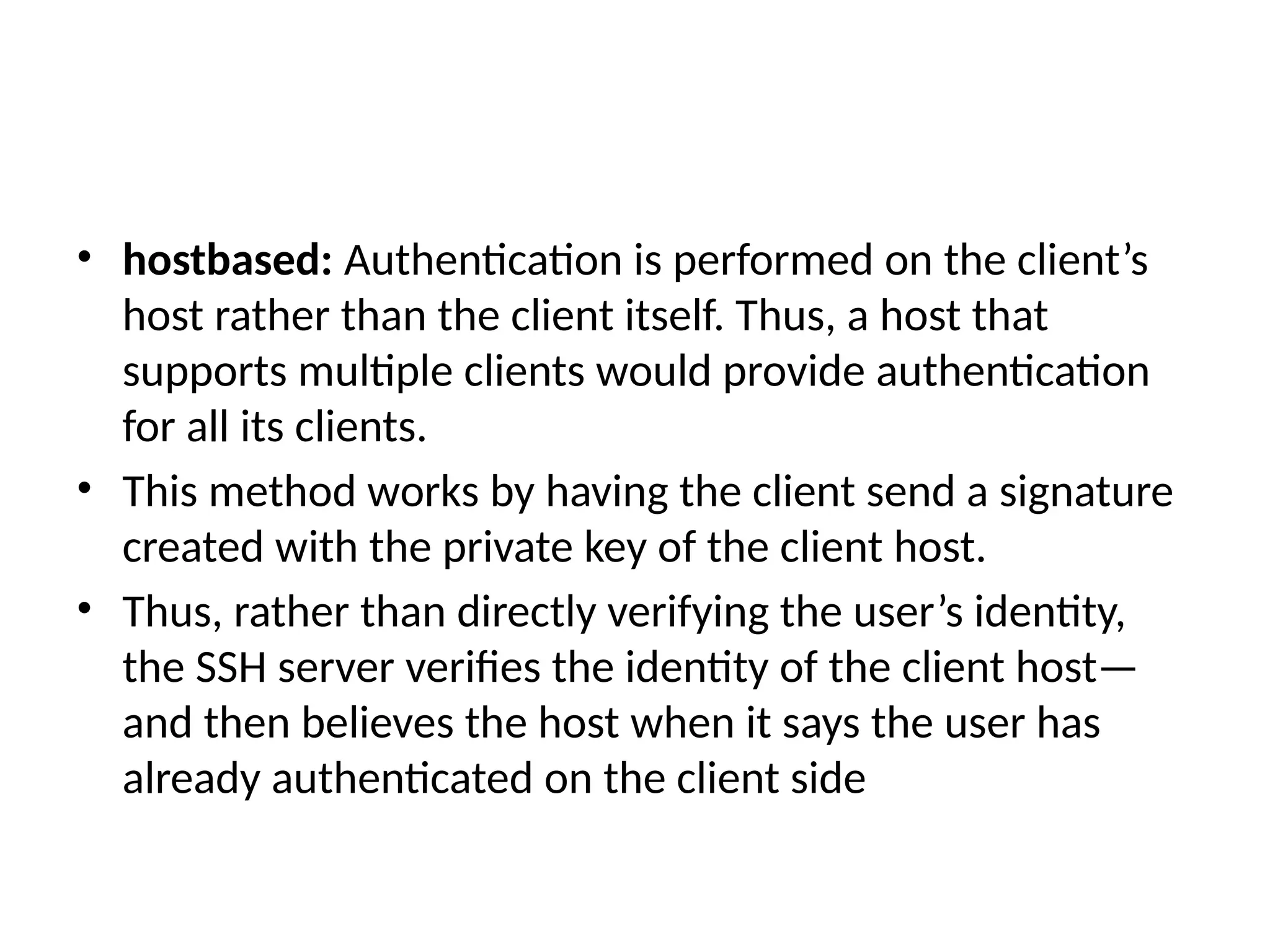
• hostbased: Authenticationis performed on the client’s
host rather than the client itself. Thus, a host that
supports multiple clients would provide authentication
for all its clients.
• This method works by having the client send a signature
created with the private key of the client host.
• Thus, rather than directly verifying the user’s identity,
the SSH server verifies the identity of the client host—
and then believes the host when it says the user has
already authenticated on the client side
122.
Connection Protocol
• TheSSH Connection Protocol runs on top of
the SSH Transport Layer Protocol
• secure authentication connection, referred to
as a tunnel, is used by the Connection
Protocol to multiplex a number of logical
channels
123.
• Channel Mechanism- All types of communication using
SSH, such as a terminal session, are supported using
separate channels.
• Either side may open a channel.
• For each channel, each side associates a unique channel
number, which need not be the same on both ends.
• Channels are flow controlled using a window
mechanism.
• No data may be sent to a channel until a message is
received to indicate that window space is available.
124.
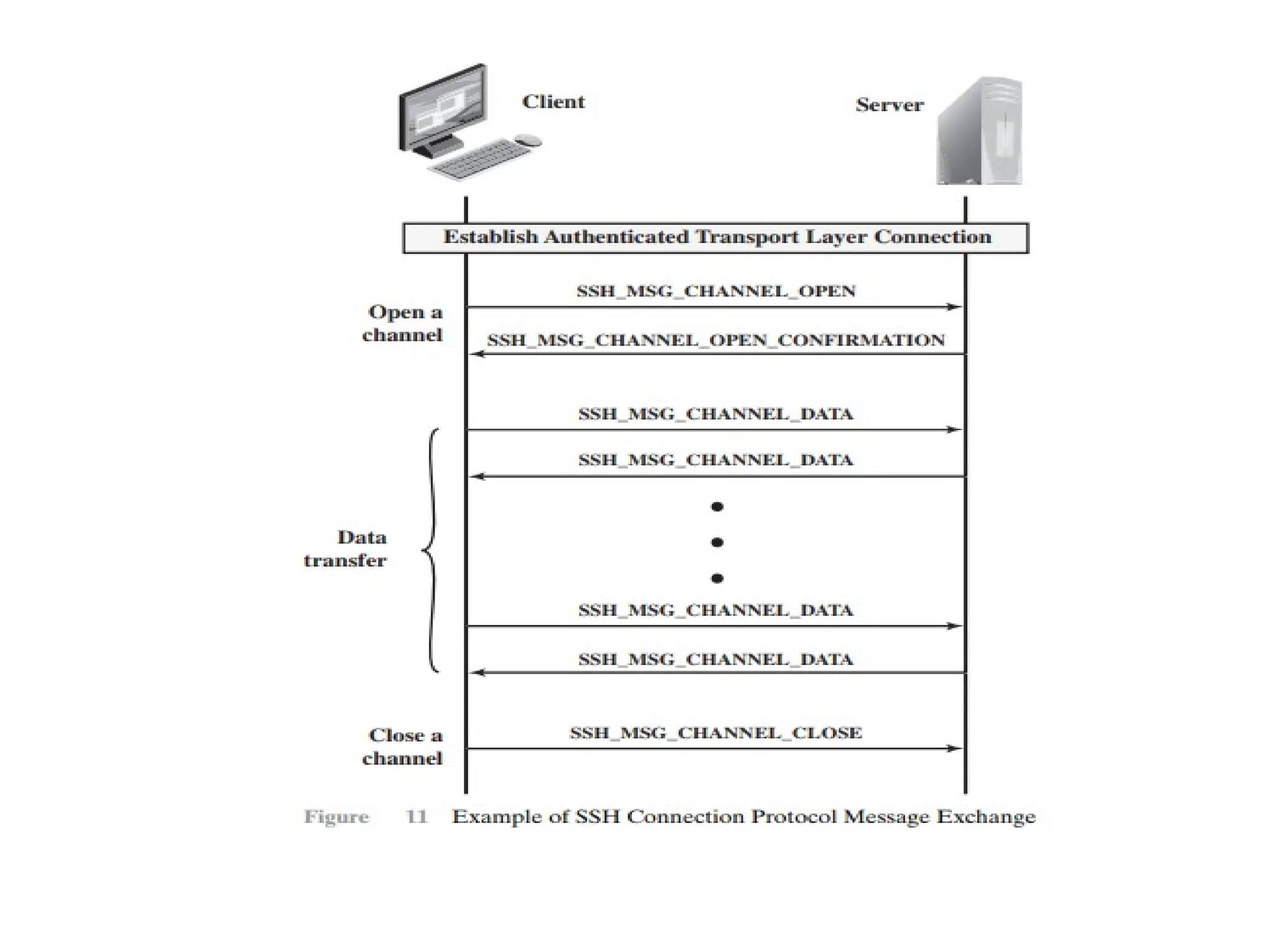
• The lifeof a channel progresses through three
stages:
• 1)opening a channel
• 2) data transfer, and
• 3) closing a channel
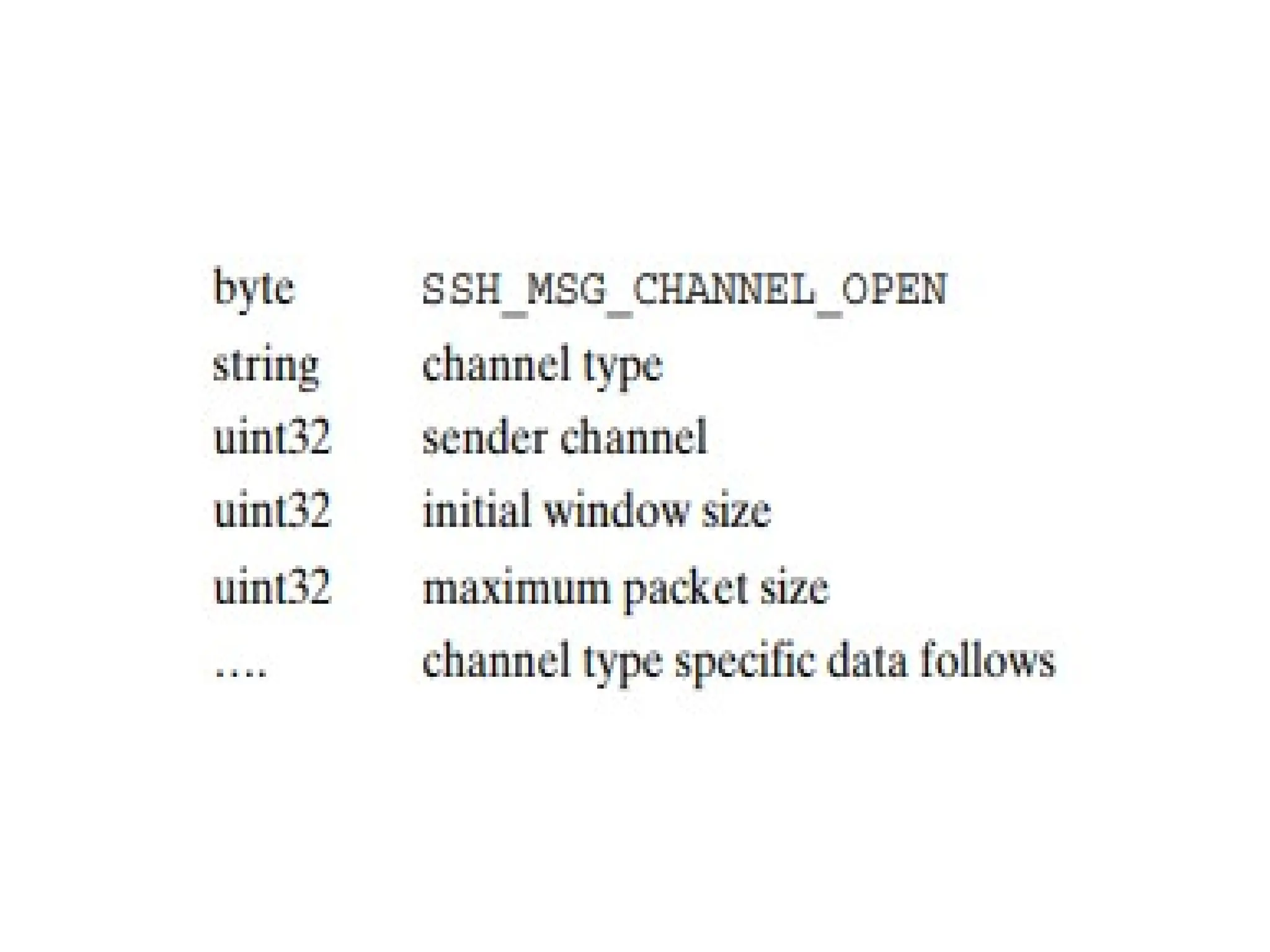
• When either side wishes to open a new channel,
it allocates a local number for the channel and
then sends a message of the form:
126.
• where uint32means unsigned 32-bit integer.
• The channel type identifies the application for this
channel, as described subsequently.
• The sender channel is the local channel number.
• The initial window size specifies how many bytes of
channel data can be sent to the sender of this message
without adjusting the window.
• The maximum packet size specifies the maximum size
of an individual data packet that can be sent to the
sender.
127.
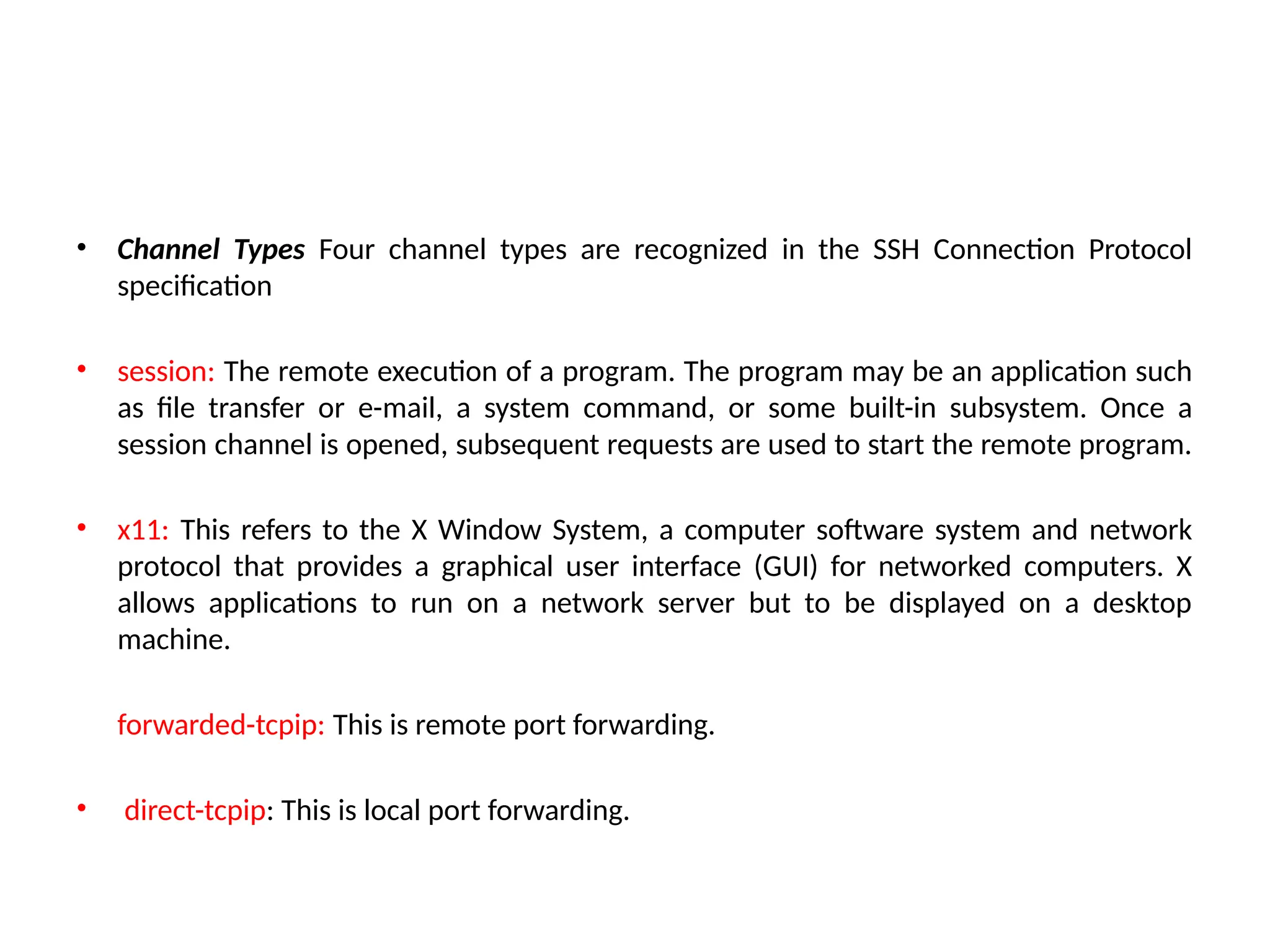
• Channel TypesFour channel types are recognized in the SSH Connection Protocol
specification
• session: The remote execution of a program. The program may be an application such
as file transfer or e-mail, a system command, or some built-in subsystem. Once a
session channel is opened, subsequent requests are used to start the remote program.
• x11: This refers to the X Window System, a computer software system and network
protocol that provides a graphical user interface (GUI) for networked computers. X
allows applications to run on a network server but to be displayed on a desktop
machine.
forwarded-tcpip: This is remote port forwarding.
• direct-tcpip: This is local port forwarding.
129.
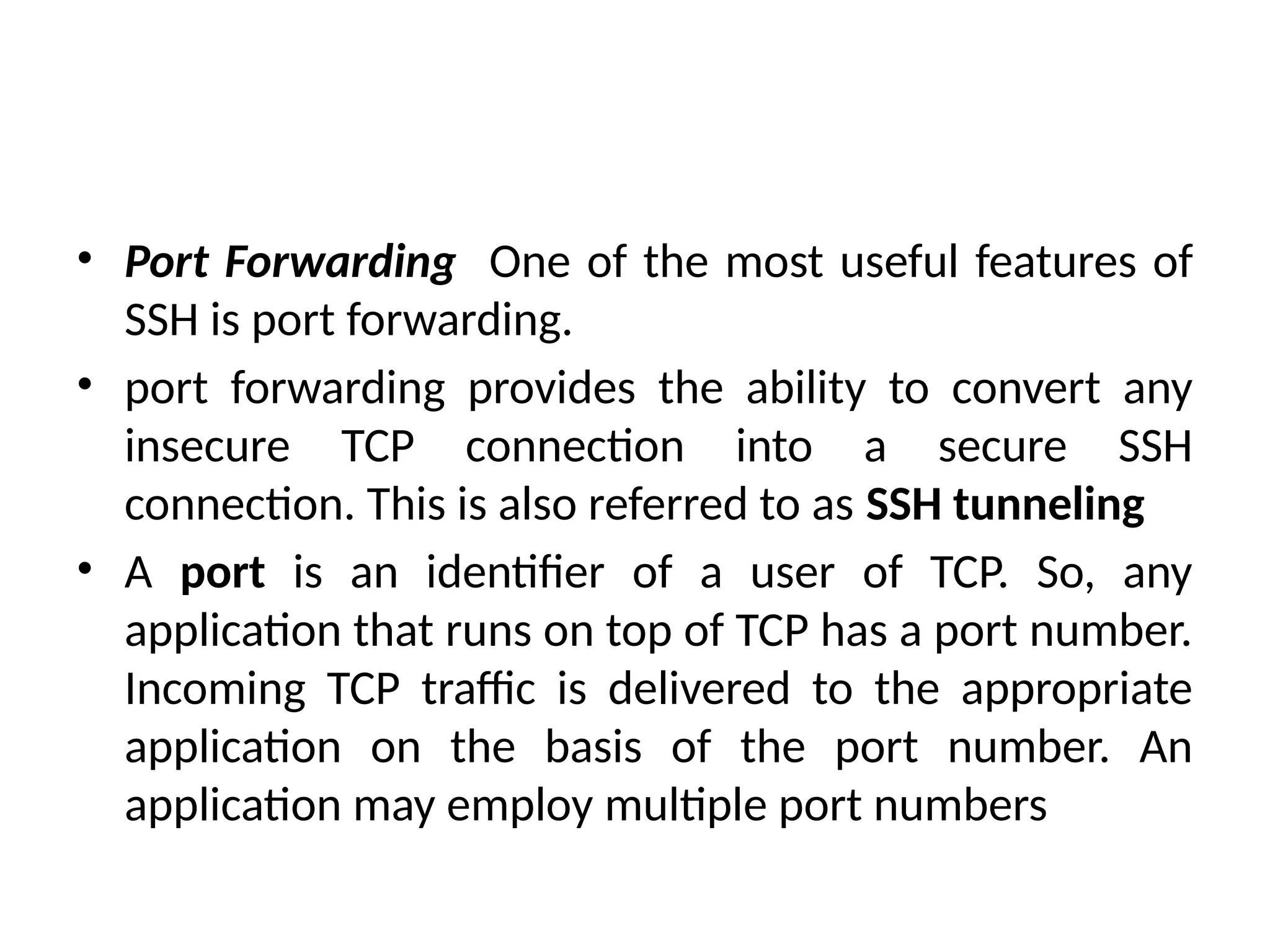
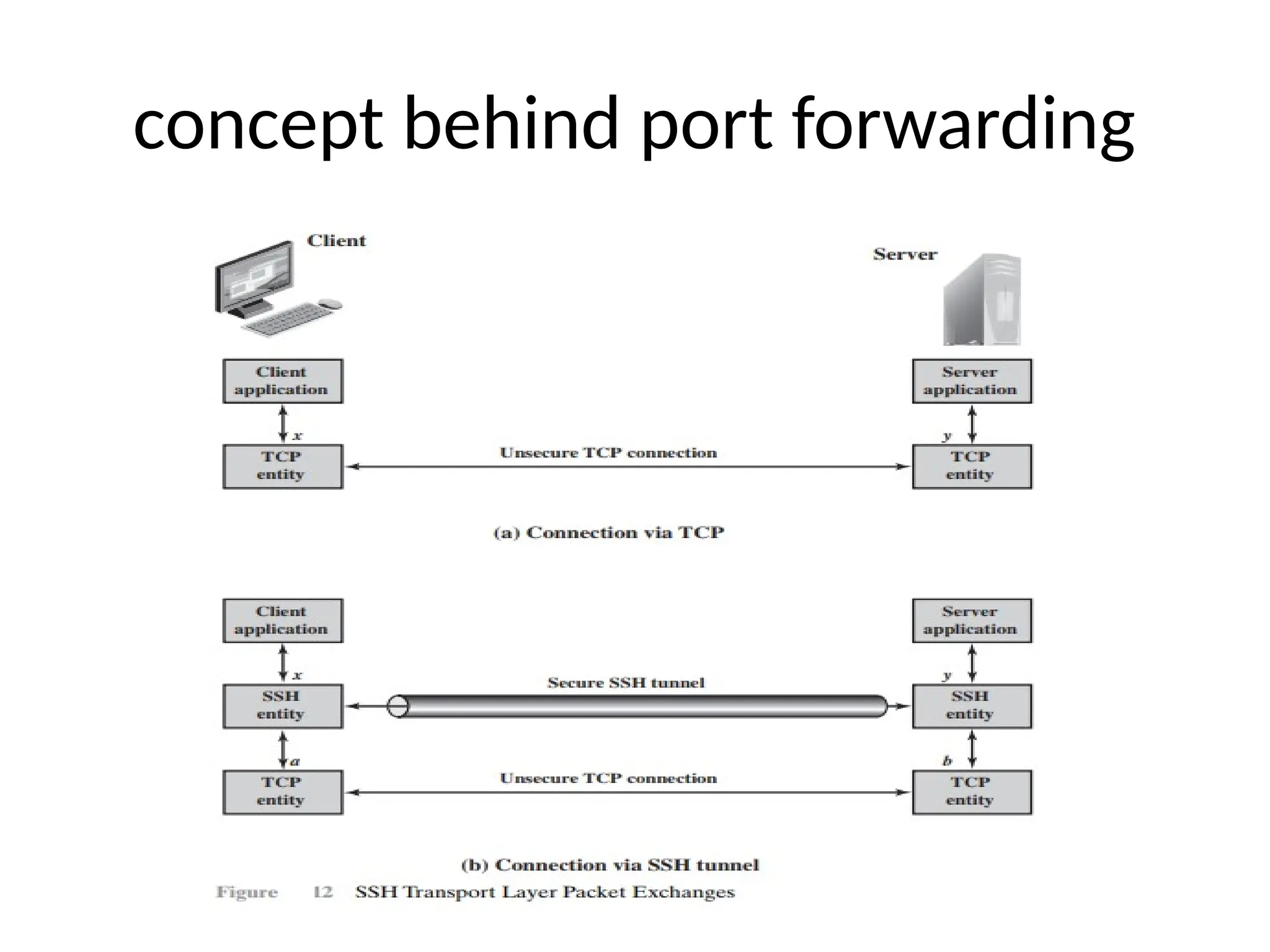
• Port ForwardingOne of the most useful features of
SSH is port forwarding.
• port forwarding provides the ability to convert any
insecure TCP connection into a secure SSH
connection. This is also referred to as SSH tunneling
• A port is an identifier of a user of TCP. So, any
application that runs on top of TCP has a port number.
Incoming TCP traffic is delivered to the appropriate
application on the basis of the port number. An
application may employ multiple port numbers
130.
• For example,for the Simple Mail Transfer
Protocol (smtp), the server side generally
listens on port 25, so an incoming SMTP
request uses TCP and addresses the data to
destination port 25. TCP recognizes that this is
the SMTP server address and routes the data
to the SMTP server application.
• SSH supportstwo types of port forwarding:
• 1) Local forwarding and
• 2) Remote forwarding.
133.
• Local forwarding-allows the client to set up a “hijacker”
process.
• This will intercept selected application-level traffic and
redirect it from an unsecured TCP connection to a secure
SSH tunnel.
• SSH is configured to listen on selected ports.
• SSH grabs all traffic using a selected port and sends it
through an SSH tunnel.
• On the other end, the SSH server sends the incoming traffic
to the destination port dictated by the client application.
134.
• example :Supposeyou have an e-mail client on your desktop and use it to get e-
mail from your mail server via the Post Office Protocol (POP). The assigned port
number for POP3 is port 110. We can secure this traffic in the following way:
1. The SSH client sets up a connection to the remote server.
2. Select an unused local port number, say 9999, and configure SSH to accept
traffic from this port destined for port 110 on the server.
3. The SSH client informs the SSH server to create a connection to the destination,
in this case mail server port 110.
4. The client takes any bits sent to local port 9999 and sends them to the server
inside the encrypted SSH session. The SSH server decrypts the incoming bits
and sends the plaintext to port 110.
5. In the other direction, the SSH server takes any bits received on port 110 and
sends them inside the SSH session back to the client, who decrypts and sends
them to the process connected to port 9999.
135.
• Remote forwarding- the user’s SSH client acts
on the server’s behalf. The client receives
traffic with a given destination port number,
places the traffic on the correct port and
sends it to the destination the user chooses.
136.
• example: Youwish to access a server at work from your home computer.
Because the work server is behind a firewall, it will not accept an SSH
request from your home computer. However, from work you can set up an
SSH tunnel using remote forwarding.
This involves the following steps.
1. From the work computer, set up an SSH connection to your home computer.
The firewall will allow this, because it is a protected outgoing connection.
2. Configure the SSH server to listen on a local port, say 22, and to deliver data
across the SSH connection addressed to remote port, say 2222.
3. You can now go to your home computer, and configure SSH to accept traffic
on port 2222.
4. You now have an SSH tunnel that can be used for remote logon to the work
server.
![Phase 1. Establish Security Capabilities
• This phase is used to initiate a logical connection and to
establish the security capabilities
• The exchange is initiated by the client, which sends a
client_hello message with following parameter
• Version: The highest SSL version[2.0] understood by the client.
• Random: Clients send random number,from this number pre
master key is generateed
These values serve as nonces and are used during key
exchange to prevent replay attacks.](https://image.slidesharecdn.com/ncsmodule1ppt-250813085329-f14c432e/75/ncsmodule-module-department-of-electronics-40-2048.jpg)
![Message Authentication Code
• TLS makes use of the HMAC algorithm defined in RFC 2104.
• HMACK(M) = H[(K+ opad) } H[(K+ ipad) } M]]
⊕ ⊕
where H = embedded hash function (for TLS, either MD5 or SHA-1)
M = message input to HMAC
K+ = secret key padded with zeros on the left so that the result is equal to the block length
of the hash code (for MD5 and SHA-1, block length = 512 bits)
ipad = 00110110 (36 in hexadecimal) repeated 64 times (512 bits)
opad = 01011100 (5C in hexadecimal) repeated 64 times (512 bits)
SSLv3 uses the same algorithm, except that the padding bytes are concatenated with the
secret key rather than being XORed with the secret key padded to the block length](https://image.slidesharecdn.com/ncsmodule1ppt-250813085329-f14c432e/75/ncsmodule-module-department-of-electronics-65-2048.jpg)