IP Security
 have a range of application specific
security mechanisms

eg. S/MIME, PGP, Kerberos, SSL/HTTPS
 however there are security concerns that
cut across protocol layers
 would like security implemented by the
network for all applications
IP Security
 general IP Security mechanisms
 provides

authentication

confidentiality

key management
 applicable to use over LANs, across public
& private WANs, & for the Internet
 need identified in 1994 report

need authentication, encryption in IPv4 & IPv6
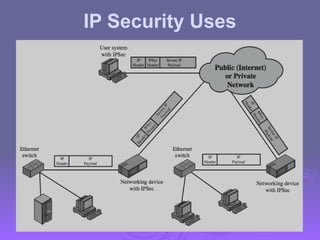
Applications of IPSec
 Secure Branch office connectivity over
Internet
 Secure Remote Access over Internet
 Establishing Extranet and Intranet
connectivity with Partners
 Enhancing Electronic Commerce Security.

Encrypt &/ Authenticate all tfc.
IP Security Uses
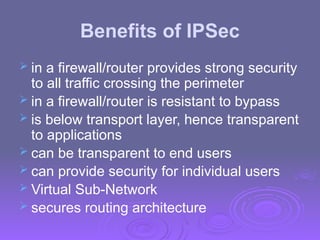
Benefits of IPSec
 in a firewall/router provides strong security
to all traffic crossing the perimeter
 in a firewall/router is resistant to bypass
 is below transport layer, hence transparent
to applications
 can be transparent to end users
 can provide security for individual users
 Virtual Sub-Network
 secures routing architecture
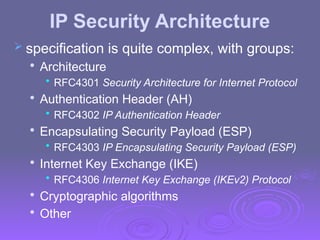
IP Security Architecture
 specification is quite complex, with groups:

Architecture
• RFC4301 Security Architecture for Internet Protocol

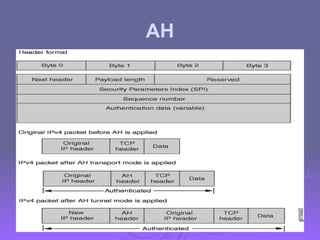
Authentication Header (AH)
• RFC4302 IP Authentication Header

Encapsulating Security Payload (ESP)
• RFC4303 IP Encapsulating Security Payload (ESP)

Internet Key Exchange (IKE)
• RFC4306 Internet Key Exchange (IKEv2) Protocol

Cryptographic algorithms

Other
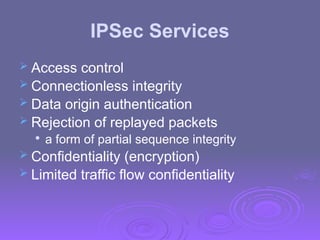
IPSec Services
 Access control
 Connectionless integrity
 Data origin authentication
 Rejection of replayed packets

a form of partial sequence integrity
 Confidentiality (encryption)
 Limited traffic flow confidentiality
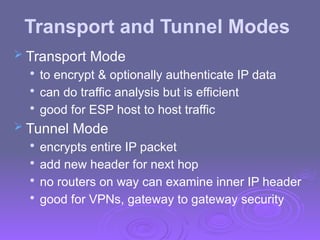
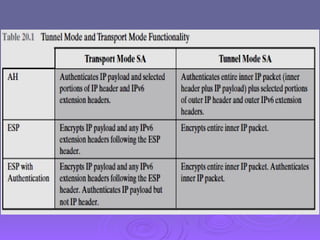
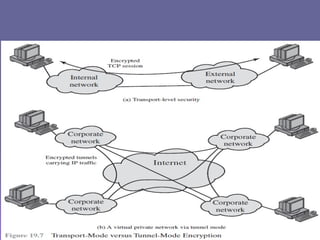
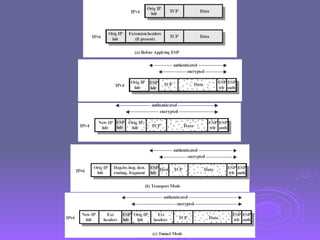
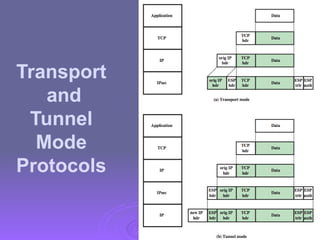
Transport and Tunnel Modes
 Transport Mode

to encrypt & optionally authenticate IP data

can do traffic analysis but is efficient

good for ESP host to host traffic
 Tunnel Mode

encrypts entire IP packet

add new header for next hop

no routers on way can examine inner IP header

good for VPNs, gateway to gateway security
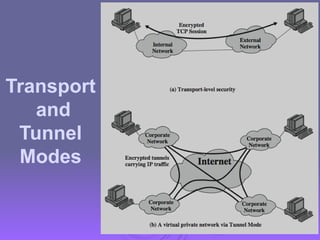
Transport
and
Tunnel
Modes
IP Sec Policy
 Security Association Database (SAD)
 Security Policy Database (SPD)
 Security Association

One way logical connection for security

Security Parameters
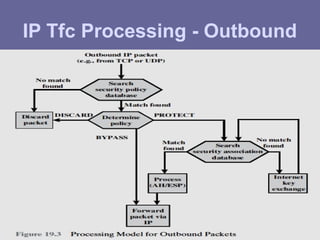
IP Tfc Processing - Outbound
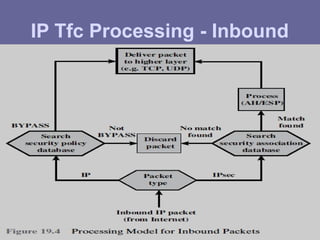
IP Tfc Processing - Inbound
Security Associations
 a one-way relationship between sender &
receiver that affords security for traffic flow
 defined by 3 parameters:

Security Parameters Index (SPI)

IP Destination Address

Security Protocol Identifier
 SA iden by Dest Addr and SPI
 has a number of other parameters

seq no, AH & EH info, lifetime etc
 have a database of Security Associations
Security Association Database
 Parameters associated with each SA.
 Parameters

Sec Parameter Index – 32 bit
• Inbound - to uniquely iden the SA.
• Outbound SA – construct AH or ESP header

Seq No – 32 bit to genr seq no fd in AH/ESP header

Seq Counter Overflow – flag indicator

Anti-Replay window – Determine whether it’s a replay

AH Info – Authn algos, keys, key lifetimes and other parameters

ESP Info – Encrypt and authn algos, keys, IV, key lifetimes and other
params.

Lifetime of this SA – timeline or byte count for SA replacement

IPSec Proto Mode – Tunnel or tpt or wildcard

Path MTU – Observed Max Transmission Unit and Aging variables
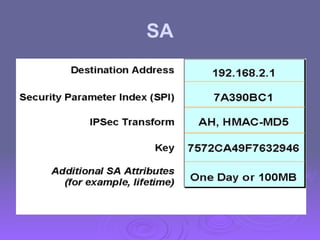
SA
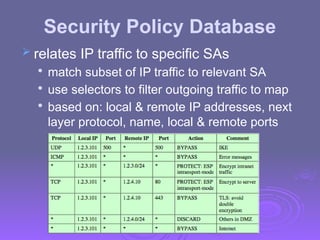
Security Policy Database
 relates IP traffic to specific SAs

match subset of IP traffic to relevant SA

use selectors to filter outgoing traffic to map

based on: local & remote IP addresses, next
layer protocol, name, local & remote ports
AH
Encapsulating Security Payload
(ESP)
 provides message content confidentiality, data
origin authentication, connectionless integrity, an
anti-replay service, limited traffic flow
confidentiality
 services depend on options selected when
establish Security Association (SA), net location
 can use a variety of encryption & authentication
algorithms
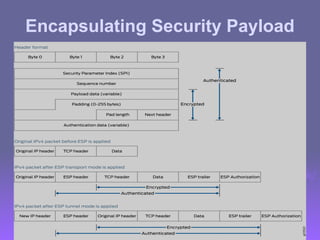
Encapsulating Security Payload
Encryption & Authentication
Algorithms & Padding
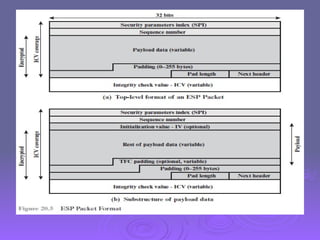
 ESP can encrypt payload data, padding,
pad length, and next header fields

if needed have IV at start of payload data
 ESP can have optional ICV for integrity

is computed after encryption is performed
 ESP uses padding

to expand plaintext to required length

to align pad length and next header fields

to provide partial traffic flow confidentiality
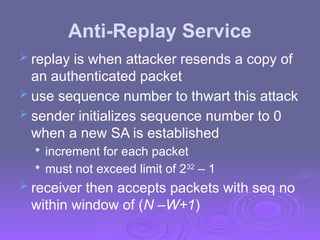
Anti-Replay Service
 replay is when attacker resends a copy of
an authenticated packet
 use sequence number to thwart this attack
 sender initializes sequence number to 0
when a new SA is established

increment for each packet

must not exceed limit of 232
– 1
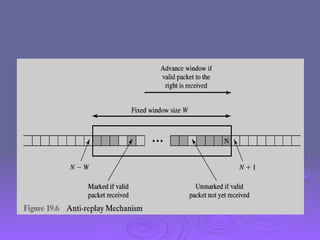
 receiver then accepts packets with seq no
within window of (N –W+1)
Transport
and
Tunnel
Mode
Protocols
Combining Security
Associations
 SA’s can implement either AH or ESP
 to implement both need to combine SA’s

form a security association bundle

may terminate at different or same endpoints

combined by
• transport adjacency – AH and ESP on same IP pkt
• iterated tunneling – More than one tunnel
 combining authentication & encryption

ESP with authentication, bundled inner ESP &
outer AH, bundled inner transport & outer ESP
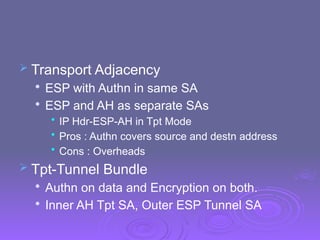
 Transport Adjacency

ESP with Authn in same SA

ESP and AH as separate SAs
• IP Hdr-ESP-AH in Tpt Mode
• Pros : Authn covers source and destn address
• Cons : Overheads
 Tpt-Tunnel Bundle

Authn on data and Encryption on both.

Inner AH Tpt SA, Outer ESP Tunnel SA
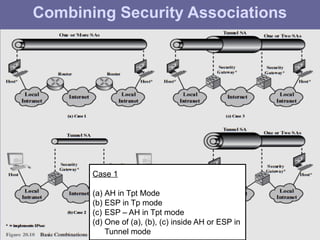
Combining Security Associations
Case 1
(a) AH in Tpt Mode
(b) ESP in Tp mode
(c) ESP – AH in Tpt mode
(d) One of (a), (b), (c) inside AH or ESP in
Tunnel mode
IPSec Key Management
 handles key generation & distribution
 typically need 2 pairs of keys

2 per direction for AH & ESP
 manual key management

sysadmin manually configures every system
 automated key management

automated system for on demand creation of
keys for SA’s in large systems

has Oakley & ISAKMP elements
Oakley
 a key exchange protocol
 based on Diffie-Hellman key exchange
 adds features to address weaknesses

no info on parties, man-in-middle attack, cost

so adds cookies, groups (global params),
nonces, DH key exchange with authentication
 can use arithmetic in prime fields or elliptic
curve fields
Key Determination Protocol
 Refined D-H Key Exch
 Features

Keys on reqmt. No need for long time key
storage

No pre existing infra
 Weakness

Iden of the parties – not provided

MITM possible

Computationally intensive – Clogging Attack –
Request more keys
Key Determination Protocol
 Features

Cookies – against clogging attacks
• Hash of IP, Ports and a Secret Value

2 parties negotiate a group – global params
• 5 groups (3 x Modular Exponentiation, 2 x ECC)

Nonces against replay attacks

Exch D-H public key values

Authenticates – against Replay attacks
• Dig Signatures
• PKC
• Symmetric Key
 Clogging

Spoof the source addr and send D-H Key

Dest computes secret key (modular arith)

Repeated calc lead to clog.

Cookie – Pseudorandom No called cookie –
• Each side in Initial msg and other side ack.
• Incl ack in D-H key exch.
• Forged addr (attacker) will not
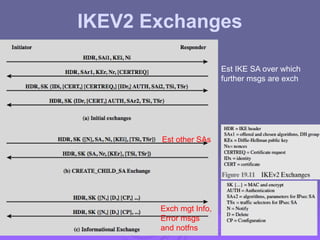
IKEV2 Exchanges
Est IKE SA over which
further msgs are exch
Est other SAs
Exch mgt Info,
Error msgs
and notfns
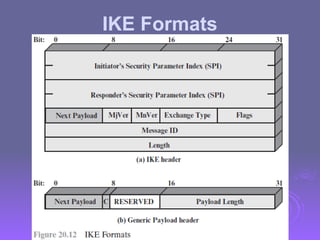
IKE Formats
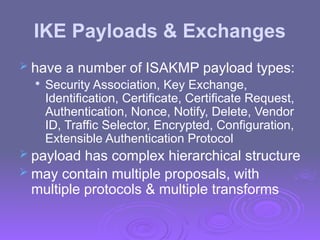
IKE Payloads & Exchanges
 have a number of ISAKMP payload types:

Security Association, Key Exchange,
Identification, Certificate, Certificate Request,
Authentication, Nonce, Notify, Delete, Vendor
ID, Traffic Selector, Encrypted, Configuration,
Extensible Authentication Protocol
 payload has complex hierarchical structure
 may contain multiple proposals, with
multiple protocols & multiple transforms
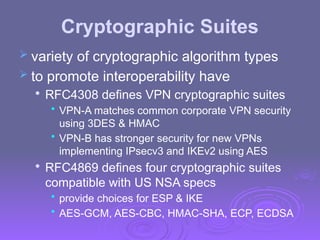
Cryptographic Suites
 variety of cryptographic algorithm types
 to promote interoperability have

RFC4308 defines VPN cryptographic suites
• VPN-A matches common corporate VPN security
using 3DES & HMAC
• VPN-B has stronger security for new VPNs
implementing IPsecv3 and IKEv2 using AES

RFC4869 defines four cryptographic suites
compatible with US NSA specs
• provide choices for ESP & IKE
• AES-GCM, AES-CBC, HMAC-SHA, ECP, ECDSA
Summary
 have considered:

IPSec security framework

IPSec security policy

ESP

combining security associations

internet key exchange

cryptographic suites used

chAPTER 19 INTERNET PROTOCOL SECURITY PRESENTATION

  • 1.
    IP Security  havea range of application specific security mechanisms  eg. S/MIME, PGP, Kerberos, SSL/HTTPS  however there are security concerns that cut across protocol layers  would like security implemented by the network for all applications
  • 2.
    IP Security  generalIP Security mechanisms  provides  authentication  confidentiality  key management  applicable to use over LANs, across public & private WANs, & for the Internet  need identified in 1994 report  need authentication, encryption in IPv4 & IPv6
  • 3.
    Applications of IPSec Secure Branch office connectivity over Internet  Secure Remote Access over Internet  Establishing Extranet and Intranet connectivity with Partners  Enhancing Electronic Commerce Security.  Encrypt &/ Authenticate all tfc.
  • 5.
  • 6.
    Benefits of IPSec in a firewall/router provides strong security to all traffic crossing the perimeter  in a firewall/router is resistant to bypass  is below transport layer, hence transparent to applications  can be transparent to end users  can provide security for individual users  Virtual Sub-Network  secures routing architecture
  • 7.
    IP Security Architecture specification is quite complex, with groups:  Architecture • RFC4301 Security Architecture for Internet Protocol  Authentication Header (AH) • RFC4302 IP Authentication Header  Encapsulating Security Payload (ESP) • RFC4303 IP Encapsulating Security Payload (ESP)  Internet Key Exchange (IKE) • RFC4306 Internet Key Exchange (IKEv2) Protocol  Cryptographic algorithms  Other
  • 8.
    IPSec Services  Accesscontrol  Connectionless integrity  Data origin authentication  Rejection of replayed packets  a form of partial sequence integrity  Confidentiality (encryption)  Limited traffic flow confidentiality
  • 9.
    Transport and TunnelModes  Transport Mode  to encrypt & optionally authenticate IP data  can do traffic analysis but is efficient  good for ESP host to host traffic  Tunnel Mode  encrypts entire IP packet  add new header for next hop  no routers on way can examine inner IP header  good for VPNs, gateway to gateway security
  • 11.
  • 12.
    IP Sec Policy Security Association Database (SAD)  Security Policy Database (SPD)  Security Association  One way logical connection for security  Security Parameters
  • 14.
  • 15.
  • 16.
    Security Associations  aone-way relationship between sender & receiver that affords security for traffic flow  defined by 3 parameters:  Security Parameters Index (SPI)  IP Destination Address  Security Protocol Identifier  SA iden by Dest Addr and SPI  has a number of other parameters  seq no, AH & EH info, lifetime etc  have a database of Security Associations
  • 17.
    Security Association Database Parameters associated with each SA.  Parameters  Sec Parameter Index – 32 bit • Inbound - to uniquely iden the SA. • Outbound SA – construct AH or ESP header  Seq No – 32 bit to genr seq no fd in AH/ESP header  Seq Counter Overflow – flag indicator  Anti-Replay window – Determine whether it’s a replay  AH Info – Authn algos, keys, key lifetimes and other parameters  ESP Info – Encrypt and authn algos, keys, IV, key lifetimes and other params.  Lifetime of this SA – timeline or byte count for SA replacement  IPSec Proto Mode – Tunnel or tpt or wildcard  Path MTU – Observed Max Transmission Unit and Aging variables
  • 18.
  • 19.
    Security Policy Database relates IP traffic to specific SAs  match subset of IP traffic to relevant SA  use selectors to filter outgoing traffic to map  based on: local & remote IP addresses, next layer protocol, name, local & remote ports
  • 20.
  • 21.
    Encapsulating Security Payload (ESP) provides message content confidentiality, data origin authentication, connectionless integrity, an anti-replay service, limited traffic flow confidentiality  services depend on options selected when establish Security Association (SA), net location  can use a variety of encryption & authentication algorithms
  • 22.
  • 24.
    Encryption & Authentication Algorithms& Padding  ESP can encrypt payload data, padding, pad length, and next header fields  if needed have IV at start of payload data  ESP can have optional ICV for integrity  is computed after encryption is performed  ESP uses padding  to expand plaintext to required length  to align pad length and next header fields  to provide partial traffic flow confidentiality
  • 25.
    Anti-Replay Service  replayis when attacker resends a copy of an authenticated packet  use sequence number to thwart this attack  sender initializes sequence number to 0 when a new SA is established  increment for each packet  must not exceed limit of 232 – 1  receiver then accepts packets with seq no within window of (N –W+1)
  • 29.
  • 30.
    Combining Security Associations  SA’scan implement either AH or ESP  to implement both need to combine SA’s  form a security association bundle  may terminate at different or same endpoints  combined by • transport adjacency – AH and ESP on same IP pkt • iterated tunneling – More than one tunnel  combining authentication & encryption  ESP with authentication, bundled inner ESP & outer AH, bundled inner transport & outer ESP
  • 31.
     Transport Adjacency  ESPwith Authn in same SA  ESP and AH as separate SAs • IP Hdr-ESP-AH in Tpt Mode • Pros : Authn covers source and destn address • Cons : Overheads  Tpt-Tunnel Bundle  Authn on data and Encryption on both.  Inner AH Tpt SA, Outer ESP Tunnel SA
  • 32.
    Combining Security Associations Case1 (a) AH in Tpt Mode (b) ESP in Tp mode (c) ESP – AH in Tpt mode (d) One of (a), (b), (c) inside AH or ESP in Tunnel mode
  • 33.
    IPSec Key Management handles key generation & distribution  typically need 2 pairs of keys  2 per direction for AH & ESP  manual key management  sysadmin manually configures every system  automated key management  automated system for on demand creation of keys for SA’s in large systems  has Oakley & ISAKMP elements
  • 34.
    Oakley  a keyexchange protocol  based on Diffie-Hellman key exchange  adds features to address weaknesses  no info on parties, man-in-middle attack, cost  so adds cookies, groups (global params), nonces, DH key exchange with authentication  can use arithmetic in prime fields or elliptic curve fields
  • 35.
    Key Determination Protocol Refined D-H Key Exch  Features  Keys on reqmt. No need for long time key storage  No pre existing infra  Weakness  Iden of the parties – not provided  MITM possible  Computationally intensive – Clogging Attack – Request more keys
  • 36.
    Key Determination Protocol Features  Cookies – against clogging attacks • Hash of IP, Ports and a Secret Value  2 parties negotiate a group – global params • 5 groups (3 x Modular Exponentiation, 2 x ECC)  Nonces against replay attacks  Exch D-H public key values  Authenticates – against Replay attacks • Dig Signatures • PKC • Symmetric Key
  • 37.
     Clogging  Spoof thesource addr and send D-H Key  Dest computes secret key (modular arith)  Repeated calc lead to clog.  Cookie – Pseudorandom No called cookie – • Each side in Initial msg and other side ack. • Incl ack in D-H key exch. • Forged addr (attacker) will not
  • 38.
    IKEV2 Exchanges Est IKESA over which further msgs are exch Est other SAs Exch mgt Info, Error msgs and notfns
  • 39.
  • 40.
    IKE Payloads &Exchanges  have a number of ISAKMP payload types:  Security Association, Key Exchange, Identification, Certificate, Certificate Request, Authentication, Nonce, Notify, Delete, Vendor ID, Traffic Selector, Encrypted, Configuration, Extensible Authentication Protocol  payload has complex hierarchical structure  may contain multiple proposals, with multiple protocols & multiple transforms
  • 41.
    Cryptographic Suites  varietyof cryptographic algorithm types  to promote interoperability have  RFC4308 defines VPN cryptographic suites • VPN-A matches common corporate VPN security using 3DES & HMAC • VPN-B has stronger security for new VPNs implementing IPsecv3 and IKEv2 using AES  RFC4869 defines four cryptographic suites compatible with US NSA specs • provide choices for ESP & IKE • AES-GCM, AES-CBC, HMAC-SHA, ECP, ECDSA
  • 42.
    Summary  have considered:  IPSecsecurity framework  IPSec security policy  ESP  combining security associations  internet key exchange  cryptographic suites used

Editor's Notes

  • #1 The Internet community has developed application-specific security mechanisms in a number of application areas, including electronic mail (S/MIME, PGP), client/server (Kerberos), Web access (Secure Sockets Layer), and others. However users have some security concerns that cut across protocol layers. By implementing security at the IP level, an organization can ensure secure networking not only for applications that have security mechanisms but also for the many security-ignorant applications.
  • #2 IP-level security encompasses three functional areas: authentication, confidentiality, and key management. The authentication mechanism assures that a received packet was transmitted by the party identified as the source in the packet header, and that the packet has not been altered in transit. The confidentiality facility enables communicating nodes to encrypt messages to prevent eavesdropping by third parties. The key management facility is concerned with the secure exchange of keys. IPSec provides the capability to secure communications across a LAN, across private and public WANs, and across the Internet. In 1994, the Internet Architecture Board (IAB) issued a report titled "Security in the Internet Architecture" (RFC 1636). The report stated the general consensus that the Internet needs more and better security and identified key areas for security mechanisms. To provide security, the IAB included authentication and encryption as necessary security features in the next-generation IP, which has been issued as IPv6. Fortunately, these security capabilities were designed to be usable both with the current IPv4 and the future IPv6.
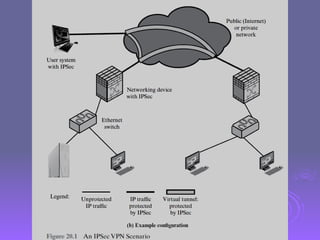
  • #5 Stallings Figure 19.1 illustrates a typical IP Security scenario. An organization maintains LANs at dispersed locations. Nonsecure IP traffic is conducted on each LAN. For traffic offsite, through some sort of private or public WAN, IPSec protocols are used. These protocols operate in networking devices, such as a router or firewall, that connect each LAN to the outside world. The IPSec networking device will typically encrypt and compress all traffic going into the WAN, and decrypt and decompress traffic coming from the WAN; these operations are transparent to workstations and servers on the LAN. Secure transmission is also possible with individual users who dial into the WAN. Such user workstations must implement the IPSec protocols to provide security.
  • #6 Some of the benefits of IPSec include: • When implemented in a firewall or router, it provides strong security that can be applied to all traffic crossing the perimeter. Traffic within a company or workgroup does not incur the overhead of security-related processing. • in a firewall is resistant to bypass if all traffic from the outside must use IP and the firewall is the only means of entrance from the Internet into the organization. • is below the transport layer (TCP, UDP) and so is transparent to applications. There is no need to change software on a user or server system when IPsec is implemented in the firewall or router. Even if IPsec is implemented in end systems, upper-layer software, including applications, is not affected. • can be transparent to end users. There is no need to train users on security mechanisms, issue keying material on a per-user basis, or revoke keying material when users leave the organization. • can provide security for individual users if needed. This is useful for offsite workers and for setting up a secure virtual subnetwork within an organization for sensitive applications. It also plays a vital role in the routing architecture required for internetworking.
  • #7 The IPSec specification has become quite complex. key management. The totality of the IPsec specification is scattered across dozens of RFCs and draft IETF documents, making this the most complex and difficult to grasp of all IETF specifications. The best way to keep track of and get a handle on this body of work is to consult the latest version of the IPsec document roadmap. The documents can be categorized into the following groups: • Architecture: Covers the general concepts, security requirements, definitions, and mechanisms defining IPsec technology, see RFC 4301, Security Architecture for the Internet Protocol. • Authentication Header (AH): AH is an extension header for message authentication, now deprecated. See RFC 4302, IP Authentication Header. • Encapsulating Security Payload (ESP): ESP consists of an encapsulating header and trailer used to provide encryption or combined encryption/authentication. See RFC 4303, IP Encapsulating Security Payload (ESP). • Internet Key Exchange (IKE): a collection of documents describing the key management schemes for use with IPsec. See RFC4306, Internet Key Exchange (IKEv2) Protocol, and other related RFCs. • Cryptographic algorithms: a large set of documents that define and describe cryptographic algorithms for encryption, message authentication, pseudorandom functions (PRFs), and cryptographic key exchange. • Other: There are a variety of other IPsec-related RFCs, including those dealing with security policy and management information base (MIB) content.
  • #8 IPSec provides security services at the IP layer by enabling a system to select required security protocols, determine the algorithm(s) to use for the service(s), and put in place any cryptographic keys required to provide the requested services. Two protocols are used to provide security: an authentication protocol designated by the header of the protocol, Authentication Header (AH); and a combined encryption/authentication protocol designated by the format of the packet for that protocol, Encapsulating Security Payload (ESP). RFC 4301 lists the security services supported as shown above.
  • #9 Both AH and ESP support two modes of use: transport and tunnel mode, but will focus on ESP. Transport mode provides protection primarily for upper-layer protocols. Transport mode ESP is used to encrypt and optionally authenticate the data carried by IP. Typically, transport mode is used for end-to-end communication between two hosts (e.g., a client and a server, or two workstations). When a host runs AH or ESP over IPv4, the payload is the data that normally follow the IP header. For IPv6, the payload is the data that normally follow both the IP header and any IPv6 extensions headers that are present. Transport mode operation provides confidentiality for any application that uses it, thus avoiding the need to implement confidentiality in every individual application. Tunnel mode ESP is used to encrypt an entire IP packet. To achieve this, after the AH or ESP fields are added to the IP packet, the entire packet plus security fields is treated as the payload of new "outer" IP packet with a new outer IP header. The entire original, or inner, packet travels through a "tunnel" from one point of an IP network to another; no routers along the way are able to examine the inner IP header. Tunnel mode is useful in a configuration that includes a firewall or other sort of security gateway that protects a trusted network from external networks. In this latter case, encryption occurs only between an external host and the security gateway or between two security gateways. With tunnel mode, a number of hosts on networks behind firewalls may engage in secure communications without implementing IPsec.
  • #11 Stallings Figure 19.7 shows two ways in which the IPsec ESP service can be used. In the upper part of the figure, encryption (and optionally authentication) is provided directly between two hosts. Figure 19.7b shows how tunnel mode operation can be used to set up a virtual private network. In this example, an organization has four private networks interconnected across the Internet. Hosts on the internal networks use the Internet for transport of data but do not interact with other Internet- based hosts. By terminating the tunnels at the security gateway to each internal network, the configuration allows the hosts to avoid implementing the security capability. The former technique is support by a transport mode SA, while the latter technique uses a tunnel mode SA.
  • #14 1. IPsec searches the SPD for a match to this packet. 2. If no match is found, then the packet is discarded and an error message is generated. 3. If a match is found, further processing is determined by the first matching entry in the SPD. If the policy for this packet is DISCARD, then the packet is discarded. If the policy is BYPASS, then there is no further IPsec processing; the packet is forwarded to the network for transmission. 4. If the policy is PROTECT, then a search is made of the SAD for a matching entry. If no entry is found, then IKE is invoked to create an SA with the appropriate keys and an entry is made in the SA. 5. The matching entry in the SAD determines the processing for this packet. Either encryption, authentication, or both can be performed, and either transport or tunnel mode can be used.The packet is then forwarded to the network for transmission.
  • #15 IPsec determines whether this is an unsecured IP packet or one that has ESP or AH headers/trailers, by examining the IP Protocol field (IPv4) or Next Header field (IPv6). 2. If the packet is unsecured, IPsec searches the SPD for a match to this packet. If the first matching entry has a policy of BYPASS, the IP header is processed and stripped off and the packet body is delivered to the next higher layer, such as TCP. If the first matching entry has a policy of PROTECT or DISCARD, or if there is no matching entry, the packet is discarded. 3. For a secured packet, IPsec searches the SAD. If no match is found, the packet is discarded. Otherwise, IPsec applies the appropriate ESP or AH processing. Then, the IP header is processed and stripped off and the packet body is delivered to the next higher layer, such as TCP.
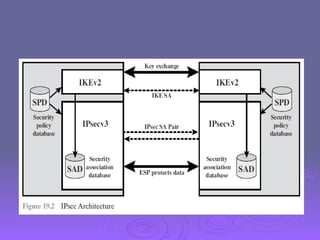
  • #16 Fundamental to the operation of IPsec is the concept of a security policy applied to each IP packet that transits from a source to a destination. IPsec policy is determined primarily by the interaction of two databases, the security association database (SAD) and the security policy database (SPD). A key concept that appears in both the authentication and confidentiality mechanisms for IP is the security association (SA). An association is a one-way relationship between a sender and a receiver that affords security services to the traffic carried on it. If a peer relationship is needed, for two-way secure exchange, then two security associations are required. Security services are afforded to an SA for the use of AH or ESP, but not both. A security association is uniquely identified by three parameters: • Security Parameters Index (SPI): A bit string assigned to this SA and having local significance only • IP Destination Address: the address of the destination endpoint of the SA • Security Protocol Identifier: indicates whether the association is an AH or ESP security association. A SA may also have a number of other parameters. In each IPSec implementation, there is a Security Association Database that defines the parameters associated with each SA. See text for details of these.
  • #19 The means by which IP traffic is related to specific SAs (or no SA in the case of traffic allowed to bypass IPsec) is the nominal Security Policy Database. In its simplest form, an SPD contains entries, each of which defines a subset of IP traffic and points to an SA for that traffic. In more complex environments, there may be multiple entries that potentially relate to a single SA or multiple SAs associated with a single SPD entry. Each SPD entry is defined by a set of IP and upper-layer protocol field values, called selectors. These include local & remote IP addresses, next layer protocol, name, local & remote ports. In effect, these selectors are used to filter outgoing traffic in order to map it into a particular SA. Stallings Table 19.2 provides an example of an SPD on a host system (as opposed to a network system such as a firewall or router). This table reflects the following configuration: A local network configuration consists of two networks. The basic corporate has the IP network number 1.2.3.0/24. The local configuration also includes a secure LAN, often known as a DMZ, that is identified as 1.2.4.0/24. The DMZ is protected from both the outside world and the rest of the corporate LAN by firewalls. The host in this example has the IP address 1.2.3.10, and it is authorized to connect to the server 1.2.4.10 in the DMZ. The entries in the SPD should be self-explanatory. For example, UDP port 500 is the designated port for IKE. Any traffic from the local host to a remote host for purposes of an IKE exchange bypasses the IPsec processing.
  • #21 ESP can be used to provide confidentiality, data origin authentication, connectionless integrity, an anti-replay service (a form of partial sequence integrity), and (limited) traffic flow confidentiality. The set of services provided depends on options selected at the time of Security Association (SA) establishment and on the location of the implementation in a network topology. ESP can work with a variety of encryption and authentication algorithms, including authenticated encryption algorithms such as GCM.
  • #22 Stallings Figure 19.5b shows the format of an ESP packet, with fields: • Security Parameters Index (32 bits): Identifies a security association • Sequence Number (32 bits): A monotonically increasing counter value; this provides an anti-replay function • Payload Data (variable): This is a transport-level segment (transport mode) or IP packet (tunnel mode) that is protected by encryption • Padding (0–255 bytes): for various reasons • Pad Length (8 bits): the number of pad bytes immediately preceding this field • Next Header (8 bits): identifies the type of data in the payload data field • Integrity check value (variable): a variable-length field that contains the Integrity Check Value computed over the ESP packet When any combined mode algorithm is employed, it is expected to return both the decrypted plaintext and a pass/fail indication for the integrity check. Two additional fields may be present in the payload. An initialization value (IV), or nonce, is present if this is required by the encryption or authenticated encryption algorithm used for ESP. If tunnel mode is being used, then the IPsec implementation may add traffic flow confidentiality (TFC) padding after the Payload Data and before the Padding field, as explained subsequently.
  • #24 The Payload Data, Padding, Pad Length, and Next Header fields are encrypted by the ESP service. If the algorithm used to encrypt the payload requires cryptographic synchronization data, such as an initialization vector (IV), then these data may be carried explicitly at the beginning of the Payload Data field. If included, an IV is usually not encrypted, although it is often referred to as being part of the ciphertext. The ICV field is optional. It is present only if the integrity service is selected and is provided by either a separate integrity algorithm or a combined mode algorithm that uses an ICV. The ICV is computed after the encryption is performed. The Padding field serves several purposes: If an encryption algorithm requires the plaintext to be a multiple of some number of bytes, the Padding field is used to expand the plaintext to the required length; to assure that the Pad Length and Next Header fields are right aligned within a 32-bit word; to provide partial traffic flow confidentiality by concealing the actual length of the payload.
  • #25 A replay attack is one in which an attacker obtains a copy of an authenticated packet and later transmits it to the intended destination. The receipt of duplicate, authenticated IP packets may disrupt service in some way or may have some other undesired consequence. The Sequence Number field is designed to thwart such attacks. When a new SA is established, the sender initializes a sequence number counter to 0. Each time that a packet is sent on this SA, the sender increments the counter and places the value in the Sequence Number field. Thus, the first value to be used is 1. If anti-replay is enabled (the default), the sender must not allow the sequence number to cycle past 232 – 1 back to zero. If this limit is reached, the sender should terminate this SA and negotiate a new SA with a new key. Because IP is a connectionless, unreliable service, the protocol does not guarantee that packets will be delivered in order and does not guarantee that all packets will be delivered. Therefore, the IPsec authentication document dictates that the receiver should implement a window of size W, with a default of W = 64. The right edge of the window represents the highest sequence number, N, so far received for a valid packet. For any packet with a sequence number in the range from N – W + 1 to N that has been correctly received (i.e., properly authenticated), the corresponding slot in the window is marked .
  • #26 1. If the received packet falls within the window and is new, the MAC is checked. If the packet is authenticated, the corresponding slot in the window is marked. 2. If the received packet is to the right of the window and is new, the MAC is checked. If the packet is authenticated, the window is advanced so that this sequence number is the right edge of the window, and the corresponding slot in the window is marked. 3. If the received packet is to the left of the window or if authentication fails, the packet is discarded; this is an auditable event.
  • #29 Stallings Figure 19.9 shows the protocol architecture for the two modes when ESP is used.
  • #30 An individual SA can implement either the AH or ESP protocol but not both. Sometimes a particular traffic flow will call for the services provided by both AH and ESP. Further, a particular traffic flow may require IPSec services between hosts and ,for that same flow, separate services between security gateways, such as firewalls. In all of these cases, multiple SAs must be employed for the same traffic flow to achieve the desired IPSec services. The term security association bundle refers to a sequence of SAs through which traffic must be processed to provide a desired set of IPSec services. The SAs in a bundle may terminate at different endpoints or at the same endpoints. Security associations may be combined into bundles in two ways: • Transport adjacency: more than one security protocol on same IP packet, without invoking tunneling • Iterated tunneling: application of multiple layers of security protocols effected through IP tunneling Encryption and authentication can be combined in order to transmit an IP packet that has both confidentiality and authentication between hosts. We look at several approaches, including: ESP with authentication option, use two bundled transport SAs, with the inner being an ESP SA and the outer being an AH SA; use a bundle consisting of an inner AH transport SA and an outer ESP tunnel SA. See text for more details.
  • #32 Case 1. All security is provided between end systems that implement IPsec. For any two end systems to communicate via an SA, they must share the appropriate secret keys. Among the possible combinations are a. AH in transport mode b. ESP in transport mode c. ESP followed by AH in transport mode (an ESP SA inside an AH SA) d. Any one of a, b, or c inside an AH or ESP in tunnel mode We have already discussed how these various combinations can be used to support authentication, encryption, authentication before encryption, and authentication after encryption. Case 2. Security is provided only between gateways (routers, firewalls, etc.) and no hosts implement IPsec. This case illustrates simple virtual private network support.The security architecture document specifies that only a single tunnel SA is needed for this case. The tunnel could support AH, ESP, or ESP with the authentication option. Nested tunnels are not required, because the IPsec services apply to the entire inner packet. Case 3. This builds on case 2 by adding end-to-end security.The same combinations discussed for cases 1 and 2 are allowed here.The gateway-to-gateway tunnel provides either authentication, confidentiality, or both for all traffic between end systems.When the gateway-to-gateway tunnel is ESP, it also provides a limited form of traffic confidentiality. Individual hosts can implement any additional IPsec services required for given applications or given users by means of end-to-end SAs. Case 4. This provides support for a remote host that uses the Internet to reach an organization’s firewall and then to gain access to some server or workstation behind the firewall. Only tunnel mode is required between the remote host and the firewall. As in case 1, one or two SAs may be used between the remote host and the local host.
  • #33 The key management portion of IPSec involves the determination and distribution of secret keys. A typical requirement is four keys for communication between two applications: transmit and receive pairs for both AH and ESP. The IPSec Architecture document mandates support for two types of key management: • Manual where a system administrator manually configures each system with its own keys and with the keys of other communicating • Automated where an automated system enables the on-demand creation of keys for SAs and facilitates the use of keys in a large distributed system with an evolving configuration The default automated key management protocol for IPSec is referred to as ISAKMP/Oakley.
  • #34 Oakley is a key exchange protocol based on the Diffie-Hellman algorithm but providing added security. Oakley is generic in that it does not dictate specific formats. Oakley is designed to retain the advantages of Diffie-Hellman while countering its weaknesses. These include that it does not provide any information about the identities of the parties, is subject to a man-in-the-middle attack, and is computationally intensive The Oakley algorithm is characterized by five important features: 1. It employs a mechanism known as cookies to thwart clogging attacks 2. It enables the two parties to negotiate a group; this, in essence, specifies the global parameters of the Diffie-Hellman key exchange 3. It uses nonces to ensure against replay attacks 4. It enables the exchange of Diffie-Hellman public key values 5. It authenticates the Diffie-Hellman exchange to thwart man-in-the-middle attacks Oakley supports the use of different groups for the Diffie-Hellman key exchange, being 768, 1024 or 1536 bit primes, or 155 or 185 bit elliptic curves. See text for more details.
  • #38 The Internet Security Association and Key Management Protocol (ISAKMP) provides a framework for Internet key management and provides the specific protocol support, defining procedures and packet formats to establish, negotiate, modify, and delete security associations. ISAKMP by itself does not dictate a specific key exchange algorithm; rather, ISAKMP consists of a set of message types that enable the use of a variety of key exchange algorithms. Oakley is the specific key exchange algorithm mandated for use with the initial version of ISAKMP. In IKEv2, the terms Oakley and ISAKMP are no longer used, and there are significant differences from the use of Oakley and ISAKMP in IKEv1. Nevertheless, the basic functionality is the same.
  • #39 The IKEv2 protocol involves the exchange of messages in pairs. The first two pairs of exchanges are referred to as the initial exchanges (see Stallings Figure 19.11a). In the first exchange the two peers exchange information concerning cryptographic algorithms and other security parameters they are willing to use along with nonces and Diffie-Hellman (DH) values. The result of this exchange is to set up a special SA called the IKE SA (Figure 19.2). This SA defines parameters for a secure channel between the peers over which subsequent message exchanges take place. Thus, all subsequent IKE message exchanges are protected by encryption and message authentication. In the second exchange, the two parties authenticate one another and set up a first IPsec SA to be placed in the SADB and used for protecting ordinary (i.e. non-IKE) communications between the peers. Thus four messages are needed to establish the first SA for general use. The CREATE_CHILD_SA exchange can be used to establish further SAs for protecting traffic. The informational exchange is used to exchange management information, IKEv2 error messages, and other notifications.
  • #40 An ISAKMP message consists of an ISAKMP header followed by one or more payloads, carried in a transport protocol (UDP by default). Stallings Figure19.12a shows the header format for an ISAKMP message, which includes the fields: • Initiator SPI (64 bits): chosen by the initiator to identify a unique SA • Responder Cookie (64 bits): chosen by responder to identify unique IKE SA • Next Payload (8 bits): type of the first payload in the message. • Major/Minor Version (4 bits): Indicates major/minor version of IKE in use • Exchange Type (8 bits): type of exchange. • Flags (8 bits): specific options set for this IKE exchange. • Message ID (32 bits): control retransmission, matching of requests /responses. • Length (32 bits): of total message (header plus all payloads) in octets. All ISAKMP payloads begin with the same generic payload header shown in Figure 12.12b. The Next Payload field has a value of 0 if this is the last payload in the message; otherwise its value is the type of the next payload. The Payload Length field indicates the length in octets of this payload, including the generic payload header. The critical bit is zero if the sender wants the recipient to skip this payload if it does not understand the payload type code in the Next Payload field of the previous payload. It is set to one if the sender wants the recipient to reject this entire message if it does not understand the payload type.
  • #41 Stallings Table19.3 summarizes the payload types defined for ISAKMP, and lists the fields, or parameters, that are part of each payload. The SA payload is used to begin the establishment of an SA. The payload has a complex, hierarchical structure. The payload may contain multiple proposals. Each proposal may contain multiple protocols. Each protocol may contain multiple transforms. And each transform may contain multiple attributes. These elements are formatted as substructures within the payload with proposal, transform and attribute. See text for more details.
  • #42 The IPsecv3 and IKEv3 protocols rely on a variety of types of cryptographic algorithms. To promote interoperability, two RFCs define recommended suites of cryptographic algorithms and parameters for various applications. RFC 4308 defines two cryptographic suites for establishing virtual private networks. Suite VPN-A matches the commonly used corporate VPN security used in older IKEv1 implementations. Suite VPN-B provides stronger security and is recommended for new VPNs that implement IPsecv3 and IKEv2. Stallings Table 19.4a lists the algorithms and parameters for the two suites. For symmetric cryptography, VPN-A relies on 3DES and HMAC, while VPN-B relies exclusively on AES. RFC 4869 defines four optional cryptographic suites compatible with the US National Security Agency's Suite B specifications. The four suites defined in RFC 4869 provide choices for ESP and IKE. They are differentiated by the choice of cryptographic algorithm strengths and a choice of whether ESP is to provide both confidentiality and integrity or integrity only. All of the suites offer greater protection than the two VPN suites defined in RFC 4308. Stallings Table 19.4b lists the algorithms and parameters for these suites. For ESP, authenticated encryption is provided using the GCM mode with either 128-bit or 256-bit AES keys. For IKE encryption, CBC is used, as it was for the VPN suites. For ESP, if only authentication is required, then GMAC is used. For IKE, message authentication is provided using HMAC with one of the SHA-3 hash functions. As with the VPN suites, IKEv2 in these suites generates pseudorandom bits by repeated use of the MAC used for message authentication. For the Diffie-Hellman algorithm, the use of elliptic curve groups modulo a prime is specified. Finally, for authentication, elliptic curve digital signatures are listed.
  • #43 Chapter 19 summary.