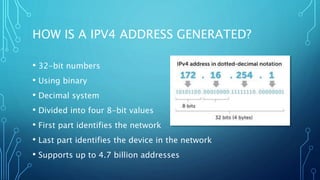
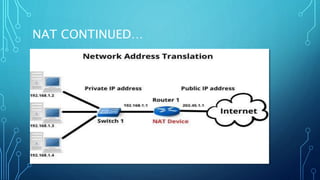
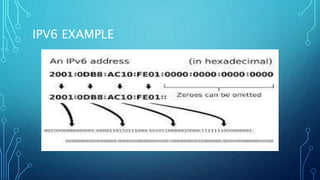
This document discusses IP addressing and how it uniquely identifies devices on the internet. It explains that while IPv4 addresses originally used 32-bit numbers to uniquely identify over 4 billion devices, the number of internet-connected devices has now surpassed the available IPv4 addresses. As a result, Network Address Translation (NAT) is commonly used to map multiple private IP addresses to a single public IP address. The document also introduces IPv6, which uses 128-bit addresses to uniquely identify far more than the number of existing and expected internet-connected devices. It notes that while IPv6 adoption is growing, both IPv4 and IPv6 are still in use, and conversion or tunneling tools are needed for compatibility between the different IP versions.