Wellcome To Presentation
IP ADDRESSING
Protocol
TCP/IP, NetBIOS(Microsoft)
TCP/IP-http, ftp, DNS.
What is IPAddressing
Unique name for each device
LAN Example
Logical Address
Network Layer Address (Layer 3)
IP Version
.
 IP version 4 (32 bit address)
 IP version 6 (128 bit address)
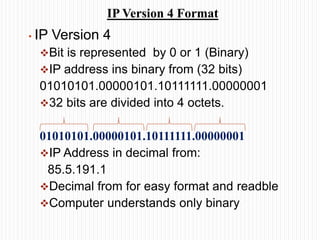
IP Version 4 Format
• IP Version 4
Bit is represented by 0 or 1 (Binary)
IP address ins binary from (32 bits)
01010101.00000101.10111111.00000001
32 bits are divided into 4 octets.
01010101.00000101.10111111.00000001
IP Address in decimal from:
85.5.191.1
Decimal from for easy format and readble
Computer understands only binary
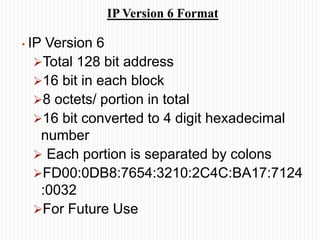
IP Version 6 Format
• IP Version 6
Total 128 bit address
16 bit in each block
8 octets/ portion in total
16 bit converted to 4 digit hexadecimal
number
 Each portion is separated by colons
FD00:0DB8:7654:3210:2C4C:BA17:7124
:0032
For Future Use
IP Version 4 Format
•Minimum Number in each portion is 0(00000000 in
binary)
•Maximum number in each portion is 255(11111111
in binary)
•Range of IP address is 0 to 255
•More then 255 is not applicable
•Check by 100.256.1.0
•Total IP address range of IPV4 is 0.0.0.0 to
255.255.255.255
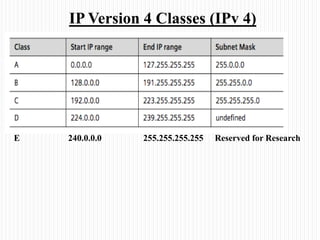
IP Version 4 Classes (IPv 4)
E 240.0.0.0 255.255.255.255 Reserved for Research
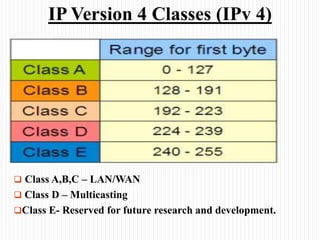
IP Version 4 Classes (IPv 4)
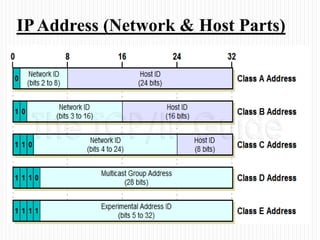
 Class A,B,C – LAN/WAN
 Class D – Multicasting
Class E- Reserved for future research and development.
Identifying IP Class
•See only first portion of any IP
•Example:
192.168.10.10- C Class.
150.12.10.10 – B Class
100.10.10.10 – A Class
Types of Data Communication
Generally, 3 types of communication in network
 Unicast- One to One
 Broadcast- One to all
 Multicast- One to group.
Unicast Communication
• One to one communication in a network
• Example (network types. PNG)
• Most communication is default one-to-
one communication.
Broadcast Communication
• One to all communication in a network.
• Example (network types.PNG)
• 200 devices connected in a LAN.
•Universal broadcast address is 255.255.255.255
Multicast Communication
• One to a group communication in a network.
• Example (network types.PNG)
• Suppose 100 devices are connected in a LAN
• Total 10 groups (each contains 10 devices)
• Example: Video Conference, Online live, streaming, etc.
• D class IP identifies multicast traffic/group
• Multicast is not included into CCNA course.
• We can not use it in LAN or WAN (check by putting 224 in first
portion of IP)
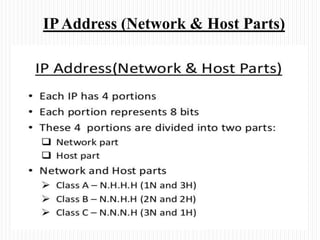
IPAddress (Network & Host Parts)
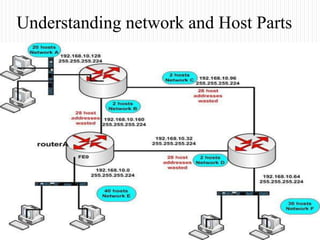
Understanding network and Host Parts
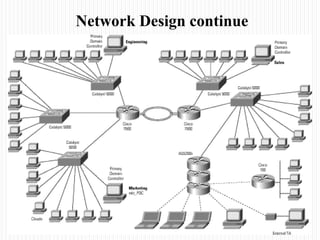
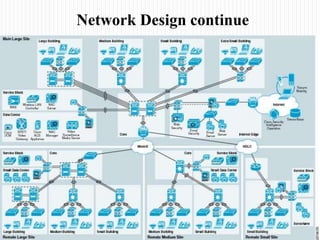
Network Design
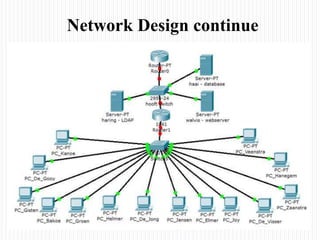
Network Design continue
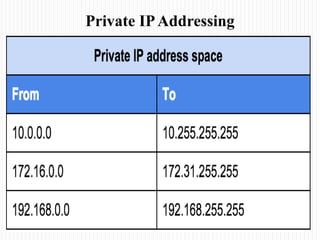
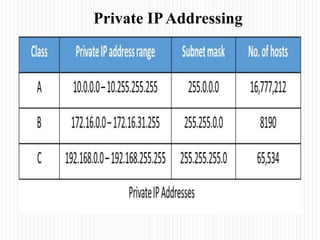
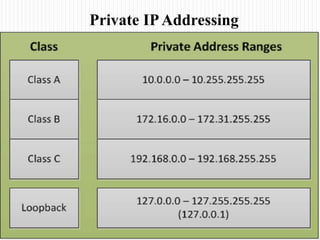
Private IPAddressing
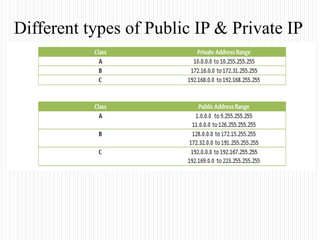
Different types of Public IP & Private IP

Ip addresing

  • 1.
  • 2.
    IP ADDRESSING Protocol TCP/IP, NetBIOS(Microsoft) TCP/IP-http,ftp, DNS. What is IPAddressing Unique name for each device LAN Example Logical Address Network Layer Address (Layer 3)
  • 4.
    IP Version .  IPversion 4 (32 bit address)  IP version 6 (128 bit address)
  • 5.
    IP Version 4Format • IP Version 4 Bit is represented by 0 or 1 (Binary) IP address ins binary from (32 bits) 01010101.00000101.10111111.00000001 32 bits are divided into 4 octets. 01010101.00000101.10111111.00000001 IP Address in decimal from: 85.5.191.1 Decimal from for easy format and readble Computer understands only binary
  • 6.
    IP Version 6Format • IP Version 6 Total 128 bit address 16 bit in each block 8 octets/ portion in total 16 bit converted to 4 digit hexadecimal number  Each portion is separated by colons FD00:0DB8:7654:3210:2C4C:BA17:7124 :0032 For Future Use
  • 7.
    IP Version 4Format •Minimum Number in each portion is 0(00000000 in binary) •Maximum number in each portion is 255(11111111 in binary) •Range of IP address is 0 to 255 •More then 255 is not applicable •Check by 100.256.1.0 •Total IP address range of IPV4 is 0.0.0.0 to 255.255.255.255
  • 8.
    IP Version 4Classes (IPv 4) E 240.0.0.0 255.255.255.255 Reserved for Research
  • 9.
    IP Version 4Classes (IPv 4)  Class A,B,C – LAN/WAN  Class D – Multicasting Class E- Reserved for future research and development.
  • 10.
    Identifying IP Class •Seeonly first portion of any IP •Example: 192.168.10.10- C Class. 150.12.10.10 – B Class 100.10.10.10 – A Class
  • 11.
    Types of DataCommunication Generally, 3 types of communication in network  Unicast- One to One  Broadcast- One to all  Multicast- One to group.
  • 12.
    Unicast Communication • Oneto one communication in a network • Example (network types. PNG) • Most communication is default one-to- one communication.
  • 13.
    Broadcast Communication • Oneto all communication in a network. • Example (network types.PNG) • 200 devices connected in a LAN. •Universal broadcast address is 255.255.255.255
  • 14.
    Multicast Communication • Oneto a group communication in a network. • Example (network types.PNG) • Suppose 100 devices are connected in a LAN • Total 10 groups (each contains 10 devices) • Example: Video Conference, Online live, streaming, etc. • D class IP identifies multicast traffic/group • Multicast is not included into CCNA course. • We can not use it in LAN or WAN (check by putting 224 in first portion of IP)
  • 15.
  • 16.
  • 17.
  • 18.
  • 19.
  • 20.
  • 21.
  • 22.
  • 23.
  • 24.
  • 25.
    Different types ofPublic IP & Private IP