WHITE PAPER
Wireless Technology in Industrial Automation
The clear path to operational excellence
The use of wireless technology in industrial automation
systems offers a number of potential benefits, from the
obvious cost reduction brought about by the elimination of
wiring to the availability of better plant information, improved
productivity and better asset management.
However, its practical implementation faces a number of
challenges: not least the present lack of a universally agreed
standard. This article looks at some of these challenges and
presents the approach being taken by Yokogawa.
Introduction:
the wireless landscape
In order to understand the ways in which wireless technology
can aid the implementation of industrial automation systems,
it is first important to clarify what is meant by the word
‘wireless’ in this context. Essentially, wireless can act at
several levels within a plant:
RFID: At the simplest level, radio-frequency identification
can aid asset inspection and tracking, safety and security,
and location.
Wireless sensor networks: This is possibly the area where
most attention is currently being focused, and embraces
areas such as condition monitoring, wireless instruments and
measurements.
Wireless LANs, covering areas such as mobile operator
terminals, data logging, security, maintenance and IT.
Wireless WANs, including long-distance broadband
backhaul and high-bandwidth video applications.
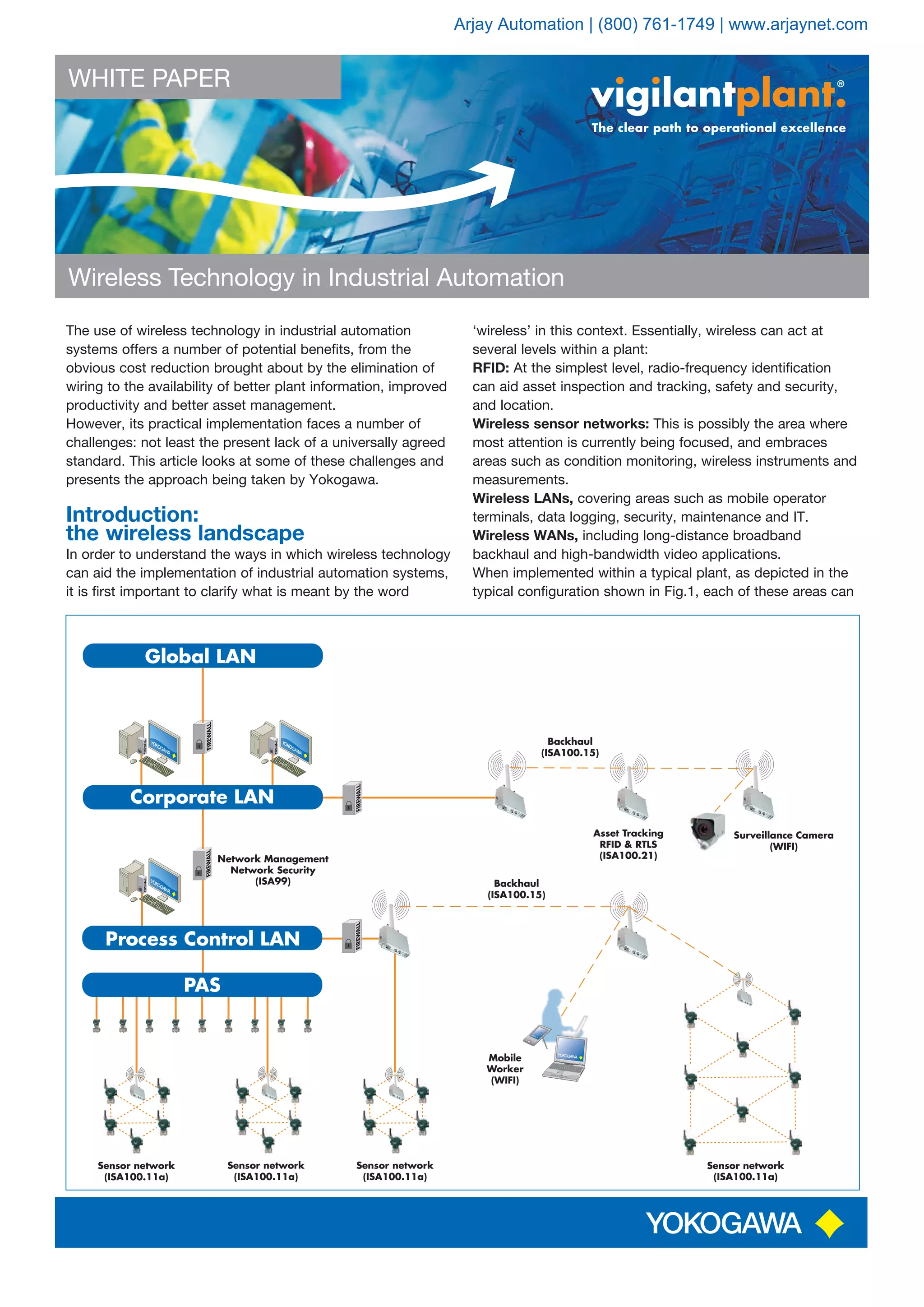
When implemented within a typical plant, as depicted in the
typical configuration shown in Fig.1, each of these areas can
PAS
Mobile
Worker
(WIFI)
Surveillance Camera
(WIFI)
Global LAN
Asset Tracking
RFID & RTLS
(ISA100.21)Network Management
Network Security
(ISA99)
Process Control LAN
Corporate LAN
Backhaul
(ISA100.15)
Backhaul
(ISA100.15)
Sensor network
(ISA100.11a)
Sensor network
(ISA100.11a)
Sensor network
(ISA100.11a)
Sensor network
(ISA100.11a)
Arjay Automation | (800) 761-1749 | www.arjaynet.com
WHITE PAPER
The clear path to operational excellence
bring benefits as well as new opportunities. For example, the
fact that plant and process information is available anywhere
via wireless sensor networks leads to more and better quality
information, with the benefits of distributed control and plant
asset management spread throughout the plant.
Another important benefit is improved workforce productivity.
The fact that there are no wires leads to reduced installation
and commissioning effort, while the fact that workers –
whether operators or maintenance engineers – can be truly
mobile eliminates the need for fixed local panels. Improved
plant management results from the improved availability of
video surveillance and people tracking for better safety and
security, along with a reduced need to access hazardous or
remote plant areas.
Wireless sensor networks
Of all the elements outlined above, wireless sensor networks
are currently attracting the most attention, as most of the
benefits directly relate to this area. Apart from the benefits
of eliminating signal and power wiring, wireless sensor
networks will open up measurement applications in sites
that are hard to access, or where the wiring cost cannot be
justified. They will also prove invaluable for the modernisation
of existing facilities, for temporary installations, or for
locations where a power source is not available.
Wireless sensor networks also offer enhanced plant asset
management through the freeing up of cable resources
for higher-priority measurements in existing installations,
the replacement of many traditional pressure gauges
and temperature indicators, and the ability to make
measurements that could not previously be justified. There
is also a reduction in ‘blind spots’ through the ability to
make measurements on rotating or moving equipment
and in remote locations. A further important point is that,
once established, wireless sensor networks are scalable:
additional sensors can be added at low cost, and temporary
measurements can be easily incorporated for process
diagnostics and optimisation.
Wireless standards
In developing a universal standard for industrial automation
wireless networks, a number of challenges emerge, not least
because most license-free wireless networks use the same
2.4 GHz bandwidth, and many sensor networks are based
on the IEEE 802.15.4 standard. Clearly there are concerns
about coexistence and interference leading to reliability and
latency problems and about multiple protocols sharing the
same bandwidth.
Field experience
In open terrain, no obstacles; a range of >200m can be
expected
In pipe lines, higher antenna position improves communication
quality; a range of >50-100m can be expected
Nearby plant steelwork, no obstacles; a range of >50m can
be expected
Inside infrastructure, inside plant steelwork; a range of
<<50m can be expected
Arjay Automation | (800) 761-1749 | www.arjaynet.com
WHITE PAPER
The clear path to operational excellence
Users have concerns about security, with the potential
for jamming, sabotage and the compromising of network
privacy. They also want systems that are open and
backwards-compatible, interoperable and cost-effective to
implement.
One thing is certain: the industry must strive to establish
one global standard which covers communication from
sensor to boardroom, which is designed with security in
mind, and which is end-user driven. Unfortunately, this
ideal scenario is unlikely to occur in the foreseeable future
since two standards are currently being used by different
industry players: WirelessHART and ISA100.11a. Although
the two have some features in common, in reality they are
very different. In particular, the scope of ISA100.11a is much
wider, since – whereas WirelessHART focuses on monitoring
from HART-enabled field instruments, ISA100.11a offers the
scope to cover everything from field instruments to control-
room integration. Moreover, it is compatible with a variety
of protocols including FOUNDATION Fieldbus, Profibus,
Modbus and others as well as HART, and allows over 1000
devices in a network compared to only around 250 with
WirelessHART.
At Yokogawa, we are committed to supporting ISA100.11a
as part of the ISA100 family of standards as a preferred
single international standard. In addition the ISA99 Security
for Industrial Automation and Control Systems standard will
be implemented to warrant overall security and privacy.
Wireless strategy
Yokogawa is currently in the process of developing and
evaluating a number of products for wireless sensor
networks, with the emphasis on self-healing mesh network
configurations, long battery life for field operation and a
high degree of security. Field trials have been carried out to
establish the characteristics of 2.4 GHz wireless transmission
within typical environments such as refineries or chemical
plants, from which a number of important lessons have been
learned:
2.4 GHz radio is sensitive to the presence of obstacles
(pipework and other metal structures, for example).
Wireless is not much affected by the local climate or by the
presence of other wireless networks.
A mesh network configuration (involving more than two
paths) is important for network reliability.
Response time is a useful indicator of the radio transmission
conditions.
As a result of this experience, Yokogawa is pressing ahead
with the development of wireless-based field instruments
and access points as the initial stage of a ‘total solutions’
approach, and is implementing partnerships with other
organisations to facilitate aspects such as the integration of
auxiliary sensors as well as mobile worker networks,
Arjay Automation | (800) 761-1749 | www.arjaynet.com
WHITE PAPER
The clear path to operational excellence
Yokogawa has an extensive sales and
distribution network.
Please refer to the European website
(www.yokogawa.com/eu) to contact your
nearest representative.
YOKOGAWA EUROPE BV
Euroweg 2
3825 HD AMERSFOORT
The Netherlands
www.yokogawa.com/eu
YOKOGAWA ELECTRIC CORPORATION
World Headquarters
9-32, Nakacho 2-chome, Musashino-shi
Tokyo 180-8750
Japan
www.yokogawa.com
YOKOGAWA CORPORATION OF AMERICA
2 Dart Road
Newnan GA 30265
USA
www.yokogawa.com/us
YOKOGAWA ELECTRIC ASIA Pte. LTD.
5 Bedok South Road
Singapore 469270
Singapore
www.yokogawa.com/sg
YOKOGAWA CHINA CO. LTD.
3F Tower D Cartelo Crocodile Building
No.568 West Tianshan Road Changing District
Shanghai, China
www.yokogawa.com/cn
YOKOGAWA MIDDLE EAST B.S.C.(c)
P.O. Box 10070, Manama
Building 577, Road 2516, Busaiteen 225
Muharraq, Bahrain
www.yokogawa.com/bh
integration of surveillance camera systems and long-haul
inter-plant connections.
A lesson learned from conducted wireless sensor field trials
and real project implementations of mobile worker networks
is that obstacles may affect the reliability, and hence the
quality of service (QoS), of the network. Specifically, the
proper location of access points and other devices and the
possible need for inclusion of repeaters should be assessed
beforehand. This is particularly critical for the successful
operation of the mobile worker network, where roaming is
essential.
It is expected that wireless sensor networks will gradually
be adopted by the process industry. Although ISA100.11a
is designed to accommodate control applications, initially
the majority of applications will be for monitoring due to
battery life limitations. In existing installations the benefits
are obvious. Measurements for process monitoring and
condition monitoring can be added where the existing
infrastructure cannot accommodate them. State of the art
greenfield sites are expected to be equipped with intelligent
instruments that are mostly connected through wired
instrumentation systems such as Foundation fieldbus while
having several wireless networks for process and condition
monitoring present.
Summary
Yokogawa is committed to the emerging wireless
technologies as a way forward in implementing total
solutions with wireless sensor networks as a key element
in providing DCS and plant asset management ‘anywhere’.
The Yokogawa values of openness, interoperability and
reliability will be provided by systems based on the ISA100
standard, with Yokogawa assuming total wireless solution
responsibility.
Henk van der Bent, Yokogawa Europe BV.
Arjay Automation | (800) 761-1749 | www.arjaynet.com

Wireless Technology in Industrial Automation

  • 1.
    WHITE PAPER Wireless Technologyin Industrial Automation The clear path to operational excellence The use of wireless technology in industrial automation systems offers a number of potential benefits, from the obvious cost reduction brought about by the elimination of wiring to the availability of better plant information, improved productivity and better asset management. However, its practical implementation faces a number of challenges: not least the present lack of a universally agreed standard. This article looks at some of these challenges and presents the approach being taken by Yokogawa. Introduction: the wireless landscape In order to understand the ways in which wireless technology can aid the implementation of industrial automation systems, it is first important to clarify what is meant by the word ‘wireless’ in this context. Essentially, wireless can act at several levels within a plant: RFID: At the simplest level, radio-frequency identification can aid asset inspection and tracking, safety and security, and location. Wireless sensor networks: This is possibly the area where most attention is currently being focused, and embraces areas such as condition monitoring, wireless instruments and measurements. Wireless LANs, covering areas such as mobile operator terminals, data logging, security, maintenance and IT. Wireless WANs, including long-distance broadband backhaul and high-bandwidth video applications. When implemented within a typical plant, as depicted in the typical configuration shown in Fig.1, each of these areas can PAS Mobile Worker (WIFI) Surveillance Camera (WIFI) Global LAN Asset Tracking RFID & RTLS (ISA100.21)Network Management Network Security (ISA99) Process Control LAN Corporate LAN Backhaul (ISA100.15) Backhaul (ISA100.15) Sensor network (ISA100.11a) Sensor network (ISA100.11a) Sensor network (ISA100.11a) Sensor network (ISA100.11a) Arjay Automation | (800) 761-1749 | www.arjaynet.com
  • 2.
    WHITE PAPER The clearpath to operational excellence bring benefits as well as new opportunities. For example, the fact that plant and process information is available anywhere via wireless sensor networks leads to more and better quality information, with the benefits of distributed control and plant asset management spread throughout the plant. Another important benefit is improved workforce productivity. The fact that there are no wires leads to reduced installation and commissioning effort, while the fact that workers – whether operators or maintenance engineers – can be truly mobile eliminates the need for fixed local panels. Improved plant management results from the improved availability of video surveillance and people tracking for better safety and security, along with a reduced need to access hazardous or remote plant areas. Wireless sensor networks Of all the elements outlined above, wireless sensor networks are currently attracting the most attention, as most of the benefits directly relate to this area. Apart from the benefits of eliminating signal and power wiring, wireless sensor networks will open up measurement applications in sites that are hard to access, or where the wiring cost cannot be justified. They will also prove invaluable for the modernisation of existing facilities, for temporary installations, or for locations where a power source is not available. Wireless sensor networks also offer enhanced plant asset management through the freeing up of cable resources for higher-priority measurements in existing installations, the replacement of many traditional pressure gauges and temperature indicators, and the ability to make measurements that could not previously be justified. There is also a reduction in ‘blind spots’ through the ability to make measurements on rotating or moving equipment and in remote locations. A further important point is that, once established, wireless sensor networks are scalable: additional sensors can be added at low cost, and temporary measurements can be easily incorporated for process diagnostics and optimisation. Wireless standards In developing a universal standard for industrial automation wireless networks, a number of challenges emerge, not least because most license-free wireless networks use the same 2.4 GHz bandwidth, and many sensor networks are based on the IEEE 802.15.4 standard. Clearly there are concerns about coexistence and interference leading to reliability and latency problems and about multiple protocols sharing the same bandwidth. Field experience In open terrain, no obstacles; a range of >200m can be expected In pipe lines, higher antenna position improves communication quality; a range of >50-100m can be expected Nearby plant steelwork, no obstacles; a range of >50m can be expected Inside infrastructure, inside plant steelwork; a range of <<50m can be expected Arjay Automation | (800) 761-1749 | www.arjaynet.com
  • 3.
    WHITE PAPER The clearpath to operational excellence Users have concerns about security, with the potential for jamming, sabotage and the compromising of network privacy. They also want systems that are open and backwards-compatible, interoperable and cost-effective to implement. One thing is certain: the industry must strive to establish one global standard which covers communication from sensor to boardroom, which is designed with security in mind, and which is end-user driven. Unfortunately, this ideal scenario is unlikely to occur in the foreseeable future since two standards are currently being used by different industry players: WirelessHART and ISA100.11a. Although the two have some features in common, in reality they are very different. In particular, the scope of ISA100.11a is much wider, since – whereas WirelessHART focuses on monitoring from HART-enabled field instruments, ISA100.11a offers the scope to cover everything from field instruments to control- room integration. Moreover, it is compatible with a variety of protocols including FOUNDATION Fieldbus, Profibus, Modbus and others as well as HART, and allows over 1000 devices in a network compared to only around 250 with WirelessHART. At Yokogawa, we are committed to supporting ISA100.11a as part of the ISA100 family of standards as a preferred single international standard. In addition the ISA99 Security for Industrial Automation and Control Systems standard will be implemented to warrant overall security and privacy. Wireless strategy Yokogawa is currently in the process of developing and evaluating a number of products for wireless sensor networks, with the emphasis on self-healing mesh network configurations, long battery life for field operation and a high degree of security. Field trials have been carried out to establish the characteristics of 2.4 GHz wireless transmission within typical environments such as refineries or chemical plants, from which a number of important lessons have been learned: 2.4 GHz radio is sensitive to the presence of obstacles (pipework and other metal structures, for example). Wireless is not much affected by the local climate or by the presence of other wireless networks. A mesh network configuration (involving more than two paths) is important for network reliability. Response time is a useful indicator of the radio transmission conditions. As a result of this experience, Yokogawa is pressing ahead with the development of wireless-based field instruments and access points as the initial stage of a ‘total solutions’ approach, and is implementing partnerships with other organisations to facilitate aspects such as the integration of auxiliary sensors as well as mobile worker networks, Arjay Automation | (800) 761-1749 | www.arjaynet.com
  • 4.
    WHITE PAPER The clearpath to operational excellence Yokogawa has an extensive sales and distribution network. Please refer to the European website (www.yokogawa.com/eu) to contact your nearest representative. YOKOGAWA EUROPE BV Euroweg 2 3825 HD AMERSFOORT The Netherlands www.yokogawa.com/eu YOKOGAWA ELECTRIC CORPORATION World Headquarters 9-32, Nakacho 2-chome, Musashino-shi Tokyo 180-8750 Japan www.yokogawa.com YOKOGAWA CORPORATION OF AMERICA 2 Dart Road Newnan GA 30265 USA www.yokogawa.com/us YOKOGAWA ELECTRIC ASIA Pte. LTD. 5 Bedok South Road Singapore 469270 Singapore www.yokogawa.com/sg YOKOGAWA CHINA CO. LTD. 3F Tower D Cartelo Crocodile Building No.568 West Tianshan Road Changing District Shanghai, China www.yokogawa.com/cn YOKOGAWA MIDDLE EAST B.S.C.(c) P.O. Box 10070, Manama Building 577, Road 2516, Busaiteen 225 Muharraq, Bahrain www.yokogawa.com/bh integration of surveillance camera systems and long-haul inter-plant connections. A lesson learned from conducted wireless sensor field trials and real project implementations of mobile worker networks is that obstacles may affect the reliability, and hence the quality of service (QoS), of the network. Specifically, the proper location of access points and other devices and the possible need for inclusion of repeaters should be assessed beforehand. This is particularly critical for the successful operation of the mobile worker network, where roaming is essential. It is expected that wireless sensor networks will gradually be adopted by the process industry. Although ISA100.11a is designed to accommodate control applications, initially the majority of applications will be for monitoring due to battery life limitations. In existing installations the benefits are obvious. Measurements for process monitoring and condition monitoring can be added where the existing infrastructure cannot accommodate them. State of the art greenfield sites are expected to be equipped with intelligent instruments that are mostly connected through wired instrumentation systems such as Foundation fieldbus while having several wireless networks for process and condition monitoring present. Summary Yokogawa is committed to the emerging wireless technologies as a way forward in implementing total solutions with wireless sensor networks as a key element in providing DCS and plant asset management ‘anywhere’. The Yokogawa values of openness, interoperability and reliability will be provided by systems based on the ISA100 standard, with Yokogawa assuming total wireless solution responsibility. Henk van der Bent, Yokogawa Europe BV. Arjay Automation | (800) 761-1749 | www.arjaynet.com