IOT PROTOCOL STACK:
A LAYERED VIEW
LEARNING OBJECTIVES
2
• Students able to state the TCP/IP layered and IoT protocol stack
• Students able to describe challenges and requirements impact the protocols which operate at
respective layer.
INTRODUCTION
3
INTRODUCTION
4
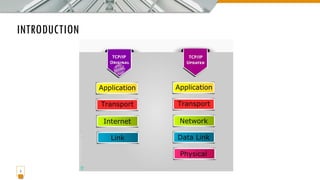
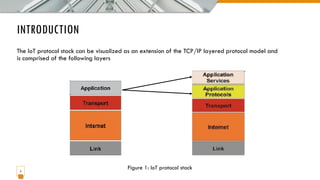
The IoT protocol stack can be visualized as an extension of the TCP/IP layered protocol model and
is comprised of the following layers
Figure 1: IoT protocol stack
LINK LAYER CHALLENGES
5
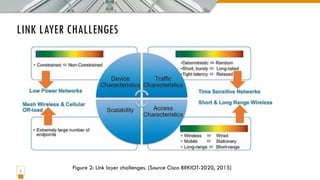
Figure 2: Link layer challenges. (Source Cisco BRKIOT-2020, 2015)
LINK LAYER CHALLENGES
6
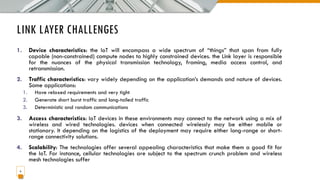
1. Device characteristics: the IoT will encompass a wide spectrum of “things” that span from fully
capable (non-constrained) compute nodes to highly constrained devices. the Link layer is responsible
for the nuances of the physical transmission technology, framing, media access control, and
retransmission.
2. Traffic characteristics: vary widely depending on the application’s demands and nature of devices.
Some applications:
1. Have relaxed requirements and very tight
2. Generate short burst traffic and long-tailed traffic
3. Deterministic and random communications
3. Access characteristics: IoT devices in these environments may connect to the network using a mix of
wireless and wired technologies. devices when connected wirelessly may be either mobile or
stationary. It depending on the logistics of the deployment may require either long-range or short-
range connectivity solutions.
4. Scalability: The technologies offer several appealing characteristics that make them a good fit for
the IoT. For instance, cellular technologies are subject to the spectrum crunch problem and wireless
mesh technologies suffer
INTERNET LAYER
7
Many IoT deployments constitute low-power and lossy networks (LLNs). These networks comprised of
a large number of constrained embedded devices with limited power, memory, and processing
resources. They are interconnected using a variety of Link layer technologies, such as IEEE 802.15.4,
Bluetooth, Wi-Fi, or power-line communication (PLC) links.
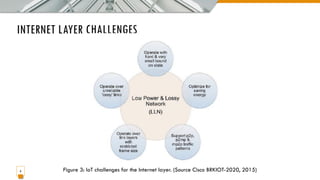
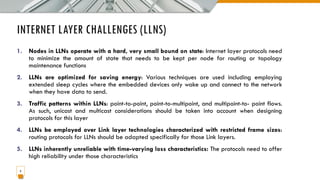
LLNs present the following five challenges to the Internet layer of the protocol stack:
INTERNET LAYER CHALLENGES
8 Figure 3: IoT challenges for the Internet layer. (Source Cisco BRKIOT-2020, 2015)
INTERNET LAYER CHALLENGES (LLNS)
9
1. Nodes in LLNs operate with a hard, very small bound on state: Internet layer protocols need
to minimize the amount of state that needs to be kept per node for routing or topology
maintenance functions
2. LLNs are optimized for saving energy: Various techniques are used including employing
extended sleep cycles where the embedded devices only wake up and connect to the network
when they have data to send.
3. Traffic patterns within LLNs: point-to-point, point-to-multipoint, and multipoint-to- point flows.
As such, unicast and multicast considerations should be taken into account when designing
protocols for this layer
4. LLNs be employed over Link layer technologies characterized with restricted frame sizes:
routing protocols for LLNs should be adapted specifically for those Link layers.
5. LLNs inherently unreliable with time-varying loss characteristics: The protocols need to offer
high reliability under those characteristics
APPLICATION PROTOCOL LAYER
10
• Application protocols are responsible for handling the communication between Application
Entities, i.e., things, gateways, and applications.
• They typically support the flow of data from things to applications and the flow of command or
control information in the reverse direction.
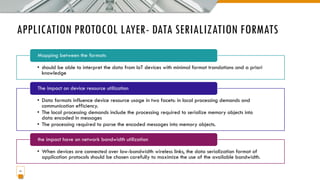
APPLICATION PROTOCOL LAYER- DATA SERIALIZATION FORMATS
11
• should be able to interpret the data from IoT devices with minimal format translations and a priori
knowledge
Mapping between the formats
• Data formats influence device resource usage in two facets: in local processing demands and
communication efficiency.
• The local processing demands include the processing required to serialize memory objects into
data encoded in messages
• The processing required to parse the encoded messages into memory objects.
The impact on device resource utilization
• When devices are connected over low-bandwidth wireless links, the data serialization format of
application protocols should be chosen carefully to maximize the use of the available bandwidth.
the impact have on network bandwidth utilization
APPLICATION PROTOCOL LAYER- COMMUNICATION PARADIGMS
12
Application protocols support different communication patterns. These patterns enable varying
paradigms of interaction between IoT applications and devices.
1. Request/Response Versus Publish/Subscribe
2. Blocking Versus Non-blocking
REQUEST/RESPONSE VS PUBLISH/SUBSCRIBE
13
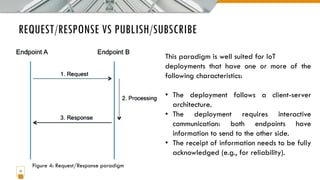
This paradigm is well suited for IoT
deployments that have one or more of the
following characteristics:
• The deployment follows a client-server
architecture.
• The deployment requires interactive
communication: both endpoints have
information to send to the other side.
• The receipt of information needs to be fully
acknowledged (e.g., for reliability).
Figure 4: Request/Response paradigm
REQUEST/RESPONSE VS PUBLISH/SUBSCRIBE
14
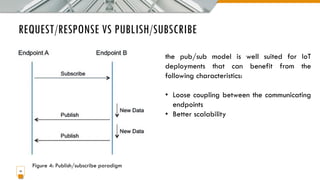
the pub/sub model is well suited for IoT
deployments that can benefit from the
following characteristics:
• Loose coupling between the communicating
endpoints
• Better scalability
Figure 4: Publish/subscribe paradigm
BLOCKING VS NON-BLOCKING
15
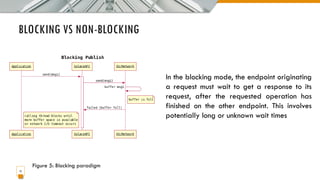
In the blocking mode, the endpoint originating
a request must wait to get a response to its
request, after the requested operation has
finished on the other endpoint. This involves
potentially long or unknown wait times
Figure 5: Blocking paradigm
BLOCKING VS NON-BLOCKING
16
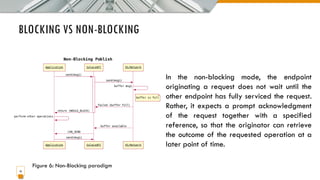
In the non-blocking mode, the endpoint
originating a request does not wait until the
other endpoint has fully serviced the request.
Rather, it expects a prompt acknowledgment
of the request together with a specified
reference, so that the originator can retrieve
the outcome of the requested operation at a
later point of time.
Figure 6: Non-Blocking paradigm
RESTFUL CONSTRAINT
17
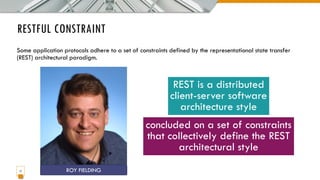
Some application protocols adhere to a set of constraints defined by the representational state transfer
(REST) architectural paradigm.
REST is a distributed
client-server software
architecture style
concluded on a set of constraints
that collectively define the REST
architectural style
ROY FIELDING
FORMAL REST CONSTRAINTS
18
Client-Server
Communication
Model
Stateless
Communication
Cacheable
Communication
Layered
Architecture
Uniform
Interfaces
Code on
Demand
FORMAL REST CONSTRAINTS
19
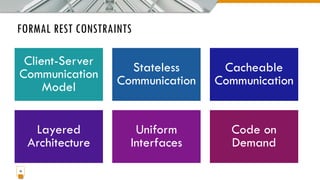
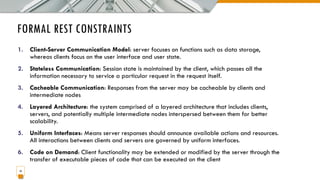
1. Client-Server Communication Model: server focuses on functions such as data storage,
whereas clients focus on the user interface and user state.
2. Stateless Communication: Session state is maintained by the client, which passes all the
information necessary to service a particular request in the request itself.
3. Cacheable Communication: Responses from the server may be cacheable by clients and
intermediate nodes
4. Layered Architecture: the system comprised of a layered architecture that includes clients,
servers, and potentially multiple intermediate nodes interspersed between them for better
scalability.
5. Uniform Interfaces: Means server responses should announce available actions and resources.
All interactions between clients and servers are governed by uniform interfaces.
6. Code on Demand: Client functionality may be extended or modified by the server through the
transfer of executable pieces of code that can be executed on the client
APPLICATION SERVICES LAYER
20
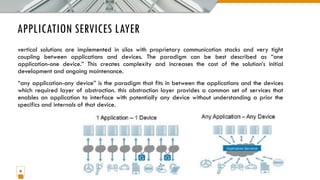
vertical solutions are implemented in silos with proprietary communication stacks and very tight
coupling between applications and devices. The paradigm can be best described as “one
application-one device.” This creates complexity and increases the cost of the solution’s initial
development and ongoing maintenance.
“any application-any device” is the paradigm that fits in between the applications and the devices
which required layer of abstraction. this abstraction layer provides a common set of services that
enables an application to interface with potentially any device without understanding a prior the
specifics and internals of that device.

IoT Protocol Stack.pdf

  • 1.
  • 2.
    LEARNING OBJECTIVES 2 • Studentsable to state the TCP/IP layered and IoT protocol stack • Students able to describe challenges and requirements impact the protocols which operate at respective layer.
  • 3.
  • 4.
    INTRODUCTION 4 The IoT protocolstack can be visualized as an extension of the TCP/IP layered protocol model and is comprised of the following layers Figure 1: IoT protocol stack
  • 5.
    LINK LAYER CHALLENGES 5 Figure2: Link layer challenges. (Source Cisco BRKIOT-2020, 2015)
  • 6.
    LINK LAYER CHALLENGES 6 1.Device characteristics: the IoT will encompass a wide spectrum of “things” that span from fully capable (non-constrained) compute nodes to highly constrained devices. the Link layer is responsible for the nuances of the physical transmission technology, framing, media access control, and retransmission. 2. Traffic characteristics: vary widely depending on the application’s demands and nature of devices. Some applications: 1. Have relaxed requirements and very tight 2. Generate short burst traffic and long-tailed traffic 3. Deterministic and random communications 3. Access characteristics: IoT devices in these environments may connect to the network using a mix of wireless and wired technologies. devices when connected wirelessly may be either mobile or stationary. It depending on the logistics of the deployment may require either long-range or short- range connectivity solutions. 4. Scalability: The technologies offer several appealing characteristics that make them a good fit for the IoT. For instance, cellular technologies are subject to the spectrum crunch problem and wireless mesh technologies suffer
  • 7.
    INTERNET LAYER 7 Many IoTdeployments constitute low-power and lossy networks (LLNs). These networks comprised of a large number of constrained embedded devices with limited power, memory, and processing resources. They are interconnected using a variety of Link layer technologies, such as IEEE 802.15.4, Bluetooth, Wi-Fi, or power-line communication (PLC) links. LLNs present the following five challenges to the Internet layer of the protocol stack:
  • 8.
    INTERNET LAYER CHALLENGES 8Figure 3: IoT challenges for the Internet layer. (Source Cisco BRKIOT-2020, 2015)
  • 9.
    INTERNET LAYER CHALLENGES(LLNS) 9 1. Nodes in LLNs operate with a hard, very small bound on state: Internet layer protocols need to minimize the amount of state that needs to be kept per node for routing or topology maintenance functions 2. LLNs are optimized for saving energy: Various techniques are used including employing extended sleep cycles where the embedded devices only wake up and connect to the network when they have data to send. 3. Traffic patterns within LLNs: point-to-point, point-to-multipoint, and multipoint-to- point flows. As such, unicast and multicast considerations should be taken into account when designing protocols for this layer 4. LLNs be employed over Link layer technologies characterized with restricted frame sizes: routing protocols for LLNs should be adapted specifically for those Link layers. 5. LLNs inherently unreliable with time-varying loss characteristics: The protocols need to offer high reliability under those characteristics
  • 10.
    APPLICATION PROTOCOL LAYER 10 •Application protocols are responsible for handling the communication between Application Entities, i.e., things, gateways, and applications. • They typically support the flow of data from things to applications and the flow of command or control information in the reverse direction.
  • 11.
    APPLICATION PROTOCOL LAYER-DATA SERIALIZATION FORMATS 11 • should be able to interpret the data from IoT devices with minimal format translations and a priori knowledge Mapping between the formats • Data formats influence device resource usage in two facets: in local processing demands and communication efficiency. • The local processing demands include the processing required to serialize memory objects into data encoded in messages • The processing required to parse the encoded messages into memory objects. The impact on device resource utilization • When devices are connected over low-bandwidth wireless links, the data serialization format of application protocols should be chosen carefully to maximize the use of the available bandwidth. the impact have on network bandwidth utilization
  • 12.
    APPLICATION PROTOCOL LAYER-COMMUNICATION PARADIGMS 12 Application protocols support different communication patterns. These patterns enable varying paradigms of interaction between IoT applications and devices. 1. Request/Response Versus Publish/Subscribe 2. Blocking Versus Non-blocking
  • 13.
    REQUEST/RESPONSE VS PUBLISH/SUBSCRIBE 13 Thisparadigm is well suited for IoT deployments that have one or more of the following characteristics: • The deployment follows a client-server architecture. • The deployment requires interactive communication: both endpoints have information to send to the other side. • The receipt of information needs to be fully acknowledged (e.g., for reliability). Figure 4: Request/Response paradigm
  • 14.
    REQUEST/RESPONSE VS PUBLISH/SUBSCRIBE 14 thepub/sub model is well suited for IoT deployments that can benefit from the following characteristics: • Loose coupling between the communicating endpoints • Better scalability Figure 4: Publish/subscribe paradigm
  • 15.
    BLOCKING VS NON-BLOCKING 15 Inthe blocking mode, the endpoint originating a request must wait to get a response to its request, after the requested operation has finished on the other endpoint. This involves potentially long or unknown wait times Figure 5: Blocking paradigm
  • 16.
    BLOCKING VS NON-BLOCKING 16 Inthe non-blocking mode, the endpoint originating a request does not wait until the other endpoint has fully serviced the request. Rather, it expects a prompt acknowledgment of the request together with a specified reference, so that the originator can retrieve the outcome of the requested operation at a later point of time. Figure 6: Non-Blocking paradigm
  • 17.
    RESTFUL CONSTRAINT 17 Some applicationprotocols adhere to a set of constraints defined by the representational state transfer (REST) architectural paradigm. REST is a distributed client-server software architecture style concluded on a set of constraints that collectively define the REST architectural style ROY FIELDING
  • 18.
  • 19.
    FORMAL REST CONSTRAINTS 19 1.Client-Server Communication Model: server focuses on functions such as data storage, whereas clients focus on the user interface and user state. 2. Stateless Communication: Session state is maintained by the client, which passes all the information necessary to service a particular request in the request itself. 3. Cacheable Communication: Responses from the server may be cacheable by clients and intermediate nodes 4. Layered Architecture: the system comprised of a layered architecture that includes clients, servers, and potentially multiple intermediate nodes interspersed between them for better scalability. 5. Uniform Interfaces: Means server responses should announce available actions and resources. All interactions between clients and servers are governed by uniform interfaces. 6. Code on Demand: Client functionality may be extended or modified by the server through the transfer of executable pieces of code that can be executed on the client
  • 20.
    APPLICATION SERVICES LAYER 20 verticalsolutions are implemented in silos with proprietary communication stacks and very tight coupling between applications and devices. The paradigm can be best described as “one application-one device.” This creates complexity and increases the cost of the solution’s initial development and ongoing maintenance. “any application-any device” is the paradigm that fits in between the applications and the devices which required layer of abstraction. this abstraction layer provides a common set of services that enables an application to interface with potentially any device without understanding a prior the specifics and internals of that device.