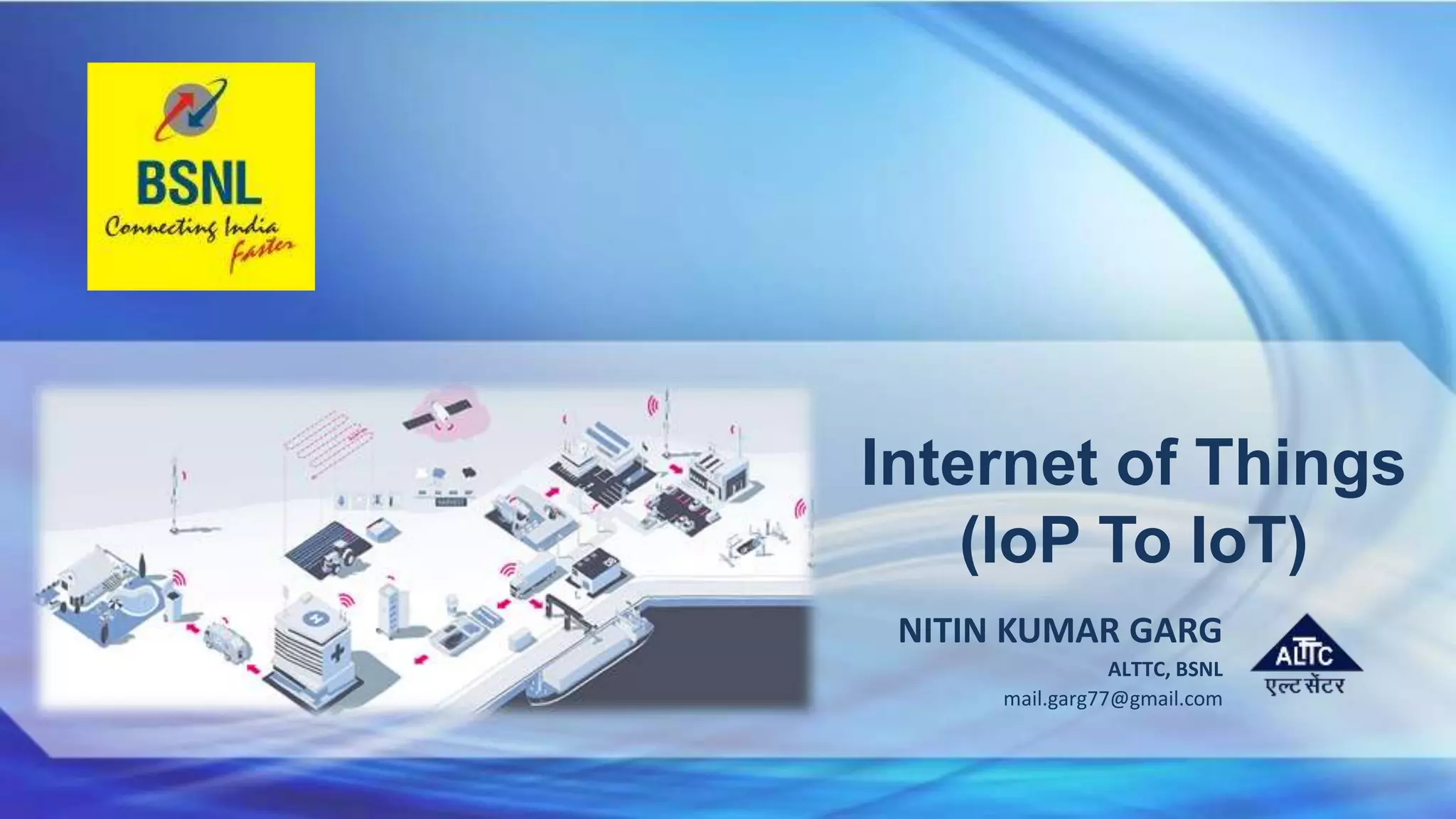
Internet of Things
(IoP To IoT)
NITIN KUMAR GARG
ALTTC, BSNL
mail.garg77@gmail.com
IoT Standards and Protocols
The Internet of Things covers a huge range of industries
and use cases that scale from a single constrained
device up to massive cross-platform deployments of
embedded technologies and cloud systems connecting
in real-time.
All together are numerous legacy and emerging
communication protocols that allow devices and servers
to talk to each other in new, more interconnected ways.
IoT Standards and Protocols
The Internet of Things covers a huge range of industries
and use cases that scale from a single constrained
device up to massive cross-platform deployments of
embedded technologies and cloud systems connecting
in real-time.
All together are numerous legacy and emerging
communication protocols that allow devices and servers
to talk to each other in new, more interconnected ways.
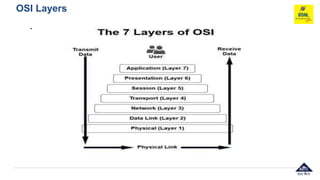
OSI Layers
.
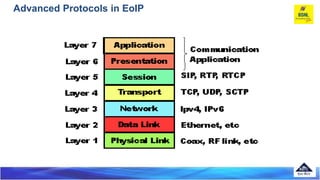
Advanced Protocols in EoIP
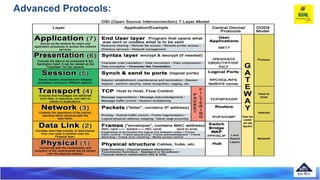
Advanced Protocols:
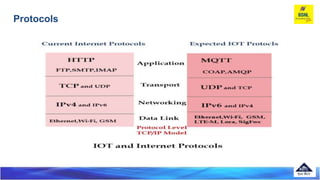
Protocols
Quick Look:
IoT technologies allow things, or devices that are
not computers, to act smartly and make collaborative
decisions that are beneficial to certain applications. They
allow things to hear, see, think or act by allowing them to
communicate and coordinate with others in order to
make decisions that can be as critical as saving lives or
buildings. They transform "things" from being passively
computing and making individual decisions to actively
and ubiquitously communicating and collaborating to
make a single critical decision.
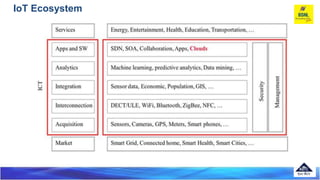
IoT Ecosystem
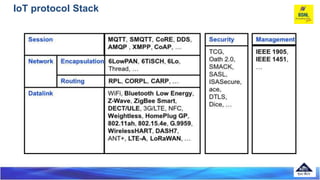
IoT protocol Stack
IoT Data Link Protocol
. IEEE 802.15.4
IEEE 802.15.4 is the most commonly used IoT
standard for MAC. It defines a frame format, headers
including source and destination addresses, and how
nodes can communicate with each other. The frame
formats used in traditional networks are not suitable for
low power multi-hop networking in IoT due to their
overhead.
In 2008, IEEE802.15.4e was created to extend
IEEE802.15.4 and support low power communication. It
uses time synchronization and channel hopping to
enable high reliability, low cost and meet IoT
communications requirements
IoT Data Link Protocol
. IEEE 802.15.4
Its specific MAC features can be summarized
Slotframe Structure
IEEE 802.15.4e frame structure is designed for
scheduling and telling each node what to do. A node can
sleep, send, or receive information. In the sleep mode, the
node turns off its radio to save power and stores all messages
that it needs to send at the next transmission opportunity.
When transmitting, it sends its data and waits for an
acknowledgment. When receiving, the node turns on its radio
before the scheduled receiving time, receives the data, sends
an acknowledgement, turn off its radio, delivers the data to the
upper layers and goes back to sleep.
IoT Data Link Protocol
. IEEE 802.15.4
Its specific MAC features can be summarized
Scheduling: The standard does not define how the
scheduling is done but it needs to be built carefully such
that it handles mobility scenarios. It can be centralized
by a manager node which is responsible for building the
schedule, informing others about the schedule and other
nodes will just follow the schedule.
IoT Data Link Protocol
. IEEE 802.15.4
Synchronization: Synchronization is necessary
to maintain nodes’ connectivity to their
neighbours and to the gateways. Two approaches can
be used: acknowledgment-based or frame-based
synchronization. In acknowledgement-based mode, the
nodes are already in communication and they send
acknowledgment for reliability guarantees, thus can be
used to maintain connectivity as well. In frame-based
mode, nodes are not communicating and hence, they
send an empty frame at pre-specified intervals (about 30
second typically).
IoT Data Link Protocol
. IEEE 802.15.4
Channel Hopping: IEEE802.15.4e introduces
channel hopping for time slotted access to the wireless
medium. Channel hopping requires changing the
frequency channel using a pre-determined random
sequence. This introduces frequency diversity and
reduces the effect of interference and multi-path fading.
Sixteen channels are available which adds to network
capacity as two frames over the same link can be
transmitted on different frequency channels at the same
time.
IoT Data Link Protocol
. IEEE 802.15.4
Network formation: Network formation includes
advertisement and joining components. A new device
should listen for advertisement commands and upon
receiving at least one such command, it can send a join
request to the advertising device. In a centralized
system, the join request is routed to the manger node
and processed there while in distributed systems, they
are processed locally. Once a device joins the network
and it is fully functional, the formation is disabled and will
be activated again if it receives another join request.
IoT Data Link Protocol
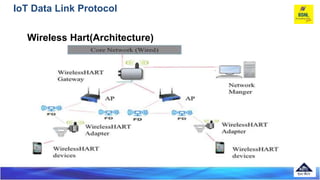
Wireless Hart
WirelessHART is a datalink protocol that
operates on the top of IEEE 802.15.4 PHY and adopts
Time Division Multiple Access (TDMA) in its MAC. It is a
secure and reliable MAC protocol that uses advanced
encryption to encrypt the messages and calculate the
integrity in order to offer reliability
IoT Data Link Protocol
Wireless Hart(Architecture)
IoT Data Link Protocol
Z-Wave
Z-Wave is a low-power MAC protocol designed for home
automation and has been used for IoT communication,
especially for smart home and small commercial domains. It
covers about 30-meter point-to-point communication and is
suitable for small messages in IoT applications, like light
control, energy control, wearable healthcare control and
others. It uses CSMA/CA for collision detection and ACK
messages for reliable transmission. It follows a master/slave
architecture in which the master control the slaves, send them
commands, and handling scheduling of the whole network
IoT Data Link Protocol
Bluetooth Low Energy
Bluetooth low energy or Bluetooth smart is a short range
communication protocol with PHY and MAC layer widely used
for in-vehicle networking. Its low energy can reach ten times
less than the classic Bluetooth while its latency can reach 15
times. Its access control uses a contention-less MAC with low
latency and fast transmission. It follows master/slave
architecture and offers two types of frames: adverting and data
frames. The Advertising frame is used for discovery and is
sent by slaves on one or more of dedicated advertisement
channels. Master nodes sense advertisement channels to find
slaves and connect them. After connection, the master tells the
slave it’s waking cycle and scheduling sequence. Nodes are
usually awake only when they are communicating and they go
to sleep otherwise to save their power
IoT Data Link Protocol
Zigbee Smart Energy
ZigBee smart energy is designed for a large range of IoT
applications including smart homes, remote controls and
healthcare systems. It supports a wide range of network
topologies including star, peer-to-peer, or cluster-tree. A
coordinator controls the network and is the central node
in a star topology, the root in a tree or cluster topology
and may be located anywhere in peer-to-peer
IoT Data Link Protocol
Zigbee Smart Energy
ZigBee standard defines two stack profiles: ZigBee and
ZigBee Pro. These stack profiles support full mesh
networking and work with different applications allowing
implementations with low memory and processing
power. ZigBee Pro offers more features including
security using symmetric-key exchange, scalability using
stochastic address assignment, and better performance
using efficient many-to-one routing mechanisms
IoT Data Link Protocol
DASH7
DASH7 is a wireless communication protocol for active
RFID that operates in globally available Industrial
Scientific Medical (ISM) band and is suitable for IoT
requirements. It is mainly designed for scalable, long
range outdoor coverage with higher data rate compared
to traditional ZigBee. It is a low-cost solution that
supports encryption and IPv6 addressing. It supports a
master/slave architecture
IoT Data Link Protocol
LTE-A
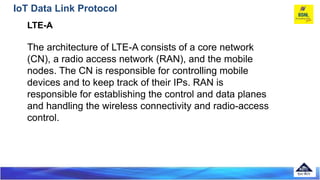
Long-Term Evolution Advanced (LTE- A) is a set of
standards designed to fit M2M communication and IoT
applications in cellular networks. LTE-A is a scalable,
lower- cost protocol compared to other cellular protocols.
LTE-A uses OFDMA (Orthogonal Frequency Division
Multiple Access) as a MAC layer access technology,
which divides the frequency into multiple bands and
each one can be used separately. The architecture of
LTE-A consists of a core network (CN), a radio access
network (RAN), and the mobile nodes. The CN is
responsible for controlling mobile devices and to keep
track of their IPs. RAN is responsible for establishing the
IoT Data Link Protocol
LTE-A
The architecture of LTE-A consists of a core network
(CN), a radio access network (RAN), and the mobile
nodes. The CN is responsible for controlling mobile
devices and to keep track of their IPs. RAN is
responsible for establishing the control and data planes
and handling the wireless connectivity and radio-access
control.
IoT Data Link Protocol
LTE-A
IoT Data Link Protocol
LoRaWAN
LoRaWAN is a newly arising wireless technology
designed for low-power WAN networks with low cost,
mobility, security, and bi- directional communication for
IoT applications. It is a low-power consumption
optimized protocol designed for scalable wireless
networks with millions of devices. It supports redundant
operation, location free, low cost, low power and energy
harvesting technologies to support the future needs of
IoT while enabling mobility and ease of use features
IoT Data Link Protocol
DECT/ULE
DECT (Digital Enhanced Cordless Telecommunications) is a
universal European standard for cordless phones. In their
latest extension DECT/ULE (Ultra Low Energy), they have
specified a low-power and low-cost air interface technology
that can be used for IoT applications. Due to its dedicated
channel assignment, DECT does not suffer from congestion
and interference. DECT/ULE supports FDMA, TDMA and time
division multiplexing which were not supported in the original
DECT protocol.
Network Layer Routing Protocols
RPL
Routing Protocol for Low-Power and Lossy Networks (RPL) is
distance-vector protocol that can support a variety of datalink
protocols, including the ones discussed in the previous
section. It builds a Destination Oriented Directed Acyclic Graph
(DODAG) that has only one route from each leaf node to the
root in which all the traffic from the node will be routed to. At
first, each node sends a DODAG Information Object (DIO)
advertising itself as the root. This message is propagated in
the network and the whole DODAG is gradually built.
Network Layer Routing Protocols
CORPL
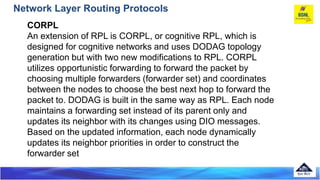
An extension of RPL is CORPL, or cognitive RPL, which is
designed for cognitive networks and uses DODAG topology
generation but with two new modifications to RPL. CORPL
utilizes opportunistic forwarding to forward the packet by
choosing multiple forwarders (forwarder set) and coordinates
between the nodes to choose the best next hop to forward the
packet to. DODAG is built in the same way as RPL. Each node
maintains a forwarding set instead of its parent only and
updates its neighbor with its changes using DIO messages.
Based on the updated information, each node dynamically
updates its neighbor priorities in order to construct the
forwarder set
Network Layer Routing Protocols
CARP
Channel-Aware Routing Protocol (CARP) is a distributed
routing protocol designed for underwater communication. It
can be used for IoT due to its lightweight packets. It considers
link quality, which is computed based on historical successful
data transmission gathered from neighboring sensors, to
select the forwarding nodes
Network Layer Routing Protocols
Three routing protocols in IoT were discussed in this section.
RPL is the most commonly used one. It is a distance vector
protocol designed by IETF in 2012. CORPL is a non-standard
extension of RPL that is designed for cognitive networks and
utilizes the opportunistic forwarding to forward packets at each
hop. On the other hand, CARP is the only distributed hop
based routing protocol that is designed for IoT sensor network
applications
Network Layer Encapsulation Protocols
One problem in IoT applications is that IPv6 addresses are too
long and cannot fit in most IoT datalink frames which are
relatively much smaller. Hence, IETF is developing a set of
standards to encapsulate IPv6 datagrams in different datalink
layer frames for use in IoT applications
Network Layer Encapsulation Protocols
6LoWPAN
IPv6 over Low power Wireless Personal Area Network
(6LoWPAN) is the first and most commonly used
standard in this category. It efficiently encapsulates IPv6
long headers in IEEE802.15.4 small packets, which
cannot exceed 128 bytes. The specification supports
different length addresses, low bandwidth, different
topologies including star or mesh, power consumption,
low cost, scalable networks, mobility, unreliability and
long sleep time. The standard provides header
compression to reduce transmission overhead,
fragmentation to meet the 128-byte maximum frame
length in IEEE802.15.4, and support of multi-hop
Network Layer Encapsulation Protocols
6LoWPAN
Frames in 6LoWPAN use four types of headers: No
6loWPAN header (00), Dispatch header
(01) , Mesh header (10) and Fragmentation header (11).
In No 6loWPAN header case, any frame that does not
follow 6loWPAN specifications is discarded. Dispatch
header is used for multicasting and IPv6 header
compressions. Mesh headers are used for broadcasting;
while Fragmentation headers are used to break long
IPv6 header to fit into fragments of maximum 128-byte
length.
Network Layer Encapsulation Protocols
IPv6 over Bluetooth Low Energy
Bluetooth Low Energy is also known as Bluetooth Smart
and was introduced in Bluetooth V4.0 and enhanced in
V4.1. RFC 7668 [RFC7668], which specifies IPv6 over
Bluetooth LE, reuses most of the 6LowPAN compression
techniques. However, since the Logical Link Control and
Adaptation Protocol (L2CAP) sublayer in Bluetooth
already provides segmentation and reassembly of larger
payloads in to 27 byte L2CAP packets, fragmentation
features from 6LowPAN standards are not used.
Session Layer Protocols
Session Layer standards and protocols for message
passing in IoT session layer proposed by different
standardization organizations. Most of the IP applications,
including IoT applications use TCP or UDP for transport.
However, there are several message distribution functions that
are common among many IoT applications; it is desirable that
these functions be implemented in an interoperable standard
ways by different applications.
Session Layer Protocols
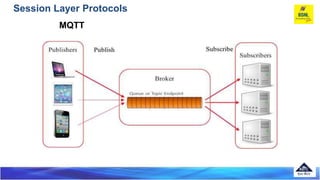
MQTT
Message Queue Telemetry Transport (MQTT) was
introduced by IBM in 1999 and standardized by OASIS
in 2013 .It is designed to provide embedded connectivity
between applications and middleware’s on one side and
networks and communications on the other side. It
follows a publish/subscribe architecture, where the
system consists of three main components: publishers,
subscribers, and a broker.
Session Layer Protocols
MQTT
Session Layer Protocols
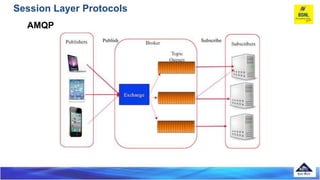
AMQP
The Advanced Message Queuing Protocol (AMQP) is
another session layer protocol that was designed for
financial industry. It runs over TCP and provides a
publish/ subscribe architecture which is similar to that of
MQTT. The difference is that the broker is divided into
two main components: exchange and queues, The
exchange is responsible for receiving publisher
messages and distributing them to queues based on
pre-defined roles and conditions. Queues basically
represent the topics and subscribed by subscribers
which will get the sensory data whenever they are
available in the queue
Session Layer Protocols
AMQP
Session Layer Protocols
CoAP
The Constrained Application Protocol (CoAP) is another
session layer protocol designed by IETF Constrained
RESTful Environment (Core) working group to provide
lightweight RESTful (HTTP) interface. Representational
State Transfer (REST) is the standard interface between
HTTP client and servers. However, for lightweight
applications such as IoT, REST could result in significant
overhead and power consumption. CoAP is designed to
enable low-power sensors to use RESTful services while
meeting their power constrains. It is built over UDP,
instead of TCP commonly used in HTTP and has a light
mechanism to provide reliability
Session Layer Protocols
CoAP
CoAP architecture is divided into two main sublayers:
messaging and request/response. The messaging
sublayer is responsible for reliability and duplication of
messages while the request/response sublayer is
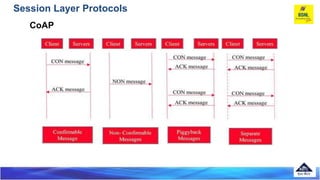
responsible for communication. CoAP has four
messaging modes: confirmable, non- confirmable,
piggyback and separate.
Session Layer Protocols
CoAP
Session Layer Protocols
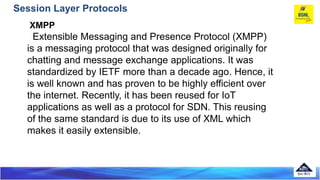
XMPP
Extensible Messaging and Presence Protocol (XMPP)
is a messaging protocol that was designed originally for
chatting and message exchange applications. It was
standardized by IETF more than a decade ago. Hence, it
is well known and has proven to be highly efficient over
the internet. Recently, it has been reused for IoT
applications as well as a protocol for SDN. This reusing
of the same standard is due to its use of XML which
makes it easily extensible.
Session Layer Protocols
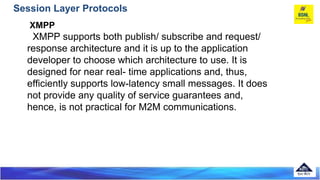
XMPP
XMPP supports both publish/ subscribe and request/
response architecture and it is up to the application
developer to choose which architecture to use. It is
designed for near real- time applications and, thus,
efficiently supports low-latency small messages. It does
not provide any quality of service guarantees and,
hence, is not practical for M2M communications.
Session Layer Protocols
DDS
Data Distribution Service (DDS) is another
publish/subscribe protocol that is designed by the Object
Management Group (OMG) for M2M communications
[DDS]. The basic benefit of thisprotocol is the excellent
quality of service levels and reliability guarantees as it
relies on a broker-less architecture, which suits IoT and
M2M communication. It offers 23 quality-of-service levels
which allow it to offer a variety of quality criteria
including: security, urgency, priority, durability, reliability,
etc
Session Layer Protocols
.
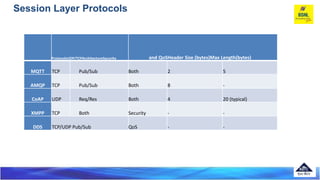
ProtocolsUDP/TCPArchitectureSecurity and QoSHeader Size (bytes)Max Length(bytes)
MQTT TCP Pub/Sub Both 2 5
AMQP TCP Pub/Sub Both 8 -
CoAP UDP Req/Res Both 4 20 (typical)
XMPP TCP Both Security - -
DDS TCP/UDP Pub/Sub QoS - -
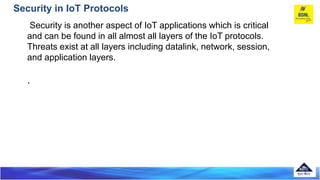
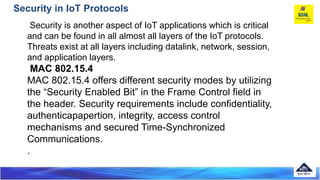
Security in IoT Protocols
Security is another aspect of IoT applications which is critical
and can be found in all almost all layers of the IoT protocols.
Threats exist at all layers including datalink, network, session,
and application layers.
.
Security in IoT Protocols
Security is another aspect of IoT applications which is critical
and can be found in all almost all layers of the IoT protocols.
Threats exist at all layers including datalink, network, session,
and application layers.
MAC 802.15.4
MAC 802.15.4 offers different security modes by utilizing
the “Security Enabled Bit” in the Frame Control field in
the header. Security requirements include confidentiality,
authenticapapertion, integrity, access control
mechanisms and secured Time-Synchronized
Communications.
.
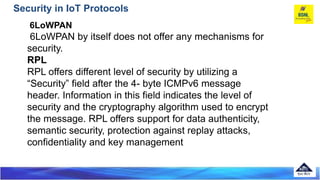
Security in IoT Protocols
6LoWPAN
6LoWPAN by itself does not offer any mechanisms for
security.
RPL
RPL offers different level of security by utilizing a
“Security” field after the 4- byte ICMPv6 message
header. Information in this field indicates the level of
security and the cryptography algorithm used to encrypt
the message. RPL offers support for data authenticity,
semantic security, protection against replay attacks,
confidentiality and key management
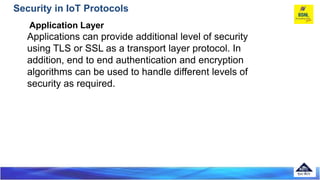
Security in IoT Protocols
Application Layer
Applications can provide additional level of security
using TLS or SSL as a transport layer protocol. In
addition, end to end authentication and encryption
algorithms can be used to handle different levels of
security as required.
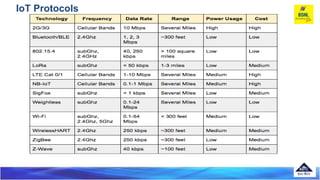
IoT Protocols
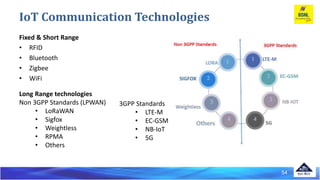
Fixed & Short Range
• RFID
• Bluetooth
• Zigbee
• WiFi
54
IoT Communication Technologies
Long Range technologies
Non 3GPP Standards (LPWAN)
• LoRaWAN
• Sigfox
• Weightless
• RPMA
• Others
3GPP Standards
• LTE-M
• EC-GSM
• NB-IoT
• 5G
55
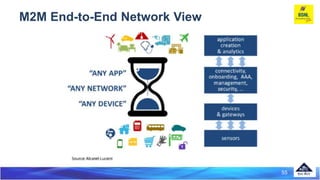
M2M End-to-End Network View
56
•IoT has been widely deployed with limited to no security.
•As massive amounts of data are being collected, stored,
manipulated, merged, analyzed, and expunged, security and
privacy concerns will have begun to explode.
•Need scalable and practical solutions to Big Data Security and
Privacy as well as applying Big Data Management and Analytics
for Cyber Security.
•
Final Thoughts
57
•
•Need to develop technologies guided by policies to
address security and privacy issues throughout the
lifecycle of the data.
•Need to understand not only the societal impact of IoT
and its ubiquitous data collection, use and analysis,
also need to formulate appropriate laws and policies for
such activities.
Final Thoughts
58
58 7/27/2023 Course Name / Topic Name
58 7/27/2023
Any Doubt..
59
koshish karne walon ki kabhi haar nahi hoti -
YouTube (360p).mp4
Hindi Motivational poem new__ by; Amitabh
Bachan in KBC - YouTube (360p).mp4
Motivational Thoughts
Thank You
& Further
Questions?
NITIN KUMAR GARG
AGM(IT),ALTTC Ghaziabad
E-mail: mail.garg77@gmail.com

IoT _protocols.ppt

  • 1.
    Internet of Things (IoPTo IoT) NITIN KUMAR GARG ALTTC, BSNL mail.garg77@gmail.com
  • 2.
    IoT Standards andProtocols The Internet of Things covers a huge range of industries and use cases that scale from a single constrained device up to massive cross-platform deployments of embedded technologies and cloud systems connecting in real-time. All together are numerous legacy and emerging communication protocols that allow devices and servers to talk to each other in new, more interconnected ways.
  • 3.
    IoT Standards andProtocols The Internet of Things covers a huge range of industries and use cases that scale from a single constrained device up to massive cross-platform deployments of embedded technologies and cloud systems connecting in real-time. All together are numerous legacy and emerging communication protocols that allow devices and servers to talk to each other in new, more interconnected ways.
  • 4.
  • 5.
  • 6.
  • 7.
  • 8.
    Quick Look: IoT technologiesallow things, or devices that are not computers, to act smartly and make collaborative decisions that are beneficial to certain applications. They allow things to hear, see, think or act by allowing them to communicate and coordinate with others in order to make decisions that can be as critical as saving lives or buildings. They transform "things" from being passively computing and making individual decisions to actively and ubiquitously communicating and collaborating to make a single critical decision.
  • 9.
  • 10.
  • 11.
    IoT Data LinkProtocol . IEEE 802.15.4 IEEE 802.15.4 is the most commonly used IoT standard for MAC. It defines a frame format, headers including source and destination addresses, and how nodes can communicate with each other. The frame formats used in traditional networks are not suitable for low power multi-hop networking in IoT due to their overhead. In 2008, IEEE802.15.4e was created to extend IEEE802.15.4 and support low power communication. It uses time synchronization and channel hopping to enable high reliability, low cost and meet IoT communications requirements
  • 12.
    IoT Data LinkProtocol . IEEE 802.15.4 Its specific MAC features can be summarized Slotframe Structure IEEE 802.15.4e frame structure is designed for scheduling and telling each node what to do. A node can sleep, send, or receive information. In the sleep mode, the node turns off its radio to save power and stores all messages that it needs to send at the next transmission opportunity. When transmitting, it sends its data and waits for an acknowledgment. When receiving, the node turns on its radio before the scheduled receiving time, receives the data, sends an acknowledgement, turn off its radio, delivers the data to the upper layers and goes back to sleep.
  • 13.
    IoT Data LinkProtocol . IEEE 802.15.4 Its specific MAC features can be summarized Scheduling: The standard does not define how the scheduling is done but it needs to be built carefully such that it handles mobility scenarios. It can be centralized by a manager node which is responsible for building the schedule, informing others about the schedule and other nodes will just follow the schedule.
  • 14.
    IoT Data LinkProtocol . IEEE 802.15.4 Synchronization: Synchronization is necessary to maintain nodes’ connectivity to their neighbours and to the gateways. Two approaches can be used: acknowledgment-based or frame-based synchronization. In acknowledgement-based mode, the nodes are already in communication and they send acknowledgment for reliability guarantees, thus can be used to maintain connectivity as well. In frame-based mode, nodes are not communicating and hence, they send an empty frame at pre-specified intervals (about 30 second typically).
  • 15.
    IoT Data LinkProtocol . IEEE 802.15.4 Channel Hopping: IEEE802.15.4e introduces channel hopping for time slotted access to the wireless medium. Channel hopping requires changing the frequency channel using a pre-determined random sequence. This introduces frequency diversity and reduces the effect of interference and multi-path fading. Sixteen channels are available which adds to network capacity as two frames over the same link can be transmitted on different frequency channels at the same time.
  • 16.
    IoT Data LinkProtocol . IEEE 802.15.4 Network formation: Network formation includes advertisement and joining components. A new device should listen for advertisement commands and upon receiving at least one such command, it can send a join request to the advertising device. In a centralized system, the join request is routed to the manger node and processed there while in distributed systems, they are processed locally. Once a device joins the network and it is fully functional, the formation is disabled and will be activated again if it receives another join request.
  • 17.
    IoT Data LinkProtocol Wireless Hart WirelessHART is a datalink protocol that operates on the top of IEEE 802.15.4 PHY and adopts Time Division Multiple Access (TDMA) in its MAC. It is a secure and reliable MAC protocol that uses advanced encryption to encrypt the messages and calculate the integrity in order to offer reliability
  • 18.
    IoT Data LinkProtocol Wireless Hart(Architecture)
  • 19.
    IoT Data LinkProtocol Z-Wave Z-Wave is a low-power MAC protocol designed for home automation and has been used for IoT communication, especially for smart home and small commercial domains. It covers about 30-meter point-to-point communication and is suitable for small messages in IoT applications, like light control, energy control, wearable healthcare control and others. It uses CSMA/CA for collision detection and ACK messages for reliable transmission. It follows a master/slave architecture in which the master control the slaves, send them commands, and handling scheduling of the whole network
  • 20.
    IoT Data LinkProtocol Bluetooth Low Energy Bluetooth low energy or Bluetooth smart is a short range communication protocol with PHY and MAC layer widely used for in-vehicle networking. Its low energy can reach ten times less than the classic Bluetooth while its latency can reach 15 times. Its access control uses a contention-less MAC with low latency and fast transmission. It follows master/slave architecture and offers two types of frames: adverting and data frames. The Advertising frame is used for discovery and is sent by slaves on one or more of dedicated advertisement channels. Master nodes sense advertisement channels to find slaves and connect them. After connection, the master tells the slave it’s waking cycle and scheduling sequence. Nodes are usually awake only when they are communicating and they go to sleep otherwise to save their power
  • 21.
    IoT Data LinkProtocol Zigbee Smart Energy ZigBee smart energy is designed for a large range of IoT applications including smart homes, remote controls and healthcare systems. It supports a wide range of network topologies including star, peer-to-peer, or cluster-tree. A coordinator controls the network and is the central node in a star topology, the root in a tree or cluster topology and may be located anywhere in peer-to-peer
  • 22.
    IoT Data LinkProtocol Zigbee Smart Energy ZigBee standard defines two stack profiles: ZigBee and ZigBee Pro. These stack profiles support full mesh networking and work with different applications allowing implementations with low memory and processing power. ZigBee Pro offers more features including security using symmetric-key exchange, scalability using stochastic address assignment, and better performance using efficient many-to-one routing mechanisms
  • 23.
    IoT Data LinkProtocol DASH7 DASH7 is a wireless communication protocol for active RFID that operates in globally available Industrial Scientific Medical (ISM) band and is suitable for IoT requirements. It is mainly designed for scalable, long range outdoor coverage with higher data rate compared to traditional ZigBee. It is a low-cost solution that supports encryption and IPv6 addressing. It supports a master/slave architecture
  • 24.
    IoT Data LinkProtocol LTE-A Long-Term Evolution Advanced (LTE- A) is a set of standards designed to fit M2M communication and IoT applications in cellular networks. LTE-A is a scalable, lower- cost protocol compared to other cellular protocols. LTE-A uses OFDMA (Orthogonal Frequency Division Multiple Access) as a MAC layer access technology, which divides the frequency into multiple bands and each one can be used separately. The architecture of LTE-A consists of a core network (CN), a radio access network (RAN), and the mobile nodes. The CN is responsible for controlling mobile devices and to keep track of their IPs. RAN is responsible for establishing the
  • 25.
    IoT Data LinkProtocol LTE-A The architecture of LTE-A consists of a core network (CN), a radio access network (RAN), and the mobile nodes. The CN is responsible for controlling mobile devices and to keep track of their IPs. RAN is responsible for establishing the control and data planes and handling the wireless connectivity and radio-access control.
  • 26.
    IoT Data LinkProtocol LTE-A
  • 27.
    IoT Data LinkProtocol LoRaWAN LoRaWAN is a newly arising wireless technology designed for low-power WAN networks with low cost, mobility, security, and bi- directional communication for IoT applications. It is a low-power consumption optimized protocol designed for scalable wireless networks with millions of devices. It supports redundant operation, location free, low cost, low power and energy harvesting technologies to support the future needs of IoT while enabling mobility and ease of use features
  • 28.
    IoT Data LinkProtocol DECT/ULE DECT (Digital Enhanced Cordless Telecommunications) is a universal European standard for cordless phones. In their latest extension DECT/ULE (Ultra Low Energy), they have specified a low-power and low-cost air interface technology that can be used for IoT applications. Due to its dedicated channel assignment, DECT does not suffer from congestion and interference. DECT/ULE supports FDMA, TDMA and time division multiplexing which were not supported in the original DECT protocol.
  • 29.
    Network Layer RoutingProtocols RPL Routing Protocol for Low-Power and Lossy Networks (RPL) is distance-vector protocol that can support a variety of datalink protocols, including the ones discussed in the previous section. It builds a Destination Oriented Directed Acyclic Graph (DODAG) that has only one route from each leaf node to the root in which all the traffic from the node will be routed to. At first, each node sends a DODAG Information Object (DIO) advertising itself as the root. This message is propagated in the network and the whole DODAG is gradually built.
  • 30.
    Network Layer RoutingProtocols CORPL An extension of RPL is CORPL, or cognitive RPL, which is designed for cognitive networks and uses DODAG topology generation but with two new modifications to RPL. CORPL utilizes opportunistic forwarding to forward the packet by choosing multiple forwarders (forwarder set) and coordinates between the nodes to choose the best next hop to forward the packet to. DODAG is built in the same way as RPL. Each node maintains a forwarding set instead of its parent only and updates its neighbor with its changes using DIO messages. Based on the updated information, each node dynamically updates its neighbor priorities in order to construct the forwarder set
  • 31.
    Network Layer RoutingProtocols CARP Channel-Aware Routing Protocol (CARP) is a distributed routing protocol designed for underwater communication. It can be used for IoT due to its lightweight packets. It considers link quality, which is computed based on historical successful data transmission gathered from neighboring sensors, to select the forwarding nodes
  • 32.
    Network Layer RoutingProtocols Three routing protocols in IoT were discussed in this section. RPL is the most commonly used one. It is a distance vector protocol designed by IETF in 2012. CORPL is a non-standard extension of RPL that is designed for cognitive networks and utilizes the opportunistic forwarding to forward packets at each hop. On the other hand, CARP is the only distributed hop based routing protocol that is designed for IoT sensor network applications
  • 33.
    Network Layer EncapsulationProtocols One problem in IoT applications is that IPv6 addresses are too long and cannot fit in most IoT datalink frames which are relatively much smaller. Hence, IETF is developing a set of standards to encapsulate IPv6 datagrams in different datalink layer frames for use in IoT applications
  • 34.
    Network Layer EncapsulationProtocols 6LoWPAN IPv6 over Low power Wireless Personal Area Network (6LoWPAN) is the first and most commonly used standard in this category. It efficiently encapsulates IPv6 long headers in IEEE802.15.4 small packets, which cannot exceed 128 bytes. The specification supports different length addresses, low bandwidth, different topologies including star or mesh, power consumption, low cost, scalable networks, mobility, unreliability and long sleep time. The standard provides header compression to reduce transmission overhead, fragmentation to meet the 128-byte maximum frame length in IEEE802.15.4, and support of multi-hop
  • 35.
    Network Layer EncapsulationProtocols 6LoWPAN Frames in 6LoWPAN use four types of headers: No 6loWPAN header (00), Dispatch header (01) , Mesh header (10) and Fragmentation header (11). In No 6loWPAN header case, any frame that does not follow 6loWPAN specifications is discarded. Dispatch header is used for multicasting and IPv6 header compressions. Mesh headers are used for broadcasting; while Fragmentation headers are used to break long IPv6 header to fit into fragments of maximum 128-byte length.
  • 36.
    Network Layer EncapsulationProtocols IPv6 over Bluetooth Low Energy Bluetooth Low Energy is also known as Bluetooth Smart and was introduced in Bluetooth V4.0 and enhanced in V4.1. RFC 7668 [RFC7668], which specifies IPv6 over Bluetooth LE, reuses most of the 6LowPAN compression techniques. However, since the Logical Link Control and Adaptation Protocol (L2CAP) sublayer in Bluetooth already provides segmentation and reassembly of larger payloads in to 27 byte L2CAP packets, fragmentation features from 6LowPAN standards are not used.
  • 37.
    Session Layer Protocols SessionLayer standards and protocols for message passing in IoT session layer proposed by different standardization organizations. Most of the IP applications, including IoT applications use TCP or UDP for transport. However, there are several message distribution functions that are common among many IoT applications; it is desirable that these functions be implemented in an interoperable standard ways by different applications.
  • 38.
    Session Layer Protocols MQTT MessageQueue Telemetry Transport (MQTT) was introduced by IBM in 1999 and standardized by OASIS in 2013 .It is designed to provide embedded connectivity between applications and middleware’s on one side and networks and communications on the other side. It follows a publish/subscribe architecture, where the system consists of three main components: publishers, subscribers, and a broker.
  • 39.
  • 40.
    Session Layer Protocols AMQP TheAdvanced Message Queuing Protocol (AMQP) is another session layer protocol that was designed for financial industry. It runs over TCP and provides a publish/ subscribe architecture which is similar to that of MQTT. The difference is that the broker is divided into two main components: exchange and queues, The exchange is responsible for receiving publisher messages and distributing them to queues based on pre-defined roles and conditions. Queues basically represent the topics and subscribed by subscribers which will get the sensory data whenever they are available in the queue
  • 41.
  • 42.
    Session Layer Protocols CoAP TheConstrained Application Protocol (CoAP) is another session layer protocol designed by IETF Constrained RESTful Environment (Core) working group to provide lightweight RESTful (HTTP) interface. Representational State Transfer (REST) is the standard interface between HTTP client and servers. However, for lightweight applications such as IoT, REST could result in significant overhead and power consumption. CoAP is designed to enable low-power sensors to use RESTful services while meeting their power constrains. It is built over UDP, instead of TCP commonly used in HTTP and has a light mechanism to provide reliability
  • 43.
    Session Layer Protocols CoAP CoAParchitecture is divided into two main sublayers: messaging and request/response. The messaging sublayer is responsible for reliability and duplication of messages while the request/response sublayer is responsible for communication. CoAP has four messaging modes: confirmable, non- confirmable, piggyback and separate.
  • 44.
  • 45.
    Session Layer Protocols XMPP ExtensibleMessaging and Presence Protocol (XMPP) is a messaging protocol that was designed originally for chatting and message exchange applications. It was standardized by IETF more than a decade ago. Hence, it is well known and has proven to be highly efficient over the internet. Recently, it has been reused for IoT applications as well as a protocol for SDN. This reusing of the same standard is due to its use of XML which makes it easily extensible.
  • 46.
    Session Layer Protocols XMPP XMPPsupports both publish/ subscribe and request/ response architecture and it is up to the application developer to choose which architecture to use. It is designed for near real- time applications and, thus, efficiently supports low-latency small messages. It does not provide any quality of service guarantees and, hence, is not practical for M2M communications.
  • 47.
    Session Layer Protocols DDS DataDistribution Service (DDS) is another publish/subscribe protocol that is designed by the Object Management Group (OMG) for M2M communications [DDS]. The basic benefit of thisprotocol is the excellent quality of service levels and reliability guarantees as it relies on a broker-less architecture, which suits IoT and M2M communication. It offers 23 quality-of-service levels which allow it to offer a variety of quality criteria including: security, urgency, priority, durability, reliability, etc
  • 48.
    Session Layer Protocols . ProtocolsUDP/TCPArchitectureSecurityand QoSHeader Size (bytes)Max Length(bytes) MQTT TCP Pub/Sub Both 2 5 AMQP TCP Pub/Sub Both 8 - CoAP UDP Req/Res Both 4 20 (typical) XMPP TCP Both Security - - DDS TCP/UDP Pub/Sub QoS - -
  • 49.
    Security in IoTProtocols Security is another aspect of IoT applications which is critical and can be found in all almost all layers of the IoT protocols. Threats exist at all layers including datalink, network, session, and application layers. .
  • 50.
    Security in IoTProtocols Security is another aspect of IoT applications which is critical and can be found in all almost all layers of the IoT protocols. Threats exist at all layers including datalink, network, session, and application layers. MAC 802.15.4 MAC 802.15.4 offers different security modes by utilizing the “Security Enabled Bit” in the Frame Control field in the header. Security requirements include confidentiality, authenticapapertion, integrity, access control mechanisms and secured Time-Synchronized Communications. .
  • 51.
    Security in IoTProtocols 6LoWPAN 6LoWPAN by itself does not offer any mechanisms for security. RPL RPL offers different level of security by utilizing a “Security” field after the 4- byte ICMPv6 message header. Information in this field indicates the level of security and the cryptography algorithm used to encrypt the message. RPL offers support for data authenticity, semantic security, protection against replay attacks, confidentiality and key management
  • 52.
    Security in IoTProtocols Application Layer Applications can provide additional level of security using TLS or SSL as a transport layer protocol. In addition, end to end authentication and encryption algorithms can be used to handle different levels of security as required.
  • 53.
  • 54.
    Fixed & ShortRange • RFID • Bluetooth • Zigbee • WiFi 54 IoT Communication Technologies Long Range technologies Non 3GPP Standards (LPWAN) • LoRaWAN • Sigfox • Weightless • RPMA • Others 3GPP Standards • LTE-M • EC-GSM • NB-IoT • 5G
  • 55.
  • 56.
    56 •IoT has beenwidely deployed with limited to no security. •As massive amounts of data are being collected, stored, manipulated, merged, analyzed, and expunged, security and privacy concerns will have begun to explode. •Need scalable and practical solutions to Big Data Security and Privacy as well as applying Big Data Management and Analytics for Cyber Security. • Final Thoughts
  • 57.
    57 • •Need to developtechnologies guided by policies to address security and privacy issues throughout the lifecycle of the data. •Need to understand not only the societal impact of IoT and its ubiquitous data collection, use and analysis, also need to formulate appropriate laws and policies for such activities. Final Thoughts
  • 58.
    58 58 7/27/2023 CourseName / Topic Name 58 7/27/2023 Course Name / Topic Name 58 7/27/2023 Any Doubt..
  • 59.
    59 koshish karne walonki kabhi haar nahi hoti - YouTube (360p).mp4 Hindi Motivational poem new__ by; Amitabh Bachan in KBC - YouTube (360p).mp4 Motivational Thoughts
  • 60.
    Thank You & Further Questions? NITINKUMAR GARG AGM(IT),ALTTC Ghaziabad E-mail: mail.garg77@gmail.com

Editor's Notes

  • #3 The legacy telecom ecosystem has been designed considering voice as the major service provided on networks. The entire operations related to network optimization, monitoring, performance and customer experience was built around voice and a bit of data on it. It has become imperative to analyse how networks behave in data intensive traffic, to address the challenges related to customer acquisition and retention. There is a need for new tools and solutions for analysing this paradigm.
  • #4 The legacy telecom ecosystem has been designed considering voice as the major service provided on networks. The entire operations related to network optimization, monitoring, performance and customer experience was built around voice and a bit of data on it. It has become imperative to analyse how networks behave in data intensive traffic, to address the challenges related to customer acquisition and retention. There is a need for new tools and solutions for analysing this paradigm.
  • #5 The legacy telecom ecosystem has been designed considering voice as the major service provided on networks. The entire operations related to network optimization, monitoring, performance and customer experience was built around voice and a bit of data on it. It has become imperative to analyse how networks behave in data intensive traffic, to address the challenges related to customer acquisition and retention. There is a need for new tools and solutions for analysing this paradigm.
  • #6 The legacy telecom ecosystem has been designed considering voice as the major service provided on networks. The entire operations related to network optimization, monitoring, performance and customer experience was built around voice and a bit of data on it. It has become imperative to analyse how networks behave in data intensive traffic, to address the challenges related to customer acquisition and retention. There is a need for new tools and solutions for analysing this paradigm.
  • #7 The legacy telecom ecosystem has been designed considering voice as the major service provided on networks. The entire operations related to network optimization, monitoring, performance and customer experience was built around voice and a bit of data on it. It has become imperative to analyse how networks behave in data intensive traffic, to address the challenges related to customer acquisition and retention. There is a need for new tools and solutions for analysing this paradigm.
  • #8 The legacy telecom ecosystem has been designed considering voice as the major service provided on networks. The entire operations related to network optimization, monitoring, performance and customer experience was built around voice and a bit of data on it. It has become imperative to analyse how networks behave in data intensive traffic, to address the challenges related to customer acquisition and retention. There is a need for new tools and solutions for analysing this paradigm.
  • #9 The legacy telecom ecosystem has been designed considering voice as the major service provided on networks. The entire operations related to network optimization, monitoring, performance and customer experience was built around voice and a bit of data on it. It has become imperative to analyse how networks behave in data intensive traffic, to address the challenges related to customer acquisition and retention. There is a need for new tools and solutions for analysing this paradigm.
  • #10 The legacy telecom ecosystem has been designed considering voice as the major service provided on networks. The entire operations related to network optimization, monitoring, performance and customer experience was built around voice and a bit of data on it. It has become imperative to analyse how networks behave in data intensive traffic, to address the challenges related to customer acquisition and retention. There is a need for new tools and solutions for analysing this paradigm.
  • #11 The legacy telecom ecosystem has been designed considering voice as the major service provided on networks. The entire operations related to network optimization, monitoring, performance and customer experience was built around voice and a bit of data on it. It has become imperative to analyse how networks behave in data intensive traffic, to address the challenges related to customer acquisition and retention. There is a need for new tools and solutions for analysing this paradigm.
  • #12 The legacy telecom ecosystem has been designed considering voice as the major service provided on networks. The entire operations related to network optimization, monitoring, performance and customer experience was built around voice and a bit of data on it. It has become imperative to analyse how networks behave in data intensive traffic, to address the challenges related to customer acquisition and retention. There is a need for new tools and solutions for analysing this paradigm.
  • #13 The legacy telecom ecosystem has been designed considering voice as the major service provided on networks. The entire operations related to network optimization, monitoring, performance and customer experience was built around voice and a bit of data on it. It has become imperative to analyse how networks behave in data intensive traffic, to address the challenges related to customer acquisition and retention. There is a need for new tools and solutions for analysing this paradigm.
  • #14 The legacy telecom ecosystem has been designed considering voice as the major service provided on networks. The entire operations related to network optimization, monitoring, performance and customer experience was built around voice and a bit of data on it. It has become imperative to analyse how networks behave in data intensive traffic, to address the challenges related to customer acquisition and retention. There is a need for new tools and solutions for analysing this paradigm.
  • #15 The legacy telecom ecosystem has been designed considering voice as the major service provided on networks. The entire operations related to network optimization, monitoring, performance and customer experience was built around voice and a bit of data on it. It has become imperative to analyse how networks behave in data intensive traffic, to address the challenges related to customer acquisition and retention. There is a need for new tools and solutions for analysing this paradigm.
  • #16 The legacy telecom ecosystem has been designed considering voice as the major service provided on networks. The entire operations related to network optimization, monitoring, performance and customer experience was built around voice and a bit of data on it. It has become imperative to analyse how networks behave in data intensive traffic, to address the challenges related to customer acquisition and retention. There is a need for new tools and solutions for analysing this paradigm.
  • #17 The legacy telecom ecosystem has been designed considering voice as the major service provided on networks. The entire operations related to network optimization, monitoring, performance and customer experience was built around voice and a bit of data on it. It has become imperative to analyse how networks behave in data intensive traffic, to address the challenges related to customer acquisition and retention. There is a need for new tools and solutions for analysing this paradigm.
  • #18 The legacy telecom ecosystem has been designed considering voice as the major service provided on networks. The entire operations related to network optimization, monitoring, performance and customer experience was built around voice and a bit of data on it. It has become imperative to analyse how networks behave in data intensive traffic, to address the challenges related to customer acquisition and retention. There is a need for new tools and solutions for analysing this paradigm.
  • #19 The legacy telecom ecosystem has been designed considering voice as the major service provided on networks. The entire operations related to network optimization, monitoring, performance and customer experience was built around voice and a bit of data on it. It has become imperative to analyse how networks behave in data intensive traffic, to address the challenges related to customer acquisition and retention. There is a need for new tools and solutions for analysing this paradigm.
  • #20 The legacy telecom ecosystem has been designed considering voice as the major service provided on networks. The entire operations related to network optimization, monitoring, performance and customer experience was built around voice and a bit of data on it. It has become imperative to analyse how networks behave in data intensive traffic, to address the challenges related to customer acquisition and retention. There is a need for new tools and solutions for analysing this paradigm.
  • #21 The legacy telecom ecosystem has been designed considering voice as the major service provided on networks. The entire operations related to network optimization, monitoring, performance and customer experience was built around voice and a bit of data on it. It has become imperative to analyse how networks behave in data intensive traffic, to address the challenges related to customer acquisition and retention. There is a need for new tools and solutions for analysing this paradigm.
  • #22 The legacy telecom ecosystem has been designed considering voice as the major service provided on networks. The entire operations related to network optimization, monitoring, performance and customer experience was built around voice and a bit of data on it. It has become imperative to analyse how networks behave in data intensive traffic, to address the challenges related to customer acquisition and retention. There is a need for new tools and solutions for analysing this paradigm.
  • #23 The legacy telecom ecosystem has been designed considering voice as the major service provided on networks. The entire operations related to network optimization, monitoring, performance and customer experience was built around voice and a bit of data on it. It has become imperative to analyse how networks behave in data intensive traffic, to address the challenges related to customer acquisition and retention. There is a need for new tools and solutions for analysing this paradigm.
  • #24 The legacy telecom ecosystem has been designed considering voice as the major service provided on networks. The entire operations related to network optimization, monitoring, performance and customer experience was built around voice and a bit of data on it. It has become imperative to analyse how networks behave in data intensive traffic, to address the challenges related to customer acquisition and retention. There is a need for new tools and solutions for analysing this paradigm.
  • #25 The legacy telecom ecosystem has been designed considering voice as the major service provided on networks. The entire operations related to network optimization, monitoring, performance and customer experience was built around voice and a bit of data on it. It has become imperative to analyse how networks behave in data intensive traffic, to address the challenges related to customer acquisition and retention. There is a need for new tools and solutions for analysing this paradigm.
  • #26 The legacy telecom ecosystem has been designed considering voice as the major service provided on networks. The entire operations related to network optimization, monitoring, performance and customer experience was built around voice and a bit of data on it. It has become imperative to analyse how networks behave in data intensive traffic, to address the challenges related to customer acquisition and retention. There is a need for new tools and solutions for analysing this paradigm.
  • #27 The legacy telecom ecosystem has been designed considering voice as the major service provided on networks. The entire operations related to network optimization, monitoring, performance and customer experience was built around voice and a bit of data on it. It has become imperative to analyse how networks behave in data intensive traffic, to address the challenges related to customer acquisition and retention. There is a need for new tools and solutions for analysing this paradigm.
  • #28 The legacy telecom ecosystem has been designed considering voice as the major service provided on networks. The entire operations related to network optimization, monitoring, performance and customer experience was built around voice and a bit of data on it. It has become imperative to analyse how networks behave in data intensive traffic, to address the challenges related to customer acquisition and retention. There is a need for new tools and solutions for analysing this paradigm.
  • #29 The legacy telecom ecosystem has been designed considering voice as the major service provided on networks. The entire operations related to network optimization, monitoring, performance and customer experience was built around voice and a bit of data on it. It has become imperative to analyse how networks behave in data intensive traffic, to address the challenges related to customer acquisition and retention. There is a need for new tools and solutions for analysing this paradigm.
  • #30 The legacy telecom ecosystem has been designed considering voice as the major service provided on networks. The entire operations related to network optimization, monitoring, performance and customer experience was built around voice and a bit of data on it. It has become imperative to analyse how networks behave in data intensive traffic, to address the challenges related to customer acquisition and retention. There is a need for new tools and solutions for analysing this paradigm.
  • #31 The legacy telecom ecosystem has been designed considering voice as the major service provided on networks. The entire operations related to network optimization, monitoring, performance and customer experience was built around voice and a bit of data on it. It has become imperative to analyse how networks behave in data intensive traffic, to address the challenges related to customer acquisition and retention. There is a need for new tools and solutions for analysing this paradigm.
  • #32 The legacy telecom ecosystem has been designed considering voice as the major service provided on networks. The entire operations related to network optimization, monitoring, performance and customer experience was built around voice and a bit of data on it. It has become imperative to analyse how networks behave in data intensive traffic, to address the challenges related to customer acquisition and retention. There is a need for new tools and solutions for analysing this paradigm.
  • #33 The legacy telecom ecosystem has been designed considering voice as the major service provided on networks. The entire operations related to network optimization, monitoring, performance and customer experience was built around voice and a bit of data on it. It has become imperative to analyse how networks behave in data intensive traffic, to address the challenges related to customer acquisition and retention. There is a need for new tools and solutions for analysing this paradigm.
  • #34 The legacy telecom ecosystem has been designed considering voice as the major service provided on networks. The entire operations related to network optimization, monitoring, performance and customer experience was built around voice and a bit of data on it. It has become imperative to analyse how networks behave in data intensive traffic, to address the challenges related to customer acquisition and retention. There is a need for new tools and solutions for analysing this paradigm.
  • #35 The legacy telecom ecosystem has been designed considering voice as the major service provided on networks. The entire operations related to network optimization, monitoring, performance and customer experience was built around voice and a bit of data on it. It has become imperative to analyse how networks behave in data intensive traffic, to address the challenges related to customer acquisition and retention. There is a need for new tools and solutions for analysing this paradigm.
  • #36 The legacy telecom ecosystem has been designed considering voice as the major service provided on networks. The entire operations related to network optimization, monitoring, performance and customer experience was built around voice and a bit of data on it. It has become imperative to analyse how networks behave in data intensive traffic, to address the challenges related to customer acquisition and retention. There is a need for new tools and solutions for analysing this paradigm.
  • #37 The legacy telecom ecosystem has been designed considering voice as the major service provided on networks. The entire operations related to network optimization, monitoring, performance and customer experience was built around voice and a bit of data on it. It has become imperative to analyse how networks behave in data intensive traffic, to address the challenges related to customer acquisition and retention. There is a need for new tools and solutions for analysing this paradigm.
  • #38 The legacy telecom ecosystem has been designed considering voice as the major service provided on networks. The entire operations related to network optimization, monitoring, performance and customer experience was built around voice and a bit of data on it. It has become imperative to analyse how networks behave in data intensive traffic, to address the challenges related to customer acquisition and retention. There is a need for new tools and solutions for analysing this paradigm.
  • #39 The legacy telecom ecosystem has been designed considering voice as the major service provided on networks. The entire operations related to network optimization, monitoring, performance and customer experience was built around voice and a bit of data on it. It has become imperative to analyse how networks behave in data intensive traffic, to address the challenges related to customer acquisition and retention. There is a need for new tools and solutions for analysing this paradigm.
  • #40 The legacy telecom ecosystem has been designed considering voice as the major service provided on networks. The entire operations related to network optimization, monitoring, performance and customer experience was built around voice and a bit of data on it. It has become imperative to analyse how networks behave in data intensive traffic, to address the challenges related to customer acquisition and retention. There is a need for new tools and solutions for analysing this paradigm.
  • #41 The legacy telecom ecosystem has been designed considering voice as the major service provided on networks. The entire operations related to network optimization, monitoring, performance and customer experience was built around voice and a bit of data on it. It has become imperative to analyse how networks behave in data intensive traffic, to address the challenges related to customer acquisition and retention. There is a need for new tools and solutions for analysing this paradigm.
  • #42 The legacy telecom ecosystem has been designed considering voice as the major service provided on networks. The entire operations related to network optimization, monitoring, performance and customer experience was built around voice and a bit of data on it. It has become imperative to analyse how networks behave in data intensive traffic, to address the challenges related to customer acquisition and retention. There is a need for new tools and solutions for analysing this paradigm.
  • #43 The legacy telecom ecosystem has been designed considering voice as the major service provided on networks. The entire operations related to network optimization, monitoring, performance and customer experience was built around voice and a bit of data on it. It has become imperative to analyse how networks behave in data intensive traffic, to address the challenges related to customer acquisition and retention. There is a need for new tools and solutions for analysing this paradigm.
  • #44 The legacy telecom ecosystem has been designed considering voice as the major service provided on networks. The entire operations related to network optimization, monitoring, performance and customer experience was built around voice and a bit of data on it. It has become imperative to analyse how networks behave in data intensive traffic, to address the challenges related to customer acquisition and retention. There is a need for new tools and solutions for analysing this paradigm.
  • #45 The legacy telecom ecosystem has been designed considering voice as the major service provided on networks. The entire operations related to network optimization, monitoring, performance and customer experience was built around voice and a bit of data on it. It has become imperative to analyse how networks behave in data intensive traffic, to address the challenges related to customer acquisition and retention. There is a need for new tools and solutions for analysing this paradigm.
  • #46 The legacy telecom ecosystem has been designed considering voice as the major service provided on networks. The entire operations related to network optimization, monitoring, performance and customer experience was built around voice and a bit of data on it. It has become imperative to analyse how networks behave in data intensive traffic, to address the challenges related to customer acquisition and retention. There is a need for new tools and solutions for analysing this paradigm.
  • #47 The legacy telecom ecosystem has been designed considering voice as the major service provided on networks. The entire operations related to network optimization, monitoring, performance and customer experience was built around voice and a bit of data on it. It has become imperative to analyse how networks behave in data intensive traffic, to address the challenges related to customer acquisition and retention. There is a need for new tools and solutions for analysing this paradigm.
  • #48 The legacy telecom ecosystem has been designed considering voice as the major service provided on networks. The entire operations related to network optimization, monitoring, performance and customer experience was built around voice and a bit of data on it. It has become imperative to analyse how networks behave in data intensive traffic, to address the challenges related to customer acquisition and retention. There is a need for new tools and solutions for analysing this paradigm.
  • #49 The legacy telecom ecosystem has been designed considering voice as the major service provided on networks. The entire operations related to network optimization, monitoring, performance and customer experience was built around voice and a bit of data on it. It has become imperative to analyse how networks behave in data intensive traffic, to address the challenges related to customer acquisition and retention. There is a need for new tools and solutions for analysing this paradigm.
  • #50 The legacy telecom ecosystem has been designed considering voice as the major service provided on networks. The entire operations related to network optimization, monitoring, performance and customer experience was built around voice and a bit of data on it. It has become imperative to analyse how networks behave in data intensive traffic, to address the challenges related to customer acquisition and retention. There is a need for new tools and solutions for analysing this paradigm.
  • #51 The legacy telecom ecosystem has been designed considering voice as the major service provided on networks. The entire operations related to network optimization, monitoring, performance and customer experience was built around voice and a bit of data on it. It has become imperative to analyse how networks behave in data intensive traffic, to address the challenges related to customer acquisition and retention. There is a need for new tools and solutions for analysing this paradigm.
  • #52 The legacy telecom ecosystem has been designed considering voice as the major service provided on networks. The entire operations related to network optimization, monitoring, performance and customer experience was built around voice and a bit of data on it. It has become imperative to analyse how networks behave in data intensive traffic, to address the challenges related to customer acquisition and retention. There is a need for new tools and solutions for analysing this paradigm.
  • #53 The legacy telecom ecosystem has been designed considering voice as the major service provided on networks. The entire operations related to network optimization, monitoring, performance and customer experience was built around voice and a bit of data on it. It has become imperative to analyse how networks behave in data intensive traffic, to address the challenges related to customer acquisition and retention. There is a need for new tools and solutions for analysing this paradigm.
  • #54 The legacy telecom ecosystem has been designed considering voice as the major service provided on networks. The entire operations related to network optimization, monitoring, performance and customer experience was built around voice and a bit of data on it. It has become imperative to analyse how networks behave in data intensive traffic, to address the challenges related to customer acquisition and retention. There is a need for new tools and solutions for analysing this paradigm.
  • #55 eMTC – delivering further LTE enhancements for Machine Type Communications, building on the work that started in Release-12 (UE Cat 0, new power saving mode) NB-IOT - a new radio added to the LTE platform, optimized for the low end of the market EC-GSM-IoT – bringing EGPRS enhancements, which in combination with Power Save Mode (PSM) makes GSM/EDGE systems IoT ready.