IoT
Dr.Selvaraj Kesavan
Agenda
2
➢Introduction to IoT and IIoT
➢IoT Technology Landscape
➢Sensors/MCU/Things
➢Gateway – Introduction, Functionalities
➢Southbound and Northbound connectivity & Protocols – Introduction
➢Cloud platform for IoT
➢AWS IoT service – Device Registration, Onboarding, Rule Engine & connect
with AWS Services
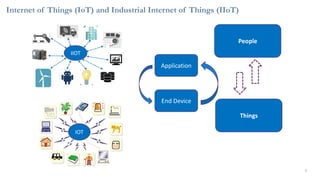
Internet of Things (IoT) and Industrial Internet of Things (IIoT)
3
People
Things
IIOT
IOT
Application
End Device
What is IOT
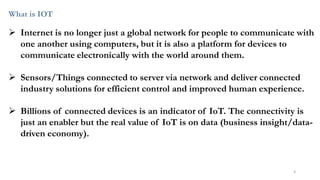
➢ Internet is no longer just a global network for people to communicate with
one another using computers, but it is also a platform for devices to
communicate electronically with the world around them.
➢ Sensors/Things connected to server via network and deliver connected
industry solutions for efficient control and improved human experience.
➢ Billions of connected devices is an indicator of IoT. The connectivity is
just an enabler but the real value of IoT is on data (business insight/data-
driven economy).
4
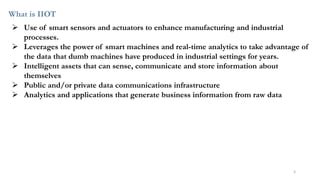
What is IIOT
➢ Use of smart sensors and actuators to enhance manufacturing and industrial
processes.
➢ Leverages the power of smart machines and real-time analytics to take advantage of
the data that dumb machines have produced in industrial settings for years.
➢ Intelligent assets that can sense, communicate and store information about
themselves
➢ Public and/or private data communications infrastructure
➢ Analytics and applications that generate business information from raw data
5
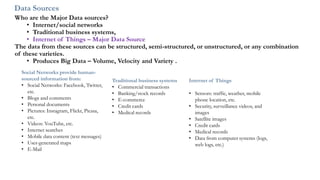
Who are the Major Data sources?
• Internet/social networks
• Traditional business systems,
• Internet of Things – Major Data Source
The data from these sources can be structured, semi-structured, or unstructured, or any combination
of these varieties.
• Produces Big Data – Volume, Velocity and Variety .
Social Networks provide human-
sourced information from:
• Social Networks: Facebook, Twitter,
etc.
• Blogs and comments
• Personal documents
• Pictures: Instagram, Flickr, Picasa,
etc.
• Videos: YouTube, etc.
• Internet searches
• Mobile data content (text messages)
• User-generated maps
• E-Mail
Traditional business systems
• Commercial transactions
• Banking/stock records
• E-commerce
• Credit cards
• Medical records
Internet of Things
• Sensors: traffic, weather, mobile
phone location, etc.
• Security, surveillance videos, and
images
• Satellite images
• Credit cards
• Medical records
• Data from computer systems (logs,
web logs, etc.)
Data Sources
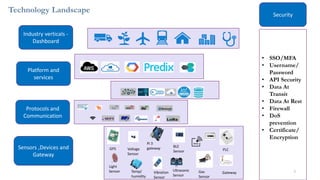
Technology Landscape
7
Industry verticals -
Dashboard
Platform and
services
Protocols and
Communication
Sensors ,Devices and
Gateway
Light
Sensor
Voltage
Sensor
Temp/
humidity
Vibration
Sensor
Ultrasonic
Sensor
Gas
Sensor
BLE
Sensor
GPS
Pi 3
gateway
Gateway
PLC
• SSO/MFA
• Username/
Password
• API Security
• Data At
Transit
• Data At Rest
• Firewall
• DoS
prevention
• Certificate/
Encryption
Security
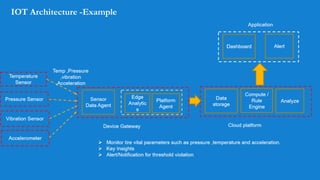
IOT Architecture -Example
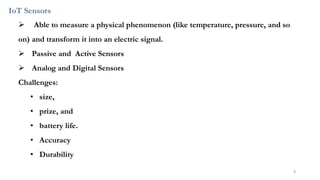
IoT Sensors
➢ Able to measure a physical phenomenon (like temperature, pressure, and so
on) and transform it into an electric signal.
➢ Passive and Active Sensors
➢ Analog and Digital Sensors
Challenges:
• size,
• prize, and
• battery life.
• Accuracy
• Durability
9
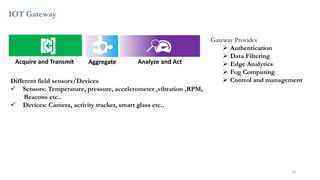
IOT Gateway
10
Acquire and Transmit Analyze and ActAggregate
Gateway Provides
➢ Authentication
➢ Data Filtering
➢ Edge Analytics
➢ Fog Computing
➢ Control and managementDifferent field sensors/Devices
✓ Sensors: Temperature, pressure, accelerometer ,vibration ,RPM,
Beacons etc..
✓ Devices: Camera, activity tracker, smart glass etc..
IoT Gateway
• OSGi
• Developing and deploying modular software programs and libraries
• Modular components ( bundles), bundle's life cycle and communication among
bundles.
• JVM for level service registry that bundles can use to publish, discover and bind to
services
• Kura
• Most popular IoT Gateway frameworks available with Eclipse
• IoT Gateways powered by Java or OSGi
• Develop custom bundles, deploy and run
• Node-RED
• visual tool for wiring IoT connections and integrating them simply
• built on JavaScript and Node.js
11
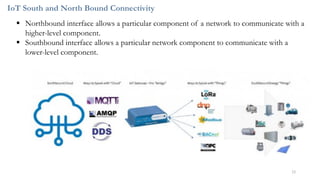
IoT South and North Bound Connectivity
▪ Northbound interface allows a particular component of a network to communicate with a
higher-level component.
▪ Southbound interface allows a particular network component to communicate with a
lower-level component.
12
IoT Protocols - Device to Device and Device to Cloud
• Protocols should support transferring information from one to many
• Protocols should have the ability to listen for the events and react
• Able to transfer small payload streams quickly
• Able to sustain and transfer information in low bandwidth network environments.
• Support power constrained, processing constrains devices/sensors
• Support authentication and transport level security
• Able to deliver messages in near real time and real time
• Ensure guaranteed message delivery and message persistence
13
Communication between sensors and Gateway , Gateway to cloud platform using
▪ Zigbee
▪ BLE
▪ Wi-Fi
▪ RF
▪ LoRa
▪ MQTT
▪ AMQP
▪ CoAP
▪ HTTP/HTTPS
▪ NFC,TCP/UDP
▪ UART,SPI
IoT Protocols - Device to Device and Device to Cloud
• Protocols should support transferring information from one to many
• Protocols should have the ability to listen for the events and react
• Able to transfer small payload streams quickly
• Able to sustain and transfer information in low bandwidth network
environments.
• Support power constrained, processing constrains devices/sensors
• Support authentication and transport level security
• Able to deliver messages in near real time and real time
• Ensure guaranteed message delivery and message persistence
14
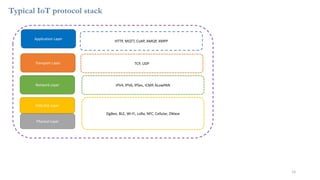
Typical IoT protocol stack
15
Application Layer
Transport Layer
Network Layer
Data link Layer
Physical Layer
HTTP, MQTT, CoAP, AMQP, XMPP
TCP, UDP
IPV4, IPV6, IPSec, ICMP, 6LowPAN
ZigBee, BLE, Wi-Fi, LoRa, NFC, Cellular, ZWave
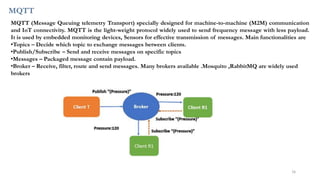
MQTT
16
MQTT (Message Queuing telemetry Transport) specially designed for machine-to-machine (M2M) communication
and IoT connectivity. MQTT is the light-weight protocol widely used to send frequency message with less payload.
It is used by embedded monitoring devices, Sensors for effective transmission of messages. Main functionalities are
•Topics – Decide which topic to exchange messages between clients.
•Publish/Subscribe – Send and receive messages on specific topics
•Messages – Packaged message contain payload.
•Broker – Receive, filter, route and send messages. Many brokers available .Mosquito ,RabbitMQ are widely used
brokers
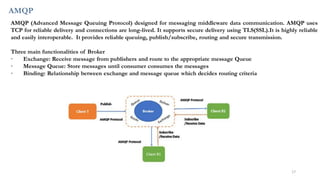
AMQP
17
AMQP (Advanced Message Queuing Protocol) designed for messaging middleware data communication. AMQP uses
TCP for reliable delivery and connections are long-lived. It supports secure delivery using TLS(SSL).It is highly reliable
and easily interoperable. It provides reliable queuing, publish/subscribe, routing and secure transmission.
Three main functionalities of Broker
· Exchange: Receive message from publishers and route to the appropriate message Queue
· Message Queue: Store messages until consumer consumes the messages
· Binding: Relationship between exchange and message queue which decides routing criteria
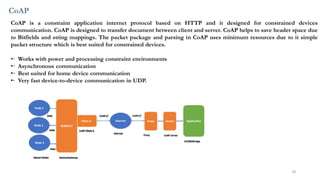
CoAP
18
CoAP is a constraint application internet protocol based on HTTP and it designed for constrained devices
communication. CoAP is designed to transfer document between client and server. CoAP helps to save header space due
to Bitfields and string mappings. The packet package and parsing in CoAP uses minimum resources due to it simple
packet structure which is best suited for constrained devices.
•· Works with power and processing constraint environments
•· Asynchronous communication
•· Best suited for home device communication
•· Very fast device-to-device communication in UDP.
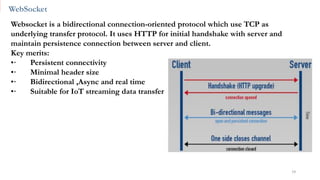
WebSocket
19
Websocket is a bidirectional connection-oriented protocol which use TCP as
underlying transfer protocol. It uses HTTP for initial handshake with server and
maintain persistence connection between server and client.
Key merits:
•· Persistent connectivity
•· Minimal header size
•· Bidirectional ,Async and real time
•· Suitable for IoT streaming data transfer
Edge and Fog Computing
Fog Computing:
• Extends the concept of cloud computing to the network edge, making it ideal for
Internet of things and other applications that require real-time interactions.
• Utilizes the local computer resources rather than accessing remote computer resources.
• Intermediate nodes process and analyze the data and/or send it to the cloud to do so.
These nodes might be gateway devices, PCs, or micro data centers.
• local area network (LAN) level of network architecture, processing data in a fog node
or IoT gateway.
• Decrease of latency issues and improve performance .
Edge Computing:
• Devices that are collecting the data actually process and analyze the data themselves
• Intelligence, processing power, and communication capabilities of an edge gateway
20
Security
• Public Key Infrastructure
• Certificate Authority
• Secure Certificate Transmission
• Device Registration
• Device on-boarding (single ,bulk and dynamic)
• Device Management
• Device update/OTA upgrade
21
Applications
➢ Asset Management
➢ Connected Health
➢ Smart Farming
➢ Connected Home
➢ Plant Automation
➢ Transportation/Logistics
➢ Smart City
➢ Automated car
➢ In-door Navigation.
22
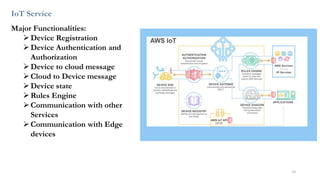
IoT Service
23
Major Functionalities:
➢Device Registration
➢Device Authentication and
Authorization
➢Device to cloud message
➢Cloud to Device message
➢Device state
➢Rules Engine
➢Communication with other
Services
➢Communication with Edge
devices
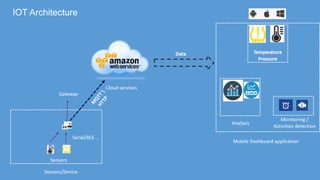
IOT Architecture
25
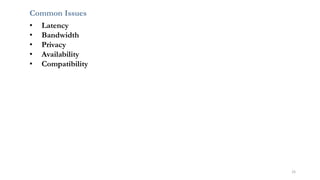
Common Issues
• Latency
• Bandwidth
• Privacy
• Availability
• Compatibility
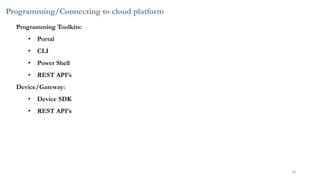
Programming/Connecting to cloud platform
26
Programming Toolkits:
• Portal
• CLI
• Power Shell
• REST API’s
Device/Gateway:
• Device SDK
• REST API’s
Thank You
27

Internet of things

  • 1.
  • 2.
    Agenda 2 ➢Introduction to IoTand IIoT ➢IoT Technology Landscape ➢Sensors/MCU/Things ➢Gateway – Introduction, Functionalities ➢Southbound and Northbound connectivity & Protocols – Introduction ➢Cloud platform for IoT ➢AWS IoT service – Device Registration, Onboarding, Rule Engine & connect with AWS Services
  • 3.
    Internet of Things(IoT) and Industrial Internet of Things (IIoT) 3 People Things IIOT IOT Application End Device
  • 4.
    What is IOT ➢Internet is no longer just a global network for people to communicate with one another using computers, but it is also a platform for devices to communicate electronically with the world around them. ➢ Sensors/Things connected to server via network and deliver connected industry solutions for efficient control and improved human experience. ➢ Billions of connected devices is an indicator of IoT. The connectivity is just an enabler but the real value of IoT is on data (business insight/data- driven economy). 4
  • 5.
    What is IIOT ➢Use of smart sensors and actuators to enhance manufacturing and industrial processes. ➢ Leverages the power of smart machines and real-time analytics to take advantage of the data that dumb machines have produced in industrial settings for years. ➢ Intelligent assets that can sense, communicate and store information about themselves ➢ Public and/or private data communications infrastructure ➢ Analytics and applications that generate business information from raw data 5
  • 6.
    Who are theMajor Data sources? • Internet/social networks • Traditional business systems, • Internet of Things – Major Data Source The data from these sources can be structured, semi-structured, or unstructured, or any combination of these varieties. • Produces Big Data – Volume, Velocity and Variety . Social Networks provide human- sourced information from: • Social Networks: Facebook, Twitter, etc. • Blogs and comments • Personal documents • Pictures: Instagram, Flickr, Picasa, etc. • Videos: YouTube, etc. • Internet searches • Mobile data content (text messages) • User-generated maps • E-Mail Traditional business systems • Commercial transactions • Banking/stock records • E-commerce • Credit cards • Medical records Internet of Things • Sensors: traffic, weather, mobile phone location, etc. • Security, surveillance videos, and images • Satellite images • Credit cards • Medical records • Data from computer systems (logs, web logs, etc.) Data Sources
  • 7.
    Technology Landscape 7 Industry verticals- Dashboard Platform and services Protocols and Communication Sensors ,Devices and Gateway Light Sensor Voltage Sensor Temp/ humidity Vibration Sensor Ultrasonic Sensor Gas Sensor BLE Sensor GPS Pi 3 gateway Gateway PLC • SSO/MFA • Username/ Password • API Security • Data At Transit • Data At Rest • Firewall • DoS prevention • Certificate/ Encryption Security
  • 8.
  • 9.
    IoT Sensors ➢ Ableto measure a physical phenomenon (like temperature, pressure, and so on) and transform it into an electric signal. ➢ Passive and Active Sensors ➢ Analog and Digital Sensors Challenges: • size, • prize, and • battery life. • Accuracy • Durability 9
  • 10.
    IOT Gateway 10 Acquire andTransmit Analyze and ActAggregate Gateway Provides ➢ Authentication ➢ Data Filtering ➢ Edge Analytics ➢ Fog Computing ➢ Control and managementDifferent field sensors/Devices ✓ Sensors: Temperature, pressure, accelerometer ,vibration ,RPM, Beacons etc.. ✓ Devices: Camera, activity tracker, smart glass etc..
  • 11.
    IoT Gateway • OSGi •Developing and deploying modular software programs and libraries • Modular components ( bundles), bundle's life cycle and communication among bundles. • JVM for level service registry that bundles can use to publish, discover and bind to services • Kura • Most popular IoT Gateway frameworks available with Eclipse • IoT Gateways powered by Java or OSGi • Develop custom bundles, deploy and run • Node-RED • visual tool for wiring IoT connections and integrating them simply • built on JavaScript and Node.js 11
  • 12.
    IoT South andNorth Bound Connectivity ▪ Northbound interface allows a particular component of a network to communicate with a higher-level component. ▪ Southbound interface allows a particular network component to communicate with a lower-level component. 12
  • 13.
    IoT Protocols -Device to Device and Device to Cloud • Protocols should support transferring information from one to many • Protocols should have the ability to listen for the events and react • Able to transfer small payload streams quickly • Able to sustain and transfer information in low bandwidth network environments. • Support power constrained, processing constrains devices/sensors • Support authentication and transport level security • Able to deliver messages in near real time and real time • Ensure guaranteed message delivery and message persistence 13 Communication between sensors and Gateway , Gateway to cloud platform using ▪ Zigbee ▪ BLE ▪ Wi-Fi ▪ RF ▪ LoRa ▪ MQTT ▪ AMQP ▪ CoAP ▪ HTTP/HTTPS ▪ NFC,TCP/UDP ▪ UART,SPI
  • 14.
    IoT Protocols -Device to Device and Device to Cloud • Protocols should support transferring information from one to many • Protocols should have the ability to listen for the events and react • Able to transfer small payload streams quickly • Able to sustain and transfer information in low bandwidth network environments. • Support power constrained, processing constrains devices/sensors • Support authentication and transport level security • Able to deliver messages in near real time and real time • Ensure guaranteed message delivery and message persistence 14
  • 15.
    Typical IoT protocolstack 15 Application Layer Transport Layer Network Layer Data link Layer Physical Layer HTTP, MQTT, CoAP, AMQP, XMPP TCP, UDP IPV4, IPV6, IPSec, ICMP, 6LowPAN ZigBee, BLE, Wi-Fi, LoRa, NFC, Cellular, ZWave
  • 16.
    MQTT 16 MQTT (Message Queuingtelemetry Transport) specially designed for machine-to-machine (M2M) communication and IoT connectivity. MQTT is the light-weight protocol widely used to send frequency message with less payload. It is used by embedded monitoring devices, Sensors for effective transmission of messages. Main functionalities are •Topics – Decide which topic to exchange messages between clients. •Publish/Subscribe – Send and receive messages on specific topics •Messages – Packaged message contain payload. •Broker – Receive, filter, route and send messages. Many brokers available .Mosquito ,RabbitMQ are widely used brokers
  • 17.
    AMQP 17 AMQP (Advanced MessageQueuing Protocol) designed for messaging middleware data communication. AMQP uses TCP for reliable delivery and connections are long-lived. It supports secure delivery using TLS(SSL).It is highly reliable and easily interoperable. It provides reliable queuing, publish/subscribe, routing and secure transmission. Three main functionalities of Broker · Exchange: Receive message from publishers and route to the appropriate message Queue · Message Queue: Store messages until consumer consumes the messages · Binding: Relationship between exchange and message queue which decides routing criteria
  • 18.
    CoAP 18 CoAP is aconstraint application internet protocol based on HTTP and it designed for constrained devices communication. CoAP is designed to transfer document between client and server. CoAP helps to save header space due to Bitfields and string mappings. The packet package and parsing in CoAP uses minimum resources due to it simple packet structure which is best suited for constrained devices. •· Works with power and processing constraint environments •· Asynchronous communication •· Best suited for home device communication •· Very fast device-to-device communication in UDP.
  • 19.
    WebSocket 19 Websocket is abidirectional connection-oriented protocol which use TCP as underlying transfer protocol. It uses HTTP for initial handshake with server and maintain persistence connection between server and client. Key merits: •· Persistent connectivity •· Minimal header size •· Bidirectional ,Async and real time •· Suitable for IoT streaming data transfer
  • 20.
    Edge and FogComputing Fog Computing: • Extends the concept of cloud computing to the network edge, making it ideal for Internet of things and other applications that require real-time interactions. • Utilizes the local computer resources rather than accessing remote computer resources. • Intermediate nodes process and analyze the data and/or send it to the cloud to do so. These nodes might be gateway devices, PCs, or micro data centers. • local area network (LAN) level of network architecture, processing data in a fog node or IoT gateway. • Decrease of latency issues and improve performance . Edge Computing: • Devices that are collecting the data actually process and analyze the data themselves • Intelligence, processing power, and communication capabilities of an edge gateway 20
  • 21.
    Security • Public KeyInfrastructure • Certificate Authority • Secure Certificate Transmission • Device Registration • Device on-boarding (single ,bulk and dynamic) • Device Management • Device update/OTA upgrade 21
  • 22.
    Applications ➢ Asset Management ➢Connected Health ➢ Smart Farming ➢ Connected Home ➢ Plant Automation ➢ Transportation/Logistics ➢ Smart City ➢ Automated car ➢ In-door Navigation. 22
  • 23.
    IoT Service 23 Major Functionalities: ➢DeviceRegistration ➢Device Authentication and Authorization ➢Device to cloud message ➢Cloud to Device message ➢Device state ➢Rules Engine ➢Communication with other Services ➢Communication with Edge devices
  • 24.
  • 25.
    25 Common Issues • Latency •Bandwidth • Privacy • Availability • Compatibility
  • 26.
    Programming/Connecting to cloudplatform 26 Programming Toolkits: • Portal • CLI • Power Shell • REST API’s Device/Gateway: • Device SDK • REST API’s
  • 27.