Z-WAVE PROTOCOL
http://smarthomedesign.in/z-wave/
Definition
Z-wave is a protocol used for wireless• Z-wave is a protocol used for wireless
communication mainly in home-automation. This
protocols caters needs of residential control and
automation market which effectively and smartly
control lighting, security systems.control lighting, security systems.
• This protocol originally developed by Danish
Startup Zen Sys and further acquired by sigma
designs in 2008. The Z-Wave transceivers chips
are supplied by sigma and Mitsumi. Output
Power is 1mw or 0 dBM
Where it is Used
• Home theatre, automated window curtain,
swimming spa controls, home access
and garage controls. Like many other
Protocols i.e Zigbee and system aimed at theProtocols i.e Zigbee and system aimed at the
office/home-automation market a z-wave
automation system can be controlled via the
internet with the Z-wave gateway or central
control device serving as both the Z-wave hub
controller and portal to the outside.
Network Setup Routing and Topology
• Z-wave device connect via source routed mesh
network architecture. A Z-Wave network can
assist of upto 232 devices with the option of
bridging network if more devices are required.bridging network if more devices are required.
Z-wave based smart devices can communicate
to one another by using central
nodes (hubs) to actively route around.
• A message from node A to node C can be
effectively transferred even though two nodes
are not within range, providing that a third
node B can communicate with nodes A and C.node B can communicate with nodes A and C.
That is the reason a Z-Wave network can span• That is the reason a Z-Wave network can span
much further than the radio range of a single
unit. Every device must be included to the Z-
Wave network before it can be controlled via Z-
Wave. We can add devices through pairing andWave. We can add devices through pairing and
adding by pressing a sequence of buttons on the
controller (Hubs) and on the device being added
to the network. The sequence only needs to be
performed once after which the device is always
recognized by the controller (Hubs).
TOPOLOGY
• Every Z-wave network is identified by a Network Id and• Every Z-wave network is identified by a Network Id and
each smart device is further identified by a Node Id.
The network Id (also called Home Id) is the common
identification of all nodes belonging to one logical Z-
Wave network. The network Id has a length of 4 bytes
and is assigned to each device by the primaryand is assigned to each device by the primary
controller and when the device is included into the
network. Nodes with the different Network Ids cannot
communicate with each other. The node id is the
address of a single node in the network. The node id is
the address of a single node in the network . The node
Id has a length of 1 byte.
Z-Wave Plus
• Z-wave plus is the newest tech-certification
standard,developed to offer greater
range,battery life, easier compatibility and
pairing. The Samsung Smart Things Hub (Hubpairing. The Samsung Smart Things Hub (Hub
V2) is Z-Wave Plus Certified.
Z-Wave based application andZ-Wave based application and
Automation DevicesAutomation DevicesAutomation Devices
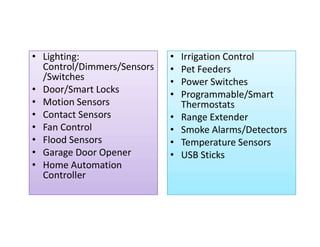
• Lighting:• Lighting:
Control/Dimmers/Sensors
/Switches
• Door/Smart Locks
• Motion Sensors
• Contact Sensors
• Fan Control
• Irrigation Control• Irrigation Control
• Pet Feeders
• Power Switches
• Programmable/Smart
Thermostats
• Range Extender
• Smoke Alarms/Detectors• Fan Control
• Flood Sensors
• Garage Door Opener
• Home Automation
Controller
• Smoke Alarms/Detectors
• Temperature Sensors
• USB Sticks
Z-Wave Frequency in IndiaZ-Wave Frequency in India
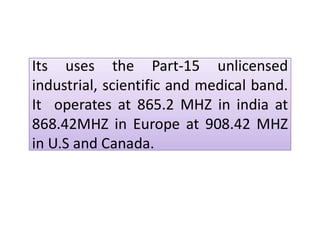
Its uses the Part-15 unlicensedIts uses the Part-15 unlicensed
industrial, scientific and medical band.
It operates at 865.2 MHZ in india at
868.42MHZ in Europe at 908.42 MHZ
in U.S and Canada.
868.42MHZ in Europe at 908.42 MHZ
in U.S and Canada.

Z wave

  • 1.
  • 2.
    Definition Z-wave is aprotocol used for wireless• Z-wave is a protocol used for wireless communication mainly in home-automation. This protocols caters needs of residential control and automation market which effectively and smartly control lighting, security systems.control lighting, security systems. • This protocol originally developed by Danish Startup Zen Sys and further acquired by sigma designs in 2008. The Z-Wave transceivers chips are supplied by sigma and Mitsumi. Output Power is 1mw or 0 dBM
  • 3.
    Where it isUsed • Home theatre, automated window curtain, swimming spa controls, home access and garage controls. Like many other Protocols i.e Zigbee and system aimed at theProtocols i.e Zigbee and system aimed at the office/home-automation market a z-wave automation system can be controlled via the internet with the Z-wave gateway or central control device serving as both the Z-wave hub controller and portal to the outside.
  • 4.
    Network Setup Routingand Topology • Z-wave device connect via source routed mesh network architecture. A Z-Wave network can assist of upto 232 devices with the option of bridging network if more devices are required.bridging network if more devices are required. Z-wave based smart devices can communicate to one another by using central nodes (hubs) to actively route around.
  • 5.
    • A messagefrom node A to node C can be effectively transferred even though two nodes are not within range, providing that a third node B can communicate with nodes A and C.node B can communicate with nodes A and C.
  • 6.
    That is thereason a Z-Wave network can span• That is the reason a Z-Wave network can span much further than the radio range of a single unit. Every device must be included to the Z- Wave network before it can be controlled via Z- Wave. We can add devices through pairing andWave. We can add devices through pairing and adding by pressing a sequence of buttons on the controller (Hubs) and on the device being added to the network. The sequence only needs to be performed once after which the device is always recognized by the controller (Hubs).
  • 7.
    TOPOLOGY • Every Z-wavenetwork is identified by a Network Id and• Every Z-wave network is identified by a Network Id and each smart device is further identified by a Node Id. The network Id (also called Home Id) is the common identification of all nodes belonging to one logical Z- Wave network. The network Id has a length of 4 bytes and is assigned to each device by the primaryand is assigned to each device by the primary controller and when the device is included into the network. Nodes with the different Network Ids cannot communicate with each other. The node id is the address of a single node in the network. The node id is the address of a single node in the network . The node Id has a length of 1 byte.
  • 8.
  • 9.
    • Z-wave plusis the newest tech-certification standard,developed to offer greater range,battery life, easier compatibility and pairing. The Samsung Smart Things Hub (Hubpairing. The Samsung Smart Things Hub (Hub V2) is Z-Wave Plus Certified.
  • 10.
    Z-Wave based applicationandZ-Wave based application and Automation DevicesAutomation DevicesAutomation Devices
  • 11.
    • Lighting:• Lighting: Control/Dimmers/Sensors /Switches •Door/Smart Locks • Motion Sensors • Contact Sensors • Fan Control • Irrigation Control• Irrigation Control • Pet Feeders • Power Switches • Programmable/Smart Thermostats • Range Extender • Smoke Alarms/Detectors• Fan Control • Flood Sensors • Garage Door Opener • Home Automation Controller • Smoke Alarms/Detectors • Temperature Sensors • USB Sticks
  • 12.
    Z-Wave Frequency inIndiaZ-Wave Frequency in India
  • 13.
    Its uses thePart-15 unlicensedIts uses the Part-15 unlicensed industrial, scientific and medical band. It operates at 865.2 MHZ in india at 868.42MHZ in Europe at 908.42 MHZ in U.S and Canada. 868.42MHZ in Europe at 908.42 MHZ in U.S and Canada.