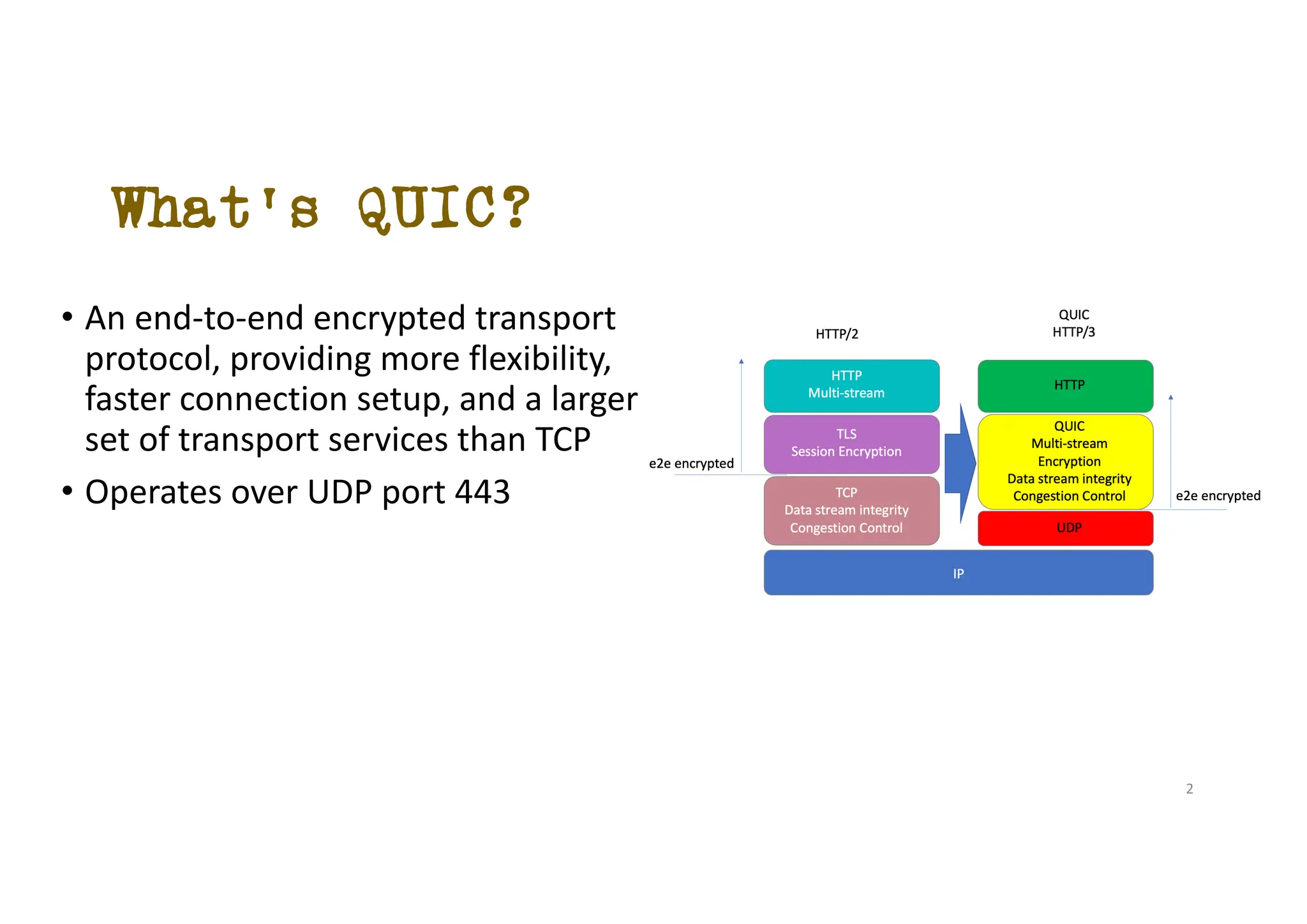
What’s QUIC?
2
• Anend-to-end encrypted transport
protocol, providing more flexibility,
faster connection setup, and a larger
set of transport services than TCP
• Operates over UDP port 443
3.
Triggering QUIC inHTTP
Method 1 - Use content-level Alt-Svc controls to trigger the client to
use the QUIC transport protocol (if it can):
• Add Alt-Svc: h3=“:443” to the HTML headers
3
4.
Setting Expectations
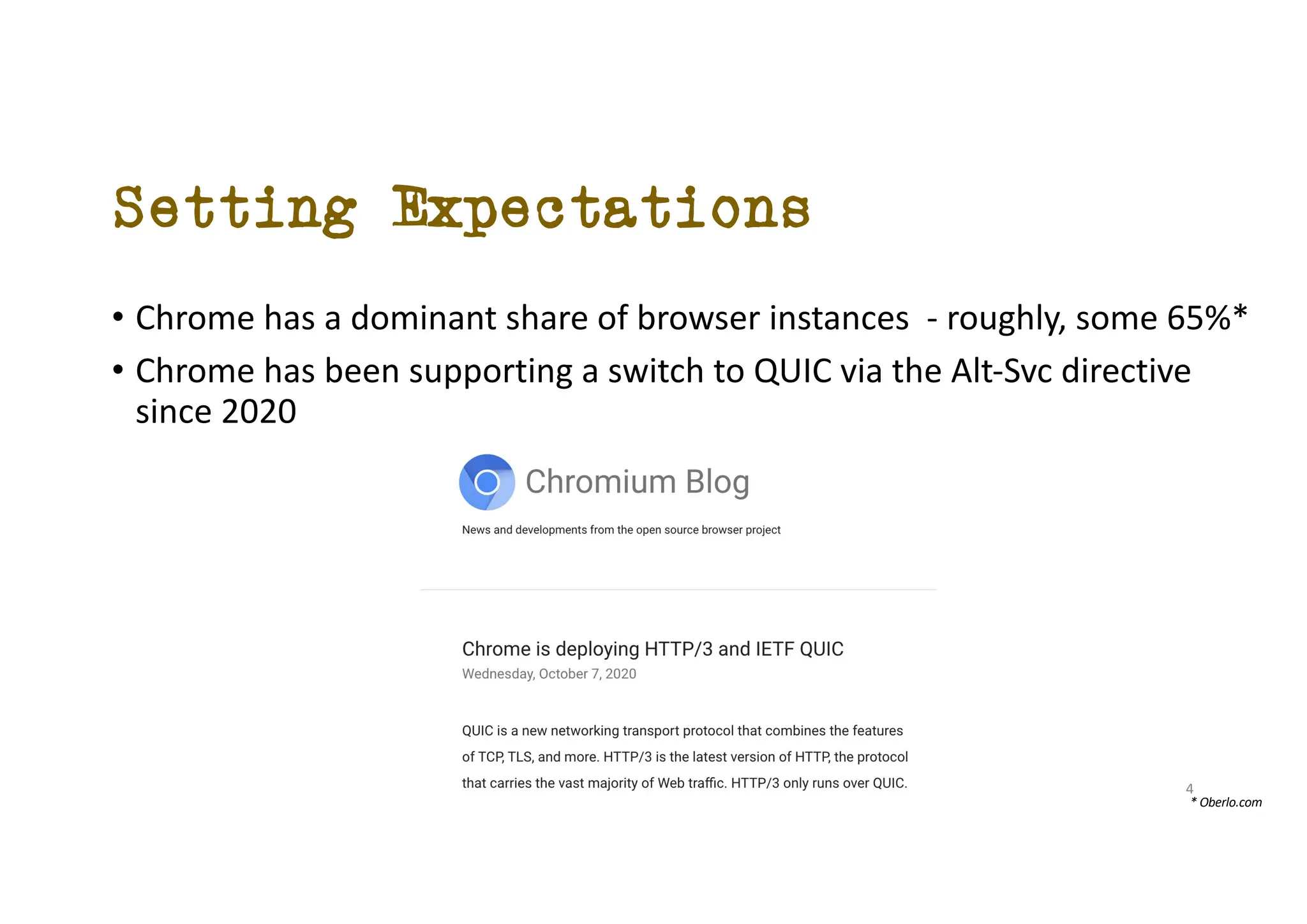
• Chromehas a dominant share of browser instances - roughly, some 65%*
• Chrome has been supporting a switch to QUIC via the Alt-Svc directive
since 2020
* Oberlo.com
4
5.
Setting Expectations
• Chromehas a dominant share of browser instances - roughly, some 65%*
• Chrome has been supporting a switch to QUIC via the Alt-Svc directive
since 2020
* Oberlo.com
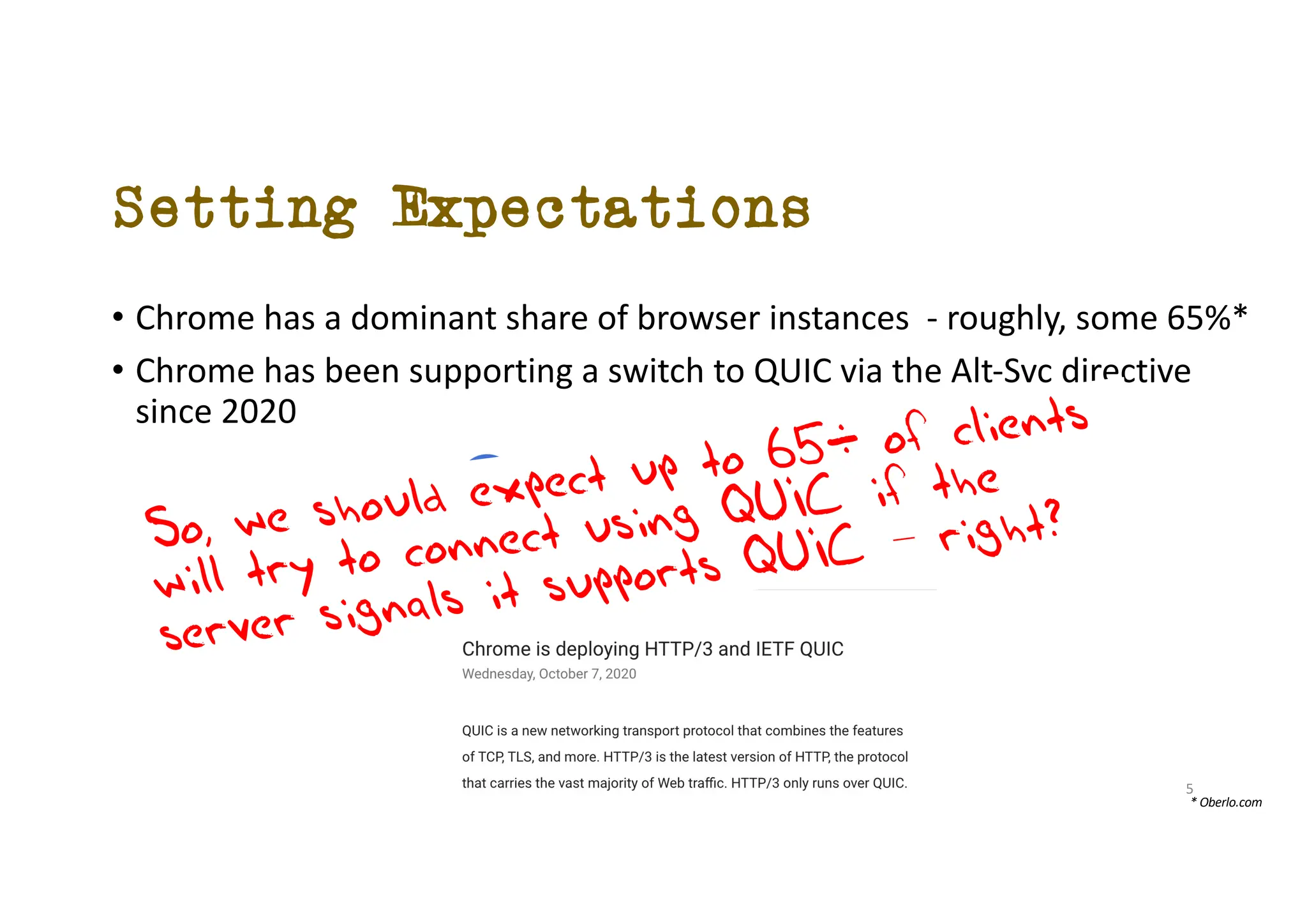
So, we should expect up to 65% of clients
will try to connect using QUIC if the
server signals it supports QUIC – right?
5
6.
The Alt-Svc Trigger
•This trigger is only effective when the client contacts this server for
the second time
• But HTTP/1.1 and HTTP/2.0 use session persistence to keep the original
TCP/TLS session open, so the condition where a client needs to open a new
connection is less likely to occur
• The per-server Alt-Svc information is cached by the user for only 24 hours by
default
6
7.
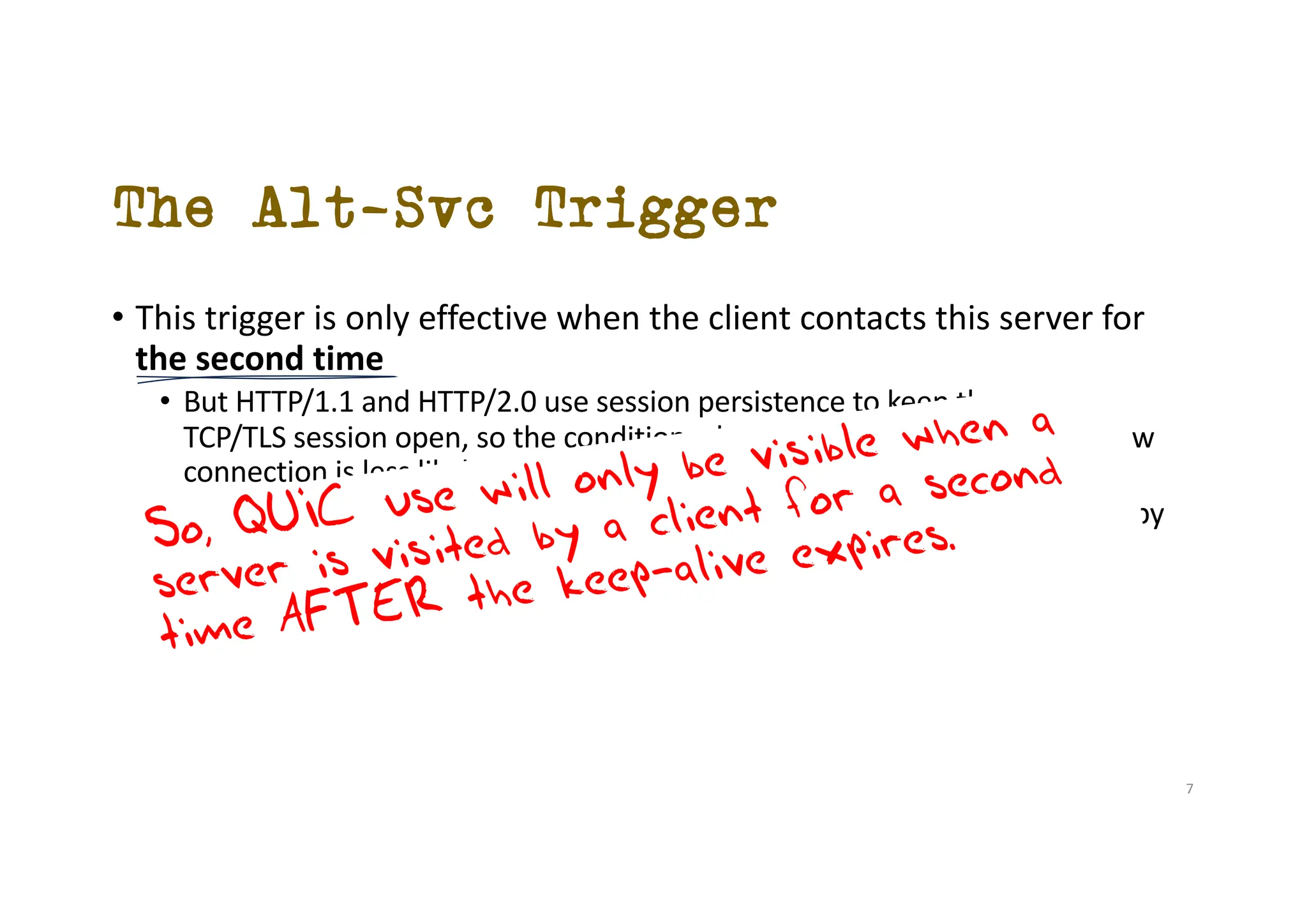
The Alt-Svc Trigger
•This trigger is only effective when the client contacts this server for
the second time
• But HTTP/1.1 and HTTP/2.0 use session persistence to keep the original
TCP/TLS session open, so the condition where a client needs to open a new
connection is less likely to occur
• The ser server Alt-Svc information is cached by the user for only 24 hours by
default
So, QUIC use will only be visible when a
server is visited by a client for a second
time AFTER the keep-alive expires.
7
8.
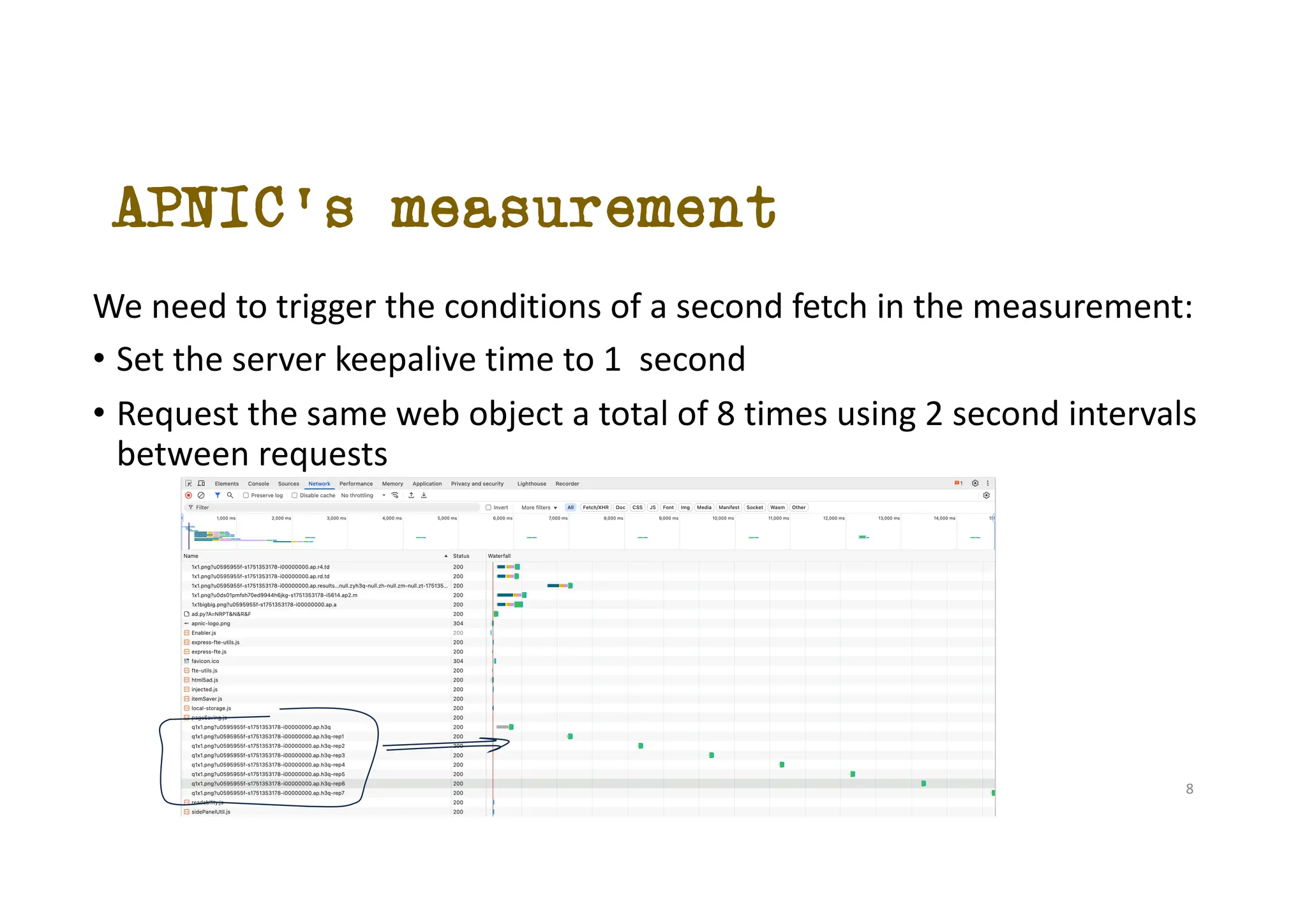
APNIC’s measurement
We needto trigger the conditions of a second fetch in the measurement:
• Set the server keepalive time to 1 second
• Request the same web object a total of 8 times using 2 second intervals
between requests
8
9.
Triggering QUIC inHTTP
Method 2 - Use the DNS to trigger QUIC:
• Set up an HTTPS record for the service name, with value: alpn=“h3”
• This allows Safari to use QUIC from the first access
9
10.
Safari supports QUIC
(usingMethod 2)
• Apple’s Safari is now supporting QUIC, using an HTTPS
query/response in the DNS, where the apln directive can specify the
use of the HTTP/3 protocol to access this service
• QUIC can be triggered immediately (no wait for the second visit), so
presumably, if the client performs a DNS HTTPS query, and the
response indicates that the server supports QUIC, then the client
should use QUIC for the connection
10
11.
Setting Expectations
• Chromehas a dominant share of browser instances - roughly, some 65%*
• Apple Safari is now supporting QUIC, using the DNS HTTPS trigger
• So, a QUIC-aware server platform should be seeing up to 85% of its
sessions using QUIC
• This figure is probably not achievable as the content level control requires some
precise conditions for the “second” visit:
• long enough between visits for the session keepalive timer to expire
• Short enough such that the local cache of server capabilities has not expired
* https://gs.statcounter.com/browser-market-share
11
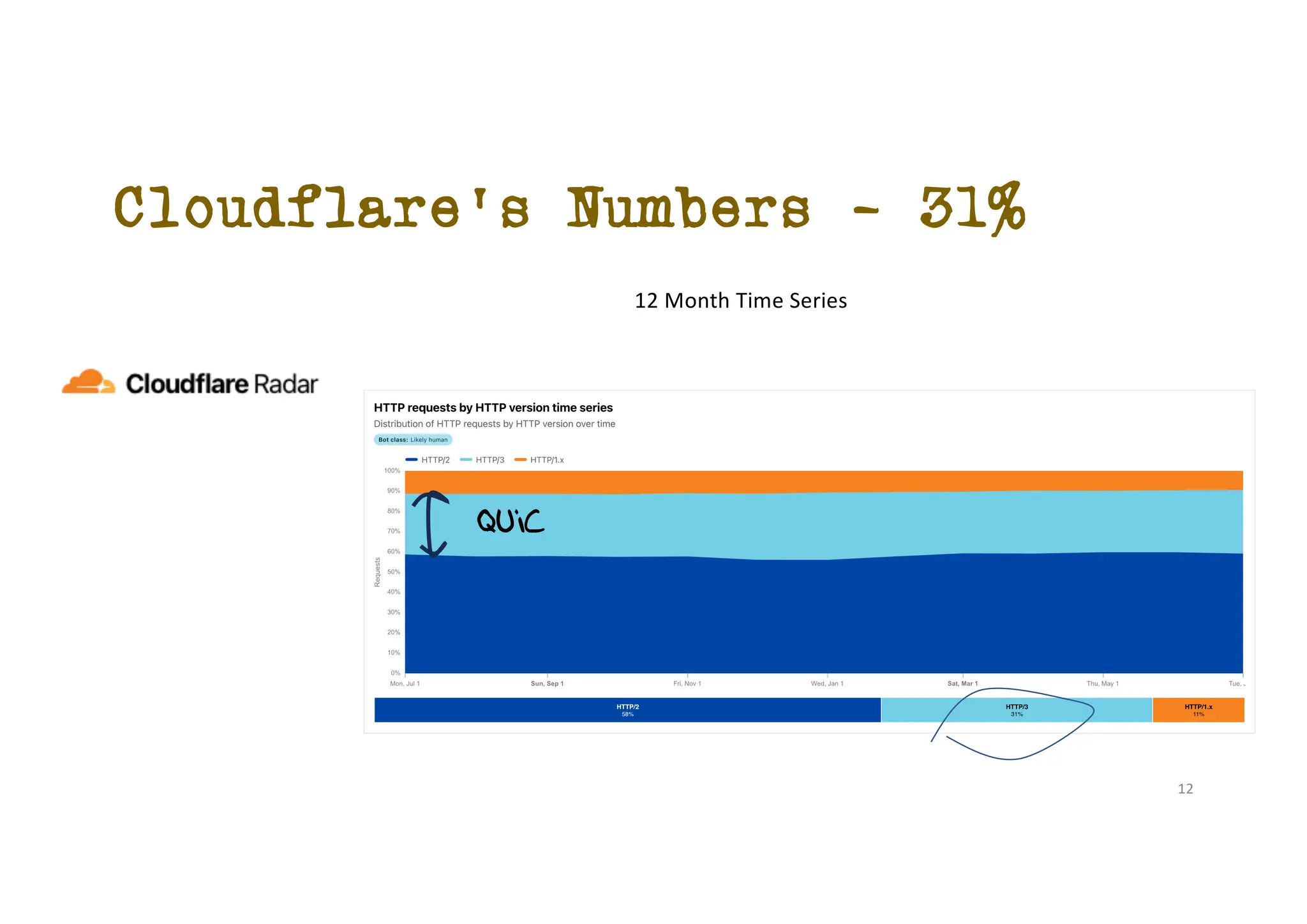
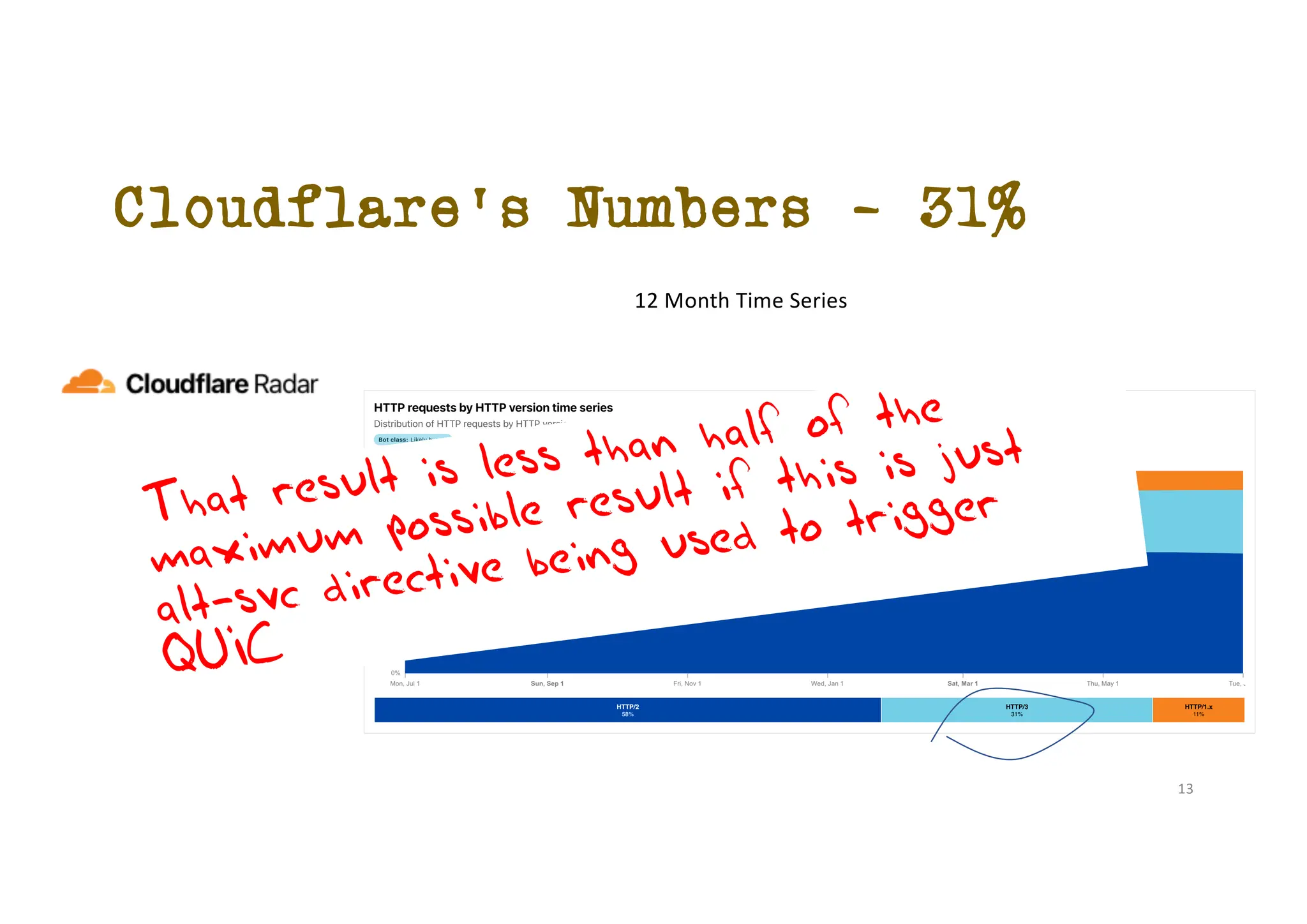
Cloudflare’s Numbers –31%
12 Month Time Series
QUIC
That result is less than half of the
maximum possible result if this is just
alt-svc directive being used to trigger
QUIC
13
14.
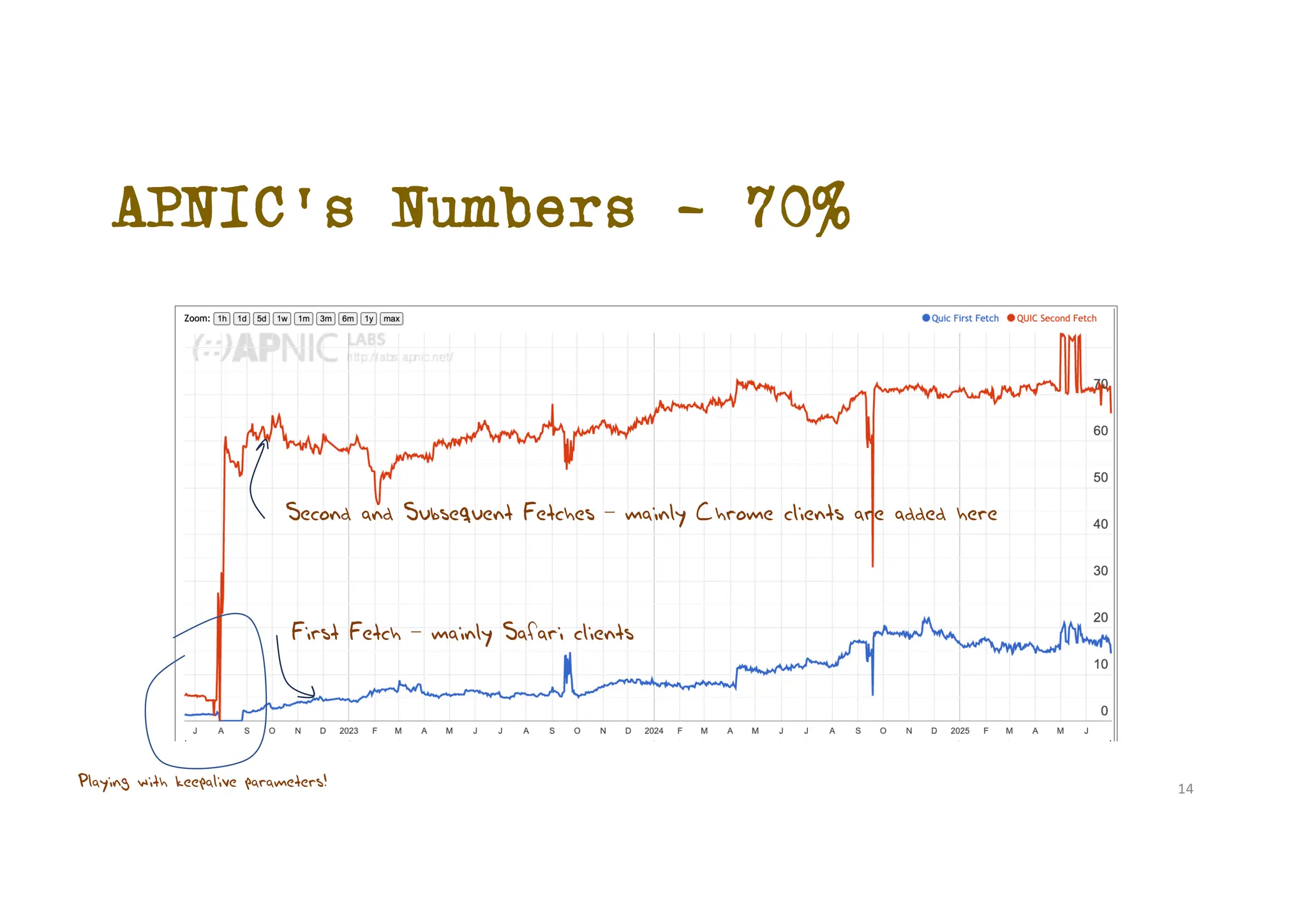
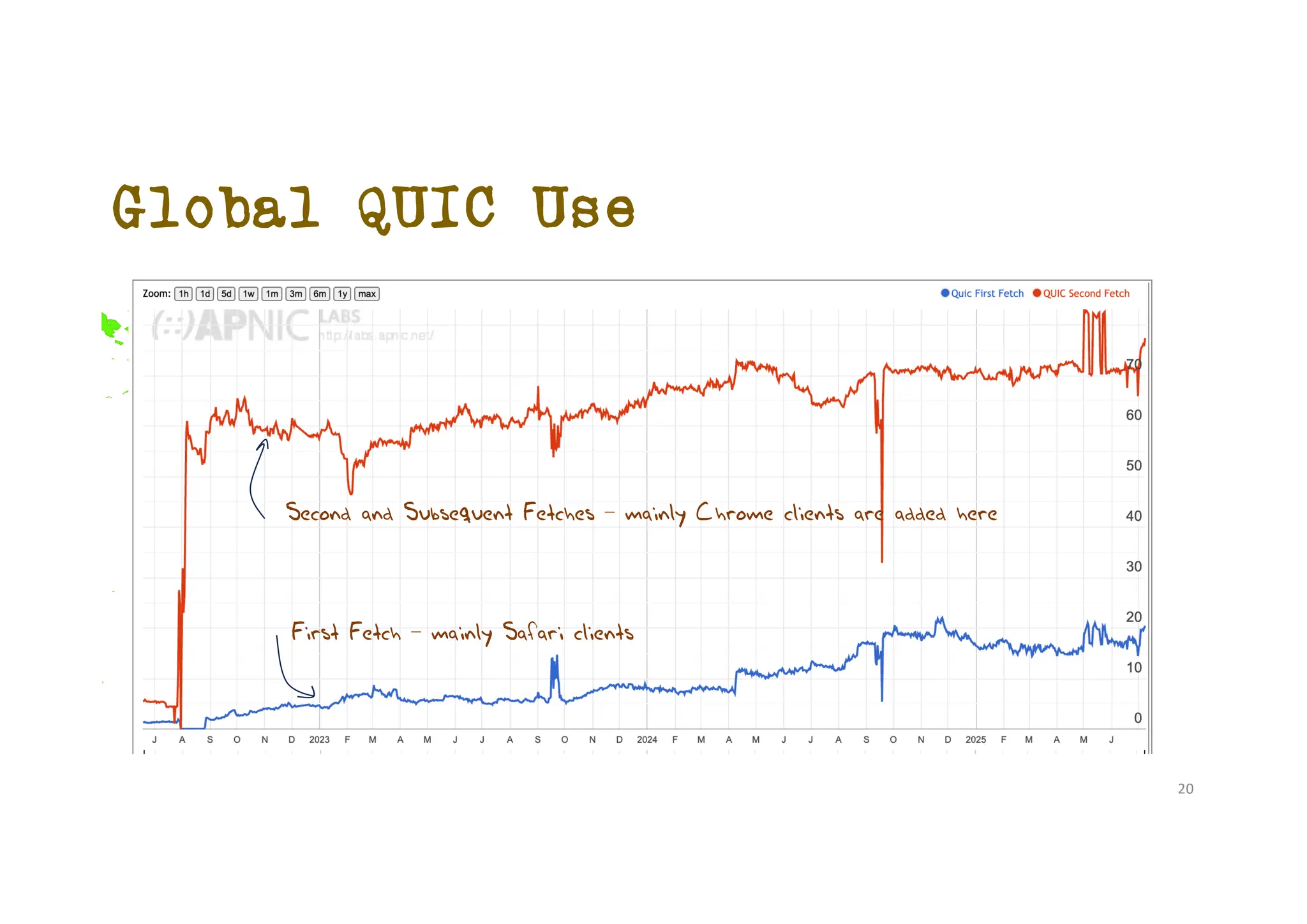
APNIC’s Numbers –70%
Playing with keepalive parameters!
First Fetch – mainly Safari clients
Second and Subsequent Fetches – mainly Chrome clients are added here
14
15.
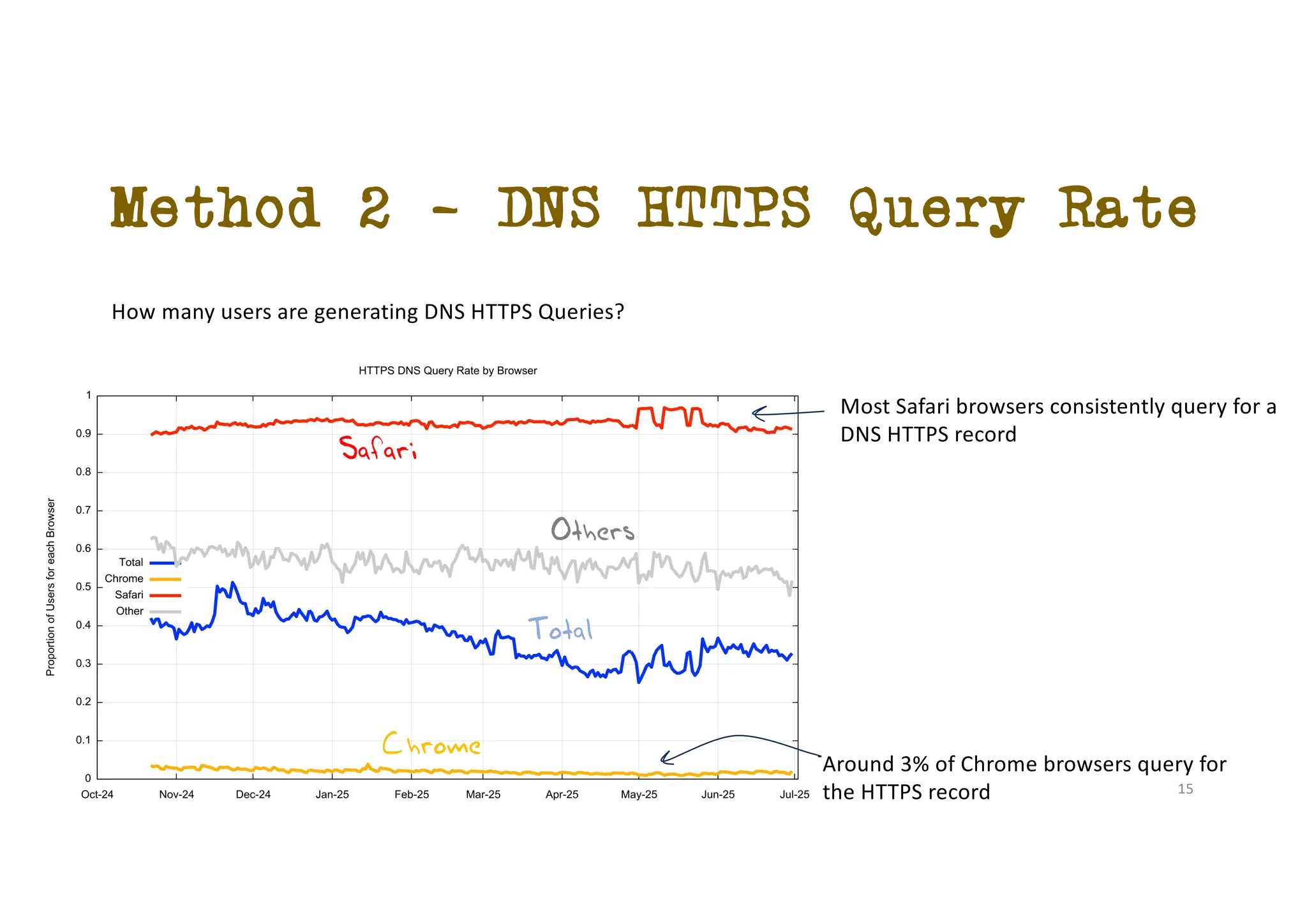
Method 2 -DNS HTTPS Query Rate
Safari
Chrome
Others
Total
Most Safari browsers consistently query for a
DNS HTTPS record
Around 3% of Chrome browsers query for
the HTTPS record
How many users are generating DNS HTTPS Queries?
15
16.
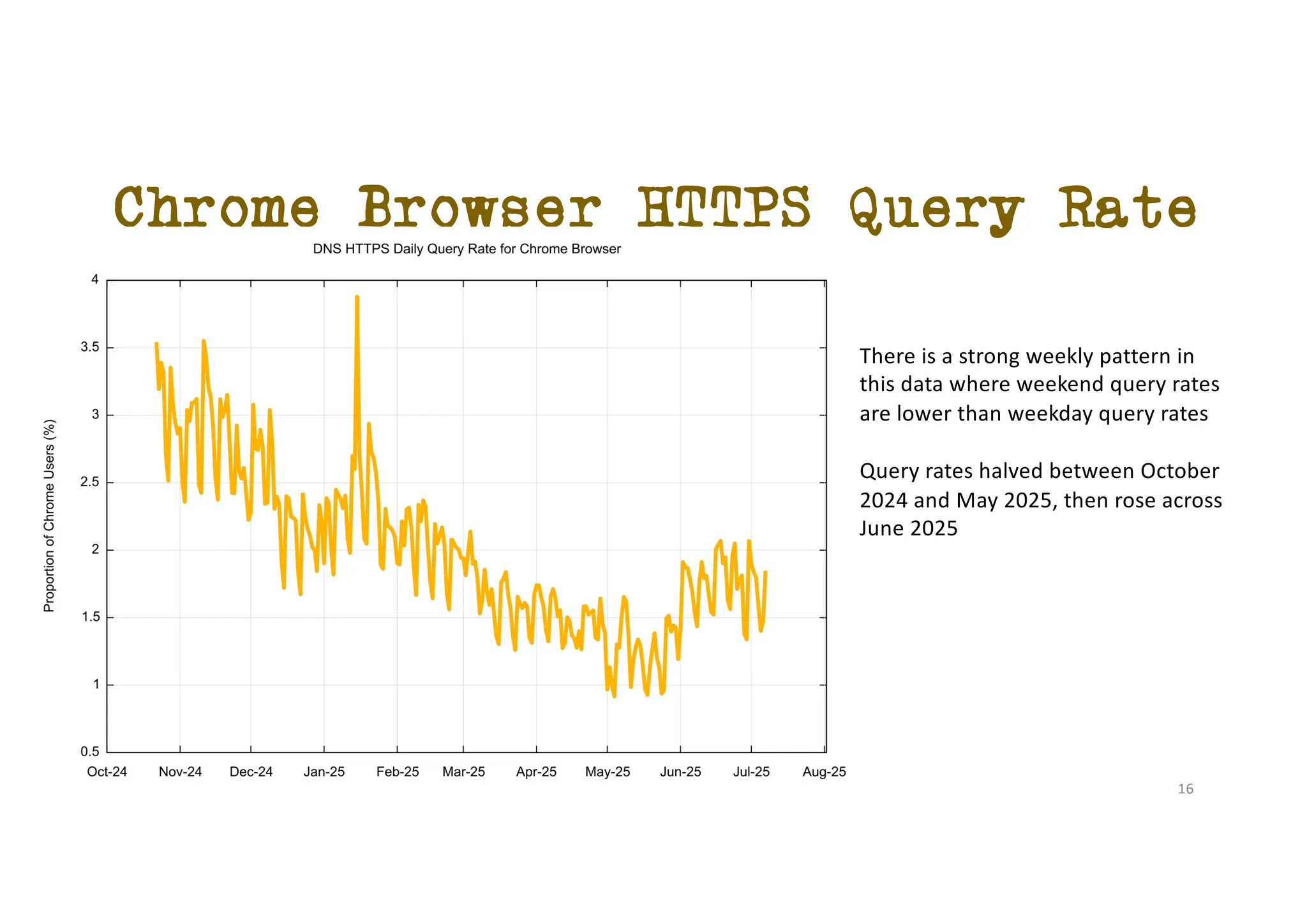
Chrome Browser HTTPSQuery Rate
There is a strong weekly pattern in
this data where weekend query rates
are lower than weekday query rates
Query rates halved between October
2024 and May 2025, then rose across
June 2025
16
17.
Chrome Browser HTTPSQuery Rate
There is a strong weekly pattern in
this data where weekend query rates
are lower than weekday query rates
Query rates halved between October
2024 and May 2025, then rose across
June 2025
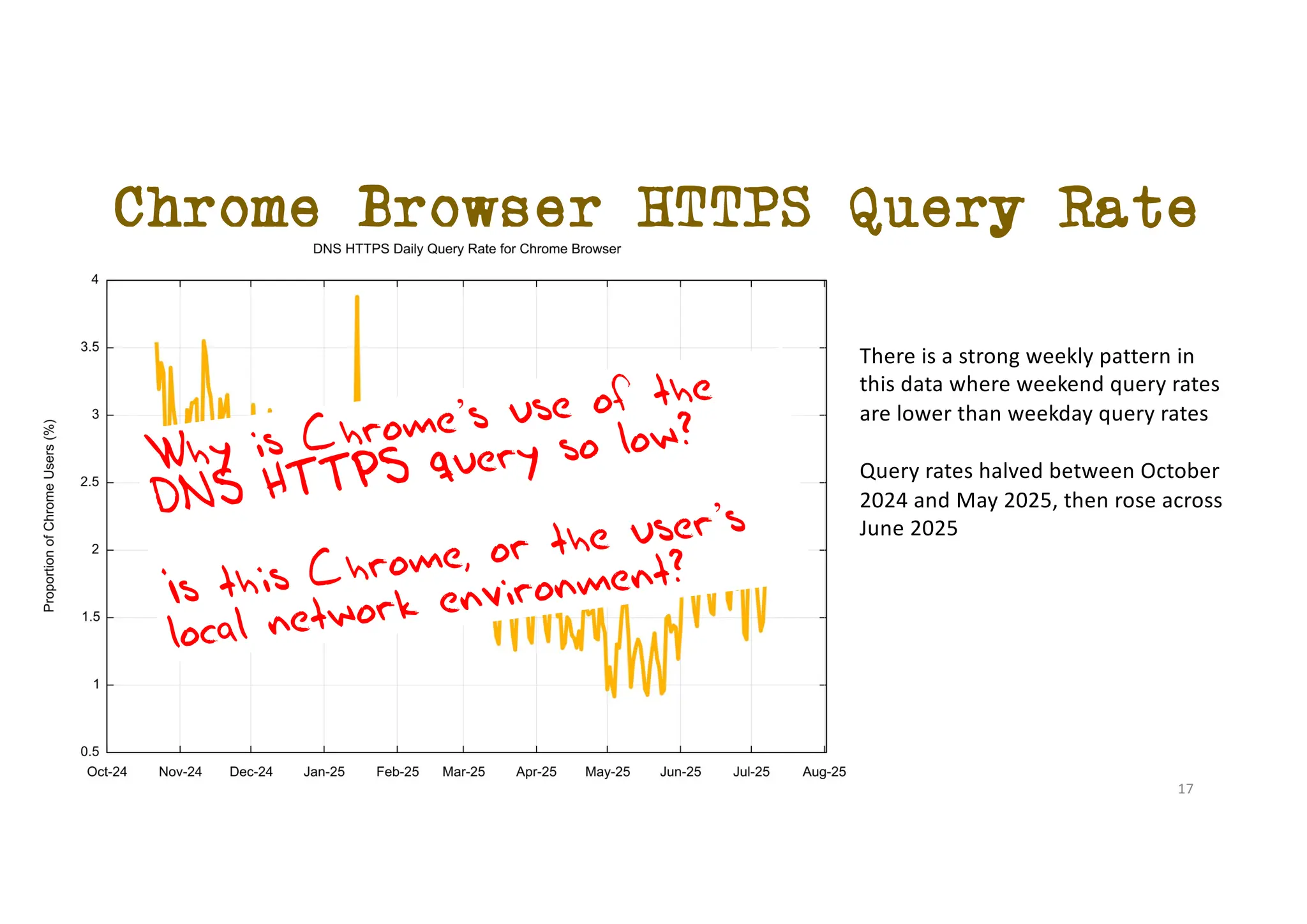
Why is Chrome’s use of the
DNS HTTPS query so low?
Is this Chrome, or the user’s
local network environment?
17
18.
QUIC Use
• IfQUIC access is supported by the current releases by both the major
browsers, then we should see a high QUIC use rate when the ability to
use QUIC is signaled by both methods (alt-svc and DNS HTTPS)
• What do we see?
18
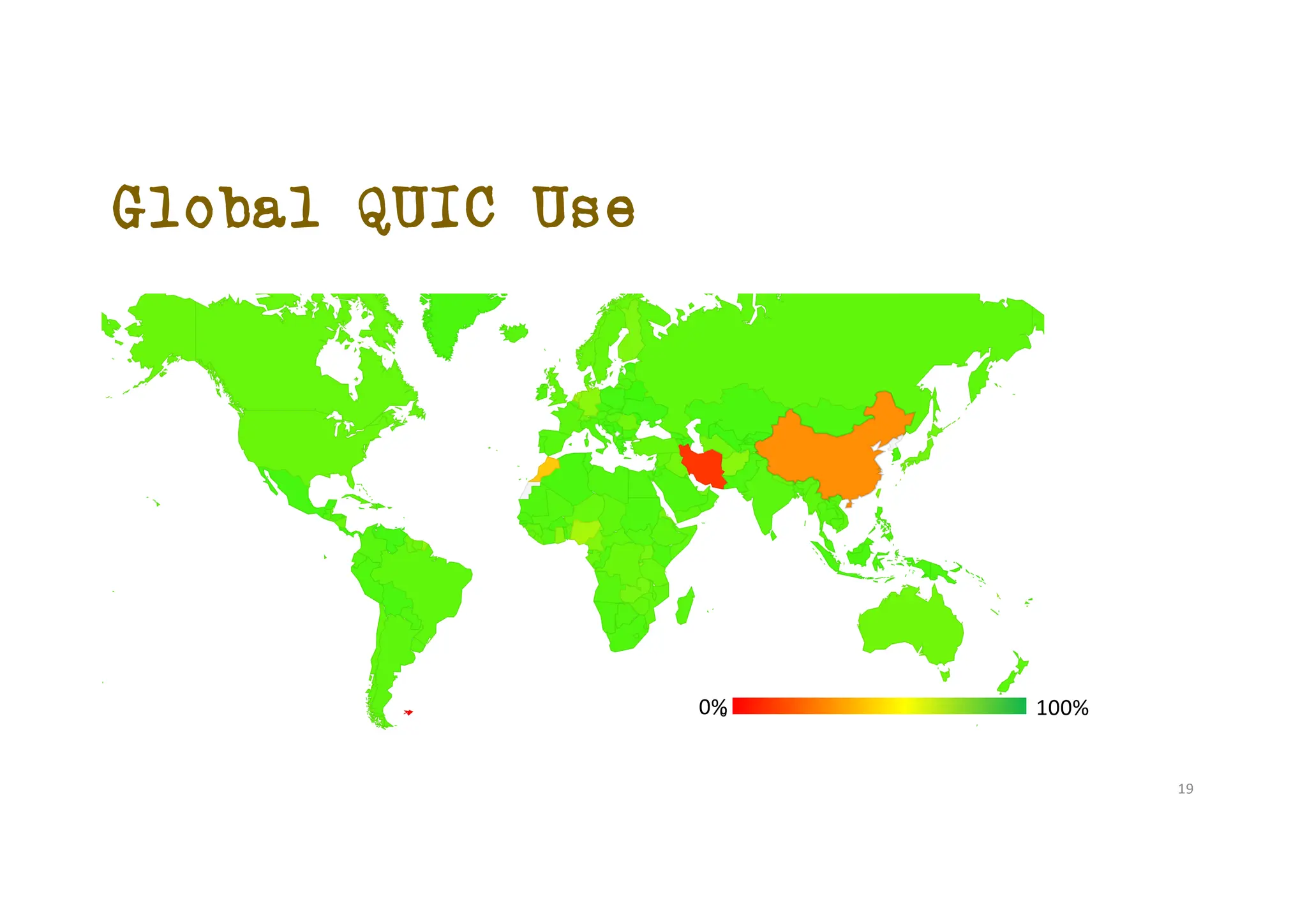
Global QUIC Use
FirstFetch – mainly Safari clients
Second and Subsequent Fetches – mainly Chrome clients are added here
20
21.
Global QUIC Use
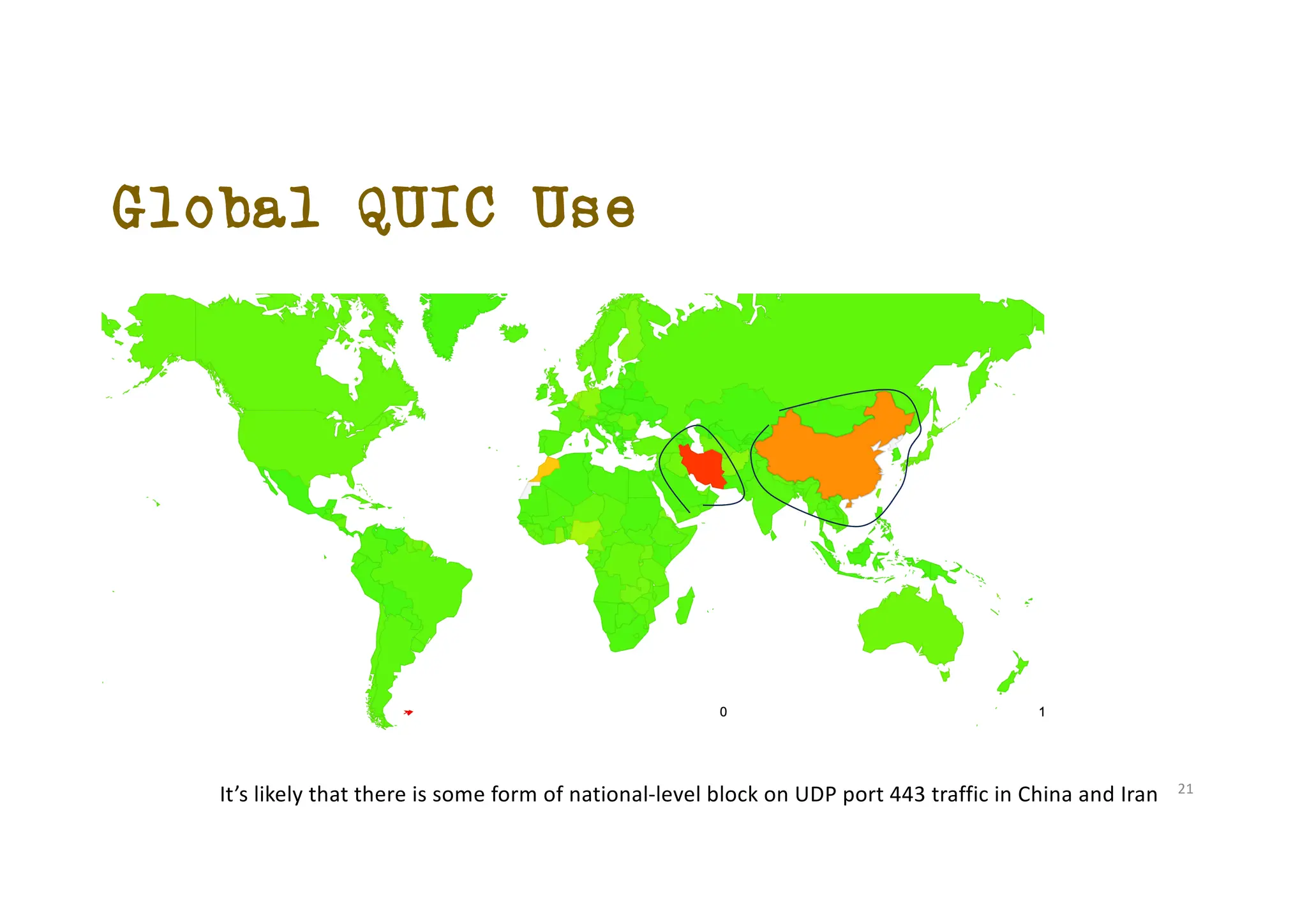
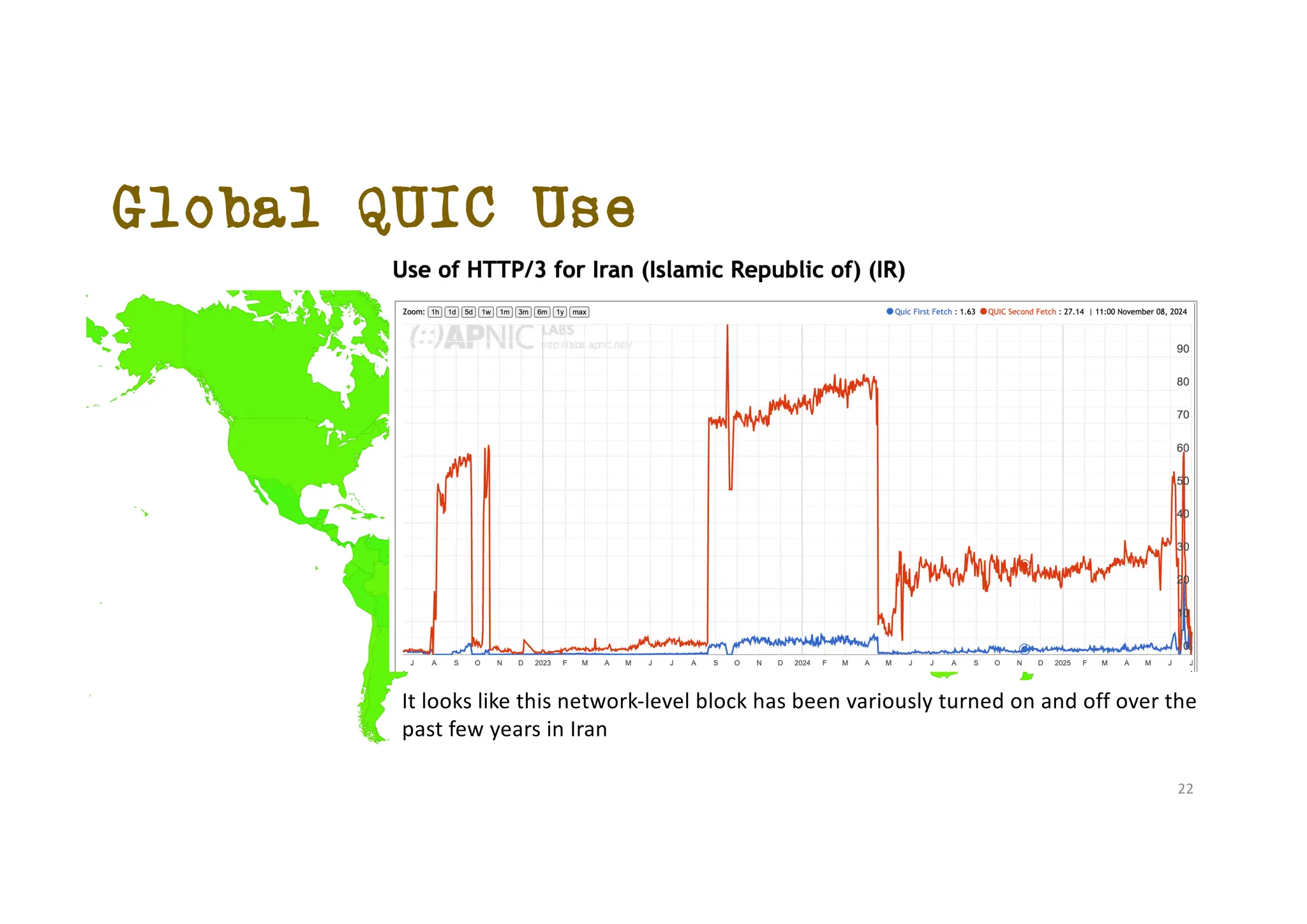
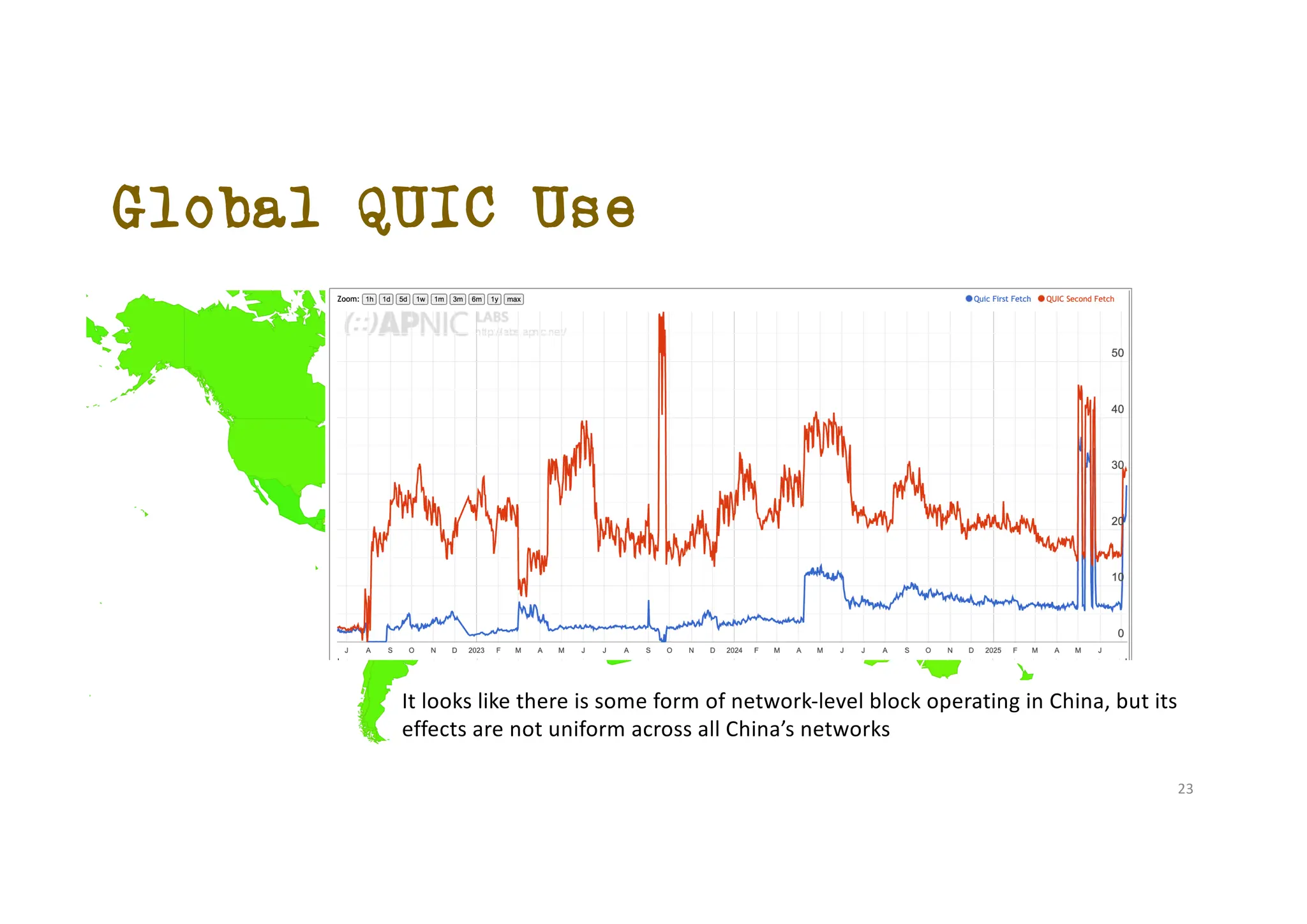
It’slikely that there is some form of national-level block on UDP port 443 traffic in China and Iran 21
22.
Global QUIC Use
Itlooks like this network-level block has been variously turned on and off over the
past few years in Iran
22
23.
Global QUIC Use
Itlooks like there is some form of network-level block operating in China, but its
effects are not uniform across all China’s networks
23
24.
QUIC Use
• IfQUIC access is supported by the current releases by both the major
browsers then we should see a high QUIC use rate when the ability to
use QUIC is signaled by both methods (alt-svc and DNS HTTPS)
• What do we see?
• In most locales the alt-svc method of triggering QUIC is supported by
browsers and network infrastructure
• What about the DNS HTTPS method of triggering QUIC?
• Who uses a DNS HTTPS query?
• Are HTTPS responses being filtered by DNS infrastructure in some cases?
24
25.
The DNS HTTPSrecord
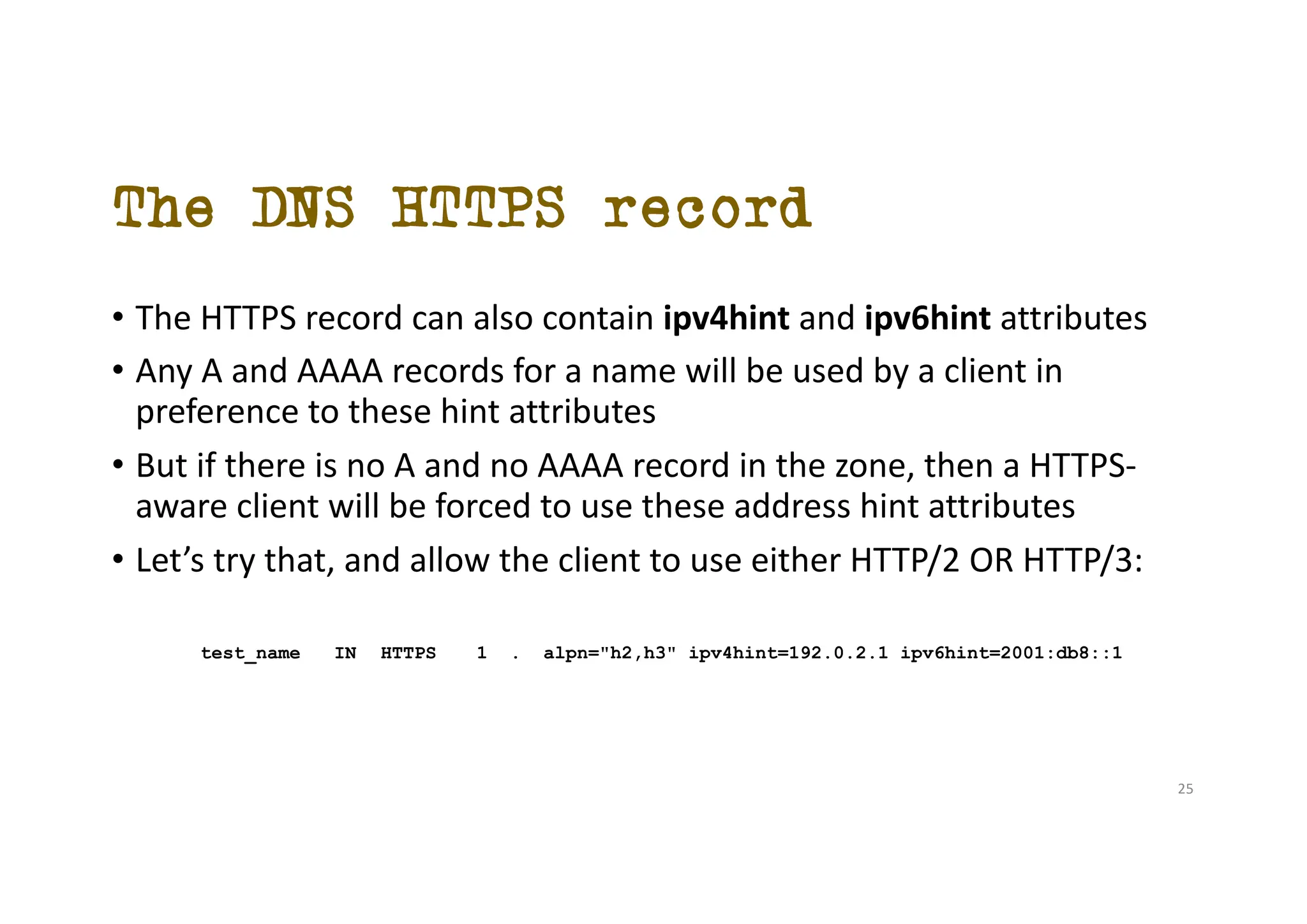
• The HTTPS record can also contain ipv4hint and ipv6hint attributes
• Any A and AAAA records for a name will be used by a client in
preference to these hint attributes
• But if there is no A and no AAAA record in the zone, then a HTTPS-
aware client will be forced to use these address hint attributes
• Let’s try that, and allow the client to use either HTTP/2 OR HTTP/3:
test_name IN HTTPS 1 . alpn="h2,h3" ipv4hint=192.0.2.1 ipv6hint=2001:db8::1
25
26.
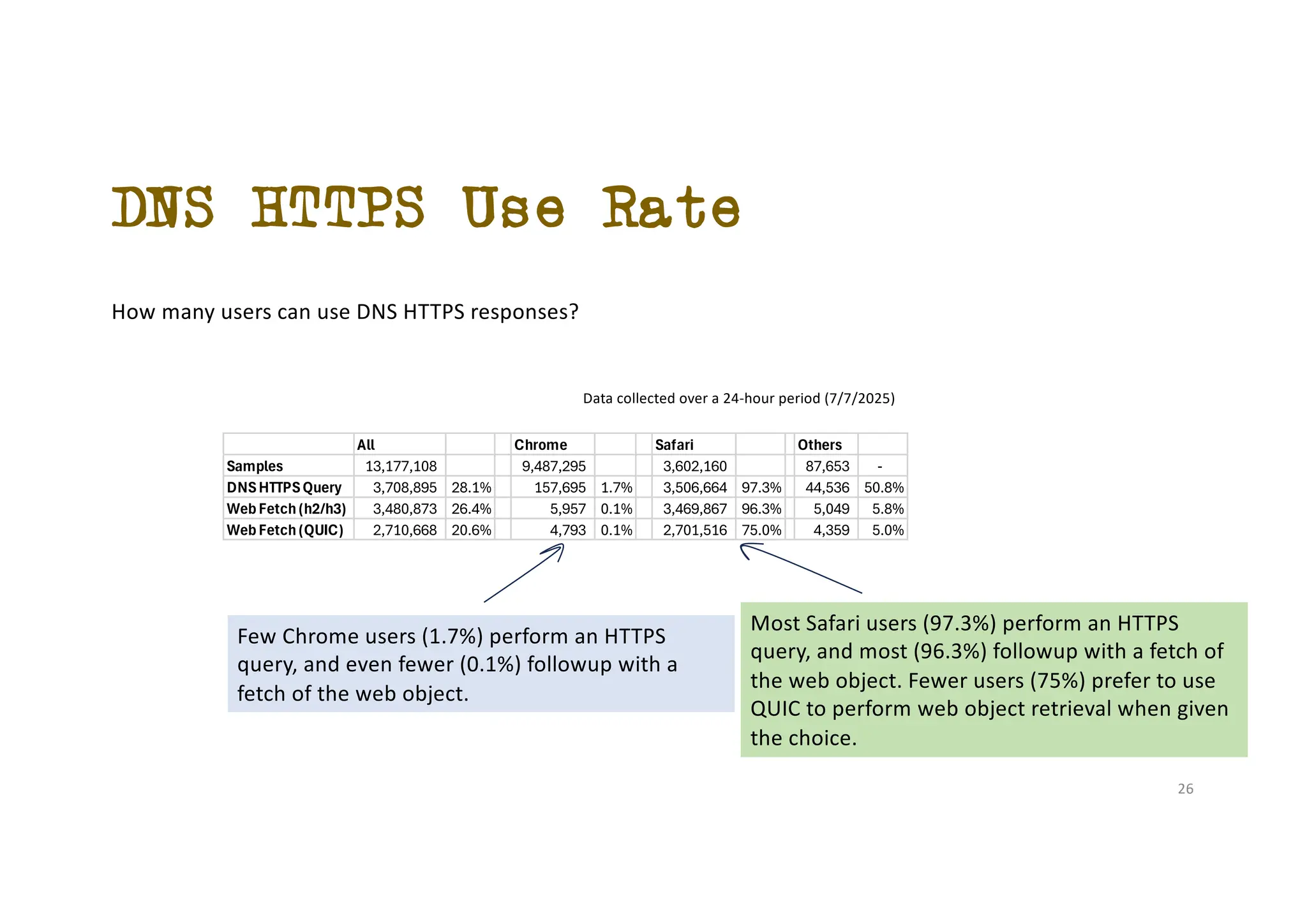
DNS HTTPS UseRate
How many users can use DNS HTTPS responses?
All Chrome Safari Others
Samples 13,177,108 9,487,295 3,602,160 87,653 -
DNSHTTPSQuery 3,708,895 28.1% 157,695 1.7% 3,506,664 97.3% 44,536 50.8%
WebFetch(h2/h3) 3,480,873 26.4% 5,957 0.1% 3,469,867 96.3% 5,049 5.8%
WebFetch(QUIC) 2,710,668 20.6% 4,793 0.1% 2,701,516 75.0% 4,359 5.0%
Data collected over a 24-hour period (7/7/2025)
Few Chrome users (1.7%) perform an HTTPS
query, and even fewer (0.1%) followup with a
fetch of the web object.
Most Safari users (97.3%) perform an HTTPS
query, and most (96.3%) followup with a fetch of
the web object. Fewer users (75%) prefer to use
QUIC to perform web object retrieval when given
the choice.
26
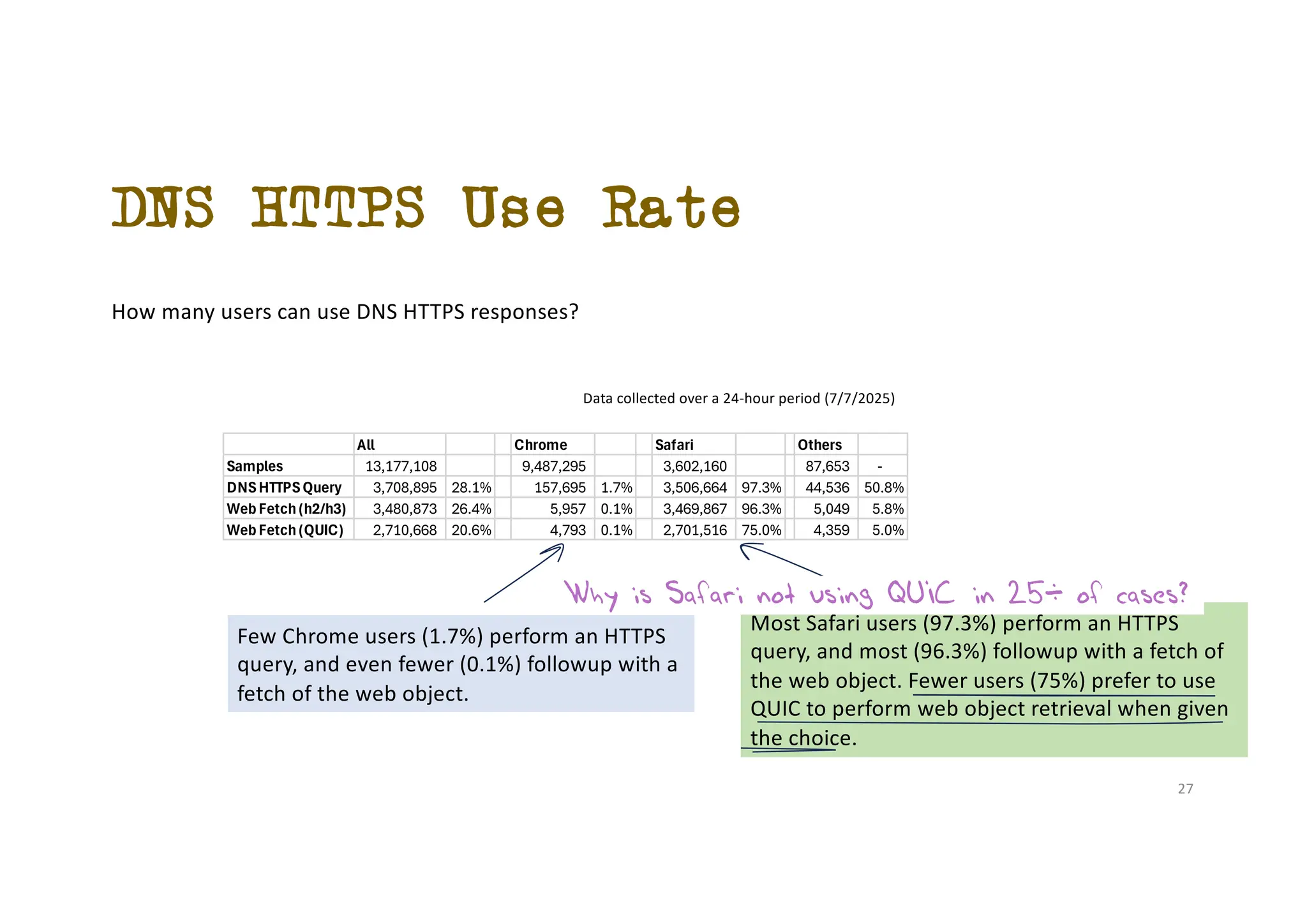
27.
DNS HTTPS UseRate
How many users can use DNS HTTPS responses?
All Chrome Safari Others
Samples 13,177,108 9,487,295 3,602,160 87,653 -
DNSHTTPSQuery 3,708,895 28.1% 157,695 1.7% 3,506,664 97.3% 44,536 50.8%
WebFetch(h2/h3) 3,480,873 26.4% 5,957 0.1% 3,469,867 96.3% 5,049 5.8%
WebFetch(QUIC) 2,710,668 20.6% 4,793 0.1% 2,701,516 75.0% 4,359 5.0%
Data collected over a 24-hour period (7/7/2025)
Few Chrome users (1.7%) perform an HTTPS
query, and even fewer (0.1%) followup with a
fetch of the web object.
Most Safari users (97.3%) perform an HTTPS
query, and most (96.3%) followup with a fetch of
the web object. Fewer users (75%) prefer to use
QUIC to perform web object retrieval when given
the choice.
27
Why is Safari not using QUIC in 25% of cases?
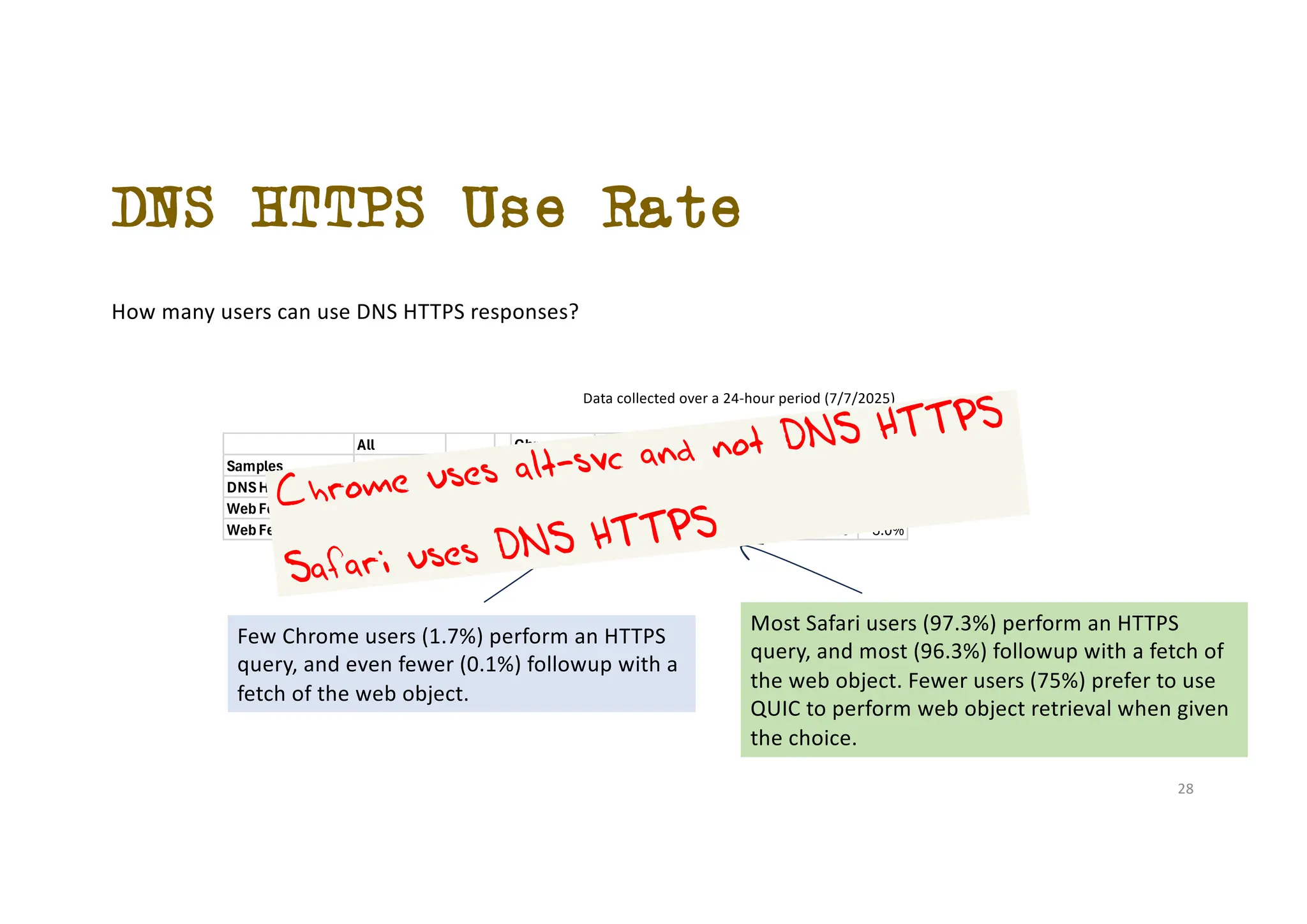
28.
DNS HTTPS UseRate
How many users can use DNS HTTPS responses?
All Chrome Safari Others
Samples 13,177,108 9,487,295 3,602,160 87,653 -
DNSHTTPSQuery 3,708,895 28.1% 157,695 1.7% 3,506,664 97.3% 44,536 50.8%
WebFetch(h2/h3) 3,480,873 26.4% 5,957 0.1% 3,469,867 96.3% 5,049 5.8%
WebFetch(QUIC) 2,710,668 20.6% 4,793 0.1% 2,701,516 75.0% 4,359 5.0%
Data collected over a 24-hour period (7/7/2025)
Few Chrome users (1.7%) perform an HTTPS
query, and even fewer (0.1%) followup with a
fetch of the web object.
Most Safari users (97.3%) perform an HTTPS
query, and most (96.3%) followup with a fetch of
the web object. Fewer users (75%) prefer to use
QUIC to perform web object retrieval when given
the choice.
Chrome uses alt-svc and not DNS HTTPS
Safari uses DNS HTTPS
28
29.
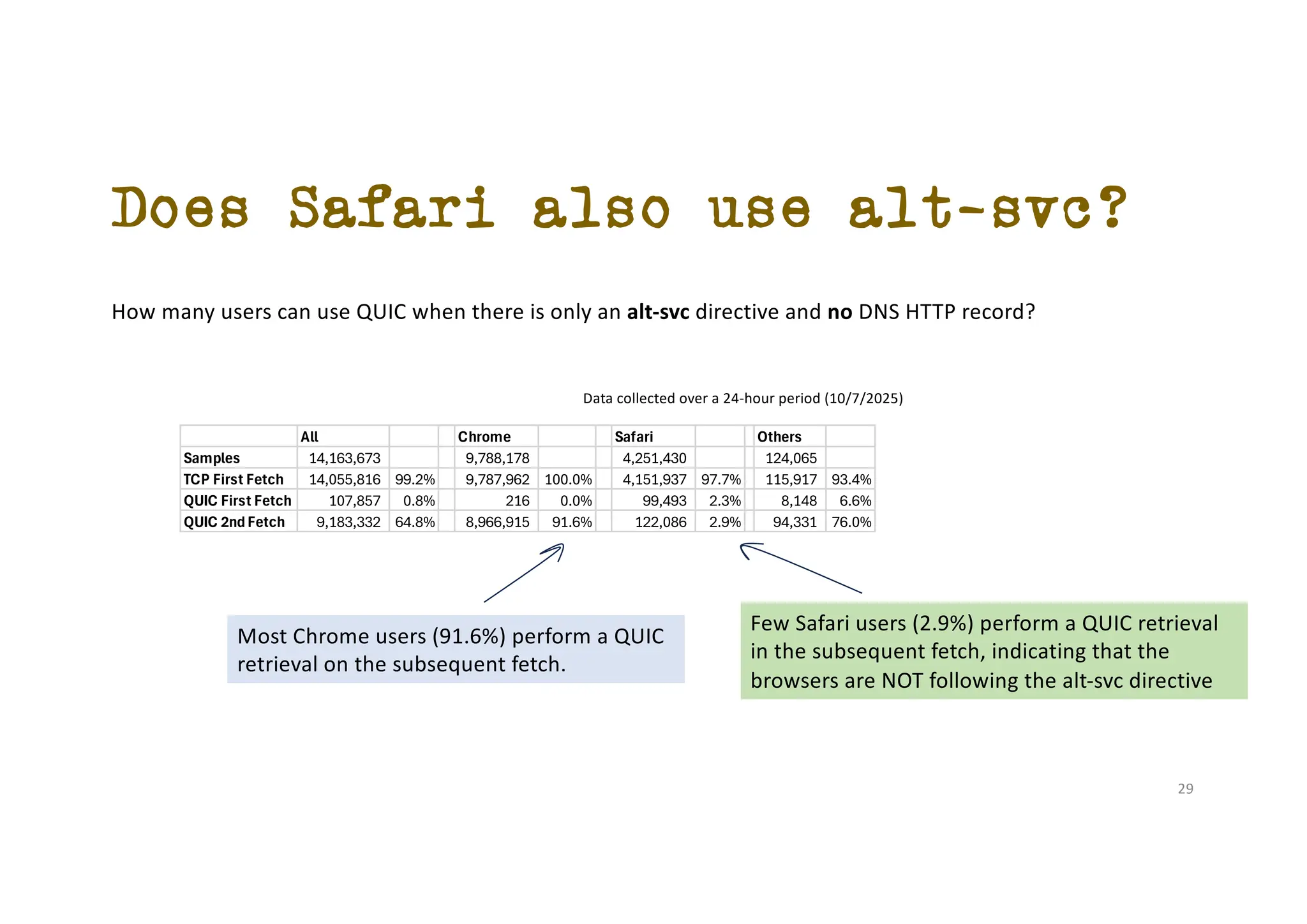
Does Safari alsouse alt-svc?
Data collected over a 24-hour period (10/7/2025)
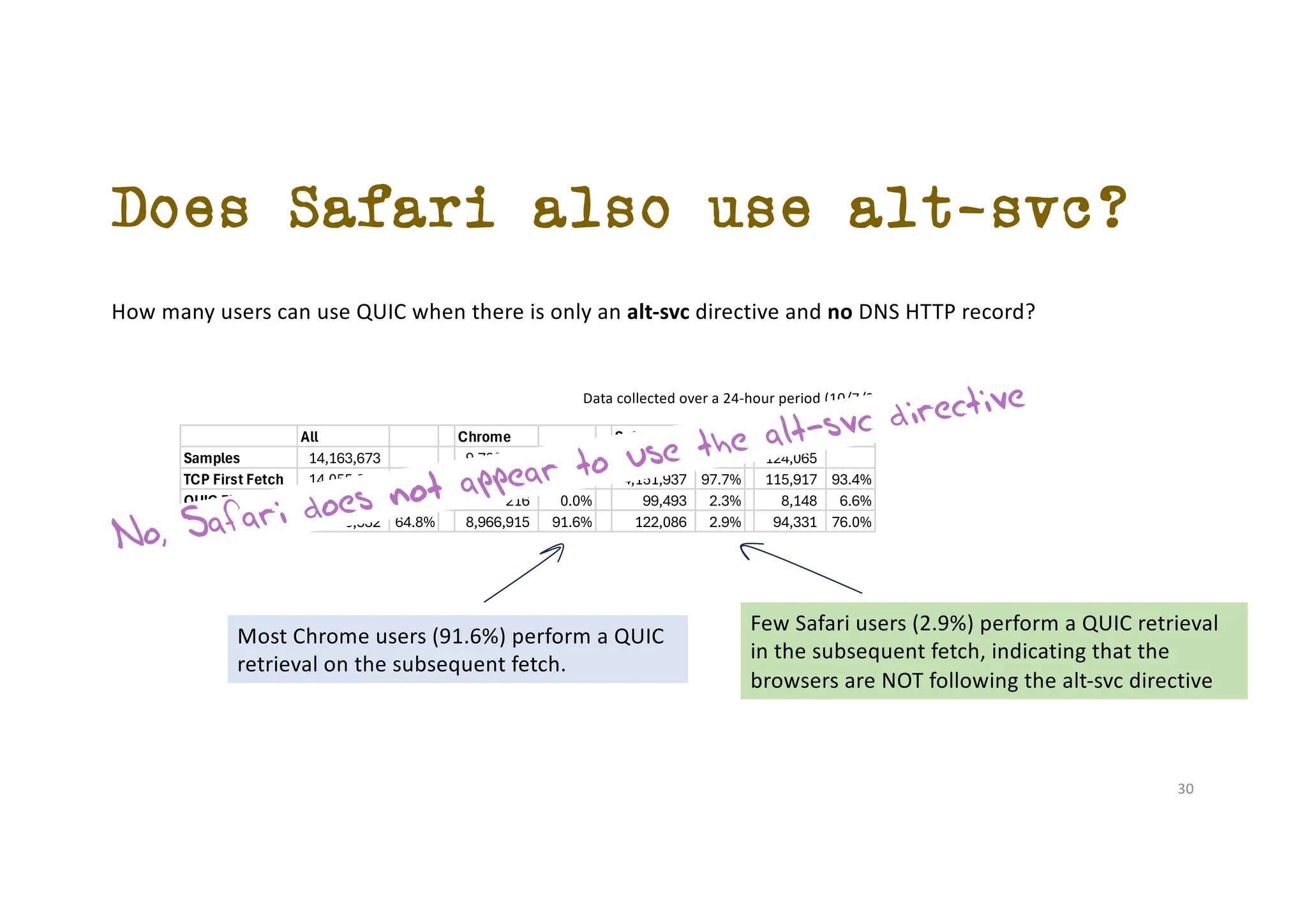
Most Chrome users (91.6%) perform a QUIC
retrieval on the subsequent fetch.
Few Safari users (2.9%) perform a QUIC retrieval
in the subsequent fetch, indicating that the
browsers are NOT following the alt-svc directive
All Chrome Safari Others
Samples 14,163,673 9,788,178 4,251,430 124,065
TCP First Fetch 14,055,816 99.2% 9,787,962 100.0% 4,151,937 97.7% 115,917 93.4%
QUIC First Fetch 107,857 0.8% 216 0.0% 99,493 2.3% 8,148 6.6%
QUIC 2ndFetch 9,183,332 64.8% 8,966,915 91.6% 122,086 2.9% 94,331 76.0%
How many users can use QUIC when there is only an alt-svc directive and no DNS HTTP record?
29
30.
Does Safari alsouse alt-svc?
Data collected over a 24-hour period (10/7/2025)
Most Chrome users (91.6%) perform a QUIC
retrieval on the subsequent fetch.
Few Safari users (2.9%) perform a QUIC retrieval
in the subsequent fetch, indicating that the
browsers are NOT following the alt-svc directive
All Chrome Safari Others
Samples 14,163,673 9,788,178 4,251,430 124,065
TCP First Fetch 14,055,816 99.2% 9,787,962 100.0% 4,151,937 97.7% 115,917 93.4%
QUIC First Fetch 107,857 0.8% 216 0.0% 99,493 2.3% 8,148 6.6%
QUIC 2ndFetch 9,183,332 64.8% 8,966,915 91.6% 122,086 2.9% 94,331 76.0%
How many users can use QUIC when there is only an alt-svc directive and no DNS HTTP record?
30
No, Safari does not appear to use the alt-svc directive
31.
Conclusions/Questions
• If youwant to serve content over QUIC you have to support BOTH
QUIC trigger methods of a DNS HTTP record AND an alt-svc directive
to signal QUIC capability to Chrome and Safari clients.
• Why doesn’t Chrome also use the HTTPS query?
• Are they concerned about the greater DNS query load that would result from
such a change?
• Why doesn’t Safari also use the alt-svc directive?
• Why do 24% of Safari users NOT perform a QUIC fetch despite a
HTTPS record being queried?
• Why do 2% of Safari users perform an initial QUIC fetch when there is
no DNS HTTPS trigger?
31




![Number_Guessing_Game_Dsbsbssbzboc[1].pptx](https://cdn.slidesharecdn.com/ss_thumbnails/numberguessinggamedoc1-251206215042-a076fc05-thumbnail.jpg?width=640&height=640&fit=bounds)


