ION-EXCHANGE
CHROMATOGRAPHY
BY-BHANUPRIYA
SAHU
MS BIOTECHNOLOGY
SIKSHA ‘O’ ANUSANDHAN
(Deemed to be University)
Content
1. What is chromatography?
2. Introduction to Ion Exchange Chromatography
3. Principle of Ion Exchange chromatography
4. Instrumentation
5. Application
6. Advantage
7. Disadvantage
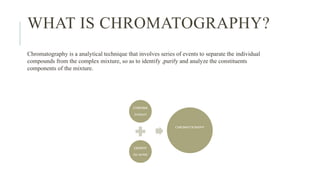
WHAT IS CHROMATOGRAPHY?
Chromatography is a analytical technique that involves series of events to separate the individual
compounds from the complex mixture, so as to identify ,purify and analyze the constituents
components of the mixture.
CHROMA
(colour)
GRAPHY
(to write)
CHROMATOGRAPHY
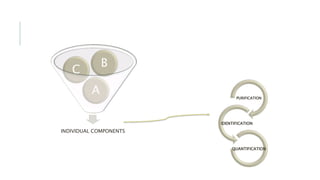
INDIVIDUAL COMPONENTS
A
C
B
PURIFICATION
IDENTIFICATION
QUANTIFICATION
INTRODUCTION TO ION EXCHANGE
CHROMATOGRAPHY
Ion exchange chromatography is a process of separating ions and polar molecules based on their
affinity towards ion exchangers.
Here, Stationary phase is a resin and Mobile phase is an eluent
Ion exchange chromatography is applicable for various charged molecules such as large proteins, amino
acids, and small nucleotides.
PRINCIPLE OF ION EXCHANGE
CHROMATOGRAPHY
The principle of separation is based on the reversible exchange of ions between the ions present in
the sample and those available in the ion exchange resin. Mainly, ion exchange separations take
place in a column covered with an ion exchanger.
INSTRUMENTATION
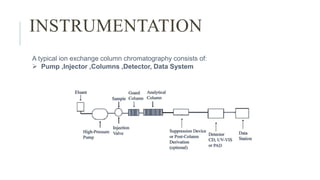
A typical ion exchange column chromatography consists of:
 Pump ,Injector ,Columns ,Detector, Data System
1.Pump – A high-pressure pump is considered as one of the main parts of the Ion exchange chromatography system which
delivers a constant flow of the eluent.
2.Injector – Amongst the various ways for sample introduction into the eluent stream and onto the column,
the most straightforward method being the use of an injection valve.
3.Columns – Depending on the area of application, a column is selected for the separation of the sample mixture.
Columns being utilized in the laboratories are built from glass whereas the columns utilized in industries are
either fabricated from high-quality stainless steel or polymer.
4.Detector – This estimates the analyte peaks as eluent from the column. Monitor the separation of samples
5.Data System – This aid in the collection and assembling of the chromatograms and data.
APPLICATION
Applications of ion exchange chromatography
1.Ion exchange chromatography is a powerful and critical tool for pharmaceutical analytical chemists.
2.Ion exchange chromatography is used for the estimation and separation of molecules with different
charges
3.or ions that include proteins, peptides, amino acids, vitamins, carbohydrates, enzymes, etc. either
on its own or along with other chromatographic techniques.
4.This is also applicable for segregating and purifying organic molecules from natural sources.
5.Various molecules with high capacity are also analyzed.
6.Desired molecules are purified at high levels.
7.At a low cost, the ion exchange chromatography technique is applicable to get transferred to the
manufacturing scales.
8.The nonsolvent extractable natural products can be followed up.
9.It plays an important role in modern drug discovery for isolating natural products.
ADVANTAGE
Advantages of ion exchange chromatography
1.It is one of the most efficient methods for the separation of charged particles.
2.It can be used for almost any kind of charged molecule including large proteins, small nucleotides
and amino acids.
3.Ion exchange is used for both analytical and preparative purposes in the laboratory, the analytical
uses being the more common.
4.Inorganic ions also can be separated by ion-exchange chromatograph
DISADVANTAGE
Disadvantages of ion exchange chromatography
•Through the ion exchange chromatography separation is possible of charged
molecules only.
•There is a Buffer requirement
•In the ion exchange column chromatography, the efficiency of the column is less
•After repeated use, it becomes difficult to predict the stability and reproducibility of
columns
•Many a time it is difficult to have control over selectivity and resolution

ION-EXCHANGE CHROMATOGRAPHY.pptx

  • 1.
  • 2.
    Content 1. What ischromatography? 2. Introduction to Ion Exchange Chromatography 3. Principle of Ion Exchange chromatography 4. Instrumentation 5. Application 6. Advantage 7. Disadvantage
  • 3.
    WHAT IS CHROMATOGRAPHY? Chromatographyis a analytical technique that involves series of events to separate the individual compounds from the complex mixture, so as to identify ,purify and analyze the constituents components of the mixture. CHROMA (colour) GRAPHY (to write) CHROMATOGRAPHY
  • 4.
  • 5.
    INTRODUCTION TO IONEXCHANGE CHROMATOGRAPHY Ion exchange chromatography is a process of separating ions and polar molecules based on their affinity towards ion exchangers. Here, Stationary phase is a resin and Mobile phase is an eluent Ion exchange chromatography is applicable for various charged molecules such as large proteins, amino acids, and small nucleotides.
  • 6.
    PRINCIPLE OF IONEXCHANGE CHROMATOGRAPHY The principle of separation is based on the reversible exchange of ions between the ions present in the sample and those available in the ion exchange resin. Mainly, ion exchange separations take place in a column covered with an ion exchanger.
  • 7.
    INSTRUMENTATION A typical ionexchange column chromatography consists of:  Pump ,Injector ,Columns ,Detector, Data System
  • 8.
    1.Pump – Ahigh-pressure pump is considered as one of the main parts of the Ion exchange chromatography system which delivers a constant flow of the eluent. 2.Injector – Amongst the various ways for sample introduction into the eluent stream and onto the column, the most straightforward method being the use of an injection valve. 3.Columns – Depending on the area of application, a column is selected for the separation of the sample mixture. Columns being utilized in the laboratories are built from glass whereas the columns utilized in industries are either fabricated from high-quality stainless steel or polymer. 4.Detector – This estimates the analyte peaks as eluent from the column. Monitor the separation of samples 5.Data System – This aid in the collection and assembling of the chromatograms and data.
  • 9.
    APPLICATION Applications of ionexchange chromatography 1.Ion exchange chromatography is a powerful and critical tool for pharmaceutical analytical chemists. 2.Ion exchange chromatography is used for the estimation and separation of molecules with different charges 3.or ions that include proteins, peptides, amino acids, vitamins, carbohydrates, enzymes, etc. either on its own or along with other chromatographic techniques. 4.This is also applicable for segregating and purifying organic molecules from natural sources. 5.Various molecules with high capacity are also analyzed. 6.Desired molecules are purified at high levels. 7.At a low cost, the ion exchange chromatography technique is applicable to get transferred to the manufacturing scales. 8.The nonsolvent extractable natural products can be followed up. 9.It plays an important role in modern drug discovery for isolating natural products.
  • 10.
    ADVANTAGE Advantages of ionexchange chromatography 1.It is one of the most efficient methods for the separation of charged particles. 2.It can be used for almost any kind of charged molecule including large proteins, small nucleotides and amino acids. 3.Ion exchange is used for both analytical and preparative purposes in the laboratory, the analytical uses being the more common. 4.Inorganic ions also can be separated by ion-exchange chromatograph
  • 11.
    DISADVANTAGE Disadvantages of ionexchange chromatography •Through the ion exchange chromatography separation is possible of charged molecules only. •There is a Buffer requirement •In the ion exchange column chromatography, the efficiency of the column is less •After repeated use, it becomes difficult to predict the stability and reproducibility of columns •Many a time it is difficult to have control over selectivity and resolution