SUBMITTED BY: ANUPAMA.C.P
1 SEM M-PHARM
INTRODUCTION
 CHNS elemental analysers provide a mean for the rapid
determination of carbon, hydrogen, nitrogen, and sulphur
in organic matrices and other type of materials.
 They are capable of handling a wide variety of sample
types including solids, liquids, volatile and viscous
samples in the fields of pharmaceuticals, polymers etc.
PRINCIPLE
In combustion process ( furnace at 1000°c)
 Carbon is converted into carbon dioxide
 Hydrogen to water
 Nitrogen to nitrogen gas / oxides of nitrogen
 Sulphur to sulphur dioxide
• If other element such as chlorine is present , they converted
into combusion products, such as hydrogen chloride.
• Combusion prdts are swept out from the chamber using inert
gas (helium) and passed over heated high purity copper.
 The gases then passed through adsorbent trapes to leave
only Co2, H2O, N2,SO2.
 Determination can be carried out in a variety of ways
 GC separation followed by qualification using thermal
conductivity detection.
 A partial separation by GC followed by thermal
conductivity.
 A series of infra red and thermal conductivity.
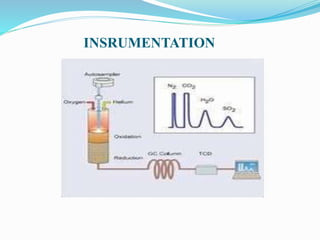
INSRUMENTATION
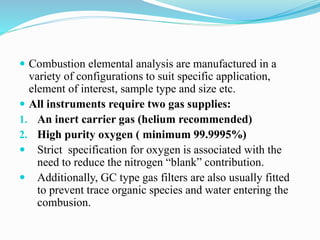
 Combustion elemental analysis are manufactured in a
variety of configurations to suit specific application,
element of interest, sample type and size etc.
 All instruments require two gas supplies:
1. An inert carrier gas (helium recommended)
2. High purity oxygen ( minimum 99.9995%)
 Strict specification for oxygen is associated with the
need to reduce the nitrogen “blank” contribution.
 Additionally, GC type gas filters are also usually fitted
to prevent trace organic species and water entering the
combusion.
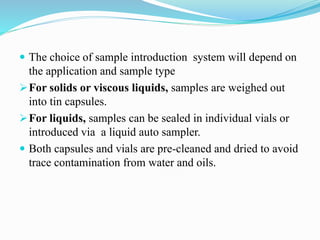
 The choice of sample introduction system will depend on
the application and sample type
For solids or viscous liquids, samples are weighed out
into tin capsules.
For liquids, samples can be sealed in individual vials or
introduced via a liquid auto sampler.
 Both capsules and vials are pre-cleaned and dried to avoid
trace contamination from water and oils.
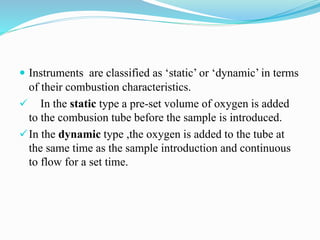
 Instruments are classified as ‘static’ or ‘dynamic’ in terms
of their combustion characteristics.
 In the static type a pre-set volume of oxygen is added
to the combusion tube before the sample is introduced.
In the dynamic type ,the oxygen is added to the tube at
the same time as the sample introduction and continuous
to flow for a set time.
APPLICATIONS
In analytical laboratories for over thirty years.
Used in pharmaceuticals, chemicals, oil-related products,
catalysts and foods.
In oil industry, regular monitoring of coke build up on
refinery catalyst to ensure that regeneration procedures.
In food analysis, the determination of nitrogen is
important for pricing grain and evaluating meat products.
REFERENCES
 www. Slideshare . net
 Elemental impurities- chns analysis

C H N S ANALYSIS.pptx

  • 1.
  • 2.
    INTRODUCTION  CHNS elementalanalysers provide a mean for the rapid determination of carbon, hydrogen, nitrogen, and sulphur in organic matrices and other type of materials.  They are capable of handling a wide variety of sample types including solids, liquids, volatile and viscous samples in the fields of pharmaceuticals, polymers etc.
  • 3.
    PRINCIPLE In combustion process( furnace at 1000°c)  Carbon is converted into carbon dioxide  Hydrogen to water  Nitrogen to nitrogen gas / oxides of nitrogen  Sulphur to sulphur dioxide • If other element such as chlorine is present , they converted into combusion products, such as hydrogen chloride. • Combusion prdts are swept out from the chamber using inert gas (helium) and passed over heated high purity copper.
  • 4.
     The gasesthen passed through adsorbent trapes to leave only Co2, H2O, N2,SO2.  Determination can be carried out in a variety of ways  GC separation followed by qualification using thermal conductivity detection.  A partial separation by GC followed by thermal conductivity.  A series of infra red and thermal conductivity.
  • 5.
  • 6.
     Combustion elementalanalysis are manufactured in a variety of configurations to suit specific application, element of interest, sample type and size etc.  All instruments require two gas supplies: 1. An inert carrier gas (helium recommended) 2. High purity oxygen ( minimum 99.9995%)  Strict specification for oxygen is associated with the need to reduce the nitrogen “blank” contribution.  Additionally, GC type gas filters are also usually fitted to prevent trace organic species and water entering the combusion.
  • 7.
     The choiceof sample introduction system will depend on the application and sample type For solids or viscous liquids, samples are weighed out into tin capsules. For liquids, samples can be sealed in individual vials or introduced via a liquid auto sampler.  Both capsules and vials are pre-cleaned and dried to avoid trace contamination from water and oils.
  • 8.
     Instruments areclassified as ‘static’ or ‘dynamic’ in terms of their combustion characteristics.  In the static type a pre-set volume of oxygen is added to the combusion tube before the sample is introduced. In the dynamic type ,the oxygen is added to the tube at the same time as the sample introduction and continuous to flow for a set time.
  • 9.
    APPLICATIONS In analytical laboratoriesfor over thirty years. Used in pharmaceuticals, chemicals, oil-related products, catalysts and foods. In oil industry, regular monitoring of coke build up on refinery catalyst to ensure that regeneration procedures. In food analysis, the determination of nitrogen is important for pricing grain and evaluating meat products.
  • 10.
    REFERENCES  www. Slideshare. net  Elemental impurities- chns analysis