Dr. Rajendra Gode Institute of Pharmacy,
University - Mardi Road, Amravati - 444602
Guided by
Prof. Vinod Jadhav
Assistant Professor
M. Pharm (Pharmacology)
Pharmacological and Toxicological Screening Methods – II
(MPL 202T)
“ Regulatory Guidelines for Conducting Toxicity Studies
by ICH”
1
Presented by
Miss. Shraddha Raut
M. Pharm (Ist year)
 Contents :
2
ICH
ICH Guidelines
Regulatory Guidelines for Conducting
Toxicity Studies by ICH
29/02/24 ICH GUIDELINES TO CONDUCT TOXICITY STUDIES
3
ICH
ICH is the “International Conference on Harmonization” which is a joint
initiative involving both regulators and research based industry representatives of the EU,
Japan and US in scientific and technical discussions of testing procedures required to
assess and ensure the safety, quality and efficacy of medicines.
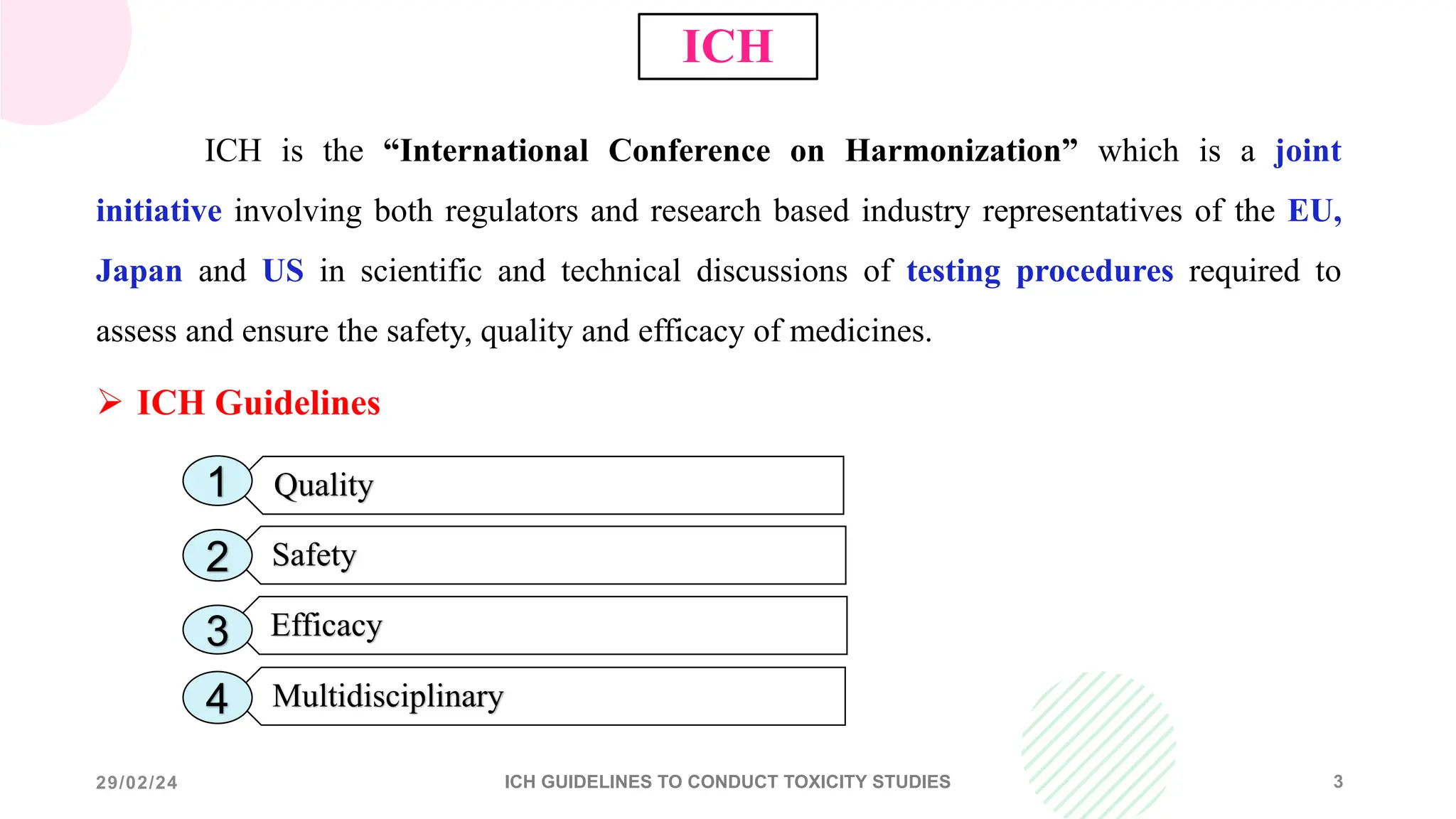
 ICH Guidelines
Quality
Safety
Efficacy
Multidisciplinary
1
2
3
4
29/02/24 ICH GUIDELINES TO CONDUCT TOXICITY STUDIES
4
• These are guidelines which are given under the guidelines of safety studies by ICH.
• ICH has produced a comprehensive set of safety Guidelines to uncover potential risks like
carcinogenicity, genotoxicity and reprotoxicity.
 Guidelines are -
a. ICH S1A-1C Rodent Carcinogenicity
b. ICH M7 Addendum Assessment & Control of Mutagenic Impurities
c. ICH S9 Nonclinical oncology Q & A
d. ICH S3A Q & A Note on Toxicokinetic: microdosing
e. ICH E14/S7B Discussion Group
f. ICH S5(R3) Reprotoxicity
g. ICH S11 Nonclinical Safety for Paediatric
Regulatory Guidelines for Conducting Toxicity Studies by ICH
29/02/24 ICH GUIDELINES TO CONDUCT TOXICITY STUDIES
5
S1A to S1C - Rodent Carcinogenicity
• Expert Working Group gather data and assess that for further use.
• S1A: Guidelines on the need for Carcinogenicity study
The main objective and goal is to ensure WOE (weight of evidence) approach of carcinogenicity
is applicable to small molecule of pharmaceuticals.
It also evaluate elements to predict 2yr rat study outcomes and values.
• S1B: Testing for Carcinogenicity of Pharmaceuticals - This document provides guidance on the
need to carry out carcinogenicity studies in both mice and rats, and guidance is also given on
alternative testing procedures which may be applied without jeopardizing safety.
• S1C(R2): Dose Selection for Carcinogenicity Studies of Pharmaceuticals - This document
addresses the criteria for the selection of the high dose to be used in carcinogenicity studies on
new therapeutic agents to harmonize current practices and improve the design of studies.
29/02/24 ICH GUIDELINES TO CONDUCT TOXICITY STUDIES
6
S2(R1): Guidance on Genotoxicity Testing and Data Interpretation for Pharmaceuticals Intended for
Human Use. This guidance is a combination of ICH S2A and S2B guidelines.
S2A: Guidance on Specific Aspects of Regulatory Genotoxicity Tests for Pharmaceuticals
• This document provided specific guidance and recommendations for in vitro and in vivo tests and
on the evaluation of test results.
• It includes terms related to genotoxicity tests to improve consistency in applications.
S2B: A Standard Battery for Genotoxicity Testing for Pharmaceuticals
• This document addresses two fundamental areas of genotoxicity testing -
1. The identification of a standard set of assays to be conducted for registration.
2. The extent of confirmatory experimentation in any particular genotoxicity assay in the
standard battery.
S2 - Genotoxicity
29/02/24 ICH GUIDELINES TO CONDUCT TOXICITY STUDIES
7
S3A: Note for guidance on toxicokinetic: The Assessment of Systemic Exposure
• ICH guidelines do not require toxicokinetic studies to be conducted, except in pregnant, lactating
animals, before initiating reproductive studies.
• The primary objective of toxicokinetic is to describe the systemic exposure achieved in animals
and its relationship to dose level and the time course of the toxicity study.
S3B: Pharmacokinetics: Guidance for Repeated Dose Tissue Distribution Studies
• Tissue distribution studies are essential in providing information on distribution and
accumulation of the compound or metabolites, especially in relation to potential sites of action;
this information may be useful for designing toxicology and pharmacology studies and for
interpreting the results of these experiments.
• This document gives guidance, when the repeated dose tissue distribution studies should be
considered (i.e., when appropriate data cannot be derived from other sources).
S3A to S3B – Toxicokinetic and Pharmacokinetics
29/02/24 ICH GUIDELINES TO CONDUCT TOXICITY STUDIES
8
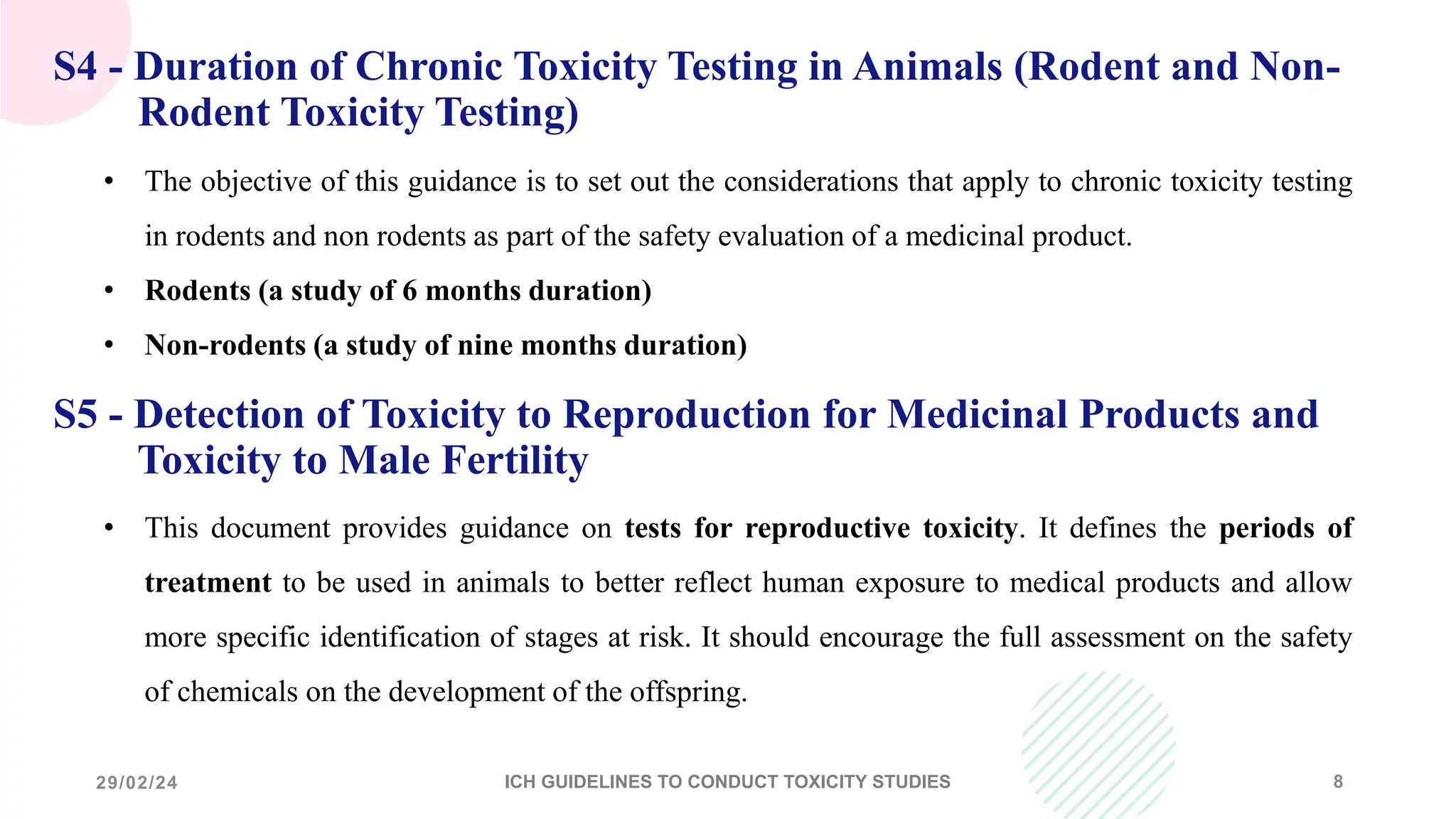
• The objective of this guidance is to set out the considerations that apply to chronic toxicity testing
in rodents and non rodents as part of the safety evaluation of a medicinal product.
• Rodents (a study of 6 months duration)
• Non-rodents (a study of nine months duration)
S4 - Duration of Chronic Toxicity Testing in Animals (Rodent and Non-
Rodent Toxicity Testing)
S5 - Detection of Toxicity to Reproduction for Medicinal Products and
Toxicity to Male Fertility
• This document provides guidance on tests for reproductive toxicity. It defines the periods of
treatment to be used in animals to better reflect human exposure to medical products and allow
more specific identification of stages at risk. It should encourage the full assessment on the safety
of chemicals on the development of the offspring.
29/02/24 ICH GUIDELINES TO CONDUCT TOXICITY STUDIES
9
• This document covers the pre-clinical safety testing requirements for biotechnological
products. It addresses the use of animal models of disease, determination of when genotoxicity
assays and carcinogenicity studies should be performed, and the impact of antibody formation on
duration of toxicology studies.
S6 - Preclinical Safety Evaluation of Biotechnology derived Pharmaceutical
S7A - Safety Pharmacology Studies for Human Pharmaceuticals
• This guideline was developed to protect clinical trial participants and patients receiving
marketed products from potential adverse effects of pharmaceuticals.
• This document addresses the definition, objectives and scope of safety pharmacology studies.
S7B – The Nonclinical Evaluation of the Potential for Delayed Ventricular
Repolarization by Pharmaceuticals
• This guideline describes a non-clinical testing strategy for assessing the potential of a test
substance to delay ventricular repolarization.
29/02/24 ICH GUIDELINES TO CONDUCT TOXICITY STUDIES
10
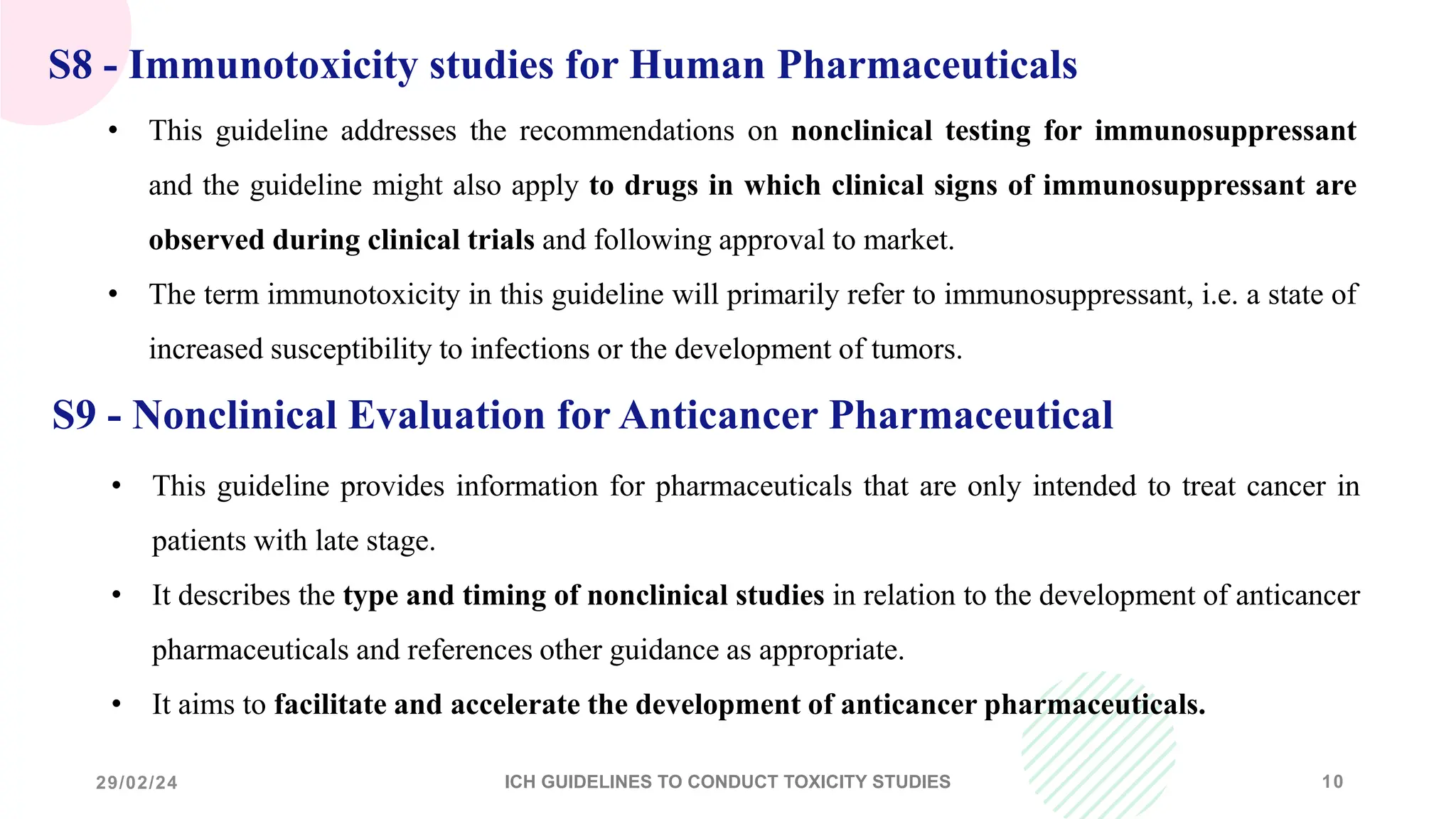
• This guideline addresses the recommendations on nonclinical testing for immunosuppressant
and the guideline might also apply to drugs in which clinical signs of immunosuppressant are
observed during clinical trials and following approval to market.
• The term immunotoxicity in this guideline will primarily refer to immunosuppressant, i.e. a state of
increased susceptibility to infections or the development of tumors.
S8 - Immunotoxicity studies for Human Pharmaceuticals
S9 - Nonclinical Evaluation for Anticancer Pharmaceutical
• This guideline provides information for pharmaceuticals that are only intended to treat cancer in
patients with late stage.
• It describes the type and timing of nonclinical studies in relation to the development of anticancer
pharmaceuticals and references other guidance as appropriate.
• It aims to facilitate and accelerate the development of anticancer pharmaceuticals.
29/02/24 ICH GUIDELINES TO CONDUCT TOXICITY STUDIES
11
• These guideline applies to new API’s, new excipients, clinical formulations for dermal
application and photodynamic therapy products. It involves an evaluation of photochemical
characteristics, data from non clinical studies and human safety information.
• The photo safety assessment aims to determine weather risk minimization measures are warranted
to prevent adverse events in humans.
• In-vitro assay for photo-toxicity is the 3T3 neutral red uptake assay.
S10 - Photosafety Evaluation of Pharmaceuticals
S11 – Nonclinical Safety Testing in Support of Development of Pediatric Medicine
• This guideline is needed to recommend standards for the conditions under which non clinical
juvenile animal testing is considered informative and support pediatric clinical trails.
• The expert working group (EWG) will consist of two nonclinical experts nominated by
EU,EFPIA,FDA, PhRMA, MHLW, JPMA, Health Canada and Swiss medic.
• One member can also be nominated by WHO Observer.
29/02/24 ICH GUIDELINES TO CONDUCT TOXICITY STUDIES
12
 References
1. https://www.ich.org/page/safety-guidelines
2. https://www.ema.europa.eu/.../scientific- guidelines/ich/ich-safety
3. https://www.fda.gov/.../ich-guidance-documents
29/02/24 ICH GUIDELINES TO CONDUCT TOXICITY STUDIES
T H A N K
Y O U
13
Any question

Regulatory Guidelines for Conducting Toxicity Studies by ICH.pptx

  • 1.
    Dr. Rajendra GodeInstitute of Pharmacy, University - Mardi Road, Amravati - 444602 Guided by Prof. Vinod Jadhav Assistant Professor M. Pharm (Pharmacology) Pharmacological and Toxicological Screening Methods – II (MPL 202T) “ Regulatory Guidelines for Conducting Toxicity Studies by ICH” 1 Presented by Miss. Shraddha Raut M. Pharm (Ist year)
  • 2.
     Contents : 2 ICH ICHGuidelines Regulatory Guidelines for Conducting Toxicity Studies by ICH 29/02/24 ICH GUIDELINES TO CONDUCT TOXICITY STUDIES
  • 3.
    3 ICH ICH is the“International Conference on Harmonization” which is a joint initiative involving both regulators and research based industry representatives of the EU, Japan and US in scientific and technical discussions of testing procedures required to assess and ensure the safety, quality and efficacy of medicines.  ICH Guidelines Quality Safety Efficacy Multidisciplinary 1 2 3 4 29/02/24 ICH GUIDELINES TO CONDUCT TOXICITY STUDIES
  • 4.
    4 • These areguidelines which are given under the guidelines of safety studies by ICH. • ICH has produced a comprehensive set of safety Guidelines to uncover potential risks like carcinogenicity, genotoxicity and reprotoxicity.  Guidelines are - a. ICH S1A-1C Rodent Carcinogenicity b. ICH M7 Addendum Assessment & Control of Mutagenic Impurities c. ICH S9 Nonclinical oncology Q & A d. ICH S3A Q & A Note on Toxicokinetic: microdosing e. ICH E14/S7B Discussion Group f. ICH S5(R3) Reprotoxicity g. ICH S11 Nonclinical Safety for Paediatric Regulatory Guidelines for Conducting Toxicity Studies by ICH 29/02/24 ICH GUIDELINES TO CONDUCT TOXICITY STUDIES
  • 5.
    5 S1A to S1C- Rodent Carcinogenicity • Expert Working Group gather data and assess that for further use. • S1A: Guidelines on the need for Carcinogenicity study The main objective and goal is to ensure WOE (weight of evidence) approach of carcinogenicity is applicable to small molecule of pharmaceuticals. It also evaluate elements to predict 2yr rat study outcomes and values. • S1B: Testing for Carcinogenicity of Pharmaceuticals - This document provides guidance on the need to carry out carcinogenicity studies in both mice and rats, and guidance is also given on alternative testing procedures which may be applied without jeopardizing safety. • S1C(R2): Dose Selection for Carcinogenicity Studies of Pharmaceuticals - This document addresses the criteria for the selection of the high dose to be used in carcinogenicity studies on new therapeutic agents to harmonize current practices and improve the design of studies. 29/02/24 ICH GUIDELINES TO CONDUCT TOXICITY STUDIES
  • 6.
    6 S2(R1): Guidance onGenotoxicity Testing and Data Interpretation for Pharmaceuticals Intended for Human Use. This guidance is a combination of ICH S2A and S2B guidelines. S2A: Guidance on Specific Aspects of Regulatory Genotoxicity Tests for Pharmaceuticals • This document provided specific guidance and recommendations for in vitro and in vivo tests and on the evaluation of test results. • It includes terms related to genotoxicity tests to improve consistency in applications. S2B: A Standard Battery for Genotoxicity Testing for Pharmaceuticals • This document addresses two fundamental areas of genotoxicity testing - 1. The identification of a standard set of assays to be conducted for registration. 2. The extent of confirmatory experimentation in any particular genotoxicity assay in the standard battery. S2 - Genotoxicity 29/02/24 ICH GUIDELINES TO CONDUCT TOXICITY STUDIES
  • 7.
    7 S3A: Note forguidance on toxicokinetic: The Assessment of Systemic Exposure • ICH guidelines do not require toxicokinetic studies to be conducted, except in pregnant, lactating animals, before initiating reproductive studies. • The primary objective of toxicokinetic is to describe the systemic exposure achieved in animals and its relationship to dose level and the time course of the toxicity study. S3B: Pharmacokinetics: Guidance for Repeated Dose Tissue Distribution Studies • Tissue distribution studies are essential in providing information on distribution and accumulation of the compound or metabolites, especially in relation to potential sites of action; this information may be useful for designing toxicology and pharmacology studies and for interpreting the results of these experiments. • This document gives guidance, when the repeated dose tissue distribution studies should be considered (i.e., when appropriate data cannot be derived from other sources). S3A to S3B – Toxicokinetic and Pharmacokinetics 29/02/24 ICH GUIDELINES TO CONDUCT TOXICITY STUDIES
  • 8.
    8 • The objectiveof this guidance is to set out the considerations that apply to chronic toxicity testing in rodents and non rodents as part of the safety evaluation of a medicinal product. • Rodents (a study of 6 months duration) • Non-rodents (a study of nine months duration) S4 - Duration of Chronic Toxicity Testing in Animals (Rodent and Non- Rodent Toxicity Testing) S5 - Detection of Toxicity to Reproduction for Medicinal Products and Toxicity to Male Fertility • This document provides guidance on tests for reproductive toxicity. It defines the periods of treatment to be used in animals to better reflect human exposure to medical products and allow more specific identification of stages at risk. It should encourage the full assessment on the safety of chemicals on the development of the offspring. 29/02/24 ICH GUIDELINES TO CONDUCT TOXICITY STUDIES
  • 9.
    9 • This documentcovers the pre-clinical safety testing requirements for biotechnological products. It addresses the use of animal models of disease, determination of when genotoxicity assays and carcinogenicity studies should be performed, and the impact of antibody formation on duration of toxicology studies. S6 - Preclinical Safety Evaluation of Biotechnology derived Pharmaceutical S7A - Safety Pharmacology Studies for Human Pharmaceuticals • This guideline was developed to protect clinical trial participants and patients receiving marketed products from potential adverse effects of pharmaceuticals. • This document addresses the definition, objectives and scope of safety pharmacology studies. S7B – The Nonclinical Evaluation of the Potential for Delayed Ventricular Repolarization by Pharmaceuticals • This guideline describes a non-clinical testing strategy for assessing the potential of a test substance to delay ventricular repolarization. 29/02/24 ICH GUIDELINES TO CONDUCT TOXICITY STUDIES
  • 10.
    10 • This guidelineaddresses the recommendations on nonclinical testing for immunosuppressant and the guideline might also apply to drugs in which clinical signs of immunosuppressant are observed during clinical trials and following approval to market. • The term immunotoxicity in this guideline will primarily refer to immunosuppressant, i.e. a state of increased susceptibility to infections or the development of tumors. S8 - Immunotoxicity studies for Human Pharmaceuticals S9 - Nonclinical Evaluation for Anticancer Pharmaceutical • This guideline provides information for pharmaceuticals that are only intended to treat cancer in patients with late stage. • It describes the type and timing of nonclinical studies in relation to the development of anticancer pharmaceuticals and references other guidance as appropriate. • It aims to facilitate and accelerate the development of anticancer pharmaceuticals. 29/02/24 ICH GUIDELINES TO CONDUCT TOXICITY STUDIES
  • 11.
    11 • These guidelineapplies to new API’s, new excipients, clinical formulations for dermal application and photodynamic therapy products. It involves an evaluation of photochemical characteristics, data from non clinical studies and human safety information. • The photo safety assessment aims to determine weather risk minimization measures are warranted to prevent adverse events in humans. • In-vitro assay for photo-toxicity is the 3T3 neutral red uptake assay. S10 - Photosafety Evaluation of Pharmaceuticals S11 – Nonclinical Safety Testing in Support of Development of Pediatric Medicine • This guideline is needed to recommend standards for the conditions under which non clinical juvenile animal testing is considered informative and support pediatric clinical trails. • The expert working group (EWG) will consist of two nonclinical experts nominated by EU,EFPIA,FDA, PhRMA, MHLW, JPMA, Health Canada and Swiss medic. • One member can also be nominated by WHO Observer. 29/02/24 ICH GUIDELINES TO CONDUCT TOXICITY STUDIES
  • 12.
    12  References 1. https://www.ich.org/page/safety-guidelines 2.https://www.ema.europa.eu/.../scientific- guidelines/ich/ich-safety 3. https://www.fda.gov/.../ich-guidance-documents 29/02/24 ICH GUIDELINES TO CONDUCT TOXICITY STUDIES
  • 13.
    T H AN K Y O U 13 Any question