Investment Decisions Under Risk
Investment Decisions and Risk
• The main function of a finance manager is to allocate various
resources among available investments
• Investment may be long term or short term
• Investment decisions are made on the basis of forecasts.
• Risk will also vary from one investment proposal to another
• Risk is defined as the variability that is likely to occur in
future between the estimated and actual returns
Types of Investment Decision
Situations
• Certainty : No risk involved
• Uncertainty : Future loss cannot be foreseen
• Risk : Future loss can be foreseen
Techniques of Investment Decisions
1) Risk Adjusted Discount Rate (RADR)
2) Certainty Equivalent method
3) Statistical Method
• Standard Deviation Method
• Coefficient of Variation Method
• Sensitivity Analysis
• Simulation Method
• Probability and expected values method
• Decision tree analysis
Risk Adjusted Discount Rate
• RADR is the discount rate which is used to convert future
cash inflow into present values.
• Investors expect a higher rate of return on risky projects as
compared to less risky projects.
Merits :
• It is easy to understand and very simple to calculate
• It gives some premium for risk
RADR = Risk free interest rate + Risk Premium
Demerits :
• It assumes that risk increases with time
• There is no proper method for calculate RADR – difficult to
calculate it
• Does not make use of information from probability distribution
expected future cash.
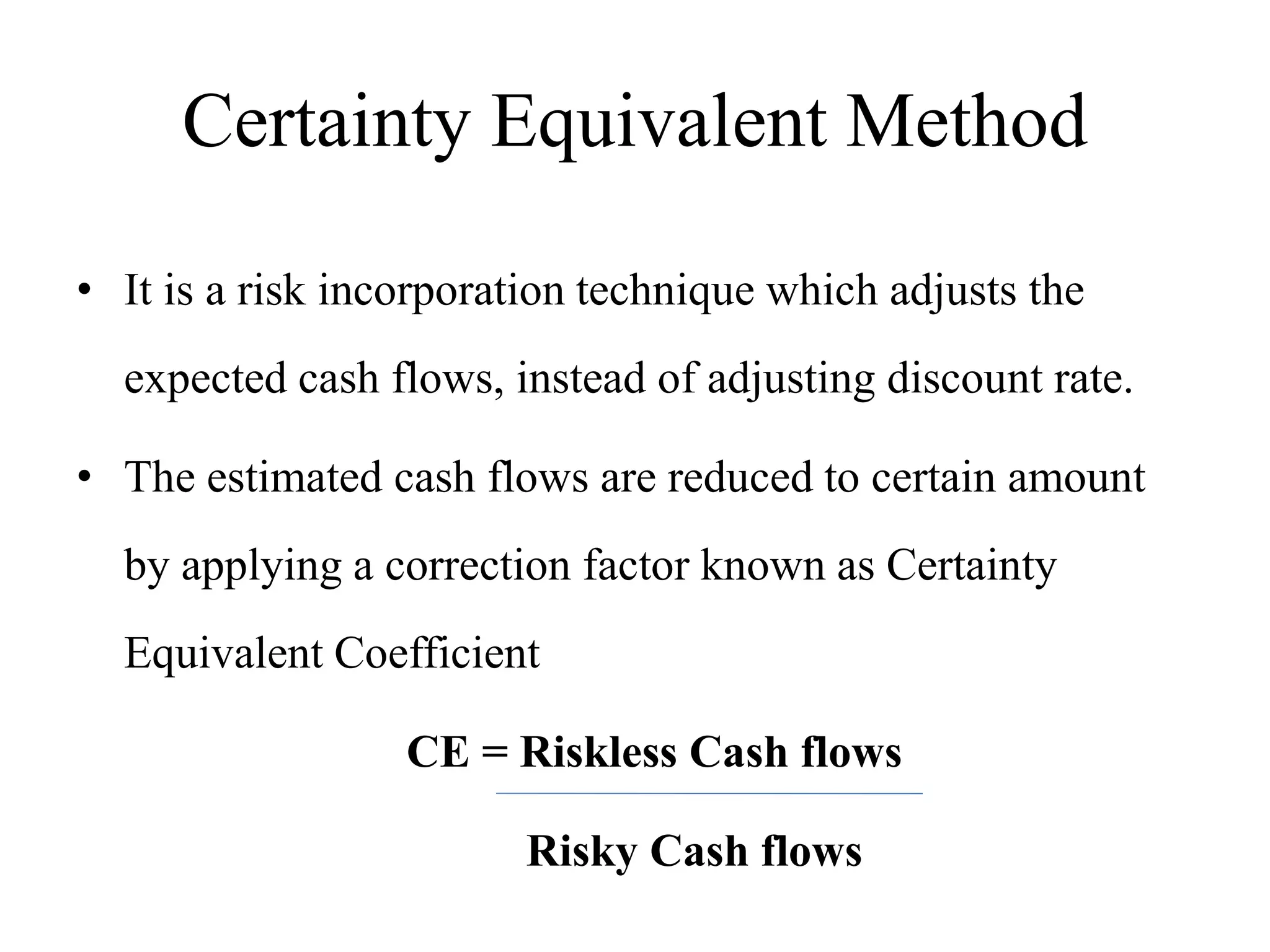
Certainty Equivalent Method
• It is a risk incorporation technique which adjusts the
expected cash flows, instead of adjusting discount rate.
• The estimated cash flows are reduced to certain amount
by applying a correction factor known as Certainty
Equivalent Coefficient
CE = Riskless Cash flows
Risky Cash flows
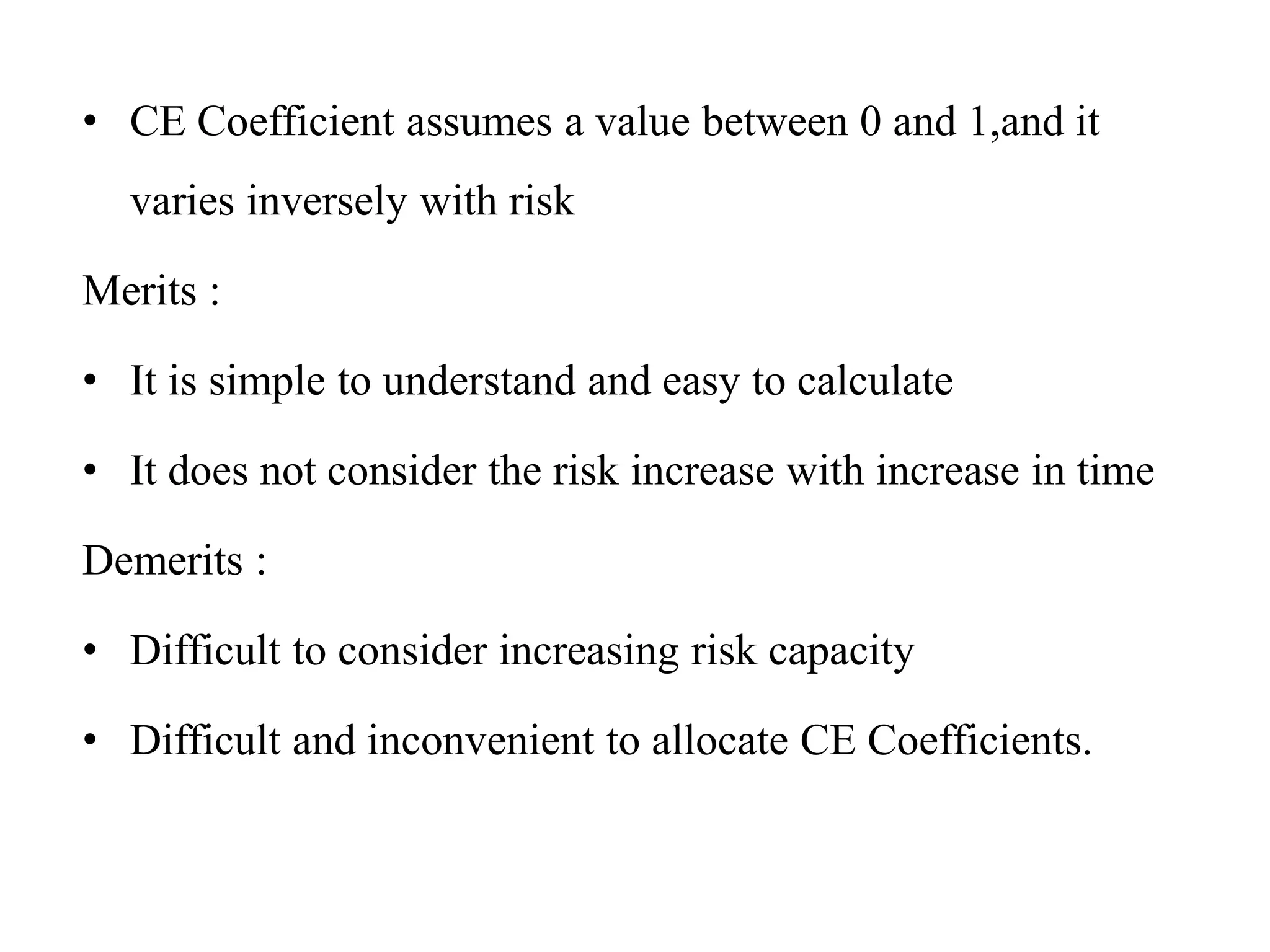
• CE Coefficient assumes a value between 0 and 1,and it
varies inversely with risk
Merits :
• It is simple to understand and easy to calculate
• It does not consider the risk increase with increase in time
Demerits :
• Difficult to consider increasing risk capacity
• Difficult and inconvenient to allocate CE Coefficients.
Standard Deviation Method
• It is used to compare the variability of possible cash flows of
different projects from their expected values.
• A project having high SD will be more risky
Coefficient of Variation
It is the risk per unit of return
CoV = Standard Deviation * 100
Mean
Sensitivity Analysis
• It is concerned with judging the sensitivity of items of
data which are needed to make a decision.
• It provides information about cash flows under three
assumptions :
1) Pessimistic
2) Most likely
3) Optimistic
Merits :
• It helps to know the viability of a project by considering
the variables
• It helps to frame alternative plans
Demerits :
• No clarity in results. Values may be inconsistent
• Fails to focus on the interrelationship between variables
• Ignores the chances associated with different values
Simulation Method
• It is also known as Method of statistical trails or Monte
Carlo’s Simulation.
• It involves random selection of an outcome for each
variable and combining these outcomes and obtaining one
trial outcome
• It is used to solve problems which cannot be represented
by mathematical models or by analytical method
Decision Tree Analysis
• Decision tree is a graphical representation of the
relationship between a present decision and future
events, future decisions, and their consequences in the
form of branches of a tree.
• Evaluation of a project can be done in different stages
and over a period of years with the help of decision
tree.
Merits :
• It is easy to understand and very simple
• Clearly brings out the assumptions and calculations
• Give an overview of all the possibilities – helps to keep the
entire picture in mind
• Helps to analyse the assumptions in graphical form
Demerits :
• Time consuming
• Complex
• Difficult to make calculations when tree diagram become more
complicated.

Investment decisions under risk

  • 1.
  • 2.
    Investment Decisions andRisk • The main function of a finance manager is to allocate various resources among available investments • Investment may be long term or short term • Investment decisions are made on the basis of forecasts. • Risk will also vary from one investment proposal to another • Risk is defined as the variability that is likely to occur in future between the estimated and actual returns
  • 3.
    Types of InvestmentDecision Situations • Certainty : No risk involved • Uncertainty : Future loss cannot be foreseen • Risk : Future loss can be foreseen
  • 4.
    Techniques of InvestmentDecisions 1) Risk Adjusted Discount Rate (RADR) 2) Certainty Equivalent method 3) Statistical Method • Standard Deviation Method • Coefficient of Variation Method • Sensitivity Analysis • Simulation Method • Probability and expected values method • Decision tree analysis
  • 5.
    Risk Adjusted DiscountRate • RADR is the discount rate which is used to convert future cash inflow into present values. • Investors expect a higher rate of return on risky projects as compared to less risky projects. Merits : • It is easy to understand and very simple to calculate • It gives some premium for risk RADR = Risk free interest rate + Risk Premium
  • 6.
    Demerits : • Itassumes that risk increases with time • There is no proper method for calculate RADR – difficult to calculate it • Does not make use of information from probability distribution expected future cash.
  • 7.
    Certainty Equivalent Method •It is a risk incorporation technique which adjusts the expected cash flows, instead of adjusting discount rate. • The estimated cash flows are reduced to certain amount by applying a correction factor known as Certainty Equivalent Coefficient CE = Riskless Cash flows Risky Cash flows
  • 8.
    • CE Coefficientassumes a value between 0 and 1,and it varies inversely with risk Merits : • It is simple to understand and easy to calculate • It does not consider the risk increase with increase in time Demerits : • Difficult to consider increasing risk capacity • Difficult and inconvenient to allocate CE Coefficients.
  • 9.
    Standard Deviation Method •It is used to compare the variability of possible cash flows of different projects from their expected values. • A project having high SD will be more risky Coefficient of Variation It is the risk per unit of return CoV = Standard Deviation * 100 Mean
  • 10.
    Sensitivity Analysis • Itis concerned with judging the sensitivity of items of data which are needed to make a decision. • It provides information about cash flows under three assumptions : 1) Pessimistic 2) Most likely 3) Optimistic
  • 11.
    Merits : • Ithelps to know the viability of a project by considering the variables • It helps to frame alternative plans Demerits : • No clarity in results. Values may be inconsistent • Fails to focus on the interrelationship between variables • Ignores the chances associated with different values
  • 12.
    Simulation Method • Itis also known as Method of statistical trails or Monte Carlo’s Simulation. • It involves random selection of an outcome for each variable and combining these outcomes and obtaining one trial outcome • It is used to solve problems which cannot be represented by mathematical models or by analytical method
  • 13.
    Decision Tree Analysis •Decision tree is a graphical representation of the relationship between a present decision and future events, future decisions, and their consequences in the form of branches of a tree. • Evaluation of a project can be done in different stages and over a period of years with the help of decision tree.
  • 14.
    Merits : • Itis easy to understand and very simple • Clearly brings out the assumptions and calculations • Give an overview of all the possibilities – helps to keep the entire picture in mind • Helps to analyse the assumptions in graphical form Demerits : • Time consuming • Complex • Difficult to make calculations when tree diagram become more complicated.