INVERTEBRATES (Zool-02506)
3(2-1)
Presented by: Nabeel Tahir
M.Phil. Zoology
Class: ADP 5 Semester
Molluscan Success
Evolutionary Perspective
• Triploblastic
• Coelomate
• Very successful
• 100,000 living species
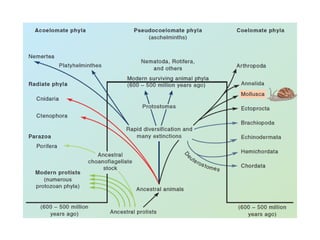
• Relationships to other animals
• Lophotrochozoans
• Coelom performs multiple functions
• Molluscs are protostome animal
• Coelom forms by the splitting of the mesoderm.
• Reduced size and importance of the coelom.
RELATIONSHIPS TO OTHER ANIMALS
•Molluscs are protostomes
•Similarities in the embryological development of
the molluscs and annelids (segmented worms).
– Trochophore larvae.
– Excretory organs and their duct systems.
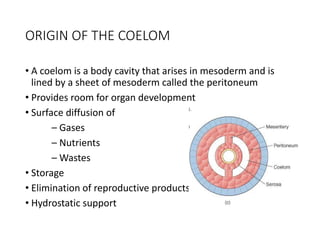
ORIGIN OF THE COELOM
• A coelom is a body cavity that arises in mesoderm and is
lined by a sheet of mesoderm called the peritoneum
• Provides room for organ development
• Surface diffusion of
– Gases
– Nutrients
– Wastes
• Storage
• Elimination of reproductive products
• Hydrostatic support
Cont.
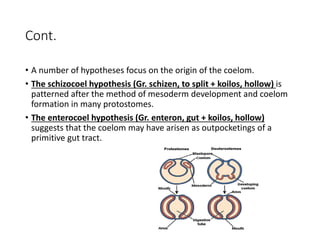
• A number of hypotheses focus on the origin of the coelom.
• The schizocoel hypothesis (Gr. schizen, to split + koilos, hollow) is
patterned after the method of mesoderm development and coelom
formation in many protostomes.
• The enterocoel hypothesis (Gr. enteron, gut + koilos, hollow)
suggests that the coelom may have arisen as outpocketings of a
primitive gut tract.
Molluscan Characteristics
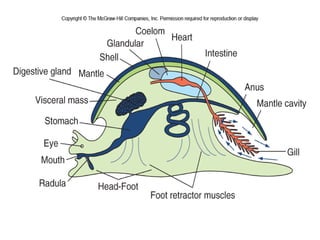
• Body of two parts: head-foot and visceral mass
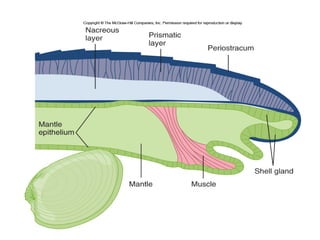
• Mantle that secretes a calcareous shell and covers the visceral mass
• Shell is secreted in 3 layers:
Outer layer – periostracum. Secreted by the mantle’s outer margin
cells
Middle layer – prismatic. Thickest of the three. Consists of calcium
carbonate and organic materials. Secreted by mantle’s outer margin cells
Inner layer – nacreous layer. Formed from thin sheets of calcium
carbonate alternating with organic matter. Secreted by the entire
epithelial border of the mantle. Nacre thickens the shell
• Mantle cavity functions in excretion, gas exchange, elimination of
digestive wastes, and release of reproductive products.
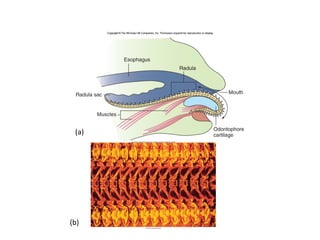
• Radula: Rasping structure.
• Bilateral symmetry
• Trochophore larvae, spiral cleavage, and schizocoel coelom formation
• Coelom reduced.
• Open circulatory system (except Cephalopoda)
Body Organization
• Head-foot
• Elongate
• Mouth
• Attachment and locomotion
• Visceral mass
• Dorsal to head-foot
• Organs of digestion, circulation, reproduction
• Mantle
• Enfolds body
• Secretes shell
– periostracum
– prismatic.
– nacreous layer.
• Mantle cavity
• Gas exchange, excretion, elimination of digestive wastes and reproductive products
• Radula
• Supported by odontophore
• Rasping food
(a)
(b)
Class Gastropoda
•Snails and slugs
•35,000 living species
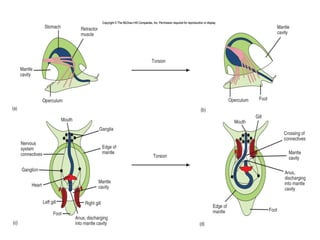
•Torsion
•180o counterclockwise twisting of visceral mass,
mantle, and mantle cavity during development
•Possible adaptive significance
•Head enters shell first.
•Clean water enters anteriorly oriented mantle
cavity opening.
•Mantle sensory organs move to head region.
Class Gastropoda
• Shell coiling
• Earliest fossils, one plane
• Modern, asymmetrical
• More compact
• Internal organs asymmetrical and sometimes no longer paired
• Locomotion
• Flattened foot
• Cilia propel over mucous trail
• Muscular waves
Class Gastropoda
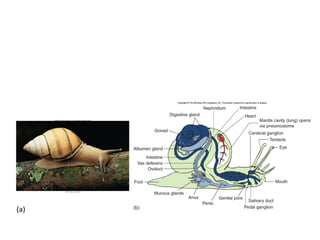
• Feeding and digestion
• Most scrape algae and attached organisms
• Herbivores, predators, scavengers
• Digestive tract
• Ciliated
• Food incorporated into mucous mass called protostyle.
• Gas exchange
• One or two gills in mantle cavity
• Land snails (pulmonates)
• Mantle cavity richly vascular for gas exchange with air
(a)
Other Maintenance Functions
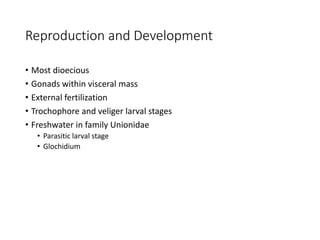
• Open circulatory system
• Blood bathes tissues in sinuses.
• Heart
• Single ventricle and single auricle
• Functions
• Transports nutrients and gases
• Hydraulic skeleton
• Nervous system
• Six ganglia plus nerve cords
• Sensory structures
• Eyes at base or end of tentacles
• Statocysts in foot
• Osphradia in mantle cavity
Other Maintenance Functions
• Excretion
• Single nephridium
• Result of shell coiling
• Discharges into mantle cavity or adjacent to mantle cavity (pulmonates)
• Ammonia (aquatic species)
• Uric acid (pulmonates)
Reproduction
• Dioecious or monoecious
• External fertilization
• Some dioecious marine species
• Copulation
• Sperm transfer may be mutual or one-way.
• Eggs shed singly, in strings, or in masses
• Larval stages
• Trochophore
• Veliger
Gastropod Diversity
• Subclasses
• Prosobranchia
• 20,000 species
• Mostly marine
• Opisthobranchia
• 2,000 species
• Mostly marine
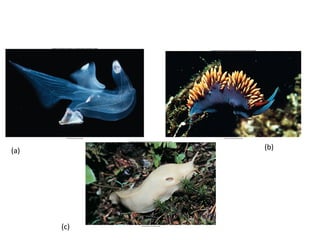
• Sea hares, sea slugs
• Shell, mantle cavity, and gills reduced or lost
• Pulmonata
• 17,000 species
• Freshwater or terrestrial
• Vascular mantle cavity serves as lung
(a) (b)
(c)
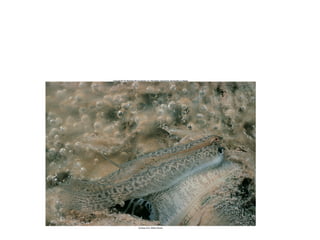
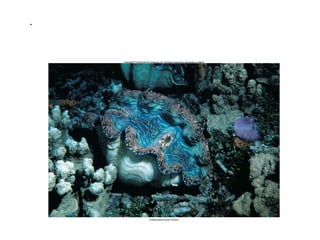
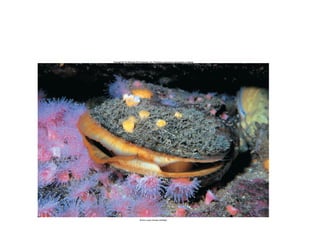
Class Bivalvia
• Clams, oysters, mussels, scallops
• 30,000 species
• Shell and associated structures
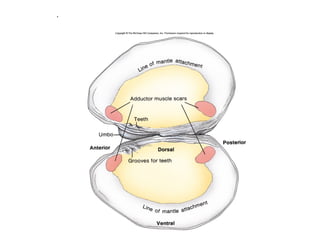
• Single shell consisting of two hinged valves
• Mantle sheetlike and covers laterally compressed body.
.
Gas Exchange, Filter Feeding, and Digestion
• Sedentary filter feeders
• Loss of head and radula
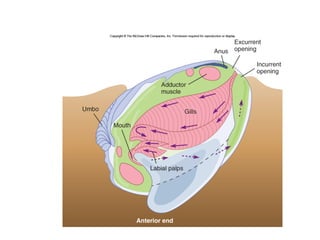
• Expansion of cilia-covered gills into folded sheets (lamellae)
• Cilia create water currents into and through mantle cavity.
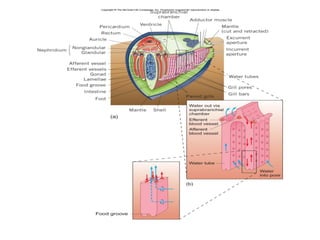
• Gas exchange in water tubes
• Food trapped along gill surface and transported to food grooves and labial palps
• Digestion
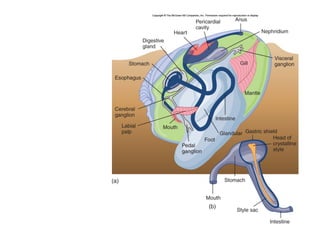
• Crystaline style and gastric shield
Other Maintenance Functions
• Open circulatory system
• Mantle and gills oxygenate blood
• Nephridia
• Below pericardial cavity
• Open to suprabranchial chamber
• Nervous system
• Three pairs of interconnected ganglia
• Sensory receptors at mantle margin
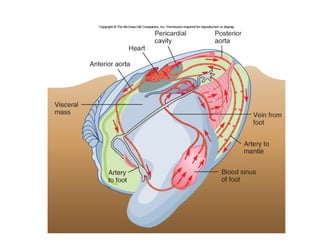
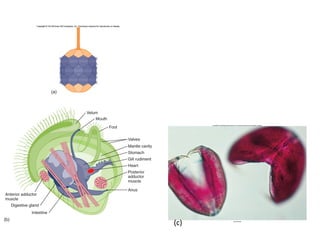
Reproduction and Development
• Most dioecious
• Gonads within visceral mass
• External fertilization
• Trochophore and veliger larval stages
• Freshwater in family Unionidae
• Parasitic larval stage
• Glochidium
(c)
.
Gooduck
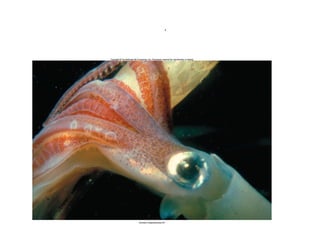
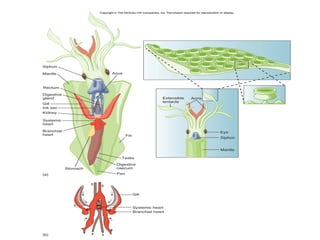
Class Cephalopoda
• Squid, octopuses, cuttlefish, and nautiluses
• Foot modified into circle of tentacles or arms and incorporated into
siphon
• Head in line with visceral mass
• Muscular mantle
Class Cephalopoda
• Shell
• Reduced or absent except in nautilus
• Locomotion
• Jet propulsion using muscles of mantle compressing water within mantle cavity
and siphon
• Feeding and Digestion
• Predators
• Tentacles, jaws, radula
• Digestive tract muscular with large digestive glands
.
Other Maintenance Functions
• Closed circulatory system
• Nervous system
• Large brains
• Complex sensory structures
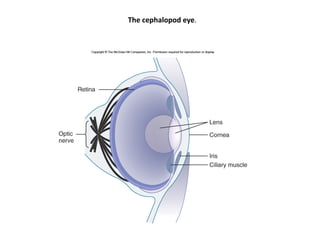
• Eyes
• Statocysts
• Chromatophores
• Color changes involved with courtship and other displays
• Ink glands
The cephalopod eye.
Learning
• Unparalleled in comparison to any other invertebrate and many
vertebrates
• Evolved in response to predatory lifestyles
Reproduction and Development
• Dioecious
• Male produces spermatophores
• Transfers to female’s mantle cavity using modified tentacle (hectocotylus)
• Eggs deposited singly or in masses attached to substrate.
• Eggs tended by parents.
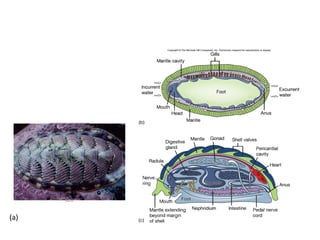
Class Polyplacophora
• Chitons
• Reduced head, flattened foot, shell consisting of eight dorsal valves,
muscular mantle extends beyond margin of shell
• Feed on attached algae
• Ladderlike nervous system
• Dioecious with external fertilization
(a)
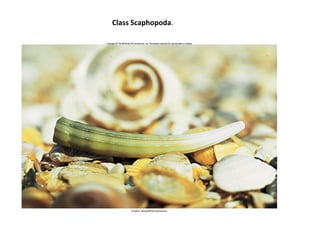
Class Scaphopoda
• Tooth shells or tusk shells
• Marine, burrowing
• Conical shell open at both ends
• Dioecious with trochophore and veliger larvae
Class Scaphopoda.
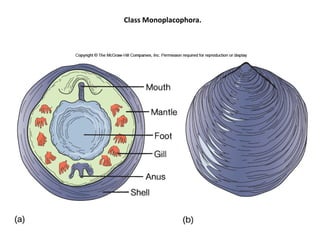
Class Monoplacophora
• Marine
• Undivided arched shell
• Broad, flat foot
• Serially repeated pairs of gills and foot retractor muscles
• Dioecious
Class Monoplacophora.
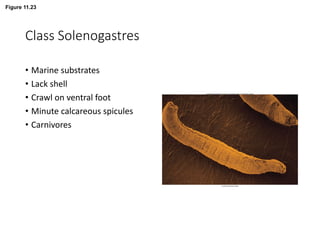
Figure 11.23
Class Solenogastres
• Marine substrates
• Lack shell
• Crawl on ventral foot
• Minute calcareous spicules
• Carnivores
Class Caudofoveata
• Deep sea
• Wormlike
• Feed on foraminifera
• Lack shell, foot, and nephridia
• 120 species
Further Phylogenetic Considerations
• More than 500 million years old
• Lophotrochozoa
• Shell and muscular foot not ancestral
• Solenogaster spicules may be similar to ancestral “shell”.
• Muscular foot first seen in Polyplacophora.
• Quickly diversified into modern classes
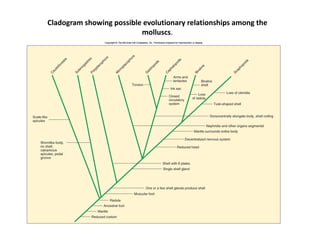
Cladogram showing possible evolutionary relationships among the
molluscs.

INVERTEBRATES Molluscan.pdf

  • 1.
    INVERTEBRATES (Zool-02506) 3(2-1) Presented by:Nabeel Tahir M.Phil. Zoology Class: ADP 5 Semester
  • 2.
  • 3.
    Evolutionary Perspective • Triploblastic •Coelomate • Very successful • 100,000 living species • Relationships to other animals • Lophotrochozoans • Coelom performs multiple functions • Molluscs are protostome animal • Coelom forms by the splitting of the mesoderm. • Reduced size and importance of the coelom.
  • 5.
    RELATIONSHIPS TO OTHERANIMALS •Molluscs are protostomes •Similarities in the embryological development of the molluscs and annelids (segmented worms). – Trochophore larvae. – Excretory organs and their duct systems.
  • 6.
    ORIGIN OF THECOELOM • A coelom is a body cavity that arises in mesoderm and is lined by a sheet of mesoderm called the peritoneum • Provides room for organ development • Surface diffusion of – Gases – Nutrients – Wastes • Storage • Elimination of reproductive products • Hydrostatic support
  • 7.
    Cont. • A numberof hypotheses focus on the origin of the coelom. • The schizocoel hypothesis (Gr. schizen, to split + koilos, hollow) is patterned after the method of mesoderm development and coelom formation in many protostomes. • The enterocoel hypothesis (Gr. enteron, gut + koilos, hollow) suggests that the coelom may have arisen as outpocketings of a primitive gut tract.
  • 8.
    Molluscan Characteristics • Bodyof two parts: head-foot and visceral mass • Mantle that secretes a calcareous shell and covers the visceral mass • Shell is secreted in 3 layers: Outer layer – periostracum. Secreted by the mantle’s outer margin cells Middle layer – prismatic. Thickest of the three. Consists of calcium carbonate and organic materials. Secreted by mantle’s outer margin cells Inner layer – nacreous layer. Formed from thin sheets of calcium carbonate alternating with organic matter. Secreted by the entire epithelial border of the mantle. Nacre thickens the shell • Mantle cavity functions in excretion, gas exchange, elimination of digestive wastes, and release of reproductive products. • Radula: Rasping structure. • Bilateral symmetry • Trochophore larvae, spiral cleavage, and schizocoel coelom formation • Coelom reduced. • Open circulatory system (except Cephalopoda)
  • 9.
    Body Organization • Head-foot •Elongate • Mouth • Attachment and locomotion • Visceral mass • Dorsal to head-foot • Organs of digestion, circulation, reproduction • Mantle • Enfolds body • Secretes shell – periostracum – prismatic. – nacreous layer. • Mantle cavity • Gas exchange, excretion, elimination of digestive wastes and reproductive products • Radula • Supported by odontophore • Rasping food
  • 12.
  • 13.
    Class Gastropoda •Snails andslugs •35,000 living species •Torsion •180o counterclockwise twisting of visceral mass, mantle, and mantle cavity during development •Possible adaptive significance •Head enters shell first. •Clean water enters anteriorly oriented mantle cavity opening. •Mantle sensory organs move to head region.
  • 15.
    Class Gastropoda • Shellcoiling • Earliest fossils, one plane • Modern, asymmetrical • More compact • Internal organs asymmetrical and sometimes no longer paired • Locomotion • Flattened foot • Cilia propel over mucous trail • Muscular waves
  • 16.
    Class Gastropoda • Feedingand digestion • Most scrape algae and attached organisms • Herbivores, predators, scavengers • Digestive tract • Ciliated • Food incorporated into mucous mass called protostyle. • Gas exchange • One or two gills in mantle cavity • Land snails (pulmonates) • Mantle cavity richly vascular for gas exchange with air
  • 17.
  • 18.
    Other Maintenance Functions •Open circulatory system • Blood bathes tissues in sinuses. • Heart • Single ventricle and single auricle • Functions • Transports nutrients and gases • Hydraulic skeleton • Nervous system • Six ganglia plus nerve cords • Sensory structures • Eyes at base or end of tentacles • Statocysts in foot • Osphradia in mantle cavity
  • 19.
    Other Maintenance Functions •Excretion • Single nephridium • Result of shell coiling • Discharges into mantle cavity or adjacent to mantle cavity (pulmonates) • Ammonia (aquatic species) • Uric acid (pulmonates)
  • 20.
    Reproduction • Dioecious ormonoecious • External fertilization • Some dioecious marine species • Copulation • Sperm transfer may be mutual or one-way. • Eggs shed singly, in strings, or in masses • Larval stages • Trochophore • Veliger
  • 21.
    Gastropod Diversity • Subclasses •Prosobranchia • 20,000 species • Mostly marine • Opisthobranchia • 2,000 species • Mostly marine • Sea hares, sea slugs • Shell, mantle cavity, and gills reduced or lost • Pulmonata • 17,000 species • Freshwater or terrestrial • Vascular mantle cavity serves as lung
  • 22.
  • 23.
    Class Bivalvia • Clams,oysters, mussels, scallops • 30,000 species • Shell and associated structures • Single shell consisting of two hinged valves • Mantle sheetlike and covers laterally compressed body.
  • 24.
  • 25.
    Gas Exchange, FilterFeeding, and Digestion • Sedentary filter feeders • Loss of head and radula • Expansion of cilia-covered gills into folded sheets (lamellae) • Cilia create water currents into and through mantle cavity. • Gas exchange in water tubes • Food trapped along gill surface and transported to food grooves and labial palps • Digestion • Crystaline style and gastric shield
  • 29.
    Other Maintenance Functions •Open circulatory system • Mantle and gills oxygenate blood • Nephridia • Below pericardial cavity • Open to suprabranchial chamber • Nervous system • Three pairs of interconnected ganglia • Sensory receptors at mantle margin
  • 30.
    Reproduction and Development •Most dioecious • Gonads within visceral mass • External fertilization • Trochophore and veliger larval stages • Freshwater in family Unionidae • Parasitic larval stage • Glochidium
  • 32.
  • 34.
  • 36.
  • 37.
    Class Cephalopoda • Squid,octopuses, cuttlefish, and nautiluses • Foot modified into circle of tentacles or arms and incorporated into siphon • Head in line with visceral mass • Muscular mantle
  • 39.
    Class Cephalopoda • Shell •Reduced or absent except in nautilus • Locomotion • Jet propulsion using muscles of mantle compressing water within mantle cavity and siphon • Feeding and Digestion • Predators • Tentacles, jaws, radula • Digestive tract muscular with large digestive glands
  • 40.
  • 41.
    Other Maintenance Functions •Closed circulatory system • Nervous system • Large brains • Complex sensory structures • Eyes • Statocysts • Chromatophores • Color changes involved with courtship and other displays • Ink glands
  • 42.
  • 43.
    Learning • Unparalleled incomparison to any other invertebrate and many vertebrates • Evolved in response to predatory lifestyles
  • 44.
    Reproduction and Development •Dioecious • Male produces spermatophores • Transfers to female’s mantle cavity using modified tentacle (hectocotylus) • Eggs deposited singly or in masses attached to substrate. • Eggs tended by parents.
  • 45.
    Class Polyplacophora • Chitons •Reduced head, flattened foot, shell consisting of eight dorsal valves, muscular mantle extends beyond margin of shell • Feed on attached algae • Ladderlike nervous system • Dioecious with external fertilization
  • 46.
  • 47.
    Class Scaphopoda • Toothshells or tusk shells • Marine, burrowing • Conical shell open at both ends • Dioecious with trochophore and veliger larvae
  • 48.
  • 49.
    Class Monoplacophora • Marine •Undivided arched shell • Broad, flat foot • Serially repeated pairs of gills and foot retractor muscles • Dioecious
  • 50.
  • 51.
    Figure 11.23 Class Solenogastres •Marine substrates • Lack shell • Crawl on ventral foot • Minute calcareous spicules • Carnivores
  • 52.
    Class Caudofoveata • Deepsea • Wormlike • Feed on foraminifera • Lack shell, foot, and nephridia • 120 species
  • 53.
    Further Phylogenetic Considerations •More than 500 million years old • Lophotrochozoa • Shell and muscular foot not ancestral • Solenogaster spicules may be similar to ancestral “shell”. • Muscular foot first seen in Polyplacophora. • Quickly diversified into modern classes
  • 54.
    Cladogram showing possibleevolutionary relationships among the molluscs.