Matrices &
Determinants
Square Matrix | Determinant | Singular & Non-
Singular Matrices | Minor of a Matrix | Cofactor of
an Element | Inverse of Order 3 × 3 by Cofactor
Method
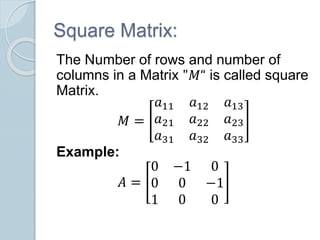
Square Matrix:
The Number of rows and number of
columns in a Matrix "𝑀“ is called square
Matrix.
𝑀 =
𝑎11 𝑎12 𝑎13
𝑎21 𝑎22 𝑎23
𝑎31 𝑎32 𝑎33
Example:
𝐴 =
0 −1 0
0 0 −1
1 0 0
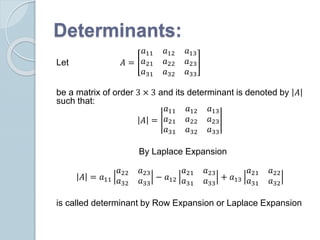
Determinants:
Let 𝐴 =
𝑎11 𝑎12 𝑎13
𝑎21 𝑎22 𝑎23
𝑎31 𝑎32 𝑎33
be a matrix of order 3 × 3 and its determinant is denoted by 𝐴
such that:
𝐴 =
𝑎11 𝑎12 𝑎13
𝑎21 𝑎22 𝑎23
𝑎31 𝑎32 𝑎33
By Laplace Expansion
𝐴 = 𝑎11
𝑎22 𝑎23
𝑎32 𝑎33
− 𝑎12
𝑎21 𝑎23
𝑎31 𝑎33
+ 𝑎13
𝑎21 𝑎22
𝑎31 𝑎32
is called determinant by Row Expansion or Laplace Expansion
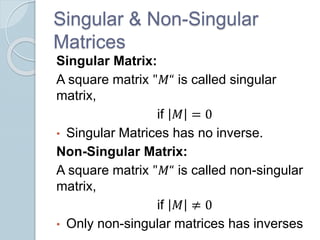
Singular & Non-Singular
Matrices
Singular Matrix:
A square matrix "𝑀“ is called singular
matrix,
if 𝑀 = 0
• Singular Matrices has no inverse.
Non-Singular Matrix:
A square matrix "𝑀“ is called non-singular
matrix,
if 𝑀 ≠ 0
• Only non-singular matrices has inverses
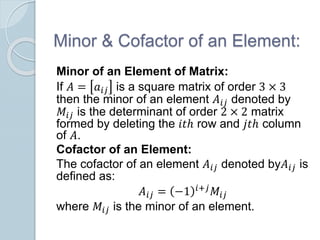
Minor & Cofactor of an Element:
Minor of an Element of Matrix:
If 𝐴 = 𝑎𝑖𝑗 is a square matrix of order 3 × 3
then the minor of an element 𝐴𝑖𝑗 denoted by
𝑀𝑖𝑗 is the determinant of order 2 × 2 matrix
formed by deleting the 𝑖𝑡ℎ row and 𝑗𝑡ℎ column
of 𝐴.
Cofactor of an Element:
The cofactor of an element 𝐴𝑖𝑗 denoted by𝐴𝑖𝑗 is
defined as:
𝐴𝑖𝑗 = −1 𝑖+𝑗 𝑀𝑖𝑗
where 𝑀𝑖𝑗 is the minor of an element.
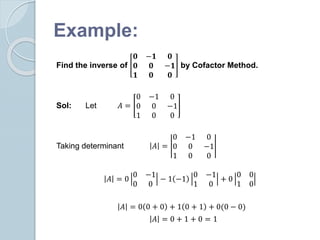
Example:
Find the inverse of
𝟎 −𝟏 𝟎
𝟎 𝟎 −𝟏
𝟏 𝟎 𝟎
by Cofactor Method.
Sol: Let 𝐴 =
0 −1 0
0 0 −1
1 0 0
Taking determinant 𝐴 =
0 −1 0
0 0 −1
1 0 0
𝐴 = 0
0 −1
0 0
− 1 −1
0 −1
1 0
+ 0
0 0
1 0
𝐴 = 0 0 + 0 + 1 0 + 1 + 0(0 − 0)
𝐴 = 0 + 1 + 0 = 1
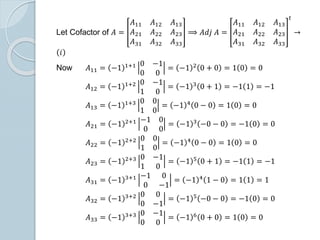
Let Cofactor of 𝐴 =
𝐴11 𝐴12 𝐴13
𝐴21 𝐴22 𝐴23
𝐴31 𝐴32 𝐴33
⟹ 𝐴𝑑𝑗 𝐴 =
𝐴11 𝐴12 𝐴13
𝐴21 𝐴22 𝐴23
𝐴31 𝐴32 𝐴33
𝑡
→
𝑖
Now 𝐴11 = −1 1+1 0 −1
0 0
= −1 2
0 + 0 = 1 0 = 0
𝐴12 = −1 1+2 0 −1
1 0
= −1 3 0 + 1 = −1 1 = −1
𝐴13 = −1 1+3 0 0
1 0
= −1 4
0 − 0 = 1 0 = 0
𝐴21 = −1 2+1 −1 0
0 0
= −1 3
−0 − 0 = −1 0 = 0
𝐴22 = −1 2+2 0 0
1 0
= −1 4
0 − 0 = 1 0 = 0
𝐴23 = −1 2+3 0 −1
1 0
= −1 5
0 + 1 = −1 1 = −1
𝐴31 = −1 3+1 −1 0
0 −1
= −1 4
1 − 0 = 1 1 = 1
𝐴32 = −1 3+2 0 0
0 −1
= −1 5 −0 − 0 = −1 0 = 0
𝐴33 = −1 3+3 0 −1
0 0
= −1 6 0 + 0 = 1 0 = 0
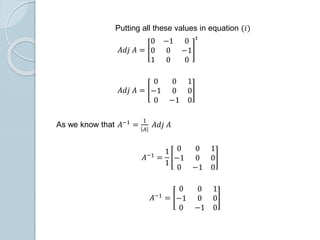
Putting all these values in equation (𝑖)
𝐴𝑑𝑗 𝐴 =
0 −1 0
0 0 −1
1 0 0
𝑡
𝐴𝑑𝑗 𝐴 =
0 0 1
−1 0 0
0 −1 0
As we know that 𝐴−1 =
1
𝐴
𝐴𝑑𝑗 𝐴
𝐴−1 =
1
1
0 0 1
−1 0 0
0 −1 0
𝐴−1
=
0 0 1
−1 0 0
0 −1 0
Like, share, Subscribe My
YouTube Channel & Press
The Bell Icon For More
Videos

Inverse of matrices by cofactor method

  • 1.
    Matrices & Determinants Square Matrix| Determinant | Singular & Non- Singular Matrices | Minor of a Matrix | Cofactor of an Element | Inverse of Order 3 × 3 by Cofactor Method
  • 2.
    Square Matrix: The Numberof rows and number of columns in a Matrix "𝑀“ is called square Matrix. 𝑀 = 𝑎11 𝑎12 𝑎13 𝑎21 𝑎22 𝑎23 𝑎31 𝑎32 𝑎33 Example: 𝐴 = 0 −1 0 0 0 −1 1 0 0
  • 3.
    Determinants: Let 𝐴 = 𝑎11𝑎12 𝑎13 𝑎21 𝑎22 𝑎23 𝑎31 𝑎32 𝑎33 be a matrix of order 3 × 3 and its determinant is denoted by 𝐴 such that: 𝐴 = 𝑎11 𝑎12 𝑎13 𝑎21 𝑎22 𝑎23 𝑎31 𝑎32 𝑎33 By Laplace Expansion 𝐴 = 𝑎11 𝑎22 𝑎23 𝑎32 𝑎33 − 𝑎12 𝑎21 𝑎23 𝑎31 𝑎33 + 𝑎13 𝑎21 𝑎22 𝑎31 𝑎32 is called determinant by Row Expansion or Laplace Expansion
  • 4.
    Singular & Non-Singular Matrices SingularMatrix: A square matrix "𝑀“ is called singular matrix, if 𝑀 = 0 • Singular Matrices has no inverse. Non-Singular Matrix: A square matrix "𝑀“ is called non-singular matrix, if 𝑀 ≠ 0 • Only non-singular matrices has inverses
  • 5.
    Minor & Cofactorof an Element: Minor of an Element of Matrix: If 𝐴 = 𝑎𝑖𝑗 is a square matrix of order 3 × 3 then the minor of an element 𝐴𝑖𝑗 denoted by 𝑀𝑖𝑗 is the determinant of order 2 × 2 matrix formed by deleting the 𝑖𝑡ℎ row and 𝑗𝑡ℎ column of 𝐴. Cofactor of an Element: The cofactor of an element 𝐴𝑖𝑗 denoted by𝐴𝑖𝑗 is defined as: 𝐴𝑖𝑗 = −1 𝑖+𝑗 𝑀𝑖𝑗 where 𝑀𝑖𝑗 is the minor of an element.
  • 6.
    Example: Find the inverseof 𝟎 −𝟏 𝟎 𝟎 𝟎 −𝟏 𝟏 𝟎 𝟎 by Cofactor Method. Sol: Let 𝐴 = 0 −1 0 0 0 −1 1 0 0 Taking determinant 𝐴 = 0 −1 0 0 0 −1 1 0 0 𝐴 = 0 0 −1 0 0 − 1 −1 0 −1 1 0 + 0 0 0 1 0 𝐴 = 0 0 + 0 + 1 0 + 1 + 0(0 − 0) 𝐴 = 0 + 1 + 0 = 1
  • 7.
    Let Cofactor of𝐴 = 𝐴11 𝐴12 𝐴13 𝐴21 𝐴22 𝐴23 𝐴31 𝐴32 𝐴33 ⟹ 𝐴𝑑𝑗 𝐴 = 𝐴11 𝐴12 𝐴13 𝐴21 𝐴22 𝐴23 𝐴31 𝐴32 𝐴33 𝑡 → 𝑖 Now 𝐴11 = −1 1+1 0 −1 0 0 = −1 2 0 + 0 = 1 0 = 0 𝐴12 = −1 1+2 0 −1 1 0 = −1 3 0 + 1 = −1 1 = −1 𝐴13 = −1 1+3 0 0 1 0 = −1 4 0 − 0 = 1 0 = 0 𝐴21 = −1 2+1 −1 0 0 0 = −1 3 −0 − 0 = −1 0 = 0 𝐴22 = −1 2+2 0 0 1 0 = −1 4 0 − 0 = 1 0 = 0 𝐴23 = −1 2+3 0 −1 1 0 = −1 5 0 + 1 = −1 1 = −1 𝐴31 = −1 3+1 −1 0 0 −1 = −1 4 1 − 0 = 1 1 = 1 𝐴32 = −1 3+2 0 0 0 −1 = −1 5 −0 − 0 = −1 0 = 0 𝐴33 = −1 3+3 0 −1 0 0 = −1 6 0 + 0 = 1 0 = 0
  • 8.
    Putting all thesevalues in equation (𝑖) 𝐴𝑑𝑗 𝐴 = 0 −1 0 0 0 −1 1 0 0 𝑡 𝐴𝑑𝑗 𝐴 = 0 0 1 −1 0 0 0 −1 0 As we know that 𝐴−1 = 1 𝐴 𝐴𝑑𝑗 𝐴 𝐴−1 = 1 1 0 0 1 −1 0 0 0 −1 0 𝐴−1 = 0 0 1 −1 0 0 0 −1 0
  • 9.
    Like, share, SubscribeMy YouTube Channel & Press The Bell Icon For More Videos