SQL JOINS
Ankit Rai
Outline
1.
WHAT IS SQL
JOIN
2.
WHY JOIN IS
USED
3.
TYPES OF SQL
JOINS
4.
SQL INNER JOIN
5.
SQL OUTER JOIN
6.
SQL LEFT JOIN
7.
SQL RIGHT JOIN
7.
SQL CROSS
JOIN
7.
SQL SELF JOIN
Ankit Rai
WHAT IS SQL JOIN
SQL join combines rows from more than
one table by using common column in both
the tables.
Ankit Rai
WHY WE USE SQL JOIN?
 Flexibility – It allows the user to access and manage records from more than
one table.
 Data Redundancy – SQL join allows us to keep data redundancy low so that
we can reduce the amount of data anomalies.
 Efficiency – Executes faster and shows results much more quickly than any
other sub query.
Ankit Rai
TYPES OF JOINS
1
INNER JOIN
2
OUTER
JOIN
3
LEFT JOIN
4
RIGHT JOIN
5
CROSS JOIN
6
SELF JOIN
Ankit Rai
INNER JOIN
Inner join returns a new table by
combining records that only have
matching values in both the tables.
SYNTAX
SELECT table1.col_name, table2.col_name,…...
FROM table1
INNER JOIN table2
ON table1.column = table2.column;
Ankit Rai
OUTER JOIN
Outer join returns all those records
which are in either the left table or right
table.
SYNTAX
SELECT table1.col_name, table2.col_name,…...
FROM table1
FULL OUTER JOIN table2
ON table1.column = table2.column;
Ankit Rai
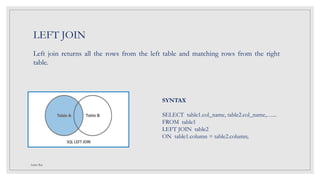
LEFT JOIN
Left join returns all the rows from the left table and matching rows from the right
table.
SYNTAX
SELECT table1.col_name, table2.col_name,…...
FROM table1
LEFT JOIN table2
ON table1.column = table2.column;
Ankit Rai
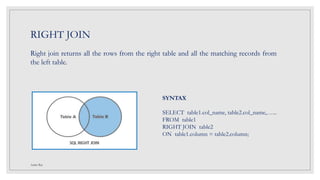
RIGHT JOIN
Right join returns all the rows from the right table and all the matching records from
the left table.
SYNTAX
SELECT table1.col_name, table2.col_name,…...
FROM table1
RIGHT JOIN table2
ON table1.column = table2.column;
Ankit Rai
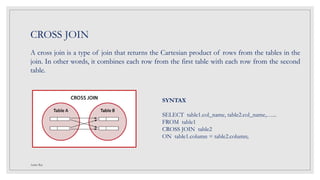
CROSS JOIN
A cross join is a type of join that returns the Cartesian product of rows from the tables in the
join. In other words, it combines each row from the first table with each row from the second
table.
SYNTAX
SELECT table1.col_name, table2.col_name,…...
FROM table1
CROSS JOIN table2
ON table1.column = table2.column;
Ankit Rai
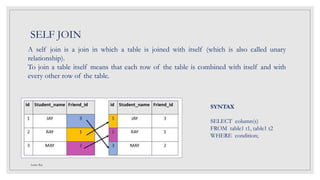
SELF JOIN
A self join is a join in which a table is joined with itself (which is also called unary
relationship).
To join a table itself means that each row of the table is combined with itself and with
every other row of the table.
SYNTAX
SELECT column(s)
FROM table1 t1, table1 t2
WHERE condition;
Ankit Rai
THANK YOU!
Ankit Rai

SQL Joins.pptx

  • 1.
  • 2.
    Outline 1. WHAT IS SQL JOIN 2. WHYJOIN IS USED 3. TYPES OF SQL JOINS 4. SQL INNER JOIN 5. SQL OUTER JOIN 6. SQL LEFT JOIN 7. SQL RIGHT JOIN 7. SQL CROSS JOIN 7. SQL SELF JOIN Ankit Rai
  • 3.
    WHAT IS SQLJOIN SQL join combines rows from more than one table by using common column in both the tables. Ankit Rai
  • 4.
    WHY WE USESQL JOIN?  Flexibility – It allows the user to access and manage records from more than one table.  Data Redundancy – SQL join allows us to keep data redundancy low so that we can reduce the amount of data anomalies.  Efficiency – Executes faster and shows results much more quickly than any other sub query. Ankit Rai
  • 5.
    TYPES OF JOINS 1 INNERJOIN 2 OUTER JOIN 3 LEFT JOIN 4 RIGHT JOIN 5 CROSS JOIN 6 SELF JOIN Ankit Rai
  • 6.
    INNER JOIN Inner joinreturns a new table by combining records that only have matching values in both the tables. SYNTAX SELECT table1.col_name, table2.col_name,…... FROM table1 INNER JOIN table2 ON table1.column = table2.column; Ankit Rai
  • 7.
    OUTER JOIN Outer joinreturns all those records which are in either the left table or right table. SYNTAX SELECT table1.col_name, table2.col_name,…... FROM table1 FULL OUTER JOIN table2 ON table1.column = table2.column; Ankit Rai
  • 8.
    LEFT JOIN Left joinreturns all the rows from the left table and matching rows from the right table. SYNTAX SELECT table1.col_name, table2.col_name,…... FROM table1 LEFT JOIN table2 ON table1.column = table2.column; Ankit Rai
  • 9.
    RIGHT JOIN Right joinreturns all the rows from the right table and all the matching records from the left table. SYNTAX SELECT table1.col_name, table2.col_name,…... FROM table1 RIGHT JOIN table2 ON table1.column = table2.column; Ankit Rai
  • 10.
    CROSS JOIN A crossjoin is a type of join that returns the Cartesian product of rows from the tables in the join. In other words, it combines each row from the first table with each row from the second table. SYNTAX SELECT table1.col_name, table2.col_name,…... FROM table1 CROSS JOIN table2 ON table1.column = table2.column; Ankit Rai
  • 11.
    SELF JOIN A selfjoin is a join in which a table is joined with itself (which is also called unary relationship). To join a table itself means that each row of the table is combined with itself and with every other row of the table. SYNTAX SELECT column(s) FROM table1 t1, table1 t2 WHERE condition; Ankit Rai
  • 12.