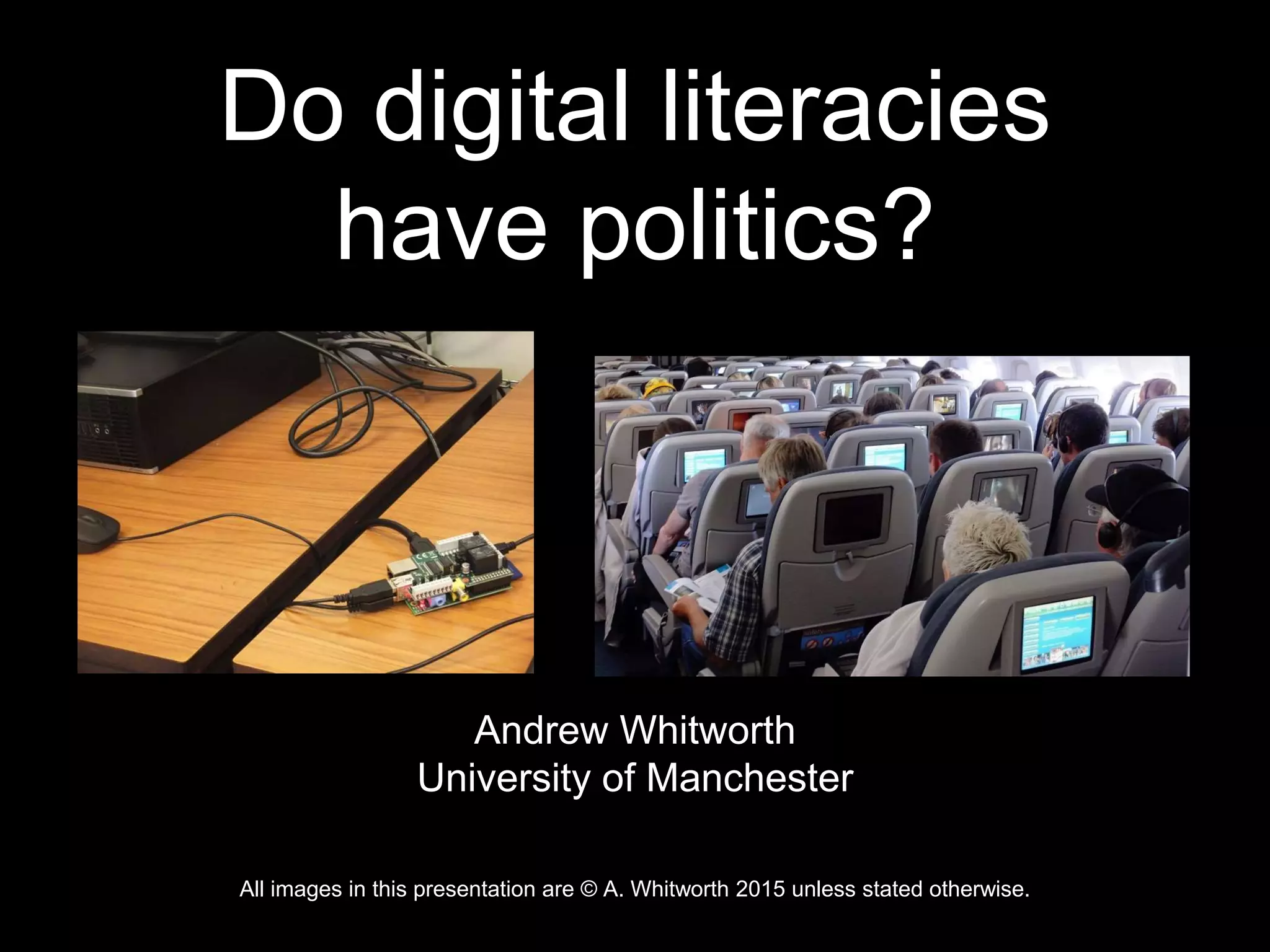
Do digital literacies
have politics?
Andrew Whitworth
University of Manchester
All images in this presentation are © A. Whitworth 2015 unless stated otherwise.
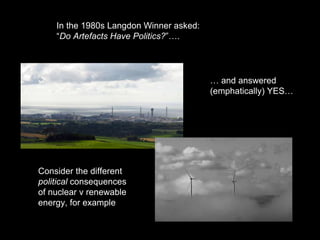
In the 1980s Langdon Winner asked:
“Do Artefacts Have Politics?”….
Consider the different
political consequences
of nuclear v renewable
energy, for example
… and answered
(emphatically) YES…
I want to suggest that ‘digital literacy’
has constantly been pulled towards
definitions that meet the needs of
dominant interests in society
In terms used by Mikhail Bakhtin,
centripetal force has long been
exerted on digital literacy…
…as opposed to centrifugal force, which pushes
to the margins….
…and thus promotes a view of digital literacy as
empowerment.
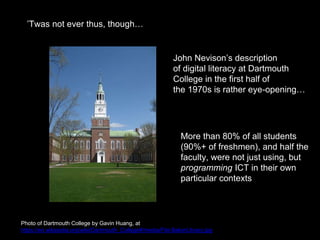
’Twas not ever thus, though…
Photo of Dartmouth College by Gavin Huang, at
https://en.wikipedia.org/wiki/Dartmouth_College#/media/File:BakerLibrary.jpg
John Nevison’s description
of digital literacy at Dartmouth
College in the first half of
the 1970s is rather eye-opening…
More than 80% of all students
(90%+ of freshmen), and half the
faculty, were not just using, but
programming ICT in their own
particular contexts
Nevison wrote:
(Full reference: Nevison, J. (1976).
Computing in the liberal arts college.
Science 194: 396–402.)
The growth of computing among the students and
faculty at Dartmouth has been organic. It has proceeded
at an unhurried pace where students and faculty learn to
program largely on their own.
A new instructor at Dartmouth will find computing all
around…
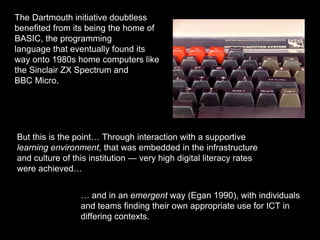
The Dartmouth initiative doubtless
benefited from its being the home of
BASIC, the programming
language that eventually found its
way onto 1980s home computers like
the Sinclair ZX Spectrum and
BBC Micro.
But this is the point… Through interaction with a supportive
learning environment, that was embedded in the infrastructure
and culture of this institution — very high digital literacy rates
were achieved…
… and in an emergent way (Egan 1990), with individuals
and teams finding their own appropriate use for ICT in
differing contexts.
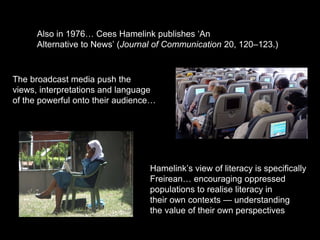
Also in 1976… Cees Hamelink publishes ‘An
Alternative to News’ (Journal of Communication 20, 120–123.)
Hamelink’s view of literacy is specifically
Freirean… encouraging oppressed
populations to realise literacy in
their own contexts — understanding
the value of their own perspectives
The broadcast media push the
views, interpretations and language
of the powerful onto their audience…
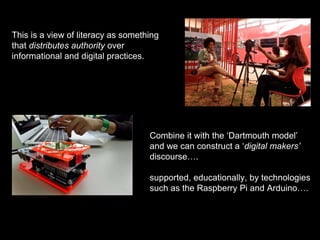
This is a view of literacy as something
that distributes authority over
informational and digital practices.
Combine it with the ‘Dartmouth model’
and we can construct a ‘digital makers’
discourse….
supported, educationally, by technologies
such as the Raspberry Pi and Arduino….
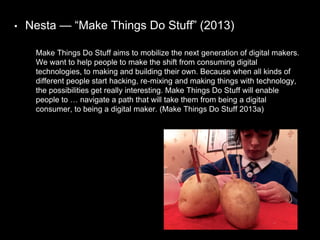
• Nesta — “Make Things Do Stuff” (2013)
Make Things Do Stuff aims to mobilize the next generation of digital makers.
We want to help people to make the shift from consuming digital
technologies, to making and building their own. Because when all kinds of
different people start hacking, re-mixing and making things with technology,
the possibilities get really interesting. Make Things Do Stuff will enable
people to … navigate a path that will take them from being a digital
consumer, to being a digital maker. (Make Things Do Stuff 2013a)
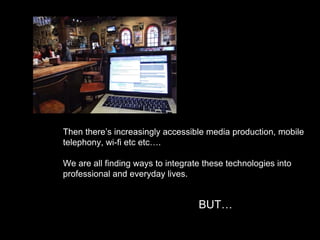
Then there’s increasingly accessible media production, mobile
telephony, wi-fi etc etc….
We are all finding ways to integrate these technologies into
professional and everyday lives.
BUT…
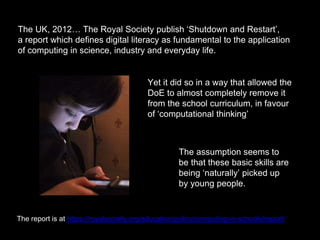
The UK, 2012… The Royal Society publish ‘Shutdown and Restart’,
a report which defines digital literacy as fundamental to the application
of computing in science, industry and everyday life.
Yet it did so in a way that allowed the
DoE to almost completely remove it
from the school curriculum, in favour
of ‘computational thinking’
The report is at https://royalsociety.org/education/policy/computing-in-schools/report/
The assumption seems to
be that these basic skills are
being ‘naturally’ picked up
by young people.
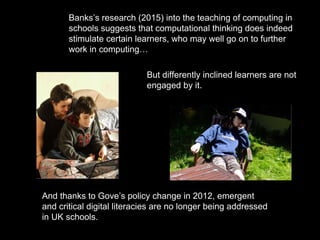
Banks’s research (2015) into the teaching of computing in
schools suggests that computational thinking does indeed
stimulate certain learners, who may well go on to further
work in computing…
But differently inclined learners are not
engaged by it.
And thanks to Gove’s policy change in 2012, emergent
and critical digital literacies are no longer being addressed
in UK schools.
Banks writes:
Computer science students have a particular responsibility to
develop criticality, given that they are learning to develop the
technologies of the future and this gives them potential for
considerable power that they are often unaware of.
CS students generally have a technical background and are
“used to sitting and listening... learning the correct way to
do things” (Bullen, 1998). But if the students’ underlying
epistemology is based on a deterministic “correct way”, this
is problematic for critical thinking: for example Chan, Ho,
and Ku’s (2011) research suggests that students who view
knowledge as certain have a reduced capacity for critical
thinking.
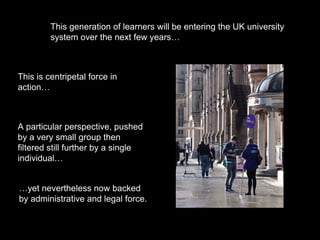
This generation of learners will be entering the UK university
system over the next few years…
This is centripetal force in
action…
A particular perspective, pushed
by a very small group then
filtered still further by a single
individual…
…yet nevertheless now backed
by administrative and legal force.
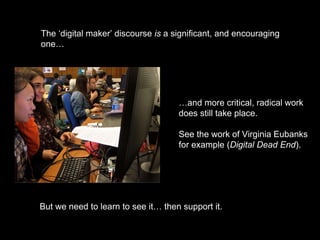
The ‘digital maker’ discourse is a significant, and encouraging
one…
…and more critical, radical work
does still take place.
See the work of Virginia Eubanks
for example (Digital Dead End).
But we need to learn to see it… then support it.
THANK YOU…
drew.whitworth@manchester.ac.uk
@DrewWhitworth1
http://www.MAdigitaltechnologies.com

Do digital literacies have politics?

  • 1.
    Do digital literacies havepolitics? Andrew Whitworth University of Manchester All images in this presentation are © A. Whitworth 2015 unless stated otherwise.
  • 2.
    In the 1980sLangdon Winner asked: “Do Artefacts Have Politics?”…. Consider the different political consequences of nuclear v renewable energy, for example … and answered (emphatically) YES…
  • 3.
    I want tosuggest that ‘digital literacy’ has constantly been pulled towards definitions that meet the needs of dominant interests in society In terms used by Mikhail Bakhtin, centripetal force has long been exerted on digital literacy… …as opposed to centrifugal force, which pushes to the margins…. …and thus promotes a view of digital literacy as empowerment.
  • 4.
    ’Twas not everthus, though… Photo of Dartmouth College by Gavin Huang, at https://en.wikipedia.org/wiki/Dartmouth_College#/media/File:BakerLibrary.jpg John Nevison’s description of digital literacy at Dartmouth College in the first half of the 1970s is rather eye-opening… More than 80% of all students (90%+ of freshmen), and half the faculty, were not just using, but programming ICT in their own particular contexts
  • 5.
    Nevison wrote: (Full reference:Nevison, J. (1976). Computing in the liberal arts college. Science 194: 396–402.) The growth of computing among the students and faculty at Dartmouth has been organic. It has proceeded at an unhurried pace where students and faculty learn to program largely on their own. A new instructor at Dartmouth will find computing all around…
  • 6.
    The Dartmouth initiativedoubtless benefited from its being the home of BASIC, the programming language that eventually found its way onto 1980s home computers like the Sinclair ZX Spectrum and BBC Micro. But this is the point… Through interaction with a supportive learning environment, that was embedded in the infrastructure and culture of this institution — very high digital literacy rates were achieved… … and in an emergent way (Egan 1990), with individuals and teams finding their own appropriate use for ICT in differing contexts.
  • 7.
    Also in 1976…Cees Hamelink publishes ‘An Alternative to News’ (Journal of Communication 20, 120–123.) Hamelink’s view of literacy is specifically Freirean… encouraging oppressed populations to realise literacy in their own contexts — understanding the value of their own perspectives The broadcast media push the views, interpretations and language of the powerful onto their audience…
  • 8.
    This is aview of literacy as something that distributes authority over informational and digital practices. Combine it with the ‘Dartmouth model’ and we can construct a ‘digital makers’ discourse…. supported, educationally, by technologies such as the Raspberry Pi and Arduino….
  • 9.
    • Nesta —“Make Things Do Stuff” (2013) Make Things Do Stuff aims to mobilize the next generation of digital makers. We want to help people to make the shift from consuming digital technologies, to making and building their own. Because when all kinds of different people start hacking, re-mixing and making things with technology, the possibilities get really interesting. Make Things Do Stuff will enable people to … navigate a path that will take them from being a digital consumer, to being a digital maker. (Make Things Do Stuff 2013a)
  • 10.
    Then there’s increasinglyaccessible media production, mobile telephony, wi-fi etc etc…. We are all finding ways to integrate these technologies into professional and everyday lives. BUT…
  • 11.
    The UK, 2012…The Royal Society publish ‘Shutdown and Restart’, a report which defines digital literacy as fundamental to the application of computing in science, industry and everyday life. Yet it did so in a way that allowed the DoE to almost completely remove it from the school curriculum, in favour of ‘computational thinking’ The report is at https://royalsociety.org/education/policy/computing-in-schools/report/ The assumption seems to be that these basic skills are being ‘naturally’ picked up by young people.
  • 12.
    Banks’s research (2015)into the teaching of computing in schools suggests that computational thinking does indeed stimulate certain learners, who may well go on to further work in computing… But differently inclined learners are not engaged by it. And thanks to Gove’s policy change in 2012, emergent and critical digital literacies are no longer being addressed in UK schools.
  • 13.
    Banks writes: Computer sciencestudents have a particular responsibility to develop criticality, given that they are learning to develop the technologies of the future and this gives them potential for considerable power that they are often unaware of. CS students generally have a technical background and are “used to sitting and listening... learning the correct way to do things” (Bullen, 1998). But if the students’ underlying epistemology is based on a deterministic “correct way”, this is problematic for critical thinking: for example Chan, Ho, and Ku’s (2011) research suggests that students who view knowledge as certain have a reduced capacity for critical thinking.
  • 14.
    This generation oflearners will be entering the UK university system over the next few years… This is centripetal force in action… A particular perspective, pushed by a very small group then filtered still further by a single individual… …yet nevertheless now backed by administrative and legal force.
  • 15.
    The ‘digital maker’discourse is a significant, and encouraging one… …and more critical, radical work does still take place. See the work of Virginia Eubanks for example (Digital Dead End). But we need to learn to see it… then support it.
  • 16.