Warming Up!
Network TheoryCOMM2378 TCPLecturer: Duong Trong HueTran Ngoc Son - s3245709Hoang Duyen Ha - s3245615
Social network theory, social network analysis or network analysisIdea of ‘social network’: over a century, complex set of relationships between members of social systems at all scales, from interpersonal to international (Social network analysis: Theory and applications 2011)In 1954, Barnes coined the credible concept of social networks.Origin of Network Theory
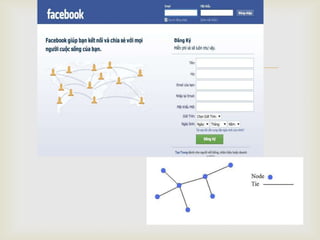
A social network includes a set of actors (“nodes”) and the relationships (“ties”/ “edges”) between these actors (Wasserman & Faust 1994) A network consists of a set of actors or “nodes” along with a set of “ties” of specified type (such as friendship) that link them (Borgatti & Halgin 2011)Social structure created by communication among individuals and groups (Littlejohn & Foss 2008)Network?
Line of Communication
FORMALCEOsSaleMarketingFinanceHRABCDINFORMAL
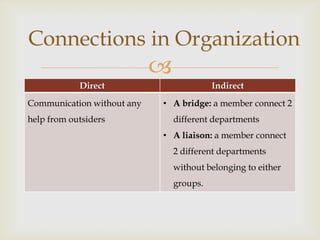
Connections in Organization
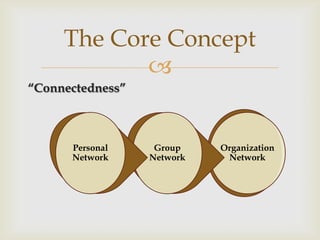
“Connectedness”The Core ConceptOrganization NetworkGroup NetworkPersonal Network
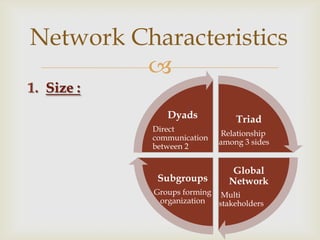
Network CharacteristicsSize : Triad Relationship  among 3 sidesDyadsDirect communication between 2Global Network Multi stakeholdersSubgroupsGroups forming organization
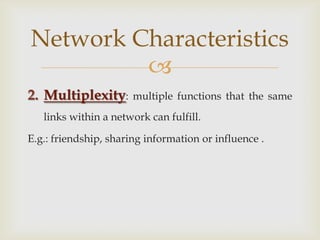
Multiplexity: multiple functions that the same links within a network can fulfill. E.g.: friendship, sharing information or influence .Network Characteristics
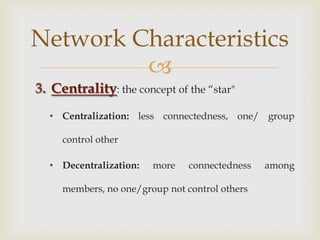
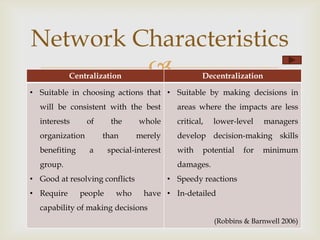
Centrality: the concept of the “star"Centralization: less connectedness, one/ group control other
Decentralization: more connectedness among members, no one/group not control othersNetwork Characteristics
Network Characteristics
http://www.youtube.com/watch?v=ySG64wdojwE
Group Activities
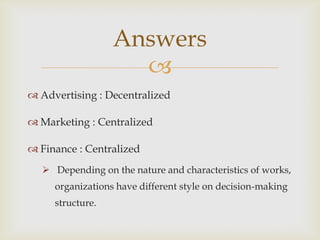
Advertising : Decentralized Marketing : Centralized Finance : Centralized  Depending on the nature and characteristics of works, organizations have different style on decision-making structure. Answers
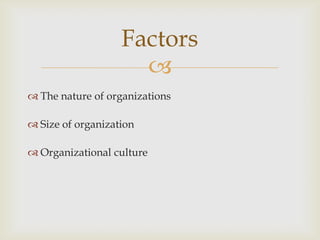
The nature of organizations Size of organizationOrganizational culture Factors
In real case, how can we apply this theory on organization?Right type of structure Sharing information and exchange resourcesEnhance social influencesApplication

Network Theory

  • 1.
  • 2.
    Network TheoryCOMM2378 TCPLecturer:Duong Trong HueTran Ngoc Son - s3245709Hoang Duyen Ha - s3245615
  • 3.
    Social network theory,social network analysis or network analysisIdea of ‘social network’: over a century, complex set of relationships between members of social systems at all scales, from interpersonal to international (Social network analysis: Theory and applications 2011)In 1954, Barnes coined the credible concept of social networks.Origin of Network Theory
  • 4.
    A social networkincludes a set of actors (“nodes”) and the relationships (“ties”/ “edges”) between these actors (Wasserman & Faust 1994) A network consists of a set of actors or “nodes” along with a set of “ties” of specified type (such as friendship) that link them (Borgatti & Halgin 2011)Social structure created by communication among individuals and groups (Littlejohn & Foss 2008)Network?
  • 6.
  • 7.
  • 8.
  • 9.
    “Connectedness”The Core ConceptOrganizationNetworkGroup NetworkPersonal Network
  • 10.
    Network CharacteristicsSize :Triad Relationship among 3 sidesDyadsDirect communication between 2Global Network Multi stakeholdersSubgroupsGroups forming organization
  • 11.
    Multiplexity: multiple functionsthat the same links within a network can fulfill. E.g.: friendship, sharing information or influence .Network Characteristics
  • 12.
    Centrality: the conceptof the “star"Centralization: less connectedness, one/ group control other
  • 13.
    Decentralization: more connectednessamong members, no one/group not control othersNetwork Characteristics
  • 14.
  • 15.
  • 16.
  • 17.
    Advertising : DecentralizedMarketing : Centralized Finance : Centralized Depending on the nature and characteristics of works, organizations have different style on decision-making structure. Answers
  • 18.
    The nature oforganizations Size of organizationOrganizational culture Factors
  • 19.
    In real case,how can we apply this theory on organization?Right type of structure Sharing information and exchange resourcesEnhance social influencesApplication
  • 20.
    Borgatti, PS &Halgin, SD 2011, ‘On Network Theory’, Organization Science, Articles in Advance, pp. 1-14.Littlejohn, SW & Foss, KA 2008, ‘Network Theory’, Theories of Human Communication , 9thedn, CengageLearning, Wadsmorth, CA, pp. 260-262., ‘Organization Theory: Concepts and cases’, 5thedn, Pearson Education Australia, NSW. Malone, T 2004, Making the Decision to Decentralize, 29 March, viewed 13 August 2011, http://hbswk.hbs.edu/archive/4020.html‘Social connectedness’ 2010, The Social Report, viewed 20 August 2011, <http://socialreport.msd.govt.nz/social-connectedness/>.‘Social network analysis: Theory and applications’ 2011, WF ED 543 Evaluation of Investments in Workforce Education and Development, 3 January, PENNSTATE University, USA.Wasserman, S & Faust, K 1994, Social network analysis: methods and applications, Cambridge University Press, USA.References

Editor's Notes

  • #10 Social connectedness refers to the relationships people have with others and the benefits these relationships can bring to the individual as well as to society.