

e-Research and the Demise
of the Scholarly Article
David De Roure
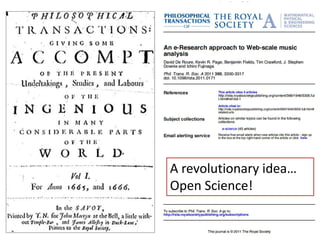
A revolutionary idea…
Open Science!
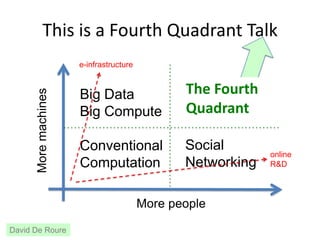
This is a Fourth Quadrant Talk
More machines

e-infrastructure

Big Data
Big Compute

The Fourth
The Future!

Conventional
Computation

Social
Networking

Quadrant

More people
David De Roure

online
R&D
Christine Borgman
First
Research Councils UK
Notifications and automatic re-runs
Autonomic
Curation

Self-repair
New research?

Machines are users too
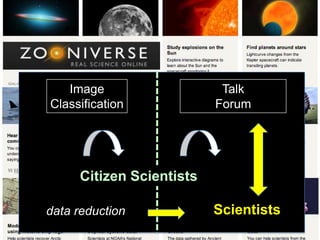
Image
Classification

Talk
Forum

Citizen Scientists
data reduction

Scientists
Edwards, P. N., et al. (2013) Knowledge Infrastructures: Intellectual Frameworks and
Research Challenges. Ann Arbor: Deep Blue. http://hdl.handle.net/2027.42/97552
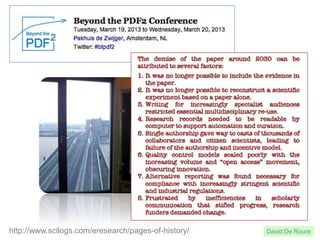
http://www.scilogs.com/eresearch/pages-of-history/

David De Roure
http://www.scilogs.com/eresearch/pages-of-history/
David De Roure
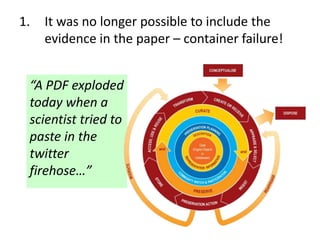
1.

It was no longer possible to include the
evidence in the paper – container failure!

“A PDF exploded
today when a
scientist tried to
paste in the
twitter
firehose…”
2.

It was no longer possible to reconstruct a
scientific experiment based on a paper alone
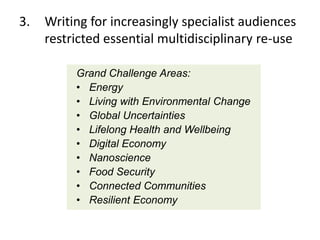
3.

Writing for increasingly specialist audiences
restricted essential multidisciplinary re-use
Grand Challenge Areas:
• Energy
• Living with Environmental Change
• Global Uncertainties
• Lifelong Health and Wellbeing
• Digital Economy
• Nanoscience
• Food Security
• Connected Communities
• Resilient Economy
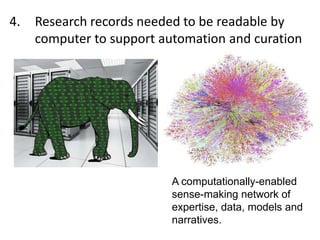
4.

Research records needed to be readable by
computer to support automation and curation

A computationally-enabled
sense-making network of
expertise, data, models and
narratives.
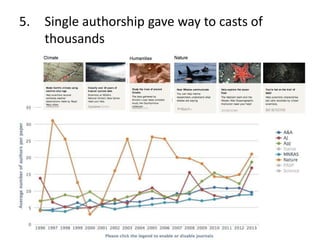
5.

Single authorship gave way to casts of
thousands
6.

Quality control models scaled poorly with
the increasing volume

Filter, Publish, Filter, Publish, …
Like big data, publishing has
increasing volume, variety and
velocity
But what about veracity?
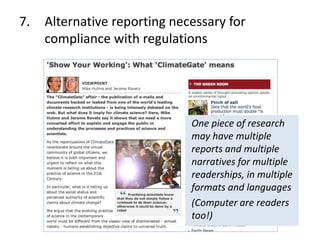
7.

Alternative reporting necessary for
compliance with regulations

One piece of research
may have multiple
reports and multiple
narratives for multiple
readerships, in multiple
formats and languages
(Computer are readers
too!)
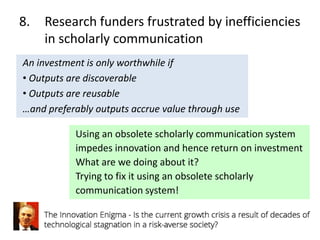
8.

Research funders frustrated by inefficiencies
in scholarly communication

An investment is only worthwhile if
• Outputs are discoverable
• Outputs are reusable
…and preferably outputs accrue value through use
Using an obsolete scholarly communication system
impedes innovation and hence return on investment
What are we doing about it?
Trying to fix it using an obsolete scholarly
communication system!
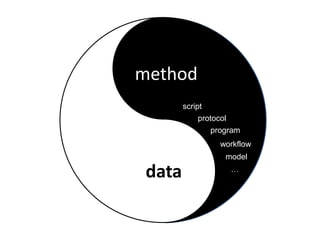
Big data elephant versus sense-making network?

The challenge is to foster the co-constituted socio-technical
system on the right i.e. a computationally-enabled sensemaking network of humans and machines sharing social
objects… not just papers but
data, models, software, narratives – new digital artefacts we
call research objects.
method
script
protocol
program
workflow
model

data

…
Neil Chue Hong
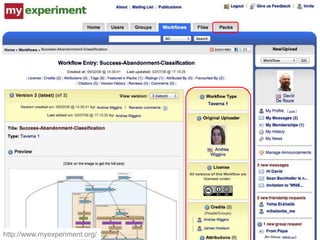
http://www.myexperiment.org/
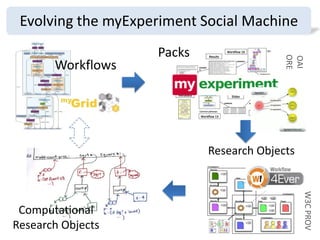
Evolving the myExperiment Social Machine
OAI
ORE

Workflows

Packs

Research Objects

W3C PROV

Computational
Research Objects
The R dimensions
Reusable. The key tenet of Research Replayable. Studies might involve
Objects is to support the sharing and single investigations that happen in
milliseconds or protracted processes
reuse of data, methods and
that take years.
processes.
Referenceable. If research objects
Repurposeable. Reuse may also
are to augment or replace traditional
involve the reuse of constituent
publication methods, then they must
parts of the Research Object.
be referenceable or citeable.
Repeatable. There should be
sufficient information in a Research
Object to be able to repeat the
study, perhaps years later.

Reproducible. A third party can

Revealable. Third parties must be

able to audit the steps performed in
the research in order to be convinced
of the validity of results.

Respectful. Explicit representations
start with the same inputs and
methods and see if a prior result can of the provenance, lineage and flow
of intellectual property.
be confirmed.
http://www.scilogs.com/eresearch/replacing-the-paper-the-twelve-rs-of-the-e-research-record/
Jun Zhao

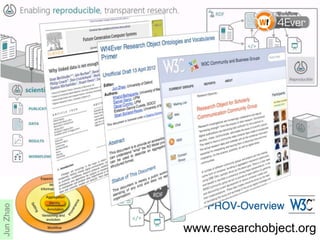
www.researchobject.org
The Order of Social Machines
Real life is and must be full of all kinds of social
constraint – the very processes from which
society arises. Computers can help if we use
them to create abstract social machines on
the Web: processes in which the people do
the creative work and the machine does the
administration… The stage is set for an
evolutionary growth of new social engines.
Berners-Lee, Weaving the Web, 1999
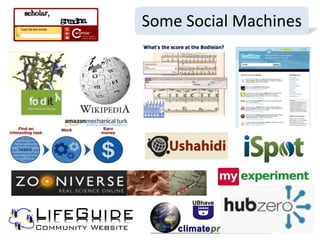
Some Social Machines
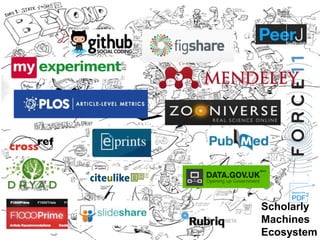
Scholarly
Machines
Ecosystem
Discussion points
1. Citation in tomorrow’s sense-making
network of humans and machines:
– What are the artefacts / social objects?
– How and why are they cited?

2. Think about an ecosystem of interacting
Scholarly Social Machines
3. Science as a Social Machine?
Thanks to Christine Borgman, Iain Buchan, Neil Chue
Hong, Jun Zhao, Carole
Goble, FORCE11, myExperiment, Software Sustainability
Institute, wf4ever and SOCIAM

david.deroure@oerc.ox.ac.uk
www.oerc.ox.ac.uk/people/dder
http://www.scilogs.com/eresearch
@dder
www.oerc.ox.ac.uk
www.force11.org
www.researchobject.org
www.software.ac.uk
sociam.org

e-Research and the Demise of the Scholarly Article

  • 1.
    e-Research and theDemise of the Scholarly Article David De Roure
  • 2.
  • 3.
    This is aFourth Quadrant Talk More machines e-infrastructure Big Data Big Compute The Fourth The Future! Conventional Computation Social Networking Quadrant More people David De Roure online R&D
  • 4.
  • 5.
  • 6.
  • 7.
    Notifications and automaticre-runs Autonomic Curation Self-repair New research? Machines are users too
  • 8.
  • 9.
    Edwards, P. N.,et al. (2013) Knowledge Infrastructures: Intellectual Frameworks and Research Challenges. Ann Arbor: Deep Blue. http://hdl.handle.net/2027.42/97552
  • 10.
  • 11.
  • 12.
    1. It was nolonger possible to include the evidence in the paper – container failure! “A PDF exploded today when a scientist tried to paste in the twitter firehose…”
  • 13.
    2. It was nolonger possible to reconstruct a scientific experiment based on a paper alone
  • 14.
    3. Writing for increasinglyspecialist audiences restricted essential multidisciplinary re-use Grand Challenge Areas: • Energy • Living with Environmental Change • Global Uncertainties • Lifelong Health and Wellbeing • Digital Economy • Nanoscience • Food Security • Connected Communities • Resilient Economy
  • 15.
    4. Research records neededto be readable by computer to support automation and curation A computationally-enabled sense-making network of expertise, data, models and narratives.
  • 16.
    5. Single authorship gaveway to casts of thousands
  • 17.
    6. Quality control modelsscaled poorly with the increasing volume Filter, Publish, Filter, Publish, … Like big data, publishing has increasing volume, variety and velocity But what about veracity?
  • 18.
    7. Alternative reporting necessaryfor compliance with regulations One piece of research may have multiple reports and multiple narratives for multiple readerships, in multiple formats and languages (Computer are readers too!)
  • 19.
    8. Research funders frustratedby inefficiencies in scholarly communication An investment is only worthwhile if • Outputs are discoverable • Outputs are reusable …and preferably outputs accrue value through use Using an obsolete scholarly communication system impedes innovation and hence return on investment What are we doing about it? Trying to fix it using an obsolete scholarly communication system!
  • 20.
    Big data elephantversus sense-making network? The challenge is to foster the co-constituted socio-technical system on the right i.e. a computationally-enabled sensemaking network of humans and machines sharing social objects… not just papers but data, models, software, narratives – new digital artefacts we call research objects.
  • 21.
  • 22.
  • 23.
  • 24.
    Evolving the myExperimentSocial Machine OAI ORE Workflows Packs Research Objects W3C PROV Computational Research Objects
  • 25.
    The R dimensions Reusable.The key tenet of Research Replayable. Studies might involve Objects is to support the sharing and single investigations that happen in milliseconds or protracted processes reuse of data, methods and that take years. processes. Referenceable. If research objects Repurposeable. Reuse may also are to augment or replace traditional involve the reuse of constituent publication methods, then they must parts of the Research Object. be referenceable or citeable. Repeatable. There should be sufficient information in a Research Object to be able to repeat the study, perhaps years later. Reproducible. A third party can Revealable. Third parties must be able to audit the steps performed in the research in order to be convinced of the validity of results. Respectful. Explicit representations start with the same inputs and methods and see if a prior result can of the provenance, lineage and flow of intellectual property. be confirmed. http://www.scilogs.com/eresearch/replacing-the-paper-the-twelve-rs-of-the-e-research-record/
  • 26.
  • 27.
    The Order ofSocial Machines Real life is and must be full of all kinds of social constraint – the very processes from which society arises. Computers can help if we use them to create abstract social machines on the Web: processes in which the people do the creative work and the machine does the administration… The stage is set for an evolutionary growth of new social engines. Berners-Lee, Weaving the Web, 1999
  • 28.
  • 29.
  • 30.
    Discussion points 1. Citationin tomorrow’s sense-making network of humans and machines: – What are the artefacts / social objects? – How and why are they cited? 2. Think about an ecosystem of interacting Scholarly Social Machines 3. Science as a Social Machine?
  • 31.
    Thanks to ChristineBorgman, Iain Buchan, Neil Chue Hong, Jun Zhao, Carole Goble, FORCE11, myExperiment, Software Sustainability Institute, wf4ever and SOCIAM david.deroure@oerc.ox.ac.uk www.oerc.ox.ac.uk/people/dder http://www.scilogs.com/eresearch @dder www.oerc.ox.ac.uk www.force11.org www.researchobject.org www.software.ac.uk sociam.org

Editor's Notes

  • #23 Thanks to Simon Hettrick for additional input to this slide.