Mapping
disciplinary mobility
for tackling complex
problems
Luis Enrique Marines (Mexico)
lemarines.com
Models and processes of systemic design
—
Presented @ Politecnico di Torino - Campus Lingotto
24th October, 2018
Ciao!
Luis Enrique Marines Hernández
BA Graphic Communication Design
UAM-A (Mexico)
Former Research Assistant
UBC Policy Studio (Canada)
Visual Design Consultant
INSITUM (Mexico)
Latin designerd based in Mexico City. Knowmad and
communicaction strategist with academic and professional
background working for projects that involve research, visual
communication and strategic design in Mexico, Argentina,
Uruguay and Canada.
lemarines.com
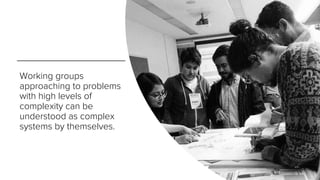
Working groups
approaching to problems
with high levels of
complexity can be
understood as complex
systems by themselves.
Working groups
approaching to problems
with high levels of
complexity can be
understood as complex
systems by themselves.
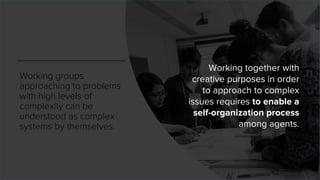
Working together with
creative purposes in order
to approach to complex
issues requires to enable a
self-organization process
among agents.
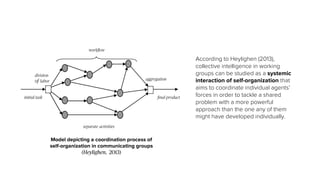
workflow
aggregation
division
of labor
initial task final product
separate activities
Model depicting a coordination process of
self-organization in communicating groups
(Heylighen, 2013)
According to Heylighen (2013),
collective intelligence in working
groups can be studied as a systemic
interaction of self-organization that
aims to coordinate individual agents’
forces in order to tackle a shared
problem with a more powerful
approach than the one any of them
might have developed individually.
Adaptation of
situations/problems pyramid
(González-Castillo, 2015)
Adaptation of disciplinary
orientations pyramid
(González-Castillo, 2015)
Isolated phenomena
Simple systems
Complex systems
Accumulative
impact on the
environment
Experimental world
Real world
Monodisciplinarity
Multidisciplinarity
Interdisciplinarity
Transdisciplinarity
Work at a lab
Wprk over reality
THE NATURE OF
THE PROBLEM
THE GROUP’S REQUIRED
ORIENTATION
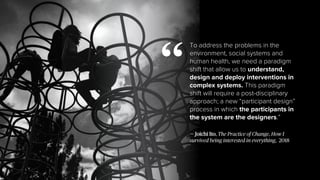
To address the problems in the
environment, social systems and
human health, we need a paradigm
shift that allow us to understand,
design and deploy interventions in
complex systems. This paradigm
shift will require a post-disciplinary
approach; a new “participant design”
process in which the participants in
the system are the designers.”
— Joichi Ito, The Practice of Change, How I
survived being interested in everything, 2018
“
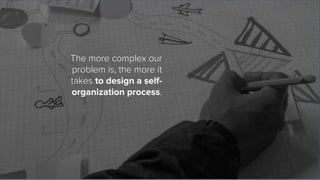
The more complex our
problem is, the more it
takes to design a self-
organization process.
Supongamos que éste es un individuo
cuyas estrategias están encaminadas hacia
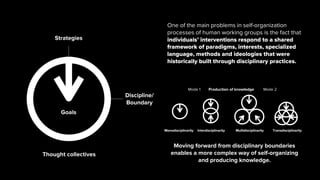
determinado resultado dentro de su disciplina. One of the main problems in self-organization
processes of human working groups is the fact that
individuals’ interventions respond to a shared
framework of paradigms, interests, specialized
language, methods and ideologies that were
historically built through disciplinary practices.
Goals
Strategies
Discipline/
Boundary
Thought collectives
Esta lógica permite
comprender las
orientaciones que
toma la interacción
entre disciplinas
Mode 1 Production of knowledge
Monodisciplinarity Interdisciplinarity Multidisciplinarity Transdisciplinarity
Mode 2
Moving forward from disciplinary boundaries
enables a more complex way of self-organizing
and producing knowledge.
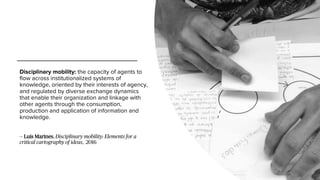
Disciplinary mobility: the capacity of agents to
flow across institutionalized systems of
knowledge, oriented by their interests of agency,
and regulated by diverse exchange dynamics
that enable their organization and linkage with
other agents through the consumption,
production and application of information and
knowledge.
— Luis Marines, Disciplinary mobility: Elements for a
critical cartography of ideas, 2016
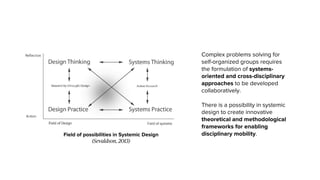
Field of possibilities in Systemic Design
(Sevaldson, 2013)
Complex problems solving for
self-organized groups requires
the formulation of systems-
oriented and cross-disciplinary
approaches to be developed
collaboratively.
There is a possibility in systemic
design to create innovative
theoretical and methodological
frameworks for enabling
disciplinary mobility.
The challenge
• To design an experience that helps
understanding how our disciplines shape
the way we approach to complex
problems and how we interact with other
individuals while working in a group.
• To make those interactions explicit through
visual thinking tools.
• To create an interactive dynamic that
promotes disciplinary mobility in self-
organizing groups.
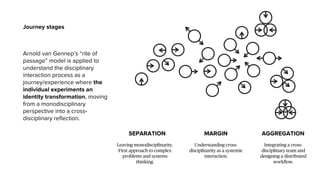
Journey stages
Adaptation of Arnold van
Gennep’s “rite of passage”
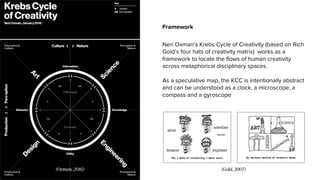
Framework
Neri Oxman’s Krebs
Cycle of Creativity
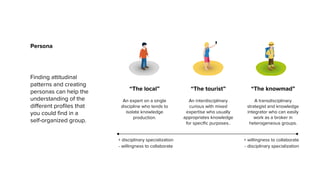
Persona
John Moravec’s
concept of “knowmad”
“… a nomadic knowledge and
innovation worker […] who can
instantly reconfigure and
recontextualize their work
environments and relationships.”
(Moravec, 2008)
“a map that describes the
perpetuation of creative energy […]
(across) four modalities of human
creativity—Science, Engineering,
Design and Art—.”
(Oxman, 2016)
“rites which accompany every change of
state and are marked by three phases:
separation, margin, and aggregation.”
(Turner, 1966)
Adaptation of Arnold van
Gennep’s “rite of passage”
Neri Oxman’s Krebs
Cycle of Creativity
John Moravec’s
concept of “knowmad”
“… a nomadic knowledge and
innovation worker […] who can
instantly reconfigure and
recontextualize their work
environments and relationships.”
(Moravec, 2008)
“a map that describes the
perpetuation of creative energy […]
(across) four modalities of human
creativity—Science, Engineering,
Design and Art—.”
(Oxman, 2016)
“rites which accompany every change of
state and are marked by three phases:
separation, margin, and aggregation.”
(Turner, 1966)
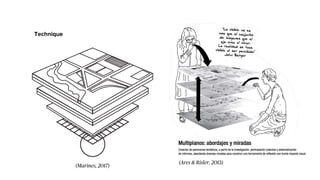
Technique
GIGA-mapping
“GIGA-mapping is super
extensive mapping across multiple layers
and scales, investigating relations between
seemingly separated categories and so
implementing boundary critique to the
conception and framing of systems.”
(Sevaldson, 2011)
Journey stages Framework Persona
SEPARATION MARGIN AGGREGATION
Arnold van Gennep’s “rite of
passage” model is applied to
understand the disciplinary
interaction process as a
journey/experience where the
individual experiments an
identity transformation, moving
from a monodisciplinary
perspective into a cross-
disciplinary reflection.
Leaving monodisciplinarity.
First approach to complex
problems and systems
thinking.
Understanding cross-
disciplinarity as a systemic
interaction.
Integrating a cross-
disciplinary team and
designing a distributed
workflow.
Journey stages
(Oxman, 2016)
Neri Oxman’s Krebs Cycle of Creativity (based on Rich
Gold’s four hats of creativity matrix) works as a
framework to locate the flows of human creativity
across metaphorical disciplinary spaces.
As a speculative map, the KCC is intentionally abstract
and can be understood as a clock, a microscope, a
compass and a gyroscope
Framework
(Gold, 2007)
THE LOCAL
Es experto en su área de
conocimiento y domina las
estrategias más efectivas
para generar soluciones
prácticas a los problemas
que enfrenta. Sin embargo,
su nivel de especialización
restringe sus interacciones y
las reduce a un quehacer casi
individual. Regularmente se
siente frustrado al no generar
el impacto deseado desde su
única disciplina.
THE TOURIST
Además de haberse formado
originalmente en un campo de
conocimiento, manifiesta una
constante curiosidad por conocer
métodos y estrategias de otras
áreas que puedan vincularse con
su quehacer individual.
Sabe trabajar en equipo, aunque
regularmente sólo busca benefi-
ciarse del trabajo de otros para
mejorar sus proyectos y la forma
de entender los problemas a los
que se enfrenta.
THE KNOWMAD
Curioso nato. Su formación
disciplinaria no restringe su
producción creativa, por lo que
sus proyectos son diversos
al igual que sus capacidades
para desarrollarlos. Valora
el trabajo en equipo y busca
mezclar conocimientos para
generar sinergias entre sus
colaboradores, crear métodos
alternativos y soluciones
integrales. Asume tareas y
coordina el flujo de trabajo.
Finding attitudinal
patterns and creating
personas can help the
understanding of the
different profiles that
you could find in a
self-organized group.
“The local”
An expert on a single
discipline who tends to
isolate knowledge
production.
“The tourist”
An interdisciplinary
curious with mixed
expertise who usually
appropriates knowledge
for specific purposes..
“The knowmad”
A transdisciplinary
strategist and knowledge
integrator who can easily
work as a broker in
heterogeneous groups.
Persona
+ disciplinary specialization + willingness to collaborate
- disciplinary specialization- willingness to collaborate
(Ares & Risler, 2013)
Technique
(Marines, 2017)
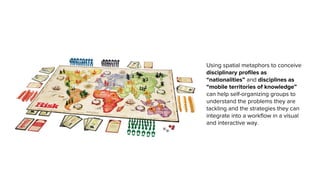
Using spatial metaphors to conceive
disciplinary profiles as
“nationalities” and disciplines as
“mobile territories of knowledge”
can help self-organizing groups to
understand the problems they are
tackling and the strategies they can
integrate into a workflow in a visual
and interactive way.
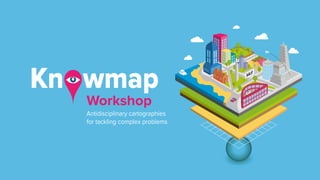
Workshop
Antidisciplinary cartographies
for tackling complex problems
— Separation— — Margin— — Aggregation—
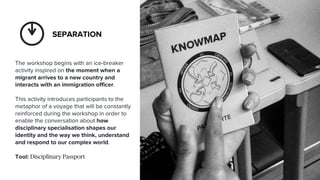
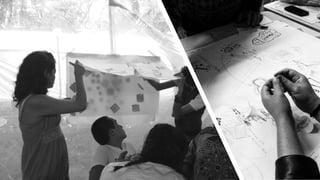
SEPARATION
The workshop begins with an ice-breaker
activity inspired on the moment when a
migrant arrives to a new country and
interacts with an immigration officer.
This activity introduces participants to the
metaphor of a voyage that will be constantly
reinforced during the workshop in order to
enable the conversation about how
disciplinary specialisation shapes our
identity and the way we think, understand
and respond to our complex world.
Tool: Disciplinary Passport
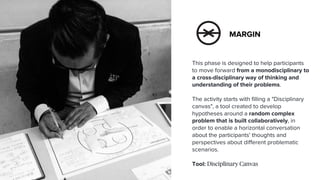
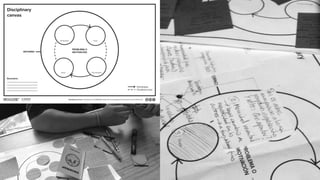
MARGIN
This phase is designed to help participants
to move forward from a monodisciplinary to
a cross-disciplinary way of thinking and
understanding of their problems.
The activity starts with filling a "Disciplinary
canvas", a tool created to develop
hypotheses around a random complex
problem that is built collaboratively, in
order to enable a horizontal conversation
about the participants' thoughts and
perspectives about different problematic
scenarios.
Tool: Disciplinary Canvas
— Separation— — Margin— — Aggregation—
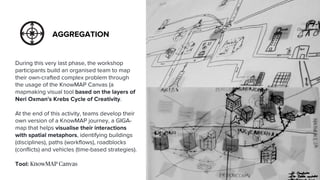
AGGREGATION
During this very last phase, the workshop
participants build an organised team to map
their own-crafted complex problem through
the usage of the KnowMAP Canvas (a
mapmaking visual tool based on the layers of
Neri Oxman's Krebs Cycle of Creativity.
At the end of this activity, teams develop their
own version of a KnowMAP journey, a GIGA-
map that helps visualise their interactions
with spatial metaphors, identifying buildings
(disciplines), paths (workflows), roadblocks
(conflicts) and vehicles (time-based strategies).
Tool: KnowMAP Canvas
— Aggregation—
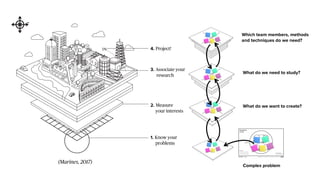
Conoce
Know
Mide
Measure
Asocia
Associate
Proyecta
Project
What do we want to create?
What do we need to study?
Which team members, methods
and techniques do we need?
2. Measure
your interests
3. Associate your
research
4. Project!
1. Know your
problems
Complex problem
(Marines, 2017)
Thank you!
lemarines.com
Looking for feedback,
collaborations and future
workshop sessions!
© 2018 Luis Enrique Marines Hernández

Mapping disciplinary mobility for tackling complex problems

  • 1.
    Mapping disciplinary mobility for tacklingcomplex problems Luis Enrique Marines (Mexico) lemarines.com Models and processes of systemic design — Presented @ Politecnico di Torino - Campus Lingotto 24th October, 2018
  • 2.
    Ciao! Luis Enrique MarinesHernández BA Graphic Communication Design UAM-A (Mexico) Former Research Assistant UBC Policy Studio (Canada) Visual Design Consultant INSITUM (Mexico) Latin designerd based in Mexico City. Knowmad and communicaction strategist with academic and professional background working for projects that involve research, visual communication and strategic design in Mexico, Argentina, Uruguay and Canada. lemarines.com
  • 3.
    Working groups approaching toproblems with high levels of complexity can be understood as complex systems by themselves.
  • 4.
    Working groups approaching toproblems with high levels of complexity can be understood as complex systems by themselves. Working together with creative purposes in order to approach to complex issues requires to enable a self-organization process among agents.
  • 5.
    workflow aggregation division of labor initial taskfinal product separate activities Model depicting a coordination process of self-organization in communicating groups (Heylighen, 2013) According to Heylighen (2013), collective intelligence in working groups can be studied as a systemic interaction of self-organization that aims to coordinate individual agents’ forces in order to tackle a shared problem with a more powerful approach than the one any of them might have developed individually.
  • 6.
    Adaptation of situations/problems pyramid (González-Castillo,2015) Adaptation of disciplinary orientations pyramid (González-Castillo, 2015) Isolated phenomena Simple systems Complex systems Accumulative impact on the environment Experimental world Real world Monodisciplinarity Multidisciplinarity Interdisciplinarity Transdisciplinarity Work at a lab Wprk over reality THE NATURE OF THE PROBLEM THE GROUP’S REQUIRED ORIENTATION
  • 7.
    To address theproblems in the environment, social systems and human health, we need a paradigm shift that allow us to understand, design and deploy interventions in complex systems. This paradigm shift will require a post-disciplinary approach; a new “participant design” process in which the participants in the system are the designers.” — Joichi Ito, The Practice of Change, How I survived being interested in everything, 2018 “
  • 8.
    The more complexour problem is, the more it takes to design a self- organization process.
  • 9.
    Supongamos que éstees un individuo cuyas estrategias están encaminadas hacia determinado resultado dentro de su disciplina. One of the main problems in self-organization processes of human working groups is the fact that individuals’ interventions respond to a shared framework of paradigms, interests, specialized language, methods and ideologies that were historically built through disciplinary practices. Goals Strategies Discipline/ Boundary Thought collectives Esta lógica permite comprender las orientaciones que toma la interacción entre disciplinas Mode 1 Production of knowledge Monodisciplinarity Interdisciplinarity Multidisciplinarity Transdisciplinarity Mode 2 Moving forward from disciplinary boundaries enables a more complex way of self-organizing and producing knowledge.
  • 10.
    Disciplinary mobility: thecapacity of agents to flow across institutionalized systems of knowledge, oriented by their interests of agency, and regulated by diverse exchange dynamics that enable their organization and linkage with other agents through the consumption, production and application of information and knowledge. — Luis Marines, Disciplinary mobility: Elements for a critical cartography of ideas, 2016
  • 11.
    Field of possibilitiesin Systemic Design (Sevaldson, 2013) Complex problems solving for self-organized groups requires the formulation of systems- oriented and cross-disciplinary approaches to be developed collaboratively. There is a possibility in systemic design to create innovative theoretical and methodological frameworks for enabling disciplinary mobility.
  • 12.
    The challenge • Todesign an experience that helps understanding how our disciplines shape the way we approach to complex problems and how we interact with other individuals while working in a group. • To make those interactions explicit through visual thinking tools. • To create an interactive dynamic that promotes disciplinary mobility in self- organizing groups.
  • 13.
    Journey stages Adaptation ofArnold van Gennep’s “rite of passage” Framework Neri Oxman’s Krebs Cycle of Creativity Persona John Moravec’s concept of “knowmad” “… a nomadic knowledge and innovation worker […] who can instantly reconfigure and recontextualize their work environments and relationships.” (Moravec, 2008) “a map that describes the perpetuation of creative energy […] (across) four modalities of human creativity—Science, Engineering, Design and Art—.” (Oxman, 2016) “rites which accompany every change of state and are marked by three phases: separation, margin, and aggregation.” (Turner, 1966)
  • 14.
    Adaptation of Arnoldvan Gennep’s “rite of passage” Neri Oxman’s Krebs Cycle of Creativity John Moravec’s concept of “knowmad” “… a nomadic knowledge and innovation worker […] who can instantly reconfigure and recontextualize their work environments and relationships.” (Moravec, 2008) “a map that describes the perpetuation of creative energy […] (across) four modalities of human creativity—Science, Engineering, Design and Art—.” (Oxman, 2016) “rites which accompany every change of state and are marked by three phases: separation, margin, and aggregation.” (Turner, 1966) Technique GIGA-mapping “GIGA-mapping is super extensive mapping across multiple layers and scales, investigating relations between seemingly separated categories and so implementing boundary critique to the conception and framing of systems.” (Sevaldson, 2011) Journey stages Framework Persona
  • 15.
    SEPARATION MARGIN AGGREGATION Arnoldvan Gennep’s “rite of passage” model is applied to understand the disciplinary interaction process as a journey/experience where the individual experiments an identity transformation, moving from a monodisciplinary perspective into a cross- disciplinary reflection. Leaving monodisciplinarity. First approach to complex problems and systems thinking. Understanding cross- disciplinarity as a systemic interaction. Integrating a cross- disciplinary team and designing a distributed workflow. Journey stages
  • 16.
    (Oxman, 2016) Neri Oxman’sKrebs Cycle of Creativity (based on Rich Gold’s four hats of creativity matrix) works as a framework to locate the flows of human creativity across metaphorical disciplinary spaces. As a speculative map, the KCC is intentionally abstract and can be understood as a clock, a microscope, a compass and a gyroscope Framework (Gold, 2007)
  • 17.
    THE LOCAL Es expertoen su área de conocimiento y domina las estrategias más efectivas para generar soluciones prácticas a los problemas que enfrenta. Sin embargo, su nivel de especialización restringe sus interacciones y las reduce a un quehacer casi individual. Regularmente se siente frustrado al no generar el impacto deseado desde su única disciplina. THE TOURIST Además de haberse formado originalmente en un campo de conocimiento, manifiesta una constante curiosidad por conocer métodos y estrategias de otras áreas que puedan vincularse con su quehacer individual. Sabe trabajar en equipo, aunque regularmente sólo busca benefi- ciarse del trabajo de otros para mejorar sus proyectos y la forma de entender los problemas a los que se enfrenta. THE KNOWMAD Curioso nato. Su formación disciplinaria no restringe su producción creativa, por lo que sus proyectos son diversos al igual que sus capacidades para desarrollarlos. Valora el trabajo en equipo y busca mezclar conocimientos para generar sinergias entre sus colaboradores, crear métodos alternativos y soluciones integrales. Asume tareas y coordina el flujo de trabajo. Finding attitudinal patterns and creating personas can help the understanding of the different profiles that you could find in a self-organized group. “The local” An expert on a single discipline who tends to isolate knowledge production. “The tourist” An interdisciplinary curious with mixed expertise who usually appropriates knowledge for specific purposes.. “The knowmad” A transdisciplinary strategist and knowledge integrator who can easily work as a broker in heterogeneous groups. Persona + disciplinary specialization + willingness to collaborate - disciplinary specialization- willingness to collaborate
  • 18.
    (Ares & Risler,2013) Technique (Marines, 2017)
  • 19.
    Using spatial metaphorsto conceive disciplinary profiles as “nationalities” and disciplines as “mobile territories of knowledge” can help self-organizing groups to understand the problems they are tackling and the strategies they can integrate into a workflow in a visual and interactive way.
  • 20.
  • 21.
    — Separation— —Margin— — Aggregation— SEPARATION The workshop begins with an ice-breaker activity inspired on the moment when a migrant arrives to a new country and interacts with an immigration officer. This activity introduces participants to the metaphor of a voyage that will be constantly reinforced during the workshop in order to enable the conversation about how disciplinary specialisation shapes our identity and the way we think, understand and respond to our complex world. Tool: Disciplinary Passport
  • 23.
    MARGIN This phase isdesigned to help participants to move forward from a monodisciplinary to a cross-disciplinary way of thinking and understanding of their problems. The activity starts with filling a "Disciplinary canvas", a tool created to develop hypotheses around a random complex problem that is built collaboratively, in order to enable a horizontal conversation about the participants' thoughts and perspectives about different problematic scenarios. Tool: Disciplinary Canvas — Separation— — Margin— — Aggregation—
  • 25.
    AGGREGATION During this verylast phase, the workshop participants build an organised team to map their own-crafted complex problem through the usage of the KnowMAP Canvas (a mapmaking visual tool based on the layers of Neri Oxman's Krebs Cycle of Creativity. At the end of this activity, teams develop their own version of a KnowMAP journey, a GIGA- map that helps visualise their interactions with spatial metaphors, identifying buildings (disciplines), paths (workflows), roadblocks (conflicts) and vehicles (time-based strategies). Tool: KnowMAP Canvas — Aggregation—
  • 27.
    Conoce Know Mide Measure Asocia Associate Proyecta Project What do wewant to create? What do we need to study? Which team members, methods and techniques do we need? 2. Measure your interests 3. Associate your research 4. Project! 1. Know your problems Complex problem (Marines, 2017)
  • 28.
    Thank you! lemarines.com Looking forfeedback, collaborations and future workshop sessions! © 2018 Luis Enrique Marines Hernández