SOCIAL NETWORK 
( made easy ) ANALYSIS
happiness is best predicted 
by the breadth & depth 
of one’s social connections. 
- Robert Putnam
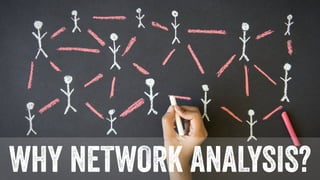
WHY NETWORK ANALYSIS?
reason #1 
The challenges we face are so complex 
they can’t be solved by any one 
organization.
The urgency and scale of social 
problems, coupled with the limited 
results to date, cry out for 
new approaches. 
- Jane Wei-Skillern, Nora Silver and Eric Heitz “Cracking the Network Code”
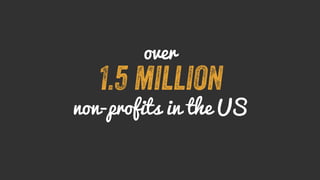
over 
1.5 million 
non-profits in the US
Organizations have been the lever 
through which we try to create social 
change for far too long. 
! 
We have to bring people together across 
sectors, from within and outside 
government, and from all walks of life.
Reason #2 
Even within organizations, hierarchies 
aren’t accurate representations of how 
work actually gets done.
Reason #2 
Even within organizations, hierarchies 
aren’t accurate representations of how 
work actually gets done. 
org charts lie!
Information doesn’t flow along 
organizational hierarchies. 
! 
Networks are a far more accurate picture 
of how work gets done. 
org charts lie!
Reason #3 
We must understand the 
status quo to overcome it.
The status quo is a result of the web of 
relationships and incentives among 
stakeholders (including us). 
! 
It’s not that we’re “stuck” — it’s that 
competing interests provide a balancing 
effect that resists change.
hi there! 
Jeff Mohr 
Cofounder & CEO of Kumu
Jeff Mohr 
Cofounder & CEO of Kumu 
my background 
systems 
networks 
social change
So… WHERE can SNA help?
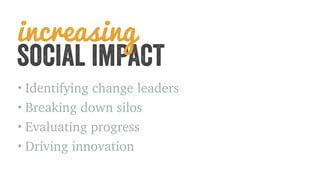
social impact increasing 
• Identifying change leaders 
• Breaking down silos 
• Evaluating progress 
• Driving innovation
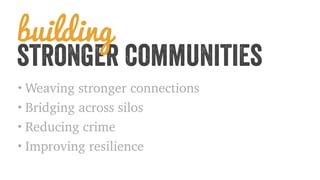
stronger communities building 
•Weaving stronger connections 
• Bridging across silos 
• Reducing crime 
• Improving resilience
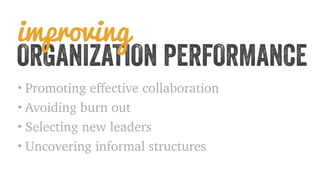
improving 
ORGANIZATION PERFORMANCE 
• Promoting effective collaboration 
• Avoiding burn out 
• Selecting new leaders 
• Uncovering informal structures
Great! How do i start?
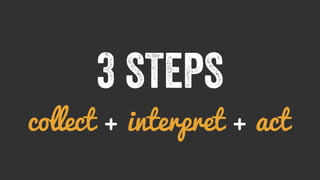
3 STEPS 
collect + interpret + act
Step 1 
COLLECT THE DATA
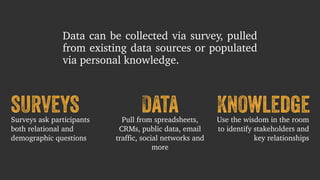
Data can be collected via survey, pulled 
from existing data sources or populated 
via personal knowledge. 
surveys Data Knowledge 
Pull from spreadsheets, 
CRMs, public data, email 
traffic, social networks and 
more 
Surveys ask participants 
both relational and 
demographic questions 
Use the wisdom in the room 
to identify stakeholders and 
key relationships
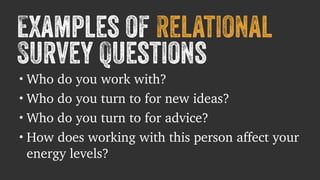
Examples of Relational 
Survey Questions 
•Who do you work with? 
•Who do you turn to for new ideas? 
•Who do you turn to for advice? 
•How does working with this person affect your 
energy levels?
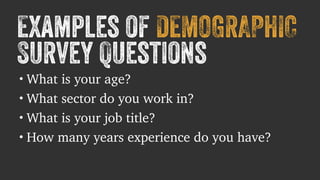
Examples of DEMOGRAPHIC 
Survey Questions 
•What is your age? 
•What sector do you work in? 
•What is your job title? 
•How many years experience do you have?
GREAT RESULTS ARE DRIVEN 
FROM GReAT QUESTIONs.
GREAT RESULTS ARE DRIVEN 
FROM GReAT QUESTIONs. 
!CHoose WISELY.
And Don’t be afraid to simulate 
holes in the data.
And Don’t be afraid to simulate 
holes in the data. 
just because they didn’t 
respond doesn’t mean they 
aren’t part of the network.
Step 2 
INTERPRET
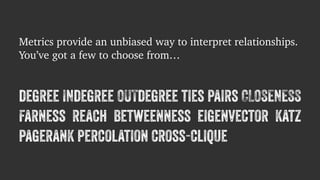
Metrics provide an unbiased way to interpret relationships. 
You’ve got a few to choose from… 
degree INdegree OUTdegree ties pairs CLOSENESS 
farness reach betweenness eigenvector katz 
pagerank percolation cross-clique
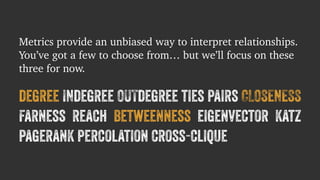
Metrics provide an unbiased way to interpret relationships. 
You’ve got a few to choose from… but we’ll focus on these 
three for now. 
degree INdegree OUTdegree ties pairs CLOSENESS 
farness reach betweenness eigenvector katz 
pagerank percolation cross-clique
Understanding the 
Core Metrics 
degree + closeness + betweenness
Degree 
Identifies local connectors and hubs
Degree 
Identifies local connectors and hubs 
by counting the number of connections 
for a given element
Degree WARNING 
Not necessarily the most influential or 
best connected to the wider network
Closeness 
Identifies those with high visibility about 
what’s happening across the network
Closeness 
Identifies those with high visibility about 
what’s happening across the network 
by measuring the distance from one 
element to all other elements
Closeness WARNING 
These people can quickly spread 
information (good or bad) 
across the network
Betweenness 
Identifies key bridges and those who 
control the flow of information
Betweenness 
Identifies key bridges and those who 
control the flow of information 
by counting the number of times an 
element lies on the shortest path 
between two other elements
Betweenness WARNING 
These people may be bottlenecks 
or single points of failure
Metrics are people too
Metrics are people too 
Each one reveals its own personality
let’s Focus 
on the extremes
two types of overly 
CENTRAL people
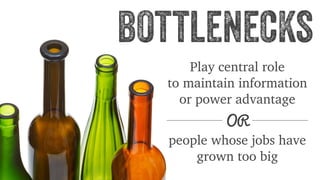
bottlenecks 
Play central role 
to maintain information 
or power advantage 
OR 
people whose jobs have 
grown too big
UNSUNG 
HEROES 
Engage selflessly to help 
the group in ways that 
often go unnoticed
people at the 
Borders of the network
bridges 
Share different types of expertise, broker 
information and connect across geographies
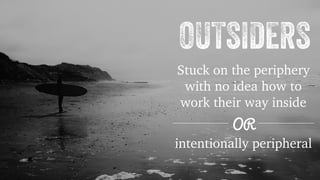
OUTSIDERS 
Stuck on the periphery 
with no idea how to 
work their way inside 
OR 
intentionally peripheral
WARNING 
Metrics only get 
You Started 
Use them to identify potential influencers 
and then validate with common sense
Step 3 
DO SOMETHING
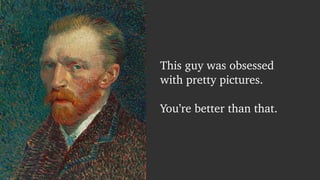
This guy was obsessed 
with pretty pictures.
This guy was obsessed 
with pretty pictures. 
! 
You’re better than that.
go beyond the pretty 
picture and get shit done. 
Use strong visualizations, compelling 
narrative, and convincing arguments 
to make your impact.
shameless plug 
Kumu helps you do all three 
Use strong visualizations, compelling 
narrative, and convincing arguments 
to make your impact.
a few caveats to 
Network Analysis 
• be data-informed, not data-driven 
• take results with a grain of salt 
• validate using common sense
let’s recap 
1. SNA helps tackle complex social problems. 
2. Use surveys, data, and local knowledge to build the network. 
3. Calculate metrics to identify key players within the network. 
4. Apply what you’ve learned to make a difference. 
5. Don’t forget to use common sense!
If you want to go quickly, go alone. 
If you want to go far, go together. 
- African Proverb
join us at Kumu.io
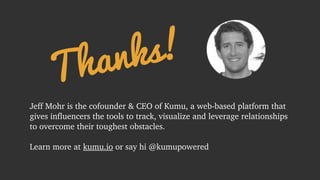
Thanks! 
Jeff Mohr is the cofounder & CEO of Kumu, a web-based platform that 
gives influencers the tools to track, visualize and leverage relationships 
to overcome their toughest obstacles. 
! 
Learn more at kumu.io or say hi @kumupowered

Social Network Analysis (SNA) Made Easy

  • 1.
    SOCIAL NETWORK (made easy ) ANALYSIS
  • 2.
    happiness is bestpredicted by the breadth & depth of one’s social connections. - Robert Putnam
  • 3.
  • 4.
    reason #1 Thechallenges we face are so complex they can’t be solved by any one organization.
  • 5.
    The urgency andscale of social problems, coupled with the limited results to date, cry out for new approaches. - Jane Wei-Skillern, Nora Silver and Eric Heitz “Cracking the Network Code”
  • 6.
    over 1.5 million non-profits in the US
  • 7.
    Organizations have beenthe lever through which we try to create social change for far too long. ! We have to bring people together across sectors, from within and outside government, and from all walks of life.
  • 8.
    Reason #2 Evenwithin organizations, hierarchies aren’t accurate representations of how work actually gets done.
  • 9.
    Reason #2 Evenwithin organizations, hierarchies aren’t accurate representations of how work actually gets done. org charts lie!
  • 10.
    Information doesn’t flowalong organizational hierarchies. ! Networks are a far more accurate picture of how work gets done. org charts lie!
  • 11.
    Reason #3 Wemust understand the status quo to overcome it.
  • 12.
    The status quois a result of the web of relationships and incentives among stakeholders (including us). ! It’s not that we’re “stuck” — it’s that competing interests provide a balancing effect that resists change.
  • 13.
    hi there! JeffMohr Cofounder & CEO of Kumu
  • 14.
    Jeff Mohr Cofounder& CEO of Kumu my background systems networks social change
  • 15.
    So… WHERE canSNA help?
  • 16.
    social impact increasing • Identifying change leaders • Breaking down silos • Evaluating progress • Driving innovation
  • 17.
    stronger communities building •Weaving stronger connections • Bridging across silos • Reducing crime • Improving resilience
  • 18.
    improving ORGANIZATION PERFORMANCE • Promoting effective collaboration • Avoiding burn out • Selecting new leaders • Uncovering informal structures
  • 19.
    Great! How doi start?
  • 20.
    3 STEPS collect+ interpret + act
  • 21.
  • 22.
    Data can becollected via survey, pulled from existing data sources or populated via personal knowledge. surveys Data Knowledge Pull from spreadsheets, CRMs, public data, email traffic, social networks and more Surveys ask participants both relational and demographic questions Use the wisdom in the room to identify stakeholders and key relationships
  • 23.
    Examples of Relational Survey Questions •Who do you work with? •Who do you turn to for new ideas? •Who do you turn to for advice? •How does working with this person affect your energy levels?
  • 24.
    Examples of DEMOGRAPHIC Survey Questions •What is your age? •What sector do you work in? •What is your job title? •How many years experience do you have?
  • 25.
    GREAT RESULTS AREDRIVEN FROM GReAT QUESTIONs.
  • 26.
    GREAT RESULTS AREDRIVEN FROM GReAT QUESTIONs. !CHoose WISELY.
  • 27.
    And Don’t beafraid to simulate holes in the data.
  • 28.
    And Don’t beafraid to simulate holes in the data. just because they didn’t respond doesn’t mean they aren’t part of the network.
  • 29.
  • 30.
    Metrics provide anunbiased way to interpret relationships. You’ve got a few to choose from… degree INdegree OUTdegree ties pairs CLOSENESS farness reach betweenness eigenvector katz pagerank percolation cross-clique
  • 31.
    Metrics provide anunbiased way to interpret relationships. You’ve got a few to choose from… but we’ll focus on these three for now. degree INdegree OUTdegree ties pairs CLOSENESS farness reach betweenness eigenvector katz pagerank percolation cross-clique
  • 32.
    Understanding the CoreMetrics degree + closeness + betweenness
  • 33.
    Degree Identifies localconnectors and hubs
  • 34.
    Degree Identifies localconnectors and hubs by counting the number of connections for a given element
  • 35.
    Degree WARNING Notnecessarily the most influential or best connected to the wider network
  • 36.
    Closeness Identifies thosewith high visibility about what’s happening across the network
  • 37.
    Closeness Identifies thosewith high visibility about what’s happening across the network by measuring the distance from one element to all other elements
  • 38.
    Closeness WARNING Thesepeople can quickly spread information (good or bad) across the network
  • 39.
    Betweenness Identifies keybridges and those who control the flow of information
  • 40.
    Betweenness Identifies keybridges and those who control the flow of information by counting the number of times an element lies on the shortest path between two other elements
  • 41.
    Betweenness WARNING Thesepeople may be bottlenecks or single points of failure
  • 42.
  • 43.
    Metrics are peopletoo Each one reveals its own personality
  • 44.
    let’s Focus onthe extremes
  • 45.
    two types ofoverly CENTRAL people
  • 46.
    bottlenecks Play centralrole to maintain information or power advantage OR people whose jobs have grown too big
  • 47.
    UNSUNG HEROES Engageselflessly to help the group in ways that often go unnoticed
  • 48.
    people at the Borders of the network
  • 49.
    bridges Share differenttypes of expertise, broker information and connect across geographies
  • 50.
    OUTSIDERS Stuck onthe periphery with no idea how to work their way inside OR intentionally peripheral
  • 51.
    WARNING Metrics onlyget You Started Use them to identify potential influencers and then validate with common sense
  • 52.
    Step 3 DOSOMETHING
  • 53.
    This guy wasobsessed with pretty pictures.
  • 54.
    This guy wasobsessed with pretty pictures. ! You’re better than that.
  • 55.
    go beyond thepretty picture and get shit done. Use strong visualizations, compelling narrative, and convincing arguments to make your impact.
  • 56.
    shameless plug Kumuhelps you do all three Use strong visualizations, compelling narrative, and convincing arguments to make your impact.
  • 57.
    a few caveatsto Network Analysis • be data-informed, not data-driven • take results with a grain of salt • validate using common sense
  • 58.
    let’s recap 1.SNA helps tackle complex social problems. 2. Use surveys, data, and local knowledge to build the network. 3. Calculate metrics to identify key players within the network. 4. Apply what you’ve learned to make a difference. 5. Don’t forget to use common sense!
  • 59.
    If you wantto go quickly, go alone. If you want to go far, go together. - African Proverb
  • 60.
    join us atKumu.io
  • 61.
    Thanks! Jeff Mohris the cofounder & CEO of Kumu, a web-based platform that gives influencers the tools to track, visualize and leverage relationships to overcome their toughest obstacles. ! Learn more at kumu.io or say hi @kumupowered