NETWORK
LITERACY
Essential Concepts and Core Ideas
As our world becomes increasingly connected through the use of networks that
allow instantaneous communication and the spread of information, the degree
of people’s understanding of how these networks work will play a major role in
determining how much society will benefit from this heightened connectivity. In
short, a networked society requires network literacy: basic knowledge about how
networks can be used as a tool for discovery and decision-making, and about both
their potential benefits and pitfalls, made accessible for all people living in today’s
networked world. Moreover, because even young children interact with networks
all day, every day, it is important that network literacy begins at a young age, and
because networks are present in all aspects of contemporary life, the consideration
of networks should be reflected throughout teaching practice in a cross-disciplinary
manner. Yet despite the importance and ubiquity of networks, the study of networks
is absent from current educational systems.
This brochure provides an initial step toward facilitating the development of
network literacy. It states basic ideas for the study of networks in plain language,
presenting seven essential concepts and more detailed core ideas that are described
in a concise manner. It can be used by everyone for teaching and learning. This
work was developed iteratively and collaboratively by a community of scientists and
practitioners who develop and use the cutting-edge science of networks. For more
information and additional resources about the network literacy initiative, please
visit the project website: http://sites.google.com/a/binghamton.edu/netscied
NETWORKS ARE
EVERYWHERE
The concept of networks is broad and
general, and it describes how things are
connected to each other. Networks are
present in every aspect of life.
There are networks that form the
technical infrastructure of our society—
e.g., communication systems, semantic
systems, the Internet, electrical grids,
the water supply, etc.
There are networks of people—e.g.,
families and friends, e-mail/text
exchanges, Facebook/Twitter/
Instagram, professional groups, etc.
There are economic networks—e.g.,
networks of products, financial
transactions, corporate partnerships,
international trades, etc.
There are biological and ecological
networks—e.g., food webs, gene/
protein interactions, neuronal networks,
pathways of disease spreading, etc.
There are cultural networks—e.g.,
language/literature/art connected by
their similarities, historical events linked
by causal chains, religions connected by
their shared roots, people connected to
events, etc.
Networks can exist at various spatial
and/or temporal scales.
1
1
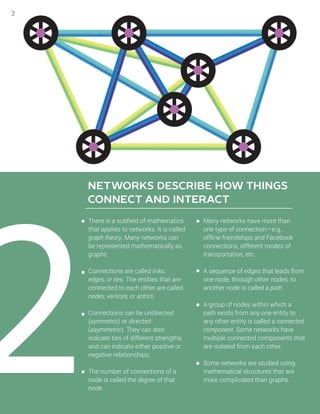
NETWORKS DESCRIBE HOW THINGS
CONNECT AND INTERACT
2
There is a subfield of mathematics
that applies to networks. It is called
graph theory. Many networks can
be represented mathematically as
graphs.
Connections are called links,
edges, or ties. The entities that are
connected to each other are called
nodes, vertices, or actors.
Connections can be undirected
(symmetric) or directed
(asymmetric). They can also
indicate ties of different strengths,
and can indicate either positive or
negative relationships.
The number of connections of a
node is called the degree of that
node.
Many networks have more than
one type of connection—e.g.,
offline friendships and Facebook
connections, different modes of
transportation, etc.
A sequence of edges that leads from
one node, through other nodes, to
another node is called a path.
A group of nodes within which a
path exists from any one entity to
any other entity is called a connected
component. Some networks have
multiple connected components that
are isolated from each other.
Some networks are studied using
mathematical structures that are
more complicated than graphs.
2
3
NETWORKS CAN HELP REVEAL PATTERNS
You can represent something as
a network by describing its parts
and how they are connected
to each other. Such a network
representation is a very powerful
way to study a system’s properties.
The properties in a network that
you can study include:
	 how the degrees are 		
distributed across nodes
	 which parts or connections
	 are most important 	
	 strengths and/or
	 weaknesses of the network
	 if there is any sub-structure
	 or hierarchy
	 how many steps, on
	 average, are needed to
	 move from one node to
	 another in the network
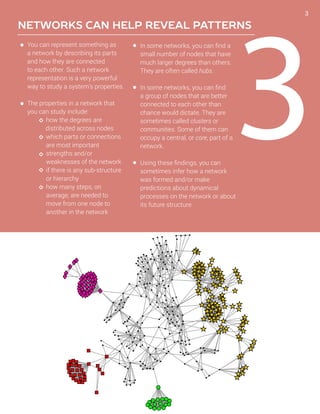
In some networks, you can find a
small number of nodes that have
much larger degrees than others.
They are often called hubs.
In some networks, you can find
a group of nodes that are better
connected to each other than
chance would dictate. They are
sometimes called clusters or
communities. Some of them can
occupy a central, or core, part of a
network.
Using these findings, you can
sometimes infer how a network
was formed and/or make
predictions about dynamical
processes on the network or about
its future structure.
3
4
Visualizations
can help provide
an understanding
of networks
Networks can be visualized in many
different ways.
You can draw a diagram of a network
by connecting nodes to each other
using edges.
There are a variety of tools available
for visualizing networks.
Visualization of a network often helps
to understand it and communicate
ideas about connectivity in an
intuitive, non-technical way.
Creative information design plays
a very important role in making an
effective visualization.
It is important to be careful
when interpreting and evaluating
visualizations, because they typically
do not tell the whole story about
networks.
4
4
Today’s Computer
technology allows
you to study real-
world networks
5Computer technology has dramatically
enhanced the ability to study networks,
and this is especially important for
large ones with rich structure.
There are many free software tools
available for network visualization and
analysis.
Using personal computers, everyone
(not just scientists) can construct,
visualize, and analyze networks.
Through the Internet, everyone has
access to many interesting network
data sets.
Computers allow you to simulate
hypothetical or virtual networks, as well
as to simulate dynamical processes on
both real and hypothetical networks.
Learning computer literacy skills opens
the door to myriad possibilities for a
career. These include scientist, data
analyst, software engineer, educator,
web developer, media creator, and
many others.
5
6NETWORKS HELP
YOU TO COMPARE
A WIDE VARIETY
OF SYSTEMS
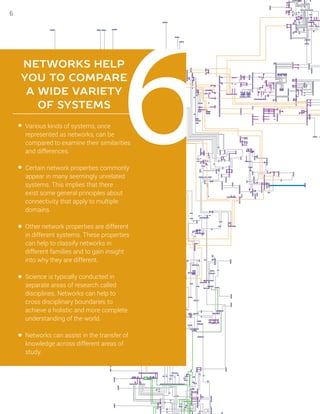
Various kinds of systems, once
represented as networks, can be
compared to examine their similarities
and differences.
Certain network properties commonly
appear in many seemingly unrelated
systems. This implies that there
exist some general principles about
connectivity that apply to multiple
domains.
Other network properties are different
in different systems. These properties
can help to classify networks in
different families and to gain insight
into why they are different.
Science is typically conducted in
separate areas of research called
disciplines. Networks can help to
cross disciplinary boundaries to
achieve a holistic and more complete
understanding of the world.
Networks can assist in the transfer of
knowledge across different areas of
study.
6
7
The structure of a network can
influence its state and vice versa
Network structure indicates how
parts are connected in a network.
Network state indicates the
properties of a network’s nodes
and edges.
Network structure and state can
each change over time.
The time scales on which network
structure and state co-evolve can
be either similar or different.
Network structure can influence
changes of network state.
Examples include the spread of
diseases, behaviors, or memes in a
social network, and traffic patterns
on the road network in a city.
Network state can influence
changes of network structure.
Examples include the creation of
new “following” edges in social
media and the construction of new
roads to address traffic jams.
7
Designed by Eri Yamamoto
eriyamamoto.wix.com/eydesigns
IMAGE CREDITS
Cover
“Map of Protein Interactions in Yeast”
Hawoong Jeong, Korea Advanced Institute of Science and Technology
Page 1 & Back cover
“Map of the Internet Showing Major Internet Service Providers”
Bill Cheswick
Copyright, Lumeta Corporation 2001 All Rights Reserved.
Page 2
“Build Your Own Network Graphic”
Copyright, New York Hall of Science 2004
Page 3
“Think Locally, Act Locally: The Detection of Small, Medium-Sized, and Large Communities in Large Networks”,
Physical Review E, Vol. 91, No. 1: 012821.
L. G. S. Jeub, K. Balachandran, M. A. Porter, P. J. Mucha, and M. W. Mahoney [2015].
Page 4
“Topology of the MBONE, the Internet’s Broadcast Backbone, Which Transmits Real-time Audio and Video
Across the Globe”
Elan Amir, University of California at Berkeley
Copyright 1996
Page 5 & Inside of Back Cover
“Flow of Email Among a Large Project Team. Each Node Represents a Person Color Coded by Department.”
Valdis Krebs
Copyright 2008
Page 6 & 8
“Router Pinball Graphic”
Copyright, New York Hall of Science 2004
Page 7
“Binary-State Generative Network Automata Simulation”
Hiroki Sayama, Binghamton University
Copyright 2015
8
ACKNOWLEDGMENTS
The Network Literacy initiative would not have been possible without the participation, support, and
encouragement received from the following:
Army Research Office
Albert-László Barabási, Northeastern University
Raissa D’Souza, University of California Davis
National Science Foundation
Sarah Schoedinger, NOAA
H. Eugene Stanley, Boston University
Craig Strang, Lawrence Hall of Science
The Network Science Society
NetSci High students and teachers
University of California Berkeley
And all of the members of the Network Science community who have contributed to and supported this effort.
PARTICIPANTS
Catherine Cramer, New York Hall of Science
Mason A. Porter, Mathematical Institute, University of Oxford
Hiroki Sayama, Binghamton University, State University of New York
Lori Sheetz, The Network Science Center, US Military Academy West Point
Stephen Uzzo, New York Hall of Science
Alvar Agusti
Chris Arney
Robert F. Chen
Arthur Hjorth
Khaldoun Khashanah
Yasamin Khorramzadeh
Erik Laby
Toshi Tanizawa
Paolo Tieri
Brooke Foucault Welles
Robin Wilkins
The views, opinions, and/or findings contained in this report are those of the author(s) and should not be construed as an official Department
of the Army position, policy, or decision, unless so designated by other documentation.
For more information, contact Catherine Cramer at ccramer@nysci.org
https://sites.google.com/a/binghamton.edu/netscied/
https://www.facebook.com/netscied

Network literacy-high-res

  • 1.
  • 2.
    As our worldbecomes increasingly connected through the use of networks that allow instantaneous communication and the spread of information, the degree of people’s understanding of how these networks work will play a major role in determining how much society will benefit from this heightened connectivity. In short, a networked society requires network literacy: basic knowledge about how networks can be used as a tool for discovery and decision-making, and about both their potential benefits and pitfalls, made accessible for all people living in today’s networked world. Moreover, because even young children interact with networks all day, every day, it is important that network literacy begins at a young age, and because networks are present in all aspects of contemporary life, the consideration of networks should be reflected throughout teaching practice in a cross-disciplinary manner. Yet despite the importance and ubiquity of networks, the study of networks is absent from current educational systems. This brochure provides an initial step toward facilitating the development of network literacy. It states basic ideas for the study of networks in plain language, presenting seven essential concepts and more detailed core ideas that are described in a concise manner. It can be used by everyone for teaching and learning. This work was developed iteratively and collaboratively by a community of scientists and practitioners who develop and use the cutting-edge science of networks. For more information and additional resources about the network literacy initiative, please visit the project website: http://sites.google.com/a/binghamton.edu/netscied
  • 3.
    NETWORKS ARE EVERYWHERE The conceptof networks is broad and general, and it describes how things are connected to each other. Networks are present in every aspect of life. There are networks that form the technical infrastructure of our society— e.g., communication systems, semantic systems, the Internet, electrical grids, the water supply, etc. There are networks of people—e.g., families and friends, e-mail/text exchanges, Facebook/Twitter/ Instagram, professional groups, etc. There are economic networks—e.g., networks of products, financial transactions, corporate partnerships, international trades, etc. There are biological and ecological networks—e.g., food webs, gene/ protein interactions, neuronal networks, pathways of disease spreading, etc. There are cultural networks—e.g., language/literature/art connected by their similarities, historical events linked by causal chains, religions connected by their shared roots, people connected to events, etc. Networks can exist at various spatial and/or temporal scales. 1 1
  • 4.
    NETWORKS DESCRIBE HOWTHINGS CONNECT AND INTERACT 2 There is a subfield of mathematics that applies to networks. It is called graph theory. Many networks can be represented mathematically as graphs. Connections are called links, edges, or ties. The entities that are connected to each other are called nodes, vertices, or actors. Connections can be undirected (symmetric) or directed (asymmetric). They can also indicate ties of different strengths, and can indicate either positive or negative relationships. The number of connections of a node is called the degree of that node. Many networks have more than one type of connection—e.g., offline friendships and Facebook connections, different modes of transportation, etc. A sequence of edges that leads from one node, through other nodes, to another node is called a path. A group of nodes within which a path exists from any one entity to any other entity is called a connected component. Some networks have multiple connected components that are isolated from each other. Some networks are studied using mathematical structures that are more complicated than graphs. 2
  • 5.
    3 NETWORKS CAN HELPREVEAL PATTERNS You can represent something as a network by describing its parts and how they are connected to each other. Such a network representation is a very powerful way to study a system’s properties. The properties in a network that you can study include: how the degrees are distributed across nodes which parts or connections are most important strengths and/or weaknesses of the network if there is any sub-structure or hierarchy how many steps, on average, are needed to move from one node to another in the network In some networks, you can find a small number of nodes that have much larger degrees than others. They are often called hubs. In some networks, you can find a group of nodes that are better connected to each other than chance would dictate. They are sometimes called clusters or communities. Some of them can occupy a central, or core, part of a network. Using these findings, you can sometimes infer how a network was formed and/or make predictions about dynamical processes on the network or about its future structure. 3
  • 6.
    4 Visualizations can help provide anunderstanding of networks Networks can be visualized in many different ways. You can draw a diagram of a network by connecting nodes to each other using edges. There are a variety of tools available for visualizing networks. Visualization of a network often helps to understand it and communicate ideas about connectivity in an intuitive, non-technical way. Creative information design plays a very important role in making an effective visualization. It is important to be careful when interpreting and evaluating visualizations, because they typically do not tell the whole story about networks. 4 4
  • 7.
    Today’s Computer technology allows youto study real- world networks 5Computer technology has dramatically enhanced the ability to study networks, and this is especially important for large ones with rich structure. There are many free software tools available for network visualization and analysis. Using personal computers, everyone (not just scientists) can construct, visualize, and analyze networks. Through the Internet, everyone has access to many interesting network data sets. Computers allow you to simulate hypothetical or virtual networks, as well as to simulate dynamical processes on both real and hypothetical networks. Learning computer literacy skills opens the door to myriad possibilities for a career. These include scientist, data analyst, software engineer, educator, web developer, media creator, and many others. 5
  • 8.
    6NETWORKS HELP YOU TOCOMPARE A WIDE VARIETY OF SYSTEMS Various kinds of systems, once represented as networks, can be compared to examine their similarities and differences. Certain network properties commonly appear in many seemingly unrelated systems. This implies that there exist some general principles about connectivity that apply to multiple domains. Other network properties are different in different systems. These properties can help to classify networks in different families and to gain insight into why they are different. Science is typically conducted in separate areas of research called disciplines. Networks can help to cross disciplinary boundaries to achieve a holistic and more complete understanding of the world. Networks can assist in the transfer of knowledge across different areas of study. 6
  • 9.
    7 The structure ofa network can influence its state and vice versa Network structure indicates how parts are connected in a network. Network state indicates the properties of a network’s nodes and edges. Network structure and state can each change over time. The time scales on which network structure and state co-evolve can be either similar or different. Network structure can influence changes of network state. Examples include the spread of diseases, behaviors, or memes in a social network, and traffic patterns on the road network in a city. Network state can influence changes of network structure. Examples include the creation of new “following” edges in social media and the construction of new roads to address traffic jams. 7
  • 10.
    Designed by EriYamamoto eriyamamoto.wix.com/eydesigns IMAGE CREDITS Cover “Map of Protein Interactions in Yeast” Hawoong Jeong, Korea Advanced Institute of Science and Technology Page 1 & Back cover “Map of the Internet Showing Major Internet Service Providers” Bill Cheswick Copyright, Lumeta Corporation 2001 All Rights Reserved. Page 2 “Build Your Own Network Graphic” Copyright, New York Hall of Science 2004 Page 3 “Think Locally, Act Locally: The Detection of Small, Medium-Sized, and Large Communities in Large Networks”, Physical Review E, Vol. 91, No. 1: 012821. L. G. S. Jeub, K. Balachandran, M. A. Porter, P. J. Mucha, and M. W. Mahoney [2015]. Page 4 “Topology of the MBONE, the Internet’s Broadcast Backbone, Which Transmits Real-time Audio and Video Across the Globe” Elan Amir, University of California at Berkeley Copyright 1996 Page 5 & Inside of Back Cover “Flow of Email Among a Large Project Team. Each Node Represents a Person Color Coded by Department.” Valdis Krebs Copyright 2008 Page 6 & 8 “Router Pinball Graphic” Copyright, New York Hall of Science 2004 Page 7 “Binary-State Generative Network Automata Simulation” Hiroki Sayama, Binghamton University Copyright 2015 8
  • 11.
    ACKNOWLEDGMENTS The Network Literacyinitiative would not have been possible without the participation, support, and encouragement received from the following: Army Research Office Albert-László Barabási, Northeastern University Raissa D’Souza, University of California Davis National Science Foundation Sarah Schoedinger, NOAA H. Eugene Stanley, Boston University Craig Strang, Lawrence Hall of Science The Network Science Society NetSci High students and teachers University of California Berkeley And all of the members of the Network Science community who have contributed to and supported this effort. PARTICIPANTS Catherine Cramer, New York Hall of Science Mason A. Porter, Mathematical Institute, University of Oxford Hiroki Sayama, Binghamton University, State University of New York Lori Sheetz, The Network Science Center, US Military Academy West Point Stephen Uzzo, New York Hall of Science Alvar Agusti Chris Arney Robert F. Chen Arthur Hjorth Khaldoun Khashanah Yasamin Khorramzadeh Erik Laby Toshi Tanizawa Paolo Tieri Brooke Foucault Welles Robin Wilkins The views, opinions, and/or findings contained in this report are those of the author(s) and should not be construed as an official Department of the Army position, policy, or decision, unless so designated by other documentation.
  • 12.
    For more information,contact Catherine Cramer at ccramer@nysci.org https://sites.google.com/a/binghamton.edu/netscied/ https://www.facebook.com/netscied