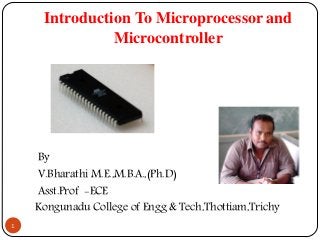






Introduction To Microprocessor and
Microcontroller
1
By
V.Bharathi M.E.,M.B.A.,(Ph.D)
Asst.Prof -ECE
Kongunadu College of Engg & Tech,Thottiam,Trichy
Objective
 Introduction to microprocessor
 Applications of microprocessor
 Architecture
 Addressing mode and its types
 Instruction Set
 Peripherals in MP and MC
 Difference Between MP and MC
 Videos
6 August 20172
Introduction
6 August 20173
 Microprocessor (µP) is the “brain” of a
computer that has been implemented on
one semiconductor chip.
 Processor means a device that processes
whatever(binary numbers, 0’s and 1’s)
 To process means to manipulate. It
describes all manipulation.
 Micro-> extremely small
Definition of a Microprocessor.
6 August 20174
 A microprocessor is multi programmable
clock driven register based semiconductor
device that is used to fetch , process
&execute a data within fraction of
seconds .
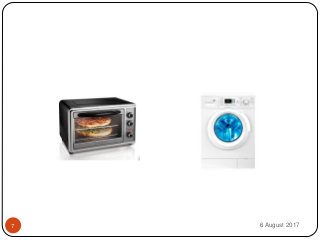
Applications
6 August 20175
 Calculators
 Accounting system
 Games machine
 Traffic light Control
 Multi user, multi-function environments
 Military applications
 Communication systems
6 August 20176
6 August 20177
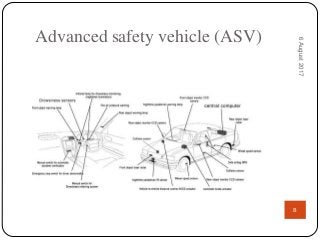
Advanced safety vehicle (ASV)
6August2017
8
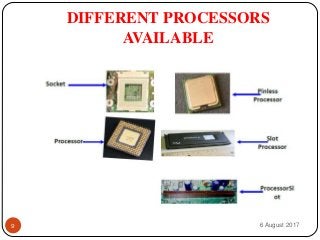
DIFFERENT PROCESSORS
AVAILABLE
6 August 20179
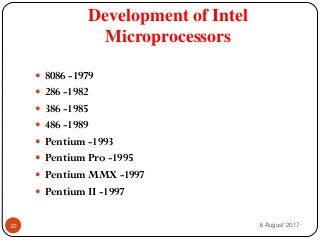
Development of Intel
Microprocessors
 8086 -1979
 286 -1982
 386 -1985
 486 -1989
 Pentium -1993
 Pentium Pro -1995
 Pentium MMX -1997
 Pentium II -1997
6 August 201710
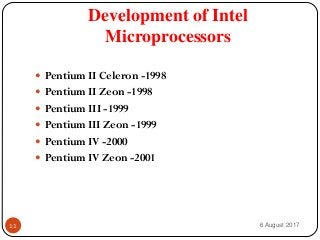
Development of Intel
Microprocessors
 Pentium II Celeron -1998
 Pentium II Zeon -1998
 Pentium III -1999
 Pentium III Zeon -1999
 Pentium IV -2000
 Pentium IV Zeon -2001
6 August 201711
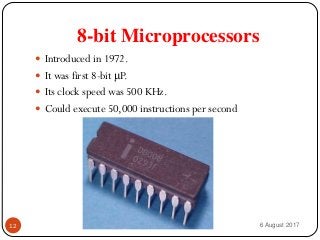
8-bit Microprocessors
 Introduced in 1972.
 It was first 8-bit μP.
 Its clock speed was 500 KHz.
 Could execute 50,000 instructions per second
6 August 201712
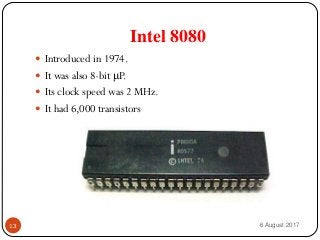
Intel 8080
 Introduced in 1974.
 It was also 8-bit μP.
 Its clock speed was 2 MHz.
 It had 6,000 transistors
6 August 201713
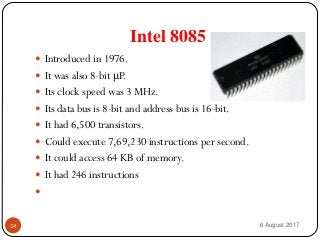
Intel 8085
 Introduced in 1976.
 It was also 8-bit μP.
 Its clock speed was 3 MHz.
 Its data bus is 8-bit and address bus is 16-bit.
 It had 6,500 transistors.
 Could execute 7,69,230 instructions per second.
 It could access 64 KB of memory.
 It had 246 instructions

6 August 201714
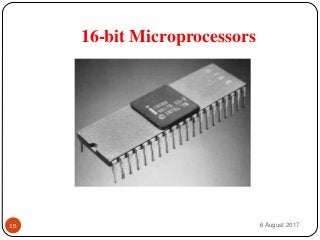
16-bit Microprocessors
6 August 201715
Introduction to
INTEL8086
Features of 8086
 Introduced in 1978.
 It was first 16-bit μP.
 Its clock speed is 4.77
MHz, 8 MHz and 10
MHz, depending on the
version.
 Its data bus is 16-bit and
address bus is 20-bit.
 It had 29,000 transistors.
 Could execute 2.5
million instructions per
second.
 It could access 1 MB of
memory.
 It had 22,000
instructions.
6 August 201716
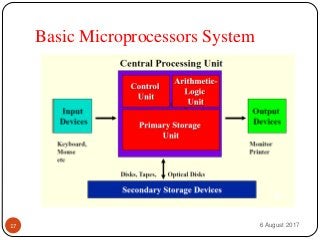
Basic Microprocessors System
6 August 201717
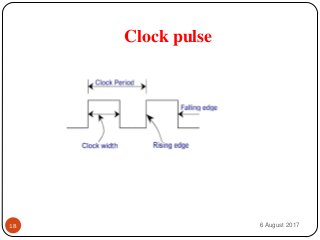
Clock pulse
6 August 201718
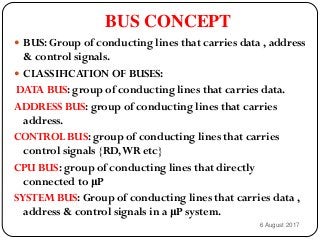
BUS CONCEPT
 BUS: Group of conducting lines that carries data , address
& control signals.
 CLASSIFICATION OF BUSES:
DATA BUS: group of conducting lines that carries data.
ADDRESS BUS: group of conducting lines that carries
address.
CONTROL BUS: group of conducting lines that carries
control signals {RD,WR etc}
CPU BUS: group of conducting lines that directly
connected to μP
SYSTEM BUS: Group of conducting lines that carries data ,
address & control signals in a μP system.
6 August 2017
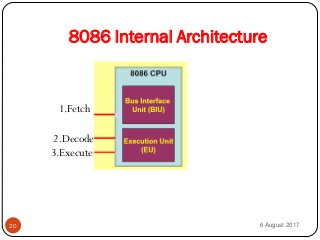
8086 Internal Architecture
6 August 201720
1.Fetch
2.Decode
3.Execute
Registers organization 0f 8086
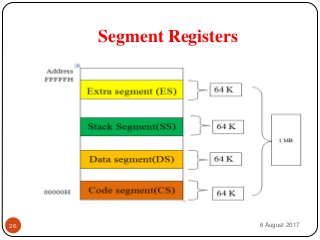
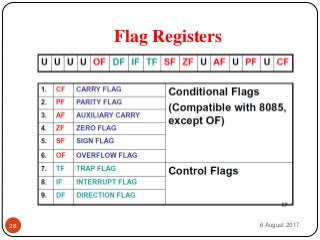
 8086 has powerful set of registers, It includes
1. General purpose Register.
2. Segment Register.
3. Flag Register.
4.Pointer and Index Register.
6 August 201721
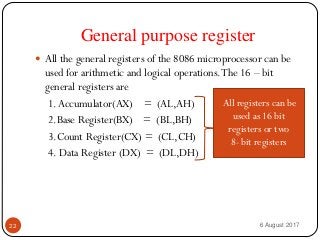
General purpose register
 All the general registers of the 8086 microprocessor can be
used for arithmetic and logical operations.The 16 – bit
general registers are
1.Accumulator(AX) = (AL,AH)
2.Base Register(BX) = (BL,BH)
3.Count Register(CX) = (CL,CH)
4. Data Register (DX) = (DL,DH)
6 August 201722
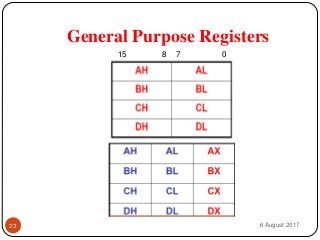
All registers can be
used as 16 bit
registers or two
8- bit registers
General Purpose Registers
6 August 201723
15 8 7 0
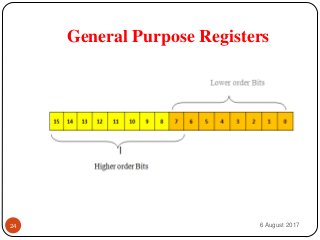
General Purpose Registers
6 August 201724
6 August 201725
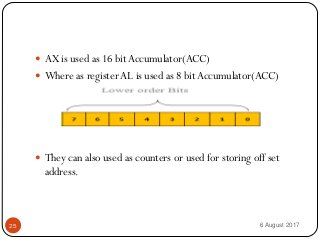
 AX is used as 16 bit Accumulator(ACC)
 Where as register AL is used as 8 bit Accumulator(ACC)
 They can also used as counters or used for storing off set
address.
Segment Registers
6 August 201726
?
6 August 201727
Flag Registers
6 August 201728
Architecture of 8086
6 August 201729
Architecture of 8086
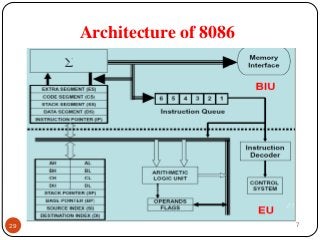
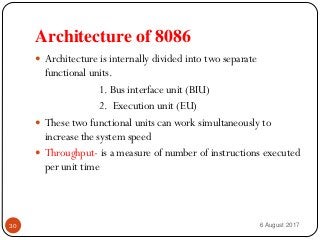
 Architecture is internally divided into two separate
functional units.
1. Bus interface unit (BIU)
2. Execution unit (EU)
 These two functional units can work simultaneously to
increase the system speed
 Throughput- is a measure of number of instructions executed
per unit time
6 August 201730
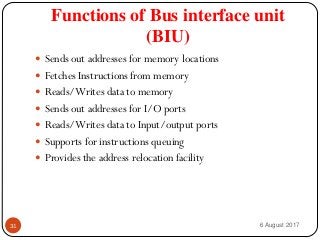
Functions of Bus interface unit
(BIU)
 Sends out addresses for memory locations
 Fetches Instructions from memory
 Reads/Writes data to memory
 Sends out addresses for I/O ports
 Reads/Writes data to Input/output ports
 Supports for instructions queuing
 Provides the address relocation facility
6 August 201731
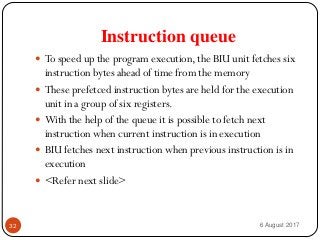
Instruction queue
 To speed up the program execution, the BIU unit fetches six
instruction bytes ahead of time from the memory
 These prefetced instruction bytes are held for the execution
unit in a group of six registers.
 With the help of the queue it is possible to fetch next
instruction when current instruction is in execution
 BIU fetches next instruction when previous instruction is in
execution
 <Refer next slide>
6 August 201732
6 August 201733
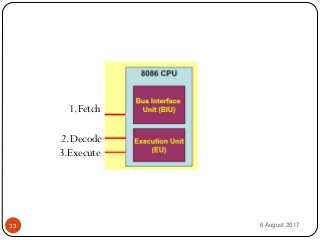
1.Fetch
2.Decode
3.Execute
Execution Unit
 The execution unit of 8086 tells the BIU from where to
fetch instructions or data, decodes instruction and execute
instructions.
 It contains
1. Control Circuitry
2. Instruction decoder
3.Arithmetic Logic Unit (ALU)
4. Flag register
5. General purpose registers
6. Pointers and instruction registers
6 August 201734
Pointer Register
 Stack Pointer (SP)
It is a 16- bit register pointing to program stack
 Base Pointer (BP)
It is a 16 bit register pointing to data in the stack segment.
BP register is usually used for base index or register indirect
addressing mode
6 August 201735
Index register
 Source Index(SI)
It is a 16 bit register .SI is used for indexed ,based indexed
and register indirect addressing mode
• Destination Index(DI)
It is a 16 bit register, DI is used for indexed ,based indexed
and register indirect addressing mode
6 August 201736
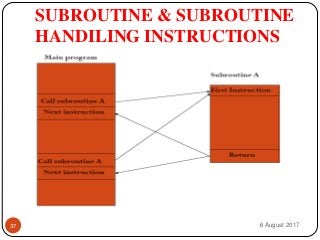
SUBROUTINE & SUBROUTINE
HANDILING INSTRUCTIONS
6 August 201737
6 August 201738
INTERRUPTS &INTERRUPT
SERVICE ROUTINE(ISR)
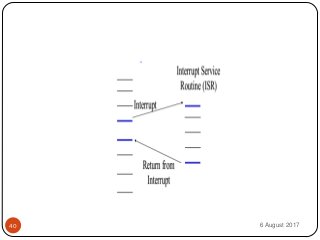
 INTERRUPT & ISR ?
 ‘Interrupts’ is to break the sequence of operation.
While the CPU is executing a program, on‘interrupt’ breaks
the normal sequence of execution of instructions, diverts its
execution to some other program called Interrupt Service
Routine (ISR)
6 August 201739
6 August 201740
6 August 201741
6 August 201742
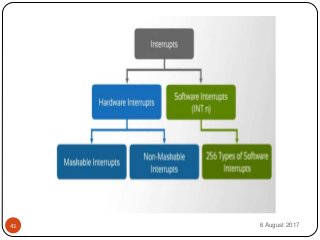
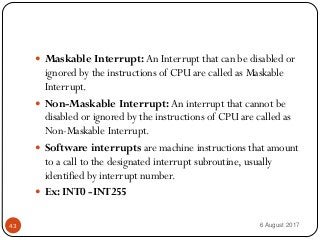
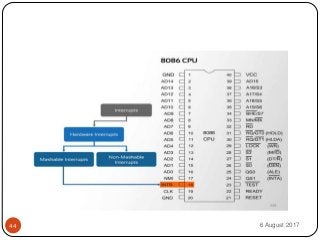
 Maskable Interrupt: An Interrupt that can be disabled or
ignored by the instructions of CPU are called as Maskable
Interrupt.
 Non-Maskable Interrupt: An interrupt that cannot be
disabled or ignored by the instructions of CPU are called as
Non-Maskable Interrupt.
 Software interrupts are machine instructions that amount
to a call to the designated interrupt subroutine, usually
identified by interrupt number.
 Ex: INT0 -INT255
6 August 201743
6 August 201744
6 August 201745
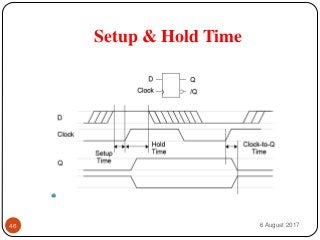
Setup & Hold Time
6 August 201746
 Setup time
The time before the rising edge of the clock,
while the data must be valid and constant
 Hold time
The time after the rising edge of the clock during
which the data must remain valid and constant
6 August 201747
MICRO CONTROLLER
 An IC which process and also controls the devices such as
Keyboard
Speaker
Display
6 August 201748
PHERIPERALS IN 8086
6 August 201749
I/O PORTS
I/O Ports Is Used For Input /Output Data
Communication
6 August 201750
6 August 201751
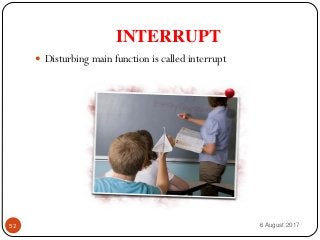
INTERRUPT
 Disturbing main function is called interrupt
6 August 201752
6 August 201753
FLAG
6 August 201754
 Intimation of work completed

6 August 201755
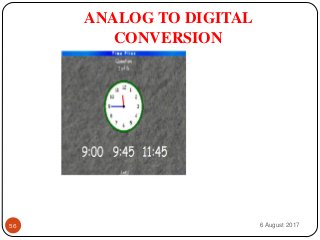
ANALOG TO DIGITAL
CONVERSION
6 August 201756
6 August 201757
TIMER /COUNTER
6 August 201758
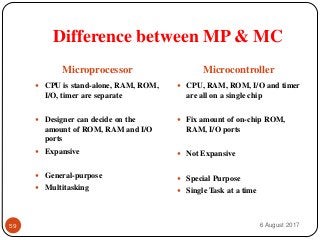
Difference between MP & MC
Microprocessor Microcontroller
 CPU is stand-alone, RAM, ROM,
I/O, timer are separate
 Designer can decide on the
amount of ROM, RAM and I/O
ports
 Expansive
 General-purpose
 Multitasking
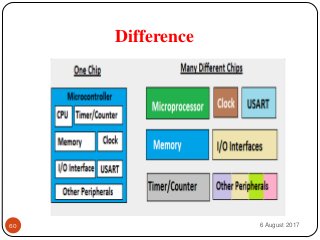
 CPU, RAM, ROM, I/O and timer
are all on a single chip
 Fix amount of on-chip ROM,
RAM, I/O ports
 Not Expansive
 Special Purpose
 Single Task at a time
6 August 201759
Difference
6 August 201760
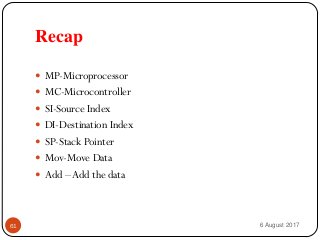
Recap
 MP-Microprocessor
 MC-Microcontroller
 SI-Source Index
 DI-Destination Index
 SP-Stack Pointer
 Mov-Move Data
 Add – Add the data
6 August 201761
Thank you
6 August 201762

introduction to Micro Processor and Microcontroller

  • 1.
    Introduction To Microprocessorand Microcontroller 1 By V.Bharathi M.E.,M.B.A.,(Ph.D) Asst.Prof -ECE Kongunadu College of Engg & Tech,Thottiam,Trichy
  • 2.
    Objective  Introduction tomicroprocessor  Applications of microprocessor  Architecture  Addressing mode and its types  Instruction Set  Peripherals in MP and MC  Difference Between MP and MC  Videos 6 August 20172
  • 3.
    Introduction 6 August 20173 Microprocessor (µP) is the “brain” of a computer that has been implemented on one semiconductor chip.  Processor means a device that processes whatever(binary numbers, 0’s and 1’s)  To process means to manipulate. It describes all manipulation.  Micro-> extremely small
  • 4.
    Definition of aMicroprocessor. 6 August 20174  A microprocessor is multi programmable clock driven register based semiconductor device that is used to fetch , process &execute a data within fraction of seconds .
  • 5.
    Applications 6 August 20175 Calculators  Accounting system  Games machine  Traffic light Control  Multi user, multi-function environments  Military applications  Communication systems
  • 6.
  • 7.
  • 8.
    Advanced safety vehicle(ASV) 6August2017 8
  • 9.
  • 10.
    Development of Intel Microprocessors 8086 -1979  286 -1982  386 -1985  486 -1989  Pentium -1993  Pentium Pro -1995  Pentium MMX -1997  Pentium II -1997 6 August 201710
  • 11.
    Development of Intel Microprocessors Pentium II Celeron -1998  Pentium II Zeon -1998  Pentium III -1999  Pentium III Zeon -1999  Pentium IV -2000  Pentium IV Zeon -2001 6 August 201711
  • 12.
    8-bit Microprocessors  Introducedin 1972.  It was first 8-bit μP.  Its clock speed was 500 KHz.  Could execute 50,000 instructions per second 6 August 201712
  • 13.
    Intel 8080  Introducedin 1974.  It was also 8-bit μP.  Its clock speed was 2 MHz.  It had 6,000 transistors 6 August 201713
  • 14.
    Intel 8085  Introducedin 1976.  It was also 8-bit μP.  Its clock speed was 3 MHz.  Its data bus is 8-bit and address bus is 16-bit.  It had 6,500 transistors.  Could execute 7,69,230 instructions per second.  It could access 64 KB of memory.  It had 246 instructions  6 August 201714
  • 15.
  • 16.
    Introduction to INTEL8086 Features of8086  Introduced in 1978.  It was first 16-bit μP.  Its clock speed is 4.77 MHz, 8 MHz and 10 MHz, depending on the version.  Its data bus is 16-bit and address bus is 20-bit.  It had 29,000 transistors.  Could execute 2.5 million instructions per second.  It could access 1 MB of memory.  It had 22,000 instructions. 6 August 201716
  • 17.
  • 18.
  • 19.
    BUS CONCEPT  BUS:Group of conducting lines that carries data , address & control signals.  CLASSIFICATION OF BUSES: DATA BUS: group of conducting lines that carries data. ADDRESS BUS: group of conducting lines that carries address. CONTROL BUS: group of conducting lines that carries control signals {RD,WR etc} CPU BUS: group of conducting lines that directly connected to μP SYSTEM BUS: Group of conducting lines that carries data , address & control signals in a μP system. 6 August 2017
  • 20.
    8086 Internal Architecture 6August 201720 1.Fetch 2.Decode 3.Execute
  • 21.
    Registers organization 0f8086  8086 has powerful set of registers, It includes 1. General purpose Register. 2. Segment Register. 3. Flag Register. 4.Pointer and Index Register. 6 August 201721
  • 22.
    General purpose register All the general registers of the 8086 microprocessor can be used for arithmetic and logical operations.The 16 – bit general registers are 1.Accumulator(AX) = (AL,AH) 2.Base Register(BX) = (BL,BH) 3.Count Register(CX) = (CL,CH) 4. Data Register (DX) = (DL,DH) 6 August 201722 All registers can be used as 16 bit registers or two 8- bit registers
  • 23.
    General Purpose Registers 6August 201723 15 8 7 0
  • 24.
  • 25.
    6 August 201725 AX is used as 16 bit Accumulator(ACC)  Where as register AL is used as 8 bit Accumulator(ACC)  They can also used as counters or used for storing off set address.
  • 26.
  • 27.
  • 28.
  • 29.
  • 30.
    Architecture of 8086 Architecture is internally divided into two separate functional units. 1. Bus interface unit (BIU) 2. Execution unit (EU)  These two functional units can work simultaneously to increase the system speed  Throughput- is a measure of number of instructions executed per unit time 6 August 201730
  • 31.
    Functions of Businterface unit (BIU)  Sends out addresses for memory locations  Fetches Instructions from memory  Reads/Writes data to memory  Sends out addresses for I/O ports  Reads/Writes data to Input/output ports  Supports for instructions queuing  Provides the address relocation facility 6 August 201731
  • 32.
    Instruction queue  Tospeed up the program execution, the BIU unit fetches six instruction bytes ahead of time from the memory  These prefetced instruction bytes are held for the execution unit in a group of six registers.  With the help of the queue it is possible to fetch next instruction when current instruction is in execution  BIU fetches next instruction when previous instruction is in execution  <Refer next slide> 6 August 201732
  • 33.
  • 34.
    Execution Unit  Theexecution unit of 8086 tells the BIU from where to fetch instructions or data, decodes instruction and execute instructions.  It contains 1. Control Circuitry 2. Instruction decoder 3.Arithmetic Logic Unit (ALU) 4. Flag register 5. General purpose registers 6. Pointers and instruction registers 6 August 201734
  • 35.
    Pointer Register  StackPointer (SP) It is a 16- bit register pointing to program stack  Base Pointer (BP) It is a 16 bit register pointing to data in the stack segment. BP register is usually used for base index or register indirect addressing mode 6 August 201735
  • 36.
    Index register  SourceIndex(SI) It is a 16 bit register .SI is used for indexed ,based indexed and register indirect addressing mode • Destination Index(DI) It is a 16 bit register, DI is used for indexed ,based indexed and register indirect addressing mode 6 August 201736
  • 37.
    SUBROUTINE & SUBROUTINE HANDILINGINSTRUCTIONS 6 August 201737
  • 38.
  • 39.
    INTERRUPTS &INTERRUPT SERVICE ROUTINE(ISR) INTERRUPT & ISR ?  ‘Interrupts’ is to break the sequence of operation. While the CPU is executing a program, on‘interrupt’ breaks the normal sequence of execution of instructions, diverts its execution to some other program called Interrupt Service Routine (ISR) 6 August 201739
  • 40.
  • 41.
  • 42.
  • 43.
     Maskable Interrupt:An Interrupt that can be disabled or ignored by the instructions of CPU are called as Maskable Interrupt.  Non-Maskable Interrupt: An interrupt that cannot be disabled or ignored by the instructions of CPU are called as Non-Maskable Interrupt.  Software interrupts are machine instructions that amount to a call to the designated interrupt subroutine, usually identified by interrupt number.  Ex: INT0 -INT255 6 August 201743
  • 44.
  • 45.
  • 46.
    Setup & HoldTime 6 August 201746
  • 47.
     Setup time Thetime before the rising edge of the clock, while the data must be valid and constant  Hold time The time after the rising edge of the clock during which the data must remain valid and constant 6 August 201747
  • 48.
    MICRO CONTROLLER  AnIC which process and also controls the devices such as Keyboard Speaker Display 6 August 201748
  • 49.
    PHERIPERALS IN 8086 6August 201749
  • 50.
    I/O PORTS I/O PortsIs Used For Input /Output Data Communication 6 August 201750
  • 51.
  • 52.
    INTERRUPT  Disturbing mainfunction is called interrupt 6 August 201752
  • 53.
  • 54.
    FLAG 6 August 201754 Intimation of work completed 
  • 55.
  • 56.
  • 57.
  • 58.
  • 59.
    Difference between MP& MC Microprocessor Microcontroller  CPU is stand-alone, RAM, ROM, I/O, timer are separate  Designer can decide on the amount of ROM, RAM and I/O ports  Expansive  General-purpose  Multitasking  CPU, RAM, ROM, I/O and timer are all on a single chip  Fix amount of on-chip ROM, RAM, I/O ports  Not Expansive  Special Purpose  Single Task at a time 6 August 201759
  • 60.
  • 61.
    Recap  MP-Microprocessor  MC-Microcontroller SI-Source Index  DI-Destination Index  SP-Stack Pointer  Mov-Move Data  Add – Add the data 6 August 201761
  • 62.