Unblock the Writing Experience


  Resources to help develop your writing skills and style

                         Presented by
             Kate Stockton, Learning Coach at NEC
Workshop Agenda

•Learn the best way to get started with your
writing assignments
•Build confidence in ability to write
•Become aware of writing resources
•Questions? (Stop me and ask throughout)
Writers need to know…
•   How to get inspired & motivated
•   How to get started
•   The mechanics of writing
•   How to get resources
Get Inspired!
• Talk to your instructor and classmates about your topic
  (start brainstorming if/when instructor discusses the
  assignment during class)
• Visit a local library or bookstore and skim through relevant
  books/magazines
• Search for ideas and inspiration on general search engines
  (google, bing, blogs, etc.)
• Talk to others about your assignment and ask for their ideas
  and feedback
• Read! But when you read ANYTHING pay attention to the
  writing style not just the content
• Create a writing ritual in a comfortable, quiet place at a
  productive time
Why is it so hard to get started?
• Pre-existing condition: writing anxiety?
• The “eternal perfectionist” syndrome
• Lack of experience, or lack of confidence
• Not familiar with pre-writing exercises or
  writing resources
• Procrastination – under too much time
  pressure and/or stress to do a good job
• Don’t understand the assignment
Inventor, Reader, Editor
   • Writer’s block is usually because the writer is
     engaging in more than one entity at a time
   • So… take turns acting each part!
   • A rough draft is a writer’s best friend
   • You need to read your rough draft with a critical
     eye, compare to the expectations of the assignment
   • You don’t have to be the only editor! Use your
     resources (smarthinking.com, learning coaches, peer
     coaches)
Adapted from Elaine Handley’s “Writer’s Block” at
http://www.esc.edu/esconline/across_esc/writerscomplex.nsf/3cc42a422514347a852567
1d0049f395/e3e4e891568bf8b185256a010073d22d?OpenDocument
Gathering Information
• Research based?
    – Become familiar with online library and how to ask
      questions
•   Your knowledge, insight or opinion
•   Understanding the text, article, topic
•   Will you need to interview or observe others?
•   Laboratory study, experiments
•   Keep track by using a consistent system
Pre-Writing Exercises
•   Brainstorming
•   Making lists
•   Asking questions
•   Re-reading the assignment expectations
•   Mindmapping, clustering
•   Creating an organized outline
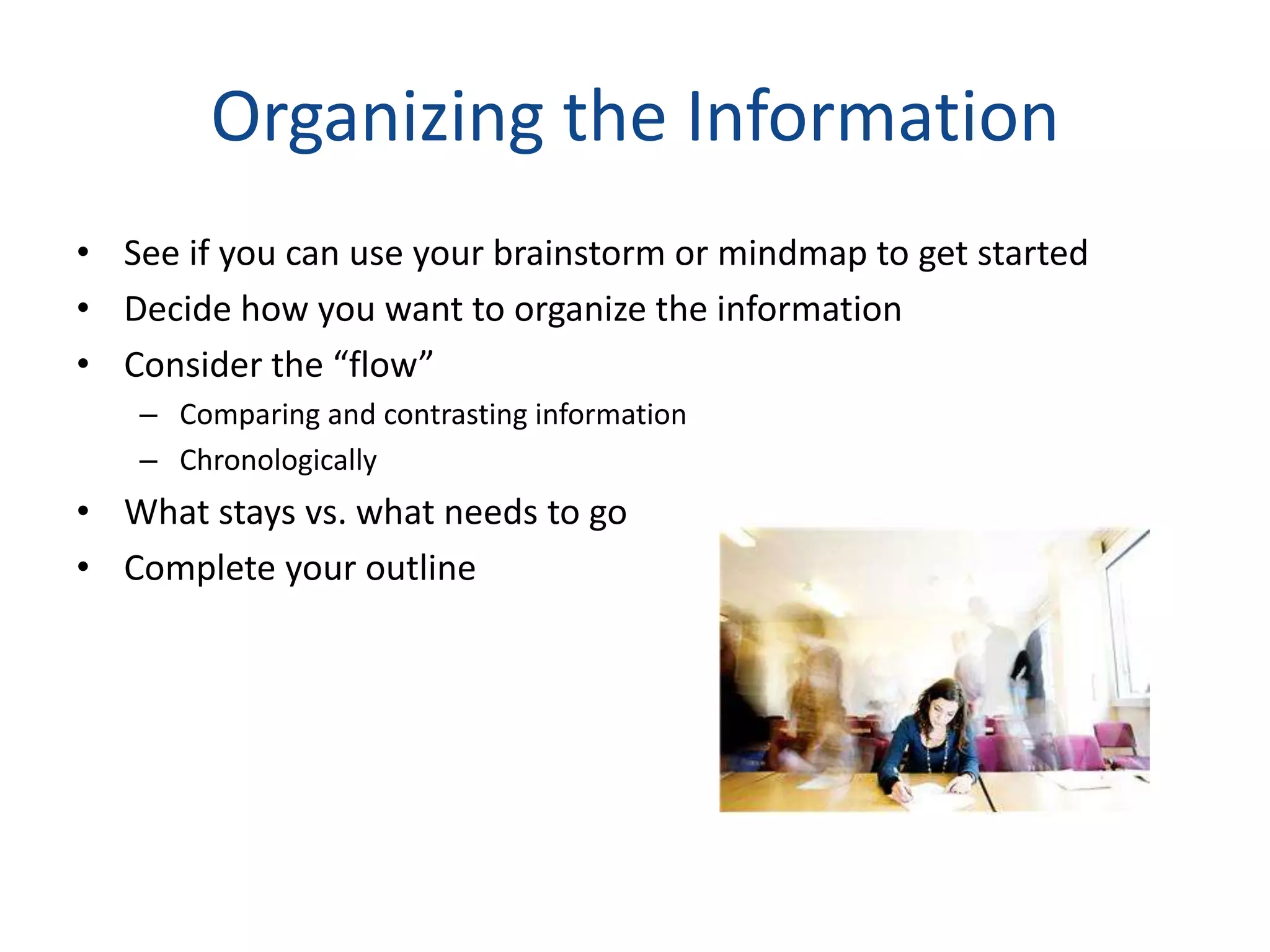
Organizing the Information
• See if you can use your brainstorm or mindmap to get started
• Decide how you want to organize the information
• Consider the “flow”
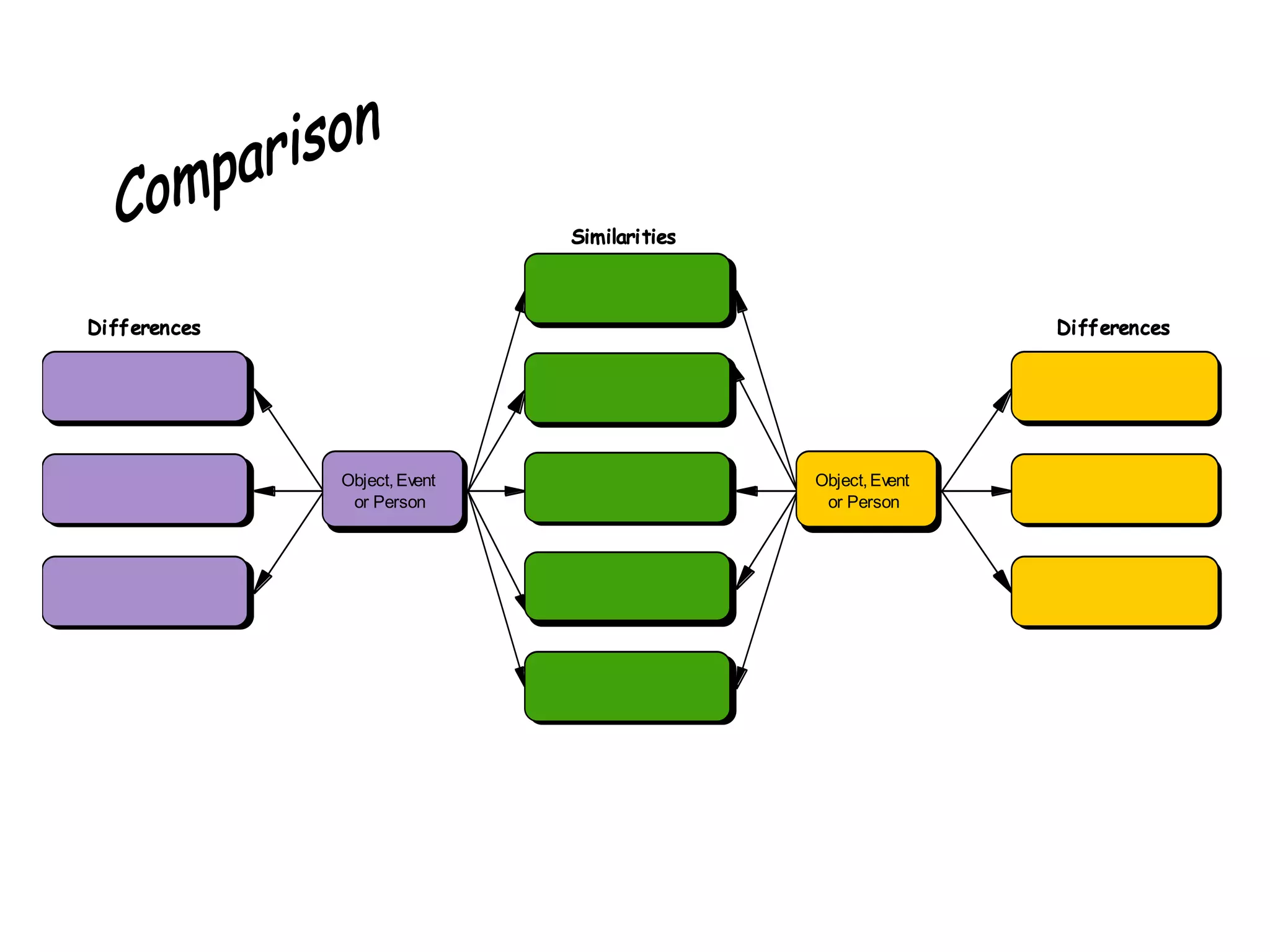
   – Comparing and contrasting information
   – Chronologically
• What stays vs. what needs to go
• Complete your outline
Writing
 Keep in mind that the hard part is done!
 Write body first, then worry about intro &
  conclusion at the end
 Just write! Don’t worry about using fancy words
  or sentence structure, proper grammar YET…
 Keep your outline, brainstorm, mindmap nearby
  to consult when necessary
 If you get stuck, skip and move on!
 Read out loud as you go
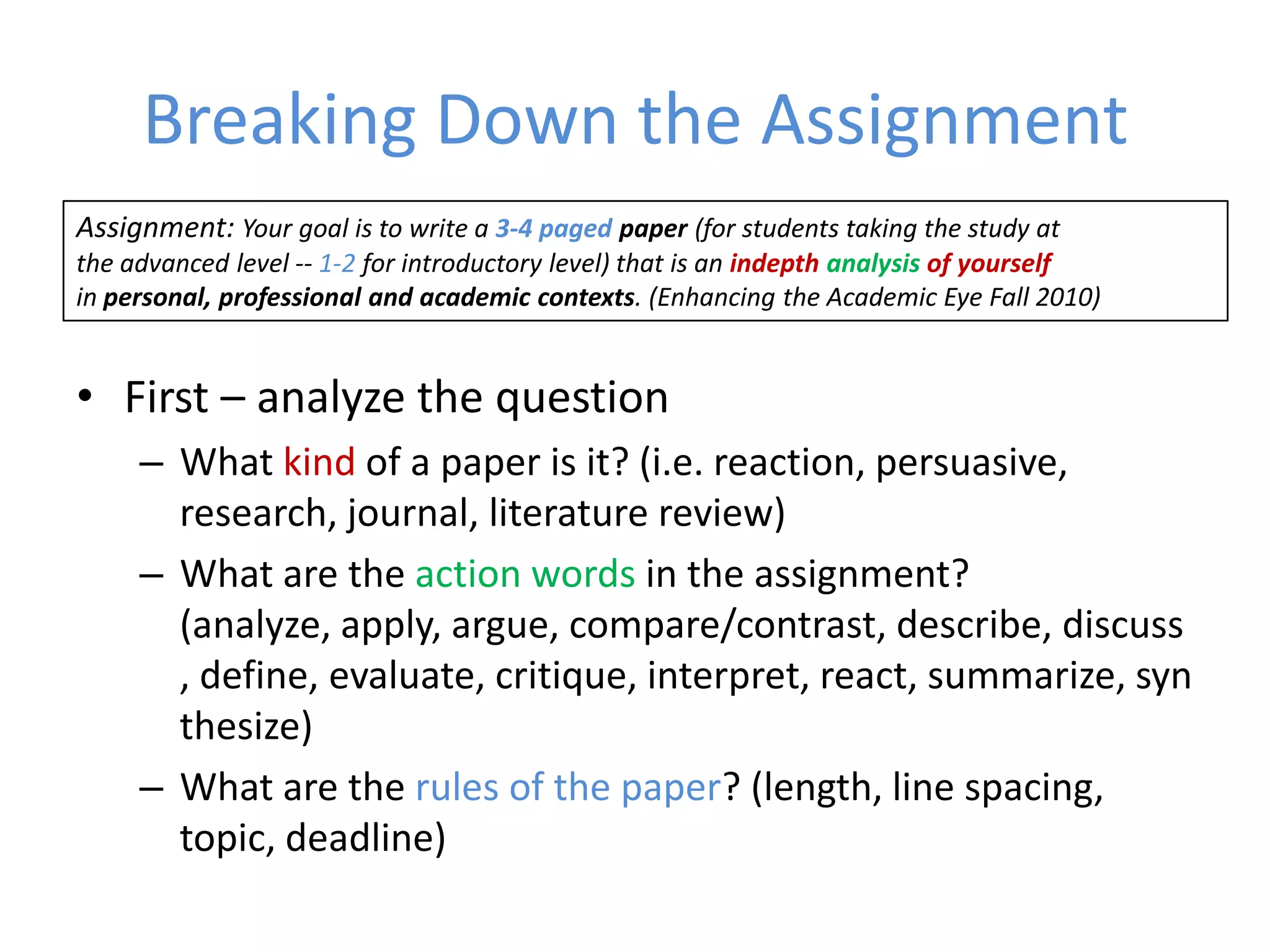
Breaking Down the Assignment
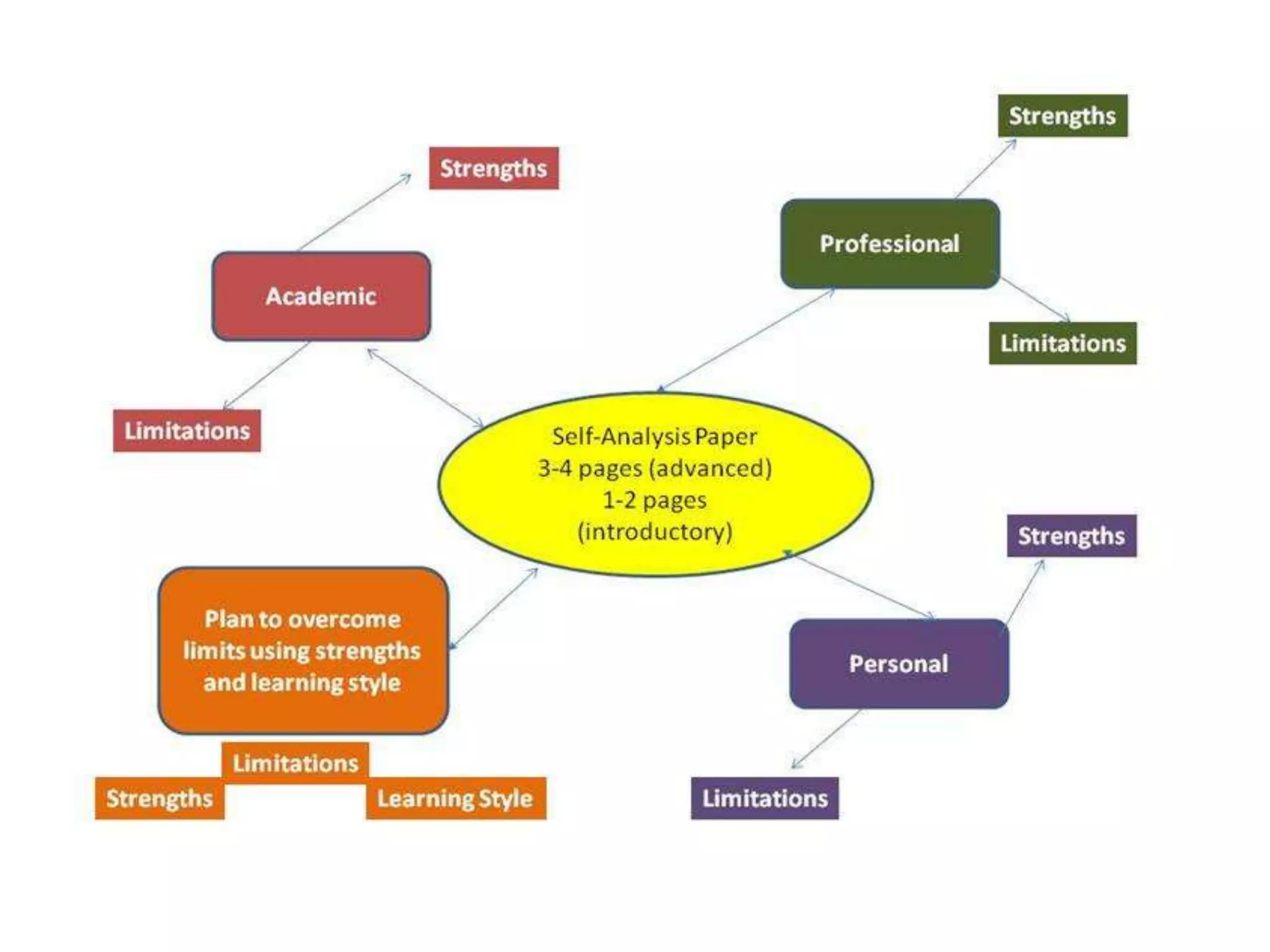
Assignment: Your goal is to write a 3-4 paged paper (for students taking the study at
the advanced level -- 1-2 for introductory level) that is an indepth analysis of yourself
in personal, professional and academic contexts. (Enhancing the Academic Eye Fall 2010)


• First – analyze the question
     – What kind of a paper is it? (i.e. reaction, persuasive,
       research, journal, literature review)
     – What are the action words in the assignment?
       (analyze, apply, argue, compare/contrast, describe, discuss
       , define, evaluate, critique, interpret, react, summarize, syn
       thesize)
     – What are the rules of the paper? (length, line spacing,
       topic, deadline)
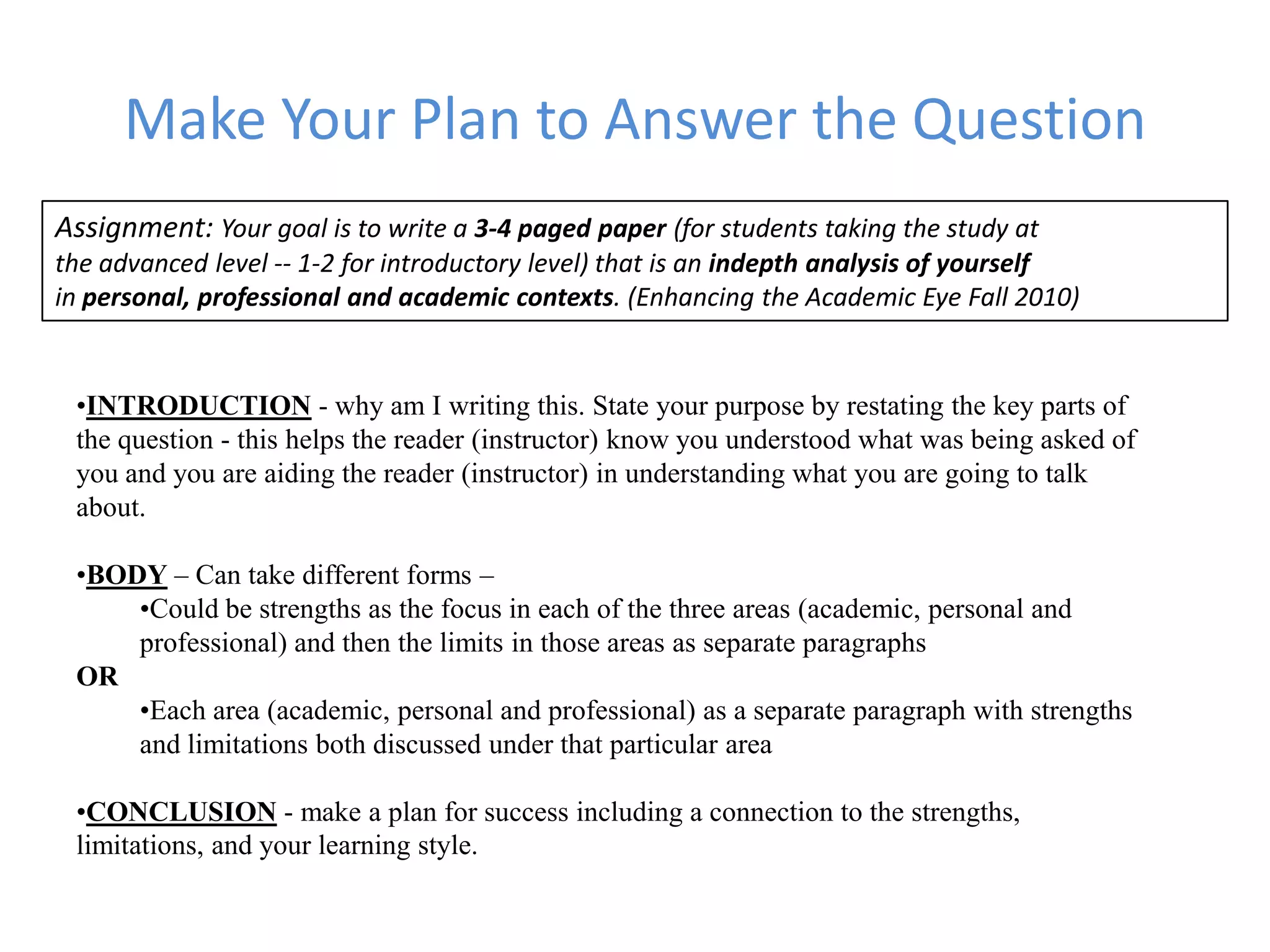
Make Your Plan to Answer the Question
Assignment: Your goal is to write a 3-4 paged paper (for students taking the study at
the advanced level -- 1-2 for introductory level) that is an indepth analysis of yourself
in personal, professional and academic contexts. (Enhancing the Academic Eye Fall 2010)


 •INTRODUCTION - why am I writing this. State your purpose by restating the key parts of
 the question - this helps the reader (instructor) know you understood what was being asked of
 you and you are aiding the reader (instructor) in understanding what you are going to talk
 about.

 •BODY – Can take different forms –
     •Could be strengths as the focus in each of the three areas (academic, personal and
     professional) and then the limits in those areas as separate paragraphs
 OR
     •Each area (academic, personal and professional) as a separate paragraph with strengths
     and limitations both discussed under that particular area

 •CONCLUSION - make a plan for success including a connection to the strengths,
 limitations, and your learning style.
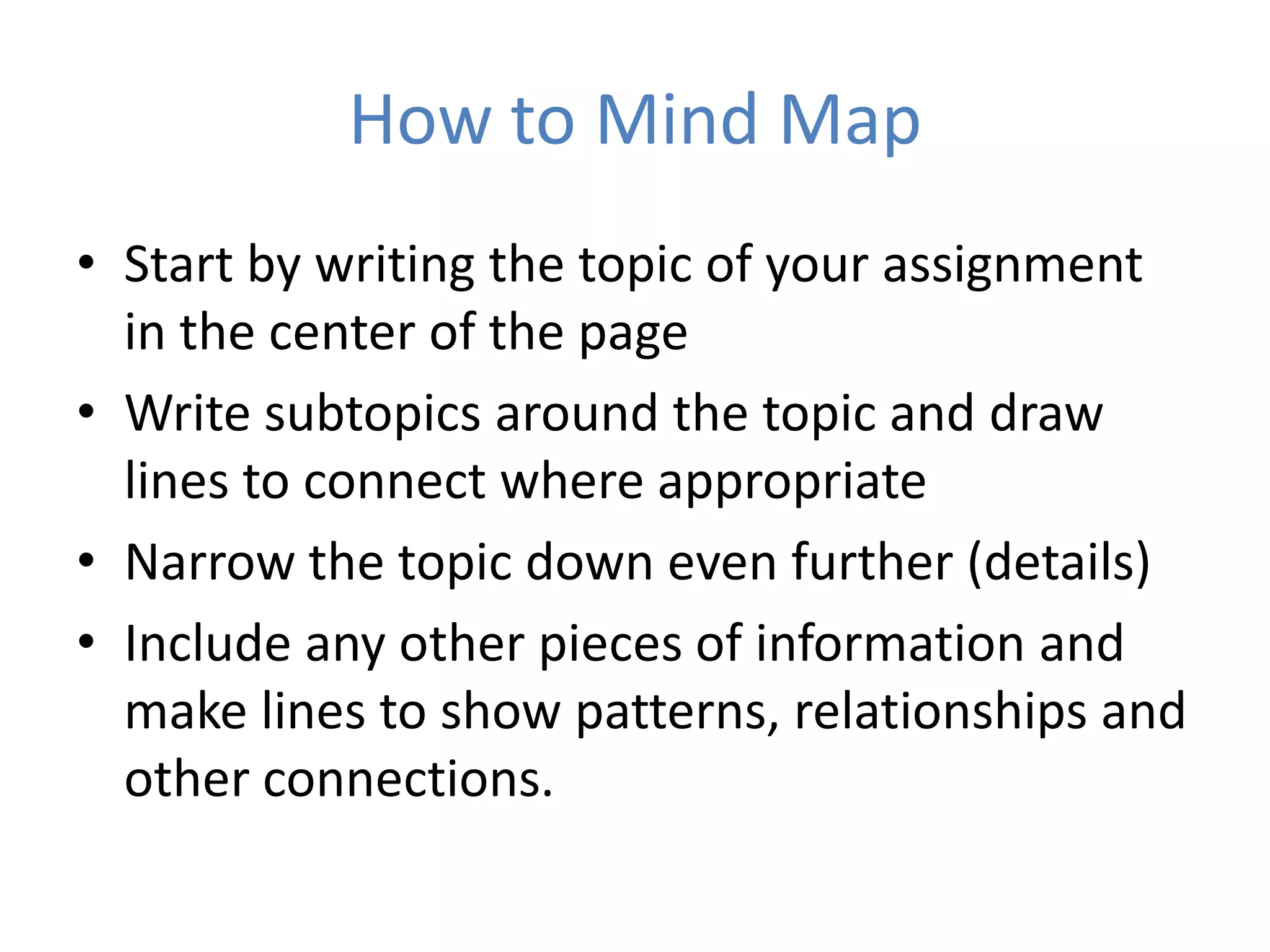
How to Mind Map
• Start by writing the topic of your assignment
  in the center of the page
• Write subtopics around the topic and draw
  lines to connect where appropriate
• Narrow the topic down even further (details)
• Include any other pieces of information and
  make lines to show patterns, relationships and
  other connections.
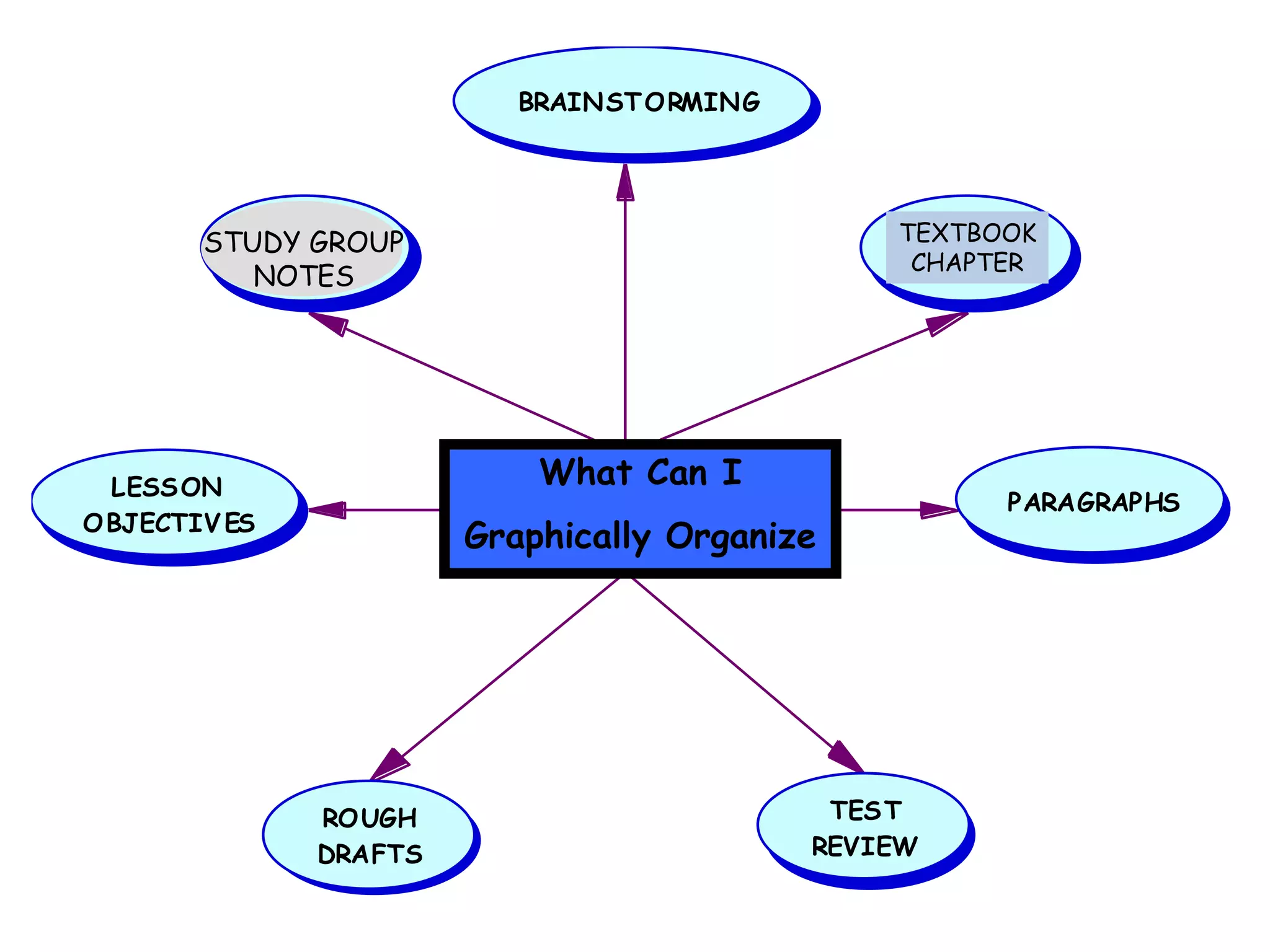
BRAINST O RMING


          LECTURE
        STUDY GROUP                              TEXTBOOK
                                                  CHAPTER
                                                  CHAPTER
           NO TES
           NOTES


  LESS ON                   What Can I
                             WHAT TO                   PARAGRAPHS
O BJECTIV ES
                        Graphically? Organize
                               G.O


               RO UGH                         TES T
               DRAFTS                        REVIEW
Similarities


Differences                                                  Differences


              Object, Event                  Object, Event
               or Person                      or Person
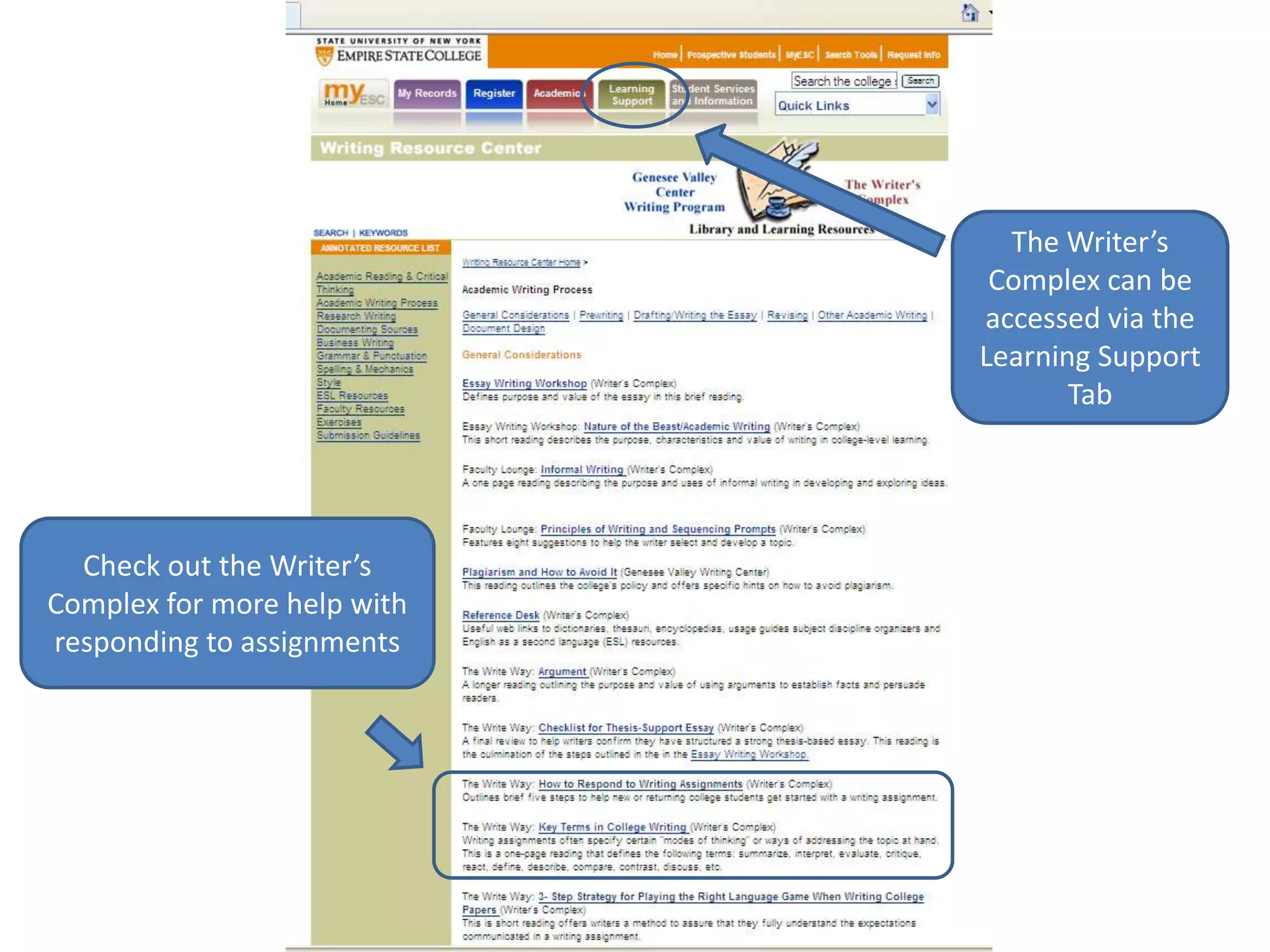
The Writer’s
                              Complex can be
                             accessed via the
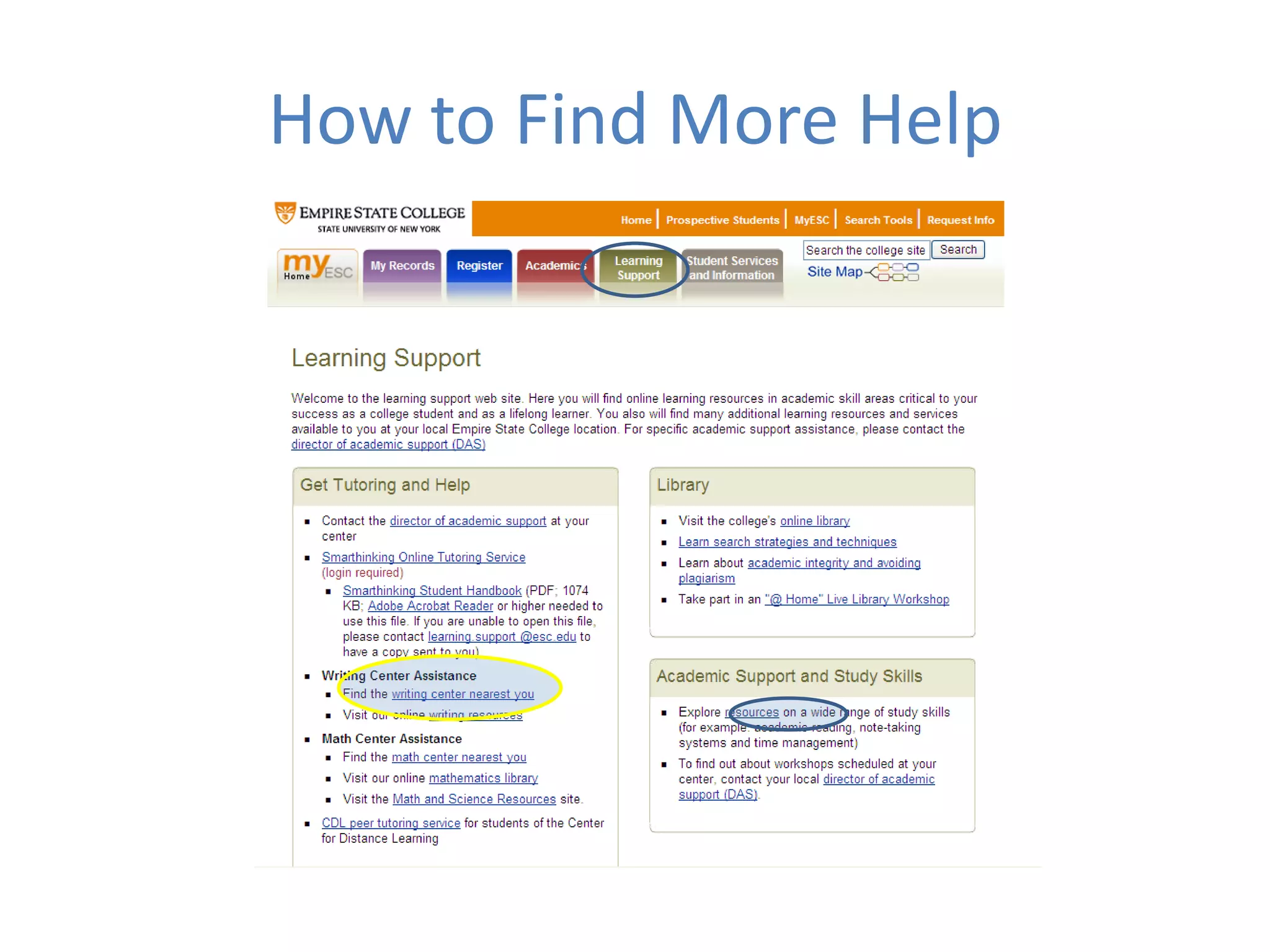
                             Learning Support
                                    Tab


  Check out the Writer’s
Complex for more help with
responding to assignments
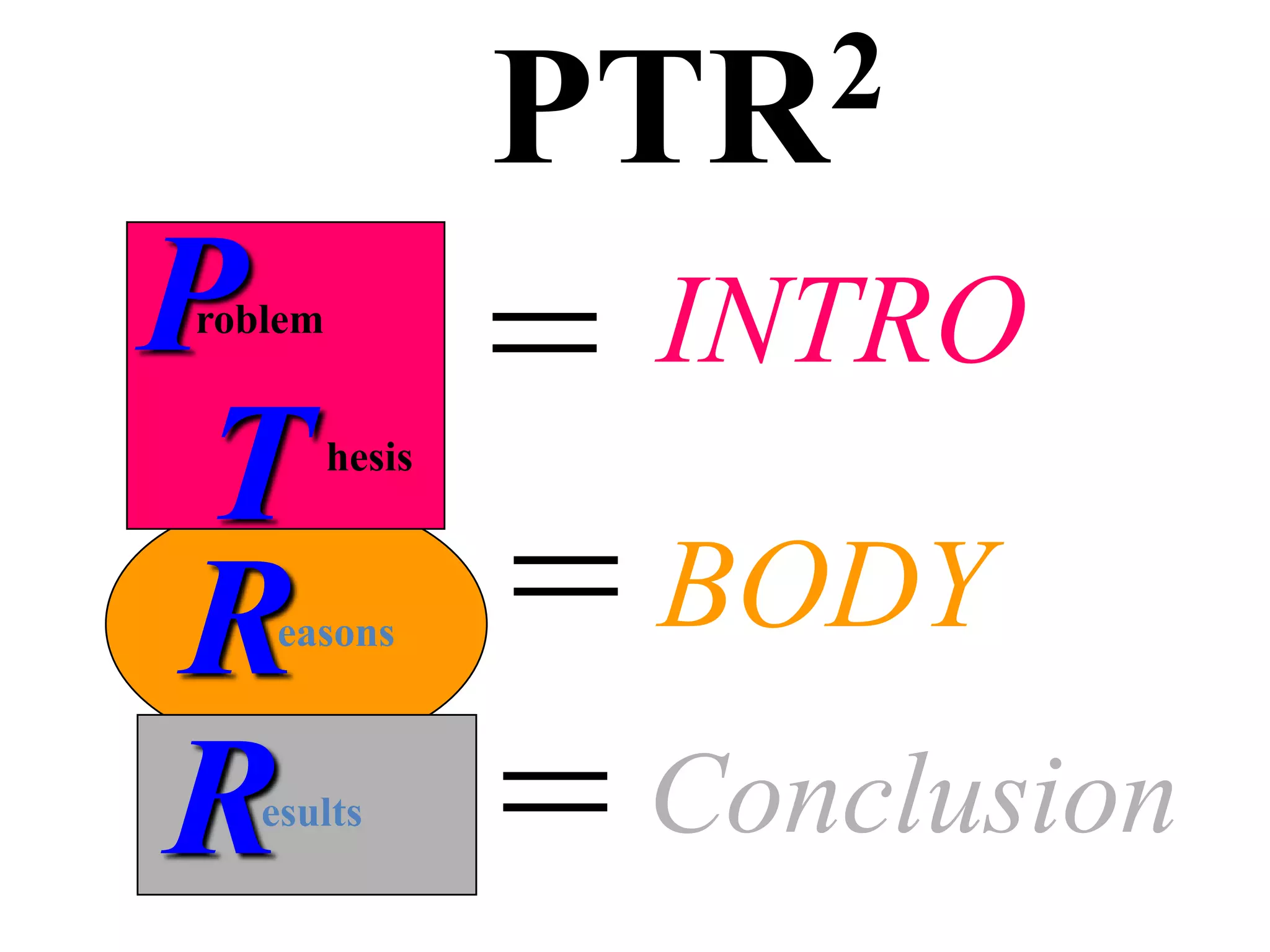
PTR 2

P
roblem
                 = INTRO
 T       hesis


R  easons        = BODY
R  esults
                 = Conclusion
Examples on how to create “flow”
• State that you have 3 points to make, then
  begin paragraph with “My first point…”, etc.
• Start the second paragraph by
  comparing/constrasting with information you
  discussed in the previous paragraph
• Break up your essay into sections and give
  each section a catch phrase (think of the book
  Eat, Pray, Love by Elizabeth Gilbert)
Proofreading & Editing
• Read the entire paper first, make only obvious corrections
• Know your own weaknesses (sentence structure, run-
  ons, tense problems, etc.) – use feedback from your
  previous papers!
• Read out loud to help with flow and sentence structure
• Ask others to read and ask for their ideas and input
• Submit paper to www.esc.edu/smarthinking
• Take a break before you read it the last time before you
  hand it in
For your next writing assignment:
1. What kind of assignment is it?
2. What is the goal of the assignment?
3. Consider why your instructor is having you
   complete this assignment
4. What is the topic/thesis statement?
5. Start brainstorming ideas
6. Draw a mindmap
7. Create an outline
8. Write your rough draft
9. Review and Edit
How to Find More Help
More Writing Resources
• ESC Writing Center
  http://www.esc.edu/ESConline/Across_ESC/WritingResourceCenter.nsf
  /homepageForm?OpenForm
• ESC Library Online Workshops - dates and registration info on
  www.esc.edu/library
• Research Tutorials: http://subjectguides.esc.edu/tutorials
• Free online writing help - www.esc.edu/smartthinking
• Writers Digest - http:// www.writersdigest.com
• VisuWords - http:// www.visuwords.com
• Fuel Your Writing - http://www.fuelyourwriting.com/
• Diana Hacker’s Writing Reference http://dianahacker.com/writersref
• Mind Mapping Resources: http://www.buzanworld.com
Work Consulted:

• Dobie, A. et. al. "Who, What, When, and Where of Writing Rituals." The
  Quarterly of The National Writing Project 24.4 (Fall 2002). 18 March 2004.
  <http://www.writingproject.org/pub/nwpr/quarterly/2002no4/dobie.html
  >.
• Hacker, D. “A Writer’s Reference” Fifth Edition. 2003.
  http://bcs.bedfordstmartins.com/writersref6e/Player/Pages/Main.aspx

Write Effectively and Overcome Writer's Block

  • 1.
    Unblock the WritingExperience Resources to help develop your writing skills and style Presented by Kate Stockton, Learning Coach at NEC
  • 2.
    Workshop Agenda •Learn thebest way to get started with your writing assignments •Build confidence in ability to write •Become aware of writing resources •Questions? (Stop me and ask throughout)
  • 3.
    Writers need toknow… • How to get inspired & motivated • How to get started • The mechanics of writing • How to get resources
  • 4.
    Get Inspired! • Talkto your instructor and classmates about your topic (start brainstorming if/when instructor discusses the assignment during class) • Visit a local library or bookstore and skim through relevant books/magazines • Search for ideas and inspiration on general search engines (google, bing, blogs, etc.) • Talk to others about your assignment and ask for their ideas and feedback • Read! But when you read ANYTHING pay attention to the writing style not just the content • Create a writing ritual in a comfortable, quiet place at a productive time
  • 5.
    Why is itso hard to get started? • Pre-existing condition: writing anxiety? • The “eternal perfectionist” syndrome • Lack of experience, or lack of confidence • Not familiar with pre-writing exercises or writing resources • Procrastination – under too much time pressure and/or stress to do a good job • Don’t understand the assignment
  • 6.
    Inventor, Reader, Editor • Writer’s block is usually because the writer is engaging in more than one entity at a time • So… take turns acting each part! • A rough draft is a writer’s best friend • You need to read your rough draft with a critical eye, compare to the expectations of the assignment • You don’t have to be the only editor! Use your resources (smarthinking.com, learning coaches, peer coaches) Adapted from Elaine Handley’s “Writer’s Block” at http://www.esc.edu/esconline/across_esc/writerscomplex.nsf/3cc42a422514347a852567 1d0049f395/e3e4e891568bf8b185256a010073d22d?OpenDocument
  • 7.
    Gathering Information • Researchbased? – Become familiar with online library and how to ask questions • Your knowledge, insight or opinion • Understanding the text, article, topic • Will you need to interview or observe others? • Laboratory study, experiments • Keep track by using a consistent system
  • 8.
    Pre-Writing Exercises • Brainstorming • Making lists • Asking questions • Re-reading the assignment expectations • Mindmapping, clustering • Creating an organized outline
  • 9.
    Organizing the Information •See if you can use your brainstorm or mindmap to get started • Decide how you want to organize the information • Consider the “flow” – Comparing and contrasting information – Chronologically • What stays vs. what needs to go • Complete your outline
  • 10.
    Writing  Keep inmind that the hard part is done!  Write body first, then worry about intro & conclusion at the end  Just write! Don’t worry about using fancy words or sentence structure, proper grammar YET…  Keep your outline, brainstorm, mindmap nearby to consult when necessary  If you get stuck, skip and move on!  Read out loud as you go
  • 11.
    Breaking Down theAssignment Assignment: Your goal is to write a 3-4 paged paper (for students taking the study at the advanced level -- 1-2 for introductory level) that is an indepth analysis of yourself in personal, professional and academic contexts. (Enhancing the Academic Eye Fall 2010) • First – analyze the question – What kind of a paper is it? (i.e. reaction, persuasive, research, journal, literature review) – What are the action words in the assignment? (analyze, apply, argue, compare/contrast, describe, discuss , define, evaluate, critique, interpret, react, summarize, syn thesize) – What are the rules of the paper? (length, line spacing, topic, deadline)
  • 12.
    Make Your Planto Answer the Question Assignment: Your goal is to write a 3-4 paged paper (for students taking the study at the advanced level -- 1-2 for introductory level) that is an indepth analysis of yourself in personal, professional and academic contexts. (Enhancing the Academic Eye Fall 2010) •INTRODUCTION - why am I writing this. State your purpose by restating the key parts of the question - this helps the reader (instructor) know you understood what was being asked of you and you are aiding the reader (instructor) in understanding what you are going to talk about. •BODY – Can take different forms – •Could be strengths as the focus in each of the three areas (academic, personal and professional) and then the limits in those areas as separate paragraphs OR •Each area (academic, personal and professional) as a separate paragraph with strengths and limitations both discussed under that particular area •CONCLUSION - make a plan for success including a connection to the strengths, limitations, and your learning style.
  • 13.
    How to MindMap • Start by writing the topic of your assignment in the center of the page • Write subtopics around the topic and draw lines to connect where appropriate • Narrow the topic down even further (details) • Include any other pieces of information and make lines to show patterns, relationships and other connections.
  • 15.
    BRAINST O RMING LECTURE STUDY GROUP TEXTBOOK CHAPTER CHAPTER NO TES NOTES LESS ON What Can I WHAT TO PARAGRAPHS O BJECTIV ES Graphically? Organize G.O RO UGH TES T DRAFTS REVIEW
  • 16.
    Similarities Differences Differences Object, Event Object, Event or Person or Person
  • 17.
    The Writer’s Complex can be accessed via the Learning Support Tab Check out the Writer’s Complex for more help with responding to assignments
  • 18.
    PTR 2 P roblem = INTRO T hesis R easons = BODY R esults = Conclusion
  • 19.
    Examples on howto create “flow” • State that you have 3 points to make, then begin paragraph with “My first point…”, etc. • Start the second paragraph by comparing/constrasting with information you discussed in the previous paragraph • Break up your essay into sections and give each section a catch phrase (think of the book Eat, Pray, Love by Elizabeth Gilbert)
  • 20.
    Proofreading & Editing •Read the entire paper first, make only obvious corrections • Know your own weaknesses (sentence structure, run- ons, tense problems, etc.) – use feedback from your previous papers! • Read out loud to help with flow and sentence structure • Ask others to read and ask for their ideas and input • Submit paper to www.esc.edu/smarthinking • Take a break before you read it the last time before you hand it in
  • 21.
    For your nextwriting assignment: 1. What kind of assignment is it? 2. What is the goal of the assignment? 3. Consider why your instructor is having you complete this assignment 4. What is the topic/thesis statement? 5. Start brainstorming ideas 6. Draw a mindmap 7. Create an outline 8. Write your rough draft 9. Review and Edit
  • 22.
    How to FindMore Help
  • 23.
    More Writing Resources •ESC Writing Center http://www.esc.edu/ESConline/Across_ESC/WritingResourceCenter.nsf /homepageForm?OpenForm • ESC Library Online Workshops - dates and registration info on www.esc.edu/library • Research Tutorials: http://subjectguides.esc.edu/tutorials • Free online writing help - www.esc.edu/smartthinking • Writers Digest - http:// www.writersdigest.com • VisuWords - http:// www.visuwords.com • Fuel Your Writing - http://www.fuelyourwriting.com/ • Diana Hacker’s Writing Reference http://dianahacker.com/writersref • Mind Mapping Resources: http://www.buzanworld.com
  • 24.
    Work Consulted: • Dobie,A. et. al. "Who, What, When, and Where of Writing Rituals." The Quarterly of The National Writing Project 24.4 (Fall 2002). 18 March 2004. <http://www.writingproject.org/pub/nwpr/quarterly/2002no4/dobie.html >. • Hacker, D. “A Writer’s Reference” Fifth Edition. 2003. http://bcs.bedfordstmartins.com/writersref6e/Player/Pages/Main.aspx

Editor's Notes

  • #22 Here is your Plan of Action!