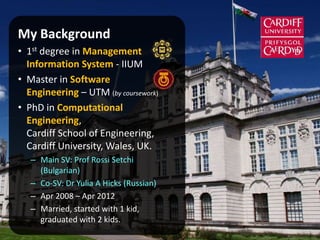
My Background
• 1st degree in Management
Information System - IIUM
• Master in Software
Engineering – UTM (by coursework)
• PhD in Computational
Engineering,
Cardiff School of Engineering,
Cardiff University, Wales, UK.
– Main SV: Prof Rossi Setchi
(Bulgarian)
– Co-SV: Dr Yulia A Hicks (Russian)
– Apr 2008 – Apr 2012
– Married, started with 1 kid,
graduated with 2 kids.
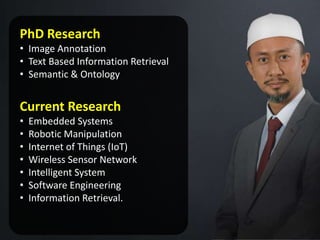
PhD Research
• Image Annotation
• Text Based Information Retrieval
• Semantic & Ontology
Current Research
• Embedded Systems
• Robotic Manipulation
• Internet of Things (IoT)
• Wireless Sensor Network
• Intelligent System
• Software Engineering
• Information Retrieval.
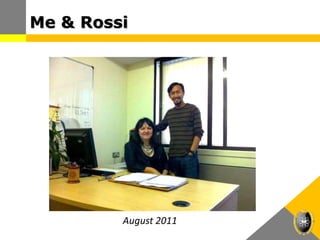
Me & Rossi
August 2011
Outline
• Introduction
• Thesis Writing
– What?
– Why?
– When?
– Who?
– How?
– Good News vs. Bad News
• General Advice
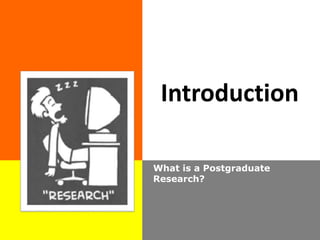
Introduction
What is a Postgraduate
Research?
What is a PG Research?
• Master or PhD is not a destination, it is a
JOURNEY.
• Ability to research anything, and the expectation
that you will understand it.
• You should be more likely to ask why things are
done a certain way, and how it could be made
better – analytical thinking.
• You can jump into a new area, pick it up quickly,
and have something interesting to say about it.
• And the most important part in all these, is the
ability to write them clearly, so that other
people can know what you know.
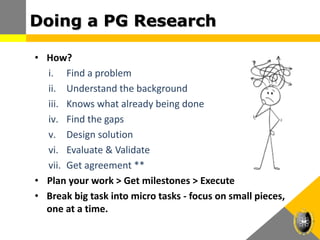
Doing a PG Research
• How?
i. Find a problem
ii. Understand the background
iii. Knows what already being done
iv. Find the gaps
v. Design solution
vi. Evaluate & Validate
vii. Get agreement **
• Plan your work > Get milestones > Execute
• Break big task into micro tasks - focus on small pieces,
one at a time.
Thesis Writing:
When?
When to start writing?
• When?
i. Find a problem - write
ii. Understand the background - write
iii. Knows what already being done - write
iv. Find the gaps - write
v. Design solution - write
vi. Evaluate & Validate - write
vii. Get agreement ** - write
• Start writing from the beginning!
When to start writing?
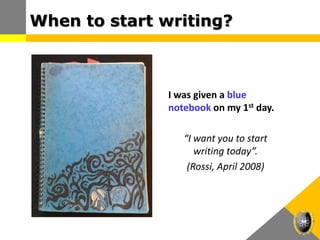
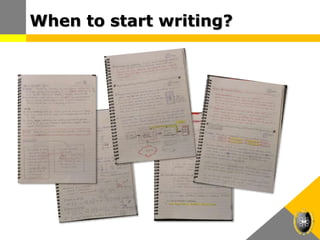
I was given a blue
notebook on my 1st day.
“I want you to start
writing today”.
(Rossi, April 2008)
When to start writing?
Thesis Writing:
What?
What is a thesis?
What a thesis is not?
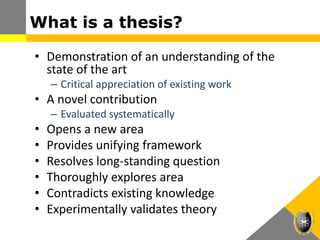
What is a thesis?
• Demonstration of an understanding of the
state of the art
– Critical appreciation of existing work
• A novel contribution
– Evaluated systematically
• Opens a new area
• Provides unifying framework
• Resolves long-standing question
• Thoroughly explores area
• Contradicts existing knowledge
• Experimentally validates theory
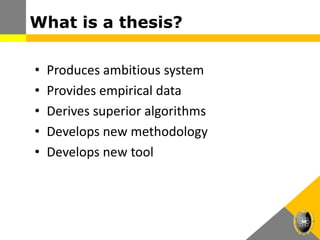
What is a thesis?
• Produces ambitious system
• Provides empirical data
• Derives superior algorithms
• Develops new methodology
• Develops new tool
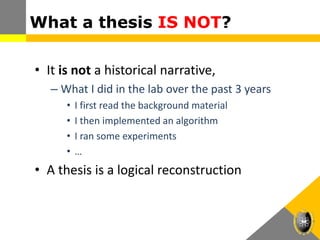
What a thesis IS NOT?
• It is not a historical narrative,
– What I did in the lab over the past 3 years
• I first read the background material
• I then implemented an algorithm
• I ran some experiments
• …
• A thesis is a logical reconstruction
What a thesis IS NOT?
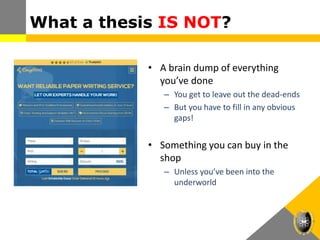
• A brain dump of everything
you’ve done
– You get to leave out the dead-ends
– But you have to fill in any obvious
gaps!
• Something you can buy in the
shop
– Unless you’ve been into the
underworld
Thesis Writing:
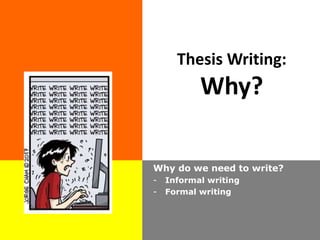
Why?
Why do we need to write?
- Informal writing
- Formal writing
Why do we need to write?
Informal Writing:
• Because you wont remember everything,
forever
– Sometimes writing will help you remember
• Training – getting yourself familiar with
writing
• Developing a good habit
• Motivate yourself to keep going
Why do we need to write?
Formal Writing:
• Data without notes are unusable
– Because you won’t remember everything,
forever
• For others who may need to understand
your research - Science includes the
dissemination of knowledge
– to communicate to the community
– to contribute to the advancement of
knowledge
Why do we need to write?
• To make progress
– Progress is measured by OUTPUT, not time
(results, publications).
– Do not spend long hours in office/lab just for
the sake of it
– If you don’t know what to do, WRITE
something. Anything.
• But there is a RISK in writing early and
often!
Why do we need to write?
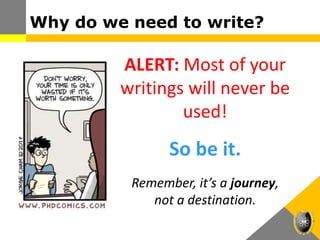
ALERT: Most of your
writings will never be
used!
So be it.
Remember, it’s a journey,
not a destination.
Why do we need to write?
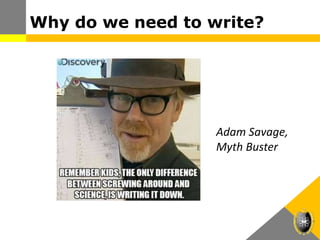
Adam Savage,
Myth Buster
Thesis Writing:
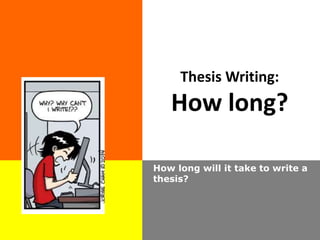
How long?
How long will it take to write a
thesis?
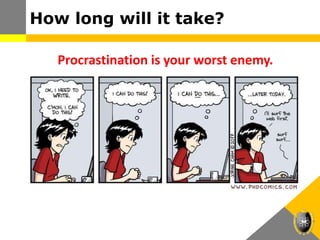
Procrastination is your worst enemy.
How long will it take?
Good News vs. Bad News
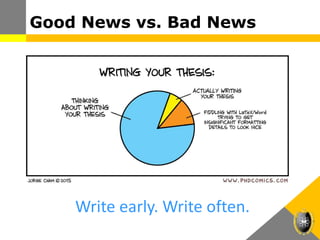
Write early. Write often.
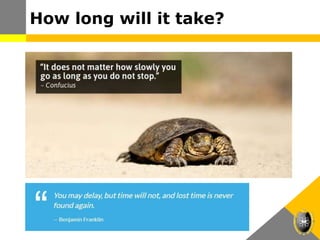
How long will it take?
How long will it take to write a thesis?
• Depends on many factors
– How much you’ve written as papers
– Many other things
• Wild estimation?
– Min = 2 months (very very very rare)
– Max = infinity
– Mean = infinity
– Median = 6-9 months
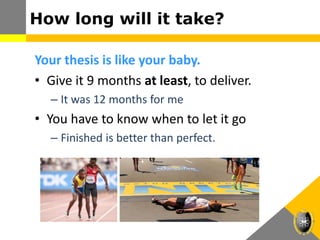
Your thesis is like your baby.
• Give it 9 months at least, to deliver.
– It was 12 months for me
• You have to know when to let it go
– Finished is better than perfect.
How long will it take?
• Make a full list of tasks to be done
– So you always aware where you are, how far more
you need to go
• Prioritize your work and tasks and set milestones
– Create deadlines for paper submission
– Get agreements
– Track your time on subtasks
• Update your SV/team on progress regularly
• Reward yourself when achieving milestones
– ALERT: Rewards kill creativity
– Pick your reward CAREFULLY. Don’t pick a reward
that negates what you’ve just achieved.
How to kill procrastination?
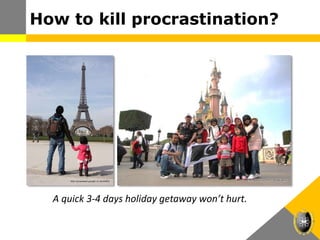
A quick 3-4 days holiday getaway won’t hurt.
Thesis Writing:
How to?
How to write a thesis
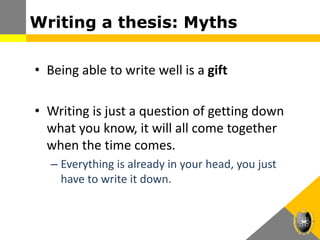
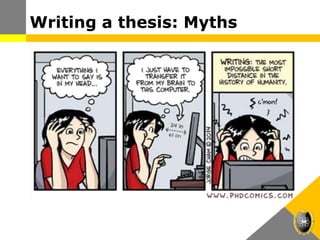
Writing a thesis: Myths
• Being able to write well is a gift
• Writing is just a question of getting down
what you know, it will all come together
when the time comes.
– Everything is already in your head, you just
have to write it down.
Writing a thesis: Myths
How to start?
• Get a good template. Solve all the technical
in the beginning
– Formats, styles, annotation, reference,
bibliography, etc.
– Strictly follow guidelines from Graduate School
from the beginning
– Use software/tools that you are comfortable
with.
– Use automated backups (external drive, clouds)
• If you have problem with the technical, get
help!
How to start?
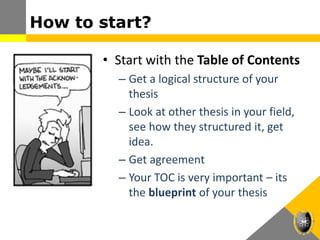
• Start with the Table of Contents
– Get a logical structure of your
thesis
– Look at other thesis in your field,
see how they structured it, get
idea.
– Get agreement
– Your TOC is very important – its
the blueprint of your thesis
How to start?
• A typical TOC structure
– Abstract
– Introduction
– Background/Literature
– Experiments and Results
– Analysis/discussion
– Conclusions
• Identical structure with research paper
– The only differences is the length, context and
scope.
How to start?
• Writing is hard for everyone. Don’t try to be
Shakespeare
• You don’t have to start with introduction
– Stop waiting for mood or inspiration
– Start where you feel happiest. It is your thesis,
you can do it however you want it.
• Typically people start in the middle and
outwards
– .. then conclusion and end with introduction
How to write?
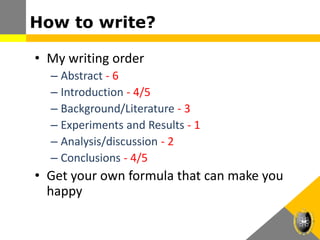
• My writing order
– Abstract - 6
– Introduction - 4/5
– Background/Literature - 3
– Experiments and Results - 1
– Analysis/discussion - 2
– Conclusions - 4/5
• Get your own formula that can make you
happy
How to write?
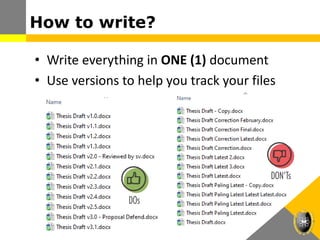
• Write everything in ONE (1) document
• Use versions to help you track your files
How to write?
• As you are writing up, you’ll discover holes
in your research
– Theorems you haven’t proved
– Experiments you didn’t run (different
environment or parameters)
• Writing will lead to more research. That’s
totally OK!.
How to write?
The Rules of Three
• Within thesis, repeat your contributions 3 times
– Intro chapter
– Main chapters
– Conclusion chapter
• Within each chapter, repeat yourself 3 times
– Introduction - We will show ..
– Body - Show them ..
– Conclusion - We have shown ..
Common problems in writing
• Complex sentences full of long words
– A thesis should be a simple, convincing
argument!
• Impossible to cover all issues
– So you will never finish?
– It’s sometimes enough to identify the issues
– Examiners greatly appreciate you identifying
limitations
– Examiners greatly happy finding a few
mistakes
Common problems in writing
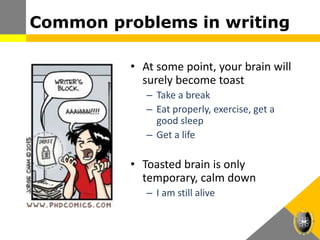
• At some point, your brain will
surely become toast
– Take a break
– Eat properly, exercise, get a
good sleep
– Get a life
• Toasted brain is only
temporary, calm down
– I am still alive
Thesis Writing:
Who?
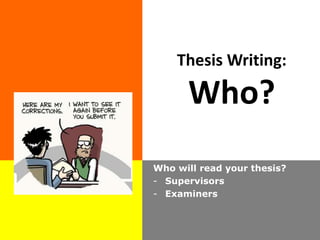
Who will read your thesis?
- Supervisors
- Examiners
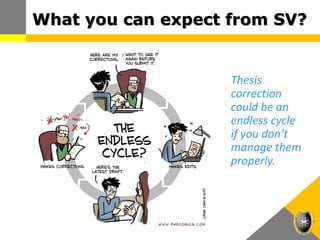
Thesis
correction
could be an
endless cycle
if you don’t
manage them
properly.
What you can expect from SV?
• Intellectual support
– You are not ALL ALONE actually. Your SV is on
your side. Your success is their success
– Quality assurance
– What standard a thesis should reach
– Indication of when to stop
• Emotional support
– Encouragement
– Constructive atmosphere
What you can expect from SV?
• Regular, constructive criticism on your
written work
• Guidance, suggestions and ideas for
research direction/opportunities
• Advice at each stage of the project
• Some direction (though probably not too
much!)
What NOT to expect from SV?
• Smiles
– If draft chapters contain simple spelling mistakes
and typos
– Remember, it isn’t your supervisor’s job to proof
read what you write.
– Get advice about your PhD, not your English.
– If you are not good in English, get help!
• Mind-reading skills
– Motivation dipping
– Absence = illness
• Show initiatives, be proactive, etc.
– basically be independent
• Be honest about how things are going
• Produce quality written work that is
not a first draft
• Meet deadlines (or explain why not)
• Meet regularly to discuss your
progress
• Tell them what you are learning
• Teach them something new
What SV expect from you?
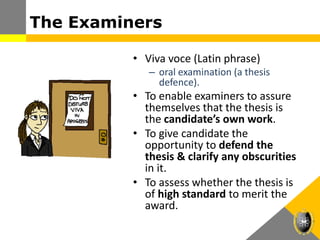
The Examiners
• Viva voce (Latin phrase)
– oral examination (a thesis
defence).
• To enable examiners to assure
themselves that the thesis is
the candidate’s own work.
• To give candidate the
opportunity to defend the
thesis & clarify any obscurities
in it.
• To assess whether the thesis is
of high standard to merit the
award.
What Are They Looking For?
• Did you do the work yourself?
• Have you done the reading?
• Do you have a good knowledge of the field?
• Did you write the thesis yourself?
• Can you do research independently?
• Can you teach the subject?
• Can you talk about it professionally?
• Have you contributed to knowledge?
• Did you learn anything?
Defending Your Thesis
• Enjoy it
– You’ve the world’s experts in the room
– They want to talk about your work
– How often will that happen in the future?
• If you want, have a practice
– Get your supervisor to set up a “dummy” jury
– Prepare your opening statement
Your thesis is your best friend
• Know your thesis very well
• Re-read your thesis carefully
• If you find any mistakes, don’t panic, but
make a note of it
• Identify the originality of your work
• Identify the contribution to knowledge in
your field study
• Identify the strengths & weaknesses and
make a note of them
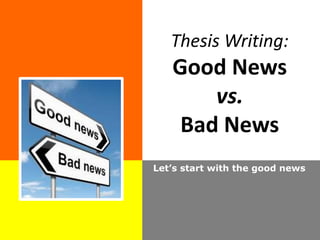
Thesis Writing:
Good News
vs.
Bad News
Let’s start with the good news
Good News vs. Bad News
• You only have to write ONE
thesis
– And couple of journal articles
• It will make you famous
– Just kidding
• It will change the world
– Based on statistics, it is very
unlikely
Good News vs. Bad News
• At the end, you will be invited to a
convocation ceremony
– You are likely to be in the 1st session!
– Can post a lot of photos in your soc
med!
• For PhD candidate, you get to add “Dr” to
your name
– Grandpa, Grandma, Aunties, Uncles,
Neighbours, Village people.. They are
all going to be very impressed
Good News vs. Bad News
• Writing a thesis is hard and
painful work
– You’ve already done the fun part
(the research)
– Most students are not trained to
write properly
• It’s a lonely process
– Nobody will write it for you.
Good News vs. Bad News
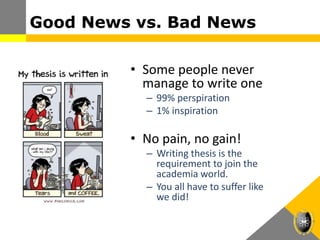
• Some people never
manage to write one
– 99% perspiration
– 1% inspiration
• No pain, no gain!
– Writing thesis is the
requirement to join the
academia world.
– You all have to suffer like
we did!
Good News vs. Bad News
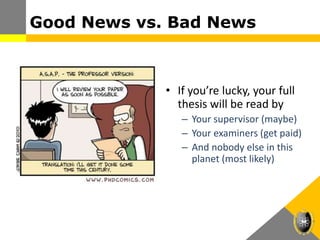
• If you’re lucky, your full
thesis will be read by
– Your supervisor (maybe)
– Your examiners (get paid)
– And nobody else in this
planet (most likely)
Good News vs. Bad News
Remember!
NEVER UNDERESTIMATE how
hard/long it will take to write up.
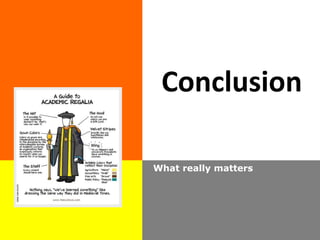
What really matters
Conclusion
The DOs and DON’Ts:
• DON’T leave the responsibility for your project to others.
• DON’T spend long hours in office/lab for the sake of it.
• DON’T be alone. Talk to others about your problems.
• DON’T wait, write now. One day or day one, you decide.
• DO get support from other PG students.
• DO give support to other PG students.
• DO take every opportunity to practice and learn.
• DO get a life. Enjoy your ‘play time’.
General Advice
“The only way to find out how to
do a Postgraduate Research is to
do one. Therefore all advice is
useless.”
(Richard Butterworth, 1998)
-The End-
General Advice
References
• Mihir Bellare http://cseweb.ucsd.edu/~mihir/phd.html
• Richard Butterworth
http://public.randomnotes.org/richard/PhDtalk.html
• Alex Hope
http://drsustainable.wordpress.com/2012/05/25/experiences-as-a-
phd-student/
• Matt Schonlau, How to finish a Ph.D.
http://www.schonlau.net/finishphd.html
• PhD Comics http://www.phdcomics.com
• Toby Walsh, How to Write a Thesis, University College Cork

How To Write a Thesis (Research Documentation)

  • 2.
    My Background • 1stdegree in Management Information System - IIUM • Master in Software Engineering – UTM (by coursework) • PhD in Computational Engineering, Cardiff School of Engineering, Cardiff University, Wales, UK. – Main SV: Prof Rossi Setchi (Bulgarian) – Co-SV: Dr Yulia A Hicks (Russian) – Apr 2008 – Apr 2012 – Married, started with 1 kid, graduated with 2 kids.
  • 3.
    PhD Research • ImageAnnotation • Text Based Information Retrieval • Semantic & Ontology Current Research • Embedded Systems • Robotic Manipulation • Internet of Things (IoT) • Wireless Sensor Network • Intelligent System • Software Engineering • Information Retrieval.
  • 4.
  • 5.
    Outline • Introduction • ThesisWriting – What? – Why? – When? – Who? – How? – Good News vs. Bad News • General Advice
  • 6.
    Introduction What is aPostgraduate Research?
  • 7.
    What is aPG Research? • Master or PhD is not a destination, it is a JOURNEY. • Ability to research anything, and the expectation that you will understand it. • You should be more likely to ask why things are done a certain way, and how it could be made better – analytical thinking. • You can jump into a new area, pick it up quickly, and have something interesting to say about it. • And the most important part in all these, is the ability to write them clearly, so that other people can know what you know.
  • 8.
    Doing a PGResearch • How? i. Find a problem ii. Understand the background iii. Knows what already being done iv. Find the gaps v. Design solution vi. Evaluate & Validate vii. Get agreement ** • Plan your work > Get milestones > Execute • Break big task into micro tasks - focus on small pieces, one at a time.
  • 9.
  • 10.
    When to startwriting? • When? i. Find a problem - write ii. Understand the background - write iii. Knows what already being done - write iv. Find the gaps - write v. Design solution - write vi. Evaluate & Validate - write vii. Get agreement ** - write • Start writing from the beginning!
  • 11.
    When to startwriting? I was given a blue notebook on my 1st day. “I want you to start writing today”. (Rossi, April 2008)
  • 12.
    When to startwriting?
  • 13.
    Thesis Writing: What? What isa thesis? What a thesis is not?
  • 14.
    What is athesis? • Demonstration of an understanding of the state of the art – Critical appreciation of existing work • A novel contribution – Evaluated systematically • Opens a new area • Provides unifying framework • Resolves long-standing question • Thoroughly explores area • Contradicts existing knowledge • Experimentally validates theory
  • 15.
    What is athesis? • Produces ambitious system • Provides empirical data • Derives superior algorithms • Develops new methodology • Develops new tool
  • 16.
    What a thesisIS NOT? • It is not a historical narrative, – What I did in the lab over the past 3 years • I first read the background material • I then implemented an algorithm • I ran some experiments • … • A thesis is a logical reconstruction
  • 17.
    What a thesisIS NOT? • A brain dump of everything you’ve done – You get to leave out the dead-ends – But you have to fill in any obvious gaps! • Something you can buy in the shop – Unless you’ve been into the underworld
  • 18.
    Thesis Writing: Why? Why dowe need to write? - Informal writing - Formal writing
  • 19.
    Why do weneed to write? Informal Writing: • Because you wont remember everything, forever – Sometimes writing will help you remember • Training – getting yourself familiar with writing • Developing a good habit • Motivate yourself to keep going
  • 20.
    Why do weneed to write? Formal Writing: • Data without notes are unusable – Because you won’t remember everything, forever • For others who may need to understand your research - Science includes the dissemination of knowledge – to communicate to the community – to contribute to the advancement of knowledge
  • 21.
    Why do weneed to write? • To make progress – Progress is measured by OUTPUT, not time (results, publications). – Do not spend long hours in office/lab just for the sake of it – If you don’t know what to do, WRITE something. Anything. • But there is a RISK in writing early and often!
  • 22.
    Why do weneed to write? ALERT: Most of your writings will never be used! So be it. Remember, it’s a journey, not a destination.
  • 23.
    Why do weneed to write? Adam Savage, Myth Buster
  • 24.
    Thesis Writing: How long? Howlong will it take to write a thesis?
  • 25.
    Procrastination is yourworst enemy. How long will it take?
  • 26.
    Good News vs.Bad News Write early. Write often.
  • 27.
    How long willit take?
  • 28.
    How long willit take? How long will it take to write a thesis? • Depends on many factors – How much you’ve written as papers – Many other things • Wild estimation? – Min = 2 months (very very very rare) – Max = infinity – Mean = infinity – Median = 6-9 months
  • 29.
    Your thesis islike your baby. • Give it 9 months at least, to deliver. – It was 12 months for me • You have to know when to let it go – Finished is better than perfect. How long will it take?
  • 30.
    • Make afull list of tasks to be done – So you always aware where you are, how far more you need to go • Prioritize your work and tasks and set milestones – Create deadlines for paper submission – Get agreements – Track your time on subtasks • Update your SV/team on progress regularly • Reward yourself when achieving milestones – ALERT: Rewards kill creativity – Pick your reward CAREFULLY. Don’t pick a reward that negates what you’ve just achieved. How to kill procrastination?
  • 31.
    How to killprocrastination? A quick 3-4 days holiday getaway won’t hurt.
  • 32.
    Thesis Writing: How to? Howto write a thesis
  • 33.
    Writing a thesis:Myths • Being able to write well is a gift • Writing is just a question of getting down what you know, it will all come together when the time comes. – Everything is already in your head, you just have to write it down.
  • 34.
  • 35.
    How to start? •Get a good template. Solve all the technical in the beginning – Formats, styles, annotation, reference, bibliography, etc. – Strictly follow guidelines from Graduate School from the beginning – Use software/tools that you are comfortable with. – Use automated backups (external drive, clouds) • If you have problem with the technical, get help!
  • 36.
    How to start? •Start with the Table of Contents – Get a logical structure of your thesis – Look at other thesis in your field, see how they structured it, get idea. – Get agreement – Your TOC is very important – its the blueprint of your thesis
  • 37.
    How to start? •A typical TOC structure – Abstract – Introduction – Background/Literature – Experiments and Results – Analysis/discussion – Conclusions • Identical structure with research paper – The only differences is the length, context and scope.
  • 38.
    How to start? •Writing is hard for everyone. Don’t try to be Shakespeare • You don’t have to start with introduction – Stop waiting for mood or inspiration – Start where you feel happiest. It is your thesis, you can do it however you want it. • Typically people start in the middle and outwards – .. then conclusion and end with introduction
  • 39.
    How to write? •My writing order – Abstract - 6 – Introduction - 4/5 – Background/Literature - 3 – Experiments and Results - 1 – Analysis/discussion - 2 – Conclusions - 4/5 • Get your own formula that can make you happy
  • 40.
    How to write? •Write everything in ONE (1) document • Use versions to help you track your files
  • 41.
    How to write? •As you are writing up, you’ll discover holes in your research – Theorems you haven’t proved – Experiments you didn’t run (different environment or parameters) • Writing will lead to more research. That’s totally OK!.
  • 42.
    How to write? TheRules of Three • Within thesis, repeat your contributions 3 times – Intro chapter – Main chapters – Conclusion chapter • Within each chapter, repeat yourself 3 times – Introduction - We will show .. – Body - Show them .. – Conclusion - We have shown ..
  • 43.
    Common problems inwriting • Complex sentences full of long words – A thesis should be a simple, convincing argument! • Impossible to cover all issues – So you will never finish? – It’s sometimes enough to identify the issues – Examiners greatly appreciate you identifying limitations – Examiners greatly happy finding a few mistakes
  • 44.
    Common problems inwriting • At some point, your brain will surely become toast – Take a break – Eat properly, exercise, get a good sleep – Get a life • Toasted brain is only temporary, calm down – I am still alive
  • 45.
    Thesis Writing: Who? Who willread your thesis? - Supervisors - Examiners
  • 46.
    Thesis correction could be an endlesscycle if you don’t manage them properly. What you can expect from SV?
  • 47.
    What you canexpect from SV? • Intellectual support – You are not ALL ALONE actually. Your SV is on your side. Your success is their success – Quality assurance – What standard a thesis should reach – Indication of when to stop • Emotional support – Encouragement – Constructive atmosphere
  • 48.
    What you canexpect from SV? • Regular, constructive criticism on your written work • Guidance, suggestions and ideas for research direction/opportunities • Advice at each stage of the project • Some direction (though probably not too much!)
  • 49.
    What NOT toexpect from SV? • Smiles – If draft chapters contain simple spelling mistakes and typos – Remember, it isn’t your supervisor’s job to proof read what you write. – Get advice about your PhD, not your English. – If you are not good in English, get help! • Mind-reading skills – Motivation dipping – Absence = illness
  • 50.
    • Show initiatives,be proactive, etc. – basically be independent • Be honest about how things are going • Produce quality written work that is not a first draft • Meet deadlines (or explain why not) • Meet regularly to discuss your progress • Tell them what you are learning • Teach them something new What SV expect from you?
  • 51.
    The Examiners • Vivavoce (Latin phrase) – oral examination (a thesis defence). • To enable examiners to assure themselves that the thesis is the candidate’s own work. • To give candidate the opportunity to defend the thesis & clarify any obscurities in it. • To assess whether the thesis is of high standard to merit the award.
  • 52.
    What Are TheyLooking For? • Did you do the work yourself? • Have you done the reading? • Do you have a good knowledge of the field? • Did you write the thesis yourself? • Can you do research independently? • Can you teach the subject? • Can you talk about it professionally? • Have you contributed to knowledge? • Did you learn anything?
  • 53.
    Defending Your Thesis •Enjoy it – You’ve the world’s experts in the room – They want to talk about your work – How often will that happen in the future? • If you want, have a practice – Get your supervisor to set up a “dummy” jury – Prepare your opening statement
  • 54.
    Your thesis isyour best friend • Know your thesis very well • Re-read your thesis carefully • If you find any mistakes, don’t panic, but make a note of it • Identify the originality of your work • Identify the contribution to knowledge in your field study • Identify the strengths & weaknesses and make a note of them
  • 55.
    Thesis Writing: Good News vs. BadNews Let’s start with the good news
  • 56.
    Good News vs.Bad News • You only have to write ONE thesis – And couple of journal articles • It will make you famous – Just kidding • It will change the world – Based on statistics, it is very unlikely
  • 57.
    Good News vs.Bad News • At the end, you will be invited to a convocation ceremony – You are likely to be in the 1st session! – Can post a lot of photos in your soc med! • For PhD candidate, you get to add “Dr” to your name – Grandpa, Grandma, Aunties, Uncles, Neighbours, Village people.. They are all going to be very impressed
  • 58.
    Good News vs.Bad News • Writing a thesis is hard and painful work – You’ve already done the fun part (the research) – Most students are not trained to write properly • It’s a lonely process – Nobody will write it for you.
  • 59.
    Good News vs.Bad News • Some people never manage to write one – 99% perspiration – 1% inspiration • No pain, no gain! – Writing thesis is the requirement to join the academia world. – You all have to suffer like we did!
  • 60.
    Good News vs.Bad News • If you’re lucky, your full thesis will be read by – Your supervisor (maybe) – Your examiners (get paid) – And nobody else in this planet (most likely)
  • 61.
    Good News vs.Bad News Remember! NEVER UNDERESTIMATE how hard/long it will take to write up.
  • 62.
  • 63.
    The DOs andDON’Ts: • DON’T leave the responsibility for your project to others. • DON’T spend long hours in office/lab for the sake of it. • DON’T be alone. Talk to others about your problems. • DON’T wait, write now. One day or day one, you decide. • DO get support from other PG students. • DO give support to other PG students. • DO take every opportunity to practice and learn. • DO get a life. Enjoy your ‘play time’. General Advice
  • 64.
    “The only wayto find out how to do a Postgraduate Research is to do one. Therefore all advice is useless.” (Richard Butterworth, 1998) -The End- General Advice
  • 65.
    References • Mihir Bellarehttp://cseweb.ucsd.edu/~mihir/phd.html • Richard Butterworth http://public.randomnotes.org/richard/PhDtalk.html • Alex Hope http://drsustainable.wordpress.com/2012/05/25/experiences-as-a- phd-student/ • Matt Schonlau, How to finish a Ph.D. http://www.schonlau.net/finishphd.html • PhD Comics http://www.phdcomics.com • Toby Walsh, How to Write a Thesis, University College Cork

Editor's Notes

  • #48 Some people work on an inspiration or deadline-driven basis, sometimes putting in long hours, then doing nothing for a few days. Others maintain a steady schedule, coming to the lab at a certain time in the morning and leaving a certain time in the evening. Neither is right or wrong or better or worse; it is a question of finding what works best for you.
  • #49 Some people work on an inspiration or deadline-driven basis, sometimes putting in long hours, then doing nothing for a few days. Others maintain a steady schedule, coming to the lab at a certain time in the morning and leaving a certain time in the evening. Neither is right or wrong or better or worse; it is a question of finding what works best for you.
  • #50 Some people work on an inspiration or deadline-driven basis, sometimes putting in long hours, then doing nothing for a few days. Others maintain a steady schedule, coming to the lab at a certain time in the morning and leaving a certain time in the evening. Neither is right or wrong or better or worse; it is a question of finding what works best for you.