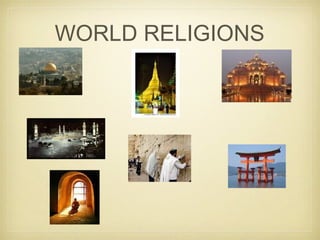
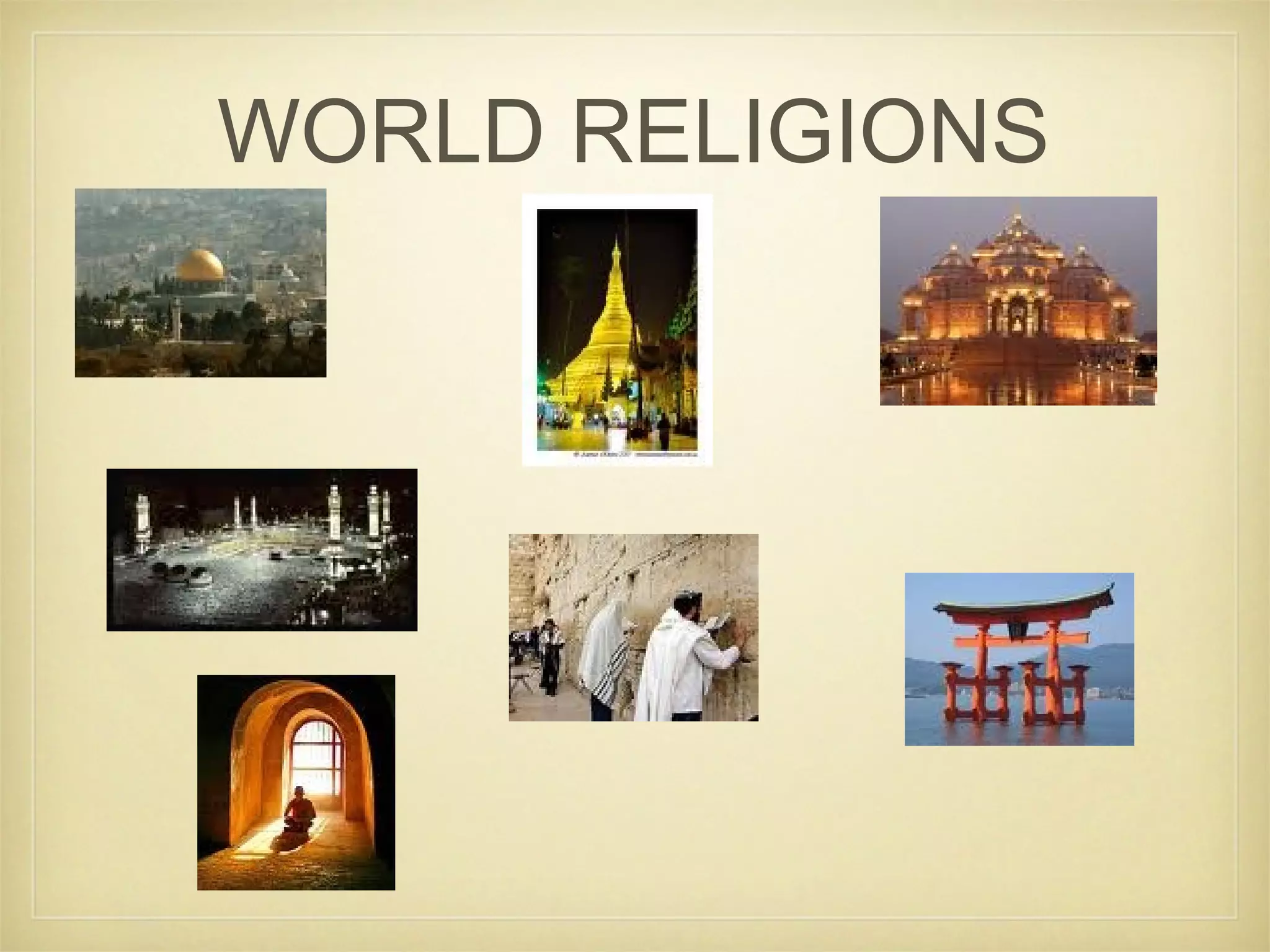
WORLD RELIGIONS
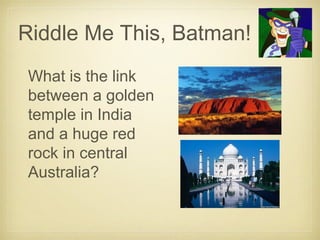
Riddle Me This, Batman!
What is the link
between a golden
temple in India
and a huge red
rock in central
Australia?
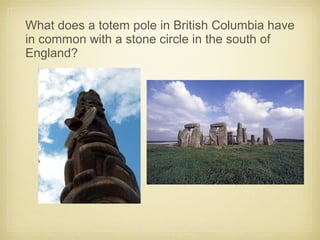
What does a totem pole in British Columbia have
in common with a stone circle in the south of
England?
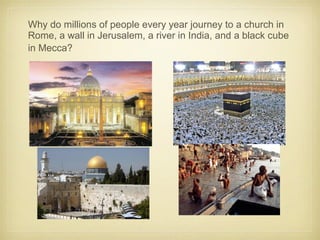
Why do millions of people every year journey to a church in

Rome, a wall in Jerusalem, a river in India, and a black cube
in Mecca?
The answer
to all of these questions
involves one word,
religion,
a phenomenon common
to all people in all times.
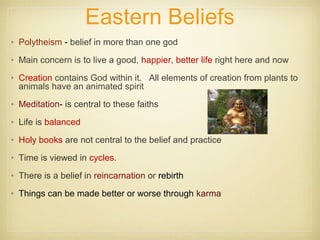
According to the dictionary, religion
involves "belief in and reverence for a
supernatural power or powers regarded as
creator and governor of the universe." 
It is "a personal or institutionalized system
grounded in such belief and worship." 
Simply put, all
religions celebrate
a sense of the
sacred in life.
Origins of Religion
Religion is as old as humankind.
Since the beginning, human beings
have looked to powers outside of
themselves for protection and reassurance.
These beliefs predate the written word, so we
must look to archaeological finds for evidence
of these ancient religious beliefs. Of course,
we cannot know exactly what these beliefs
were, but we can theorize.
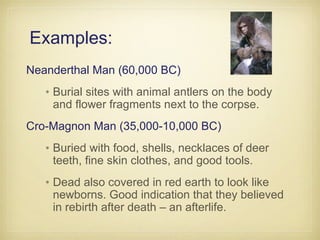
Examples:
Neanderthal Man (60,000 BC)
•Burial sites with animal antlers on the body
and flower fragments next to the corpse.
Cro-Magnon Man (35,000-10,000 BC)
•Buried with food, shells, necklaces of deer
teeth, fine skin clothes, and good tools.
•Dead also covered in red earth to look like
newborns. Good indication that they believed
in rebirth after death – an afterlife.
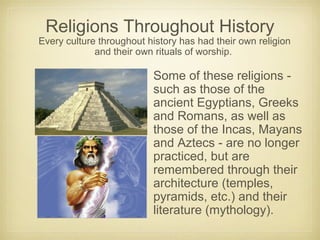
Religions Throughout History
Every culture throughout history has had their own religion
and their own rituals of worship.
Some of these religions -
such as those of the
ancient Egyptians, Greeks
and Romans, as well as
those of the Incas, Mayans
and Aztecs - are no longer
practiced, but are
remembered through their
architecture (temples,
pyramids, etc.) and their
literature (mythology).
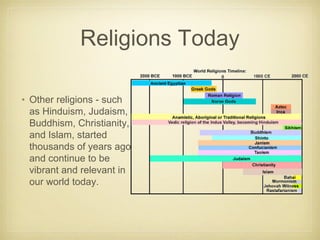
Religions Today
• Other religions - such
as Hinduism, Judaism,
Buddhism, Christianity,
and Islam, started
thousands of years ago
and continue to be
vibrant and relevant in
our world today.
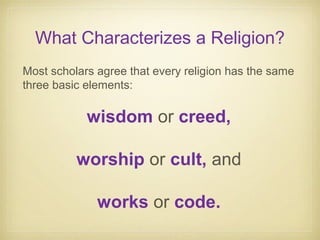
What Characterizes a Religion?
Most scholars agree that every religion has the same
three basic elements:
wisdom or creed,
worship or cult, and
works or code.
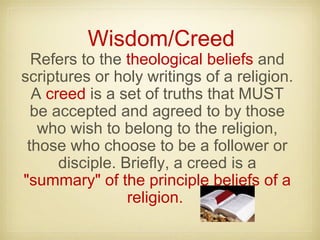
Wisdom/Creed
Refers to the theological beliefs and
scriptures or holy writings of a religion.
A creed is a set of truths that MUST
be accepted and agreed to by those
who wish to belong to the religion,
those who choose to be a follower or
disciple. Briefly, a creed is a
"summary" of the principle beliefs of a
religion.
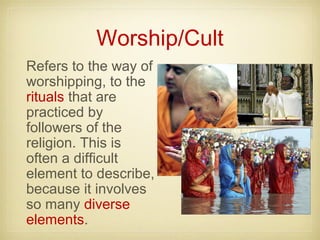
Worship/Cult
Refers to the way of
worshipping, to the
rituals that are
practiced by
followers of the
religion. This is
often a difficult
element to describe,
because it involves
so many diverse
elements.
Works/Code
Refers to the ethical values and the system
of moral practice directly resulting from an
adherence to the beliefs. It is a set of moral
principles and guidelines that must be
respected and followed by those who would
be identified as members of the religion.
Works/Code (Con’t)
A code, when used in a religious sense, is
simply a summary of the principles and
guidelines by which people choose which
actions are good, and which to be
avoided.
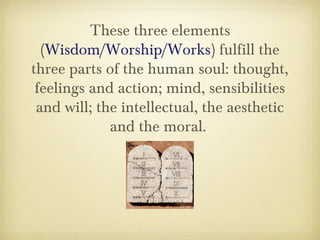
These three elements
(Wisdom/Worship/Works) fulfill the
three parts of the human soul: thought,
feelings and action; mind, sensibilities
and will; the intellectual, the aesthetic
and the moral.
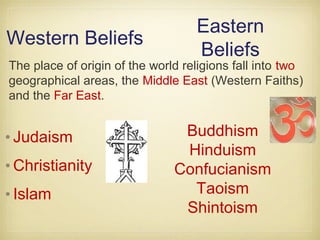
Western Beliefs
•Judaism
•Christianity
•Islam
Eastern
Beliefs
The place of origin of the world religions fall into two
geographical areas, the Middle East (Western Faiths)
and the Far East.
Buddhism
Hinduism
Confucianism
Taoism
Shintoism
Western Beliefs
• Share a similar view of the world and concept because
they both sprang from Judaism (Islam & Christianity)
• MONOTHEISTIC- believe in one GOD
• Humans must enter into an interpersonal relationship
with God
• Morality is based on learning the will of God,
understanding and living it out individually and as a
community
• Time is viewed as linear, from beginning to end
• The Bible (Christianity), Torah (Judaism) or Koran
(Islam) are the central books studied and lived by.
Eastern Beliefs
• Polytheism - belief in more than one god
• Main concern is to live a good, happier, better life right here and now
• Creation contains God within it. All elements of creation from plants to
animals have an animated spirit
• Meditation- is central to these faiths
• Life is balanced
• Holy books are not central to the belief and practice
• Time is viewed in cycles.
• There is a belief in reincarnation or rebirth
• Things can be made better or worse through karma
Importance of Studying
Religion
•1. Understand differences and see similarities
between nations and cultures both political and
philosophical
•2. Appreciate our own beliefs by seeing them
alongside those of others
•3. Work for Ecumenism through a meaningful
exchange of ideas between religious groups
Similarities of Religion
•Belief in a power greater than
humans
Similarities of Religion
•Belief in a power greater than
humans
•Holy Places eg. Mecca, Jerusalem,
Similarities of Religion
•Belief in a power greater than
humans
•Holy Places eg. Mecca, Jerusalem,
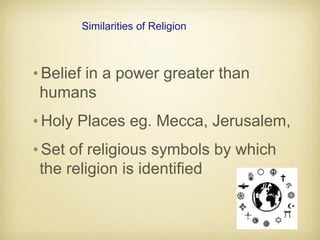
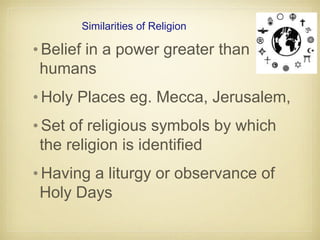
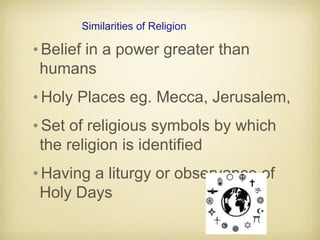
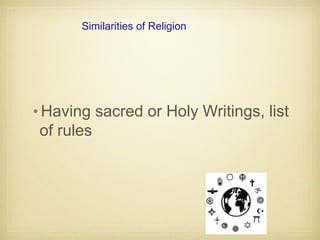
•Set of religious symbols by which
the religion is identified
Similarities of Religion
•Belief in a power greater than
humans
•Holy Places eg. Mecca, Jerusalem,
•Set of religious symbols by which
the religion is identified
•Having a liturgy or observance of
Holy Days
Similarities of Religion
•Belief in a power greater than
humans
•Holy Places eg. Mecca, Jerusalem,
•Set of religious symbols by which
the religion is identified
•Having a liturgy or observance of
Holy Days
Similarities of Religion
•Having sacred or Holy Writings, list
of rules
Similarities of Religion
•Having sacred or Holy Writings, list
of rules
•Number of important people,
founders, prophets, missionaries,
historical people
Similarities of Religion
•Having sacred or Holy Writings, list
of rules
•Number of important people,
founders, prophets, missionaries,
historical people
•Place of worship
Similarities of Religion
•Having sacred or Holy Writings, list
of rules
•Number of important people,
founders, prophets, missionaries,
historical people
•Place of worship
•Belief in a Golden Rule
RELIGIOUS DIFFERENCES
• Their idea of sin or evil
•
RELIGIOUS DIFFERENCES
• Their idea of sin or evil
• Their idea of salvation
•
RELIGIOUS DIFFERENCES
•Their idea of sin or evil
•Their idea of salvation
• The idea of priesthood
•
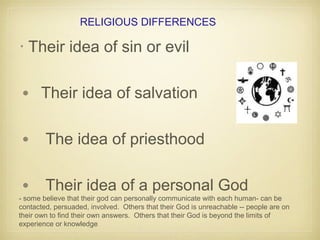
RELIGIOUS DIFFERENCES
• Their idea of sin or evil
• Their idea of salvation
• The idea of priesthood
• Their idea of a personal God
- some believe that their god can personally communicate with each human- can be
contacted, persuaded, involved. Others that their God is unreachable -- people are on
their own to find their own answers. Others that their God is beyond the limits of
experience or knowledge
World Religions and Spiritualties
All religions are an expression of a
people’s response to the Divine
People want to know:
1.Who is God?
2.What does God require of me?
3.How do I know God?
4.How can I be close to God?
World Religions and Spiritualties
The characteristics of each religion are
a reflection of its people. The unique
identities of a people are shaped by
their culture, geography, language, and
history. These become a basis for how
a people understand God, how they
show their devotion to God and how
they worship.
Three common elements of
religion
Wisdom - sacred writings and oral
tradition
Worship - rituals express the
emotional experience to have the right
attitude toward God and others
Works - Holiness in action or daily
lives, commandments to live by,
JUDAISM
History
Judaism is a monotheistic religion meaning it has a
belief in one God.
- rooted in the promised land- modern day Israel
- Covenant- an agreement between 2 or more
persons
-Covenant between Abraham and God -God
promised to make Abraham’s descendants a great
nation and he would be blessed with descendants
and land
Genesis 12:1-3, 6-7
Wisdom
Sacred Writings and Oral Traditions
Hebrew Bible is known as the Tanak.
-divided into 3 sections
- the Torah -“the Law” “Pentaeuch” - first 5 books
of the Bible (Genesis, Exodus, Leviticus, Numbers
and Deuteronomy) revealed to Moses on Mt. Sinai
- the Prophets-traces the history of the Torah
- the Writings “wisdom books”- the Psalms,
Proverbs, Song of Songs etc.
Wisdom
Oral Traditions
Oral Traditions -
Mishnah - “to repeat, to study”
- deals with issues such as how to observe Shabbat,
festivals, marriage, divorce, buying, selling
The part of the Law that was passed down orally,
then put into writing
- the teachings of the Rabbi- means“teacher”
Talmud - contains the teachings of Jewish rabbis for
the first few centuries
- purpose of the Talmud is to educate
how to live out the Torah in daily life.
Worship
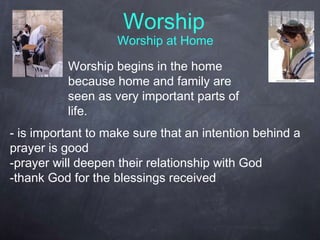
Worship at Home
Worship begins in the home
because home and family are
seen as very important parts of
life.
- is important to make sure that an intention behind a
prayer is good
-prayer will deepen their relationship with God
-thank God for the blessings received
Worship
Types of Prayer
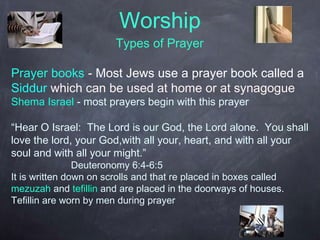
Prayer books - Most Jews use a prayer book called a
Siddur which can be used at home or at synagogue
Shema Israel - most prayers begin with this prayer
“Hear O Israel: The Lord is our God, the Lord alone. You shall
love the lord, your God,with all your, heart, and with all your
soul and with all your might.”
Deuteronomy 6:4-6:5
It is written down on scrolls and that re placed in boxes called
mezuzah and tefillin and are placed in the doorways of houses.
Tefillin are worn by men during prayer
Worship - the Synagogue
Synagogue means a “place of meeting or
assembly”and this is where Jews meet to worship
-most of the time Jews pray standing up, but they
may bow as they refer to God the King
- on certain holy days, the Jews may kneel as a sign
of humility before God
What you will see in a synagogue
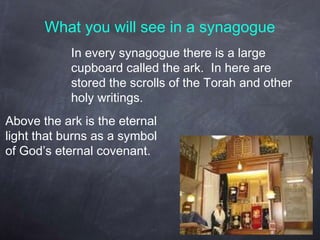
In every synagogue there is a large
cupboard called the ark. In here are
stored the scrolls of the Torah and other
holy writings.
Above the ark is the eternal
light that burns as a symbol
of God’s eternal covenant.

Introduction to World Religions

  • 1.
  • 2.
    Riddle Me This,Batman! What is the link between a golden temple in India and a huge red rock in central Australia?
  • 3.
    What does atotem pole in British Columbia have in common with a stone circle in the south of England?
  • 4.
    Why do millionsof people every year journey to a church in Rome, a wall in Jerusalem, a river in India, and a black cube in Mecca?
  • 5.
    The answer to allof these questions involves one word, religion, a phenomenon common to all people in all times.
  • 6.
    According to thedictionary, religion involves "belief in and reverence for a supernatural power or powers regarded as creator and governor of the universe."  It is "a personal or institutionalized system grounded in such belief and worship." 
  • 7.
    Simply put, all religionscelebrate a sense of the sacred in life.
  • 8.
    Origins of Religion Religionis as old as humankind. Since the beginning, human beings have looked to powers outside of themselves for protection and reassurance. These beliefs predate the written word, so we must look to archaeological finds for evidence of these ancient religious beliefs. Of course, we cannot know exactly what these beliefs were, but we can theorize.
  • 9.
    Examples: Neanderthal Man (60,000BC) •Burial sites with animal antlers on the body and flower fragments next to the corpse. Cro-Magnon Man (35,000-10,000 BC) •Buried with food, shells, necklaces of deer teeth, fine skin clothes, and good tools. •Dead also covered in red earth to look like newborns. Good indication that they believed in rebirth after death – an afterlife.
  • 10.
    Religions Throughout History Everyculture throughout history has had their own religion and their own rituals of worship. Some of these religions - such as those of the ancient Egyptians, Greeks and Romans, as well as those of the Incas, Mayans and Aztecs - are no longer practiced, but are remembered through their architecture (temples, pyramids, etc.) and their literature (mythology).
  • 11.
    Religions Today • Otherreligions - such as Hinduism, Judaism, Buddhism, Christianity, and Islam, started thousands of years ago and continue to be vibrant and relevant in our world today.
  • 12.
    What Characterizes aReligion? Most scholars agree that every religion has the same three basic elements: wisdom or creed, worship or cult, and works or code.
  • 13.
    Wisdom/Creed Refers to thetheological beliefs and scriptures or holy writings of a religion. A creed is a set of truths that MUST be accepted and agreed to by those who wish to belong to the religion, those who choose to be a follower or disciple. Briefly, a creed is a "summary" of the principle beliefs of a religion.
  • 14.
    Worship/Cult Refers to theway of worshipping, to the rituals that are practiced by followers of the religion. This is often a difficult element to describe, because it involves so many diverse elements.
  • 15.
    Works/Code Refers to theethical values and the system of moral practice directly resulting from an adherence to the beliefs. It is a set of moral principles and guidelines that must be respected and followed by those who would be identified as members of the religion.
  • 16.
    Works/Code (Con’t) A code,when used in a religious sense, is simply a summary of the principles and guidelines by which people choose which actions are good, and which to be avoided.
  • 17.
    These three elements (Wisdom/Worship/Works)fulfill the three parts of the human soul: thought, feelings and action; mind, sensibilities and will; the intellectual, the aesthetic and the moral.
  • 18.
    Western Beliefs •Judaism •Christianity •Islam Eastern Beliefs The placeof origin of the world religions fall into two geographical areas, the Middle East (Western Faiths) and the Far East. Buddhism Hinduism Confucianism Taoism Shintoism
  • 19.
    Western Beliefs • Sharea similar view of the world and concept because they both sprang from Judaism (Islam & Christianity) • MONOTHEISTIC- believe in one GOD • Humans must enter into an interpersonal relationship with God • Morality is based on learning the will of God, understanding and living it out individually and as a community • Time is viewed as linear, from beginning to end • The Bible (Christianity), Torah (Judaism) or Koran (Islam) are the central books studied and lived by.
  • 20.
    Eastern Beliefs • Polytheism- belief in more than one god • Main concern is to live a good, happier, better life right here and now • Creation contains God within it. All elements of creation from plants to animals have an animated spirit • Meditation- is central to these faiths • Life is balanced • Holy books are not central to the belief and practice • Time is viewed in cycles. • There is a belief in reincarnation or rebirth • Things can be made better or worse through karma
  • 21.
    Importance of Studying Religion •1.Understand differences and see similarities between nations and cultures both political and philosophical •2. Appreciate our own beliefs by seeing them alongside those of others •3. Work for Ecumenism through a meaningful exchange of ideas between religious groups
  • 22.
    Similarities of Religion •Beliefin a power greater than humans
  • 23.
    Similarities of Religion •Beliefin a power greater than humans •Holy Places eg. Mecca, Jerusalem,
  • 24.
    Similarities of Religion •Beliefin a power greater than humans •Holy Places eg. Mecca, Jerusalem, •Set of religious symbols by which the religion is identified
  • 25.
    Similarities of Religion •Beliefin a power greater than humans •Holy Places eg. Mecca, Jerusalem, •Set of religious symbols by which the religion is identified •Having a liturgy or observance of Holy Days
  • 26.
    Similarities of Religion •Beliefin a power greater than humans •Holy Places eg. Mecca, Jerusalem, •Set of religious symbols by which the religion is identified •Having a liturgy or observance of Holy Days
  • 27.
    Similarities of Religion •Havingsacred or Holy Writings, list of rules
  • 28.
    Similarities of Religion •Havingsacred or Holy Writings, list of rules •Number of important people, founders, prophets, missionaries, historical people
  • 29.
    Similarities of Religion •Havingsacred or Holy Writings, list of rules •Number of important people, founders, prophets, missionaries, historical people •Place of worship
  • 30.
    Similarities of Religion •Havingsacred or Holy Writings, list of rules •Number of important people, founders, prophets, missionaries, historical people •Place of worship •Belief in a Golden Rule
  • 31.
    RELIGIOUS DIFFERENCES • Theiridea of sin or evil •
  • 32.
    RELIGIOUS DIFFERENCES • Theiridea of sin or evil • Their idea of salvation •
  • 33.
    RELIGIOUS DIFFERENCES •Their ideaof sin or evil •Their idea of salvation • The idea of priesthood •
  • 34.
    RELIGIOUS DIFFERENCES • Theiridea of sin or evil • Their idea of salvation • The idea of priesthood • Their idea of a personal God - some believe that their god can personally communicate with each human- can be contacted, persuaded, involved. Others that their God is unreachable -- people are on their own to find their own answers. Others that their God is beyond the limits of experience or knowledge
  • 35.
    World Religions andSpiritualties All religions are an expression of a people’s response to the Divine People want to know: 1.Who is God? 2.What does God require of me? 3.How do I know God? 4.How can I be close to God?
  • 36.
    World Religions andSpiritualties The characteristics of each religion are a reflection of its people. The unique identities of a people are shaped by their culture, geography, language, and history. These become a basis for how a people understand God, how they show their devotion to God and how they worship.
  • 37.
    Three common elementsof religion Wisdom - sacred writings and oral tradition Worship - rituals express the emotional experience to have the right attitude toward God and others Works - Holiness in action or daily lives, commandments to live by,
  • 39.
    JUDAISM History Judaism is amonotheistic religion meaning it has a belief in one God. - rooted in the promised land- modern day Israel - Covenant- an agreement between 2 or more persons -Covenant between Abraham and God -God promised to make Abraham’s descendants a great nation and he would be blessed with descendants and land Genesis 12:1-3, 6-7
  • 40.
    Wisdom Sacred Writings andOral Traditions Hebrew Bible is known as the Tanak. -divided into 3 sections - the Torah -“the Law” “Pentaeuch” - first 5 books of the Bible (Genesis, Exodus, Leviticus, Numbers and Deuteronomy) revealed to Moses on Mt. Sinai - the Prophets-traces the history of the Torah - the Writings “wisdom books”- the Psalms, Proverbs, Song of Songs etc.
  • 41.
    Wisdom Oral Traditions Oral Traditions- Mishnah - “to repeat, to study” - deals with issues such as how to observe Shabbat, festivals, marriage, divorce, buying, selling The part of the Law that was passed down orally, then put into writing - the teachings of the Rabbi- means“teacher” Talmud - contains the teachings of Jewish rabbis for the first few centuries - purpose of the Talmud is to educate how to live out the Torah in daily life.
  • 42.
    Worship Worship at Home Worshipbegins in the home because home and family are seen as very important parts of life. - is important to make sure that an intention behind a prayer is good -prayer will deepen their relationship with God -thank God for the blessings received
  • 43.
    Worship Types of Prayer Prayerbooks - Most Jews use a prayer book called a Siddur which can be used at home or at synagogue Shema Israel - most prayers begin with this prayer “Hear O Israel: The Lord is our God, the Lord alone. You shall love the lord, your God,with all your, heart, and with all your soul and with all your might.” Deuteronomy 6:4-6:5 It is written down on scrolls and that re placed in boxes called mezuzah and tefillin and are placed in the doorways of houses. Tefillin are worn by men during prayer
  • 44.
    Worship - theSynagogue Synagogue means a “place of meeting or assembly”and this is where Jews meet to worship -most of the time Jews pray standing up, but they may bow as they refer to God the King - on certain holy days, the Jews may kneel as a sign of humility before God
  • 45.
    What you willsee in a synagogue In every synagogue there is a large cupboard called the ark. In here are stored the scrolls of the Torah and other holy writings. Above the ark is the eternal light that burns as a symbol of God’s eternal covenant.