Introduction to Buddhism
1. The “Middle Way of Wisdom and Compassion”
A 2500 year old tradition that began in
India and spread and diversified
throughout the Far East
A philosophy, religion, and spiritual
practice followed by more than 300
million people
Based on the teachings of the Buddha
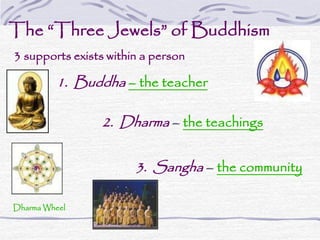
The “Three Jewels” of Buddhism
1. Buddha – the teacher
2. Dharma – the teachings
3. Sangha – the community
3 supports exists within a person
Dharma Wheel
3. Who was the Buddha?
Born Siddhartha Gautama – of noble caste in India,
563 B.C.E.
Raised in great luxury to be a king
Empathy for the suffering of others; at age 29
rejected the life of luxury to seek enlightenment and
the solution to suffering
Followed a strict ascetic lifestyle for six years
Rejected this extreme, sat in meditation, achieved
Nirvana – an awakening to the truth about life,
becoming a Buddha, the “Awakened One”at the age
of 35
Spent the remaining 45 years of his life teaching
others how to achieve the peace of mind he had
achieved
The Four Noble Truths:
Life is suffering - Dukkha
The cause of suffering is self-centered
desire & attachments - Tanha
The solution is to eliminate desire and
attachment, thus achieving Nirvana (“extinction”)
People should use their skills and follow the
“Eight-Fold Path”
1. What did the Buddha Teach?
Wisdom
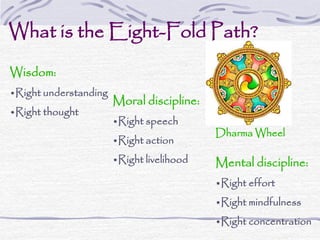
What is the Eight-Fold Path?
Wisdom:
•Right understanding
•Right thought
Moral discipline:
•Right speech
•Right action
•Right livelihood Mental discipline:
•Right effort
•Right mindfulness
•Right concentration
Dharma Wheel
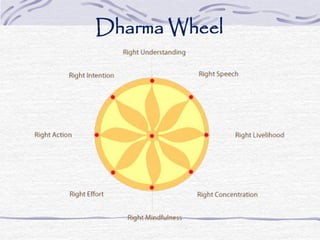
Dharma Wheel
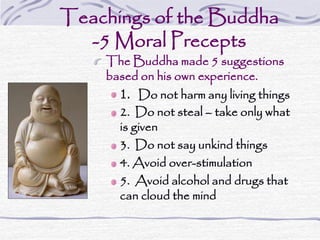
Teachings of the Buddha
-5 Moral Precepts
The Buddha made 5 suggestions
based on his own experience.
1. Do not harm any living things
2. Do not steal – take only what
is given
3. Do not say unkind things
4. Avoid over-stimulation
5. Avoid alcohol and drugs that
can cloud the mind
How does Buddhism differ
from Hinduism?
Buddhism rejects…
Authority of the ancient Vedic texts
The Vedic caste system
The Vedic and Hindu deities
Vedic worship and ritual
The concept of Brahman (God)
What do Buddhists
believe?
Rebirth (reincarnation) results from attachments (karma)
Nirvana is a peaceful, detached state of mind
Achieving Nirvana means escape from the cycle of
rebirth
Once Gautama Buddha died, after 80 years of life in this
world, having achieved Nirvana and teaching multitudes
his way of life, he ceased to exist as a distinct being
Buddhism is non-theistic: Buddha is not the Buddhist
God – he is just a revered teacher
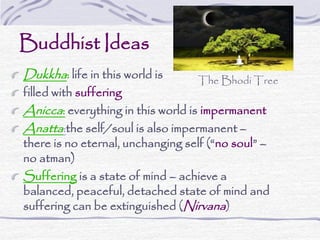
Buddhist Ideas
Dukkha: life in this world is
filled with suffering
Anicca: everything in this world is impermanent
Anatta:the self/soul is also impermanent –
there is no eternal, unchanging self (“no soul” –
no atman)
Suffering is a state of mind – achieve a
balanced, peaceful, detached state of mind and
suffering can be extinguished (Nirvana)
The Bhodi Tree
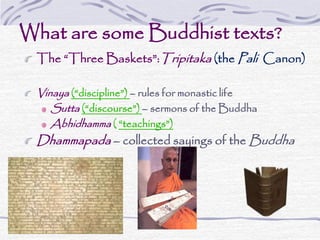
What are some Buddhist texts?
The “Three Baskets”:Tripitaka (the Pali Canon)
Vinaya (“discipline”) – rules for monastic life
Sutta (“discourse”) – sermons of the Buddha
Abhidhamma ( “teachings”)
Dhammapada – collected sayings of the Buddha
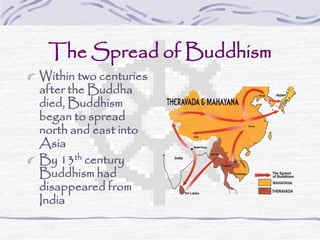
The Spread of Buddhism
Within two centuries
after the Buddha
died, Buddhism
began to spread
north and east into
Asia
By 13th century
Buddhism had
disappeared from
India
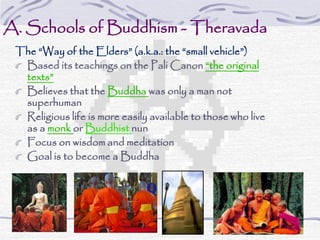
A. Schools of Buddhism - Theravada
The “Way of the Elders” (a.k.a.: the “small vehicle”)
Based its teachings on the Pali Canon “the original
texts”
Believes that the Buddha was only a man not
superhuman
Religious life is more easily available to those who live
as a monk or Buddhist nun
Focus on wisdom and meditation
Goal is to become a Buddha
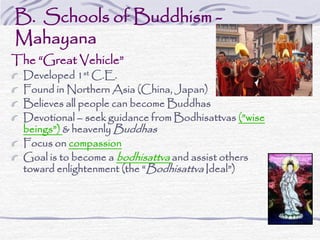
B. Schools of Buddhism -
Mahayana
The “Great Vehicle”
Developed 1st C.E.
Found in Northern Asia (China, Japan)
Believes all people can become Buddhas
Devotional – seek guidance from Bodhisattvas (”wise
beings”) & heavenly Buddhas
Focus on compassion
Goal is to become a bodhisattva and assist others
toward enlightenment (the “Bodhisattva Ideal”)
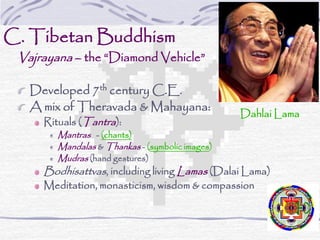
C. Tibetan Buddhism
Vajrayana – the “Diamond Vehicle”
Developed 7th century C.E.
A mix of Theravada & Mahayana:
Rituals (Tantra):
Mantras - (chants)
Mandalas & Thankas - (symbolic images)
Mudras (hand gestures)
Bodhisattvas, including living Lamas (Dalai Lama)
Meditation, monasticism, wisdom & compassion
Dahlai Lama
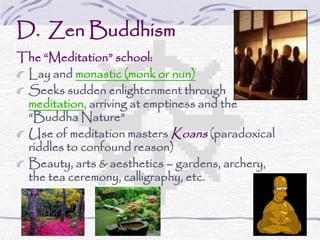
D. Zen Buddhism
The “Meditation” school:
Lay and monastic (monk or nun)
Seeks sudden enlightenment through
meditation, arriving at emptiness and the
“Buddha Nature”
Use of meditation masters Koans (paradoxical
riddles to confound reason)
Beauty, arts & aesthetics – gardens, archery,
the tea ceremony, calligraphy, etc.
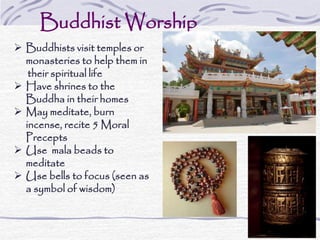
Buddhist Worship
 Buddhists visit temples or
monasteries to help them in
their spiritual life
 Have shrines to the
Buddha in their homes
 May meditate, burn
incense, recite 5 Moral
Precepts
 Use mala beads to
meditate
 Use bells to focus (seen as
a symbol of wisdom)
Buddhism in the West
Over the past two centuries, especially since the
later half of the 20th century, Buddhism has made
inroads into the Western world through…
Immigration of Asian peoples who have brought their
diverse forms of Buddhism to the West
Western followers who tend to adopt meditation practices
and the philosophy rather than more devotional forms of
Buddhism
Many such western followers remain within their own
faith traditions, finding Buddhism to be a complement to
rather than in conflict with other religions
The two groups remain independent of one another

Introduction to Buddhism

  • 1.
    Introduction to Buddhism 1.The “Middle Way of Wisdom and Compassion” A 2500 year old tradition that began in India and spread and diversified throughout the Far East A philosophy, religion, and spiritual practice followed by more than 300 million people Based on the teachings of the Buddha
  • 2.
    The “Three Jewels”of Buddhism 1. Buddha – the teacher 2. Dharma – the teachings 3. Sangha – the community 3 supports exists within a person Dharma Wheel
  • 3.
    3. Who wasthe Buddha? Born Siddhartha Gautama – of noble caste in India, 563 B.C.E. Raised in great luxury to be a king Empathy for the suffering of others; at age 29 rejected the life of luxury to seek enlightenment and the solution to suffering Followed a strict ascetic lifestyle for six years Rejected this extreme, sat in meditation, achieved Nirvana – an awakening to the truth about life, becoming a Buddha, the “Awakened One”at the age of 35 Spent the remaining 45 years of his life teaching others how to achieve the peace of mind he had achieved
  • 4.
    The Four NobleTruths: Life is suffering - Dukkha The cause of suffering is self-centered desire & attachments - Tanha The solution is to eliminate desire and attachment, thus achieving Nirvana (“extinction”) People should use their skills and follow the “Eight-Fold Path” 1. What did the Buddha Teach? Wisdom
  • 5.
    What is theEight-Fold Path? Wisdom: •Right understanding •Right thought Moral discipline: •Right speech •Right action •Right livelihood Mental discipline: •Right effort •Right mindfulness •Right concentration Dharma Wheel
  • 6.
  • 7.
  • 8.
    Teachings of theBuddha -5 Moral Precepts The Buddha made 5 suggestions based on his own experience. 1. Do not harm any living things 2. Do not steal – take only what is given 3. Do not say unkind things 4. Avoid over-stimulation 5. Avoid alcohol and drugs that can cloud the mind
  • 9.
    How does Buddhismdiffer from Hinduism? Buddhism rejects… Authority of the ancient Vedic texts The Vedic caste system The Vedic and Hindu deities Vedic worship and ritual The concept of Brahman (God)
  • 10.
    What do Buddhists believe? Rebirth(reincarnation) results from attachments (karma) Nirvana is a peaceful, detached state of mind Achieving Nirvana means escape from the cycle of rebirth Once Gautama Buddha died, after 80 years of life in this world, having achieved Nirvana and teaching multitudes his way of life, he ceased to exist as a distinct being Buddhism is non-theistic: Buddha is not the Buddhist God – he is just a revered teacher
  • 11.
    Buddhist Ideas Dukkha: lifein this world is filled with suffering Anicca: everything in this world is impermanent Anatta:the self/soul is also impermanent – there is no eternal, unchanging self (“no soul” – no atman) Suffering is a state of mind – achieve a balanced, peaceful, detached state of mind and suffering can be extinguished (Nirvana) The Bhodi Tree
  • 12.
    What are someBuddhist texts? The “Three Baskets”:Tripitaka (the Pali Canon) Vinaya (“discipline”) – rules for monastic life Sutta (“discourse”) – sermons of the Buddha Abhidhamma ( “teachings”) Dhammapada – collected sayings of the Buddha
  • 13.
    The Spread ofBuddhism Within two centuries after the Buddha died, Buddhism began to spread north and east into Asia By 13th century Buddhism had disappeared from India
  • 14.
    A. Schools ofBuddhism - Theravada The “Way of the Elders” (a.k.a.: the “small vehicle”) Based its teachings on the Pali Canon “the original texts” Believes that the Buddha was only a man not superhuman Religious life is more easily available to those who live as a monk or Buddhist nun Focus on wisdom and meditation Goal is to become a Buddha
  • 15.
    B. Schools ofBuddhism - Mahayana The “Great Vehicle” Developed 1st C.E. Found in Northern Asia (China, Japan) Believes all people can become Buddhas Devotional – seek guidance from Bodhisattvas (”wise beings”) & heavenly Buddhas Focus on compassion Goal is to become a bodhisattva and assist others toward enlightenment (the “Bodhisattva Ideal”)
  • 16.
    C. Tibetan Buddhism Vajrayana– the “Diamond Vehicle” Developed 7th century C.E. A mix of Theravada & Mahayana: Rituals (Tantra): Mantras - (chants) Mandalas & Thankas - (symbolic images) Mudras (hand gestures) Bodhisattvas, including living Lamas (Dalai Lama) Meditation, monasticism, wisdom & compassion Dahlai Lama
  • 17.
    D. Zen Buddhism The“Meditation” school: Lay and monastic (monk or nun) Seeks sudden enlightenment through meditation, arriving at emptiness and the “Buddha Nature” Use of meditation masters Koans (paradoxical riddles to confound reason) Beauty, arts & aesthetics – gardens, archery, the tea ceremony, calligraphy, etc.
  • 18.
    Buddhist Worship  Buddhistsvisit temples or monasteries to help them in their spiritual life  Have shrines to the Buddha in their homes  May meditate, burn incense, recite 5 Moral Precepts  Use mala beads to meditate  Use bells to focus (seen as a symbol of wisdom)
  • 19.
    Buddhism in theWest Over the past two centuries, especially since the later half of the 20th century, Buddhism has made inroads into the Western world through… Immigration of Asian peoples who have brought their diverse forms of Buddhism to the West Western followers who tend to adopt meditation practices and the philosophy rather than more devotional forms of Buddhism Many such western followers remain within their own faith traditions, finding Buddhism to be a complement to rather than in conflict with other religions The two groups remain independent of one another

Editor's Notes

  • #6 Right understanding – understand the Noble Truths and strive to understand the workings of your own mind Right Thought – think kindly of others, do not dwell on the past Right Speech – Speak kindly and truthfully Right Action – act kindly towards all living things Right Livelihood – have a work vocation that does not harm others Right effort – be determined to cleanse the mind Right mindfulness- be aware of what you are doing, always with concern for others Right Concentration – concentrate during mediation to focus on being one with any situation