Introduction to
Hinduism
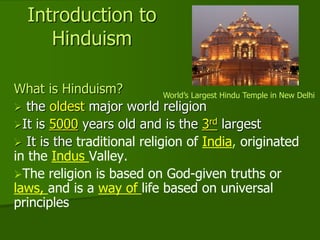
What is Hinduism?
 the oldest major world religion
It is 5000 years old and is the 3rd largest
 It is the traditional religion of India, originated
in the Indus Valley.
The religion is based on God-given truths or
laws, and is a way of life based on universal
principles
World’s Largest Hindu Temple in New Delhi
Faith Spreads Beyond India
 About 1000 years
ago, the faith was
carried along trade
routes to lands to
the east.
Hindu influences
remain in Thailand,
Malaysia and Bali, in
Indonesia
The World’s Oldest Living Faith
 It has no founder therefore it is not based
on the teachings of a person or group of
people; most likely the Indus Valley
people
 Archeologists have found many statues of
a female figure in the homes of Indus
Valley people.
 A collection of beliefs and practices
developed over thousands of years
 Hinduism is a polytheistic religion
The Arrival of the Aryans
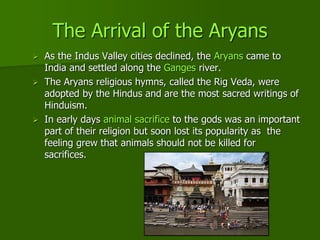
 As the Indus Valley cities declined, the Aryans came to
India and settled along the Ganges river.
 The Aryans religious hymns, called the Rig Veda, were
adopted by the Hindus and are the most sacred writings of
Hinduism.
 In early days animal sacrifice to the gods was an important
part of their religion but soon lost its popularity as the
feeling grew that animals should not be killed for
sacrifices.
Wisdom – Vedas:
the Holy Writings
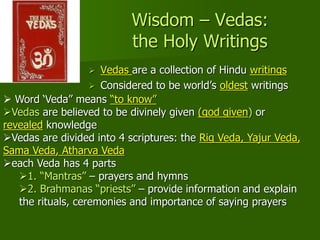
 Vedas are a collection of Hindu writings
 Considered to be world’s oldest writings
 Word ‘Veda” means “to know”
Vedas are believed to be divinely given (god given) or
revealed knowledge
Vedas are divided into 4 scriptures: the Rig Veda, Yajur Veda,
Sama Veda, Atharva Veda
each Veda has 4 parts
1. “Mantras” – prayers and hymns
2. Brahmanas “priests” – provide information and explain
the rituals, ceremonies and importance of saying prayers
Vedas: The Holy Writings
3. Aranyakas “ the forest books”– written
for hermits and saints who lived simple lives
isolated in the forest
- contain meditations and asceticism
4. Upanishads “sitting down near” – writings
about the origins of the universe,
characteristics of God and the presence of
the atman or soul in all living beings
- are religious conversations between holy
men that ordinary people could listen to
Rig Veda
Rig Veda – the oldest
and most important
section of the Vedas.
Vishnu
Shiva
- The Rig Veda tells of 33 gods, all
of whom are born of one creator,
Brahman.
-the 3 gods, Brahman, Vishnu and
Shiva form the Hindu trinity.
Brahman
A. How do Hindus Worship?
believe in one supreme being, whom
they call Brahman
worship that one God in various
forms, according to the different
functions they believe He performs.
believe that God is omnipresent
(always present) everywhere in all
living things.
They believe that the deity may be
represented in masculine and
feminine ways.
Worship
How do Hindus Understand God?
 Some Hindus say that the three letters of the
word
G-O-D relate to the deities’ three main functions
 1. G: Generator – this represents God’s ability to
create things
 2. O: Operator – this represents God’s ability to
preserve things and keep them going
 3. D: Destroyer – this represents God’s ability to
destroy things.
 Hindus believe that these three roles are fulfilled
in the Hindu Trinity.
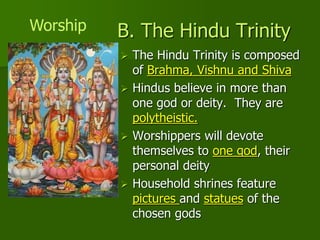
B. The Hindu Trinity
 The Hindu Trinity is composed
of Brahma, Vishnu and Shiva
 Hindus believe in more than
one god or deity. They are
polytheistic.
 Worshippers will devote
themselves to one god, their
personal deity
 Household shrines feature
pictures and statues of the
chosen gods
Worship
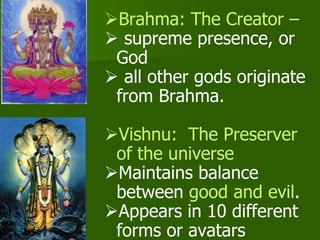
Brahma: The Creator –
 supreme presence, or
God
 all other gods originate
from Brahma.
Vishnu: The Preserver
of the universe
Maintains balance
between good and evil.
Appears in 10 different
forms or avatars
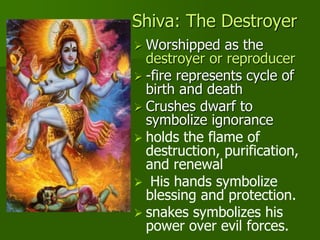
Shiva: The Destroyer
 Worshipped as the
destroyer or reproducer
 -fire represents cycle of
birth and death
 Crushes dwarf to
symbolize ignorance
 holds the flame of
destruction, purification,
and renewal
 His hands symbolize
blessing and protection.
 snakes symbolizes his
power over evil forces.
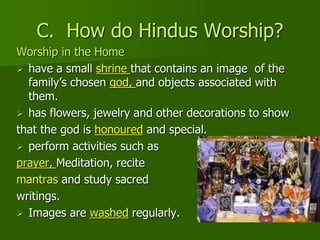
C. How do Hindus Worship?
Worship in the Home
 have a small shrine that contains an image of the
family’s chosen god, and objects associated with
them.
 has flowers, jewelry and other decorations to show
that the god is honoured and special.
 perform activities such as
prayer, Meditation, recite
mantras and study sacred
writings.
 Images are washed regularly.
Worship in the Home
 Puja is the name given to the ritualistic worship
 The shrine in the house contains a Puja tray
 Items on the Puja tray symbolize different things
 Bell: rung to let the deity know that worship is about to start
 Dish containing sandalwood paste: used to mark the worshipper’s
forehead as a symbol of devotion, blessing and protection of God
 Food: offerings of rice, nuts, sweets,
Fruit that symbolizes an exchange of
Love between the worshipper and deity
 Holy Water: used for purification and
Cleansing. Sometimes water is from the
River Ganges.
 Incense stick: lit to purify the air
 Lamp: represents the elements of the
Universe: earth, air, fire, water, ether
Puja Tray
D. Worship in the Mandir
 The Hindu place of
worship is called a
mandir or temple.
 The mandir is
considered to be the
“home of God”
 each mandir is
dedicated to a god or
deity
World’s largest Hindu temple in
Delhi
4 Basic Hindu Beliefs
1. Dharma
 Dharma is the moral balance of all things
Dharma is played out in all aspects of life:
religious, social, family
2. Karma
 Karma is the belief that a person experiences
the effects of his or her actions—that every act
or thought has consequences.
Hindu Beliefs
3. Samsara
Reincarnation “Samsara” – represents the cycle of life, death
and rebirth in which a person carries his or her own karma
 a person may experience effects of past lives and a worldly
status depends upon actions in a past life.
 Good thoughts and actions can liberate a person.
4. Moksha
Like heaven for the Christian, Hindus strive to reach moksha
or a state of changeless bliss. This is achieved by living a life
of religious devotion or moral integrity. The ultimate reward is
a release from samsara and union with God.
E. The Caste System
 The caste system is the basis for social
divisions in Hinduism
 Each Hindu is born into a caste group
 Whether one is born into a high or low
cast depends on the cycle of rebirth and
depends on the deeds of one’s previous
life
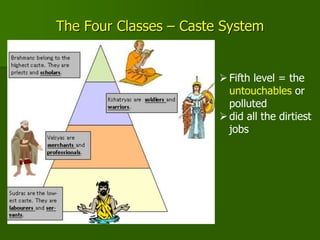
The Four Classes – Caste System
Fifth level = the
untouchables or
polluted
did all the dirtiest
jobs

Hinduism

  • 1.
    Introduction to Hinduism What isHinduism?  the oldest major world religion It is 5000 years old and is the 3rd largest  It is the traditional religion of India, originated in the Indus Valley. The religion is based on God-given truths or laws, and is a way of life based on universal principles World’s Largest Hindu Temple in New Delhi
  • 2.
    Faith Spreads BeyondIndia  About 1000 years ago, the faith was carried along trade routes to lands to the east. Hindu influences remain in Thailand, Malaysia and Bali, in Indonesia
  • 3.
    The World’s OldestLiving Faith  It has no founder therefore it is not based on the teachings of a person or group of people; most likely the Indus Valley people  Archeologists have found many statues of a female figure in the homes of Indus Valley people.  A collection of beliefs and practices developed over thousands of years  Hinduism is a polytheistic religion
  • 4.
    The Arrival ofthe Aryans  As the Indus Valley cities declined, the Aryans came to India and settled along the Ganges river.  The Aryans religious hymns, called the Rig Veda, were adopted by the Hindus and are the most sacred writings of Hinduism.  In early days animal sacrifice to the gods was an important part of their religion but soon lost its popularity as the feeling grew that animals should not be killed for sacrifices.
  • 5.
    Wisdom – Vedas: theHoly Writings  Vedas are a collection of Hindu writings  Considered to be world’s oldest writings  Word ‘Veda” means “to know” Vedas are believed to be divinely given (god given) or revealed knowledge Vedas are divided into 4 scriptures: the Rig Veda, Yajur Veda, Sama Veda, Atharva Veda each Veda has 4 parts 1. “Mantras” – prayers and hymns 2. Brahmanas “priests” – provide information and explain the rituals, ceremonies and importance of saying prayers
  • 6.
    Vedas: The HolyWritings 3. Aranyakas “ the forest books”– written for hermits and saints who lived simple lives isolated in the forest - contain meditations and asceticism 4. Upanishads “sitting down near” – writings about the origins of the universe, characteristics of God and the presence of the atman or soul in all living beings - are religious conversations between holy men that ordinary people could listen to
  • 7.
    Rig Veda Rig Veda– the oldest and most important section of the Vedas. Vishnu Shiva - The Rig Veda tells of 33 gods, all of whom are born of one creator, Brahman. -the 3 gods, Brahman, Vishnu and Shiva form the Hindu trinity. Brahman
  • 8.
    A. How doHindus Worship? believe in one supreme being, whom they call Brahman worship that one God in various forms, according to the different functions they believe He performs. believe that God is omnipresent (always present) everywhere in all living things. They believe that the deity may be represented in masculine and feminine ways. Worship
  • 9.
    How do HindusUnderstand God?  Some Hindus say that the three letters of the word G-O-D relate to the deities’ three main functions  1. G: Generator – this represents God’s ability to create things  2. O: Operator – this represents God’s ability to preserve things and keep them going  3. D: Destroyer – this represents God’s ability to destroy things.  Hindus believe that these three roles are fulfilled in the Hindu Trinity.
  • 10.
    B. The HinduTrinity  The Hindu Trinity is composed of Brahma, Vishnu and Shiva  Hindus believe in more than one god or deity. They are polytheistic.  Worshippers will devote themselves to one god, their personal deity  Household shrines feature pictures and statues of the chosen gods Worship
  • 11.
    Brahma: The Creator–  supreme presence, or God  all other gods originate from Brahma. Vishnu: The Preserver of the universe Maintains balance between good and evil. Appears in 10 different forms or avatars
  • 12.
    Shiva: The Destroyer Worshipped as the destroyer or reproducer  -fire represents cycle of birth and death  Crushes dwarf to symbolize ignorance  holds the flame of destruction, purification, and renewal  His hands symbolize blessing and protection.  snakes symbolizes his power over evil forces.
  • 13.
    C. How doHindus Worship? Worship in the Home  have a small shrine that contains an image of the family’s chosen god, and objects associated with them.  has flowers, jewelry and other decorations to show that the god is honoured and special.  perform activities such as prayer, Meditation, recite mantras and study sacred writings.  Images are washed regularly.
  • 14.
    Worship in theHome  Puja is the name given to the ritualistic worship  The shrine in the house contains a Puja tray  Items on the Puja tray symbolize different things  Bell: rung to let the deity know that worship is about to start  Dish containing sandalwood paste: used to mark the worshipper’s forehead as a symbol of devotion, blessing and protection of God  Food: offerings of rice, nuts, sweets, Fruit that symbolizes an exchange of Love between the worshipper and deity  Holy Water: used for purification and Cleansing. Sometimes water is from the River Ganges.  Incense stick: lit to purify the air  Lamp: represents the elements of the Universe: earth, air, fire, water, ether Puja Tray
  • 15.
    D. Worship inthe Mandir  The Hindu place of worship is called a mandir or temple.  The mandir is considered to be the “home of God”  each mandir is dedicated to a god or deity World’s largest Hindu temple in Delhi
  • 16.
    4 Basic HinduBeliefs 1. Dharma  Dharma is the moral balance of all things Dharma is played out in all aspects of life: religious, social, family 2. Karma  Karma is the belief that a person experiences the effects of his or her actions—that every act or thought has consequences.
  • 17.
    Hindu Beliefs 3. Samsara Reincarnation“Samsara” – represents the cycle of life, death and rebirth in which a person carries his or her own karma  a person may experience effects of past lives and a worldly status depends upon actions in a past life.  Good thoughts and actions can liberate a person. 4. Moksha Like heaven for the Christian, Hindus strive to reach moksha or a state of changeless bliss. This is achieved by living a life of religious devotion or moral integrity. The ultimate reward is a release from samsara and union with God.
  • 18.
    E. The CasteSystem  The caste system is the basis for social divisions in Hinduism  Each Hindu is born into a caste group  Whether one is born into a high or low cast depends on the cycle of rebirth and depends on the deeds of one’s previous life
  • 19.
    The Four Classes– Caste System Fifth level = the untouchables or polluted did all the dirtiest jobs