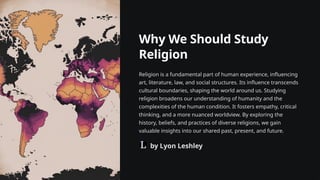
Why We Should Study
Religion
Religion is a fundamental part of human experience, influencing
art, literature, law, and social structures. Its influence transcends
cultural boundaries, shaping the world around us. Studying
religion broadens our understanding of humanity and the
complexities of the human condition. It fosters empathy, critical
thinking, and a more nuanced worldview. By exploring the
history, beliefs, and practices of diverse religions, we gain
valuable insights into our shared past, present, and future.
by Lyon Leshley
Understanding Different Faiths
Abrahamic Faiths
The Abrahamic religions include
Judaism, Christianity, and Islam,
all sharing a common lineage and
core beliefs. These faiths
emphasize monotheism, divine
revelation, and ethical principles.
They have shaped the course of
Western civilization and continue
to influence countless individuals
worldwide.
Eastern Religions
Eastern religions, such as
Hinduism, Buddhism, and Taoism,
offer unique perspectives on
spirituality, the nature of reality,
and the path to enlightenment.
They emphasize concepts like
reincarnation, karma, and
mindfulness, influencing
philosophical and artistic
traditions for millennia.
Indigenous Religions
Indigenous religions, practiced by
diverse groups across the globe,
hold deep reverence for nature,
ancestors, and sacred traditions.
They often involve animistic
beliefs, spiritual connections to
the land, and intricate rituals
passed down through
generations.
The Role of Religion in History
1
Ancient Civilizations
Religion played a vital role in the development of
early civilizations. From the ancient Egyptians to
the Greeks and Romans, religion shaped their
social structures, political systems, and artistic
expressions. It provided a sense of purpose,
order, and meaning in a complex world.
2 Medieval Era
The medieval period witnessed the rise of
Christianity in Europe and the spread of Islam
across the Middle East and North Africa. Religion
influenced everything from architecture and art
to law and education, shaping a distinct cultural
identity for each region.
3
Modern World
In the modern era, religion continues to shape
global events, influencing political movements,
social activism, and cultural identities. From the
American Civil Rights Movement to the Arab
Spring, religion has played a significant role in
shaping the modern world.
Exploring Religious Traditions
Judaism
Judaism, one of the oldest monotheistic religions,
emphasizes the covenant between God and the
Jewish people. It emphasizes the importance of
Torah, the Hebrew Bible, and the observance of
traditional rituals and practices.
Christianity
Christianity, based on the teachings of Jesus of
Nazareth, emphasizes love, forgiveness, and
salvation through faith. It encompasses diverse
denominations, each with unique interpretations
and practices.
Islam
Islam, the youngest of the Abrahamic religions,
emphasizes the submission to Allah, the one true
God. It revolves around the Quran, the holy book,
and the five pillars of Islam.
Hinduism
Hinduism, one of the oldest and most complex
religions, encompasses a vast array of beliefs and
practices. It emphasizes the cycle of reincarnation,
karma, and the pursuit of spiritual liberation.
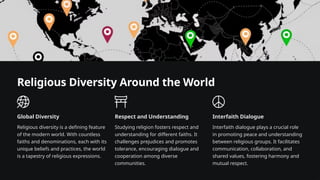
Religious Diversity Around the World
Global Diversity
Religious diversity is a defining feature
of the modern world. With countless
faiths and denominations, each with its
unique beliefs and practices, the world
is a tapestry of religious expressions.
Respect and Understanding
Studying religion fosters respect and
understanding for different faiths. It
challenges prejudices and promotes
tolerance, encouraging dialogue and
cooperation among diverse
communities.
Interfaith Dialogue
Interfaith dialogue plays a crucial role
in promoting peace and understanding
between religious groups. It facilitates
communication, collaboration, and
shared values, fostering harmony and
mutual respect.
Religion and Morality
1
2
3
Ethical Principles
Religion often provides a framework
for ethical decision-making. It sets
forth principles and values that guide
individuals in their interactions with
others and the world around them.
Moral Compass
Religious beliefs can serve as a moral
compass, providing guidance on what
is right and wrong, and inspiring acts
of compassion, charity, and justice.
Social Impact
Religion has a significant impact on
social behavior, influencing laws,
customs, and institutions. It shapes
our understanding of family,
community, and our role in society.
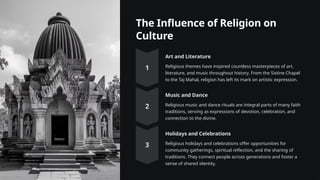
The Influence of Religion on
Culture
Art and Literature
Religious themes have inspired countless masterpieces of art,
literature, and music throughout history. From the Sistine Chapel
to the Taj Mahal, religion has left its mark on artistic expression.
Music and Dance
Religious music and dance rituals are integral parts of many faith
traditions, serving as expressions of devotion, celebration, and
connection to the divine.
Holidays and Celebrations
Religious holidays and celebrations offer opportunities for
community gatherings, spiritual reflection, and the sharing of
traditions. They connect people across generations and foster a
sense of shared identity.
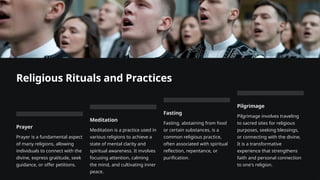
Religious Rituals and Practices
Prayer
Prayer is a fundamental aspect
of many religions, allowing
individuals to connect with the
divine, express gratitude, seek
guidance, or offer petitions.
Meditation
Meditation is a practice used in
various religions to achieve a
state of mental clarity and
spiritual awareness. It involves
focusing attention, calming
the mind, and cultivating inner
peace.
Fasting
Fasting, abstaining from food
or certain substances, is a
common religious practice,
often associated with spiritual
reflection, repentance, or
purification.
Pilgrimage
Pilgrimage involves traveling
to sacred sites for religious
purposes, seeking blessings,
or connecting with the divine.
It is a transformative
experience that strengthens
faith and personal connection
to one's religion.
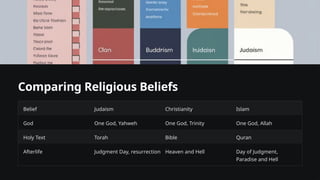
Comparing Religious Beliefs
Belief Judaism Christianity Islam
God One God, Yahweh One God, Trinity One God, Allah
Holy Text Torah Bible Quran
Afterlife Judgment Day, resurrection Heaven and Hell Day of Judgment,
Paradise and Hell
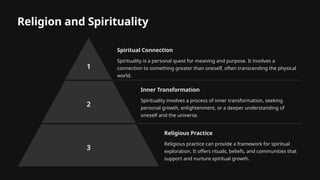
Religion and Spirituality
1
Spiritual Connection
Spirituality is a personal quest for meaning and purpose. It involves a
connection to something greater than oneself, often transcending the physical
world.
2
Inner Transformation
Spirituality involves a process of inner transformation, seeking
personal growth, enlightenment, or a deeper understanding of
oneself and the universe.
3
Religious Practice
Religious practice can provide a framework for spiritual
exploration. It offers rituals, beliefs, and communities that
support and nurture spiritual growth.
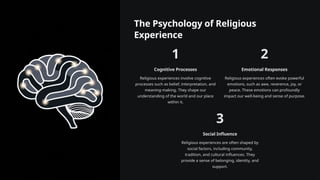
The Psychology of Religious
Experience
1
Cognitive Processes
Religious experiences involve cognitive
processes such as belief, interpretation, and
meaning-making. They shape our
understanding of the world and our place
within it.
2
Emotional Responses
Religious experiences often evoke powerful
emotions, such as awe, reverence, joy, or
peace. These emotions can profoundly
impact our well-being and sense of purpose.
3
Social Influence
Religious experiences are often shaped by
social factors, including community,
tradition, and cultural influences. They
provide a sense of belonging, identity, and
support.
Religion and Social Justice
1
Advocacy for the Marginalized
Throughout history, religion has motivated social justice movements, advocating for the rights of
the marginalized, the poor, and the oppressed. It has inspired compassion and action to address
societal injustices.
2
Moral Imperative
Many religions view social justice as a moral imperative, emphasizing the
importance of caring for the less fortunate, promoting equality, and working
towards a more just and equitable society.
3
Social Change
Religious organizations and individuals have played a
significant role in promoting social change, advocating for
human rights, poverty reduction, and environmental
protection.
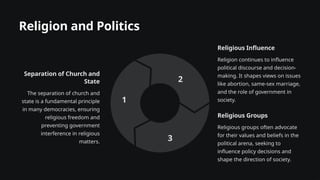
Religion and Politics
Separation of Church and
State
The separation of church and
state is a fundamental principle
in many democracies, ensuring
religious freedom and
preventing government
interference in religious
matters.
1
Religious Influence
Religion continues to influence
political discourse and decision-
making. It shapes views on issues
like abortion, same-sex marriage,
and the role of government in
society.
2
Religious Groups
Religious groups often advocate
for their values and beliefs in the
political arena, seeking to
influence policy decisions and
shape the direction of society.
3
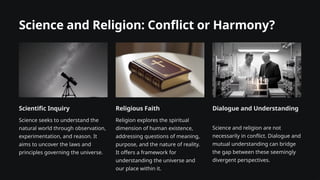
Science and Religion: Conflict or Harmony?
Scientific Inquiry
Science seeks to understand the
natural world through observation,
experimentation, and reason. It
aims to uncover the laws and
principles governing the universe.
Religious Faith
Religion explores the spiritual
dimension of human existence,
addressing questions of meaning,
purpose, and the nature of reality.
It offers a framework for
understanding the universe and
our place within it.
Dialogue and Understanding
Science and religion are not
necessarily in conflict. Dialogue and
mutual understanding can bridge
the gap between these seemingly
divergent perspectives.
Religious Holidays and Celebrations
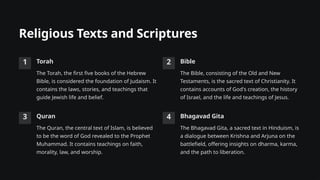
Religious Texts and Scriptures
1 Torah
The Torah, the first five books of the Hebrew
Bible, is considered the foundation of Judaism. It
contains the laws, stories, and teachings that
guide Jewish life and belief.
2 Bible
The Bible, consisting of the Old and New
Testaments, is the sacred text of Christianity. It
contains accounts of God's creation, the history
of Israel, and the life and teachings of Jesus.
3 Quran
The Quran, the central text of Islam, is believed
to be the word of God revealed to the Prophet
Muhammad. It contains teachings on faith,
morality, law, and worship.
4 Bhagavad Gita
The Bhagavad Gita, a sacred text in Hinduism, is
a dialogue between Krishna and Arjuna on the
battlefield, offering insights on dharma, karma,
and the path to liberation.
Women in Religion
Religious Leadership
Women have played significant
roles in religious leadership
throughout history, serving as
prophets, teachers, and spiritual
guides. Their contributions have
shaped the development and
expression of many faiths.
Religious Roles
Women hold diverse roles in
religious communities,
participating in worship, rituals,
and charitable work. They
contribute to the spiritual life and
the social fabric of religious
organizations.
Feminist Theology
Feminist theology examines
religious texts and traditions from
a feminist perspective,
challenging gender inequalities
and advocating for greater
inclusivity and equality in religious
practices.
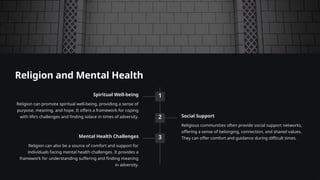
Religion and Mental Health
1
Spiritual Well-being
Religion can promote spiritual well-being, providing a sense of
purpose, meaning, and hope. It offers a framework for coping
with life's challenges and finding solace in times of adversity. 2 Social Support
Religious communities often provide social support networks,
offering a sense of belonging, connection, and shared values.
They can offer comfort and guidance during difficult times.
3
Mental Health Challenges
Religion can also be a source of comfort and support for
individuals facing mental health challenges. It provides a
framework for understanding suffering and finding meaning
in adversity.
Religion and Environmental Stewardship
Stewardship of Creation
Many religions emphasize the importance of caring for the natural world, viewing it as a gift from the divine or a sacred space to be
respected and protected.
Environmental Ethics
Religious teachings often provide ethical frameworks for environmental stewardship, advocating for sustainability, conservation, and
responsible resource management.
Environmental Activism
Religious organizations and individuals are increasingly involved in environmental activism, working to address climate change, protect
biodiversity, and promote sustainable practices.
Interfaith Dialogue and Cooperation
Interfaith dialogue and cooperation are essential for fostering peace and understanding in a world increasingly
marked by religious diversity. It promotes communication, collaboration, and shared values among different faith
communities, working towards a more harmonious and inclusive society.

Why We Should Study Religion/power point presentation

  • 1.
    Why We ShouldStudy Religion Religion is a fundamental part of human experience, influencing art, literature, law, and social structures. Its influence transcends cultural boundaries, shaping the world around us. Studying religion broadens our understanding of humanity and the complexities of the human condition. It fosters empathy, critical thinking, and a more nuanced worldview. By exploring the history, beliefs, and practices of diverse religions, we gain valuable insights into our shared past, present, and future. by Lyon Leshley
  • 2.
    Understanding Different Faiths AbrahamicFaiths The Abrahamic religions include Judaism, Christianity, and Islam, all sharing a common lineage and core beliefs. These faiths emphasize monotheism, divine revelation, and ethical principles. They have shaped the course of Western civilization and continue to influence countless individuals worldwide. Eastern Religions Eastern religions, such as Hinduism, Buddhism, and Taoism, offer unique perspectives on spirituality, the nature of reality, and the path to enlightenment. They emphasize concepts like reincarnation, karma, and mindfulness, influencing philosophical and artistic traditions for millennia. Indigenous Religions Indigenous religions, practiced by diverse groups across the globe, hold deep reverence for nature, ancestors, and sacred traditions. They often involve animistic beliefs, spiritual connections to the land, and intricate rituals passed down through generations.
  • 3.
    The Role ofReligion in History 1 Ancient Civilizations Religion played a vital role in the development of early civilizations. From the ancient Egyptians to the Greeks and Romans, religion shaped their social structures, political systems, and artistic expressions. It provided a sense of purpose, order, and meaning in a complex world. 2 Medieval Era The medieval period witnessed the rise of Christianity in Europe and the spread of Islam across the Middle East and North Africa. Religion influenced everything from architecture and art to law and education, shaping a distinct cultural identity for each region. 3 Modern World In the modern era, religion continues to shape global events, influencing political movements, social activism, and cultural identities. From the American Civil Rights Movement to the Arab Spring, religion has played a significant role in shaping the modern world.
  • 4.
    Exploring Religious Traditions Judaism Judaism,one of the oldest monotheistic religions, emphasizes the covenant between God and the Jewish people. It emphasizes the importance of Torah, the Hebrew Bible, and the observance of traditional rituals and practices. Christianity Christianity, based on the teachings of Jesus of Nazareth, emphasizes love, forgiveness, and salvation through faith. It encompasses diverse denominations, each with unique interpretations and practices. Islam Islam, the youngest of the Abrahamic religions, emphasizes the submission to Allah, the one true God. It revolves around the Quran, the holy book, and the five pillars of Islam. Hinduism Hinduism, one of the oldest and most complex religions, encompasses a vast array of beliefs and practices. It emphasizes the cycle of reincarnation, karma, and the pursuit of spiritual liberation.
  • 5.
    Religious Diversity Aroundthe World Global Diversity Religious diversity is a defining feature of the modern world. With countless faiths and denominations, each with its unique beliefs and practices, the world is a tapestry of religious expressions. Respect and Understanding Studying religion fosters respect and understanding for different faiths. It challenges prejudices and promotes tolerance, encouraging dialogue and cooperation among diverse communities. Interfaith Dialogue Interfaith dialogue plays a crucial role in promoting peace and understanding between religious groups. It facilitates communication, collaboration, and shared values, fostering harmony and mutual respect.
  • 6.
    Religion and Morality 1 2 3 EthicalPrinciples Religion often provides a framework for ethical decision-making. It sets forth principles and values that guide individuals in their interactions with others and the world around them. Moral Compass Religious beliefs can serve as a moral compass, providing guidance on what is right and wrong, and inspiring acts of compassion, charity, and justice. Social Impact Religion has a significant impact on social behavior, influencing laws, customs, and institutions. It shapes our understanding of family, community, and our role in society.
  • 7.
    The Influence ofReligion on Culture Art and Literature Religious themes have inspired countless masterpieces of art, literature, and music throughout history. From the Sistine Chapel to the Taj Mahal, religion has left its mark on artistic expression. Music and Dance Religious music and dance rituals are integral parts of many faith traditions, serving as expressions of devotion, celebration, and connection to the divine. Holidays and Celebrations Religious holidays and celebrations offer opportunities for community gatherings, spiritual reflection, and the sharing of traditions. They connect people across generations and foster a sense of shared identity.
  • 8.
    Religious Rituals andPractices Prayer Prayer is a fundamental aspect of many religions, allowing individuals to connect with the divine, express gratitude, seek guidance, or offer petitions. Meditation Meditation is a practice used in various religions to achieve a state of mental clarity and spiritual awareness. It involves focusing attention, calming the mind, and cultivating inner peace. Fasting Fasting, abstaining from food or certain substances, is a common religious practice, often associated with spiritual reflection, repentance, or purification. Pilgrimage Pilgrimage involves traveling to sacred sites for religious purposes, seeking blessings, or connecting with the divine. It is a transformative experience that strengthens faith and personal connection to one's religion.
  • 9.
    Comparing Religious Beliefs BeliefJudaism Christianity Islam God One God, Yahweh One God, Trinity One God, Allah Holy Text Torah Bible Quran Afterlife Judgment Day, resurrection Heaven and Hell Day of Judgment, Paradise and Hell
  • 10.
    Religion and Spirituality 1 SpiritualConnection Spirituality is a personal quest for meaning and purpose. It involves a connection to something greater than oneself, often transcending the physical world. 2 Inner Transformation Spirituality involves a process of inner transformation, seeking personal growth, enlightenment, or a deeper understanding of oneself and the universe. 3 Religious Practice Religious practice can provide a framework for spiritual exploration. It offers rituals, beliefs, and communities that support and nurture spiritual growth.
  • 11.
    The Psychology ofReligious Experience 1 Cognitive Processes Religious experiences involve cognitive processes such as belief, interpretation, and meaning-making. They shape our understanding of the world and our place within it. 2 Emotional Responses Religious experiences often evoke powerful emotions, such as awe, reverence, joy, or peace. These emotions can profoundly impact our well-being and sense of purpose. 3 Social Influence Religious experiences are often shaped by social factors, including community, tradition, and cultural influences. They provide a sense of belonging, identity, and support.
  • 12.
    Religion and SocialJustice 1 Advocacy for the Marginalized Throughout history, religion has motivated social justice movements, advocating for the rights of the marginalized, the poor, and the oppressed. It has inspired compassion and action to address societal injustices. 2 Moral Imperative Many religions view social justice as a moral imperative, emphasizing the importance of caring for the less fortunate, promoting equality, and working towards a more just and equitable society. 3 Social Change Religious organizations and individuals have played a significant role in promoting social change, advocating for human rights, poverty reduction, and environmental protection.
  • 13.
    Religion and Politics Separationof Church and State The separation of church and state is a fundamental principle in many democracies, ensuring religious freedom and preventing government interference in religious matters. 1 Religious Influence Religion continues to influence political discourse and decision- making. It shapes views on issues like abortion, same-sex marriage, and the role of government in society. 2 Religious Groups Religious groups often advocate for their values and beliefs in the political arena, seeking to influence policy decisions and shape the direction of society. 3
  • 14.
    Science and Religion:Conflict or Harmony? Scientific Inquiry Science seeks to understand the natural world through observation, experimentation, and reason. It aims to uncover the laws and principles governing the universe. Religious Faith Religion explores the spiritual dimension of human existence, addressing questions of meaning, purpose, and the nature of reality. It offers a framework for understanding the universe and our place within it. Dialogue and Understanding Science and religion are not necessarily in conflict. Dialogue and mutual understanding can bridge the gap between these seemingly divergent perspectives.
  • 15.
  • 16.
    Religious Texts andScriptures 1 Torah The Torah, the first five books of the Hebrew Bible, is considered the foundation of Judaism. It contains the laws, stories, and teachings that guide Jewish life and belief. 2 Bible The Bible, consisting of the Old and New Testaments, is the sacred text of Christianity. It contains accounts of God's creation, the history of Israel, and the life and teachings of Jesus. 3 Quran The Quran, the central text of Islam, is believed to be the word of God revealed to the Prophet Muhammad. It contains teachings on faith, morality, law, and worship. 4 Bhagavad Gita The Bhagavad Gita, a sacred text in Hinduism, is a dialogue between Krishna and Arjuna on the battlefield, offering insights on dharma, karma, and the path to liberation.
  • 17.
    Women in Religion ReligiousLeadership Women have played significant roles in religious leadership throughout history, serving as prophets, teachers, and spiritual guides. Their contributions have shaped the development and expression of many faiths. Religious Roles Women hold diverse roles in religious communities, participating in worship, rituals, and charitable work. They contribute to the spiritual life and the social fabric of religious organizations. Feminist Theology Feminist theology examines religious texts and traditions from a feminist perspective, challenging gender inequalities and advocating for greater inclusivity and equality in religious practices.
  • 18.
    Religion and MentalHealth 1 Spiritual Well-being Religion can promote spiritual well-being, providing a sense of purpose, meaning, and hope. It offers a framework for coping with life's challenges and finding solace in times of adversity. 2 Social Support Religious communities often provide social support networks, offering a sense of belonging, connection, and shared values. They can offer comfort and guidance during difficult times. 3 Mental Health Challenges Religion can also be a source of comfort and support for individuals facing mental health challenges. It provides a framework for understanding suffering and finding meaning in adversity.
  • 19.
    Religion and EnvironmentalStewardship Stewardship of Creation Many religions emphasize the importance of caring for the natural world, viewing it as a gift from the divine or a sacred space to be respected and protected. Environmental Ethics Religious teachings often provide ethical frameworks for environmental stewardship, advocating for sustainability, conservation, and responsible resource management. Environmental Activism Religious organizations and individuals are increasingly involved in environmental activism, working to address climate change, protect biodiversity, and promote sustainable practices.
  • 20.
    Interfaith Dialogue andCooperation Interfaith dialogue and cooperation are essential for fostering peace and understanding in a world increasingly marked by religious diversity. It promotes communication, collaboration, and shared values among different faith communities, working towards a more harmonious and inclusive society.