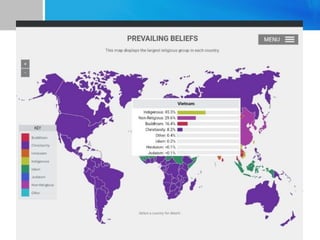
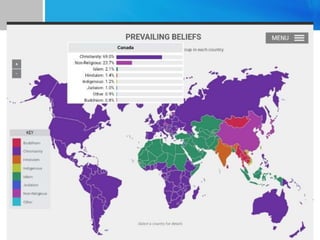
INTRODUCTION TO WORLD
RELIGIONS AND BELIEF
SYSTEM
Belief System, World View, Religion and
Spirituality
• Introduction: a prayer allows the person to establish
relationship and find rapport to the divine beings or
supernatural entities that are far off the purely real world.
The larger part or world religions abides by a set of
prayers in a form of chants, creeds or mantras. Either
you pray or not, you may have experienced the
significant roles played by religions across the world.
• To understand the nature of religion requires knowledge
and appreciation of the way its adherents relate beliefs
and practices to supremely inportant beings. It gives light
on the basic grounds that hold together believers into
appraising the frequent questions that emanate from life
and death, of love and hate, and why or how persons
desire for spiritual inspiration that characterize the
human condition.
OBJECTIVES
• At the end of the lesson, the learners
should be able to:
• a. Differentiate the concept, elements and
characteristics of belief system, worldview,
religion, and spirituality;
• b. Discuss the concepts of belief system,
worldview, religion, and spirituality
• c. Identify the different elements of belief
system, worldview, religion and spirituality
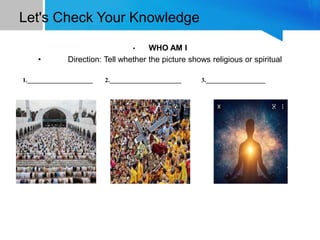
Let's Check Your Knowledge
• WHO AM I
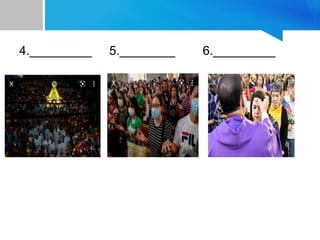
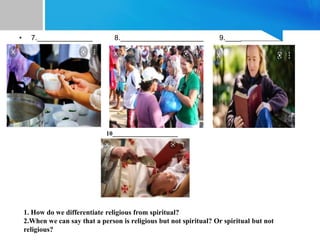
• Direction: Tell whether the picture shows religious or spiritual
1._____________________ 2._______________________ 3.___________________
4._________ 5.________ 6._________
• 7.______________ 8._____________________ 9._____________________
•
10_____________________
1. How do we differentiate religious from spiritual?
2.When we can say that a person is religious but not spiritual? Or spiritual but not
religious?
Understanding the Nature of Religion
• Religion is a cultural system of behaviors and practices that relate humanity to
what anthropologist has called an order to existence.
• Understanding the nature of religion clears the questions in the mind of the learners
between life and death. It also gives a clear difference between the quotations “
religious but not spiritual” and spiritual but not religious”.
Concept of Religion and Spirituality
• SPIRITUALITY RELIGION
• - Belief that the divine is within us -Belief in a superhuman power
outside of you, the creator of universe
• -Personal belief or value system -Dictated belief or conditioned mind
• -God is inside the heart -God is inside the mind
• -Spiritual Law based -Faith based
• -Heaven is the state of mind - Heaven is a place you go when
you die
• -Human relationship/deed -Brick or mortar temple
• -People’s inherit goodness - People inherit sinfulness
• -Spiritual development -Praise and worship
• -Authentic self -Conditioned self
• -Joyous living -Narrow creeds
Concept of Spirituality
Belief within individuals
Internal Focus
Goal: determine common principles, values and ethics
Unites people over society
Concept of Religion
Expressly stated; organized belief system
External focus and formal structure
Goal: salvation through one truth and one right way
Characteristics of Religion
1. Belief in Diety
2. A Doctrine of Salvation
3. A Code of Conduct
4. Religious Rituals
Every religion has the same three basic elements.
Wisdom or Creed
Worship or Cult
Works or Code
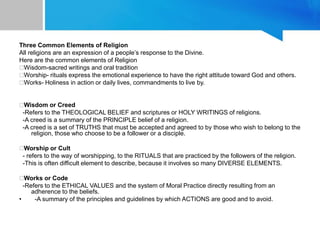
Three Common Elements of Religion
All religions are an expression of a people’s response to the Divine.
Here are the common elements of Religion
Wisdom-sacred writings and oral tradition
Worship- rituals express the emotional experience to have the right attitude toward God and others.
Works- Holiness in action or daily lives, commandments to live by.
Wisdom or Creed
-Refers to the THEOLOGICAL BELIEF and scriptures or HOLY WRITINGS of religions.
-A creed is a summary of the PRINCIPLE belief of a religion.
-A creed is a set of TRUTHS that must be accepted and agreed to by those who wish to belong to the
religion, those who choose to be a follower or a disciple.
Worship or Cult
- refers to the way of worshipping, to the RITUALS that are practiced by the followers of the religion.
-This is often difficult element to describe, because it involves so many DIVERSE ELEMENTS.
Works or Code
-Refers to the ETHICAL VALUES and the system of Moral Practice directly resulting from an
adherence to the beliefs.
• -A summary of the principles and guidelines by which ACTIONS are good and to avoid.
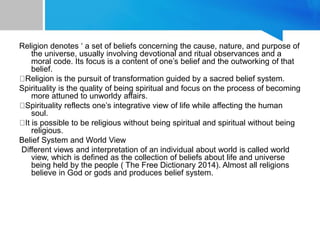
Religion denotes ‘ a set of beliefs concerning the cause, nature, and purpose of
the universe, usually involving devotional and ritual observances and a
moral code. Its focus is a content of one’s belief and the outworking of that
belief.
Religion is the pursuit of transformation guided by a sacred belief system.
Spirituality is the quality of being spiritual and focus on the process of becoming
more attuned to unworldy affairs.
Spirituality reflects one’s integrative view of life while affecting the human
soul.
It is possible to be religious without being spiritual and spiritual without being
religious.
Belief System and World View
Different views and interpretation of an individual about world is called world
view, which is defined as the collection of beliefs about life and universe
being held by the people ( The Free Dictionary 2014). Almost all religions
believe in God or gods and produces belief system.
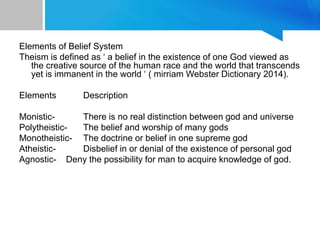
Elements of Belief System
Theism is defined as ‘ a belief in the existence of one God viewed as
the creative source of the human race and the world that transcends
yet is immanent in the world ‘ ( mirriam Webster Dictionary 2014).
Elements Description
Monistic- There is no real distinction between god and universe
Polytheistic- The belief and worship of many gods
Monotheistic- The doctrine or belief in one supreme god
Atheistic- Disbelief in or denial of the existence of personal god
Agnostic- Deny the possibility for man to acquire knowledge of god.
Definition and Nature of Religion
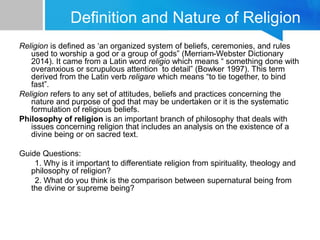
Religion is defined as ‘an organized system of beliefs, ceremonies, and rules
used to worship a god or a group of gods” (Merriam-Webster Dictionary
2014). It came from a Latin word religio which means “ something done with
overanxious or scrupulous attention to detail” (Bowker 1997). This term
derived from the Latin verb religare which means “to tie together, to bind
fast”.
Religion refers to any set of attitudes, beliefs and practices concerning the
nature and purpose of god that may be undertaken or it is the systematic
formulation of religious beliefs.
Philosophy of religion is an important branch of philosophy that deals with
issues concerning religion that includes an analysis on the existence of a
divine being or on sacred text.
Guide Questions:
1. Why is it important to differentiate religion from spirituality, theology and
philosophy of religion?
2. What do you think is the comparison between supernatural being from
the divine or supreme being?
INTERCONNECTEDNESS
OF GEOGRAPHY,
CULTURE,
AND RELIGIONS
Just like any living organism,
religions are born in history,
gradually develop into living
traditions, and affect the lives of
their adherents. Belief systems
began in certain places within the
given conditions of culture and
geography.
Various organized religions have
their set of symbols as they
continue to influence the lives of
their devotees all over the world.
Based from its fundamental
structure, religions continually
developed into a complicated
system filled with rites and
practices that made recruitment of
its adherents necessary
There are also other religions
that faced demised as in the
case of Zoroastrianism that
once originated in South Asia
but is now restricted only in
India, Iran, and Central Asia.
They may also give impetus to
establish new movements within
religious groups, such as in the
case of Buddhism that may be
viewed as a reaction to the
overly ritualistic beliefs and
exclusivity in the nature of
Hinduism.
They may also contribute to the
foundation of other religions,
such as those borrowed themes
of Christianity from Judaism,
and of Islam from both
Christianity and Judaism.
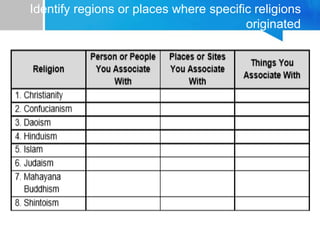
Identify regions or places where specific religions
originated
Write an essay about the
importance of studying
religions
Additional activities for
application or remediation
essay about the importance
of studying religions
INTERCONNECTEDNESS
OF GEOGRAPHY,
CULTURE,
AND RELIGIONS
• Discuss the Approaches to The Study
of Religions
 THEOLOGY
oPhilosophy of Religion
oPsychology of Religion
oSociology of Religion
oAnthropology of Religion
Philosophy of Religion
Philosophy of Religion deals with
the meaning and nature of religion.
It may involve the study of
concepts and belief systems of the
religions that includes the prior
phenomena of religious experience
and activities of worship and
meditation on which these belief
systems rest and out of which they
have originated.
Psychology of Religion
Tries to understand the cause-
effect relationship of religious
experiences and religious
consciousness so as to be able to
predict behaviors.
Studies the past, present and
future
Psychology of Religion
Past: what psychological factors
gave rise to particular religious
belief in various societies and
cultures or what psychological
factors were responsible for a
particular individuals adoption of
certain religious beliefs.
Ex. The belief in God is an attempt
to feel more secure in a dangerous
world.
Psychology of Religion
Present: What is the psychological
impact of specific attitudes and
practices in a religious community
or individual?
Ex. When a person joins a religious
group I often seems to result in
improved mental health.
Psychology of Religion
Future: What are the likely
psychological consequences of
religious belief and practice for the
individual and for society?
Ex. People who believe that the end
of the world is imminent might be
more likely to withdraw from society.
While others who have experienced
forgiveness sins are more likely to live
happy,productive lives.
Sociology of Religion
Study of the beliefs, practices and
organizational forms of religion using
the tools and methods of the
discipline of sociology.
Quantitative method- survey, polls,
demographic, and census analysis.
Qualitative approaches- interview,
historical and documentary materials,
participant observation
Anthropology of Religion
Study of Religion in relation to other
social institutions, and the comparison
of religious beliefs and practices
across cultures.
Ex, myth, rituals, ghosts, spirits,
sacred texts, religious hierarchy
INTERCONNECTEDNESS OF GEOGRAPHY, CULTURE,
AND RELIGIONS
• Just like any living organism, religious are
born in history, gradually develop living
traditions, and affect the lives of their
adherents. Belief sytems began in certain
places within the given conditions of
culture and geography.
• Various organized religions have their set
of symbols as they continue to influence
the lives of their devotees all over the
world.
• Based from its fundamental structure,
religions continually developed into a
complicated system filled with rites
and practices that made recruitment
of its adherents necessary.
• There are also other religions that
faced demised as in the case of
Zoroastrianism that once originated in
South Asia but is now restricted only
in India, Iran and Central Asia.
• They may also give impetus to establish
new movements within religious groups,
such as in the case of Buddhism that may
be viewed as a reaction to the overly
ritualistic beliefs and exclusivity in the
nature of Hinduism.
• They may also contribute to the foundation
of the religions, such as those borrowed
themes of Christianity from Judaism, and
Islam from both Christianity and Judaism.
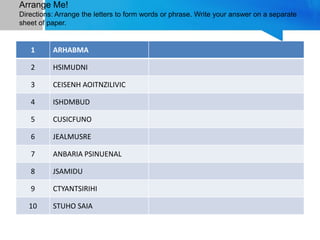
Arrange Me!
Directions: Arrange the letters to form words or phrase. Write your answer on a separate
sheet of paper.
1 ARHABMA
2 HSIMUDNI
3 CEISENH AOITNZILIVIC
4 ISHDMBUD
5 CUSICFUNO
6 JEALMUSRE
7 ANBARIA PSINUENAL
8 JSAMIDU
9 CTYANTSIRIHI
10 STUHO SAIA
Task 2: Arrange Me!
Directions: Arrange the letters to form words or phrases.
• The existence of humankind
for so long a time has resulted
in the establishment of religion
and belief system. It is certain
that many religions may have
been undocumented in the
past. Others may have
gradually expired.
• Various scholars hold the view
that religion is universal and can
be found in all known
contemporary societies. Even the
most basic of belief system can
be seen in all known
contemporary societies. Even the
most basic of belief system can
be seen to greater or lesser
degree in all religions.
• There are many theories that have
been formulated to explain the origin
of religion. Even pre-historic men,
such as Neanderthals and Cro-
Magnons, have practiced a set of
belief system in one way or another,
including burying of their dead,
painting on the walls of caves, and
carving images from the stones.
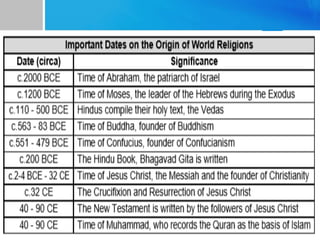
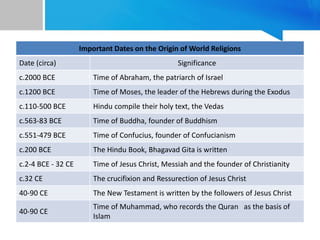
Important Dates on the Origin of World Religions
Date (circa) Significance
c.2000 BCE Time of Abraham, the patriarch of Israel
c.1200 BCE Time of Moses, the leader of the Hebrews during the Exodus
c.110-500 BCE Hindu compile their holy text, the Vedas
c.563-83 BCE Time of Buddha, founder of Buddhism
c.551-479 BCE Time of Confucius, founder of Confucianism
c.200 BCE The Hindu Book, Bhagavad Gita is written
c.2-4 BCE - 32 CE Time of Jesus Christ, Messiah and the founder of Christianity
c.32 CE The crucifixion and Ressurection of Jesus Christ
40-90 CE The New Testament is written by the followers of Jesus Christ
40-90 CE
Time of Muhammad, who records the Quran as the basis of
Islam
Development of Early Religious Beliefs
• Patriarch Abraham
-the prophet Abraham is the
"father in faith" as narrated in
the bible and considered as
the common origin of the
monotheistic religions, namely
Judaism, Christianity and
Islam. These three organized
religions collectively known as
Abrahamaic religions.
Development of Early Religious Beliefs
-the Jews regard Abraham as
the progenitor of the
Israelites through his
successor Isaac and Jacob.
Abraham's son Ishmael is
believed to be ancestor of
the Arabs.
• The significance of Abraham
in these three religions lies
in the fact that the patriarch
appears as an elemental
figure for a monotheistic
belief system and as a
paragon of extreme
devotion.
• The three monotheistic
religions share similarities in
their basic tenets. They all
worship one Supreme
being. The ancient Hebrews
named their god Elohim,
Adonai, or Yaweh. Modern-
day Judaism uses the name
of the "Lord" and "God".
• Muslims called their god
Allah.
• Prophets play major roles in
these religions. Judaism has
forty-eight prophets and
seven prophetesses.
• early prophets include
Abraham, Isaac, Jacob,
Moses, Aaron and Joshua
to name a few. The Muslims
believe that Muhammad is
the final prophet or the
• " Seal of the Prophets".
• Prior to their establishment as
organized religions, the role of
divine revelation or intervention
is associated among the
progenitors. For instance, God
instructed Abraham to sacrifice
his son Isaac at Mount Moriah.
God presented the "Ten
Commandments" to Moses at
Mount Sinai.
• God commanded
Muhammad to establish a
new religion at a cave in
Mount Hira.
• Then and now, followers of
the three Abrahamic religions
are presented with a choice
between good and evil.
Indian Mosaic
• India is considered as one of
the world's oldest civilization
with its history dating back
6500 BCE.
• Four great religions originited
in India, Hinduism, Buddhism,
Jainism and Sikhism and other
innumerable minor cults and
local sects.
Indian Mosaic
•Christians and
Muslims also found
their way into Indian
heartland along with
the Jews and
Zoroastrians.
• Hinduism perfectly describes
Indian diversity with its assorted,
diversified and eclectic means
of religious expressions that are
quite clouded to outsiders.
• It has no definite founder, no
one sacred book and
inumerable gods and
goddesses that any Hindu can
worship.
•Hinduism or Sanatana
Dharma turned
systematized as a
religion that preached
order and purpose to the
cosmos and human life
during the Vedic Period.
• Throughout this period,
universal order became
tantamount with stable society
as manifested by the
establishment of a centralized
government and the integration
of collective traditions into the
lives of the Indians.
Buddhism
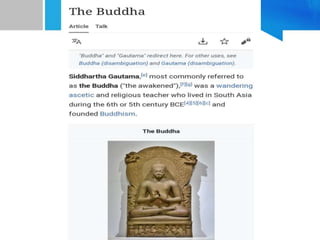
• focus its attention to Siddharta Gautama
known as Buddha who was born near the
end of the 6th Century BCE. His life is
closely associated with the historical and
religious development of Buddhism in
India.
• He was not considered as a god but a
human being who happened to come
across on how to eliminate sufferings in
order to break free from the continous and
painful cycle of rebirth.
Buddhism
• Buddhist followers respect Buddha in the
same way that adherents of the other
world religions worship their gods.
• The Mahayana sect of Buddhism differs
from Theravada school because of its rich
ordering of buddhas and bodhisattvas
which attained spiritual enlightenment.
• These being are said to be eligible to enter
nirvana but choose to impede this glorious
path to guide others to the path of
salvation.
• Presently, Buddhism has
become more popular outside
its place of origin while
Hinduism has remained
concentrated in India
throughout many centuries.
The Way of the Dao
• Another world's oldest civilization tracing
back almost 4,000 years ago is the
Chinese civilization.
• The Chinese had already aspired to
institute and obtain good governance.
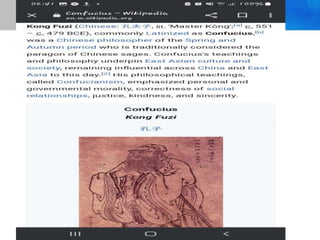
• Kung Fu Tzu ( Confucius) the great
master, China embraced his deals and
ethics as the Chinese advance
meritocracy as a basis for government
officials.
• Confucius is regarded as the greatest
philosopher and teacher who lived at the
same time as Siddharta Gautama in India.
• Confucian ideals geared in harmonizing
human relations and serve as guide to
social behavior.
• Chinese dynasties used Confucian morals
and political ideals that became influential
among Chinese people.
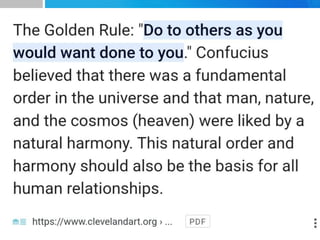
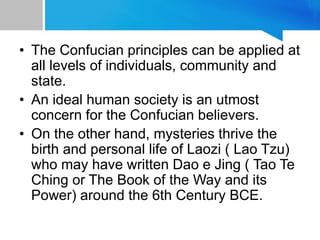
• The Confucian principles can be applied at
all levels of individuals, community and
state.
• An ideal human society is an utmost
concern for the Confucian believers.
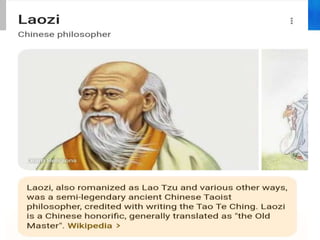
• On the other hand, mysteries thrive the
birth and personal life of Laozi ( Lao Tzu)
who may have written Dao e Jing ( Tao Te
Ching or The Book of the Way and its
Power) around the 6th Century BCE.
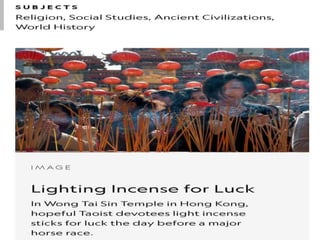
• Around 142 CE, Daoism began organized
religion with the establishment of the " Way of
the Celestial Masters" sect by Zhang Daoling
during Han Dysnasty.
• The writings of Daoism centers on the concept
of Dao as a way or path signifying
appropriateness of one's behavior to lead other
people.
• Similar with Daoism, the writings of Confucius
frequently dwell upon that theme of the Dao
understood as being the truth or way things
ought to be done concordant withn specific view
of life, politics and customs.
• This Confucian view is somehow close to the
meaning of Dao in Daoism which means road,
path or way in which one does something. The
Confucian Dao principally concerns human
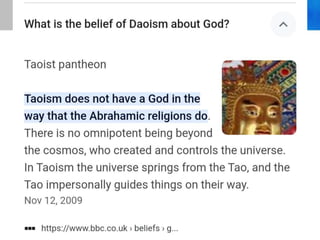
affairs while Daoist Dao means the way the
universe works.
• Both Confucius and Lao-tzu were followers of
Dao.
• The Sacred texts of Confucianism is the
Analects of Confucius and Daoism the Dao De
Jing of Lao-tzu.
Choose and
discuss one religion
and identify the set
of belief system
that they practiced
The Western Frontier
West Asia is home of three great
religions, namely, Judaism,
Christianity and Islam. Comprising
the area bordered on the west by
the fertile coasts of the
Mediterranean Sea an on the east
by the arid desserts of Arabia, the
history of these religions is closely
linked with this region.
Levant- Countries closest to the
eastern part of the Mediterranean
Sea north of the Arabian Sea and
south of Turkey.
--have experienced numerous
religious cataclysms in their
existence as nation-states.
--includes Lebanon, Jordan, Israel,
Syria, and Palestine.
Gaining the independence in 1944,
Lebanon has undergone a
protracted civil war from 1975 to
1990 between Christians and
Muslims.
During that time, while the
Christians controlled wealth and
power, majority of the Muslim felt
discriminated. Around 250,000 lives
were lost as a result of conflict.
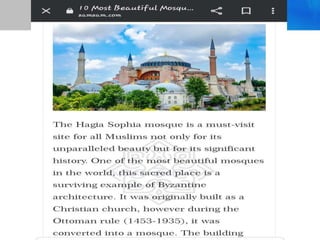
Presently, followers of the
three Abrahamic religions
place high regard on the city
of the Jerusalem in Israel
because of the numerous
sites that are central to their
belief system.
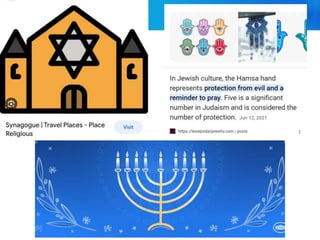
In Jerusalem,
there are more than a
thousand synagogues,
more than a hundred
churches,
and more than 70 mosques
At present…
Jerusalem has been sacred for the Jews almost
three thousand years now.
The city being the site of the
1. First Temple (King Solomon’s Temple) and the
Second Temple.
2. The Western Wall (Wailing Wall or Kotel),
3. One of the four retaining walls that surrounded
the Temple Mount, is the second holiest shrine
for the Jews.
The Indian Subcontinent
The Subcontinent of South Asia
covers an area of more than one
and half million square miles
stretching from the Hindu Kush and
Baluchi Hills on the west and the
Great Himalayan mountain range
on the north, to the Burmese
mountain on the East and the
Indian Ocean on the south (Wolpert
1993).
More than 4000 years ago, a
civilization emerged along the
Indus River that developed a
unique and exceptional culture long
before the dawn of Christian era.
Invasions from people originating in
Macedonia and Central Asia have
added diversity to India’s
population and complexity to its
culture (Wolpert 1993).
The Eastern End
At the eastern end of the great
Asian continent one finds the
cultural and political dominance of
China. Stretching more than 5,000
kilometers across the Asian
landmass, it is bordered by various
bodies of water in the east and land
borders in all directions.
Chinese culture practically
influenced all other countries at its
outskirts, including Japan and
Korea.
The supremacy of China on the
eastern front can be explained by
the role of its environment and
geography that includes vast
alluvial plains, extensive fertile
valleys, and a pleasant climate.
The location of China proper in
the valleys of two great bodies
of water, the Huang He and
Yangtze, is quite favorable
because of the support these
streams provide to the Chinese
people that made historic China
the center of culture.
Geographically speaking, the
farming people of the river valley
were isolated from the rest of the
Asia because of deserts and
mountains. From these river valleys
emerged small states now
controlled by the first recorded
dynasties in China, the Shang and
the Zhou.
Religion is considered universal and it
can be found in all known
contemporary societies. Monotheism or
the belief in one god is an ancient idea
that predated the establishment of
Abrahamic religions. The prophet and
patriarch Abraham is considered the
common origin of three monotheistic
religions, namely, Judaism, Christianity
and Islam.
Religion is an essential part of Indian
tradition as four main religions originated
here, namely, Hinduism, Buddhism, Jainism,
and Sikhism. The concept of dharma is
integral in religion that emerged in India,
most especially Buddhism and Hinduism.
Heat and water are major features of India’s
ecological setting. As a result, deities of sun,
fire, and water are venerated in India.
• Both Confucius and Lao Tzu were
followers of the Dao. The Confucian Dao
principally concerns human affairs while
the Daoist Dao means the way the
universe work. Chinese culture influenced
all other nations at its outskirts, including
Japan and Korea. Chinese belief system
arrived in Japan and influenced the local
culture and the indigenous polytheistic
religion Shinto.
Glossary
Abrahamic religions –religious communities that
claim descent from the ancient Israelites and the
worship of the God of Abraham
Confucian Dao - principally concerns human
affairs
Daoist Dao – means the way the universe work
Dharmic Religion – religions originated in the
Indian subcontinent
Subcontinent of South Asia - covers an area of
more than one and half million square miles
stretching from the Hindu Kush and Baluchi Hills
on the west and the Great Himalayan mountain
range on the north, to the Burmese mountain on
the East and the Indian
Ocean on the south West Asia – comprising the
area bordered on the west by the fertile coasts
of the Mediterranean Sea an on the east by the
arid desserts of Arabia
Lesson-in-World-Religion-week-2.pptx

Lesson-in-World-Religion-week-2.pptx

  • 1.
  • 2.
    Belief System, WorldView, Religion and Spirituality • Introduction: a prayer allows the person to establish relationship and find rapport to the divine beings or supernatural entities that are far off the purely real world. The larger part or world religions abides by a set of prayers in a form of chants, creeds or mantras. Either you pray or not, you may have experienced the significant roles played by religions across the world. • To understand the nature of religion requires knowledge and appreciation of the way its adherents relate beliefs and practices to supremely inportant beings. It gives light on the basic grounds that hold together believers into appraising the frequent questions that emanate from life and death, of love and hate, and why or how persons desire for spiritual inspiration that characterize the human condition.
  • 3.
    OBJECTIVES • At theend of the lesson, the learners should be able to: • a. Differentiate the concept, elements and characteristics of belief system, worldview, religion, and spirituality; • b. Discuss the concepts of belief system, worldview, religion, and spirituality • c. Identify the different elements of belief system, worldview, religion and spirituality
  • 4.
    Let's Check YourKnowledge • WHO AM I • Direction: Tell whether the picture shows religious or spiritual 1._____________________ 2._______________________ 3.___________________
  • 5.
  • 6.
    • 7.______________ 8._____________________9._____________________ • 10_____________________ 1. How do we differentiate religious from spiritual? 2.When we can say that a person is religious but not spiritual? Or spiritual but not religious?
  • 7.
    Understanding the Natureof Religion • Religion is a cultural system of behaviors and practices that relate humanity to what anthropologist has called an order to existence. • Understanding the nature of religion clears the questions in the mind of the learners between life and death. It also gives a clear difference between the quotations “ religious but not spiritual” and spiritual but not religious”. Concept of Religion and Spirituality • SPIRITUALITY RELIGION • - Belief that the divine is within us -Belief in a superhuman power outside of you, the creator of universe • -Personal belief or value system -Dictated belief or conditioned mind • -God is inside the heart -God is inside the mind • -Spiritual Law based -Faith based • -Heaven is the state of mind - Heaven is a place you go when you die • -Human relationship/deed -Brick or mortar temple • -People’s inherit goodness - People inherit sinfulness • -Spiritual development -Praise and worship • -Authentic self -Conditioned self • -Joyous living -Narrow creeds
  • 8.
    Concept of Spirituality Beliefwithin individuals Internal Focus Goal: determine common principles, values and ethics Unites people over society Concept of Religion Expressly stated; organized belief system External focus and formal structure Goal: salvation through one truth and one right way Characteristics of Religion 1. Belief in Diety 2. A Doctrine of Salvation 3. A Code of Conduct 4. Religious Rituals Every religion has the same three basic elements. Wisdom or Creed Worship or Cult Works or Code
  • 9.
    Three Common Elementsof Religion All religions are an expression of a people’s response to the Divine. Here are the common elements of Religion Wisdom-sacred writings and oral tradition Worship- rituals express the emotional experience to have the right attitude toward God and others. Works- Holiness in action or daily lives, commandments to live by. Wisdom or Creed -Refers to the THEOLOGICAL BELIEF and scriptures or HOLY WRITINGS of religions. -A creed is a summary of the PRINCIPLE belief of a religion. -A creed is a set of TRUTHS that must be accepted and agreed to by those who wish to belong to the religion, those who choose to be a follower or a disciple. Worship or Cult - refers to the way of worshipping, to the RITUALS that are practiced by the followers of the religion. -This is often difficult element to describe, because it involves so many DIVERSE ELEMENTS. Works or Code -Refers to the ETHICAL VALUES and the system of Moral Practice directly resulting from an adherence to the beliefs. • -A summary of the principles and guidelines by which ACTIONS are good and to avoid.
  • 10.
    Religion denotes ‘a set of beliefs concerning the cause, nature, and purpose of the universe, usually involving devotional and ritual observances and a moral code. Its focus is a content of one’s belief and the outworking of that belief. Religion is the pursuit of transformation guided by a sacred belief system. Spirituality is the quality of being spiritual and focus on the process of becoming more attuned to unworldy affairs. Spirituality reflects one’s integrative view of life while affecting the human soul. It is possible to be religious without being spiritual and spiritual without being religious. Belief System and World View Different views and interpretation of an individual about world is called world view, which is defined as the collection of beliefs about life and universe being held by the people ( The Free Dictionary 2014). Almost all religions believe in God or gods and produces belief system.
  • 11.
    Elements of BeliefSystem Theism is defined as ‘ a belief in the existence of one God viewed as the creative source of the human race and the world that transcends yet is immanent in the world ‘ ( mirriam Webster Dictionary 2014). Elements Description Monistic- There is no real distinction between god and universe Polytheistic- The belief and worship of many gods Monotheistic- The doctrine or belief in one supreme god Atheistic- Disbelief in or denial of the existence of personal god Agnostic- Deny the possibility for man to acquire knowledge of god.
  • 12.
    Definition and Natureof Religion Religion is defined as ‘an organized system of beliefs, ceremonies, and rules used to worship a god or a group of gods” (Merriam-Webster Dictionary 2014). It came from a Latin word religio which means “ something done with overanxious or scrupulous attention to detail” (Bowker 1997). This term derived from the Latin verb religare which means “to tie together, to bind fast”. Religion refers to any set of attitudes, beliefs and practices concerning the nature and purpose of god that may be undertaken or it is the systematic formulation of religious beliefs. Philosophy of religion is an important branch of philosophy that deals with issues concerning religion that includes an analysis on the existence of a divine being or on sacred text. Guide Questions: 1. Why is it important to differentiate religion from spirituality, theology and philosophy of religion? 2. What do you think is the comparison between supernatural being from the divine or supreme being?
  • 14.
  • 15.
    Just like anyliving organism, religions are born in history, gradually develop into living traditions, and affect the lives of their adherents. Belief systems began in certain places within the given conditions of culture and geography.
  • 16.
    Various organized religionshave their set of symbols as they continue to influence the lives of their devotees all over the world. Based from its fundamental structure, religions continually developed into a complicated system filled with rites and practices that made recruitment of its adherents necessary
  • 17.
    There are alsoother religions that faced demised as in the case of Zoroastrianism that once originated in South Asia but is now restricted only in India, Iran, and Central Asia.
  • 18.
    They may alsogive impetus to establish new movements within religious groups, such as in the case of Buddhism that may be viewed as a reaction to the overly ritualistic beliefs and exclusivity in the nature of Hinduism.
  • 19.
    They may alsocontribute to the foundation of other religions, such as those borrowed themes of Christianity from Judaism, and of Islam from both Christianity and Judaism.
  • 20.
    Identify regions orplaces where specific religions originated
  • 22.
    Write an essayabout the importance of studying religions
  • 23.
    Additional activities for applicationor remediation essay about the importance of studying religions
  • 24.
  • 25.
    • Discuss theApproaches to The Study of Religions  THEOLOGY oPhilosophy of Religion oPsychology of Religion oSociology of Religion oAnthropology of Religion
  • 26.
    Philosophy of Religion Philosophyof Religion deals with the meaning and nature of religion. It may involve the study of concepts and belief systems of the religions that includes the prior phenomena of religious experience and activities of worship and meditation on which these belief systems rest and out of which they have originated.
  • 27.
    Psychology of Religion Triesto understand the cause- effect relationship of religious experiences and religious consciousness so as to be able to predict behaviors. Studies the past, present and future
  • 28.
    Psychology of Religion Past:what psychological factors gave rise to particular religious belief in various societies and cultures or what psychological factors were responsible for a particular individuals adoption of certain religious beliefs. Ex. The belief in God is an attempt to feel more secure in a dangerous world.
  • 29.
    Psychology of Religion Present:What is the psychological impact of specific attitudes and practices in a religious community or individual? Ex. When a person joins a religious group I often seems to result in improved mental health.
  • 30.
    Psychology of Religion Future:What are the likely psychological consequences of religious belief and practice for the individual and for society? Ex. People who believe that the end of the world is imminent might be more likely to withdraw from society. While others who have experienced forgiveness sins are more likely to live happy,productive lives.
  • 31.
    Sociology of Religion Studyof the beliefs, practices and organizational forms of religion using the tools and methods of the discipline of sociology. Quantitative method- survey, polls, demographic, and census analysis. Qualitative approaches- interview, historical and documentary materials, participant observation
  • 32.
    Anthropology of Religion Studyof Religion in relation to other social institutions, and the comparison of religious beliefs and practices across cultures. Ex, myth, rituals, ghosts, spirits, sacred texts, religious hierarchy
  • 33.
    INTERCONNECTEDNESS OF GEOGRAPHY,CULTURE, AND RELIGIONS • Just like any living organism, religious are born in history, gradually develop living traditions, and affect the lives of their adherents. Belief sytems began in certain places within the given conditions of culture and geography. • Various organized religions have their set of symbols as they continue to influence the lives of their devotees all over the world.
  • 34.
    • Based fromits fundamental structure, religions continually developed into a complicated system filled with rites and practices that made recruitment of its adherents necessary. • There are also other religions that faced demised as in the case of Zoroastrianism that once originated in South Asia but is now restricted only in India, Iran and Central Asia.
  • 35.
    • They mayalso give impetus to establish new movements within religious groups, such as in the case of Buddhism that may be viewed as a reaction to the overly ritualistic beliefs and exclusivity in the nature of Hinduism. • They may also contribute to the foundation of the religions, such as those borrowed themes of Christianity from Judaism, and Islam from both Christianity and Judaism.
  • 36.
    Arrange Me! Directions: Arrangethe letters to form words or phrase. Write your answer on a separate sheet of paper. 1 ARHABMA 2 HSIMUDNI 3 CEISENH AOITNZILIVIC 4 ISHDMBUD 5 CUSICFUNO 6 JEALMUSRE 7 ANBARIA PSINUENAL 8 JSAMIDU 9 CTYANTSIRIHI 10 STUHO SAIA
  • 37.
    Task 2: ArrangeMe! Directions: Arrange the letters to form words or phrases.
  • 38.
    • The existenceof humankind for so long a time has resulted in the establishment of religion and belief system. It is certain that many religions may have been undocumented in the past. Others may have gradually expired.
  • 39.
    • Various scholarshold the view that religion is universal and can be found in all known contemporary societies. Even the most basic of belief system can be seen in all known contemporary societies. Even the most basic of belief system can be seen to greater or lesser degree in all religions.
  • 40.
    • There aremany theories that have been formulated to explain the origin of religion. Even pre-historic men, such as Neanderthals and Cro- Magnons, have practiced a set of belief system in one way or another, including burying of their dead, painting on the walls of caves, and carving images from the stones.
  • 41.
    Important Dates onthe Origin of World Religions Date (circa) Significance c.2000 BCE Time of Abraham, the patriarch of Israel c.1200 BCE Time of Moses, the leader of the Hebrews during the Exodus c.110-500 BCE Hindu compile their holy text, the Vedas c.563-83 BCE Time of Buddha, founder of Buddhism c.551-479 BCE Time of Confucius, founder of Confucianism c.200 BCE The Hindu Book, Bhagavad Gita is written c.2-4 BCE - 32 CE Time of Jesus Christ, Messiah and the founder of Christianity c.32 CE The crucifixion and Ressurection of Jesus Christ 40-90 CE The New Testament is written by the followers of Jesus Christ 40-90 CE Time of Muhammad, who records the Quran as the basis of Islam
  • 42.
    Development of EarlyReligious Beliefs • Patriarch Abraham -the prophet Abraham is the "father in faith" as narrated in the bible and considered as the common origin of the monotheistic religions, namely Judaism, Christianity and Islam. These three organized religions collectively known as Abrahamaic religions.
  • 43.
    Development of EarlyReligious Beliefs -the Jews regard Abraham as the progenitor of the Israelites through his successor Isaac and Jacob. Abraham's son Ishmael is believed to be ancestor of the Arabs.
  • 44.
    • The significanceof Abraham in these three religions lies in the fact that the patriarch appears as an elemental figure for a monotheistic belief system and as a paragon of extreme devotion.
  • 45.
    • The threemonotheistic religions share similarities in their basic tenets. They all worship one Supreme being. The ancient Hebrews named their god Elohim, Adonai, or Yaweh. Modern- day Judaism uses the name of the "Lord" and "God".
  • 46.
    • Muslims calledtheir god Allah. • Prophets play major roles in these religions. Judaism has forty-eight prophets and seven prophetesses.
  • 47.
    • early prophetsinclude Abraham, Isaac, Jacob, Moses, Aaron and Joshua to name a few. The Muslims believe that Muhammad is the final prophet or the • " Seal of the Prophets".
  • 48.
    • Prior totheir establishment as organized religions, the role of divine revelation or intervention is associated among the progenitors. For instance, God instructed Abraham to sacrifice his son Isaac at Mount Moriah. God presented the "Ten Commandments" to Moses at Mount Sinai.
  • 49.
    • God commanded Muhammadto establish a new religion at a cave in Mount Hira. • Then and now, followers of the three Abrahamic religions are presented with a choice between good and evil.
  • 50.
    Indian Mosaic • Indiais considered as one of the world's oldest civilization with its history dating back 6500 BCE. • Four great religions originited in India, Hinduism, Buddhism, Jainism and Sikhism and other innumerable minor cults and local sects.
  • 51.
    Indian Mosaic •Christians and Muslimsalso found their way into Indian heartland along with the Jews and Zoroastrians.
  • 52.
    • Hinduism perfectlydescribes Indian diversity with its assorted, diversified and eclectic means of religious expressions that are quite clouded to outsiders. • It has no definite founder, no one sacred book and inumerable gods and goddesses that any Hindu can worship.
  • 53.
    •Hinduism or Sanatana Dharmaturned systematized as a religion that preached order and purpose to the cosmos and human life during the Vedic Period.
  • 54.
    • Throughout thisperiod, universal order became tantamount with stable society as manifested by the establishment of a centralized government and the integration of collective traditions into the lives of the Indians.
  • 55.
    Buddhism • focus itsattention to Siddharta Gautama known as Buddha who was born near the end of the 6th Century BCE. His life is closely associated with the historical and religious development of Buddhism in India. • He was not considered as a god but a human being who happened to come across on how to eliminate sufferings in order to break free from the continous and painful cycle of rebirth.
  • 56.
  • 57.
    • Buddhist followersrespect Buddha in the same way that adherents of the other world religions worship their gods. • The Mahayana sect of Buddhism differs from Theravada school because of its rich ordering of buddhas and bodhisattvas which attained spiritual enlightenment. • These being are said to be eligible to enter nirvana but choose to impede this glorious path to guide others to the path of salvation.
  • 58.
    • Presently, Buddhismhas become more popular outside its place of origin while Hinduism has remained concentrated in India throughout many centuries.
  • 59.
    The Way ofthe Dao • Another world's oldest civilization tracing back almost 4,000 years ago is the Chinese civilization. • The Chinese had already aspired to institute and obtain good governance. • Kung Fu Tzu ( Confucius) the great master, China embraced his deals and ethics as the Chinese advance meritocracy as a basis for government officials.
  • 60.
    • Confucius isregarded as the greatest philosopher and teacher who lived at the same time as Siddharta Gautama in India. • Confucian ideals geared in harmonizing human relations and serve as guide to social behavior. • Chinese dynasties used Confucian morals and political ideals that became influential among Chinese people.
  • 65.
    • The Confucianprinciples can be applied at all levels of individuals, community and state. • An ideal human society is an utmost concern for the Confucian believers. • On the other hand, mysteries thrive the birth and personal life of Laozi ( Lao Tzu) who may have written Dao e Jing ( Tao Te Ching or The Book of the Way and its Power) around the 6th Century BCE.
  • 70.
    • Around 142CE, Daoism began organized religion with the establishment of the " Way of the Celestial Masters" sect by Zhang Daoling during Han Dysnasty. • The writings of Daoism centers on the concept of Dao as a way or path signifying appropriateness of one's behavior to lead other people. • Similar with Daoism, the writings of Confucius frequently dwell upon that theme of the Dao understood as being the truth or way things ought to be done concordant withn specific view of life, politics and customs.
  • 71.
    • This Confucianview is somehow close to the meaning of Dao in Daoism which means road, path or way in which one does something. The Confucian Dao principally concerns human affairs while Daoist Dao means the way the universe works. • Both Confucius and Lao-tzu were followers of Dao. • The Sacred texts of Confucianism is the Analects of Confucius and Daoism the Dao De Jing of Lao-tzu.
  • 75.
    Choose and discuss onereligion and identify the set of belief system that they practiced
  • 76.
    The Western Frontier WestAsia is home of three great religions, namely, Judaism, Christianity and Islam. Comprising the area bordered on the west by the fertile coasts of the Mediterranean Sea an on the east by the arid desserts of Arabia, the history of these religions is closely linked with this region.
  • 77.
    Levant- Countries closestto the eastern part of the Mediterranean Sea north of the Arabian Sea and south of Turkey. --have experienced numerous religious cataclysms in their existence as nation-states. --includes Lebanon, Jordan, Israel, Syria, and Palestine.
  • 78.
    Gaining the independencein 1944, Lebanon has undergone a protracted civil war from 1975 to 1990 between Christians and Muslims. During that time, while the Christians controlled wealth and power, majority of the Muslim felt discriminated. Around 250,000 lives were lost as a result of conflict.
  • 79.
    Presently, followers ofthe three Abrahamic religions place high regard on the city of the Jerusalem in Israel because of the numerous sites that are central to their belief system.
  • 80.
    In Jerusalem, there aremore than a thousand synagogues, more than a hundred churches, and more than 70 mosques
  • 84.
    At present… Jerusalem hasbeen sacred for the Jews almost three thousand years now. The city being the site of the 1. First Temple (King Solomon’s Temple) and the Second Temple. 2. The Western Wall (Wailing Wall or Kotel), 3. One of the four retaining walls that surrounded the Temple Mount, is the second holiest shrine for the Jews.
  • 85.
    The Indian Subcontinent TheSubcontinent of South Asia covers an area of more than one and half million square miles stretching from the Hindu Kush and Baluchi Hills on the west and the Great Himalayan mountain range on the north, to the Burmese mountain on the East and the Indian Ocean on the south (Wolpert 1993).
  • 86.
    More than 4000years ago, a civilization emerged along the Indus River that developed a unique and exceptional culture long before the dawn of Christian era. Invasions from people originating in Macedonia and Central Asia have added diversity to India’s population and complexity to its culture (Wolpert 1993).

  • 87.
    The Eastern End Atthe eastern end of the great Asian continent one finds the cultural and political dominance of China. Stretching more than 5,000 kilometers across the Asian landmass, it is bordered by various bodies of water in the east and land borders in all directions.
  • 88.
    Chinese culture practically influencedall other countries at its outskirts, including Japan and Korea. The supremacy of China on the eastern front can be explained by the role of its environment and geography that includes vast alluvial plains, extensive fertile valleys, and a pleasant climate.
  • 89.
    The location ofChina proper in the valleys of two great bodies of water, the Huang He and Yangtze, is quite favorable because of the support these streams provide to the Chinese people that made historic China the center of culture.
  • 90.
    Geographically speaking, the farmingpeople of the river valley were isolated from the rest of the Asia because of deserts and mountains. From these river valleys emerged small states now controlled by the first recorded dynasties in China, the Shang and the Zhou.
  • 91.
    Religion is considereduniversal and it can be found in all known contemporary societies. Monotheism or the belief in one god is an ancient idea that predated the establishment of Abrahamic religions. The prophet and patriarch Abraham is considered the common origin of three monotheistic religions, namely, Judaism, Christianity and Islam.
  • 92.
    Religion is anessential part of Indian tradition as four main religions originated here, namely, Hinduism, Buddhism, Jainism, and Sikhism. The concept of dharma is integral in religion that emerged in India, most especially Buddhism and Hinduism. Heat and water are major features of India’s ecological setting. As a result, deities of sun, fire, and water are venerated in India.
  • 93.
    • Both Confuciusand Lao Tzu were followers of the Dao. The Confucian Dao principally concerns human affairs while the Daoist Dao means the way the universe work. Chinese culture influenced all other nations at its outskirts, including Japan and Korea. Chinese belief system arrived in Japan and influenced the local culture and the indigenous polytheistic religion Shinto.
  • 94.
    Glossary Abrahamic religions –religiouscommunities that claim descent from the ancient Israelites and the worship of the God of Abraham Confucian Dao - principally concerns human affairs Daoist Dao – means the way the universe work Dharmic Religion – religions originated in the Indian subcontinent
  • 95.
    Subcontinent of SouthAsia - covers an area of more than one and half million square miles stretching from the Hindu Kush and Baluchi Hills on the west and the Great Himalayan mountain range on the north, to the Burmese mountain on the East and the Indian Ocean on the south West Asia – comprising the area bordered on the west by the fertile coasts of the Mediterranean Sea an on the east by the arid desserts of Arabia

Editor's Notes

  • #16 follower
  • #18 Demised- loss of position or status
  • #22 CE- period dating from the birth of Jesus BCE- before the Christian Era
  • #34 adherents
  • #38 Abraham Hinduism Chinese civilization Buddhism Confucius Jerusalem Arabian Peninsula Judaism Christianity South Asia
  • #44 Descendants of Jacob. People of Irael
  • #45 Paragon-model Elemental figure-supernatural figure
  • #46 Tenets- principle or doctrine generally held to be true
  • #49 Progenitors- forefather, ancestors in the direct line
  • #51 Jainism- religion of India originationg in the 6th Century BC and teaching liberation of the soul by right knowledge, right faith, and right conduct. Faith – belief and trust in and loyalty to God Sikhism- An adherent ofa monotheistic religion Of India founded about 1500 by Guru Nānak and marked by rejection of idolatry and caste. Idolatry-worship of physical object as a God Caste- division of society based on difference of wealth, inherited rank or privilege, profession, occupation or race Any one of the grouo that human is divided into.
  • #52 Zoroastrianism- Persian religion founded in the 6th Century B.C. -characterized by worship of a supreme God Ahura Mazda who requires a good deed for help in his cosmic struggles against the eil and the Spirit Ahriman.
  • #53 Eclectic- heterogeneous, elements drawn from various sources.
  • #54 Cosmos-universe Vedic Period- Hindu culture between 1500 bc and 500 bc
  • #78 Earthquake vo;lcanic eruption, floods, landslides Cataclysm, a momentous and violent event marked by overwhelming upheaval and demolition Ex.
  • #81 Synagogue, is where the Jews do their worship.
  • #82 Synagogue, is where the Jews do their worship.
  • #83 Synagogue, is where the Jews do their worship.
  • #84 Synagogue, is where the Jews do their worship.
  • #89 Alluvial- flat landform created by the deposition of sediment over a long period of time by one or more rivers coming from higgland regions.
  • #90 Huang He- yellow river Yangtze- long river
  • #91 Shang dynasty- known for advances in math, astronomy, artwork and military 1600-1046 B>C> Heralded as the Bronze age in China Zhou dynasty-1046 BC- 256 BC, after Shang dynasty The longest dynastic regime in Chinese history—789 years