What is Myth? 
-Characteristics of myth 
-Some of the most influential 19th and 20th century 
theories about myths nature and function
The question “what is myth” has no easy or obvious answer. 
As used in popular speech, “myth” has several meanings that 
we can exclude right away. It is often used to mean a lie, a 
mistaken belief, or a misconception. These usages do not 
concern us here.
We can begin our working definition of 
myth by identifying some characteristics of 
“myth”: 
Myths are traditional tales of stories. 
Myths are presented in narrative form. 
Myths are handed down in a society from 
one generation to the next. It is usually 
impossible to say who first invented a 
particular myth. In this regard, they are 
unlike most other forms of narrative, such 
as poems, novels and plays.
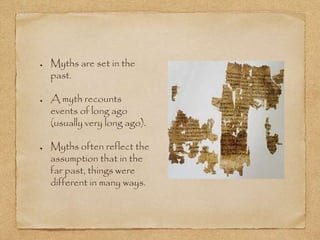
Myths are set in the 
past. 
A myth recounts 
events of long ago 
(usually very long ago). 
Myths often reflect the 
assumption that in the 
far past, things were 
different in many ways.
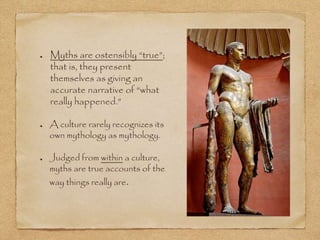
Myths are ostensibly “true”; 
that is, they present 
themselves as giving an 
accurate narrative of “what 
really happened.” 
A culture rarely recognizes its 
own mythology as mythology. 
Judged from within a culture, 
myths are true accounts of the 
way things really are.
Myths often explain, justify, instruct, or 
warn. 
An aetiological myth may explain why things are as they are or how 
certain events, entities, or conditions came into existence. 
A charter myth may offer a justification for a certain rite or social 
institution. 
A myth may instruct its audience in how people ought or ought not to 
behave. 
Such instruction frequently takes place in the form of a warning by 
showing the consequences of misbehavior.
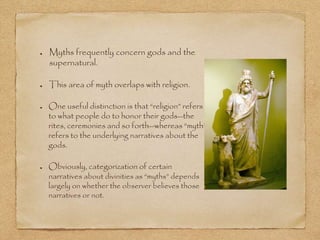
Myths frequently concern gods and the 
supernatural. 
This area of myth overlaps with religion. 
One useful distinction is that “religion” refers 
to what people do to honor their gods--the 
rites, ceremonies and so forth--whereas “myth” 
refers to the underlying narratives about the 
gods. 
Obviously, categorization of certain 
narratives about divinities as “myths” depends 
largely on whether the observer believes those 
narratives or not.
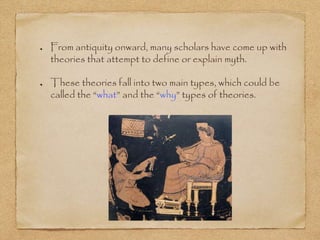
From antiquity onward, many scholars have come up with 
theories that attempt to define or explain myth. 
These theories fall into two main types, which could be 
called the “what” and the “why” types of theories.
“What” theories attempt to explain myth by identifying it as a subcategory, 
derivative, or forerunner of something else (such as history, ritual, or 
philosophy). 
At worst, such theories are excessively reductive: they tend to say that myth “is 
only” misunderstood history, or primitive science, or some other thing. 
For example, Euhemerus (c. 300 B.C.) suggested that myth was misremembered 
history; the gods of Greece had originally been great kings whose characteristics 
were exaggerated through time. Later versions of this theory are called euhemerism. 
Even at their best, such theories tend to ignore the distinctive qualities that make 
myth appealing; the theories can’t explain why transformations into myth occur in 
the first place.
“Why” theories look for wider explanations to identify 
the impetus in the human mind or human culture that 
motivates myth-making. 
Psychological and structuralist theories fall under this 
heading 
“Why” theories assume that myth is an extra- or 
transcultural phenomenon; the same narrative elements 
serve the same functions in different cultures.
One very popular theory that has been resurrected over and over since 
antiquity is that myths are a form of allegory. 
Max Muller (1823-1900) developed the allegorical interpretation of myth 
into what is often call the “Solar Mythology” theory. 
Muller thought that myths were misunderstood statements about the battle 
between light (specifically sunlight) and darkness. 
In a phrase that has become infamous, Muller said that mythology is “a 
disease of language.” He meant that as terms changed meaning, people 
misinterpreted them. Thus, the “maiden dawn” came to be seen, much later, 
as a female deity.
The primary challenge to Muller’s 
theory was mounted by Andrew Lang 
(1844-1912), who saw explanation as 
the essential function of myth. 
Myth, he thought, was driven by the 
same impulse that would later develop 
into science; in fact, myths were 
“primitive science.” 
Thus, all myths were basically 
aetiological.
One of the most influential theorists was Sir James Frazer (1854-1941). 
For Frazer, myth was part of a continuum, running from magic through religion to 
science. He modified the idea of myth as explanation to argue that myth, in all societies, 
was specifically an explanation for ritual. 
In The Golden Bough (pub. 1890), Frazer presented evidence collected from around 
the world to demonstrate myth’s origins in primordial religious beliefs common to most 
human societies. He argues that narratives of myth remain long after the ritual they are 
based on have disappeared.
The next important school of myth theory to arise after Frazer was Functionalism, 
pioneered by Bronislaw Malinowski (1884-1942). 
Malinowski studied myth as a living tradition among the Trobriand islanders and concluded 
that the defining characteristic of myth was its functionality. 
Myth contributes to society by helping to maintain the social system. Its origin is less 
important than its function. 
Malinowski rejected the idea that myth’s primary purpose is to explain, rather than to help 
justify and maintain the social system. Myths do not, in fact, refer to any culture outside of 
their own. 
He called such justificatory myths “charters”’ they provided validation for the social 
institutions they described. 
He also posited a hard & fast distinction between myth as “sacred” narrative and folktale as 
“entertainment.” with a third category of historicizing legend in between these two poles.
Each of these theories has struck its critics as 
unsatisfactory in at least some regards. 
Some see too restrictive. The “Solar Myth” 
hypothesis of the 19th century is perhaps the most 
obvious example, but other theories too, fall short in this 
regard: 
If myths must be tied to rituals, then how do we account 
for stories that seem to have no ritual associations 
whatsoever? 
If myths must concern the gods, then the stories of 
Oedipus, Theseus, Perseus, and many others are 
excluded by definition. 
If myths must provide charters for social institutions, how 
do we explain those that seem to perform no such 
function?
The most obvious answer in each case is to 
say that those tales that do not fit the 
definition are not myths at all but some other 
type of traditional tale. This sort of 
narrowing of the definition to make the theory 
work is not very satisfactory. 
Another answer is to say that in each case, 
the myth has undergone change or corruption 
that has disguised its original character. But 
this is a form of special pleading, persuasive 
only to those who have already accepted the 
theory in question. 
It seems better to admit that, so far, no 
“monolithic” theory has completely defined or 
explained myth.

What Is Myth?

  • 1.
    What is Myth? -Characteristics of myth -Some of the most influential 19th and 20th century theories about myths nature and function
  • 2.
    The question “whatis myth” has no easy or obvious answer. As used in popular speech, “myth” has several meanings that we can exclude right away. It is often used to mean a lie, a mistaken belief, or a misconception. These usages do not concern us here.
  • 3.
    We can beginour working definition of myth by identifying some characteristics of “myth”: Myths are traditional tales of stories. Myths are presented in narrative form. Myths are handed down in a society from one generation to the next. It is usually impossible to say who first invented a particular myth. In this regard, they are unlike most other forms of narrative, such as poems, novels and plays.
  • 4.
    Myths are setin the past. A myth recounts events of long ago (usually very long ago). Myths often reflect the assumption that in the far past, things were different in many ways.
  • 5.
    Myths are ostensibly“true”; that is, they present themselves as giving an accurate narrative of “what really happened.” A culture rarely recognizes its own mythology as mythology. Judged from within a culture, myths are true accounts of the way things really are.
  • 6.
    Myths often explain,justify, instruct, or warn. An aetiological myth may explain why things are as they are or how certain events, entities, or conditions came into existence. A charter myth may offer a justification for a certain rite or social institution. A myth may instruct its audience in how people ought or ought not to behave. Such instruction frequently takes place in the form of a warning by showing the consequences of misbehavior.
  • 7.
    Myths frequently concerngods and the supernatural. This area of myth overlaps with religion. One useful distinction is that “religion” refers to what people do to honor their gods--the rites, ceremonies and so forth--whereas “myth” refers to the underlying narratives about the gods. Obviously, categorization of certain narratives about divinities as “myths” depends largely on whether the observer believes those narratives or not.
  • 8.
    From antiquity onward,many scholars have come up with theories that attempt to define or explain myth. These theories fall into two main types, which could be called the “what” and the “why” types of theories.
  • 9.
    “What” theories attemptto explain myth by identifying it as a subcategory, derivative, or forerunner of something else (such as history, ritual, or philosophy). At worst, such theories are excessively reductive: they tend to say that myth “is only” misunderstood history, or primitive science, or some other thing. For example, Euhemerus (c. 300 B.C.) suggested that myth was misremembered history; the gods of Greece had originally been great kings whose characteristics were exaggerated through time. Later versions of this theory are called euhemerism. Even at their best, such theories tend to ignore the distinctive qualities that make myth appealing; the theories can’t explain why transformations into myth occur in the first place.
  • 10.
    “Why” theories lookfor wider explanations to identify the impetus in the human mind or human culture that motivates myth-making. Psychological and structuralist theories fall under this heading “Why” theories assume that myth is an extra- or transcultural phenomenon; the same narrative elements serve the same functions in different cultures.
  • 11.
    One very populartheory that has been resurrected over and over since antiquity is that myths are a form of allegory. Max Muller (1823-1900) developed the allegorical interpretation of myth into what is often call the “Solar Mythology” theory. Muller thought that myths were misunderstood statements about the battle between light (specifically sunlight) and darkness. In a phrase that has become infamous, Muller said that mythology is “a disease of language.” He meant that as terms changed meaning, people misinterpreted them. Thus, the “maiden dawn” came to be seen, much later, as a female deity.
  • 12.
    The primary challengeto Muller’s theory was mounted by Andrew Lang (1844-1912), who saw explanation as the essential function of myth. Myth, he thought, was driven by the same impulse that would later develop into science; in fact, myths were “primitive science.” Thus, all myths were basically aetiological.
  • 13.
    One of themost influential theorists was Sir James Frazer (1854-1941). For Frazer, myth was part of a continuum, running from magic through religion to science. He modified the idea of myth as explanation to argue that myth, in all societies, was specifically an explanation for ritual. In The Golden Bough (pub. 1890), Frazer presented evidence collected from around the world to demonstrate myth’s origins in primordial religious beliefs common to most human societies. He argues that narratives of myth remain long after the ritual they are based on have disappeared.
  • 14.
    The next importantschool of myth theory to arise after Frazer was Functionalism, pioneered by Bronislaw Malinowski (1884-1942). Malinowski studied myth as a living tradition among the Trobriand islanders and concluded that the defining characteristic of myth was its functionality. Myth contributes to society by helping to maintain the social system. Its origin is less important than its function. Malinowski rejected the idea that myth’s primary purpose is to explain, rather than to help justify and maintain the social system. Myths do not, in fact, refer to any culture outside of their own. He called such justificatory myths “charters”’ they provided validation for the social institutions they described. He also posited a hard & fast distinction between myth as “sacred” narrative and folktale as “entertainment.” with a third category of historicizing legend in between these two poles.
  • 15.
    Each of thesetheories has struck its critics as unsatisfactory in at least some regards. Some see too restrictive. The “Solar Myth” hypothesis of the 19th century is perhaps the most obvious example, but other theories too, fall short in this regard: If myths must be tied to rituals, then how do we account for stories that seem to have no ritual associations whatsoever? If myths must concern the gods, then the stories of Oedipus, Theseus, Perseus, and many others are excluded by definition. If myths must provide charters for social institutions, how do we explain those that seem to perform no such function?
  • 16.
    The most obviousanswer in each case is to say that those tales that do not fit the definition are not myths at all but some other type of traditional tale. This sort of narrowing of the definition to make the theory work is not very satisfactory. Another answer is to say that in each case, the myth has undergone change or corruption that has disguised its original character. But this is a form of special pleading, persuasive only to those who have already accepted the theory in question. It seems better to admit that, so far, no “monolithic” theory has completely defined or explained myth.