Semitic religions
All theAbrahamic religions
are called semitic
religions.
these include:
> Islam
> Judaism
> Christianity
3.
Contents:
Historical background
Concept of god
Beliefs and scriptures
Worships and practices
Calendars and events
Commonalities
Differences
Spread and Influence
Interaction and conflicts
Contemporary Relevance:
conclusion
4.
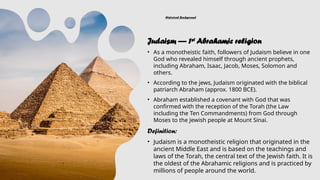
Historical Background
Judaism —1st
Abrahamic religion
• As a monotheistic faith, followers of Judaism believe in one
God who revealed himself through ancient prophets,
including Abraham, Isaac, Jacob, Moses, Solomon and
others.
• According to the jews, Judaism originated with the biblical
patriarch Abraham (approx. 1800 BCE).
• Abraham established a covenant with God that was
confirmed with the reception of the Torah (the Law
including the Ten Commandments) from God through
Moses to the Jewish people at Mount Sinai.
Definition:
• Judaism is a monotheistic religion that originated in the
ancient Middle East and is based on the teachings and
laws of the Torah, the central text of the Jewish faith. It is
the oldest of the Abrahamic religions and is practiced by
millions of people around the world.
5.
Cont……
Christianity — 2nd
Abrahamicreligion
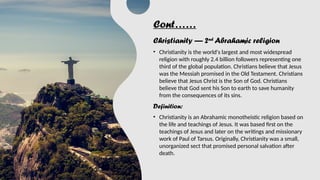
• Christianity is the world's largest and most widespread
religion with roughly 2.4 billion followers representing one
third of the global population. Christians believe that Jesus
was the Messiah promised in the Old Testament. Christians
believe that Jesus Christ is the Son of God. Christians
believe that God sent his Son to earth to save humanity
from the consequences of its sins.
Definition:
• Christianity is an Abrahamic monotheistic religion based on
the life and teachings of Jesus. It was based first on the
teachings of Jesus and later on the writings and missionary
work of Paul of Tarsus. Originally, Christianity was a small,
unorganized sect that promised personal salvation after
death.
6.
Cont…
Islam — 3rd
Abrahamicreligion
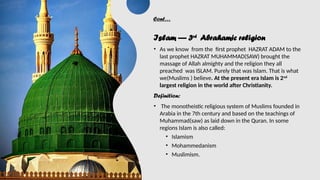
• As we know from the first prophet HAZRAT ADAM to the
last prophet HAZRAT MUHAMMAD(SAW) brought the
massage of Allah almighty and the religion they all
preached was ISLAM. Purely that was Islam. That is what
we(Muslims ) believe. At the present era Islam is 2nd
largest religion in the world after Christianity.
Definition:
• The monotheistic religious system of Muslims founded in
Arabia in the 7th century and based on the teachings of
Muhammad(saw) as laid down in the Quran. In some
regions Islam is also called:
• Islamism
• Mohammedanism
• Muslimism.
7.
Concept of God
Conceptof God in Christianity:
Christians are monotheistic, i.e., they believe there's only one God, and he created the
heavens and the earth.
This divine Godhead consists of three parts: the father (God himself), the son (Jesus Christ)
and the Holy Spirit
Hebrews 11:6
[And without faith it is impossible to please Him, for he who comes to God must believe
that He is and that He is a rewarder of those who seek Him]
Concept of God in Islam:
In Islam, Muslims believe in the oneness of Allah
Almighty. Muslims believe that there is no God
except Allah. Allah is the only diety.
In Quran said that:
“Say, Allah is one. Allah is independent. He begot
none, Nor he was begotten .Indeed, he is
carefree.”(surah Ikhlas)
8.
Cont……….
• The conceptof God in Judaism:
• The concept of God in Judaism is monotheistic,
meaning that there is only one God, and this belief is
central to Jewish faith and practice. God is also seen
as being transcendent and beyond human
comprehension , justice, and mercy. The concept of
God in Judaism is one of a loving and just creator who
is intimately involved in the lives of the Jewish
people.
• [Know therefore today, and lay it to your
heart, that the Lord is God in heaven above
and on the earth beneath; there is no
other.“] –
Deuteronomy 4:39
9.
In Islam:
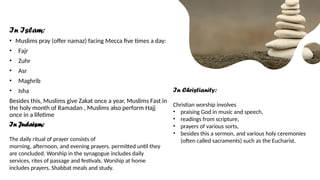
• Muslimspray (offer namaz) facing Mecca five times a day:
• Fajr
• Zuhr
• Asr
• Maghrib
• Isha
Besides this, Muslims give Zakat once a year, Muslims Fast in
the holy month of Ramadan , Muslims also perform Hajj
once in a lifetime
In Judaism:
The daily ritual of prayer consists of
morning, afternoon, and evening prayers. permitted until they
are concluded. Worship in the synagogue includes daily
services, rites of passage and festivals. Worship at home
includes prayers, Shabbat meals and study.
In Christianity:
Christian worship involves
• praising God in music and speech,
• readings from scripture,
• prayers of various sorts,
• besides this a sermon, and various holy ceremonies
(often called sacraments) such as the Eucharist.
10.
worship places:
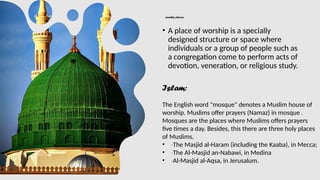
• Aplace of worship is a specially
designed structure or space where
individuals or a group of people such as
a congregation come to perform acts of
devotion, veneration, or religious study.
Islam:
The English word "mosque" denotes a Muslim house of
worship. Muslims offer prayers (Namaz) in mosque .
Mosques are the places where Muslims offers prayers
five times a day. Besides, this there are three holy places
of Muslims.
• ∙The Masjid al-Haram (including the Kaaba), in Mecca;
• ∙The Al-Masjid an-Nabawi, in Medina
• ∙Al-Masjid al-Aqsa, in Jerusalum.
11.
cont………..
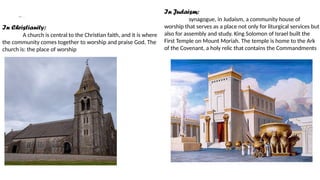
In Christianity:
A churchis central to the Christian faith, and it is where
the community comes together to worship and praise God. The
church is: the place of worship
In Judaism:
synagogue, in Judaism, a community house of
worship that serves as a place not only for liturgical services but
also for assembly and study. King Solomon of Israel built the
First Temple on Mount Moriah. The temple is home to the Ark
of the Covenant, a holy relic that contains the Commandments
12.
Religious Calendar andevents:
Christian Calendar:
The Christian calendar is based on the Gregorian calendar and includes significant
religious observances such as Christmas (celebrating the birth of Jesus), Easter
(commemorating the resurrection of Jesus), and Pentecost (marking the descent of
the Holy Spirit. Pentecost is celebrated on the seventh Sunday after Easter)
Islamic Calendar:
The Islamic calendar, also known as the Hijri calendar, is a lunar calendar consisting of
12 months in a year of 354 or 355 days. It is used to determine the dates of Islamic
holidays such as Ramadan (the month of fasting), Eid al-Fitr (the festival marking the
end of Ramadan), and Eid al-Adha.
Judaism Calendar:
The Jewish calendar is a lunisolar calendar, meaning it is based on both the phases of
the moon and the solar year. It consists of 12 or 13 months, with leap years occurring
to align the lunar and solar cycles. The Jewish calendar begins with the creation of
the world, and dates are often given in terms of the number of years since the
creation. The Jewish calendar is used to determine the dates of religious holidays
such as Rosh Hashanah, Yom Kippur, Passover, and Hanukahh.
13.
• The believesand the events which are common in all the Abrahamic religions.
Monotheism:
All three religions are monotheistic, meaning they
believe in the existence of one God.
.. Shared Prophets:
They all believe in many of the same prophets,
such as Abraham, Moses, and Noah.
Moral and Ethical Values:
They all emphasize moral and ethical values, such as
compassion, justice, charity, and the importance of leading
a righteous life.
Sacred sites:
They share certain sacred sites, particularly in the
Holy Land, such as Jerusalem, which holds significance for
all three religions.
Belief in Afterlife:
They all have beliefs in an afterlife, where individuals will
be judged based on their actions and faith.
Importance of Prayer:
Each religion places a strong emphasis on prayer and
regular communication with God.
Commonalities:
14.
Differences :
. Beliefsabout Jesus:
In Christianity, Jesus is the of God and the savior of
humanity. In Islam, Jesus is prophet but not the son of God. In
Judaism, Jesus is not recognized as a prophet or the Messiah.
Concept of God:
While all three religions are monotheistic and
believe in one God, they have different understandings of
the nature of God. For example, Christians believe in the
Holy Trinity (Father, Son, and Holy Spirit), while Jews and
Muslims believe in a singular, indivisible God.
There are several key differences between the Semitic religions
of Judaism, Christianity, and Islam.
Holy Books:
Each religion has its own holy book. Judaism's holy
book is the Torah, Christianity's holy book is the Bible (including
the Old Testament and the New Testament), and Islam's holy
book is the Quran.
. Practices and Rituals:
Each religion has its own set of practices and
rituals. For example, Muslims pray five times a day,
Christians celebrate the Eucharist, and Jews observe
the Sabbath.
15.
Spread and Influence:
TheSemitic religions of Judaism, Christianity, and Islam have had a significant spread and influence
throughout history, shaping the cultures, societies, and civilizations in which they have been practiced.
Judaism:
Judaism originated in ancient Israel Judaism has had a
profound influence on world history, particularly through its
impact on monotheism, ethical and moral values, and the
development of religious texts such as the Torah. The Jewish
diaspora has also led to the spread of Jewish communities and
influence in various parts of the world.
Christianity:
Christianity emerged from the teachings of
Jesus Christ in the first century and spread rapidly
throughout the Roman Empire and beyond. It
became the dominant religion of Europe and has
since spread to every continent, making it the
largest religion in the world .
Islam:
Islam originated in the Arabian Peninsula in the 7th
century and quickly spread across the Middle East, North
Africa, and into Europe and Asia because of it’s all the golden
rules and examples set by the prophet Muhammad(saw).
Islam has also played a major role in shaping the legal, social,
and political systems of various societies .
16.
Shared Ancestry:
• Judaism,Christianity, and Islam share
a common ancestry through the figure
of Abraham, and they revere many of
the same prophets and figures from
their respective religious traditions.
. Cultural Exchange:
The interaction between these religions has led to
significant cultural exchange, influencing art, architecture,
literature, and philosophy in various regions where they have
coexisted.
17.
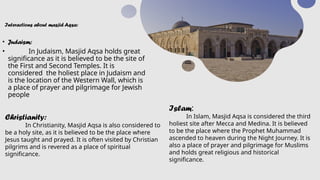
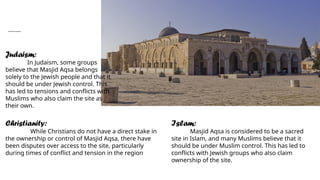
Interactions about masjidAqsa:
• Judaism:
• In Judaism, Masjid Aqsa holds great
significance as it is believed to be the site of
the First and Second Temples. It is
considered the holiest place in Judaism and
is the location of the Western Wall, which is
a place of prayer and pilgrimage for Jewish
people
Christianity:
In Christianity, Masjid Aqsa is also considered to
be a holy site, as it is believed to be the place where
Jesus taught and prayed. It is often visited by Christian
pilgrims and is revered as a place of spiritual
significance.
Islam:
In Islam, Masjid Aqsa is considered the third
holiest site after Mecca and Medina. It is believed
to be the place where the Prophet Muhammad
ascended to heaven during the Night Journey. It is
also a place of prayer and pilgrimage for Muslims
and holds great religious and historical
significance.
18.
Conflict:
• .Theological Disputes:
•Theological differences and
interpretations of religious texts have led to
conflicts and debates between believers of
these religions, particularly on issues such as
the nature of God, the status of Jesus Christ,
and the role of Muhammad(saw).
. Historical Conflicts:
Throughout history, there have
been periods of conflict between followers
of these religions, including the Crusades,
various wars in the Middle East, and
disputes over control of religious sites,
particularly in Jerusalem.
. Political Issues:
The interplay of religion and politics has
often led to tensions and conflicts between
different religious groups, particularly in
regions where these faiths have coexisted for
centuries.
19.
Conflicts about masjidAqsa:
Judaism:
In Judaism, some groups
believe that Masjid Aqsa belongs
solely to the Jewish people and that it
should be under Jewish control. This
has led to tensions and conflicts with
Muslims who also claim the site as
their own.
Christianity:
While Christians do not have a direct stake in
the ownership or control of Masjid Aqsa, there have
been disputes over access to the site, particularly
during times of conflict and tension in the region
Islam:
Masjid Aqsa is considered to be a sacred
site in Islam, and many Muslims believe that it
should be under Muslim control. This has led to
conflicts with Jewish groups who also claim
ownership of the site.
20.
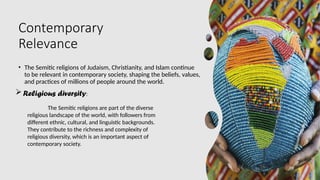
Contemporary
Relevance
• The Semiticreligions of Judaism, Christianity, and Islam continue
to be relevant in contemporary society, shaping the beliefs, values,
and practices of millions of people around the world.
Religious diversity:
The Semitic religions are part of the diverse
religious landscape of the world, with followers from
different ethnic, cultural, and linguistic backgrounds.
They contribute to the richness and complexity of
religious diversity, which is an important aspect of
contemporary society.
21.
Cont…………
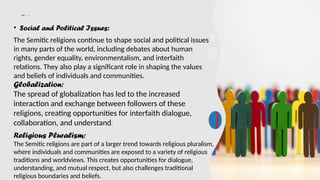
• Social andPolitical Issues:
The Semitic religions continue to shape social and political issues
in many parts of the world, including debates about human
rights, gender equality, environmentalism, and interfaith
relations. They also play a significant role in shaping the values
and beliefs of individuals and communities.
Globalization:
The spread of globalization has led to the increased
interaction and exchange between followers of these
religions, creating opportunities for interfaith dialogue,
collaboration, and understand.
Religious Pluralism:
The Semitic religions are part of a larger trend towards religious pluralism,
where individuals and communities are exposed to a variety of religious
traditions and worldviews. This creates opportunities for dialogue,
understanding, and mutual respect, but also challenges traditional
religious boundaries and beliefs.
22.
Conclusion:
The Semitic religionsas Judaism,
Christianity, and Islam have played a
significant role in shaping human history,
culture, and society. Their interactions and
conflicts have had a profound impact on
the development of art, architecture,
philosophy, science, literature, and social
and political systems across diverse regions
and historical periods. Moreover, the
contemporary relevance of these religions
is evident in their influence on social and
political issues, their role in shaping
religious diversity and pluralism, and their
impact on global events and conflicts.

![Concept of God
Concept of God in Christianity:
Christians are monotheistic, i.e., they believe there's only one God, and he created the
heavens and the earth.
This divine Godhead consists of three parts: the father (God himself), the son (Jesus Christ)
and the Holy Spirit
Hebrews 11:6
[And without faith it is impossible to please Him, for he who comes to God must believe
that He is and that He is a rewarder of those who seek Him]
Concept of God in Islam:
In Islam, Muslims believe in the oneness of Allah
Almighty. Muslims believe that there is no God
except Allah. Allah is the only diety.
In Quran said that:
“Say, Allah is one. Allah is independent. He begot
none, Nor he was begotten .Indeed, he is
carefree.”(surah Ikhlas)](https://image.slidesharecdn.com/presentationislamiat1-250914111025-0f4ea8d5/85/Semitic-religions-All-the-abrahamic-religions-7-320.jpg)
![Cont……….
• The concept of God in Judaism:
• The concept of God in Judaism is monotheistic,
meaning that there is only one God, and this belief is
central to Jewish faith and practice. God is also seen
as being transcendent and beyond human
comprehension , justice, and mercy. The concept of
God in Judaism is one of a loving and just creator who
is intimately involved in the lives of the Jewish
people.
• [Know therefore today, and lay it to your
heart, that the Lord is God in heaven above
and on the earth beneath; there is no
other.“] –
Deuteronomy 4:39](https://image.slidesharecdn.com/presentationislamiat1-250914111025-0f4ea8d5/85/Semitic-religions-All-the-abrahamic-religions-8-320.jpg)




![谷歌霸屏推广[ 𝙩𝙤𝙥 𝟮𝟯𝟯. 𝙘 𝙤𝙢 ]](https://cdn.slidesharecdn.com/ss_thumbnails/top233-260130171247-43791db0-thumbnail.jpg?width=640&height=640&fit=bounds)


