APPLICATION
OF
TRIGONOMETRY
INTRODUCTION
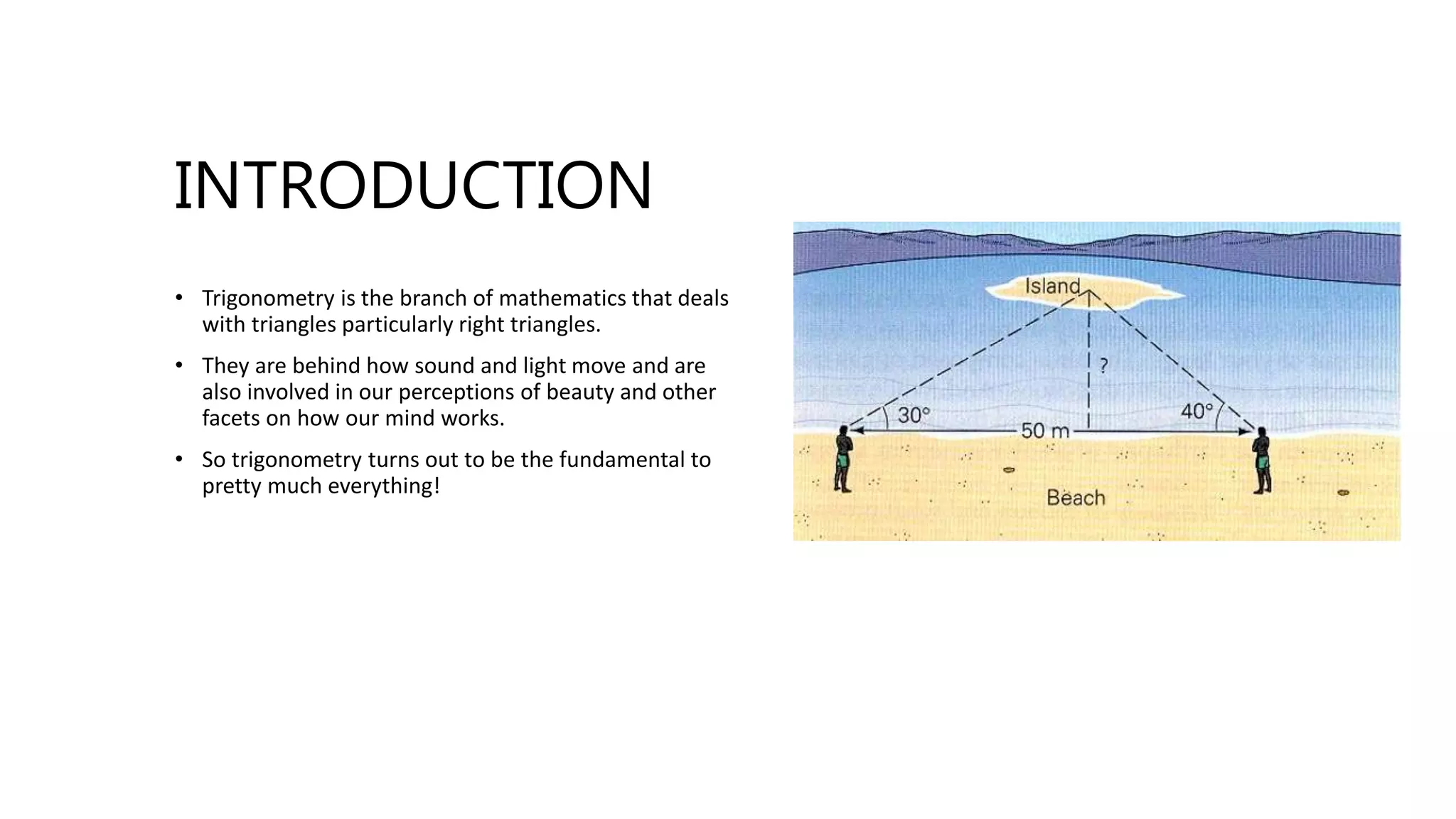
• Trigonometry is the branch of mathematics that deals
with triangles particularly right triangles.
• They are behind how sound and light move and are
also involved in our perceptions of beauty and other
facets on how our mind works.
• So trigonometry turns out to be the fundamental to
pretty much everything!
History
• The origins of trigonometry can be traced to the
civilizations of ancient Egypt, Mesopotamia and the
Indus Valley, more than 4000 years ago
• Some experts believe that trigonometry was originally
invented to calculate sundials
• The first recorded use of trigonometry came from the
Hellinistic mathematician Circa in 150 BC.
• Many mathemiticians like Aryabhatta, Ibn Yunus and
Al-Kashi also contributed significantly.
Right Triangle
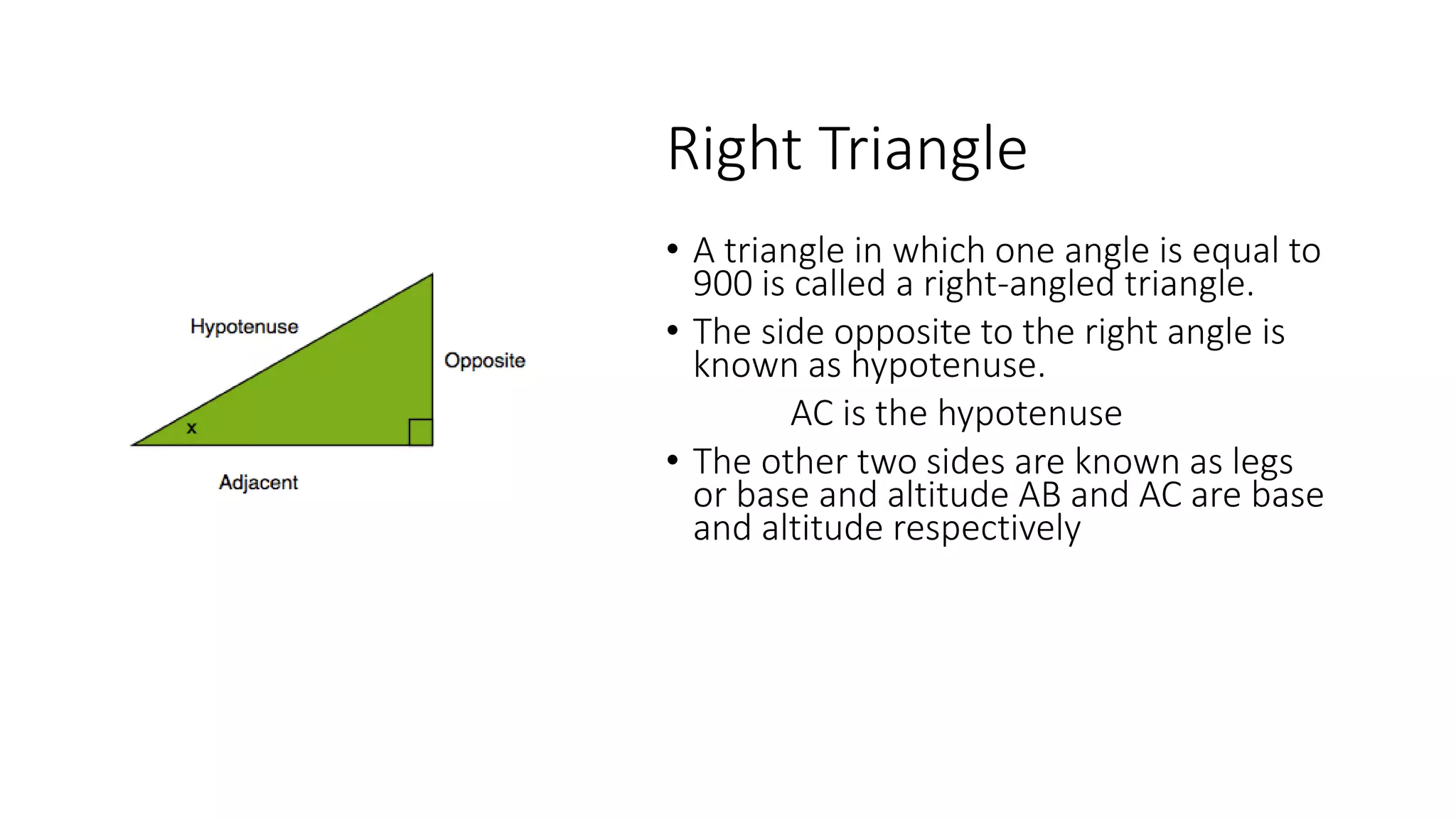
• A triangle in which one angle is equal to
900 is called a right-angled triangle.
• The side opposite to the right angle is
known as hypotenuse.
AC is the hypotenuse
• The other two sides are known as legs
or base and altitude AB and AC are base
and altitude respectively
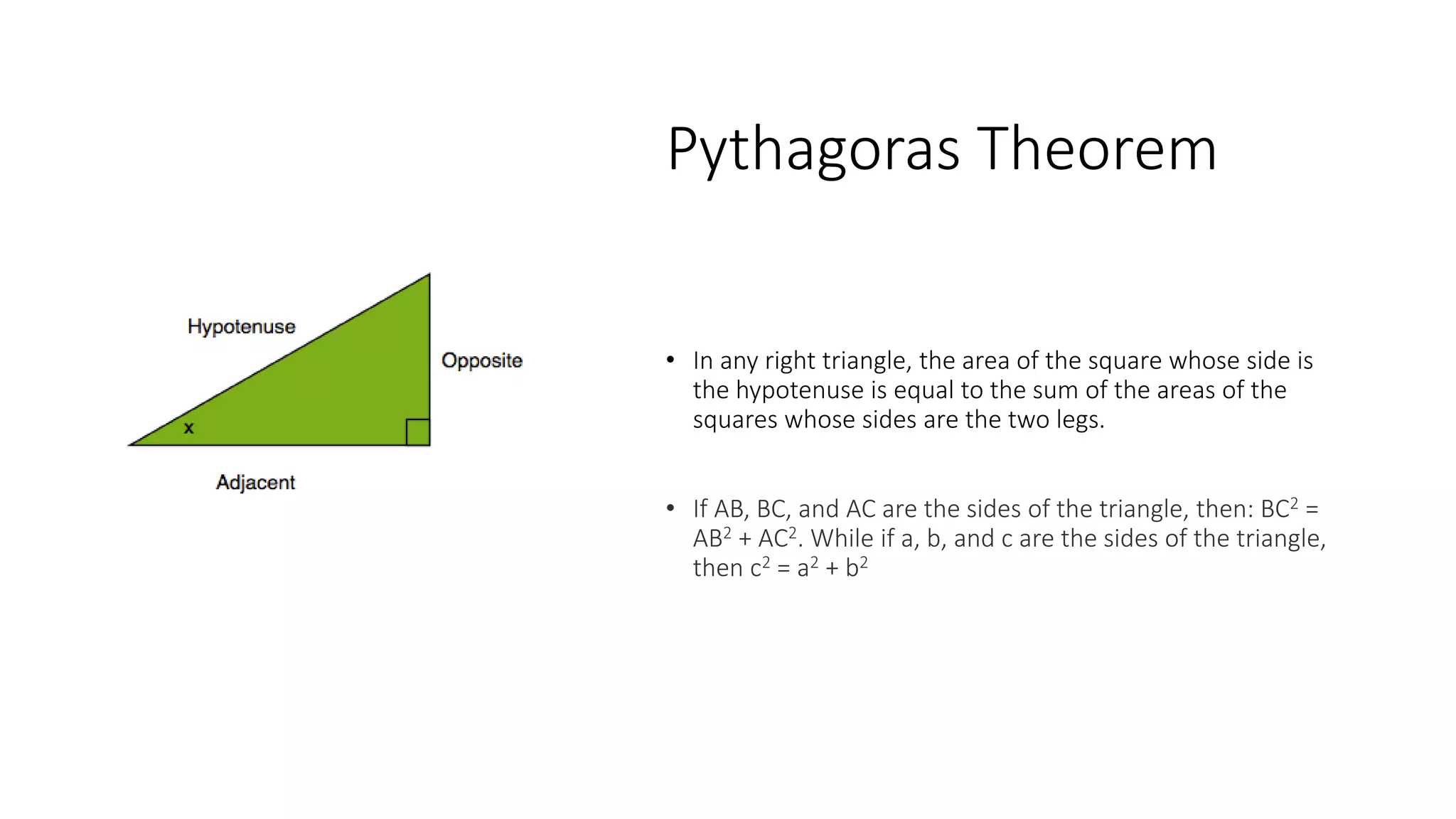
Pythagoras Theorem
• In any right triangle, the area of the square whose side is
the hypotenuse is equal to the sum of the areas of the
squares whose sides are the two legs.
• If AB, BC, and AC are the sides of the triangle, then: BC2 =
AB2 + AC2​. While if a, b, and c are the sides of the triangle,
then ​c2 = a2 + b2
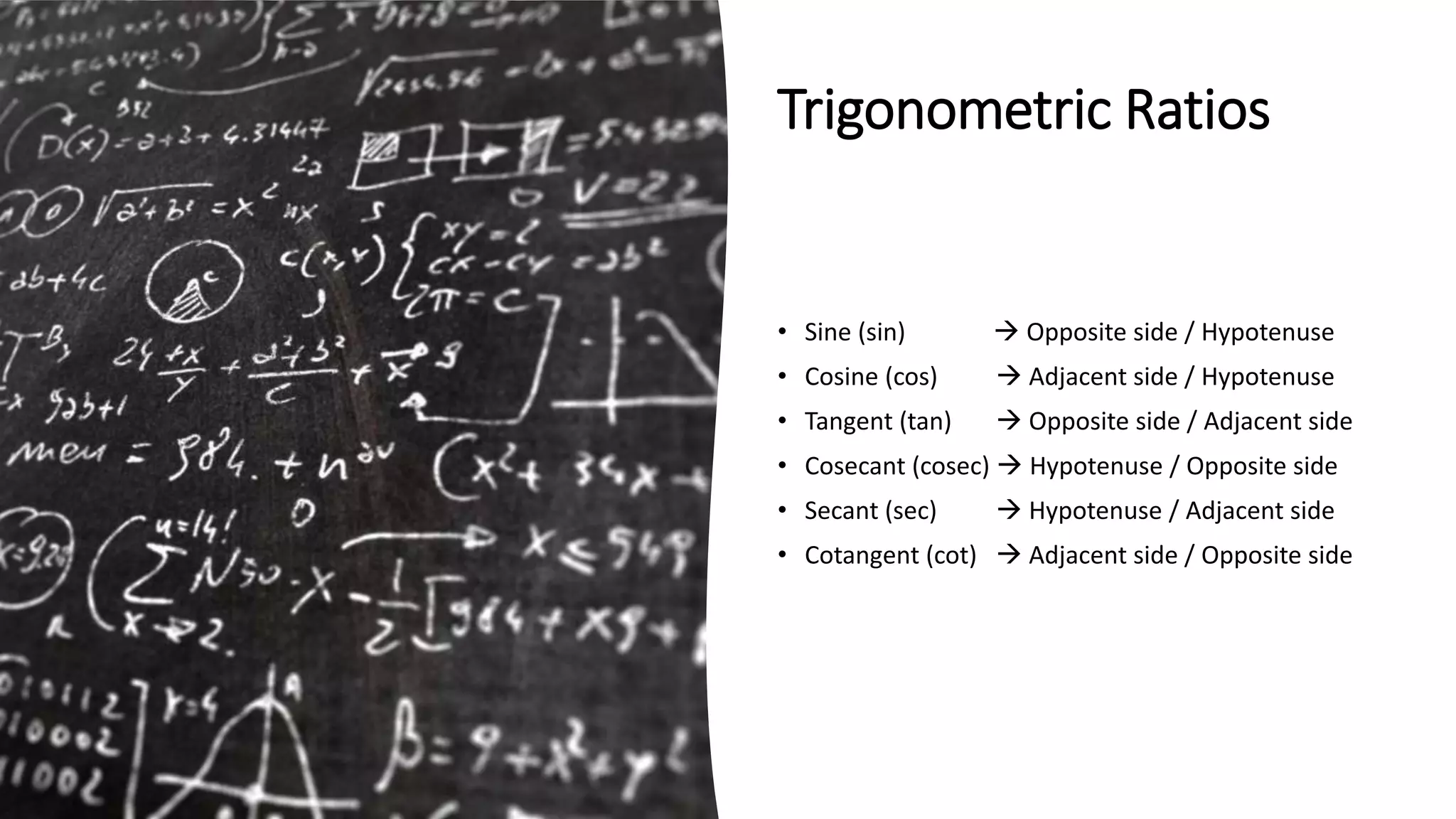
Trigonometric Ratios
• Sine (sin)  Opposite side / Hypotenuse
• Cosine (cos)  Adjacent side / Hypotenuse
• Tangent (tan)  Opposite side / Adjacent side
• Cosecant (cosec)  Hypotenuse / Opposite side
• Secant (sec)  Hypotenuse / Adjacent side
• Cotangent (cot)  Adjacent side / Opposite side
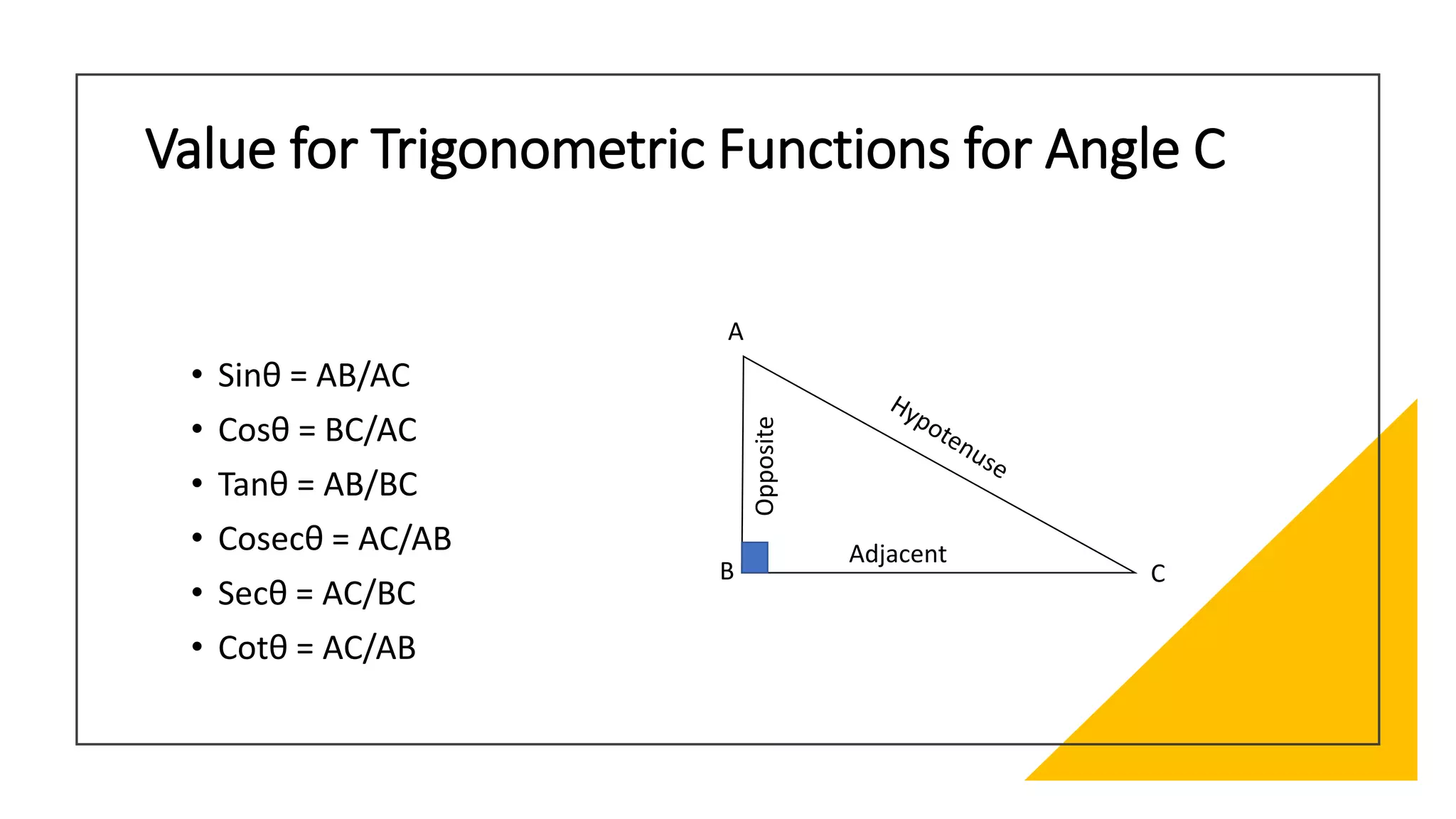
Value for Trigonometric Functions for Angle C
• Sinθ = AB/AC
• Cosθ = BC/AC
• Tanθ = AB/BC
• Cosecθ = AC/AB
• Secθ = AC/BC
• Cotθ = AC/AB
C
A
B
Adjacent
Opposite
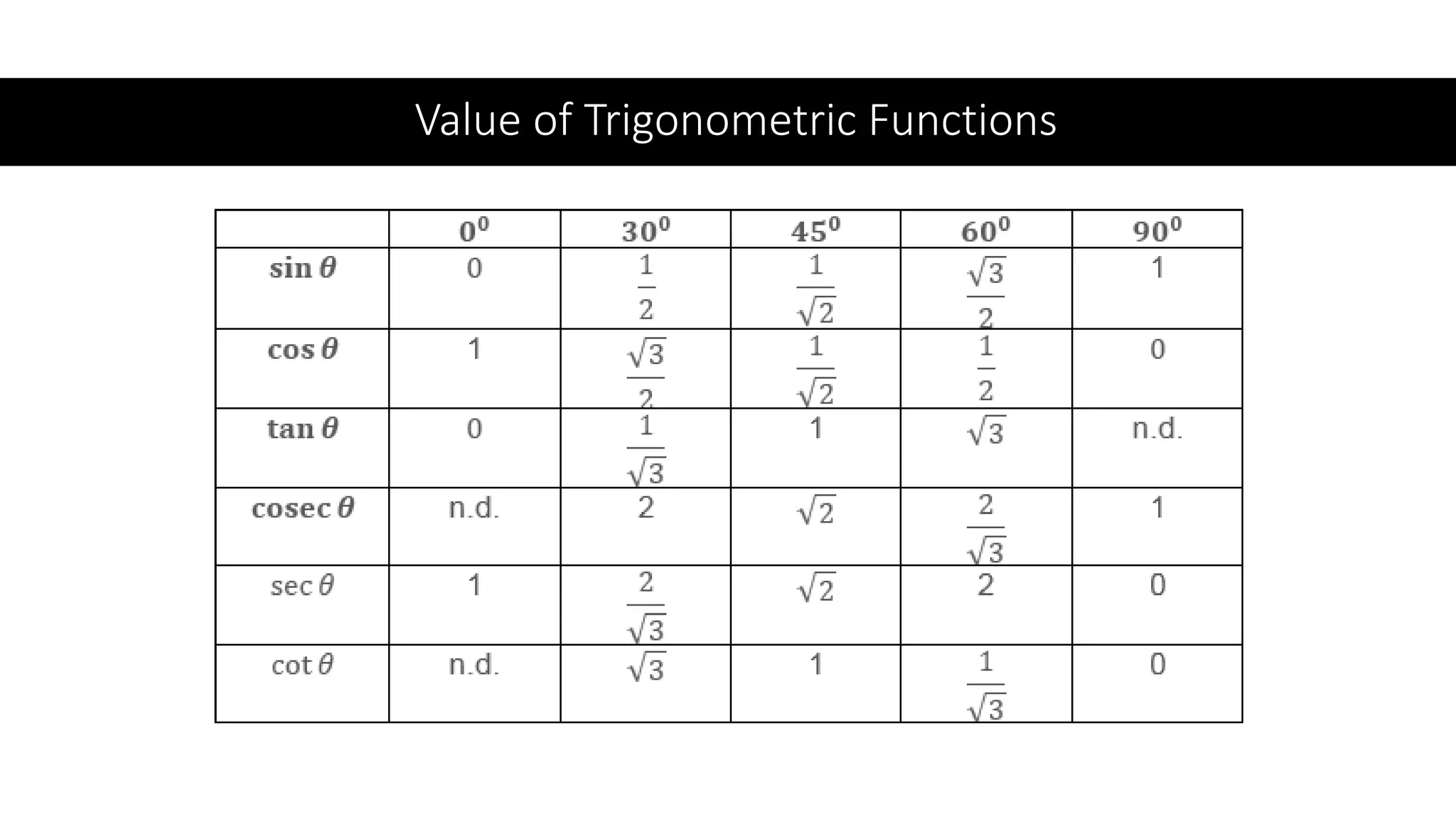
Value of Trigonometric Functions
Some Applications of
Trigonometry
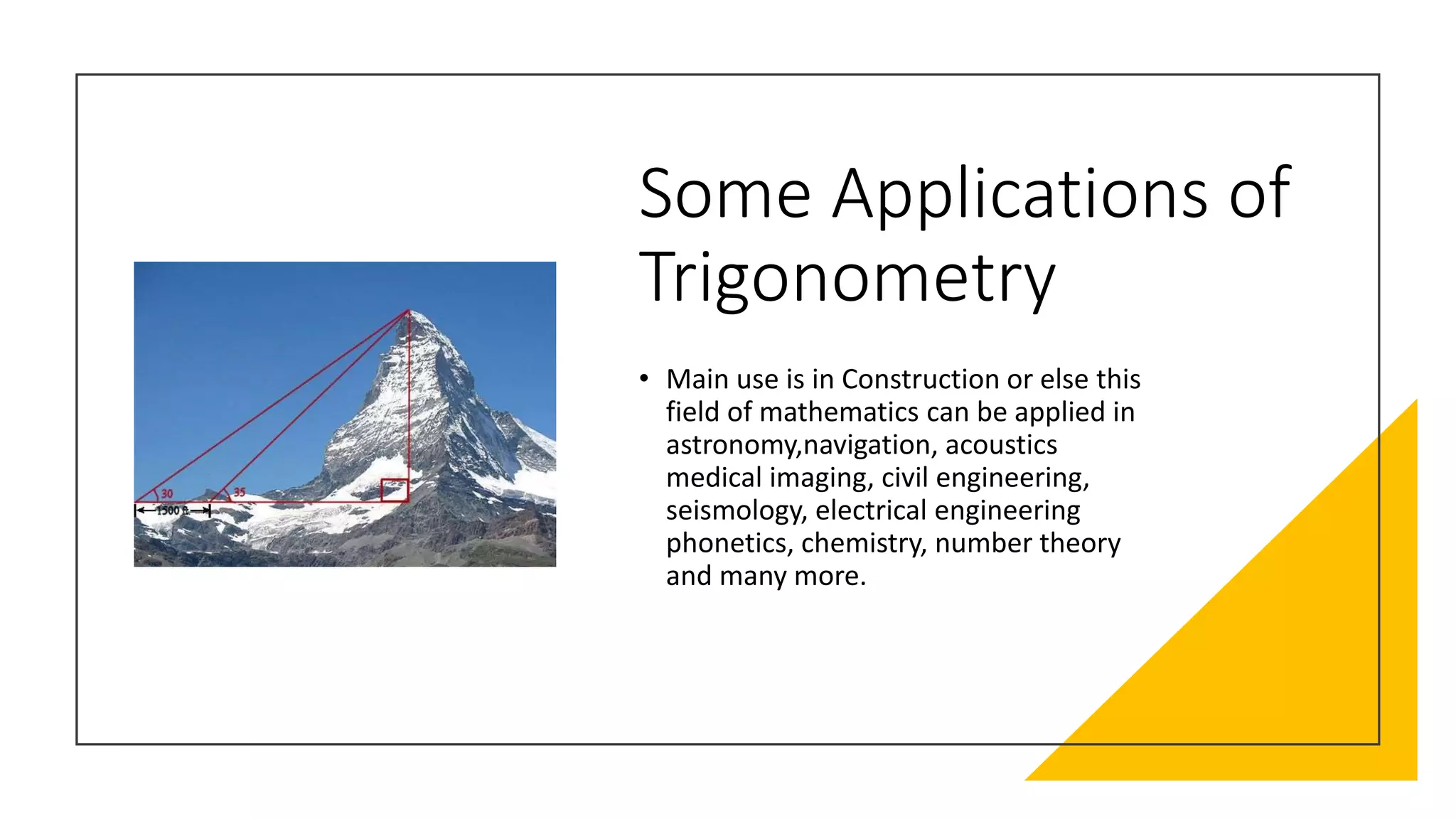
• Main use is in Construction or else this
field of mathematics can be applied in
astronomy,navigation, acoustics
medical imaging, civil engineering,
seismology, electrical engineering
phonetics, chemistry, number theory
and many more.
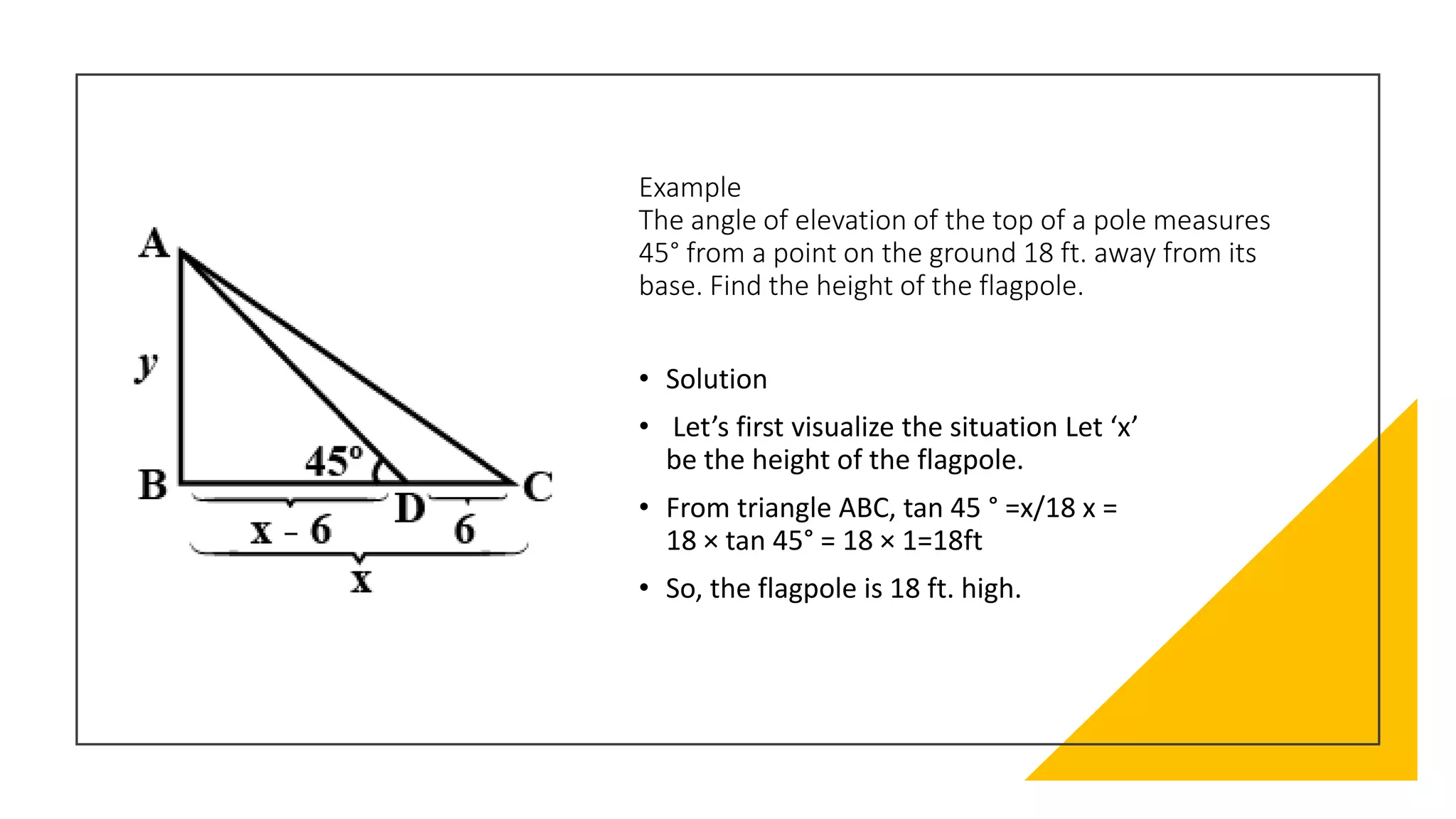
Example
The angle of elevation of the top of a pole measures
45° from a point on the ground 18 ft. away from its
base. Find the height of the flagpole.
• Solution
• Let’s first visualize the situation Let ‘x’
be the height of the flagpole.
• From triangle ABC, tan 45 ° =x/18 x =
18 × tan 45° = 18 × 1=18ft
• So, the flagpole is 18 ft. high.
Conclusion
• Trigonometry is a branch of
Mathematics with several
important and useful applications.
Hence, it attracts more and more
research with several theories
published year after year.
Thank you!
Done by Aksar Ali 😊

Class 10 Ch- introduction to trigonometrey

  • 1.
  • 2.
    INTRODUCTION • Trigonometry isthe branch of mathematics that deals with triangles particularly right triangles. • They are behind how sound and light move and are also involved in our perceptions of beauty and other facets on how our mind works. • So trigonometry turns out to be the fundamental to pretty much everything!
  • 3.
    History • The originsof trigonometry can be traced to the civilizations of ancient Egypt, Mesopotamia and the Indus Valley, more than 4000 years ago • Some experts believe that trigonometry was originally invented to calculate sundials • The first recorded use of trigonometry came from the Hellinistic mathematician Circa in 150 BC. • Many mathemiticians like Aryabhatta, Ibn Yunus and Al-Kashi also contributed significantly.
  • 4.
    Right Triangle • Atriangle in which one angle is equal to 900 is called a right-angled triangle. • The side opposite to the right angle is known as hypotenuse. AC is the hypotenuse • The other two sides are known as legs or base and altitude AB and AC are base and altitude respectively
  • 5.
    Pythagoras Theorem • Inany right triangle, the area of the square whose side is the hypotenuse is equal to the sum of the areas of the squares whose sides are the two legs. • If AB, BC, and AC are the sides of the triangle, then: BC2 = AB2 + AC2​. While if a, b, and c are the sides of the triangle, then ​c2 = a2 + b2
  • 6.
    Trigonometric Ratios • Sine(sin)  Opposite side / Hypotenuse • Cosine (cos)  Adjacent side / Hypotenuse • Tangent (tan)  Opposite side / Adjacent side • Cosecant (cosec)  Hypotenuse / Opposite side • Secant (sec)  Hypotenuse / Adjacent side • Cotangent (cot)  Adjacent side / Opposite side
  • 7.
    Value for TrigonometricFunctions for Angle C • Sinθ = AB/AC • Cosθ = BC/AC • Tanθ = AB/BC • Cosecθ = AC/AB • Secθ = AC/BC • Cotθ = AC/AB C A B Adjacent Opposite
  • 8.
  • 9.
    Some Applications of Trigonometry •Main use is in Construction or else this field of mathematics can be applied in astronomy,navigation, acoustics medical imaging, civil engineering, seismology, electrical engineering phonetics, chemistry, number theory and many more.
  • 10.
    Example The angle ofelevation of the top of a pole measures 45° from a point on the ground 18 ft. away from its base. Find the height of the flagpole. • Solution • Let’s first visualize the situation Let ‘x’ be the height of the flagpole. • From triangle ABC, tan 45 ° =x/18 x = 18 × tan 45° = 18 × 1=18ft • So, the flagpole is 18 ft. high.
  • 11.
    Conclusion • Trigonometry isa branch of Mathematics with several important and useful applications. Hence, it attracts more and more research with several theories published year after year.
  • 12.
    Thank you! Done byAksar Ali 😊