Critical Literacy In Action
The DesignInSchools Project
Wendy Cave
Faith Bentley
Macquarie Primary School
Mel Edwards
Justin Barrie
Design Managers Australia
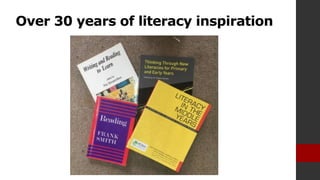
Over 30 years of literacy inspiration
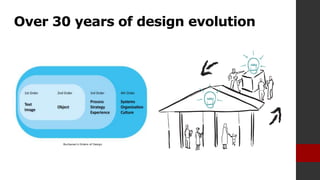
Over 30 years of design evolution
Buchanan’s Orders of Design
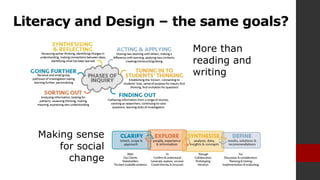
Literacy and Design – the same goals?
More than
reading and
writing
Making sense
for social
change
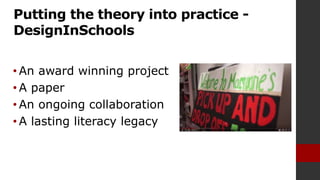
Putting the theory into practice -
DesignInSchools
• An award winning project
• A paper
• An ongoing collaboration
• A lasting literacy legacy
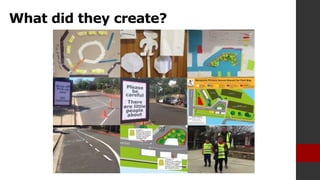
What did they create?
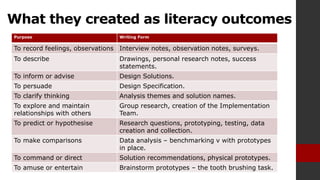
What they created as literacy outcomes
Purpose Writing Form
To record feelings, observations Interview notes, observation notes, surveys.
To describe Drawings, personal research notes, success
statements.
To inform or advise Design Solutions.
To persuade Design Specification.
To clarify thinking Analysis themes and solution names.
To explore and maintain
relationships with others
Group research, creation of the Implementation
Team.
To predict or hypothesise Research questions, prototyping, testing, data
creation and collection.
To make comparisons Data analysis – benchmarking v with prototypes
in place.
To command or direct Solution recommendations, physical prototypes.
To amuse or entertain Brainstorm prototypes – the tooth brushing task.
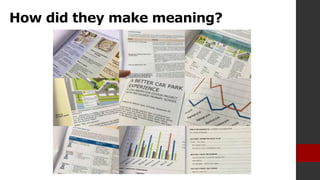
How did they make meaning?
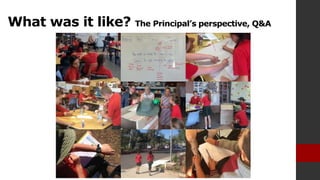
What was it like? The Principal’s perspective, Q&A
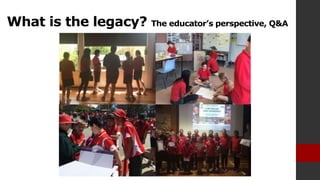
What is the legacy? The educator’s perspective, Q&A
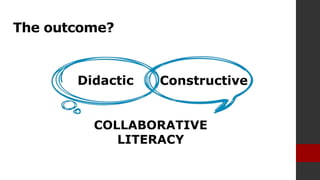
The outcome?
Didactic Constructive
COLLABORATIVE
LITERACY
Thanks!
Wendy Cave
Faith Bentley
@wendy_cave
http://www.macquarieps.act.edu.au
Mel Edwards
Justin Barrie
@DMA_Canberra
www.designmanagers.com.au
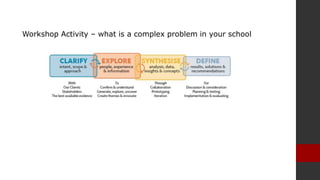
Workshop Activity – what is a complex problem in your school

Presentation to ALEA 2017

  • 1.
    Critical Literacy InAction The DesignInSchools Project Wendy Cave Faith Bentley Macquarie Primary School Mel Edwards Justin Barrie Design Managers Australia
  • 2.
    Over 30 yearsof literacy inspiration
  • 3.
    Over 30 yearsof design evolution Buchanan’s Orders of Design
  • 4.
    Literacy and Design– the same goals? More than reading and writing Making sense for social change
  • 5.
    Putting the theoryinto practice - DesignInSchools • An award winning project • A paper • An ongoing collaboration • A lasting literacy legacy
  • 6.
  • 7.
    What they createdas literacy outcomes Purpose Writing Form To record feelings, observations Interview notes, observation notes, surveys. To describe Drawings, personal research notes, success statements. To inform or advise Design Solutions. To persuade Design Specification. To clarify thinking Analysis themes and solution names. To explore and maintain relationships with others Group research, creation of the Implementation Team. To predict or hypothesise Research questions, prototyping, testing, data creation and collection. To make comparisons Data analysis – benchmarking v with prototypes in place. To command or direct Solution recommendations, physical prototypes. To amuse or entertain Brainstorm prototypes – the tooth brushing task.
  • 8.
    How did theymake meaning?
  • 9.
    What was itlike? The Principal’s perspective, Q&A
  • 10.
    What is thelegacy? The educator’s perspective, Q&A
  • 11.
  • 12.
    Thanks! Wendy Cave Faith Bentley @wendy_cave http://www.macquarieps.act.edu.au MelEdwards Justin Barrie @DMA_Canberra www.designmanagers.com.au
  • 14.
    Workshop Activity –what is a complex problem in your school

Editor's Notes

  • #2 Suggest Justin and Mel open and make an intro like: “This is a session about critical literacy with two outstanding educators, but those educators, like you, are in the final session of a humungous four day conference full of new and inspiring ideas. So in the idea of collaboration, and respecting the subject matter expertise of the education, this session will be introduced by us – the designers. So grab a breath Wendy and Faith and then we’ll kick off!”
  • #3 SLIDE 1 - WENDY “When we started thinking about presenting at this conference about Design In Schools, we always knew that it was about more than a single literacy focused project. At our school, already heavily focuses on inquiry based learning and research, it has become a way of looking at everything we do from a slightly different perspective – that of design. But the more we prepared and the more we reflected, we realised that this project and presentation wasn’t about design ‘coming into our lives’ as educators. It wasn’t even about looking to a new discipline and thinking about it in relation to literacy and education. It is about realising that, for me, a literacy journey spanning 30 years had design as an ally. And that is what makes this work so powerful. Critical Literacy encourages readers to actively analyse texts and offers strategies to uncovering underlying messages. It is about reading in a reflective manner to understand power, inequality and injustice in relationships. And it is about understanding attitudes, values and beliefs in a written, visual and spoken way. This project – Design in Schools – allowed me, my teaching staff and the young people involved to examine their situation (based around an apparently dangerous car park) and reform their social situation. Students, through literacy, became agents of social change. Authenticity. The project also provided a learning construct that doesn’t, but should, come around very often. It presented teaching and learning in an authentic and relevant setting. It used language to create meaningful interactions and asked the young people to express, through a literacy framework their (and their community’s) immediate and future needs. If our task, as Nea Stewart Dore wrote in 1986 (at the start of my own literacy journey), is to socialise children into reading and writing so that they can learn, think, shape and extend their knowledge of language and the world, then this project certainly did that. But it didn’t do that alone – it did that in collaboration with design.
  • #4 JUSTIN DMA is a Canberra-based specialist service design agency working with private, public, community and volunteer organisations. What’s important to us Making a difference to people's lives through services that may or may not even be noticed by them - for all the right reasons. Creating change that is needed and that makes things better. Bringing together a range of voices and disciplines who can make things happen - not just talk about it, but do it. We have a strong track record Working with people (staff, customers, community, change agents) Deliver for strategic and operational areas Co-designed service specifications for products and service delivery, for internal and external users. Fourth Order Design – what does it mean? 1960s-90s IID, Stanford Design in strategic application - a way of thinking differently about complex problems. “Human-centred” design Schools of Design – IID, Standford 1990s Carnegie Mellon, Dschool, IDEO Application of Co-Design Practice in Aus/NZ public sector ATO, IRD – “administration” design, “service” design, User-centred design, UX design, interaction design. Product design as “design thinking” well-established - IDEO Emerging capabilities Education Institutions – d.School
  • #5 MEL
  • #6 MEL
  • #7 WENDY You can see here some examples of the range of literacy ‘outputs’ that were created during the project:   Prototypes (both on paper but also physically altering the car park) Signage and written text Visualisations and maps   The literacy process really drew on our approach at the school:   Framing up the inquiry Tuning In Finding Out Sorting Out Going Further Reflecting and Acting Evaluation   Our guiding principles   Hope is not a strategy Laughing children learn No two people are exactly the same Learning doesn’t only happen between 9 and 3 Real contexts lead to real learning Learners need to lead Curriculum should be inch wide and mile deep   Our learning assets   We are thinkers We are communicators We are collaborators We are researchers We are self managers We are curious, capable inquirers.   The four resources model   Code breaker decoding the codes and conventions of written, spoken and visual texts Text user understanding the purposes of different written, spoken and visual texts for different cultural and social function Text participant comprehending written, spoken and visual texts Text analyst understanding how texts position readers, viewers and listeners
  • #8 WENDY And you can see here how that translates to critical literacy outcomes.
  • #9 MEL   Artefacts as meaning, each for a design purpose   Intent Research Analysis Synthesis Solution Recommendation Make Change
  • #10 MEL AND WENDY Interview style – insert your notes here
  • #11 FAITH AND JUSTIN Justin draws out the following reflections: DiS Educator Impact   Inquiry-based framework to teach literacy   The importance of real context, real purpose   Student feedback – valued/empowered   Students alongside Justin and Mel as designers - legitimate job! Rose to the challenge   Range of literacy abilities and dispositions - naturally differentiated (incidental not accidental)   Multiple roles as text users/participants/analysts – supported by collaborative approach   4 resources; code break (interviews), critical text users (surveys/anecdotal evidence/myth busting) and the need to research, analyse and draw insights gained from data   Impact of word choice in clarifying the intent and framing the inquiry question   Complex language features and technical vocabulary – evident in across all areas   Confident and informed communicators (tradeshow)   Observations/data collecting – listen and view without judgement/open to multiple perspectives   Students participated in a range of texts, as they comprehended data, graphs and maps   Influence different signs/messages have on the experience of people using the car park   Better equipped to ensure literacy learning experiences are rich and authentic (I know what it looks like)
  • #12 WENDY
  • #14 BLANK SLIDE
  • #15 Myths – how do you explore it Service Owner – what services do you want to design