PROBLEM SOLVING USING DIAMOND MODEL PRITAM DEY [email_address] www.linkedin.com/in/pritamdey
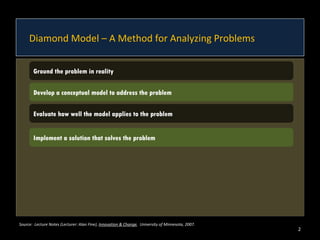
Diamond Model – A Method for Analyzing Problems Ground the problem in reality Develop a conceptual model to address the problem Evaluate how well the model applies to the problem  Implement a solution that solves the problem Source:   Lecture Notes (Lecturer: Alan Fine),  Innovation & Change ,  University of Minnesota, 2007.
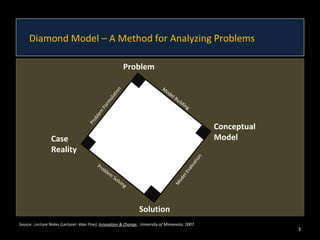
Diamond Model – A Method for Analyzing Problems Source:   Lecture Notes (Lecturer: Alan Fine),  Innovation & Change ,  University of Minnesota, 2007. Problem Formulation Model Building Model Evaluation Problem Solving Case  Reality Conceptual Model Solution Problem
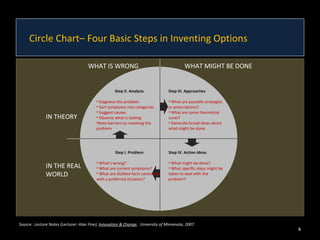
Circle Chart– Four Basic Steps in Inventing Options Source:   Lecture Notes (Lecturer: Alan Fine),  Innovation & Change ,  University of Minnesota, 2007. Step II. Analysis Diagnose the problem Sort symptoms into categories Suggest causes Observe what is lacking Note barriers to resolving the problem Step III. Approaches What are possible strategies or prescriptions? What are some theoretical cures? Generate broad ideas about what might be done. Step I. Problem What’s wrong? What are current symptoms? What are disliked facts contrasted with a preferred situation? Step IV. Action Ideas What might be done? What specific steps might be taken to deal with the problem? WHAT IS WRONG WHAT MIGHT BE DONE IN THEORY IN THE REAL WORLD
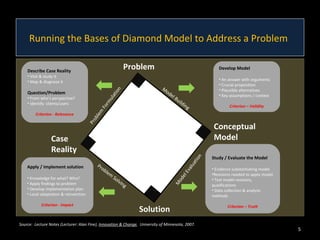
Running the Bases of Diamond Model to Address a Problem Source:   Lecture Notes (Lecturer: Alan Fine),  Innovation & Change ,  University of Minnesota, 2007. Problem Formulation Model Building Model Evaluation Problem Solving Case  Reality Conceptual Model Solution Problem Describe Case Reality Visit & study it Map & diagnose it Question/Problem From who’s perspective? Identify  clients/users Criterion - Relevance Develop Model An answer with arguments Crucial proposition Plausible alternatives Key assumptions / context Criterion – Validity Study / Evaluate the Model Evidence substantiating model Revisions needed to apply model Test model revisions, qualifications Data collection & analysis methods Criterion – Truth Apply / Implement solution Knowledge for what? Who? Apply findings to problem Develop implementation plan Local adaptation & reinvention Criterion - Impact
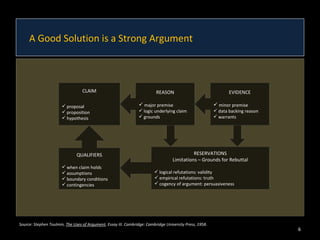
A Good Solution is a Strong Argument Source:   Stephen Toulmin,  The Uses of Argument , Essay III. Cambridge: Cambridge University Press, 1958. EVIDENCE minor premise data backing reason warrants REASON major premise logic underlying claim grounds CLAIM proposal proposition hypothesis QUALIFIERS when claim holds assumptions boundary conditions contingencies RESERVATIONS Limitations – Grounds for Rebuttal logical refutations: validity empirical refutations: truth cogency of argument: persuasiveness
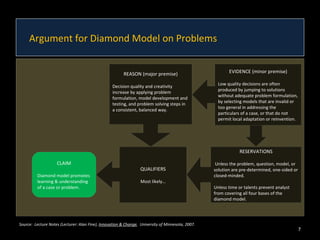
Argument for Diamond Model on Problems Source:   Lecture Notes (Lecturer: Alan Fine),  Innovation & Change ,  University of Minnesota, 2007. EVIDENCE (minor premise) Low quality decisions are often  produced by jumping to solutions without adequate problem formulation, by selecting models that are invalid or too general in addressing the particulars of a case, or that do not permit local adaptation or reinvention. RESERVATIONS Unless the problem, question, model, or solution are pre-determined, one-sided or closed-minded. Unless time or talents prevent analyst from covering all four bases of the diamond model. CLAIM Diamond model promotes learning & understanding of a case or problem. QUALIFIERS Most likely… REASON (major premise) Decision quality and creativity increase by applying problem formulation, model development and testing, and problem solving steps in a consistent, balanced way.
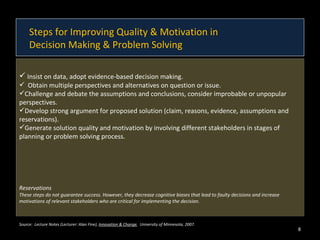
Steps for Improving Quality & Motivation in  Decision Making & Problem Solving Insist on data, adopt evidence-based decision making. Obtain multiple perspectives and alternatives on question or issue. Challenge and debate the assumptions and conclusions, consider improbable or unpopular perspectives. Develop strong argument for proposed solution (claim, reasons, evidence, assumptions and reservations). Generate solution quality and motivation by involving different stakeholders in stages of planning or problem solving process. Reservations These steps do not guarantee success. However, they decrease cognitive biases that lead to faulty decisions and increase motivations of relevant stakeholders who are critical for implementing the decision. Source:   Lecture Notes (Lecturer: Alan Fine),  Innovation & Change ,  University of Minnesota, 2007.

Problem Solving Using Diamond Model

  • 1.
    PROBLEM SOLVING USINGDIAMOND MODEL PRITAM DEY [email_address] www.linkedin.com/in/pritamdey
  • 2.
    Diamond Model –A Method for Analyzing Problems Ground the problem in reality Develop a conceptual model to address the problem Evaluate how well the model applies to the problem Implement a solution that solves the problem Source: Lecture Notes (Lecturer: Alan Fine), Innovation & Change , University of Minnesota, 2007.
  • 3.
    Diamond Model –A Method for Analyzing Problems Source: Lecture Notes (Lecturer: Alan Fine), Innovation & Change , University of Minnesota, 2007. Problem Formulation Model Building Model Evaluation Problem Solving Case Reality Conceptual Model Solution Problem
  • 4.
    Circle Chart– FourBasic Steps in Inventing Options Source: Lecture Notes (Lecturer: Alan Fine), Innovation & Change , University of Minnesota, 2007. Step II. Analysis Diagnose the problem Sort symptoms into categories Suggest causes Observe what is lacking Note barriers to resolving the problem Step III. Approaches What are possible strategies or prescriptions? What are some theoretical cures? Generate broad ideas about what might be done. Step I. Problem What’s wrong? What are current symptoms? What are disliked facts contrasted with a preferred situation? Step IV. Action Ideas What might be done? What specific steps might be taken to deal with the problem? WHAT IS WRONG WHAT MIGHT BE DONE IN THEORY IN THE REAL WORLD
  • 5.
    Running the Basesof Diamond Model to Address a Problem Source: Lecture Notes (Lecturer: Alan Fine), Innovation & Change , University of Minnesota, 2007. Problem Formulation Model Building Model Evaluation Problem Solving Case Reality Conceptual Model Solution Problem Describe Case Reality Visit & study it Map & diagnose it Question/Problem From who’s perspective? Identify clients/users Criterion - Relevance Develop Model An answer with arguments Crucial proposition Plausible alternatives Key assumptions / context Criterion – Validity Study / Evaluate the Model Evidence substantiating model Revisions needed to apply model Test model revisions, qualifications Data collection & analysis methods Criterion – Truth Apply / Implement solution Knowledge for what? Who? Apply findings to problem Develop implementation plan Local adaptation & reinvention Criterion - Impact
  • 6.
    A Good Solutionis a Strong Argument Source: Stephen Toulmin, The Uses of Argument , Essay III. Cambridge: Cambridge University Press, 1958. EVIDENCE minor premise data backing reason warrants REASON major premise logic underlying claim grounds CLAIM proposal proposition hypothesis QUALIFIERS when claim holds assumptions boundary conditions contingencies RESERVATIONS Limitations – Grounds for Rebuttal logical refutations: validity empirical refutations: truth cogency of argument: persuasiveness
  • 7.
    Argument for DiamondModel on Problems Source: Lecture Notes (Lecturer: Alan Fine), Innovation & Change , University of Minnesota, 2007. EVIDENCE (minor premise) Low quality decisions are often produced by jumping to solutions without adequate problem formulation, by selecting models that are invalid or too general in addressing the particulars of a case, or that do not permit local adaptation or reinvention. RESERVATIONS Unless the problem, question, model, or solution are pre-determined, one-sided or closed-minded. Unless time or talents prevent analyst from covering all four bases of the diamond model. CLAIM Diamond model promotes learning & understanding of a case or problem. QUALIFIERS Most likely… REASON (major premise) Decision quality and creativity increase by applying problem formulation, model development and testing, and problem solving steps in a consistent, balanced way.
  • 8.
    Steps for ImprovingQuality & Motivation in Decision Making & Problem Solving Insist on data, adopt evidence-based decision making. Obtain multiple perspectives and alternatives on question or issue. Challenge and debate the assumptions and conclusions, consider improbable or unpopular perspectives. Develop strong argument for proposed solution (claim, reasons, evidence, assumptions and reservations). Generate solution quality and motivation by involving different stakeholders in stages of planning or problem solving process. Reservations These steps do not guarantee success. However, they decrease cognitive biases that lead to faulty decisions and increase motivations of relevant stakeholders who are critical for implementing the decision. Source: Lecture Notes (Lecturer: Alan Fine), Innovation & Change , University of Minnesota, 2007.