System Administration
Basics
What system admin do
What exactly does a System Administrator do?
•no precise job description
•often learned by experience
•“makes things run”
•work behind the scenes
•often known as Operator, Network
Administrator, System Programmer, System
Manager, Service Engineer, Site Reliability
Engineer etc.
•system administrator : one who, as a primary
???system
“A group of interacting, interrelated, or
interdependent elements that together form a
complex whole.”
In the context of this class, we generally
consider computer-human systems consisting of
•the computer(s)
•the network
•the user(s)
•the organization’s goals and policies
….and Administration?
•Merriam Webster:
to administer, to manage or supervise the
execution, use, or conduct of
System Administration frequently also includes
other tasks such as
•system design and architecture
•reliability studies
•resource management
•system fault diagnosis
•...
How to become SysAdmin
System Administration is a profession with no
fixed career path.
•few degree granting programs
•heavy reliance on practical experience
•specializations in many different areas possible
•breadth of expertise as necessary as depth in
some areas
•background knowledge and requirements vary
What should you know????
Breadth of knowledge:
•operating system concepts
•TCP/IP networking
•programming
•...
•Depth of knowledge:
•certain OS flavor
•specific service (DNS, E-Mail, Databases,
Content-Delivery, ...)
•specific implementation/vendor (Oracle,
Pillars of system administration
•Scalability
•Security
•simplicity
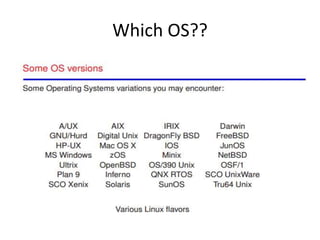
Which OS??
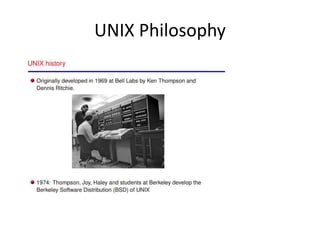
UNIX Philosophy
•Do one thing and do it well.
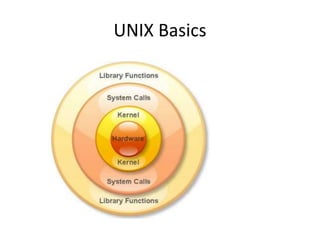
UNIX Basics
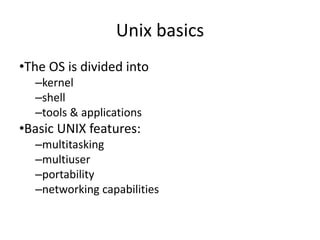
Unix basics
•The OS is divided into
–kernel
–shell
–tools & applications
•Basic UNIX features:
–multitasking
–multiuser
–portability
–networking capabilities
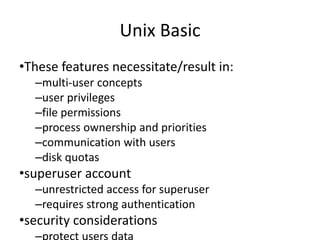
Unix Basic
•These features necessitate/result in:
–multi-user concepts
–user privileges
–file permissions
–process ownership and priorities
–communication with users
–disk quotas
•superuser account
–unrestricted access for superuser
–requires strong authentication
•security considerations
What is network/system
administration?
system administration is a branch of
engineering that concerns the operational
management of human-computer systems.
It’s about hardware,software,user-
support,diagnosis,repair and prevention.
System administrators need to know a bit of
everything: the skills are technical,
administrative and socio-psychological.
The human role in systems
System administration is a balancing act- it
requires patience,understanding,knowledge and
experience.
Working with a limited resourses,be incentive
in crisis, know the way computers works.
Need to recognize answer are not always
written down for us to copy.
Must be ready for the unexpected, resigned to
the uncertain and need able to plan for the
future.
Cont…
•Installing an OS(window,Dos,GNU/Linux)
does not mean we know a lot about system
administration,-it is the beginning .
•Today no computer examined in isolation
from the network.
•Networking = cooperation + sharing with
many user.
Goals of system administration
•System administration is
Putting together a network of
computer(workstations,pc’s,supercomput er…)
Getting them running
Keeping them running – in spite of the activities
of users who tend to cause the system to fail.
•System administrator works for the users
•System administrator should not furnish for the
benefit of selfish – but for the benefit of a whole
community.
The goals of a System
Administrator
•The person who is responsible for setting up and maintaining
the system is called as the system administrator.
•Supervise system functionality. Every system must work and be
connected to the network.
–Create backups on media, better if automatic backup.
•Create and install desktop and servers.
–Create users and assign to them customizable Graphical
User Interface.
•Update systems for the maximum performance
•Share system resources for the maximum network flow
–share disks between heterogenous systems in the better
position
–share printers to save superflous investment.
System administrator is responsible for …
•User administration (setup and maintaining account)
•Maintaining system
•Verify that peripherals are working properly
•Quickly arrange repair for hardware in occasion of
hardware failure
•Monitor system performance
•Create file systems
•Install software
•Create a backup and recovery policy
•Monitor network communication
•Update system as soon as new version of OS and
application software comes out
•Implement the policies for the use of the
computer system and network
•Setup security policies for users. A sysadmin must
have a strong grasp of computer security (e.g.
firewalls and intrusion detection systems).
Most important skill to a system
administrator
•Knowledge of common protocols like SMTP, SFTP, FTP,
HTTP, DNS,
•Ability to communicate problems and solutions both
verbally and in writing to customers and management.
•Ability to work independently and troubleshoot
problems with speed and efficiency.
•Ability to work closely with others in a small team
environment.
Goals of Network management
•Fault management is the detection of problems and faults on the
network. Such faults should be properly logged, and if appropriate an
alarm should be raised. This area is responsible for proper problem
identification, determining the cause of the fault and ensuring the proper
resolution of the problem. Management software operating in this area
may attempt to correct faults on its own.
•configuration management is to keep track of the network's
configuration, both hardware and software. This area includes keeping
track of what computers and networking infrastructure are on a network,
and how they are interconnected. In addition, configuration
management includes following what software versions each device is
running, as well as the software configuration of each device.
•Security management : incorporates all aspects of authentication and
access control, from the definition of access policies to the enforcing of
those policies. Exception reports can be generated for events that fall out
of the scope of the defined policies, and these reports can be used to
alert administrators of the policy violation.
• performance management : looks at the current and expected
performance of the network. Elements of network performance that may
be monitored include availability, response time, error rate, throughput
and utilization.
•Accounting management : covers two broad areas;asset control and cost
management. Asset control refers to knowing what computers are on the
network, who they belong to, who is using them, and perhaps where they
are located. The second area, cost management, looks at what the costs
of providing network services are and how they are paid for.
Philosophy
Practice to be cultivated include:
Independency or self sufficiency .
Systematic and tidy(methodological) practice.
An altruistic view of inevitable errors with a determination to gain
firmer control of the system.
Practice to be avoided include:
Belief that there exist right answer to every problem.
Getting fraught and upset when things do not work as expected.
Expecting that every problem has beginning, middle and an
end(some problems are chronic and cannot be solved without
impractical restructuring)
Cont…
•Other to be encouraged
Looking for answer in manual and newsgroups
Using controlled trial and error to locate problems
Listening the problem carefully
Writing down experience in A – Z : help to solve the same
problem in future.
Taking responsibility for our actions (be prepared for
accidents).
Remembering the tedious job like vacuum cleaning(may be
once a year).
After learning something new, always pose the question: like
how does this apply for me ?
Challenges of system
administration
•System admin is not just about installing OS ,but
Designing logical and efficient network.
Deploying large number of machines.
Deciding what services are needed.
Planning and implementing adequate security.
Developing ways of fixing errors and problems.
 Providing comfortable environment for users.
Keeping track and understanding how to use the enormous
amount of increasing in knowledge.
Information source for sysadms
•Printed manuals
•www
•RFC
•Newsgroups and discussions
•Papers from SAGE/usenix LISA conference
•and etc
Certification
Microsoft certification
MCSE – Microsoft certified system engineer
MCSA - Microsoft certified system Administrator
Red hat certification(RHCE/RHCT/RHCA/RHSS)
Solaris certification
OSI Management
Functional Areas
“F C A P S”
•Fault Management
•Configuration & Name Management
•Account Management
•Performance Management
•Security Management

introduction to system administration

  • 1.
  • 2.
    What system admindo What exactly does a System Administrator do? •no precise job description •often learned by experience •“makes things run” •work behind the scenes •often known as Operator, Network Administrator, System Programmer, System Manager, Service Engineer, Site Reliability Engineer etc. •system administrator : one who, as a primary
  • 3.
    ???system “A group ofinteracting, interrelated, or interdependent elements that together form a complex whole.” In the context of this class, we generally consider computer-human systems consisting of •the computer(s) •the network •the user(s) •the organization’s goals and policies
  • 4.
    ….and Administration? •Merriam Webster: toadminister, to manage or supervise the execution, use, or conduct of System Administration frequently also includes other tasks such as •system design and architecture •reliability studies •resource management •system fault diagnosis •...
  • 5.
    How to becomeSysAdmin System Administration is a profession with no fixed career path. •few degree granting programs •heavy reliance on practical experience •specializations in many different areas possible •breadth of expertise as necessary as depth in some areas •background knowledge and requirements vary
  • 6.
    What should youknow???? Breadth of knowledge: •operating system concepts •TCP/IP networking •programming •... •Depth of knowledge: •certain OS flavor •specific service (DNS, E-Mail, Databases, Content-Delivery, ...) •specific implementation/vendor (Oracle,
  • 7.
    Pillars of systemadministration •Scalability •Security •simplicity
  • 8.
  • 9.
  • 10.
    •Do one thingand do it well.
  • 11.
  • 12.
    Unix basics •The OSis divided into –kernel –shell –tools & applications •Basic UNIX features: –multitasking –multiuser –portability –networking capabilities
  • 13.
    Unix Basic •These featuresnecessitate/result in: –multi-user concepts –user privileges –file permissions –process ownership and priorities –communication with users –disk quotas •superuser account –unrestricted access for superuser –requires strong authentication •security considerations
  • 14.
    What is network/system administration? systemadministration is a branch of engineering that concerns the operational management of human-computer systems. It’s about hardware,software,user- support,diagnosis,repair and prevention. System administrators need to know a bit of everything: the skills are technical, administrative and socio-psychological.
  • 15.
    The human rolein systems System administration is a balancing act- it requires patience,understanding,knowledge and experience. Working with a limited resourses,be incentive in crisis, know the way computers works. Need to recognize answer are not always written down for us to copy. Must be ready for the unexpected, resigned to the uncertain and need able to plan for the future.
  • 16.
    Cont… •Installing an OS(window,Dos,GNU/Linux) doesnot mean we know a lot about system administration,-it is the beginning . •Today no computer examined in isolation from the network. •Networking = cooperation + sharing with many user.
  • 17.
    Goals of systemadministration •System administration is Putting together a network of computer(workstations,pc’s,supercomput er…) Getting them running Keeping them running – in spite of the activities of users who tend to cause the system to fail. •System administrator works for the users •System administrator should not furnish for the benefit of selfish – but for the benefit of a whole community.
  • 18.
    The goals ofa System Administrator •The person who is responsible for setting up and maintaining the system is called as the system administrator. •Supervise system functionality. Every system must work and be connected to the network. –Create backups on media, better if automatic backup. •Create and install desktop and servers. –Create users and assign to them customizable Graphical User Interface. •Update systems for the maximum performance •Share system resources for the maximum network flow –share disks between heterogenous systems in the better position –share printers to save superflous investment.
  • 19.
    System administrator isresponsible for … •User administration (setup and maintaining account) •Maintaining system •Verify that peripherals are working properly •Quickly arrange repair for hardware in occasion of hardware failure •Monitor system performance •Create file systems •Install software •Create a backup and recovery policy •Monitor network communication
  • 20.
    •Update system assoon as new version of OS and application software comes out •Implement the policies for the use of the computer system and network •Setup security policies for users. A sysadmin must have a strong grasp of computer security (e.g. firewalls and intrusion detection systems).
  • 21.
    Most important skillto a system administrator •Knowledge of common protocols like SMTP, SFTP, FTP, HTTP, DNS, •Ability to communicate problems and solutions both verbally and in writing to customers and management. •Ability to work independently and troubleshoot problems with speed and efficiency. •Ability to work closely with others in a small team environment.
  • 22.
    Goals of Networkmanagement •Fault management is the detection of problems and faults on the network. Such faults should be properly logged, and if appropriate an alarm should be raised. This area is responsible for proper problem identification, determining the cause of the fault and ensuring the proper resolution of the problem. Management software operating in this area may attempt to correct faults on its own. •configuration management is to keep track of the network's configuration, both hardware and software. This area includes keeping track of what computers and networking infrastructure are on a network, and how they are interconnected. In addition, configuration management includes following what software versions each device is running, as well as the software configuration of each device.
  • 23.
    •Security management :incorporates all aspects of authentication and access control, from the definition of access policies to the enforcing of those policies. Exception reports can be generated for events that fall out of the scope of the defined policies, and these reports can be used to alert administrators of the policy violation. • performance management : looks at the current and expected performance of the network. Elements of network performance that may be monitored include availability, response time, error rate, throughput and utilization. •Accounting management : covers two broad areas;asset control and cost management. Asset control refers to knowing what computers are on the network, who they belong to, who is using them, and perhaps where they are located. The second area, cost management, looks at what the costs of providing network services are and how they are paid for.
  • 24.
    Philosophy Practice to becultivated include: Independency or self sufficiency . Systematic and tidy(methodological) practice. An altruistic view of inevitable errors with a determination to gain firmer control of the system. Practice to be avoided include: Belief that there exist right answer to every problem. Getting fraught and upset when things do not work as expected. Expecting that every problem has beginning, middle and an end(some problems are chronic and cannot be solved without impractical restructuring)
  • 25.
    Cont… •Other to beencouraged Looking for answer in manual and newsgroups Using controlled trial and error to locate problems Listening the problem carefully Writing down experience in A – Z : help to solve the same problem in future. Taking responsibility for our actions (be prepared for accidents). Remembering the tedious job like vacuum cleaning(may be once a year). After learning something new, always pose the question: like how does this apply for me ?
  • 26.
    Challenges of system administration •Systemadmin is not just about installing OS ,but Designing logical and efficient network. Deploying large number of machines. Deciding what services are needed. Planning and implementing adequate security. Developing ways of fixing errors and problems.  Providing comfortable environment for users. Keeping track and understanding how to use the enormous amount of increasing in knowledge.
  • 27.
    Information source forsysadms •Printed manuals •www •RFC •Newsgroups and discussions •Papers from SAGE/usenix LISA conference •and etc
  • 28.
    Certification Microsoft certification MCSE –Microsoft certified system engineer MCSA - Microsoft certified system Administrator Red hat certification(RHCE/RHCT/RHCA/RHSS) Solaris certification
  • 29.
    OSI Management Functional Areas “FC A P S” •Fault Management •Configuration & Name Management •Account Management •Performance Management •Security Management