Introduction to Streaming in
Apache Spark
Based on Apache Spark 1.6.0
Akash Sethi
Software Consultant
Knoldus Software LLP.
Agenda

What is Streaming

Abstraction Provided For Streaming

Execution Process

Transformation

Type of Transformation

Action

Performance Tuning options
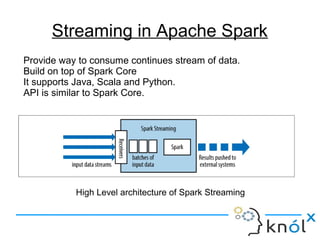
High Level architecture of Spark Streaming
Streaming in Apache Spark
Provide way to consume continues stream of data.
Build on top of Spark Core
It supports Java, Scala and Python.
API is similar to Spark Core.
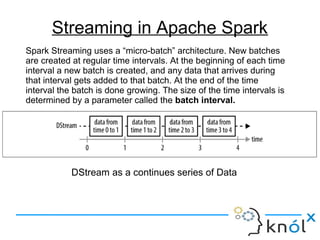
DStream as a continues series of Data
Streaming in Apache Spark
Spark Streaming uses a “micro-batch” architecture. New batches
are created at regular time intervals. At the beginning of each time
interval a new batch is created, and any data that arrives during
that interval gets added to that batch. At the end of the time
interval the batch is done growing. The size of the time intervals is
determined by a parameter called the batch interval.
Streaming in Apache Spark
Spark Streaming provides an abstraction called DStreams,
or discretized streams. A DStream is a sequence of data
arriving over time. Internally, each DStream is
represented as a sequence of RDDs arriving at each time
step. Here RDDs are created on the basis of Time.
Each input batch forms an RDD, and is processed using
Spark jobs to create other RDDs. The processed results can
then be pushed out to external systems in batches.
We can also specify block size in milliseconds.
By default, received data is replicated across
two nodes, so Spark Streaming can tolerate
single worker failures. Using just lineage,
however, re computation could take a long
time for data that has been built up since the
beginning of the program. Thus, Spark
Streaming also includes a mechanism called
checkpointing that saves state periodically to
a reliable file system (e.g., HDFS or S3).
Typically, you might set up checkpointing
every 5–10 batches of data. When recovering
lost data, Spark Streaming needs only to go
Streaming in Apache Spark
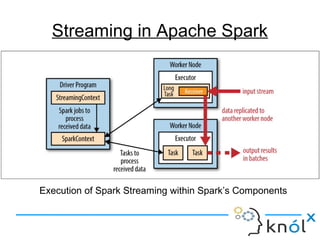
Execution of Spark Streaming within Spark’s Components
Streaming in Apache Spark
Transformation
Transformations apply some operation on
current DStream and generate a new
DStream.
Transformations on DStreams can be grouped into
either stateless or stateful:

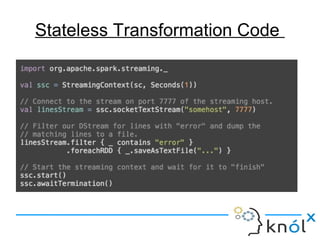
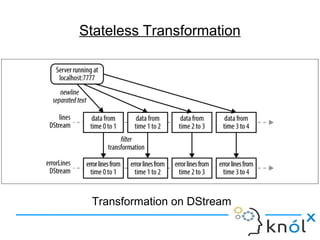
In stateless transformations the processing of each batch
does not depend on the data of its previous batches.

Stateful transformations, in contrast, use data or intermediate
results from previous batches to compute the results of the
current batch. They include transformations based on sliding
windows and on tracking state across time.
Stateless Transformation Code
Transformation on DStream
Stateless Transformation
Stateful Transformations
Stateful transformations are operations on DStreams that
track data across time; that is, some data from previous
batches is used to generate the results for a new batch.
The two main types of Stateful Transformation
are:

Windowed Operations

UpdateStateByKey
Stateful Transformation

Windowed Transformations
Windowed operations compute results across a longer time
period than the StreamingContext’s batch interval, by
combining results from multiple batches
All windowed operations need two parameters, window
duration and sliding duration, both of which must be a
multiple of the StreamingContext’s batch interval. The
window duration controls how many previous batches of
data are considered
Stateful Transformation
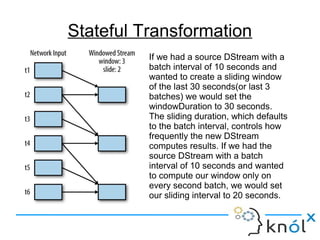
If we had a source DStream with a
batch interval of 10 seconds and
wanted to create a sliding window
of the last 30 seconds(or last 3
batches) we would set the
windowDuration to 30 seconds.
The sliding duration, which defaults
to the batch interval, controls how
frequently the new DStream
computes results. If we had the
source DStream with a batch
interval of 10 seconds and wanted
to compute our window only on
every second batch, we would set
our sliding interval to 20 seconds.
Stateful Transformations

UpdateStateByKey Transformations
it’s useful to maintain state across the batches in a DStream .
updateStateByKey() enables this by providing access to a state
variable for DStreams of key/value pairs. Given a DStream of (key,
event) pairs, it lets you construct a new DStream of (key, state)
pairs by taking a function that specifies how to update the state for
each key given new events. For example, in a web server log, our
events might be visits to the site, where the key is the user ID.
Using updateStateByKey(), we could track the last pages each user
visited. This list would be our “state” object, and we’d update it as
each event arrives.
Action/Output Operations
Output operations specify what needs to be
done with the final transformed data in a
stream.
Output Operations are similar to spark core.
- print the output
- save to text file
- save as Object in File etc.
It contains some extra methods like. forEachRdd()
Performance Considerations
Spark Streaming applications have a few
specialized tuning options.

Batch and Window Sizes
The most common question is what minimum batch size Spark
Streaming can use. In general, 500 milliseconds has proven to
be a good minimum size for many applications. The best
approach is to start with a larger batch size (around 10
seconds) and work your way down to a smaller batch size.

Level of Parallelism
A common way to reduce the processing time of batches is
to increase the parallelism.

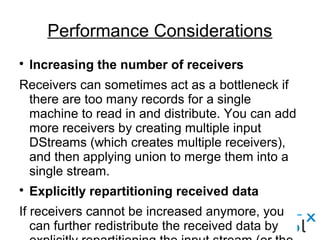
Increasing the number of receivers
Receivers can sometimes act as a bottleneck if
there are too many records for a single
machine to read in and distribute. You can add
more receivers by creating multiple input
DStreams (which creates multiple receivers),
and then applying union to merge them into a
single stream.

Explicitly repartitioning received data
If receivers cannot be increased anymore, you
can further redistribute the received data by
Performance Considerations
Demo
https://github.com/knoldus/knolx-spark-streaming
References

Learning Spark LIGHTNING-FAST DATA
ANALYSIS Holden Karau, Andy Konwinski, Patrick
Wendell & Matei Zaharia

http://spark.apache.org/streaming/
Thank You

Introduction to Spark Streaming

  • 1.
    Introduction to Streamingin Apache Spark Based on Apache Spark 1.6.0 Akash Sethi Software Consultant Knoldus Software LLP.
  • 2.
    Agenda  What is Streaming  AbstractionProvided For Streaming  Execution Process  Transformation  Type of Transformation  Action  Performance Tuning options
  • 3.
    High Level architectureof Spark Streaming Streaming in Apache Spark Provide way to consume continues stream of data. Build on top of Spark Core It supports Java, Scala and Python. API is similar to Spark Core.
  • 4.
    DStream as acontinues series of Data Streaming in Apache Spark Spark Streaming uses a “micro-batch” architecture. New batches are created at regular time intervals. At the beginning of each time interval a new batch is created, and any data that arrives during that interval gets added to that batch. At the end of the time interval the batch is done growing. The size of the time intervals is determined by a parameter called the batch interval.
  • 5.
    Streaming in ApacheSpark Spark Streaming provides an abstraction called DStreams, or discretized streams. A DStream is a sequence of data arriving over time. Internally, each DStream is represented as a sequence of RDDs arriving at each time step. Here RDDs are created on the basis of Time. Each input batch forms an RDD, and is processed using Spark jobs to create other RDDs. The processed results can then be pushed out to external systems in batches. We can also specify block size in milliseconds.
  • 6.
    By default, receiveddata is replicated across two nodes, so Spark Streaming can tolerate single worker failures. Using just lineage, however, re computation could take a long time for data that has been built up since the beginning of the program. Thus, Spark Streaming also includes a mechanism called checkpointing that saves state periodically to a reliable file system (e.g., HDFS or S3). Typically, you might set up checkpointing every 5–10 batches of data. When recovering lost data, Spark Streaming needs only to go Streaming in Apache Spark
  • 7.
    Execution of SparkStreaming within Spark’s Components Streaming in Apache Spark
  • 8.
    Transformation Transformations apply someoperation on current DStream and generate a new DStream. Transformations on DStreams can be grouped into either stateless or stateful:  In stateless transformations the processing of each batch does not depend on the data of its previous batches.  Stateful transformations, in contrast, use data or intermediate results from previous batches to compute the results of the current batch. They include transformations based on sliding windows and on tracking state across time.
  • 9.
  • 10.
  • 11.
    Stateful Transformations Stateful transformationsare operations on DStreams that track data across time; that is, some data from previous batches is used to generate the results for a new batch. The two main types of Stateful Transformation are:  Windowed Operations  UpdateStateByKey
  • 12.
    Stateful Transformation  Windowed Transformations Windowedoperations compute results across a longer time period than the StreamingContext’s batch interval, by combining results from multiple batches All windowed operations need two parameters, window duration and sliding duration, both of which must be a multiple of the StreamingContext’s batch interval. The window duration controls how many previous batches of data are considered
  • 13.
    Stateful Transformation If wehad a source DStream with a batch interval of 10 seconds and wanted to create a sliding window of the last 30 seconds(or last 3 batches) we would set the windowDuration to 30 seconds. The sliding duration, which defaults to the batch interval, controls how frequently the new DStream computes results. If we had the source DStream with a batch interval of 10 seconds and wanted to compute our window only on every second batch, we would set our sliding interval to 20 seconds.
  • 14.
    Stateful Transformations  UpdateStateByKey Transformations it’suseful to maintain state across the batches in a DStream . updateStateByKey() enables this by providing access to a state variable for DStreams of key/value pairs. Given a DStream of (key, event) pairs, it lets you construct a new DStream of (key, state) pairs by taking a function that specifies how to update the state for each key given new events. For example, in a web server log, our events might be visits to the site, where the key is the user ID. Using updateStateByKey(), we could track the last pages each user visited. This list would be our “state” object, and we’d update it as each event arrives.
  • 15.
    Action/Output Operations Output operationsspecify what needs to be done with the final transformed data in a stream. Output Operations are similar to spark core. - print the output - save to text file - save as Object in File etc. It contains some extra methods like. forEachRdd()
  • 16.
    Performance Considerations Spark Streamingapplications have a few specialized tuning options.  Batch and Window Sizes The most common question is what minimum batch size Spark Streaming can use. In general, 500 milliseconds has proven to be a good minimum size for many applications. The best approach is to start with a larger batch size (around 10 seconds) and work your way down to a smaller batch size.  Level of Parallelism A common way to reduce the processing time of batches is to increase the parallelism.
  • 17.
     Increasing the numberof receivers Receivers can sometimes act as a bottleneck if there are too many records for a single machine to read in and distribute. You can add more receivers by creating multiple input DStreams (which creates multiple receivers), and then applying union to merge them into a single stream.  Explicitly repartitioning received data If receivers cannot be increased anymore, you can further redistribute the received data by Performance Considerations
  • 18.
  • 19.
    References  Learning Spark LIGHTNING-FASTDATA ANALYSIS Holden Karau, Andy Konwinski, Patrick Wendell & Matei Zaharia  http://spark.apache.org/streaming/
  • 20.