Intruduction to
spanish verbs.
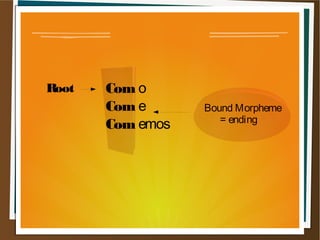
Root   Com o
       Com e      Bound Morpheme
                     = ending
       Com emos
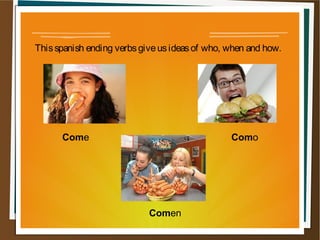
This spanish ending verbs give us ideas of who, when and how.


      Come                                      Como


                            Comen
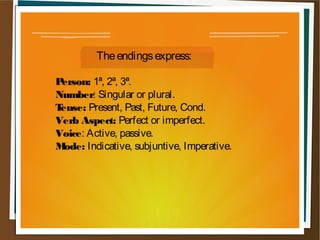
The endings express:

Person: 1ª, 2ª, 3ª.
Number: Singular or plural.
Tense: Present, Past, Future, Cond.
Verb Aspect: Perfect or imperfect.
Voice: Active, passive.
M ode: Indicative, subjuntive, Imperative.
B aron
 ail
         They
         Past time
         It's finished
         Is a fact
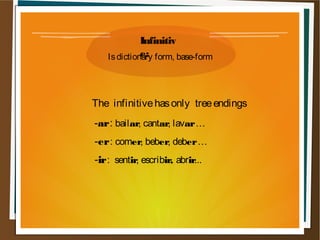
Infinitiv
             e:
   Is dictionary form, base-form


The infinitive has only tree endings
-ar : bailar, cantar, lavar …
-er : comer, beber, deber …
-ir : sentir, escribir, abrir...
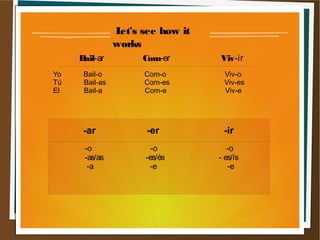
Let's see how it
                works
     Bail-ar          Com-er       Viv-ir
Yo    Bail-o          Com-o         Viv-o
Tú    Bail-as         Com-es        Viv-es
El    Bail-a          Com-e         Viv-e


      -ar              -er          -ir
      -o                -o            -o
      -as/as          -es/és       - es/ís
       -a              -e             -e
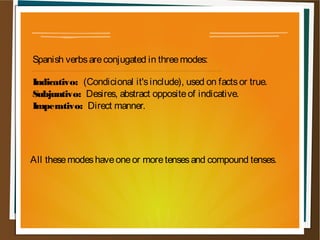
Spanish verbs are conjugated in three modes:

Indicativo: (Condicional it's include), used on facts or true.
Subjuntivo: Desires, abstract opposite of indicative.
Imperativo: Direct manner.


All these modes have one or more tenses and compound tenses.
Learn how to form those verbs properly, it's hard


Yo comer hoy
                                           H thought it was
                                            e
                                           not necessary.
Learn how to form those verbs properly, it's hard


Yo comer hoy
                                           H thought it was
                                            e
                                           not necessary.

Introduction to spanish verbs

  • 1.
  • 2.
    Root Com o Com e Bound Morpheme = ending Com emos
  • 3.
    This spanish endingverbs give us ideas of who, when and how. Come Como Comen
  • 4.
    The endings express: Person:1ª, 2ª, 3ª. Number: Singular or plural. Tense: Present, Past, Future, Cond. Verb Aspect: Perfect or imperfect. Voice: Active, passive. M ode: Indicative, subjuntive, Imperative.
  • 5.
    B aron ail They Past time It's finished Is a fact
  • 6.
    Infinitiv e: Is dictionary form, base-form The infinitive has only tree endings -ar : bailar, cantar, lavar … -er : comer, beber, deber … -ir : sentir, escribir, abrir...
  • 7.
    Let's see howit works Bail-ar Com-er Viv-ir Yo Bail-o Com-o Viv-o Tú Bail-as Com-es Viv-es El Bail-a Com-e Viv-e -ar -er -ir -o -o -o -as/as -es/és - es/ís -a -e -e
  • 8.
    Spanish verbs areconjugated in three modes: Indicativo: (Condicional it's include), used on facts or true. Subjuntivo: Desires, abstract opposite of indicative. Imperativo: Direct manner. All these modes have one or more tenses and compound tenses.
  • 9.
    Learn how toform those verbs properly, it's hard Yo comer hoy H thought it was e not necessary.
  • 10.
    Learn how toform those verbs properly, it's hard Yo comer hoy H thought it was e not necessary.