Present Tense
-ER & -IR VERBS
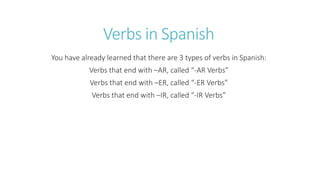
Verbs in Spanish
You have already learned that there are 3 types of verbs in Spanish:
Verbs that end with –AR, called “-AR Verbs”
Verbs that end with –ER, called “-ER Verbs”
Verbs that end with –IR, called “-IR Verbs”
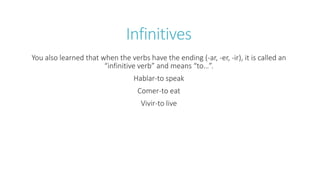
Infinitives
You also learned that when the verbs have the ending (-ar, -er, -ir), it is called an
“infinitive verb” and means “to…”.
Hablar-to speak
Comer-to eat
Vivir-to live
Subject Pronouns
You have learned about subject pronouns.
Yo
Tú
Él
Ella
Usted
…and others
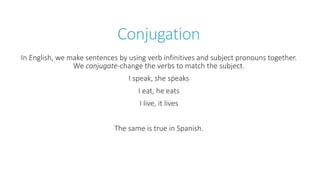
Conjugation
In English, we make sentences by using verb infinitives and subject pronouns together.
We conjugate-change the verbs to match the subject.
I speak, she speaks
I eat, he eats
I live, it lives
The same is true in Spanish.
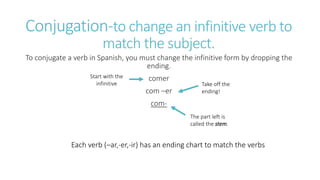
Conjugation-to change an infinitive verb to
match the subject.
To conjugate a verb in Spanish, you must change the infinitive form by dropping the
ending.
comer
com –er
com-
Each verb (–ar,-er,-ir) has an ending chart to match the verbs
Take off the
ending!
The part left is
called the stem.
Start with the
infinitive
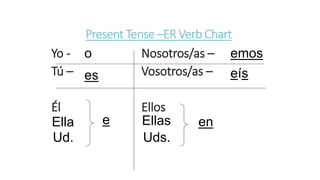
Present Tense –ER Verb Chart
Yo -
Tú –
Él
Nosotros/as –
Vosotros/as –
Ellos
Ellas
Uds.
enElla
Ud.
e
o
es eís
emos
Just take the stem and add the ending!
Yo -
Tú –
Él
Nosotros/as –
Vosotros/as –
Ellos
Ellas
Uds.
comenElla
Ud.
come
como
comes comeís
comemos
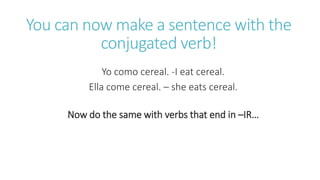
You can now make a sentence with the
conjugated verb!
Yo como cereal. -I eat cereal.
Ella come cereal. – she eats cereal.
Now do the same with verbs that end in –IR…
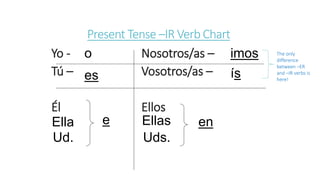
Present Tense –IR Verb Chart
Yo -
Tú –
Él
Nosotros/as –
Vosotros/as –
Ellos
Ellas
Uds.
enElla
Ud.
e
o
es ís
imos The only
difference
between –ER
and –IR verbs is
here!
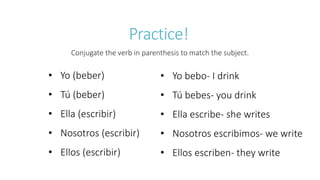
Practice!
Conjugate the verb in parenthesis to match the subject.
• Yo (beber)
• Tú (beber)
• Ella (escribir)
• Nosotros (escribir)
• Ellos (escribir)
• Yo bebo- I drink
• Tú bebes- you drink
• Ella escribe- she writes
• Nosotros escribimos- we write
• Ellos escriben- they write

Present tense er -ir verbs

  • 1.
  • 2.
    Verbs in Spanish Youhave already learned that there are 3 types of verbs in Spanish: Verbs that end with –AR, called “-AR Verbs” Verbs that end with –ER, called “-ER Verbs” Verbs that end with –IR, called “-IR Verbs”
  • 3.
    Infinitives You also learnedthat when the verbs have the ending (-ar, -er, -ir), it is called an “infinitive verb” and means “to…”. Hablar-to speak Comer-to eat Vivir-to live
  • 4.
    Subject Pronouns You havelearned about subject pronouns. Yo Tú Él Ella Usted …and others
  • 5.
    Conjugation In English, wemake sentences by using verb infinitives and subject pronouns together. We conjugate-change the verbs to match the subject. I speak, she speaks I eat, he eats I live, it lives The same is true in Spanish.
  • 6.
    Conjugation-to change aninfinitive verb to match the subject. To conjugate a verb in Spanish, you must change the infinitive form by dropping the ending. comer com –er com- Each verb (–ar,-er,-ir) has an ending chart to match the verbs Take off the ending! The part left is called the stem. Start with the infinitive
  • 7.
    Present Tense –ERVerb Chart Yo - Tú – Él Nosotros/as – Vosotros/as – Ellos Ellas Uds. enElla Ud. e o es eís emos
  • 8.
    Just take thestem and add the ending! Yo - Tú – Él Nosotros/as – Vosotros/as – Ellos Ellas Uds. comenElla Ud. come como comes comeís comemos
  • 9.
    You can nowmake a sentence with the conjugated verb! Yo como cereal. -I eat cereal. Ella come cereal. – she eats cereal. Now do the same with verbs that end in –IR…
  • 10.
    Present Tense –IRVerb Chart Yo - Tú – Él Nosotros/as – Vosotros/as – Ellos Ellas Uds. enElla Ud. e o es ís imos The only difference between –ER and –IR verbs is here!
  • 11.
    Practice! Conjugate the verbin parenthesis to match the subject. • Yo (beber) • Tú (beber) • Ella (escribir) • Nosotros (escribir) • Ellos (escribir) • Yo bebo- I drink • Tú bebes- you drink • Ella escribe- she writes • Nosotros escribimos- we write • Ellos escriben- they write